
In the field of disability studies, self-determination refers to a person’s ability to make choices about their own life, free from external influences and regardless of their level of functional autonomy (Palacios and Romañach 2006). This capacity is essential for the realization of other fundamental rights (García Alonso 2003) and is enshrined as a basic human right in the United Nations Convention on the Rights of Persons with Disabilities (UNCRPD) (United Nations 2006). For people with intellectual disabilities (ID), exercising this right requires overcoming multiple barriers, including communication difficulties that limit their ability to express needs assertively, a lack of opportunities to make decisions, and limited resources to advocate for their rights (Scior 2016).
The development of self-determination involves acquiring a set of skills necessary for making choices, solving problems, setting goals, and self-regulating behavior. These skills emerge from an individual’s earliest interactions with their environment (Palmer, Wehmeyer and Shogren 2017) across diverse participation settings that can either facilitate or hinder the expression of self-determination, depending on the opportunities available for decision-making (Nota et al. 2007; Shogren, Wehmeyer, and Burke 2017). This suggests that people with ID who engage in a broader range of activities across varied contexts have more opportunities to exercise self-determination than those who experience greater barriers to social participation (Taheri, Perry and Minnes 2017). This includes individuals with ID who exhibit behaviors that challenge (BtC) (Bigby 2012).
Considering these barriers and the need to promote the early acquisition of self-determination skills to foster more favorable conditions for social participation later in life, the present study focused on identifying the factors that facilitate or hinder the development of self-determination in a group of children with ID who exhibit BtC, living in the central zone of Chile. This country presents a particularly unequal context, marked by disparities in access to disability support services that are strongly influenced by socioeconomic status (Rotarou and Sakellariou 2017). These inequalities have been further exacerbated by the implementation of Law 21.545 (Gobierno de Chile 2023), which guarantees specific support for individuals on the autism spectrum in educational settings while excluding those with ID and other developmental disorders. In this context, generating evidence on the needs and barriers faced by children with ID is essential to inform more inclusive public policies and ensure that no group is left behind in accessing fundamental developmental supports.
Self-Determination as a Developmental Acquisition
Given the challenges of ensuring access to this right for persons with ID, the question arises as to how they can effectively exercise self-determination in their lives. This issue has been addressed through the provision of supports based on Causal Agency Theory (CAT) (Shogren et al. 2015), which offers a developmental model grounded in the principles of Self-Determination Theory (SDT) (Shogren, Wehmeyer, and Palmer 2017). Although both theories address the motivation underlying action from different perspectives, they are conceptually complementary. SDT explains self-determined behavior in terms of intrinsic and extrinsic motivations, rooted in the fulfillment of three basic psychological needs: autonomy, relatedness, and competence (Ryan and Deci 2020). Meanwhile, CAT defines actions as meaningful when the individual acts as the causal agent of their own behavior. This implies that action is volitional (i.e., performed consciously, intentionally, and deliberately, based on personal preferences); agentic (i.e., intentionally executed to achieve a particular goal; and guided by action–control beliefs, which enable individuals to act with a sense of empowerment grounded in their perceived ability to achieve desired outcomes (Shogren, Wehmeyer and Palmer 2017).
Behaviors That Challenge
BtC refer to actions considered inappropriate in certain contexts due to their intensity, frequency, or duration; these behaviors may pose a physical threat to the individual or to others. Examples include aggression, self-injury, and other behaviours that challenge the capacity of the environment to adequately respond to an individual’s needs (Emerson and Einfeld 2011). BtC can emerge at any point in development, but their consequences tend to be more severe when they occur in early childhood, as they may restrict the child’s participation in normative settings and consequently affect their social, emotional, and cognitive development (Kaiser and Raminsky 2017).
Individuals with ID are more likely to exhibit BtC than their typically developing peers throughout the lifespan (Cheng et al. 2014; Kassari and Freeman 2001). The persistence of these behaviors has been associated with an increased likelihood of individuals with ID living in institutional settings and being subjected to restrictive or aversive interventions (Grung et al. 2021). As a result of such interventions, individuals may resist environments they perceive as oppressive or hostile. This resistance can, in turn, be labeled again as BtC (Nicholson, Finlay and Stagg 2021), creating a dynamic of increasingly restrictive responses and reinforcing a cycle of repression and exclusion. In these cases, BtC form part of a feedback loop, wherein the consequences of the behaviors elicit environmental reactions that perpetuate the behaviors themselves, maintaining exclusion rather than addressing the underlying needs (Hastings et al. 2013).
The significance of the environment in the manifestation of BtC has also been underscored by individuals who exhibit these behaviors. They have reported that the attitudes of support staff and the lack of control over decisions affecting their lives generate negative emotions that may lead to aggressive behavior (van den Bogaard et al. 2019). This relationship between participation contexts and the manifestation of BtC has generated growing interest in developing interventions focused on participatory environments (Gore et al. 2013).
Intervening through Participatory Environments
Addressing BtC through participatory settings offers several advantages over traditional models, which often rely on highly specialized contexts removed from community life (McGill et al. 2020). Contextual interventions focus on environmental factors, addressing the multiple elements that contribute to the emergence of these behaviors (Chan, French and Webber 2011). This approach aligns with the principles of the UNCRPD, fostering conditions that support social participation and the respect of fundamental rights (Jorgensen, Nankervis and Chan 2023).
Adopting this perspective in the provision of supports aimed at promoting self-determination can facilitate the development of strategies that offer better opportunities for individuals to acquire self-determined skills (Vicente et al. 2020).
Enhancing self-determination may also reduce the occurrence of BtC in children by strengthening action–control beliefs, improving perceptions of competence in problem-solving, and promoting community participation, factors that may significantly mitigate the consequences of BtC (Kaiser and Raminsky 2017). A deeper understanding of the contextual factors that facilitate or hinder the development of self-determination in children with ID who exhibit BtC across their everyday participation environments is therefore essential for advancing more effective and inclusive interventions. However, current knowledge about the environmental variables that promote self-determination remains limited (Vicente et al. 2023).
This issue is particularly relevant in the Chilean context, where recent research has identified a widespread lack of awareness among individuals without professional training regarding the characteristics and needs of people with ID, as well as a high degree of stigmatization toward this population (Tenorio et al. 2022). Furthermore, national research on self-determination has primarily focused on adults with ID, paying insufficient attention to behavioral variables (Vega Córdova et al. 2023).
In light of these challenges, it becomes essential to deepen our understanding of the difficulties faced by families and professionals in diverse participatory contexts, in order to effectively support the development of self-determination in children with ID who exhibit BtC. This focus aligns with recent research emphasizing the importance of context-sensitive and collaborative approaches (Kúld et al. 2024; van Tuyll van Serooskerken et al. 2022).
In this regard, Jorgensen, Nankervis and Chan (2023) caution that the concept of environment proposed by the biopsychosocial model, while useful, is limited by its focus on biological and interpersonal variables, often overlooking broader structural and contextual factors such as culture and public policy. This perspective aligns with Schalock, Luckasson and Shogren (2020), who argue that the commonly employed notion of person–environment fit restricts analysis to the individual’s immediate surroundings, failing to consider the full range of circumstances that influence and determine human functioning. In response to this limitation, these authors propose shifting the focus from environment to context, incorporating multilevel, multifactorial, and interactive variables that acknowledge the dynamic relationship between the individual and the socioecological context that shapes behavior. This is the perspective adopted in the present study, which seeks to apply a multilevel analysis to understand how contextual factors interact with individual characteristics.
Self-Determination as an Interdependent Construct
Understanding how participation contexts contribute to the development of self-determination in children requires examining how interactions with their environments enable them to move from initial motivation to the achievement of goals. This process is often mediated by the involvement of families and professionals in various social participation contexts, who play a crucial role in providing support (Chu 2018). However, interactions may also occur with non-human elements, such as technological artifacts, which allow children to select activities of interest, establish remote relationships with peers, and express their will (Piekema et al. 2024).
Considering the role of these agents in the expression of self-determined behavior, self-determination can be characterized as a collaborative and interdependent process (Watson 2012). While the child is the causal agent of their own actions, the enactment of these actions is supported by other agents operating across different levels of socioecological participation, whose mediation is essential in either facilitating or constraining goal attainment (Correa 2023).
Building on this characterization of the self-determination process, the present study aimed to identify the contextual factors that facilitate or hinder the acquisition of self-determination in children with ID who exhibit BtC in central Chile. The research was conducted through the narratives of a group of mothers, whose privileged position as observers of their children’s autonomy needs, both at home and across diverse participation contexts (Soenens, Deci and Vansteenkiste 2017), provided a comprehensive understanding of their support needs.
Methods
Design
This study adopted an exploratory–descriptive design (Hernández Sampieri, Fernández Collado, and Baptista Lucio 2014) to provide an overview of the contextual characteristics that may promote or hinder the exercise of self-determination in a group of children aged 6 to 10 years with ID who exhibit BtC. The research was guided by Actor–Network Theory (ANT) (Latour 2005), which facilitates the understanding of how children’s interactions shape their actions, from initial motivation to goal achievement. ANT provides an adaptable conceptual framework for understanding the social life of both people and objects, based on the premise that for action to occur, contributions from a series of activities are required, in which both human and non-human agents (such as artifacts or tools) can participate (Mol 2010).
The role of each agent in the development of the course of action initiated by the child can be traced through the interactions established within their participation environments. These environments are distributed across a network of relationships that may span different contexts (Correa 2023), allowing for the description of factors that facilitate or hinder the enactment of actions at various socioecological levels (Callon 2001). Through ANT, both human and non-human agents are considered key mediators of the child’s actions, influencing the achievement of their goals. This study focused on identifying these agents and examining their roles as intermediaries that shape the exercise of self-determination, either enabling or constraining opportunities for children to act self-determinedly.
Sample
The inclusion criteria required that participants be mothers of children aged 6 to 10 years with ID, who were enrolled in school and exhibited BtC, as identified in a previous study led by one of the co-investigators. That study involved a large number of families from various regions of Chile and included the administration of the Strengths and Difficulties Questionnaire (SDQ) (Goodman 1997) to help identify BtC.
From this database, ten mothers residing in the Metropolitan Region and belonging to the middle socioeconomic segment were initially invited, in order to minimize variability in factors such as access to rehabilitation or educational services. However, due to recruitment challenges, the search was expanded to other regions in central Chile, and the socioeconomic criterion was relaxed. The final sample included five mothers from Santiago (Metropolitan Region), two from Viña del Mar (Valparaíso Region), and three from Rancagua (O’Higgins Region). All participants spoke Spanish, and all interviews were conducted in that language. No exclusion criteria were applied.
A summary of participant characteristics is presented in Table 1.
Table 1
Sociodemographic characteristics of the participants.
| INTERVIEW | CITY OF RESIDENCE | EDUCATIONAL SETTING | LEVEL OF REQUIRED SUPPORTS |
|---|---|---|---|
| 1 | Santiago | Regular school with support | Moderate |
| 2 | Santiago | Regular school with support | Mild |
| 3 | Santiago | Regular school with support | Moderate |
| 4 | Santiago | Regular school with support | Mild |
| 5 | Santiago | Regular school with support | Mild |
| 6 | Viña del mar | Regular school with support | Mild |
| 7 | Rancagua | Special School | Moderate |
| 8 | Rancagua | Special School | Mild |
| 9 | Rancagua | Special School | Moderate |
| 10 | Viña del mar | Regular school with support | Mild |
Instrument
Data were collected through semi-structured interviews divided into three sections. Section 1 included open-ended questions aimed at characterizing the child based on their interests, preferences, and the challenges perceived by mothers in child-rearing. Section 2 explored how families understood the concepts of self-determination and BtC. At the end of this section, standardized definitions of self-determination (based on the CAT, Wehmeyer 2008) and BtC (Emerson and Einfeld 2011) were provided. Using these definitions, participants identified situations in which their child acted self-determinedly. Section 3 focused on identifying factors that promoted or hindered self-determined actions and explored mothers’ expectations regarding their children’s development.
All interviews and the initial data analysis were conducted by the principal investigator, with ongoing discussions and validation from the co-investigators throughout the research process.
Procedure
The sample was drawn from participants in a prior project led by one of the co-investigators, which focused on the mental health of mothers of children with ID who exhibit BtC. The database from that study was reviewed to identify individuals who met the inclusion criteria and had agreed to be contacted for future research. Each potential participant was contacted and informed about the objectives of the current project and the nature of their participation.
Those who agreed to participate were invited to either a face-to-face or virtual meeting, according to their preference. During this meeting, participants received detailed information regarding the study’s objectives, procedures, potential risks and benefits, and ethical safeguards. They were explicitly informed that participation was voluntary and that they could withdraw at any time without explanation or consequence. Written informed consent was obtained prior to the interview, along with permission to record the session (audio or video, depending on the interview format), which was documented at the start of each recording.
The informed consent process guaranteed the confidentiality of all information shared. Identifying data were removed or pseudonymized during transcription and analysis, and all data were stored securely and scheduled for destruction five years after project completion. These procedures were reviewed and approved by the Ethics Committee of Universidad de los Andes (CEC2022012).
All interviews were conducted by the lead researcher, a clinical psychologist with over ten years of experience working with persons with disabilities and their families. His prior clinical and research experience informed his approach to participants and the interpretation of their narratives. Given his professional background, it is possible that participants perceived him as an expert, which may have influenced the way they described their experiences—particularly regarding parenting practices and help-seeking behaviors. To mitigate potential bias, the interviewer emphasized a collaborative and non-evaluative stance, expressing interest in learning from participants’ lived experiences.
The co-investigators, who are experienced researchers in socio-community studies, health, inclusion, and disability, acted as methodological advisors throughout the study, strengthening its reflexivity and analytical rigor.
Eight interviews were conducted online via Google Meet, and two were conducted in person at the researcher’s office. All interviews were recorded (audio or video, as appropriate). Sessions lasted between 45 and 60 min. Transcriptions were initially produced using the AI-based tool TurboScribe (https://turboscribe.ai) and subsequently reviewed and corrected by the researcher using the original recordings. For collaborative analysis and publication, the interviews were later translated into English by the principal investigator and reviewed by the co-investigators, who provided stylistic and grammatical refinements.
Data analysis
Data were analyzed using Thematic Analysis from an inductive perspective, allowing patterns and themes to emerge from the participants’ accounts (Braun and Clarke 2006). The principal investigator conducted the initial coding, which was reviewed and refined collaboratively with the co-investigators to ensure analytical validity.
Data from each interview were segmented based on issues raised by participants and subsequently grouped into 15 preliminary themes, including: definitions of self-determined behaviors and BtC, importance of self-determination, expression of will, participation at school, participation at home, relationships with peers, child-rearing challenges, resources, management of BtC, support networks, self-determination promoters, use of technology, limitations to self-determination, and technical supports.
These themes were then coded for content (Guest, MacQueen, and Namey 2012), leading to the identification of three core themes: (1) definitions, encompassing participants’ understandings of BtC and self-determined behaviors; (2) contexts, referring to the settings in which children engage in self-determined actions; and (3) actions and intermediaries, addressing the actions and mediations of other actors that facilitate or hinder self-determined behaviors, from initial motivation to goal attainment.
The themes were further organized into two analytical categories. The first category comprised definitions of self-determined behavior and BtC, which were essential for understanding the conditions under which self-determination can be exercised (Summers et al. 2014). The second category combined contexts and actions and intermediaries, enabling the identification of courses of action that support the enactment of self-determined behaviors. This category also highlighted the roles of both human actors (e.g., caregivers, teachers, and peers) and non-human actors (e.g., routines, tools, and technological artifacts) as intermediaries that enable or constrain behavior across three key contexts: home, school, and peer relationships. These actors form networks that facilitate the transfer and replication of behaviors across different settings, consistent with the ANT framework.
Figure 1 schematizes the sequential stages of data coding conducted for the final analysis.
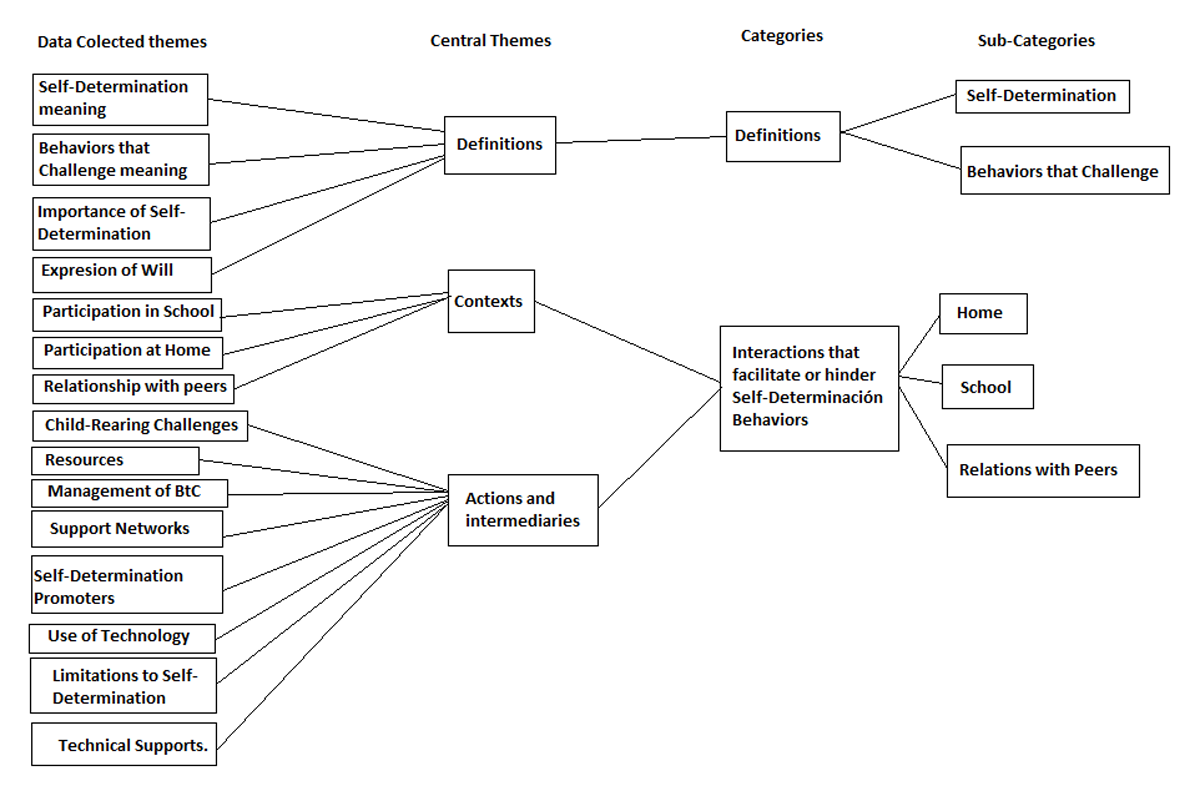
Figure 1
Sequential stages of data coding conducted for the final analysis.
Results
Relationship between BtC and self-determination
Self-determined behaviors were described as actions that express the child’s interests and through which they exercise autonomy and agency. Opportunities to engage in such behaviors were often limited to activities explicitly permitted by the mothers or to a narrow range of options, typically recreational tasks, choosing clothing, or participating in household chores under supervision. A positive perception of the child’s ability to act autonomously fostered greater freedom to choose activities, whereas a negative perception heightened maternal apprehension and restricted exploration of the child’s interests. The involvement of professionals, technicians, or family members often helped parents relax their control. This dynamic was illustrated by one mother: ‘Until 11:20 someone is watching him, monitoring, but if the time goes over, my husband says, “we have to go find him because he might be doing something else”. So maybe we don’t give him the option to decide what to do in those situations, or a teacher might say “I can’t manage him anymore”.’ (Interview 6)
Self-determined behaviors included both actions carried out independently (i.e., when the child could manipulate the required objects, such as watching television or using a cellphone) and actions in which a clear goal existed but assistance was required to achieve it. In such cases, others’ involvement ranged from supervision to direct intervention, depending on the child’s abilities and the adult’s perceptions. Thus, third-party mediation could either promote self-determination by enabling active participation, or constrain it when excessive intervention limited the child’s role in the activity.
The mothers typically equated BtC with oppositional conduct. However, analysis of their accounts revealed a broader range of behaviors reflecting resistance to participating in adult-imposed activities that did not align with the child’s interests. These behaviors resembled BtC manifestations described in adults with ID (Nicholson, Finlay and Stagg 2021).
According to participants, BtC often occurred when a preferred activity (usually recreational) was interrupted to engage in another that was either undesired or overly demanding relative to the child’s abilities. Such behaviors disrupted interactions in daily contexts, including school and home, and reduced opportunities to participate in new settings such as family outings or public spaces (e.g., cinemas and malls), contributing to social isolation and diminished access to support networks.
Overall, the mothers’ narratives revealed an inverse relationship between self-determination and BtC: higher levels of self-determination were associated with fewer BtC, whereas BtC tended to restrict opportunities for autonomous action. Participation in activities chosen autonomously increased motivation, sustained engagement, and skill development supporting self-determination, while reducing frustration. This relationship was mediated by adults’ perceptions of the child’s capabilities: positive appraisals encouraged exploration and autonomy, whereas negative evaluations led to restrictions and over-assistance that limited independent action.
Self-determination and BtC through contexts of participation
Based on these definitions, we identified factors that facilitate or hinder self-determined action by analyzing the child’s interactions with human and non-human actors across three participation contexts: Home, School, and Peer Relationships.
Home
The home was the setting in which children had the greatest opportunities to make choices, particularly in leisure activities such as painting, watching television, or using a cellphone. When parents imposed limits such as restricting screen time or prohibiting perceived risky activities, BtC were more likely to arise, especially when preventive or management strategies were lacking.
Other home-based activities, such as personal hygiene, eating, or household chores, could offer significant benefits for developing autonomy and conflict resolution skills. While motivation for these activities may vary, a child’s interest in performing them allowed for exploration of new experiences and the development of skills necessary for independent functioning in the future, as one participant illustrated.
Other domestic activities, such as hygiene, eating, or household chores, also contributed to autonomy and conflict–resolution skills. Although motivation varied, interest in performing these tasks enabled children to explore new experiences and develop functional skills for independent living. As one mother described: ‘She likes, for example, to clean… She likes cleaning. She likes to set the table, not cooking, but she likes to place the plates, the objects, the glasses. Sometimes she wakes up and says, “I want to make my bed.”’ (Interview 2)
The mothers agreed that early involvement in such routines acted as a preventive factor against BtC, as integrating these responsibilities into daily life reduced resistance. In contrast, when engagement began later, opposition was more frequent. The absence of necessary skills such as manipulating utensils or using devices, could lead to frustration and task abandonment. Appropriate supervision and support facilitated participation as long as they did not inhibit the child’s initiative.
Several mothers emphasized the importance of anticipation as a preventive strategy: explaining upcoming transitions or offering limited choices helped reduce behavioral problems. Families with fewer resources to address BtC tended to rely on less effective approaches, such as yielding to the child’s demands or, in extreme cases, using coercive measures. One participant recalled: ‘During the pandemic, he would get up from the table 10,000 times while we were having lunch. I swear I ended up tying him with his father’s belt.’ (Interview 5)
School
In Chile, educational options for children with ID include special education schools and regular schools with support, depending on the student’s support needs and available placements. Special education schools serve only students with disabilities, whereas regular schools with support integrate students with and without disabilities. Despite their diversity, these schools do not always guarantee effective inclusion (Alfaro Urrutia 2022).
According to participants, enrollment in a special education school typically followed unsuccessful experiences in the regular system, particularly regarding behavioral management. Most mothers reported positive adaptation to special schools, mainly due to greater availability of behavioral supports. However, they expressed concern that these environments often did not promote the development of skills required for transition to inclusive settings, posing barriers to future social participation.
Within schools, children benefited from access adaptations (e.g., augmentative and alternative communication systems) and curricular adjustments tailored to developmental levels. Implementation of these supports depended largely on specialized staff.
Mothers highlighted disparities in available supports between public and private schools, noting that private institutions showed wider variability in quality and type of services. Across both sectors, the main challenge was insufficient behavioral support, which limited classroom participation and peer interaction and, in extreme cases, led to discriminatory practices that undermined educational rights: ‘The school’s recommendation was to reduce her hours. She used to leave at 3:30, then they cut it to 1:00, then to 10:30, and eventually they changed her class… She was in fourth grade, and they put her in fifth, and that just made things worse. So, I ended up deciding not to send her anymore.’ (Interview 1)
In many cases, school staff attempted to compensate for systemic gaps by using individual strategies such as sensory stimuli, dedicated calm rooms, communicative facilitators, or preferred visual materials. The effectiveness of these interventions depended largely on the existence of a trusting relationship between the child and the staff.
External therapeutic services, accessed privately or through the public health system, partially mitigated these deficiencies. Based on mothers’ accounts, three patterns emerged: (1) Private multidisciplinary support: Three mothers accessed high-quality private services that coordinated with schools and families, providing effective strategies for managing BtC. However, the associated costs limited accessibility. (2) Partial or limited support: Another three mothers received therapy (occupational or speech) for only a few hours weekly, reporting minimal behavioral improvements. (3) No external support: Four mothers lacked access to any external services due to high costs, limited public provision, transportation barriers, and lack of support networks.
In the absence of professional guidance, mothers relied on personal knowledge and improvisation to manage behavioral and educational needs. This reliance occasionally led to inconsistent or ineffective strategies, increasing family stress and potentially exacerbating BtC.
Peer relationships
A significant portion of the children’s daily lives unfolded in institutional settings such as schools or therapy centers, where interactions with peers were mediated by professionals. The use of therapeutic-sensory supports, toys, or individualized reinforcement strategies played a key role in preventing BtC and promoting group participation.
Such professional mediation supported the development of essential self-determination skills (self-regulation, decision-making, and persistence) which could be transferred to other contexts. Family involvement reinforced this process by allowing the replication of successful strategies across environments. One mother reflected: ‘She obviously doesn’t obey all day… In a very challenging moment for her, she gets motivated, puts on her sticker, and stops the behavior. For example, the positive reinforcement box helps her a lot—they used it at school too.’ (Interview 2).
Non-institutional settings (homes of relatives, parks, or playgrounds) provided opportunities for interaction with more diverse peer groups. These contexts fostered less hierarchical social dynamics, allowing children to explore different roles and actions. Unlike institutional settings, participation here was voluntary: choosing to engage or not was itself an expression of will. However, this autonomy was sometimes misinterpreted as opposition or as a symptom of disability, creating tension and undermining the child’s decision-making. As one participant explained: ‘His brother always says, “Let’s go outside and jump.” He’s always encouraging him to do something (…) Sometimes there’s a fight because my younger son says, “Mom, he doesn’t want to go out.” And I tell him, “Go play.” – “I don’t want to,” and then the fight starts.’ (Interview 7)
Despite the developmental potential of these environments, numerous barriers limited participation, including inaccessible play areas, transportation difficulties, and limited support networks. Mothers described avoiding public outings for fear of behavioral incidents, which further restricted their children’s participation.
The incorporation of technology into daily routines helped mitigate some of these spatial barriers by enabling remote peer interaction through video games, mobile phones, or social media. These devices could be used independently or with assistance, depending on the child’s skills. Over time, children developed greater digital competence, often through imitation, as illustrated below: ‘Sometimes he takes my younger son’s phone and pretends to play the same game as his brother, but he doesn’t understand how it works yet. So, he pretends he’s playing, but he’s not really playing.’ (Interview 3)
Access to digital tools also enabled engagement with shared cultural content like memes, cartoons, and games, helping children connect across different social contexts.
Figure 2 presents a summary of the key findings emerging from the interviews.
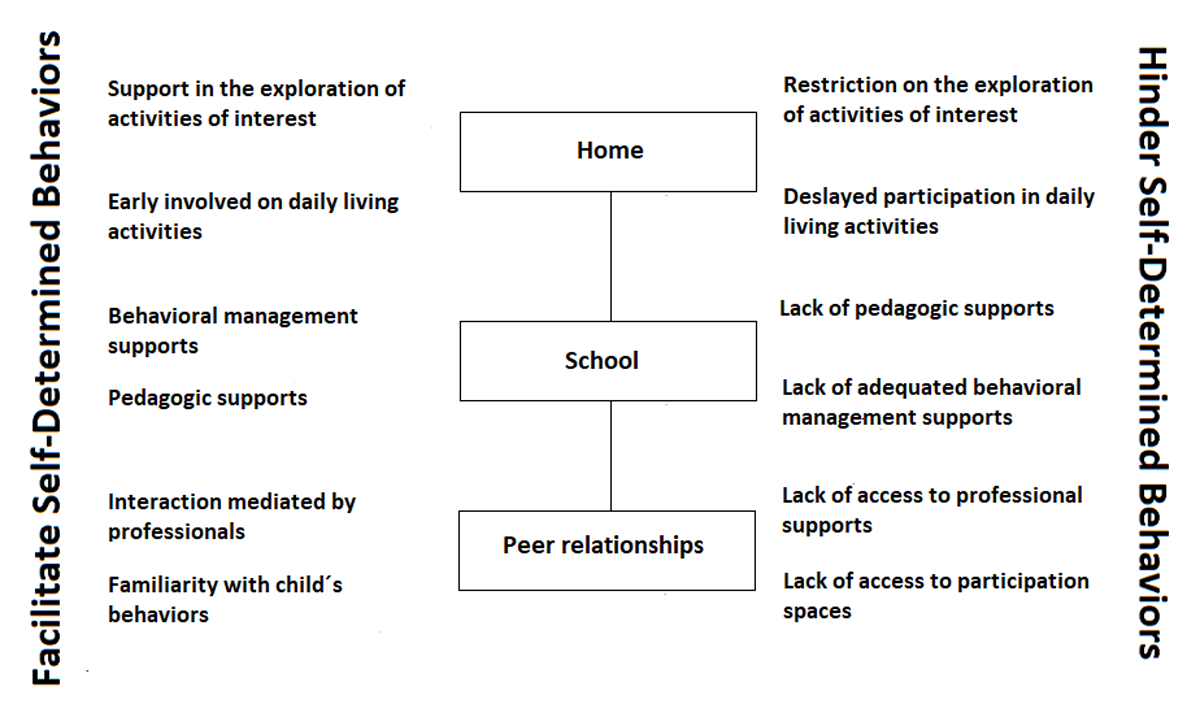
Figure 2
Graphic representation of the key findings that emerged from the interviews.
Discussion
This study aimed to characterize the contextual factors that may facilitate or hinder the acquisition of self-determined behaviors in a group of children with ID who exhibit BtC, residing in central Chile, based on the narratives of their mothers. Their accounts offered detailed descriptions of their children’s behaviors and specific needs across diverse participation contexts, accurately reflecting their daily experiences. These findings are consistent with prior research examining the lives of children with ID through the perspectives of their families (Grove et al. 2022). This methodological approach provided access to a particularly rich source of information regarding support needs and barriers to the expression of self-determination, given the central role of mothers as mediators between their children and other actors in multiple participation contexts.
Continuity of support across participation contexts
Mothers emphasized that a key factor in promoting self-determination and preventing the emergence of BtC lies in the capacity of those interacting with the child to recognize their actions as expressions of will. This recognition allows the child to carry out an action from the initial intention through to the achievement of the goal, in alignment with their own beliefs about agency and control.
This process is supported by the involvement of various human (e.g., professionals and family members) and non-human (e.g., technological devices or assistive tools) actors that enable continuity of action across participation contexts. Skills acquired in one setting can be transferred to others when the strategies used to promote these actions are adaptable. In this way, self-determined behaviors become generalized and consolidated as part of the child’s habitual behavioral repertoire, facilitating engagement in new activities.
This dynamic is evident, for instance, in the coordination between schools and therapeutic institutions regarding behavioral support plans, particularly when families have access to such services. Another relevant example is the active role of mothers as mediators, who incorporate and adapt strategies learned in institutional settings for use at home or in community environments. Their ability to adjust support mechanisms helps sustain the continuity of interventions that promote self-determined behaviors and prevent the occurrence of BtC.
When families face greater barriers to accessing specialized support, or when support networks are insufficient, mothers often act as mediators using their own resources. This can lead to high levels of stress and fatigue, diminishing their capacity to respond effectively to their children’s needs (Grenier-Martin and Rivard 2022). Such constraints not only affect the management of BtC but may also have long-term consequences for the development of more self-determined life trajectories, particularly when these limitations restrict social participation and access to diverse contexts that promote the development of autonomy and agency, such as peer interactions.
An important implication of these findings is that the active participation of families in the provision and coordination of support should be considered a strategic axis in the design of family-centered policies and interventions (Mumbardó-Adam et al. 2023), recognizing their role as co-constructors of environments that foster self-determination. In this regard, parent support networks represent a crucial resource for coping with the demands associated with BtC and for promoting the development of self-determination-related skills. These networks provide not only emotional support but also opportunities to exchange experiences and strategies that strengthen caregiving capacities. However, their presence within the public health system remains limited, and in the private sector they are rarely included in service offerings, despite evidence highlighting their importance in mitigating the social impact of disruptive behaviors (Dew et al. 2019).
Provision of support in Chile
The literature on access to specialized support for people with ID in Chile reveals significant structural limitations, including low service coverage, a shortage of specialists, and long waiting lists (Arango, Aparicio and Tenorio 2018). However, the mothers’ narratives also exposed other major obstacles related to their lived experiences as service users. These include transportation difficulties, limited territorial availability, the absence of support networks that would enable balancing service attendance with household and caregiving responsibilities, and the high cost of private services.
Participants also noted that improved financial conditions do not necessarily guarantee sustained access to professional support. The greater intensity and frequency of interventions required to meet their children’s needs result in significantly higher costs, which may limit or interrupt service provision.
Although this study represents a preliminary exploration and its scope is limited by the small number of interviews and the focus on a specific geographic context, these issues warrant further investigation in future research, particularly regarding the availability of support for individuals with ID compared to those with other developmental conditions. The implementation of Law 21.545 (Gobierno de Chile 2023) has created a significant gap in access to school-based support services in Chile, which are now prioritized to individuals identified with autism, even though it was not the intention of the law.
The evidence gathered suggests the need to re-envision support systems within a framework that incorporates the multiple variables influencing the effective exercise of the rights of persons with disabilities in Chile. This perspective aligns with recent proposals by other scholars (Jorgensen, Nankervis and Chan 2023; Schalock, Luckasson and Shogren 2020).
Actor–network theory
This study employed ANT as a methodological tool to describe and analyze the interactions that children establish with other actors, enabling the development of self-determined behaviors across various participation contexts. This approach allowed self-determination to be conceptualized not as an individual attribute but as a relational and interdependent process (Watson 2012), in which the actions of others can either support or hinder its expression.
From the ANT perspective, the social is not fixed or predetermined but emerges from the interactions among human (e.g., family members and professionals) and non-human (e.g., electronic devices and objects) actors within a dynamic network of relations. This framework made it possible to observe how the environment contributes to the child’s causal agency by identifying components of self-determination, as described in CAT and SDT, as reflected in the mothers’ narratives. Consequently, specific interactional configurations were identified that, depending on the context, enable or restrict the exercise of self-determination and the emergence of BtC (Correa 2023; Tirado Serrano and Domènech i Argemí 2005).
Through ANT, we were able to reconstruct non-linear developmental trajectories in which self-determination is understood as the outcome of the convergence between the child’s actions and those of other actors. This allowed for a detailed mapping of the relational networks shaping the child’s capacity to act at different levels of participation. The study enabled a progressive description from the home, where environmental variables are more limited, to institutional and community environments, where relational complexity increases. ANT facilitated this exploration while honoring the singularity of each interviewee’s experience and avoiding generalizations that could obscure individual differences (Soto 2023).
Limitations
The study was based on mothers’ narratives collected through in-person and video-call interviews. This methodological strategy presented certain advantages, such as enabling the participation of families living in regions adjacent to the Metropolitan Region. However, it also entailed limitations, including restricted access to complementary sources of information, particularly non-verbal communication and contextual cues, whose absence may have affected the depth and richness of the analysis (Johannessen, Rasmussen and Haldar 2025).
These limitations constrain the inclusion of non-verbal data collection strategies that could facilitate the direct participation of children, especially given the communication difficulties frequently observed in this population. Such challenges were highlighted by some interviewees and are well documented in the research literature (Coons and Watson 2013).
Taking these challenges into account, along with ethical considerations related to the progressive nature of autonomy in childhood (Zapico Lafuente 2020), the study was conducted using the perspectives of mothers, who were regarded as expert informants on their children (MacNeil et al. 2024). This approach, however, excluded the children’s own perspectives as ‘experts by experience’ regarding their support needs, from the characterization (Heerings et al. 2022). We recognize this exclusion as a limitation of the present study and highlight the importance of future research in the Chilean context incorporating children’s voices more actively.
During the interviews, participants displayed varying degrees of familiarity with the concepts of self-determination and BtC. Although they generally did not provide technical definitions, mothers recognized these constructs in their children’s everyday actions and were able to relate self-determined behaviors to those that challenge, drawing connections between both. This contrast between conceptual unfamiliarity and practical recognition raises questions about how these topics are communicated to families during support planning processes. However, this issue emerged as a reflection during data analysis and was not explored in depth in the interviews.
Conclusion
The findings of this study suggest an inverse relationship between self-determined behaviors and BtC: as one increases, the likelihood of the other decreases. According to the mothers interviewed, when self-determined behaviors are more frequent, BtC tend to diminish. Conversely, the presence of BtC often restricts children’s access to participation contexts in which they could exercise self-determination, thereby limiting opportunities to engage in activities that foster related competencies.
Given that the manifestation of self-determined behaviors may contribute to reducing BtC, the promotion of skills and competencies related to self-determination emerges as a key factor in fostering social inclusion. This can be achieved through the enhancement of decision-making, self-regulation, and assertive communication skills, thereby broadening participation opportunities across a wider range of contexts.
This process can be understood as an interdependent phenomenon in which the actions of various human and non-human actors serve as mediators that enable the child’s actions to unfold in accordance with their beliefs about agency and control. The development of self-determined behaviors may be hindered when children’s initiated actions are interrupted by external impositions or when they lack the necessary skills and competencies to achieve their goals—conditions that can foster the emergence of BtC.
These findings underscore the importance of designing supports specifically aimed at fostering self-determination in children with ID who display BtC. Further research is needed, particularly in regions beyond the metropolitan area, as well as in other countries, to deepen understanding of the contextual factors influencing these processes.
Data Accessibility Statement
The data that support the findings of this study are available on request from the corresponding author, [PSA].
Acknowledgements
IV and PSA are supported by ANID Millennium Science Initiative Program (ICS2019_024).
Competing Interests
The authors have no competing interests to declare.
Author Contributions
IV: conceptualization, investigation, data curation, analysis, writing. PSA: supervision, data curation, analysis, writing, funding acquisition. NS: supervision, review & editing. All authors contributed to the article and approved the submitted version.