
Introduction
This article presents a scoping review of workplace practices promoting sustainable employment for people with disabilities (PWD). PWD can be defined as people who have long-term physical, mental, intellectual, or sensory impairments, which in interaction with barriers can hinder participation in society on an equal basis with others (United Nations 2006: art. 1). One such barrier is acquiring and maintaining steady employment (Corbière et al. 2014; Williams et al. 2016). ‘Sustainable employment’ can be defined as the extent to which employees are able and willing to stay in work over time (Van Dam, Van Vuuren & Kemps 2017). Several aspects related to individual work ability and attributes, employers’ attitudes and practices, and labour market characteristics can influence sustainable employment (Kellard et al. 2001; Lengnick-Hall, Gaunt & Kulkarni 2008). Research from a variety of fields and disciplines (e.g., disability studies, health and rehabilitation sciences, social policy, social work, and human resource management (HRM) and organization studies) consider the employment of PWD. Despite heterogeneity in these research fields, previous studies have focused on describing and explaining the disability employment gap through discrimination and barriers that disabled people experience, either to enter the labour market (Vornholt et al. 2018; Østerud 2022) or at the workplace (Jammaers 2023; Mik-Meyer 2016). In Dobusch’s words (2021: 388), we know ‘what inclusion should not look like.’ Recognizing the value of previous research, what seems to be missing is more robust knowledge of what contributes to sustainable employment for PWD. To address the research gap, this article aims to answer the following research questions: What is currently known about workplace practices and positive employment outcomes, contributing to sustainable employment for people with disabilities? How can a focus on positive employment outcomes provide new insights in research on disability employment?
This article presents a review of the role of workplace practices for sustainable employment. From earlier research we know that employers’ and coworkers’ attitudes and engagement, and ability to provide work accommodations and support at the workplace are prerequisites for the successful inclusion of PWD (Stone & Colella 1996; Vornholt et al. 2018; Vornholt, Uitdewilligen & Nijhuis 2013). Recognizing the crucial difference between employers’ attitudes and their behavior (Bredgaard 2018), this study focuses on practices carried out by different stakeholders (e.g., managers, HR personnel, coworkers, job specialists) at the workplace and analyzes the relationship between these workplace practices and various positive employment outcomes. Unlike reviews that concentrate on specific workplace practices like recruitment (Nagtegaal et al. 2023), accommodation (Nevala et al. 2015) or HRM practices (Schloemer-Jarvis, Bader & Böhm 2022), our review article adopts a more comprehensive approach. It encompasses all practices, ranging from strategically implemented HRM practices (e.g., recruitment, diversity management, sensitivity training) to more subtle and informal cultural ones (e.g., fairness, equal opportunities, social team climate). The review thus contributes to debates on demand-side (employers and organizations) approaches in promoting sustainable employment for PWD. Much literature refers to PWD collectively, while other studies concentrate on different types of disabilities, such as mental illnesses, intellectual disabilities, and physical disabilities. In this scoping review, we do not focus on specific groups but use ‘PWD’ as a collective term. With ‘positive’ employment outcomes we mean outcomes that contribute to acquiring work, staying in work, or otherwise increasing quality of work for PWD. Thus, the article starts from the assumption that certain workplace practices can lead to positive employment outcomes, contributing to sustainable employment for PWD.
To establish the ‘lay of the land’ (Dean, Little & Dunn 2017, 14) and provide a comprehensive map of available literature, we chose scoping review as our methodological framework (Arksey & O’Malley 2005). Scoping reviews are particularly recommended when a topic is heterogeneous and multidisciplinary in nature and lacks cohesive terminology and approaches (Dean, Little & Dunn 2017). Moreover, Munn et al. (2018) claim that a scoping review is a better choice than a systematic review when asking broader questions about the characteristics of a topic, instead of answering a specific, single question. Whereas previous reviews on disability and employment have focused on the perspectives of either PWD (Jahoda et al. 2008; Robertson et al. 2019; Saunders and Nedelec 2014), employers (Jansen et al. 2021; Karpur, VanLooy & Bruyère 2014; Kersten et al. 2023), or HRM (Cavanagh et al. 2017), this review incorporates positive employment outcomes across multiple stakeholders, providing a holistic and inter-disciplinary approach, integrating streams of literature across fields, perspectives, and methods. As such, the scoping methodology was deemed optimal for the purpose of this review.
The article is structured as follows: We begin by presenting the methodological and analytical approach taken to scope the literature. In the results section, we present the identified literature emphasizing the link between workplace practices and outcome categories. The results are discussed with focus on contributions to disability research. The article concludes with recommendations for future research.
Method
Selection and screening
To chart the research landscape on workplace practices contributing to positive employment outcomes for PWD, a scoping review was conducted. In contrast to systematic reviews, a scoping review does not seek to evaluate research methodology or validity of results, but rather to summarize relevant research, disseminate results, and identify research gaps within the field (Arksey & O’Malley 2005). Given the significant increase in the prevalence of scoping reviews within research literature, several efforts have been made to establish guidelines and methodological frameworks for their execution (Arksey & O’Malley 2005; Levac et al. 2010; Peters et al. 2015). We used the suggested framework for scoping reviews developed by Arksey and O’Malley (2005) to guide our scoping process, and the PRISMA-ScR checklist for reporting (Tricco et al. 2018). The review work was conducted in a team of five researchers. First, the research question was identified to guide the literature search. Second, relevant studies were identified through multiple database searches. Third, the sample of studies were selected based on inclusion criteria developed by the research team. Fourth, data was extracted and charted. Finally, the results were summarized and reported. Before we present the details of the scoping process below, however, we want to add an important point about the nature of a scoping process. Even though we attempted to achieve a linear and structured process, a scoping process, with its wide and comprehensive search, requires researchers to engage with each stage in the process in a reflexive and iterative way (cf. Arksey & O’Malley 2005). In our team of researchers, we therefore constantly discussed the inclusion criteria as the team’s familiarity with the literature increased, resulting in an iterative review and work process.
Four electronic databases were searched: PsychINFO, Web of Science, Sociological Abstracts and Sociological Index. The search was limited to peer-reviewed English-written journal articles published between 2000 and 2022. Given the diverse national backgrounds of the researchers, it was not feasible to include languages other than English. Therefore, grey literature, which is often written in a specific country’s language, was excluded. While these limitations were necessary for practical reasons, it should be noted that potentially relevant papers may have been overlooked.
The search was conducted in January 2021 and updated in July 2022. The search string was divided into three groups of search terms. The first group was related to the target group, the second group to workplace practices, and the third group to employment outcomes. Thus, the overall search logic looked like this: ‘Target Group’ AND ‘Workplace practice’ AND ‘Employment outcome’. The three groups were combined so that each article had to contain at least one search term of all three groups. As the initial search yielded a substantial number of articles, a fourth NOT category was added to exclude irrelevant articles. See Figure 1 for the terms and combinations used.
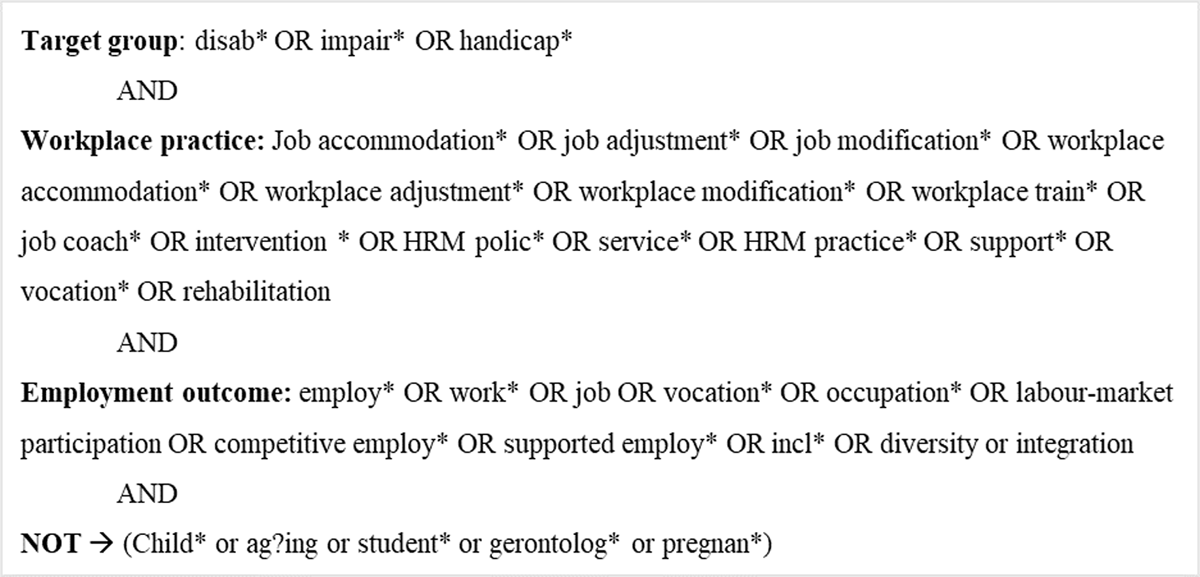
Figure 1
Search string.
Database searches returned 10,390 articles, reduced to 8,205 when duplicates were removed. Figure 2 summarizes the inclusion criteria. Inclusion criterion 1 was that articles were included if they had employer, PWD, practice, and workplace in the abstract. Articles that did not meet criterion 1 were excluded. For screening of titles and abstracts, the systematic review application Rayyan was used. Abstracts were divided between pairs of researchers. Each research pair reviewed the same abstracts and voted to include or exclude the studies. The process was blind, in which the paired researchers did not know what the other voted until all the abstracts were reviewed. After all abstracts were reviewed, the pairs resolved conflicting votes of inclusion and exclusion. Cases of uncertainty were solved in the full research team. The remaining 773 articles were reduced to 607 according, in which articles were excluded if they were published in a journal without an impact factor (criterion 2). This criterion was implemented to avoid predatory journals and to ensure a minimum quality of articles. For the remaining articles, full texts were read and were included if the theme was about workplace practices and inclusion of PWD (criterion 3). Articles that did not meet criterion 3 were excluded, and cases of doubt or disagreement were discussed in the research team. This resulted in 126 articles that substantively addressed the research topic. Finally, the two authors of this article decided to focus on articles addressing the relationship between workplace practices and outcomes (n = 53), excluding all non-empirical articles (criterion 4), and concentrate on workplace practices linked to positive outcomes (n = 42, criterion 5). Figure 3 summarizes the selection phases.
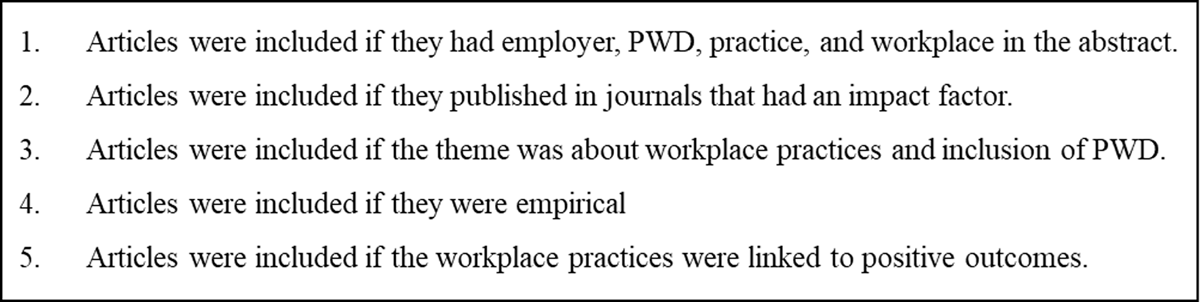
Figure 2
Selection criteria.
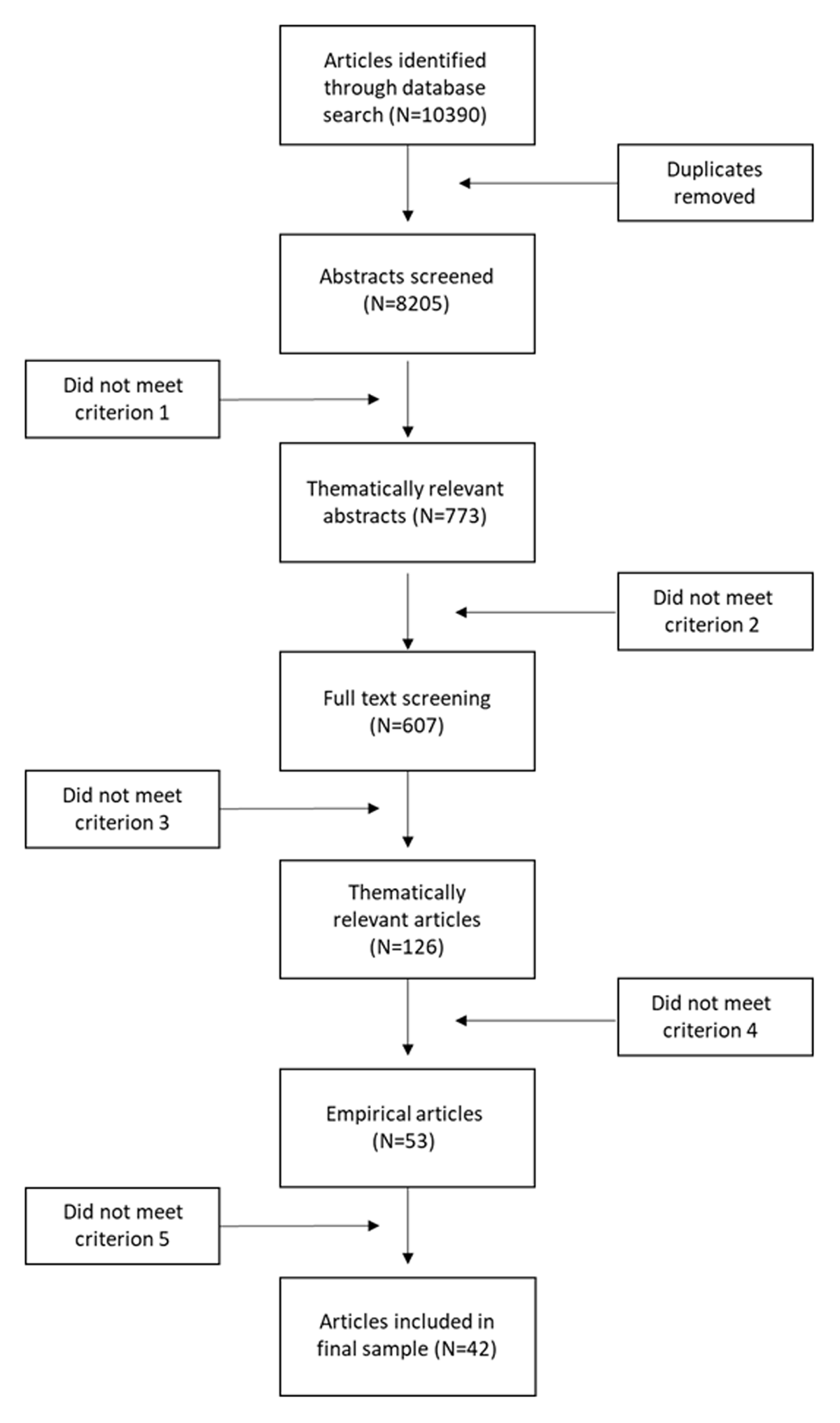
Figure 3
Selection phases.
Data extraction and analysis
The authors did a more thorough reading of the remaining 42 articles. The goal of the analysis was to compile a thorough overview of workplace practices linked to at least one positive employment outcome, revealing mechanisms contributing to sustainable employment for PWD. All data on workplace practices and outcomes were inductively extracted in separate spreadsheets for qualitative and quantitative articles. The authors divided the articles, and switched articles for cross-checking to secure inter-coder agreement (Miles & Huberman 1994). All articles were re-examined and discussed if disagreements occurred. A recurring subject for discussion was the level of detail in data extraction, as some articles mentioned various workplace practices and employment outcomes very briefly. We decided to include all the workplace practices that were linked to positive employment outcomes, irrespective of level of detail, resulting in a list of 89 practices and 47 outcomes (see Table S1 in supplementary material and Table 3 below).
As a next step, we grouped workplace practices in seven thematic codes: accommodation, cultural practices, HRM practices, leadership, participation, support, and training. These are linked to the search string for workplace practices in our literature search. The coding proved to be a meticulous process, as many practices could overlap or belong to more than one code. For example, having a ‘buddy system’ was grouped under both HRM practices and support, as the practice provides support to PWD while being a part of official HRM policy. Moreover, categories such as ‘accommodation’ and ‘support’ were sometimes used simultaneously or as synonyms in literature. We decided to distinguish the categories based on social interaction, in which support provided to PWD by leaders, coworkers, personal assistants or job coaches were defined as support, and all changes made to work tasks, schedules, or the work environment were defined as accommodation practices. Again, the authors cross-checked and discussed all articles to secure inter-coder agreement. Additionally, a continuous dialogue with the other three members of the research team proved valuable for securing reliability.
Lastly, five outcome categories were identified from employment outcomes linked to workplace practices: positive employment experiences of PWD, positive employment outcomes of PWD, positive employment outcomes of stakeholders in the organization, work performance, and positive organizational outcomes. By categorizing studies on similar positive employment outcomes across methodology and fields, evidence of mechanisms contributing to sustainable employment for PWD are synthesized. These are presented in detail in the Findings, below.
Findings
Tables 1 and 2 presents an overview of the final qualitative and quantitative articles included in the study. In total, 42 articles were included, of which 18 were qualitative, 23 were quantitative, and one article used mixed methods. The articles were published in 28 different journals, in which the three major journals were Work, Personnel Review, and Journal of Occupational Rehabilitation. The journals represented six major fields: disability, HR, rehabilitation and health, work, psychology, and social work. The studies were conducted in 16 different countries, of which the US and Australia were the major study countries, accounting for 13 and seven of the articles, respectively. Otherwise, the studies were conducted in Europe and Asia. No studies from Africa met the inclusion criteria. Many articles target specific subgroups of PWD, like people with mental illness (Chow, Cichocki & Croft 2014; Paluch, Fossey & Harvey 2012), intellectual disabilities (Bartram et al. 2021; Becerra, Montanero & Lucero 2018; Flores et al. 2021), or physical impairments (Luu 2018; Miller et al. 2014).
Table 1
Qualitative articles.
| STUDY ID | JOURNAL | COUNTRY | DISABILITY | SAMPLE | N | DESIGN | PRACTICE GROUP | OUTCOME | |
|---|---|---|---|---|---|---|---|---|---|
| 1 | Bartram et al., 2021 | Asia Pacific Journal of Human resources | Australia | Intellectual | PWD Managers | 78 | Interviews Focus groups | Accommodation Cultural practices HRM Support | Wellbeing Individual performance |
| 2 | Becerra et al., 2018 | Disability and rehabilitation | Spain | Intellectual | PWD | 5 | Multiple case study design Interrupted time series design | Accommodation | Quality of performance |
| 3 | Blonk et al., 2020 | Disability & Society | Netherlands | Intellectual Mental health conditions | PWD Employers Customers Social workers | 28 | Interviews Participant observation | Cultural practices Support | Feeling of recognition |
| 4 | Butterworth et al., 2000 | Mental Retardation | USA | Young adults with developmental disabilities | PWD Co-workers Managers Supervisors | 16 | Participant observation Interviews | Cultural practices Leadership Training | Supportive workplace |
| 5 | Carrier, 2007 | Intellectual and developmental disabilities | USA | Intellectual | PWD Co-workers Employers Job coaches | 10 | Participant observation Interviews | Accommodation Cultural practices Training | Social and professional integration |
| 6 | Cavanagh et al., 2021 | Personnel Review | Australia | Intellectual | PWD Co-workers HR managers Department managers Supervisors | 91 | Interviews Focus groups | Cultural practices HRM Support | Thriving at work |
| 7 | Foster & Fosh, 2010 | British Journal of Industrial Relations | UK | Unspecified | PWD Union officers Disability-related organizations | 20 | Interviews | Participation Support | Integrating PWD’s concerns into the organizational agenda |
| 8 | Gignac et al., 2021 | Journal of Occupational Rehabilitation | Canada | Episodic disabilities | Disability managers Union representativesOccupational health and safety representativesLabour lawyers | 27 | Interviews | Support | Inclusion and sustainable employment |
| 9 | Guillaume & Loufrani-Fedida, 2023 | Personnel Review | France | Vulnerable employees | Stakeholders in employability management | 50 | Interviews Observations | Participation HRM | Managing inclusive employability of vulnerable workers |
| 10 | Haafkens et al., 2011 | BMC Health Services Research | Netherlands | Chronically ill | HR managers Line managers | 27 | Concept mapping methodology | Accommodation, Cultural practices HRM Leadership Support | Retention |
| 11 | Jansson et al., 2015 | Work | Sweden | Unspecified | Employers | 12 | Interviews | Accommodation Cultural practices Leadership Participation Support Training | Work ability Productivity |
| 12 | Kwan, 2021 | Social Work | Hong Kong | Unspecified | Co-workers | 8 | Interviews | Cultural practices Support Training | Disability friendly work environment Understanding PWD Level of accommodation |
| 13 | Meacham, 2017a | Personnel Review | Australia | Intellectual | PWD Co-workers HR managers Department managers Supervisors | 63 | Interviews Focus groups | Accommodation Cultural practices HRM Leadership Support Training | Participation Well-being |
| 14 | Meacham, 2017b | Personnel Review | Australia | Intellectual | PWD HR managers Owner of film company | 14 | Interviews Focus groups Observations | Cultural practices HRM Support | Social integration |
| 15 | Miller et al., 2014 | Work | US | Mobility impairments | PWD | 33 | Interviews | Accommodation Support | Retention Job satisfaction |
| 16 | Paluch et al., 2012 | Work | Australia | Mental illness | PWD Co-workers | 9 | Participant observation Interviews Document analysis | Cultural practices Participation Support Training | Supportive workplace |
| 17 | Schreuer et al., 2009 | Work | US | Unspecified | PWD Employer Occupational therapist | 5 | Comparative case design | Support | Level of accommodation |
| 18 | Trezzini et al., 2021 | Disability & Society | Switzerland | Unspecified | PWD | 26 | Interviews | Accommodation Cultural practices Support | Participation on equal terms |
Table 2
Quantitative articles.
| STUDY ID | JOURNAL | COUNTRY | DISABILITY | SAMPLE | N | DESIGN | PRACTICE GROUP | OUTCOME | |
|---|---|---|---|---|---|---|---|---|---|
| 1 | Banks et al., 2001 | Psychiatric rehabilitation journal | USA | Mental | Employment support staff | 243 | Cross-sectional survey | Cultural practices Support | Wage |
| 2 | Chandola & Rouxel, 2021 | Social science & medicine | UK | Physical Sensory Mental | PWD Employees (without disabilities) | 6615 | Longitudinal survey | Accommodation Support | Staying economically active |
| 3 | Chordiya, 2022 | Review of public personnel administration | USA | Unspecified | PWD Employees (without disabilities) | 687687 (2012) 421748 (2015) | Pooled cross-sectional survey | Cultural practices HRM | Turnover intention |
| 4 | Chow et al., 2014 | Psychiatric services | USA | Mental | PWD | 1538 | Longitudinal survey | Accommodation | Hours worked Employment duration |
| 5 | Coll & Mignonac, 2023 | International journal of human resource management | France | Unspecified | PWD Supervisors | i) 200 ii) 160 | Matched employee-supervisor survey | Support | Task performance |
| 6 | Eissenstat et al., 2022 | Rehabilitation counseling bulletin | South Korea | Unspecified | PWD | 1755 | Cross-sectional survey | Accommodation | Job satisfaction Job tenure |
| 7 | Farris & Stancliffe, 2001 | Journal of intellectual and developmental disabilities | Australia | Intellectual Physical Neurological? Learning | PWD Co-workers Managers | 36 | Multi-wave surveys | Training Support | Value of PWD Support needs |
| 8 | Fillary & Pernice 2006 | International journal of rehabilitation research | New Zealand | Intellectual | PWD Co-workers Employers | 24 | Cross-sectional survey | Cultural practices | Level of inclusion |
| 9 | Flores et al., 2021 | International journal of environmental research and public health | Spain | Intellectual | PWD | 554 | Cross-sectional survey | Support | Job satisfaction |
| 10 | Gray et al., 2014 | Work | USA | Physical | PWD | 132 | Cross-sectional survey | Accommodation Cultural practices Support | Job satisfaction |
| 11 | Habeck et al., 2010 | Journal of occupational rehabilitation | USA | Unspecified | Employers | 650 | Cross-sectional survey | AccommodationHRM Leadership | Hiring PWD Retention |
| 12 | Ishii & Yaeda, 2010 | Journal of rehabilitation | Japan | Intellectual | Employers | 150 | Cross-sectional survey | Accommodation | Tasks performed by PWD |
| 13 | Kensbock & Boehm, 2016 | International journal of human resource management | Israel | Unspecified | PWD Supervisors | i) 10 ii) 55 | Mixed methods, InterviewsCross-sectional survey | Leadership | Job performance |
| 14 | Luu, 2018 | Employee relations | Vietnam | Physical | PWD Supervisors | 875 | Matched employee-supervisor survey | HRM Leadership Training | Work engagement |
| 15 | Lyubykh et al., 2020 | Journal of occupational rehabilitation | Canada | Musculoskeletal | PWD Supervisors | i) 264 ii) 224 | Cross-sectional survey | Leadership | Job satisfaction Provision of accommodation Resilience Low presenteeism Performance evaluation |
| 16 | Man et al., 2020 | Frontiers in psychology | China | Unspecified | PWD Supervisors | 300 | Multi-wave matched employee-supervisor survey | Accommodation | Creative performance |
| 17 | Mank et al., 2000 | Mental retardation | USA | Unspecified | Co-workers Employment specialists | 538 | Two-wave survey | Support Training | Wage Employment duration |
| 18 | Novak & Rogan, 2010 | Intellectual and developmental disabilities | USA | Developmental | Employment specialists | 106 | Cross-sectional survey | Cultural practices Support | Co-worker attitude towards PWD Level of participation Feelings of support |
| 19 | Sanclemente et al., 2022 | Applied psychology | Spain | Physical Intellectual Mental | PWD Co-workers | 258 | Cross-sectional survey | Cultural practices Support | Organizational learning Desire to stay in organization |
| 20 | Schur et al., 2009 | Industrial relations | USA | Unspecified | PWD Non-disabled employees | 29897 | Cross-sectional survey | Cultural practices | Job satisfaction, Willingness to work hard, company loyalty, turnover intention |
| 21 | Solovieva et al., 2011 | Disability and health journal | USA | Physical Cognitive Sensory Mental Health | Employers | 128 | Cross-sectional survey | Accommodations | Retained a qualified employee Increased worker productivity Eliminated the cost of training a new employee. |
| 22 | Tuan et al., 2021 | Review of public personnel administration | Vietnam | Physical | PWD | 662 | Two-wave survey | HRM | Well-being |
| 23 | Villotti et al., 2017 | Community mental health journal | Australia Canada Italy | Mental | PWD | 90 | Cross-sectional survey | Accommodation Support | Job tenure |
| 24 | Zhu et al., 2019 | Human resource management | China | Physical Sensory Developmental | PWD Non-disabled employees | 485 | Two-wave survey | Cultural practices | Thriving at work |
A large part of the qualitative articles can be characterized as practice-near research. The articles focus on emotional and relational processes, often in a relatively small sample, and provide thick descriptions of ‘what is going on’ at the workplace. Six articles out of a total of 18 qualitative articles have no (explicit) theoretical foundation (Becerra, Montanero & Lucero 2018; Gignac et al. 2021; Haafkens et al. 2011; Jansson et al. 2015; Miller et al. 2014; Paluch, Fossey & Harvey 2012). The most frequently used theories are various HRM theories, like for example diversity management (Bartram et al. 2021), employability management (Guillaume & Loufrani-Fedida 2023), career construction theory (Meacham et al. 2017b) and theories on inclusive organizations (Cavanagh et al. 2021). From the field of disability studies, Honneth’s recognition theory (Blonk et al. 2020) and Marshall’s work on citizenship and Fraser’s ‘parit of participation’ (Trezzini et al. 2021) are used in discussing PWD’s opportunities to participate fully and equally on the labor market. Whereas most articles in our sample apply a micro- and meso-level perspective, the latter two stand out with a macro-, society-level perspective. Through the practice- and experience-nearness, an important aim of these articles was to make research-based recommendations and eventually enhance services targeting PWD. The articles displayed a proximity and vigilance to the research context, which is important due to the sensitivity of the topic.
In contrast, 13 of the quantitative articles and the mixed-methods article build on theoretical frameworks (Banks et al. 2001; Chordiya 2022; Chow, Cichocki & Croft 2014; Coll & Mignonac 2023; Eissenstat, Lee & Hong 2022; Flores et al. 2021; Kensbock & Boehm 2016; Luu 2018; Lyubykh et al. 2020; Man, Zhu & Sun 2020; Novak & Rogan 2010; Sanclemente et al. 2022; Tuan et al. 2021; Zhu et al. 2019). All but one of these articles (Banks et al. 2001) build and test theoretical models on workplace practices and their association with employment outcomes for PWD or other stakeholders. For example, Chordiya (2022) modelled how organizational practices for inclusion affects federal employees with disabilities’ turnover intentions, while Luu (2018) modelled how disability inclusive HR practices positively contributed to PWD’s work engagement through the mediating role of organizational identification. The theoretically anchored model building in the quantitative articles shows that research has come a long way in attempting to explain variations in employment outcomes for PWD. The remaining quantitative studies are more empirically driven. For example, three were of a more descriptive nature, and examined the level of inclusion of employees with intellectual disabilities (Filary & Pernice 2006), the perspectives of wheelchair users on work and requirements to fulfil work tasks (Gray, Morgan & Hollingsworth 2014), and the benefits experienced by employers by accommodating PWD (Solovieva, Dowler & Walls 2011). Two others focused on the benefits of coworker training as an alternative to more conventional forms of support at the workplace (Farris & Stancliffe 2001; Mank, Cioffi & Yovanoff 2000), while two others used large-scale surveys to evaluate the impact of accommodations and corporate culture on employment outcomes for people with disabilities (Chandola & Rouxel 2021; Schur et al. 2009). The included articles thus demonstrate great variation in quantitative studies related to workplace practices and employment outcomes for PWD.
Workplace practices
We categorized workplace practices into seven categories: accommodations, cultural practices, HRM practices, leadership, participation, support, and training. Multiple practice categories are represented in multiple articles, which can be seen in Tables 1 and 2. A detailed summary of which practices are placed in each category can be found in Supplementary Material S1.
Accommodations refer to practices that (very broadly speaking) eliminate barriers to work for PWD (Ali, Schur & Blanck 2011). Accommodations include physical alterations at the worksite to secure accessibility for PWD, like wide doors, ramps and convenient parking possibilities (Eissenstat, Lee & Hong 2022; Gray, Morgan & Hollingsworth 2014; Man, Zhu & Sun 2020; Solovieva, Dowler & Walls 2011), environmental modifications like offering quiet workspaces (Bartram et al. 2021), assistive technologies, such as electronic devices, computer hardware and software, and graphic resources (Becerra, Montanero & Lucero 2018; Gray, Morgan & Hollingsworth 2014; Miller et al. 2014), flexible work arrangements, like schedule flexibility and teleworking opportunities (Habeck et al. 2010; Solovieva, Dowler & Walls 2011; Villotti et al. 2017), and adjusted workloads and tasks accommodation (Carrier 2007; Haafkens et al. 2011; Trezzini et al. 2021).
Cultural practices encompass all practices about the social work environment. The practices are more informal than HRM practices and involve positive behavior of managers/supervisors (Cavanagh et al. 2021; Haafkens et al. 2011; Jansson et al. 2015; Meacham et al. 2017a) and coworkers (Banks et al. 2001; Novak and Rogan 2010; Sanclemente et al. 2022) and their attitudes towards PWD. Being open, fair, encouraging, and helpful are examples of such positive behaviors (Chordiya 2022; Haafkens et al. 2011; Schur et al. 2009). Cultural practices also include social activities like team activities outside the workplace (Butterworth et al. 2000; Jansson et al. 2015) as well as collective lunch hours and random social interaction at the workplace (Bartram et al. 2021; Butterworth et al. 2000). Moreover, cultural practices entail (concrete) communicative practices like providing instruction and advice (Meacham et al. 2017a) and stimulating PWD’s personal development (Cavanagh et al. 2021).
HRM practices consist of practices that are linked to formal organizational policies (Paauwe 2009) promoting diversity in the workplace. This means that even though an article uses the term HRM practices, the practices were only categorized as HRM if they were connected to formal policies. Thus, HRM practices are the workplace’s operationalization of diversity policies, in terms of what the workplace should offer PWD, like a buddy system (Bartram et al. 2021; Tuan et al. 2021), flexible schedules, benefit packages, and personal development opportunities (Habeck et al. 2010; Tuan et al. 2021), and in terms of who needs to get involved, typically occupational physicians or others from the company’s health service (Haafkens et al. 2011; Habeck et al. 2010). Also, seeking knowledge and aiming for best practices in employment of PWD (Bartram et al. 2021; Chordiya 2022) are examples of HRM practices. As HRM practices involve a broad range of practices related to both recruitment, training, development, and retention, there are many overlaps with the other inclusive practices. For instance, providing a buddy system obviously involves support and training. The distinction is the level of formality and the explicit link to policies.
Leadership encompasses practices related to leadership behaviors and leadership styles that are important to achieve successful employment of PWD. This can be leaders’ knowledge about the impact of disease on work (Haafkens et al. 2011), leaders’ ability to communicate openly (Habeck et al. 2010), or leaders’ willingness to create time and space to listen to PWD (Haafkens et al. 2011) and to provide an inclusive environment (Butterworth et al. 2000; Jansson et al. 2015). In addition, practices connected to different leadership theories such as ‘transformational leadership’ (Kensbock & Boehm 2016), ‘moral leadership’ (Luu 2018), and ‘leader-membership-exchange’ (Lyubykh et al. 2020) are included here.
Participation consists of practices of involvement and engagement of PWD in the organization. This can be providing information and involving PWD in decision-making (Jansson et al. 2015; Paluch, Fossey & Harvey 2012), and the assistance of other stakeholders such as unions (Foster & Fosh 2010) and managers and HR departments in employability management (Guillaume & Loufrani-Fedida 2023).
Support encompasses practices in which support is provided to PWD through social interaction. Supportive practices range from broadly described ‘workplace support’(Coll & Mignonac 2023; Gignac et al. 2021) and ‘natural support’ (Banks et al. 2001; Mank, Cioffi & Yovanoff 2000; Paluch, Fossey & Harvey 2012; Villotti et al. 2017), to support provided to PWD from specific groups such as managers/supervisors (Bartram et al. 2021; Cavanagh et al. 2021) and coworkers (Farris & Stancliffe 2001; Meacham et al. 2017a; Novak & Rogan 2010). Also, managers and coworkers can receive support by stakeholders such as employment services, occupational therapists, and social workers to improve their handling of employees and coworkers with disabilities (Kwan, 2021; Mank, Cioffi & Yovanoff 2000; Schreuer et al. 2009).
Training encompasses both formal and informal practices targeting PWD, coworkers and managers. Training can be aimed at PWD in the form of worksite training to improve their work-related skills and knowledge, either provided within the organization, or from other stakeholders (Carrier 2007; Luu 2018; Paluch, Fossey & Harvey 2012). Training can also be aimed at improving managers’ or coworkers’ competence in how to work with PWD (Farris & Stancliffe 2001; Kwan 2021; Mank, Cioffi & Yovanoff 2000; Meacham et al. 2017a).
The link between workplace practices and employment outcomes
The workplace practices are connected to five categories of outcomes: positive employment experiences of PWD, positive employment outcomes of PWD, positive employment outcomes of stakeholders in the organization, work performance, and positive organizational outcomes. Table 3 presents the workplace practice categories in the left column, the outcome categories in the middle column, with the outcomes belonging to each group in the right column. In the following, we give an overview of the main findings related to positive employment outcomes within each outcome category.
Table 3
Workplace practices linked to outcome categories and outcomes.
| PRACTICE | OUTCOME CATEGORY | OUTCOMES |
|---|---|---|
| Accommodation Cultural practices HRM practices Leadership Support Training | Positive employment experiences PWD | Well-being Job satisfaction Thriving at work Social and professional integration Feeling of support Equal participation Resilience Feeling of recognition Level of inclusion Desire to stay in organization Company loyalty |
| Accommodation Cultural practices HRM practices Leadership Support Training | Positive employment outcomes PWD | Wage Duration of employment Hours worked Low presenteeism Turnover intention Receiving accommodation Staying economically active Job tenure Job security |
| Accommodation Cultural practices Training Support | Positive employment experiences of stakeholders in the organization | Co-worker attitudes Valuing PWD Understanding PwD |
| Accommodation Cultural practices HRM practices Leadership Participation Support Training | Work performance | Creative performance Individual performance Job performance Work engagement Task performance Quality of performance Lower support needs Willingness to work hard Performance evaluation Productivity Work ability |
| Accommodation Cultural practices HRM practices Leadership Participation Support Training | Positive organizational outcomes | Organizational learning Level of accommodation Provision of accommodation Hiring PWD Retention Supportive workplace Eliminating the cost of training a new employee Increasing employee productivity Integrating PWD’s concerns into organizational agenda Managing inclusive employment Inclusion and sustainable employment Disability friendly work environment |
Positive employment experiences of PWD
This outcome category is about PWD’s job satisfaction, and feelings of recognition, participation, and inclusion. It is the largest outcome category, consisting of 18 articles, of which eight are qualitative (Bartram et al. 2021; Blonk et al. 2020; Carrier 2007; Cavanagh et al. 2021; Meacham et al. 2017a; Meacham et al. 2017b; Miller et al. 2014; Trezzini et al. 2021) and 10 are quantitative (Eissenstat, Lee & Hong 2022; Filary & Pernice 2006; Flores et al. 2021; Gray, Morgan & Hollingsworth. 2014; Lyubykh et al. 2020; Novak & Rogan 2010; Sanclemente et al. 2022; Tuan et al. 2021; Zhu et al. 2019; Schur et al. 2009). Job satisfaction, well-being, and thriving at work are the most recurrent outcomes within this category.
The studies reveal that ‘being backed up’ by supportive and helpful stakeholders in the organization, and having needs met in terms of accessibility and flexibility at the worksite, are prerequisites for positive employment experiences of PWD (Bartram et al. 2021; Gray, Morgan & Hollingsworth 2014; Miller et al. 2014). In their analysis of the South Korean Panel Survey of Employment for the Disabled (n = 1755), Eissenstat, Lee and Hong (2022) found a strong association between accessible work facilities and job satisfaction. Based on this finding, they suggested that future career interventions for PWD must focus on individuals’ disability-related specific needs. Also, Miller et al. (2014), interviewing 33 successfully employed people with mobility impairments and limitations, found that obtaining the accommodation the employees need, like availability of accessible parking, automatic doors, assistive technologies, and flexible work arrangements, were prerequisites for job satisfaction. Like most other studies on positive employment experiences, however, Miller and colleagues did not distinguish accommodation as the only type of workplace practice linked to these outcomes. Instead, the articles typically addressed several types of workplace practices, both relating to accommodation, support, and cultural practices, fostering positive employment experiences of PWD. The following quote is an example:
There has [sic] been days where I have gotten out of the car and discovered there is ice in the parking lot and it is very easy. I get on my cell phone and someone comes out and helps me into the building. They are willing to do things where I don’t have to worry about my safety or worry about falling (Employee with mobility impairment) (Miller et al. 2014: 368).
Another article underscoring the importance of several workplace practices for the well-being of PWD was a qualitative study by Trezzini et al. (2021). The authors conducted life course interviews with 26 disabled persons from different impairment groups. They found that interpersonal relationships, such as positive relationships with coworkers and employers and a friendly working atmosphere, as well as environmental adjustments and assistive technologies, were crucial for the interviewees’ feelings of recognition and participation at the workplace. Meacham et al. (2017a) mentioned the same practices as Trezzini et al. but added ‘buddy-system’ as a particularly important strategy for providing workers with intellectual disabilities on-going support. However, the authors cautioned that to make the workers feel like they are ‘just like everyone else’ and an integral part of the team, it is important to avoid offering specialized training and treatment, that can inadvertently alienate them and diminish their sense of self-efficacy at work.
Positive employment outcomes PWD
This outcome category consists of more objective employment outcomes for PWD, such as wage, duration of employment, hours worked, and presenteeism. The outcome category has nine articles, all of which are quantitative (Banks et al. 2001; Chandola & Rouxel 2021; Chordiya 2022; Chow, Cichocki & Croft 2014; Eissenstat, Lee & Hong 2022; Lyubykh et al. 2020; Mank, Cioffi & Yovanoff 2000; Schur et al. 2009; Villotti et al. 2017). Two types of outcomes form part of this category. The first type describes the degree to which PWD succeed in employment through outcome measures related to duration of employment and quantity of work. For example, Villotti et al. (2017) found that work accommodations related to job training and schedule flexibility predicted longer job tenure for people with severe mental illness in social businesses. Similarly, Chow et al. (2014) show that accommodations positively impacted monthly working hours for workers with psychiatric disabilities. However, the latter article says nothing about what sort of accommodations were provided.
The second type of outcome describes the quality of employment and work through measures related to wage, low presenteeism, job security, and turnover intention. According to Banks et al. (2001), the amount of social interaction at the workplace had a positive impact on PWD’s wage level. PWD that had frequent and ongoing interactions with coworkers and supervisors had significantly higher wages compared to PWD that rarely interacted with others. Schur et al. (2009) found that PWD had lower turnover intentions in worksites with high perceived fairness and responsiveness compared to companies with low perceived fairness and responsiveness scores, indicating that corporate culture can contribute positively to employment outcomes for PWD. Lyubykh et al. (2020) found that higher quality of the employee-supervisor relationship (leader-member exchange) was related to lower levels of presenteeism for employees with musculoskeletal disabilities. The findings highlight the importance of quality relationships with supervisors for PWD to have healthy working lives.
Positive employment experiences of stakeholders in the organization
This outcome category reports on positive experiences of stakeholders in the organization (coworkers, managers) with employment of PWD. By this, we mean outcomes such as (positive) coworker attitudes, as well as valuing and understanding PWD. The outcome category is the smallest, consisting of only three articles, in which two are quantitative (Farris & Stancliffe 2001; Novak & Rogan 2010) and one is qualitative (Kwan 2021). All three articles revealed that attitudes towards and understanding of PWD were linked to the level of contact and experience between coworkers and PWD. Novak and Rogan (2010) used inter-group contact theory to predict attitudes towards employees with developmental disabilities and found that opportunity for contact and structure of contact with these employees positively predicted coworker attitudes towards them. Opportunity and structure of contact were intrinsically linked to workplace culture. A positive and accepting work culture enhanced the probability of social interaction between employees with disabilities and their coworkers.
Moreover, employees who received coworker training and support (for example from a social worker or a job coach) to follow-up PWD in the workplace seemed to place a significantly higher value on PWD after attending this training (Farris & Stancliffe 2001; Kwan 2021). Kwan (2021) followed an intervention program provided by social workers, targeting corporate culture in two companies in Hong Kong. Each staff member attended training sessions on three main factors: (1) attitudes towards PWD, (2) useful skills for communicating and working with PWD, and (3) knowledge about some disability categories and the needs and characteristics of specific groups. The staff members appreciated the social workers’ involvement as it was instructive, clarifying, helpful and gave them more confidence in working with PWD.
In the very beginning, I was invited to join [this program], and it was so sudden. I [hadn’t
had] contact with PWDs before … Hadn’t done any Internet search, having almost zero knowledge [on working with PWDs], feeling anxious. Not sure how to work and communicate with them … not sure how to deal with [them] if there were sudden incidents. But fortunately, there was a training program [in which social workers] shared with us their experiences about how to work with [PWDs] and handle possible problems. The program was smooth … I considered this a lesson (hotel staff member) (Kwan 2021: 342).
This demonstrates that contact, experience, and support in working with PWD can contribute positively to stakeholders’ employment experiences.
Work performance
This outcome category reports on aspects of PWD’s work performance, like productivity and level of support needs. The outcome category consists of 11 articles, of which three are qualitative (Bartram et al. 2021; Becerra, Montanero & Lucero 2018; Jansson et al. 2015), seven are quantitative (Coll & Mignonac 2023; Farris & Stancliffe 2001; Ishii & Yaeda 2010; Luu 2018; Lyubykh et al. 2020; Man, Zhu & Sun 2020; Schur et al. 2009) and one is a mixed methods article (Kensbock & Boehm 2016). The outcome category can be divided into three, based on whose perspective on PWD’s performance is reported.
The first perspective is that of the employers and their evaluation of PWD’s performance at work. Access to organizational support and recognition, from both coworkers, supervisors, and managers proved to be crucial to improve PWD’s individual work performance (Bartram et al. 2021; Coll & Mignonac 2023; Farris & Stancliffe 2001; Ishii & Yaeda 2010; Kensbock & Boehm 2016; Lyubykh et al. 2020). Jansson et al. (2015) interviewed employers on concerns related to work ability when considering hiring PWD. They found that managers see their own role as critical, as they can contribute to employees’ work ability and productivity through coaching and adjusting work tasks. The studies thus indicate that a favorable treatment of PWD contribute positively to their work performance.
The second perspective is PWD’s own perceptions of their performance. PWD reported a higher willingness to work hard for the company when perceived fairness at the workplace is high (Schur et al. 2009). Similarly, Luu (2018) found that implemented disability inclusive HR policies had a positive impact on PWD’s work engagement. Moreover, Man, Zhu, and Sun (2020) found that employees who were well accommodated experienced higher self-efficacy, which again boosted their creative performance. The findings indicate that when PWD are well-supported and accommodated, their work performance, work engagement, and willingness to work hard improves.
The third perspective consist of only one article, which is on the researchers’ more objective measurement of PWD’s work performance, through for instance observation. Becerra et al. (2018) compared work achievement by employees with intellectual disabilities under different conditions and found that using graphic support resources as accommodation increased their quality of performance with 20%.
Positive organizational outcomes
Whereas articles in the above category focus on outcomes related to PWD’s performance at work, this outcome category focuses on more overall implications for the organization concerning employment of PWD, for example organizational learning and retention. The outcome category consists of 12 articles, of which three are quantitative (Habeck et al. 2010; Sanclemente et al. 2022; Solovieva, Dowler & Walls 2011) and nine are qualitative (Butterworth et al. 2000; Foster & Fosh 2010; Gignac et al. 2021; Guillaume & Loufrani-Fedida 2023; Haafkens et al. 2011; Kwan 2021; Miller et al. 2014; Paluch, Fossey & Harvey 2012; Schreuer et al. 2009). The majority of articles in this category looks into practices that promote beneficial working environments for PWD (and other employees), like being a ‘supportive’ and ‘disability friendly’ workplace (Butterworth et al. 2000; Gignac et al. 2021; Kwan 2021; Paluch, Fossey & Harvey 2012). For instance, an ethnographic study of employees with and without mental illness in an Australian social firm, emphasizes practices like natural workplace supports, adequate training, and enabling participation as crucial for building supportive workplaces (Paluch, Fossey & Harvey 2012). Solovieva, Dowler, and Walls (2011) investigated the benefits of accommodating PWD (primarily through buying equipment and changing work schedules) and found that accommodating PWD led to several positive outcomes for the organization; it eliminated the cost of training new employees, facilitated retention of qualified employees, and increased employee productivity.
Some studies also focused on the role and engagement of different stakeholders in fostering inclusive organizations. Guillaume and Loufrani-Fedida (2023) claim that successful employability management for vulnerable employees depends on institutional- (HR policy strategies), organizational (training courses for managers and employees), and individual mechanisms (operational stakeholders). Foster and Fosh (2010), on the other hand, claim that ‘unions are the only workplace actors who are capable of reconfiguring the “personal as political” and integrating disability concerns into wider organizational agendas’ (Foster and Fosh 2010: 560).
Discussion
Based on a scoping review of 42 articles from a variety of disciplines, this article has synthesized knowledge about workplace practices and outcomes that can contribute to sustainable employment for PWD. Seven types of workplace practices and five outcome categories were identified in the literature. An overall picture is that similar types of practices and outcomes recur across different samples and empirical contexts: as shown in Table 3, almost all practices lead to almost all outcome categories. Thus, in short, the main finding is that an open, supportive, and inclusive working environment, where work tasks are adapted to individual needs and work training is provided, leads to positive feelings and emotions for the involved stakeholders, improved work performance and work engagement, better conditions for PWD at the workplace, and longer employment duration. This is in accordance with previous research that has highlighted that support, accommodation, and engagement from employers and coworkers is important for sustainable employment (Stone & Colella 1996; Vornholt et al. 2018; Vornholt, Uitdewilligen & Nijhuis 2013). Moreover, our results indicate that despite the abundance of articles on barriers to employment for PWD, there is also a lot of knowledge about which workplace practices contribute to positive employment outcomes for PWD, and eventually sustainable employment.
We identified outcomes related to different stakeholders and levels (PWD, stakeholders in the organization, organizations), outcomes on work performance (e.g., tasks, engagement, creativity), outcomes that are subjective (e.g., individual feelings and experiences), and outcomes that are objective (e.g., wage, employment duration). The findings in the articles were seldom surprising or provided new insights. This was especially the case for articles where the described practices and outcomes are similar, like Paluch et al. (2012) who found that natural workplace support and an adequate support infrastructure led to a supportive workplace, or Farris and Stancliffe (2001) who found that support from coworkers decreased the support needs of PWD from job coaches. There were, however, certain imbalances in the outcome categories. Whereas 17 articles reported on positive employment experiences of PWD, only three articles described positive employment experiences of stakeholders in the organization. This finding is not surprising, as we know from previous research that there are far more studies on PWD’s perspectives than employers’ perspectives (Ingold & Stuart 2015; Kersten et al. 2023; Van Berkel et al. 2017). Employee well-being is highlighted as critical at the organizational level, where thriving workers directly contribute to the benefit of the organizations (Cavanagh et al., 2021). At the societal level, job satisfaction holds a fundamental role in bolstering employment rates among PWD, transcending specific disability groups (Eissenstat, Lee & Hong 2022).
At the same time, we want to emphasize the research gap related to positive employment experiences of stakeholders in the organization, as employers’ and coworkers’ bias is considered a main barrier to employment of PWD (Bjørnshagen & Ugreninov 2021; Lengnick-Hall, Gaunt & Kulkarni 2008; Houtenville & Kalargyrou 2012; Colella, DeNisi & Varma 1997). Admittedly, some studies in our sample have examined how employers perceive PWD’s work performance (Coll & Mignonac 2023; Lyubykh et al. 2020; Man, Zhu & Sun 2020). These studies, however, have a quantitative design and focus on instrumental performance measures of PWD, without covering personal experiences of the supervisors. Positive employment outcomes at the organizational level are also well-represented in the sample of articles (Haafkens et al. 2011; Sanclemente et al. 2022) which follows the recent focus on CSR and diversity in workplaces. Nevertheless, a more explorative investigation of managers’ and coworkers’ experiences with working with PWD can reveal positive experiences and outcomes for employing PWD (cf. Lindsay et al. 2018). A case study conducted by Moore, Hanson, and Gustavson (2023) followed a cosmetics company (Sephora) on its journey to becoming a more inclusive workplace for PWD. The study found that the coworkers experienced contributing to the working lives of PWD as meaningful and positive. This indicates that facilitating employment for PWD can positively influence employment outcomes for stakeholders in the organization, highlighting the importance for future research to further examine these types of outcomes.
This article not only answers the call for research on what inclusion and sustainable employment for PWD can look like (Dobusch 2021; Vornholt et al. 2018) but also explores what a focus on positive employment outcomes can bring to research on disability and employment. Discrimination and marginalization are universal experiences of PWD (Thomas 2017) and have naturally left its mark on this research field. Disability research has also been closely connected to activism, and as Oliver (2019: 1030) states, the interflow of ideas and actions between academics and activists have positively affected the lives of disabled people. Recognizing the indisputable value of current research on disability and employment, however, our discussion evolves around how a positive focus can contribute to this tradition.
Research on employment barriers and workplace disparities for PWD is rich and comprehensive, while the literature on positive workplace practices and experiences contributing to sustainable employment for PWD is much less developed (Becker 2010; Burke et al. 2013; Schur et al. 2017). An explanation for the research gap can be found in an argument made by Aakvaag (2018) about critical sociology, versus the much less developed tradition of positive sociology. Aakvaag argues that a cornerstone of sociology has been to analyze what is not working in a society. Over generations, sociological ambitions to reveal social problems have resulted in a theoretical toolbox of what Aakvaag calls ‘pessimistic theories’ which dominate the discipline. Even if critical concepts entail a positive opposite, for example, that ‘exclusion’ also implies ‘inclusion,’ the positive, optimistic ideas are seldom developed any further. This has led to a lack of language and a lack of a good theoretical grasp of features other than the problem-oriented ones, resulting in positive perspectives being perceived as naïve and untheoretical. Aakvaag encourages sociologists to be more reflexive of which parts of reality they describe, and to a greater extent also study societal phenomena that are well-functioning. As very few sociologists have made use of more optimistic approaches, Aakvaag says it is unclear what kinds of analyses we will get with a more positive approach, as this approach will need to be refined and find its form.
We believe Aakvaag’s argument that the usefulness of positive approaches is transferable to research on disability and employment. In a field of study dominated by stories of discrimination, attention to the positive opposites of negative constructs can enable researchers to ask novel questions, to see other aspects of society, and to expand knowledge of disability and employment in a way that can mobilize resources for more proactive and humane outcomes. Most importantly, literature that highlight the successes and advantages of hiring PWD can contribute to a shift in attitudes towards PWD at the labor market (Lindsay et al. 2018). Developing a scholarly language for grasping positive empirical phenomena and building robust theories takes time and requires researchers to embark on a path involving innovation in both language and analyses. Still, we encourage researchers to contribute to this process.
Limitations
This scoping review has some limitations. Firstly, despite an extensive list of workplace practices in our review, the exact content of the practices is unclear. During the process of categorizing workplace practices, the categories were often hard to distinguish because they either overlapped or the authors of the articles used words for practices interchangeably without proper definitions. This was especially the case for the practice categories ‘accommodation’ and ‘support,’ which were often used in sentences together without it being possible to separate one practice from the other (this was less of an issue in quantitative articles, in which variables were defined). We tackled this issue by categorizing practices based on the words used by the authors. In extension, it was challenging to categorize practices and outcomes because the articles often addressed several practices leading to several outcomes.
Secondly, as we have excluded barrier-focused articles and articles with practices leading to either negative or non-significant findings, this scoping review presents a positively biased picture of workplace practices leading to outcomes related to sustainable employment for PWD and other stakeholders. This means that the articles in this review comprise evidence of which practices can contribute positively to sustainable employment for PWD, but that other studies might have found negative or non-significant findings related to similar practices and outcomes in this study.
Conclusion and future research
This scoping review has contributed to literature on employment for PWD in two ways. Firstly, the study has provided an overview of literature on workplace practices and employment outcomes across disciplines, methodology, and organizational stakeholders. Secondly, the review has focused on literature on workplace practices leading to positive employment outcomes for PWD, which stands in contrast to a field dominated by a focus on barriers and discrimination. We propose that future research focus on workplace practices that can play an integral part in advancing our theoretical and empirical understanding of what contributes to sustainable employment of PWD.
Based on the literature review, we propose a way forward for research that is at once critical, positive, and reflexive. Firstly, underpinned by the literature, we propose future research should move from accounts of specific empirical contexts to greater theory building to advance knowledge of what contributes to sustained employment of PWD. Secondly, we suggest that future research address the research gap identified in the review and conduct more research on the experiences of organizational stakeholders with the employment of PWD. Lastly, we propose synthesizing research on both positive and negative employment outcomes for PWD to generate a comprehensive knowledge base on which workplace practices can facilitate sustained employment and which practices constitute barriers.
Additional File
The additional file for this article can be found as follows:
Supplementary material S1
Summary of practices in each practice category. DOI: https://doi.org/10.16993/sjdr.1089.s1
Acknowledgements
We would like to thank Eric Breit, Rik van Berkel, and Rosan Haenraets for their collaboration in this scoping review process.
Funding Information
This review is part of the research project ‘Sustained employment of “hard-to-place” citizens in small and medium sized enterprises: A mixed-method study in Norway and the Netherlands (ENGAGE)’ funded by the Norwegian Research Council (grant number 301045).
Competing Interests
The authors have no competing interests to declare.