
Introduction
Islands are often classified as peripheral areas, serving as border regions at the edges of countries or continents. Due to their political and strategic significance, they are of great interest. Moreover, their unique socio-economic and cultural development, shaped by insularity, continues to intrigue scientists worldwide. Islands and small island states are often highly vulnerable due to their spatial isolation, small populations, limited land area, scarce resources, and poor connectivity to the mainland or other islands. These factors can negatively impact economic development and the quality of life for island residents (Briguglio, 1995; Hoti et al., 2005). Understanding island population dynamics requires a contemporary migration perspective, which emphasizes mobility as a multidimensional process shaped by economic, social, cultural, and environmental factors (de Haas, 2010) and driven by larger processes of globalization, technological development and social modernization (Hedlund & Lundholm, 2015). The economic development of islands is closely linked to demographic trends. Since islands are often rural areas with low population density, they are particularly vulnerable to extreme events that can lead to depopulation, threatening the survival of islands as rural communities, their culture, and the preservation of rural and agrarian landscapes (Faričić et al., 2010; Čuka et al., 2020). Aging populations, outward migration, and demographic decline contribute to imbalanced population distribution, eventually leading to underdeveloped regions (Copus et al., 2020) where providing essential services becomes challenging. This process accelerates uneven development and fosters economic decline.
Previous research has highlighted developmental constraints faced by islands. One of the defining processes affecting islands worldwide is emigration, primarily of young people (Royle, 2001). Depopulation and an aging workforce are recognized as key obstacles to the development of certain European islands, particularly the smaller ones (Armstrong et al., 2012). While economic motives are among the most significant reasons for emigration, it can also be driven by more complex personal and cultural factors (Alexander, 2016), making it a process that is difficult to control and even harder to stop. Moreover, long-term emigration has numerous negative implications, and although reversing the trend is challenging, it is not impossible. Some positive European examples include the Scottish islands, which, after decades of population decline, managed to increase their population in the first decade of the 21st century (McQuaid & Greig, 2008), certain Irish islands (Baldacchino & Starc, 2021), and even officially, some Croatian islands (Lajić & Mišetić, 2013). These cases illustrate processes of re-population, which can be understood as demographic renewal through selective in-migration, return migration, or lifestyle migration to previously declining areas (Johansson, 2014; Green & Zinda, 2013). These processes can also be interpreted through the lens of counter-urbanization, where individuals move from urban to rural or peripheral areas for lifestyle or amenity reasons (Adamiak et al., 2017; Mitchell & Madden, 2014), and through the migration-tourism nexus, which highlights how tourism-driven exposure can trigger return or amenity migration (Williams & Hall, 2000). Yet, such apparent growth can sometimes conceal a fictitious population, i.e. registered residents who are not physically present year-round, often due to dual residency, second-home ownership, or tax incentives. This phenomenon complicates statistical interpretations and spatial planning, producing an illusion of demographic recovery without corresponding social revitalization. Re-population does not hold only numerical significance, it also interacts with the spatial, economic, and social dimensions of place. One of the key consequences of depopulation is the loss of social capital, which may, at least partially, be restored through re-population. However, research has shown that gains in social capital do not necessarily lead to increased resilience of local communities. Pérez Rubio and Sánchez-Oro (2007) provide examples from rural Spain, where training programs and initiatives aimed at promoting youth employment in rural areas eventually increased young people’s opportunities to leave these communities once they acquired new skills. Training programs aimed at improving people’s skills and enhancing their employment opportunities are often a key step in helping local communities find sustainable solutions for economic development. In recent decades, sustainable development has become a key concept incorporated into most development documents and legal acts. Typically, there has been a focus on three main dimensions: nature, society, and economy (Fischer et al., 2023). While natural and economic components are often the focus of sustainability research, stable demographic development, a fundamental aspect of sustainable societal growth, has been somewhat overlooked or addressed only peripherally. The role of island communities in creating sustainable solutions is invaluable, due to their geographic isolation and reliance on limited local resources, islanders are especially resourceful in devising innovative approaches that support sustainable development. Kelman et al. (2015) emphasize the importance of combining local, vernacular, indigenous, and traditional knowledge in finding sustainable solutions and developing resilient practices. However, the transmission of these essential skills and island-based knowledge faces a crisis in the context of demographic decline.
Recent progress in spatial demography (Voss, 2007; Matthews & Parker, 2013) highlights that demographic processes must be understood within their geographic and socio-spatial context. Post-modern demographic theories, such as the Second Demographic Transition (Zaidi & Morgan, 2017) or broader postmodern critiques (Riley & McCarthy, 2003), have largely been shaped by urban-centered experiences, emphasizing individualization, delayed reproduction, and mobility. However, these frameworks only partially capture the complexity of island and rural dynamics, where population mobility often expresses attachment, multi-local living, and resilience rather than permanent migration. Consequently, re-population processes challenge conventional models by showing that peripheral spaces can simultaneously experience both demographic decline and selective renewal, which seems to be the case even on some Croatian islands.
Further on, second homes play an increasingly significant role in the socio-economic restructuring of rural and peripheral regions, particularly those facing depopulation. As noted by Claval (2016) and Roca (2016), second-home ownership represents a hybrid form of mobility and settlement that blurs the boundaries between tourism, temporary residence, and migration. Second homes and lifestyle migration illustrate the migration-tourism nexus, where tourism or amenity-seeking triggers temporary or permanent settlement. These properties often contribute to local economies by generating demand for services, maintaining housing stock, and supporting small-scale infrastructure, even in areas where permanent populations are declining. Breuer (2005) and King (2009) highlight that such forms of residential mobility, whether linked to lifestyle migration, retirement, or amenity-driven relocation, can mitigate the effects of demographic shrinkage and sustain cultural landscapes that might otherwise fall into neglect. However, as Balogh (2013) emphasizes, the phenomenon also produces complex social and spatial implications, creating transnational patterns of belonging and selective forms of integration. Overall, second homes offer both opportunities and challenges for the revitalization of depopulated rural and island regions, acting as a bridge between mobility, tourism, and local development.
In the European context, rural development theory increasingly recognizes the need to integrate demographic and territorial cohesion perspectives (Green & Zinda, 2013; Smailes et al., 2002). The EU’s cohesion policy framework (European Parliament Research Service, 2025) explicitly prioritizes strengthening rural and island resilience by addressing depopulation and fostering new forms of demographic renewal. Understanding these dynamics requires moving beyond static population indicators to include patterns of temporary residence, transnational mobility, and the role of tourism-driven in-migration.
The Croatian islands are among the European island regions which historically have faced long-standing negative trends, such as depopulation and emigration, that significantly impede their socio-economic development (Faričić & Čuka, 2020; Friganović, 2001; Lajić & Mišetić, 2013). This makes it particularly valuable to explore recent trends in these areas, especially in the context of Croatia’s accession to the EU. Due to their proximity to the mainland and their small size, which prevents them from forming larger administrative units beyond local governance (municipalities or towns), these islands rely heavily on policies crafted on the mainland at the county or national level. They lack the autonomy needed to independently direct and shape their development. The developmental challenges and experiences of Croatian island groups can, to some extent, be compared to those of other European islands situated near the mainland. In contrast to Southern European countries, Northern ones tend to have less centralized policies, with exceptionally empowered local governments. This approach potentially places their islands in a more favorable position (Turner, 2020), significantly affecting their economic and demographic development. Nevertheless, even with a more decentralized policy context, the small islands of this part of Europe continue to experience adverse demographic trends, most notably depopulation, which impacts their rural and peripheral communities (Rytkönen et al., 2024).
One of the objectives of this paper is to analyse migration trends on islands, with a particular focus on international migration observed over the past decade. International immigration plays a crucial role in the demographic development of islands, as these areas are often depopulated rural regions. A study conducted in Sweden highlights the positive effects of such immigration on peripheral rural areas, emphasizing its potential to contribute to re-population and foster the development of dynamic and transnational rural landscapes (Hedberg & Haandrikman, 2015). The purpose of the paper is to place the demographic processes occurring on the Croatian islands within the context of contemporary demographic theories, particularly postmodern ones that claim the depopulation of such rural, isolated areas is an irrefutable fact, and to challenge those claims.
Additionally, the study aims to highlight the importance of adequate data collection and proper interpretation of statistical indicators that serve as the basis for strategic documents and development plans. Specifically, the research seeks to examine and demonstrate that the recorded increase in the island population is fictitious and primarily the result of a growing number of residents with falsely registered permanent residence. Framing these demographic processes through migration-tourism and counter-urbanization theory allows for a more nuanced understanding of apparent population growth and the role of mobility in shaping island communities.
The findings of this paper are beneficial to policymakers, local stakeholders, and others involved in creating strategic documents for island development. Relying solely on basic statistical data is insufficient without a deeper understanding of demographic processes and paradoxical situations that might evolve from surface-level analyses. Future research should integrate island studies, rural development, and spatial demography to conceptualize islands not as demographic exceptions, but as specific areas for exploring adaptive and hybrid population dynamics in the 21st century. Integrating migration-tourism theory, counter-urbanization perspectives, and contemporary migration frameworks provides a comprehensive lens to understand islands as dynamic spaces where mobility, tourism, and selective settlement intersect.
Study area
The subject of this research is the inhabited Croatian islands, with a particular focus on their contemporary demographic development, especially migration-related characteristics. Croatia has a total of 1,244 islands (Republic of Croatia, 2025), of which only 50 are permanently inhabited. By both European and global standards, all of these islands are relatively small. The largest by area is Cres, covering just 405.71 km² (Duplančić Leder et al., 2004), while the most populous is Krk, with just under 20,000 inhabitants (Croatian Bureau of Statistics, 2021a). However, when analyzing the socio-economic characteristics and trends, it is necessary to separately examine the bridged islands (five in total) and the remaining islands. In terms of social development, the bridged islands function as extensions of the mainland and, and from a socio-economic perspective, are difficult to truly consider as islands. Nevertheless, they are included in the Croatian Islands Act. The remaining islands can be categorized in various ways based on their size and population, which is essential in understanding the intensity of the changes and processes affecting them. Although all Croatian islands are classified as small by global standards, King (1993) rightly questioned the definition of “small islands,” arguing that such classifications are often inadequate for fragmented island groups, particularly in the Mediterranean, such as those in Greece, Turkey, or Croatia. As a result, geographical analyses of Croatian islands, aside from distinguishing bridged islands, geographers often further divide them into “large” and “small” islands. Large islands are defined as those with more than three settlements and at least one administrative center (municipality or town), while small islands are those with up to three settlements and are administratively attached to municipalities or towns located either on other islands or the nearby mainland (Faričić, 2012; Faričić & Čuka, 2020). The latter group, small, administratively dependent islands, are the most demographically and economically vulnerable, with some on the brink of depopulation.
A key focus of this research was the difference in migration patterns between the islands and the rest of Croatia. The aim was to conduct an in-depth analysis of migration data and to explore the reasons why Croatian islands recorded a consistently positive migration balance between the last two censuses, even as the country as a whole experienced a severe emigration crisis. Between the last two population censuses, Croatia lost approximately 10% of its population, primarily due to a negative migration balance. Emigration accelerated significantly after Croatia joined the European Union in 2013, which had particularly adverse effects by shrinking the labor force and further intensifying the process of population aging (Graovac Matassi, 2024). Similar experiences with labor force emigration were observed in other EU countries that, at the time of accession, had unemployment rates higher than the EU average. This was especially true for countries in transition and post-transition phases (Nikolova & Graham, 2015). For example, just five years after joining the EU, Romania had around 10% of its population working abroad (Boboc et al., 2012). That same year, Poland and Romania ranked among the top three countries of origin for migrants to Organisation for Economic Co-operation and Development (OECD) member states (OECD, 2013). Demographic challenges are widespread across Europe, the only continent experiencing population decline, with particularly low birth rates affecting countries in Southern and Eastern Europe (Jurić, 2022). Yet, while national migration situation may be critical, the islands, being a peripheral and rural region, appear to be experiencing an opposite trend, which is quite paradoxical.
Methods and materials
The study employs a quantitative methodology. For the purposes of this research, statistical demographic indicators were collected and analysed for all inhabited islands. However, the data was not available at the individual island level, but rather at the level of administrative units (cities/municipalities). The territorial organization of the Croatian archipelago is quite complex, further complicating the data collection methodology. Only two inhabited islands, Vir and Mljet, form a self-contained administrative unit (i.e. a single municipality that includes only these islands). The other islands are either divided among multiple cities or municipalities, or their administrative units encompass neighbouring, less populated islands. In some cases, they even extend to adjacent mainland areas or are part of mainland administrative units. Due to this administrative fragmentation, the only way to consolidate data at the island level was by collecting primary data at the settlement level. All numerical indicators were collected individually for a total of 321 island settlements and then aggregated at the island level for comparative analysis. The importance of collecting and analysing data at the island level, rather than at the level of administrative units, is also emphasized in the document addressing the development of European islands (ESPON, 2011). In fact, the non-availability of data on the insular level is identified there as one of the key obstacles to the implementation and monitoring of policies tailored to the specific characteristics and needs of islands. The study gathered and analysed data on population trends from the last two censuses, annual vital statistics for the decade between censuses, and yearly migration data for the same ten-year inter-census period. Additionally, data on the age and gender composition of the population from two successive censuses were analysed. Data visualization was conducted using ArcGIS tools. The goal of the analysis was not only to present the main demographic trends but also to critically reflect on the results and contextualize them within the broader socio-economic development of the island areas. In particular, it seeks to explain the paradox whereby islands in a country characterized by overall emigration statistically appear as immigration areas, despite their rural and peripheral character. In addition to data from the Croatian Bureau of Statistics, the study utilized statistical indicators on the number of active islander cards provided by the Agency for Coastal Line Maritime Transport. These indicators further support the analysis regarding the presence of fictitious residents on the islands.
To complement the quantitative analysis based on available official statistical data, an additional survey was conducted among island authorities. The survey examined their perceptions of fictitious residents, including estimated numbers and their perceived impact on the island environment. In January 2026, a brief structured questionnaire was sent to the publicly available email addresses of all mayors of island towns, heads of island municipalities, and chairpersons of local councils, totalling 64 contacts. These participants were specifically chosen because, as local government representatives, they are directly involved in island governance and possess comprehensive knowledge of their communities and populations. The questionnaire addressed the presence of fictitious residents in their jurisdictions and sought participants’ perceptions of the role these residents play in local development, the maintenance of island properties and real estate, and their financial contributions. It also investigated which groups are most frequently associated with false residence registration and do not actually reside on the islands. The survey was conducted completely anonymously and in accordance with ethical standards. A reminder was sent to all participants after one week, resulting in a total of 24 responses.
Demographic change
An analysis of data from official censuses, which have been systematically conducted in Croatia since 1857, indicates that the Croatian islands reached their demographic peak a century ago, in 1921 (Faričić & Čuka, 2020). Since then, the islands have gradually experienced the negative consequences of intense emigration, which, at the turn of the 20th century, was primarily directed toward overseas countries (Čuka et al., 2020). After the Second World War and continuing until 1981, emigration persisted, both abroad and toward larger cities on the nearby mainland, driven by economic stagnation. A decline in birth rates also occurred, partly influenced by social changes, specifically, a decrease in the number of children born per family. As a result, the islands underwent intense depopulation. It was only at the turn of the 21st century that the downward demographic trend began to stabilize. Moreover, in 2011, the total population on the islands even increased (Table 1). In contrast, Croatia as a whole has been experiencing a sharp population decline since 1991, when it reached its demographic peak. The most significant drop occurred between the last two censuses (2011–2021), during which the country lost approximately 10% of its total population (Table 1).
Table 1
Population Trends on Croatian Islands at the Turn of the 21st Century.
| CENSUS YEAR | TOTAL POPULATION IN CROATIA | POPULATION CHANGE IN CROATIA | TOTAL POPULATION ON ISLANDS | POPULATION CHANGE ON ISLANDS (% CHANGE) | SHARE OF ISLAND POPULATION IN TOTAL POPULATION OF CROATIA (%) |
|---|---|---|---|---|---|
| 1991 | 4,784,265 | – | 124,306 | – | 2.60 |
| 2001 | 4,437,460 | –7.2 | 122,418 | –1.5 | 2.76 |
| 2011 | 4,284,889 | –3.4 | 124,745 | +1.9 | 2.92 |
| 2021 | 3,871,833 | –9.6 | 120,437 | –3.5 | 3.11 |
The significant decline in Croatia’s population after 1991 was the result of wartime circumstances in the early 1990s, poor economic conditions, reduced birth rates, and increased emigration. In the most recent intercensal period, the decline was primarily driven by a prolonged phase of negative natural population change, as well as the massive outmigration of mostly young people over several decades. Emigration escalated particularly after 2013, when Croatia joined the European Union. At that point, the country’s negative demographic trends took on dramatic proportions, placing Croatia among the European countries with the most adverse demographic developments (Pokos, 2017). These negative processes have affected much of the country, especially rural areas, which are experiencing significant depopulation and whose economic and demographic futures have become increasingly uncertain (Šterc, 2023). For a long time, Croatian islands have stood out as such vulnerable areas, particularly the smallest islands with fewer than 500 residents, which have long been on the verge of transforming from permanently inhabited settlements into seasonal destinations used primarily for leisure and recreation (Faričić et al., 2010).
Due to centuries of emigration, the islands lost their younger population much earlier than the rest of the country and now have an older demographic profile compared with the national average, one that is less prone to emigration. Consequently, it is not surprising that negative demographic processes, such as natural population decline and negative migration balance, have slowed, particularly on islands where the population had long since decreased to a relatively small number, composed predominantly of older residents. However, a deeper analysis of demographic indicators reveals that, already in the most recent intercensal period, a complete reversal of the negative migration trend occurred on the islands. The majority of island settlements and islands now report a positive migration balance. In contrast, Croatia as a whole recorded a significantly negative migration balance during the same period (Figure 1).
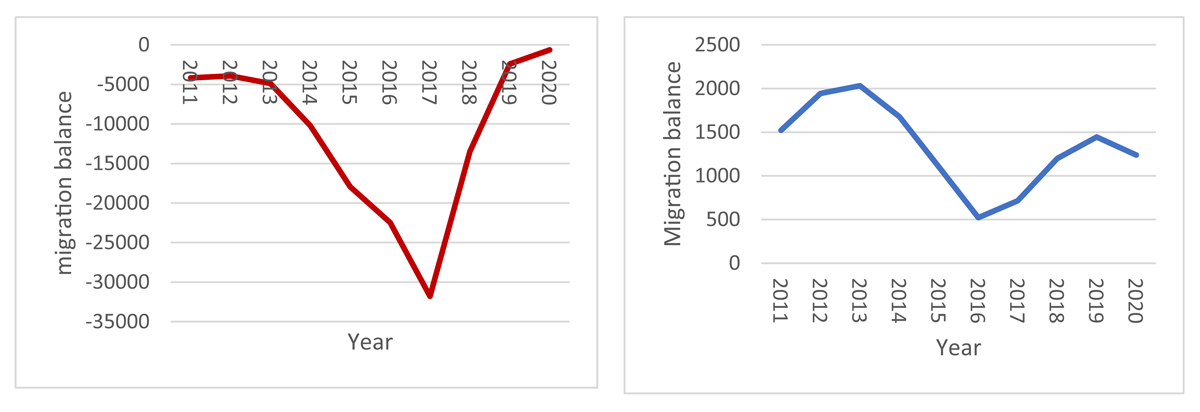
Figure 1
Migration balance in Croatia (left) and on Croatian islands (right) from 2011 to 2020.
Source: Croatian Bureau of Statistics (2020). Immigrant and emigrant population by settlements, 2011 to 2020.
Migration balance data are recorded annually, based on the officially reported number of individuals moving into and out of a given settlement. According to these records, all inhabited Croatian islands, with the exception of two small ones, Ilovik and Susak, had a positive migration balance during the period from 2011 to 2020. The same data show that the majority of both immigrants to and emigrants from the islands during the intercensal period were international migrants. For example, in 2021, as many as 38.4% of immigrants to the islands and 37.6% of emigrants from the islands were foreign nationals. These figures are based on official residence registrations. Given that tourism has significantly increased on the islands over the past decade, the number of seasonal workers has also risen (Čuka et al., 2024). At the national level, and on the islands as well, there is a shortage of workers capable of covering all jobs in tourism and hospitality during the tourist season, resulting in a significant influx of foreign labor. However, among those officially recorded as immigrants, many are actually individuals who already have permanent residence on the islands and are simply re-registered as having moved in or out within a given year. Permanent relocations to the islands are far less common. Among those who permanently relocate from other countries, an important group consists of return migrants from the Croatian diaspora (Podgorelec et al., 2024). Mostly in larger island settlements that offer adequate educational and healthcare infrastructure, as well as good transport connections to the mainland, can a positive migration balance be expected as a result of genuine, long-term settlement. For example, on the island of Brač, one of the larger Croatian islands, a stabilization and reversal of the long-standing negative demographic trend has been observed, particularly in its more demographically vital urban settlements (Nakićen & Čuka, 2016). According to the same data, many island settlements have recorded a positive migration balance, not only on bridged and larger islands, but even on some of the smallest ones. However, to avoid misinterpretation of migration data and to somewhat eliminate the influence of short-term seasonal relocations, such as those captured in official annual migration records, which also include temporary workers residing on the islands, a more accurate indicator is the migration balance calculated using data from two consecutive population censuses, along with natural population change during the same period. This method also confirms that the majority of islands and island settlements recorded a positive migration balance in the intercensal period, with only 9 out of 50 inhabited islands showing a negative migration balance. Notably, even small islands, 15 out of 18, recorded a positive migration balance (Croatian Bureau of Statistics, Migration Statistics, 2011–2020), which contrasts with earlier analyses suggesting that these islands were on the brink of depopulation (Faričić et al., 2010). During the same intercensal period, the negative natural population change at the national level continued to worsen, primarily due to a dramatic decline in the number of live births. On the islands, however, this decline was halted after 2017. Although natural population change remains negative (Figure 2), the gap between the number of deaths and live births has been gradually narrowing. This is due to a statistically recorded increase in birth rates on the islands, an encouraging trend that stands in stark contrast to the ongoing demographic decline observed at the national level.
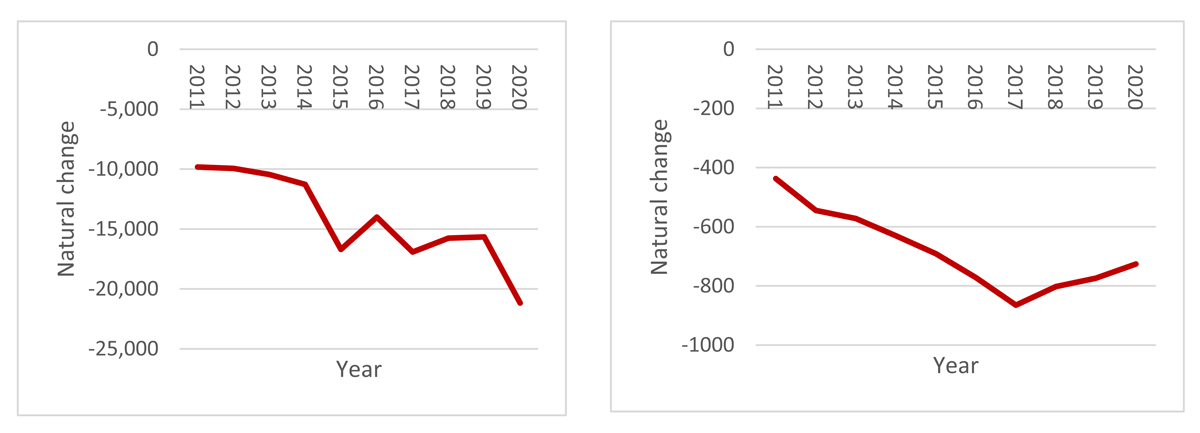
Figure 2
Natural change in Croatia (left) and on Croatian islands (right) from 2011 to 2020.
Source: Croatian Bureau of Statistics (2021).
While all islands record negative natural population change, a closer analysis at the level of island settlements reveals that only about 10 out of 321 have positive indicators (Figure 3). This aligns with the demographic reality of the islands, where the population is predominantly elderly. Only a small number of settlements demonstrate demographic vitality and positive natural population change, and these are predominantly concentrated on the island of Krk island, the most populated and bridged island. Outside Krk island, such cases are sporadic and spatially scattered.
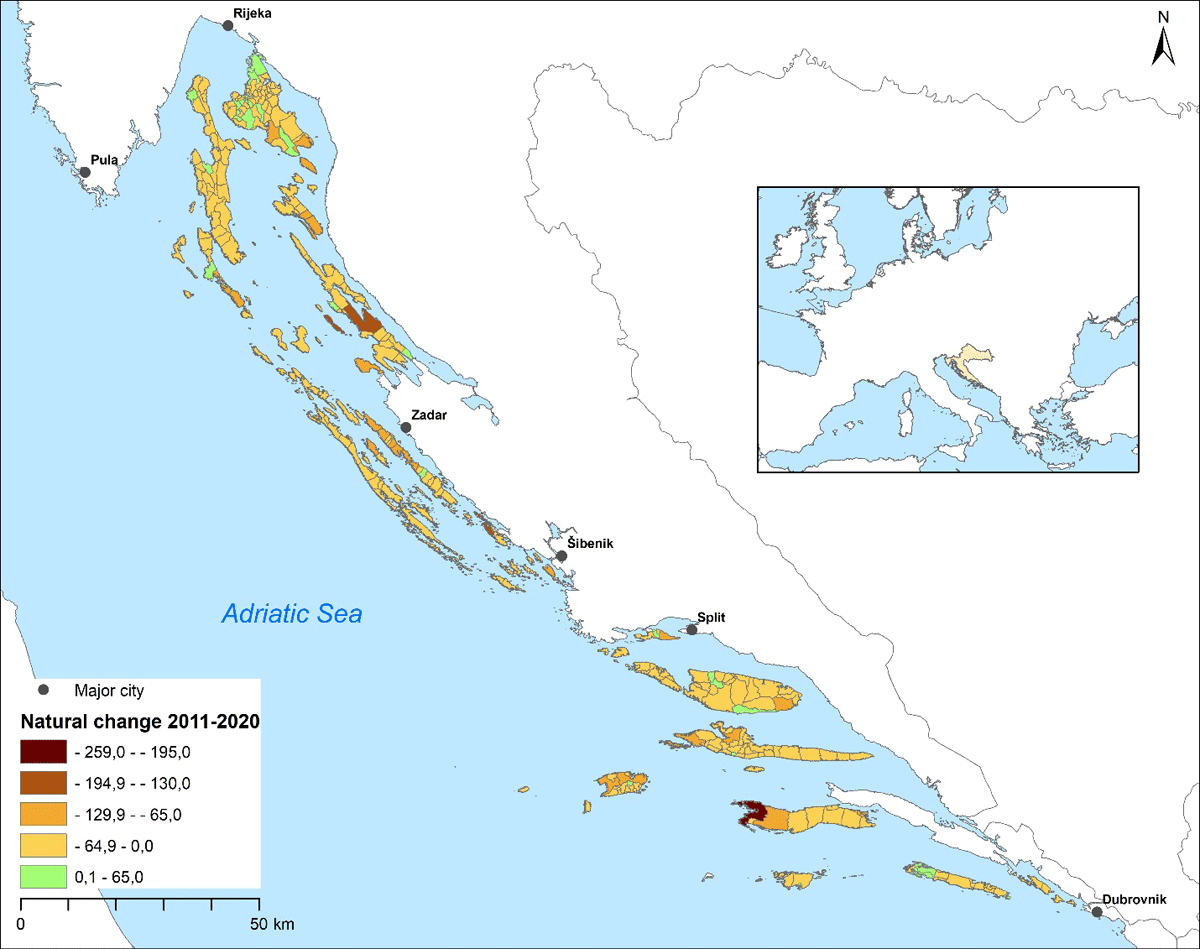
Figure 3
Natural change in island settlements from 2011 to 2020.
Source: Made using Croatian Bureau of Statistics, Vital statistics of the Republic of Croatia: Number of births and deaths from 2011 to 2020.
The age structure of potential immigrants cannot be determined from the available statistical sources; however, trends in the overall population’s age composition indicate significant demographic changes. In Croatia, the dominant trend is population aging, driven by low birth rates and the emigration of young, working-age individuals. The proportion of those aged 65 and over increased substantially in the most recent census, reaching nearly 23%. The island population similarly exhibits pronounced aging, with a continuous rise in the share of elderly residents and a decline in the proportion of young and working-age groups (Figure 4). Notably, the share of those over 65 years old on the islands has reached almost 30%. Among 321 settlements, only two have an ageing index below 40, i.e. the threshold at which population ageing begins. Thus, despite the islands recording a positive migration balance during the intercensal period, the aging process has not been halted, in fact, it is more intense than in the rest of the country, which experienced a negative migration balance during the same period. This suggests that the majority of newcomers to the islands are older individuals, belonging to the older age cohorts.
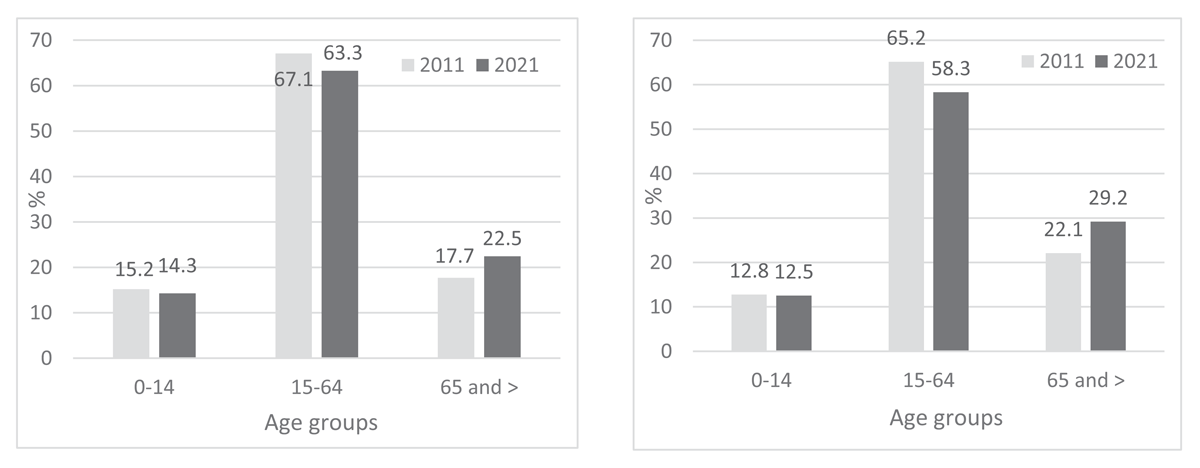
Figure 4
Population according to the main age groups in Croatia (left) and on the Croatian islands (right) in 2011 and 2021.
Source: Croatian Bureau of Statistics (2013); Croatian Bureau of Statistics (2021a).
Insights into demographic vitality, as well as emigration of young families from the islands, can also be gained by examining trends in school enrolment on the islands. For example, the islands of the Zadar archipelago have experienced a continuous decline in the number of students (Ministry of Science, Education and Youth, Republic of Croatia, n.d.), despite most of these islands recording a positive migration balance. Many of these islands are small and underdeveloped, and apart from the bridged island of Pag, none have urban settlements. A similar pattern is observed in the Šibenik area, where data on pupils in primary schools on small, non-bridged islands were largely unavailable in the official database, except for the school on the island of Kaprije, where only one pupil was recorded. For the remaining islands that are governed by mainland town Šibenik, the number of pupils is included in the total enrolment of the Faust Vrančić Primary School in Šibenik, making it difficult to identify active island-based schooling. In the Dubrovnik area, small islands are also losing pupils, and in some cases branch schools have been closed, such as the one in Suđurađ. These examples further support the argument that migration to smaller islands does not reflect an influx of young families but is more likely related to older residents or administratively registered populations. On the other hand, these migration patterns are partially fictional due to administrative in-migration. The situation is not uniform across the entire Croatian archipelago, as illustrated by the example of the island of Brač. Brač is a large, unbridged island located close to the mainland, with good transport connections, and is considered one of the islands with a more vital demographic profile, having recorded positive demographic trends over recent decades (Nakićen & Čuka, 2016). The island is divided into eight administrative units encompassing 24 settlements, only one of which holds city status, while most are rural in character. Brač hosts eleven primary schools, six of which are larger institutions offering education through all eight grades, while the remainder are branch schools educating children only through the first four grades. Despite Brač experiencing a negative natural population change during the intercensal period, it is unsurprising that the number of first-grade students has declined over the past decade. However, the total number of children enrolled across all these schools has increased by 8.2% between the 2015/16 and 2024/25 school years. This suggests that there is real long-term migration of families with children, but primarily toward larger island settlements. The most significant increase in enrolment was recorded in the urban settlement of Supetar, which also benefits from the best maritime connections to the mainland. Conversely, schools in rural settlements show a declining trend in student numbers, even though 22 out of 24 settlements recorded a positive migration balance during the intercensal period. Previous research suggests that “fictitious population” is a statistical reality (Lajić & Mišetić, 2013), which calls into question the actual demographic situation on the islands. Considering that rural, isolated settlements lack basic services and face significant challenges in organizing medical care, an essential service for the predominantly elderly population (Čuka et al., 2025), it is unlikely that these settlements are truly experiencing immigration of older residents.
The reason behind administrative in-migration lies in the provisions of the Islands Act (2018, Article 5, Paragraph 7), which stipulate that individuals registered as residents on Croatian islands and who spend at least 183 days per year there are entitled to reduced transportation costs, that is, the state subsidizes a portion of the regular ferry fare. Consequently, some citizens who own second homes on the islands, particularly older people, register their permanent residence there, even though they do not actually live on the island. Additional benefits arising from the same Act may also motivate such fictitious registrations, including discounts on drinking water and fishing permits. Moreover, government announcements regarding the taxation of holiday homes represent another potential factor contributing to the increase in administratively registered residents. A study on the Šibenik Archipelago revealed that up to 30% of the island’s registered population may be fictitious (Podgorelec & Klempić Bogadi, 2013).
One indicator of administrative migration is the number of island resident cards issued to those with registered residence on the islands. Current figures show that on 31 of the 45 inhabited unconnected islands, the number of active island resident cards exceeds the population recorded in the 2021 Census (Table 2). This suggests that the increase in island residents is likely due to administrative registration rather than natural population growth. This phenomenon is especially pronounced on small, sparsely populated islands with a single settlement, such as Premuda, Sestrunj, and Rivanj, where the number of active island resident cards is over 70% higher than the population recorded five years earlier. These islands are highly depopulated, with limited infrastructure, minimal basic services, and poor transport connections. Such a significant discrepancy indicates that the number of administratively registered residents is probably high and official statistics on population number may not accurately reflect the actual population living on these islands.
Table 2
Total population vs. number of active island resident cards on 31 islands where cards number exceed the official population.
| ISLAND | TOTAL POPULATION IN 2021 (A) | NO. OF ACTIVE ISLANDER CARDS (27 JANUARY 2026) (B) | RELATIVE DIFFERENCE BETWEEN A AND B | ISLAND | TOTAL POPULATION IN 2021 (A) | NO. OF ACTIVE ISLANDER CARDS (27 JANUARY 2026) (B) | RELATIVE DIFFERENCE BETWEEN A AND B |
|---|---|---|---|---|---|---|---|
| Biševo | 23 | 38 | +65.2% | Premuda | 65 | 121 | +86.2% |
| Cres | 2849 | 2887 | +1.3% | Rava | 67 | 107 | +59.7% |
| Drvenik Mali | 119 | 153 | +28.6% | Rivanj | 23 | 43 | +87.0% |
| Drvenik Veliki | 170 | 251 | +47.6% | Sestrunj | 45 | 80 | +77.8% |
| Dugi otok | 1691 | 2098 | +24.1% | Silba | 344 | 431 | +25.3% |
| Ilovik | 106 | 118 | +11.3% | Susak | 139 | 189 | +36.0% |
| Ist | 146 | 186 | +27.4% | Svetac/Sv. Andrija | 2 | 3 | +50.0% |
| Iž | 516 | 653 | +26.6% | Šolta | 1975 | 2258 | +14.3% |
| Kaprije | 186 | 248 | +33.3% | Ugljan | 5666 | 6138 | +8.3% |
| Koločep | 231 | 255 | +10.4% | Unije | 66 | 74 | +12.1% |
| Lastovo | 747 | 754 | +0.9% | Vele Srakane | 4 | 7 | +75.0% |
| Lopud | 278 | 283 | +1.8% | Vis | 3287 | 3322 | +1.1% |
| Molat | 190 | 267 | +40.5% | Zlarin | 293 | 302 | +3.1% |
| Olib | 117 | 146 | +4.8% | Zverinac | 55 | 68 | +23.6% |
| Ošljak | 35 | 54 | +54.3% | Žirje | 147 | 191 | +29.9% |
| Pašman | 2884 | 3053 | +59% | TOTAL | 22466 | 24788 | +10.3% |
[i] Source: Croatian Bureau of Statistics (2021a). Population by age and sex, by settlements, 2021 Census; Number of of active island resident cards, Agency for Coastal Line Maritime Transport, January 27th 2026.
An additional factor influencing recent population growth is the practice of formally registering permanent residence on the islands in order to avoid taxation on second homes. In the Croatian regulatory framework, a distinction exists between permanent residence and second-home ownership, with the latter often subject to specific local taxes and higher utility or communal fees. As a result, some property owners declare official residence at their island property despite maintaining their primary daily life elsewhere. This phenomenon contributes to an increase in administratively recorded residents without necessarily corresponding to stable, year-round settlement. Consequently, part of the observed demographic growth should be interpreted within the context of regulatory incentives and statistical registration practices rather than as unequivocal evidence of substantive demographic revitalisation.
Results of the empirical study
This section presents the findings of the empirical study based on a survey conducted among island authorities. The questionnaire gathered insights from mayors, municipal heads, and local council chairpersons regarding the presence and impact of fictitious residents in their communities. These responses provide a deeper understanding of how false residence registrations affect local development, property maintenance, and financial contributions to the islands. The questionnaire was distributed to the official email addresses of the mayors and municipal heads of all island towns and municipalities. Since some smaller islands are administratively managed by mainland towns, whose authorities have less direct contact with the islands, these were included in the study by sending the questionnaire to the chairpersons of local councils. The survey was conducted in January 2026. A reminder was sent to all 62 contacts one week after the initial invitation, resulting in a response rate of 38.7% (total 24 answers). The responses included all types of islands: bridged islands, large unbridged islands with their own administrative units (municipalities or towns), and small unbridged islands with up to three settlements, which are administratively managed by larger islands or mainland municipalities. All respondents reported living on the island year-round, except for one respondent from a small island who resides there only part of the year. This information was important to establish, as authorities who live on the islands have a much better understanding of local conditions and island communities. The survey revealed that 64% of local authorities believe there are island resident card holders with false residence registration in their jurisdictions. While most respondents do not consider this practice inherently wrong, they acknowledge that it creates a misleading picture of the number of residents, which can negatively affect planning and the development of strategies for their communities (Figure 5). When it comes to potential benefits, the majority indicated that false residents do not provide direct financial advantages to the local community or administrative units. However, many respondents noted that these individuals tend to visit the islands more frequently due to possession of the island card, and a similar proportion agreed that they contribute to the use and maintenance of properties and real estate. Overall, the majority of local authorities perceive that the islands gain more from the presence of false residents than they lose, highlighting a complex balance between administrative challenges and practical benefits.
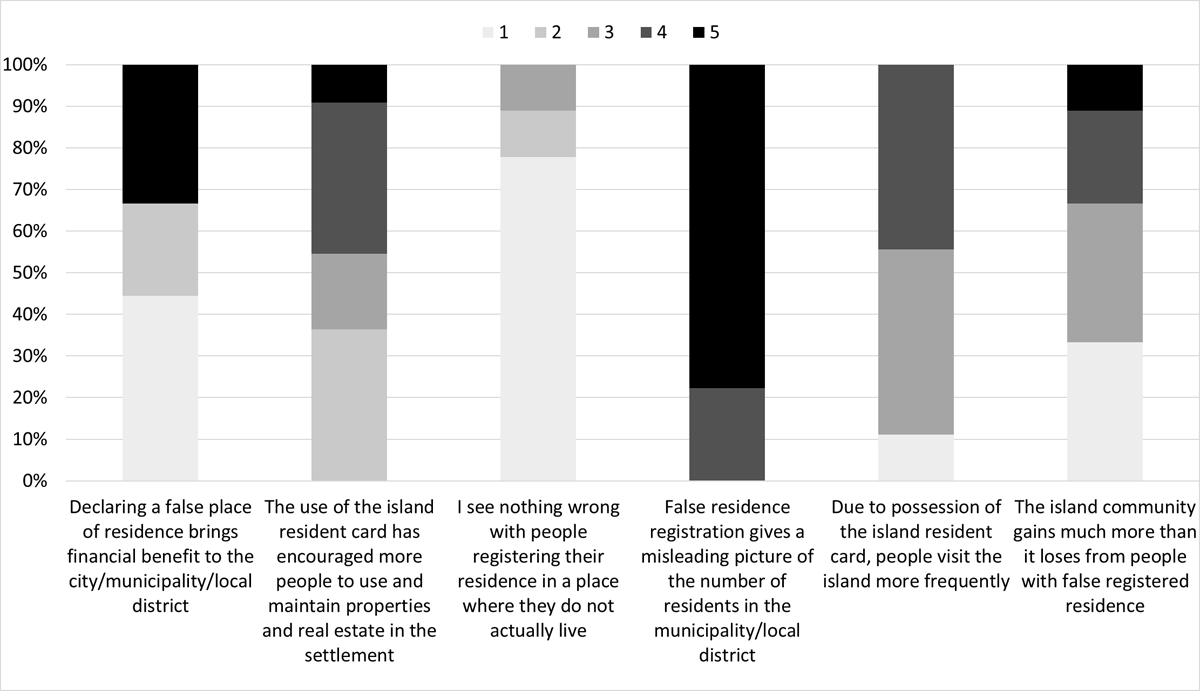
Figure 5
Perceptions of island mayors, municipal heads, and local council chairpersons on the presence and impact of fictitious residents in their communities. Percentage of responses by Likert scale rating (1 = Strongly Disagree, 2 = Disagree, 3 = Neither Agree nor Disagree, 4 = Agree, 5 = Strongly Agree).
According to survey responses, the individuals most frequently identified as false users of the island resident card are primarily people from Croatia who are not originally from the island but own property there. The second most common group consists of people from Croatia who either have parents or relatives on the island or are originally from the island. Third are foreigners who own property on the island, and finally, people from the diaspora were ranked as the least frequent users of false residence and island cards.
The survey asked respondents to estimate the proportion of residents with false registrations within the total population of their towns, municipalities, or local districts. The majority of respondents (61.5%) estimated that less than 25% of residents hold false residency. The second most common estimate, provided by a smaller portion of respondents, fell between 25% and 49%. These results suggest that while false residency is recognized as a phenomenon by local authorities, it is generally perceived as affecting a relatively small proportion of the population (Figure 6).
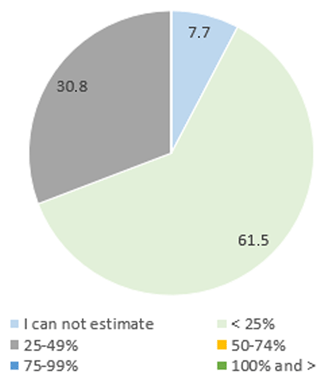
Figure 6
Respondents’ estimates of the proportion of residents with false registrations within the total population of their towns, municipalities, or local districts.
Discussion and conclusion
Statistical indicators suggest that, after centuries of negative demographic trends, the Croatian islands are finally showing demographic results that point to some positive changes. The decline in natural population change has been halted, and the migration balance has been positive for several years. At the same time, however, the ageing process continues unabated, and the age structure is deteriorating further due to the rapid increase in the share of the elderly population. A deeper analysis of the indicators, however, reveals certain inconsistencies, suggesting that statistical data should be interpreted with caution, as they do not necessarily reflect the actual demographic trends. A more detailed analysis shows that instances of repopulation do exist, but they are mostly associated with larger island settlements that possess better infrastructure, more developed local functions, and stronger connections to the mainland. In the context of island demography, repopulation refers to processes of demographic recovery following prolonged depopulation, typically characterized by renewed in-migration, return migration, or natural increase that stabilizes or revitalizes the local population (Deimantas et al., 2024). It is often linked to broader socio-economic changes such as the development of tourism, improved accessibility, and lifestyle migration, phenomena increasingly observed in island and rural peripheries across Europe (King, 2009; San-Martín González & Soler-Vaya, 2024). On the Croatian islands, repopulation is mainly concentrated in settlements with better service availability and economic opportunities, particularly those that maintain functional links with the mainland or urban centers. Some island schools, such as those on Brač, even report an increase in the number of pupils, an indicator frequently used as a proxy for demographic revitalization in peripheral areas (Lajić & Mišetić, 2013). Immigration is partly driven by the return of emigrated islanders from abroad or from the nearby mainland, but also significantly by workers who arrive seasonally or permanently due to the expansion of tourism-related activities. The repopulation of severely depopulated rural Croatian islands challenges the conclusions of studies that question the possibility of revitalising peripheral regions (Yu et al., 2022, Saiz-Echezzareta et al., 2025). While return migration is occurring on Croatian islands, it remains an isolated and spatially uneven process (Podgorelec et al., 2024). Even highly tourism-oriented islands such as Hvar continue to experience depopulation and population ageing (Graovac Matassi & Perko, 2025). Owners of second homes play an increasingly important role in the development dynamics of the Croatian islands, as well as in the maintenance of their cultural landscapes. Some of these owners are officially registered residents; although certain individuals may use privileges to which they are not legally entitled, they nonetheless sustain strong ties to the islands, visit frequently, participate in community life, and indirectly contribute to the upkeep of the local environment and built heritage.
In Croatia, the number of second homes has been steadily increasing, particularly in rural, coastal, and peripheral regions (Miletić, 2006; Opačić, 2009; Lajić & Mišetić, 2013). This phenomenon mirrors wider European and global trends in amenity migration and counter-urbanization, where second homes serve as a bridge between tourism and residential functions (Hall & Müller, 2004). On islands, such dwellings often embody a hybrid form of habitation (part residence, part leisure property) contributing to seasonal population fluctuations while providing economic and social linkages that mitigate complete depopulation. Second-home owners contribute to local economies through construction, renovation, maintenance, and consumption of local goods and services. In smaller settlements, they also help sustain social networks, maintain the physical appearance of villages, and foster cultural continuity. In certain cases, these residents become semi-permanent or even permanent inhabitants, blurring the line between tourism and migration. Consequently, second homes can act as triggers of local development, as shown by research on Croatian islands such as Krk, Vir, and Zlarin (Miletić, 2006; Opačić, 2009; Miletić, 2013). However, while second homes can contribute positively to local economies and community vitality, they also bring challenges, including increased property prices, seasonal overcrowding, and pressures on limited infrastructure (Gallent & Tewdwr-Jones, 2010). Thus, their role in island development is inherently dual, balancing between revitalization and the commodification of space. Owners of second homes play an increasingly important role in the development dynamics of the Croatian islands, as well as in the maintenance of their cultural landscapes. Some of these owners are officially registered residents; although certain individuals may use privileges to which they are not legally entitled, they nonetheless sustain strong ties to the islands, visit frequently, participate in community life, and indirectly contribute to the upkeep of the local environment and built heritage (Opačić, 2009). This also highlights the growing need for further research into the impact of part-time residents (weekenders) on island development. Recent studies on other island groups, such as in Sweden, have emphasized their positive role in local island development and the necessity to reconsider how island populations are counted. This would include not only permanent residents but also those who stay on the island periodically yet frequently enough, such as weekenders, who contribute to the local economy and community (Rytkönen et al., 2024).
The research raises concerns about the use of statistical data as the sole indicator of demographic trends and highlights the importance of conducting additional studies that would further validate island trends and provide a clearer understanding of what is actually happening on the islands, as well as the implications of such demographic processes. This observation aligns with contemporary migration theory, which emphasizes mobility as a multidimensional process shaped not only by economic motives but also by social, cultural, and environmental factors (de Haas, 2010). In the context of islands, apparent population growth may result from lifestyle migration, amenity migration, or temporary residence, reflecting the migration-tourism nexus and counter-urbanization processes. Previous studies have identified the phenomenon of administrative in-migration on Croatian islands; however, the present research further substantiates this finding and underscores the need to introduce a revised methodological framework for assessing island populations. These findings can be interpreted through postmodern demographic perspectives, which highlight that peripheral and rural areas can simultaneously experience demographic decline and selective renewal (Zaidi & Morgan, 2017; Riley & McCarthy, 2003). On islands, mobility patterns often reflect attachment, multi-local living, and resilience rather than permanent migration, emphasizing the need for local knowledge and nuanced population assessment methods.
The findings of this study illustrate how administrative registration can significantly affect demographic statistics on the islands. One of the key drivers behind the registration of false residence is the range of benefits provided under the Islands Act, including subsidized transport fares and reduced water prices, as well as the opportunity to avoid taxation on second homes. This demonstrates the hybrid forms of mobility described in the Introduction, where second-home owners and part-time residents blur the boundaries between tourism, temporary residence, and permanent settlement (Claval, 2016; Breuer, 2005). Such hybrid residency patterns can sustain local economies, social networks, and cultural landscapes even when actual permanent populations remain low. The findings of this study highlight the importance of jointly interpreting statistical and survey-based evidence. The quantitative analysis shows that many islands exhibit a positive migrational balance, while at the same time the number of active island resident cards is increasing, in several cases exceeding the officially recorded population. This indicates that official census data may overestimate the number of actual residents and that apparent demographic growth may reflect administrative patterns rather than a real increase in population.
The survey results complement these findings by suggesting that local authorities are aware of the presence of fictitious residents, that is, individuals who are administratively registered on the islands but do not reside there permanently. At the same time, these individuals are perceived as still contributing indirectly to island life, for example through more frequent visits or property maintenance. These observations point to the role of temporary or semi-permanent residents in local development, consistent with counter-urbanization and migration–tourism frameworks, and underline the importance of integrating demographic, economic, and social dimensions in planning for sustainable island development (Kelman et al., 2015; Claval, 2016). Taken together, these results suggest that island demographic dynamics are not fully captured by official statistical sources. Evidence indicates that the share of fictitiously registered residents on smaller islands has become so substantial that statistical indicators alone can no longer provide a reliable basis for interpreting actual demographic trends. This underscores the need to interpret population statistics in conjunction with local knowledge and context. At the same time, accurately identifying these trends is crucial for the formulation of effective island policies and the implementation of targeted development projects. Misinterpretation of demographic data may lead to incorrect conclusions, such as assuming that certain islands are not demographically at risk and therefore do not require investment, or, conversely, directing public and social development initiatives in misguided or inefficient ways.
In light of the findings, policy responses should focus on better aligning administrative registration systems with actual patterns of residence and territorial use. There is a need for clearer monitoring mechanisms that distinguish between formal registration and effective year-round habitation to ensure that public subsidies and island-specific benefits reach genuinely resident populations; these could include periodic verification of residence status or the introduction of service-use criteria linked to benefits. At the same time, fiscal and regulatory frameworks, particularly those concerning second-home taxation and benefits under the Islands Act, should be reassessed in order to reduce unintended incentives for fictitious or strategic registration while still protecting the social rights of permanent island residents. Policy should also move beyond a narrow focus on numerical population growth and instead promote functional and sustainable settlement through support for stable employment, accessible public services, affordable housing, and infrastructure that encourages long-term residency. More broadly, society needs to recognize that administrative population increase does not necessarily represent genuine demographic revitalisation and should therefore frame island development strategies around real socio-economic sustainability rather than statistical growth alone.