
1. Introduction
The adoption of clean energy technologies (hereafter CET) in archipelagos can potentially nurture new entrepreneurial activities and create suitable conditions for existing companies to survive in the long term (Koubaa, 2017; Misztal and Kowalska, 2023). In the eyes of authorities, it is expected to support local enterprise, innovation, economic development, and community growth (Hässler, 2022). Municipalities, industries, technological providers, business companies, and local inhabitants have different understandings of the process leading to the adoption of CET and its impacts, creating tensions between interested parties (Skjølsvold et al., 2020; Tsagkari, 2020). Archipelagos exhibit different demographic profiles, social relations, and economic dependencies that shape how new technologies are perceived and adapted. This highlights the urgent need for new knowledge to support the adoption of CET in archipelagos.
The adoption of new technologies is influenced by different factors, such as the spatial characteristics and environment in which adoption of new technologies is supposed to take place (Bergman, 2017). Previous studies examining the adoption of CET problematized the obstacles and opportunities related to the adoption, and some actual and potential impact of the adoption process (Matsumoto and Matsumura, 2022). Most studies are cases of single islands in different countries (Sperling, 2017; Ramos-Suárez et al., 2019) and archipelagos have been overlooked. However, studying processes in archipelagos requires an understanding of contextual differences between islands in the archipelago (Rytkönen et al., 2019). In Swedish island-related studies, it makes sense to use the archipelago as the unit of analysis. On the one hand, archipelagos are an important part of the geography of Sweden, on the other hand, using the archipelago enables an understanding of the CET adoption process at a system level. Archipelagos represent a unified and specific type of context composed of multiple smaller units.
A contextual perspective to study the adoption of CET and its consequences, enables research to apply a comprehensive approach to analyze the adoption of innovations and new technologies through the interaction between different stakeholders, regulations, physical, social, and cultural environments (Baker and Welter, 2020). The context lens highlights institutional, business specific, social and spatial dimensions influencing economic processes (Rytkönen et al., 2019; Welter, 2011). Although the original framework does not explicitly include the technological dimension, we integrate it to shed new knowledge about challenges and characteristics of the adoption of CET in the archipelago context.
We answer the following questions:
RQ1: Which are the main contextual characteristics in the CET adoption process?
RQ2: Which technologies are suitable for the archipelago, and which challenges do current experiences of identified technologies envision?
The paper is organized as follows. The next section presents a literature review and a theoretical framework, followed by an account of the research method and data. Thereafter, results are followed by discussion and conclusions.
2. Literature review and theoretical considerations
2.1 Clean energy technologies on islands
CET encompasses the production of renewable energy using methods and processes that, to a large extent, reduce the negative emissions from the production of energy and therefore also have a low environmental impact. The concept of CET can include new technologies, practices, and solutions linked to the adoption of CET (Dearing and Cox, 2018; Wejnert, 2002). Some examples are solar power, wind power, hydroelectric power, bioenergy, and wave generated power. In this study, only the first two are relevant.
Archipelagos differ from islands and rural areas by being influenced by multicentric and multilevel dynamics that are on the one hand insular and on the other hand stamped by the geographical, political, cultural and societal fragmentation of archipelagos (Stratford et al., 2011). Many countries have an abundance of archipelagos; therefore, new knowledge about clean energy issues in archipelagos is needed. Furthermore, there is scarce research that explicitly theorizes the archipelago as a unique conceptual framework for CET research.
The adoption of CET is characterized by complex socio-economic and technical processes (Jakimowicz, 2022) whose results depend on which renewable energy source and resources are in focus (Alves et al., 2019; Meschede et al., 2022). The adoption of CET, how it is designed and implemented, is context-based (Groppi et al., 2021). Some studies highlight the energy saving impact of introducing electric vehicles on islands (Pina et al., 2014; Shah et al., 2022), or how grid system improvements can be staged (Tsai et al., 2020). The success of CET adoption on islands is often explained by the existence of local community commitment and the mobilization of collective action driven by strong local support for CET (Sperling, 2017). Other explanations include capital availability, the capacity to capture necessary resources, the ability to share knowledge and of capacity building to solve challenges and obstacles related to the adoption process and the existence of suitable legislation and regulations that enable the adoption of CET (Matsumoto and Matsumura, 2022). Mentioned explanations tend to be the same regardless of where the studies were conducted, for example in Danish islands (Sperling, 2017), on the Canary Islands (Ramos-Suárez et al., 2019), or in the South China Sea (Ye et al., 2017).
Some studies conceptualize the adoption of CET as processes of sociotechnical imaginaries, highlighting energy technologies as imagined forms of energy transition emanating from different actors, and as products and components of its occurrence (Skjølsvold et al., 2020). Another perspective highlights how clean energy processes are planned, decided on, and adapted to island contexts. Such studies conclude that the creation of successful renewable energy islands requires long-term testing of the alignment between technologies, humans, organizations, and space, suggesting that social dimensions related to the adoption process and the characteristics of the local community can significantly contribute to the adoption of CET (Tsagkari, 2020).
Research about the CET on islands often lacks a relation to the main concepts found in island research, such as insularity and islandness, e.g., a “sense of place”, a way of defining island culture and island identity often shaped by the physical characteristics of islands and the limitations or opportunities that the island gives rise to (Foley et al., 2023), as well as the economic, social, cultural and political distance between island communities and mainland society (Hall, 2012).
Conceptual frameworks used to analyze archipelagos include the multiplicity of identities and the political, cultural, social and economic aspects present;and the relational and multicentric power structures governing archipelagos and the relationships within islands, between islands, between single islands and the mainland and between the archipelago and the mainland. Leading research recommends that such a diversity of theoretical and methodological perspectives is needed to study any topic unfolding in an archipelago setting (Stratford et al., 2011).
2.2 Adopting clean energy technologies to create change in society
This study is about how archipelago communities, authorities and other stakeholders understand and act to promote, enable, or adopt CET. The adoption of new technologies is influenced by the characteristics of the technology in question and by the characteristics and driving forces of the adopters. Furthermore, existing institutional frameworks as well as institutional gaps play roles in the adoption of new technologies. The diffusion and adoption of new solutions or technologies is often linked to the characteristics of the new technology in question, while others underline the role played by features of the social system within which the new technology or solution is diffused and adopted (Bergman, 2017). We recognize the need to include the mentioned perspectives to understand the adoption of CET on islands.
CET can be adopted by private households or different types of existing or new businesses. Previous research agrees that the adoption of new technologies can be analyzed using the “epidemic model”, in which new technologies spread from user to user, following personal observations that lead to the realization of the benefits generated by the adoption. In the epidemic model, the object of adoption has a relatively high level of recognizability, and it is easy to understand its benefits (Bergman, 2017; Silva et al., 2021). Another model used to analyze the adoption of new technologies is the “threshold model”, which refers to diffusion and adoption of technologies that involve additional investments, for example in education or infrastructure without which the technology cannot be used (Bergman, 2017). A third way of understanding the diffusion and adoption of new technologies is a dynamic and systemic approach. This line of research suggests that the diffusion and adoption of technologies is approached from an ecosystemic and institutional perspective, highlighting the interactions and touchpoints taking place between organizations, people and technologies that are part of the diffusion and adoption process (Vargo et al., 2020). A common denominator of all approaches is that the adoption of CET entails a spatial, time-geographic perspective (Dearing and Cox, 2018; Wejnert, 2002), as well as a contextual perspective (Welter, 2011; Baker and Welter, 2020). In this case, it means that end-users can obtain the necessary knowledge and perceive sufficient benefits and existence of necessary infrastructure and supporting regulations to adopt CET (Bergman, 2017).
2.3 Context and the adoption of clean energy technologies
Previous research calls for new studies that focus on specific regional contexts, such as archipelagos. A key perspective is to highlight institutions and how institutions work in such contexts and to scrutinize the “institutional environment” and the “institutional arrangements” unfolding in relation to the unique characteristics of a territory (Rodríguez-Pose, 2013). A rising theoretical approach is entrepreneurship context theory (Welter, 2011; Baker and Welter, 2020). This approach refers to situational opportunities and constraints that affect behavior; it includes different conditions, situations, environments, and more (Welter, 2011). Contextual characteristics can be defined as “any implicit and explicit information about circumstances or situations which affect an entity” (Kronsbein et al., 2014, p. 2). Most previous studies define context in relation to situational factors or settings that influence the object of study. Some examples are “family business context”, or “start-up business context”. Other scholars highlight the overarching features and conditions of the physical, social, political, cultural, and business environment in which the study is conducted. Such a wider scope is useful to analyze multiple and multilevel cases and socio-economic processes. A strength of context theory is its suitability for studies conducted in well-defined geographical spaces (Audretsch and Belitski, 2021). In recent debates, technologies are put forward as key contextual elements and active agents in societal and economic processes (Audretsch et al., 2019; Schmidt and Sewerin, 2017). Our analysis focuses on mainstream contextual analysis based on institutional, industry-specific, spatial, and social dimensions (Welter, 2011), but also technological contexts connected to the adoption of CET. The spatial context is especially important, in this case it consists of the Stockholm archipelago, its specific socio-political and natural conditions, fragmented geography and multicentric power relations exerted within islands, from island to mainland, from cluster of islands to mainland and vice-versa (Stratford et al., 2011). We argue that technology is also especially important, since it plays an active role in society, influencing and being influenced by the society in which it is adopted (Schmidt and Sewerin, 2017).
3. Method
3.1 The studied region
The study is conducted in the Stockholm archipelago, located along the coast of Stockholm in the Baltic Sea (Figure 1). It includes around 30,000 islands, islets, and skerries and extends 150 kilometres from North to South. Decisions over the archipelago are fragmented across seven municipalities (Haninge, Norrtälje, Nynäshamn, Södertälje, Vaxholm, Värmdö and Österåker), regional and national authorities (Rytkönen et al., 2019). The population ascends to 10,000 people in official statistics. However, more than four million people stay in the archipelago during shorter or longer periods (Skärgårdsstiftelsen, 2023). There are also 50,000 second homes. On many islands, second homeowners are actively influencing various types of decisions on their respective islands (Merouani et al., 2023).
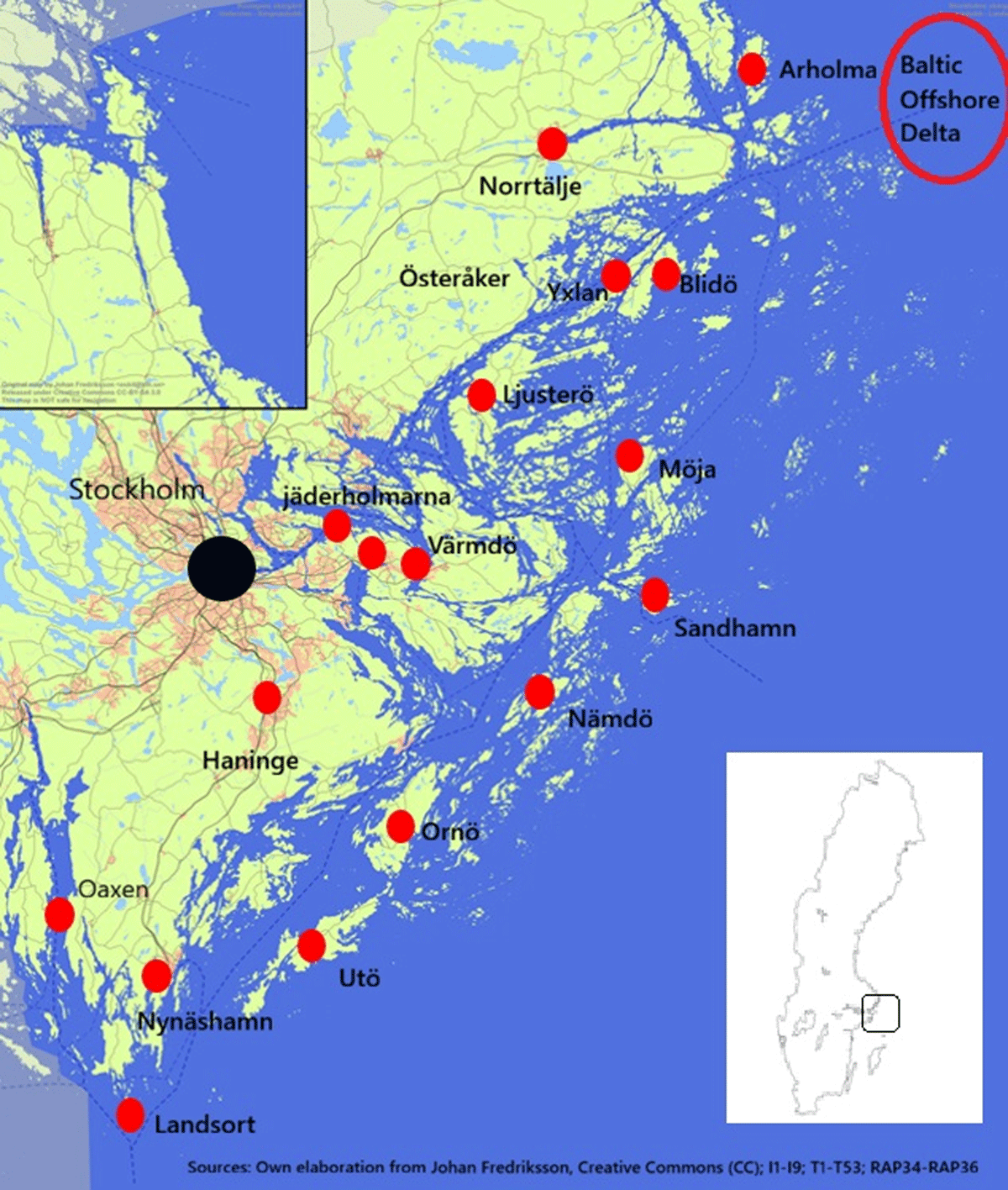
Figure 1
Map over Stockholm archipelago and places mentioned in the article.
Source: Own elaboration.
3.2 Research design, data and elaboration
Our overarching research design is methodological triangulation (Carter, 2014) based on text analysis (Wesley, 2014) and phenomenology (Flick and Eberle, 2014). A phenomenology protocol was developed to analyze interviews and minutes from meetings identifying “meaning-bearing units”. We used phenomenology because it supports the fast identification of the essence of a phenomenon. Interviews and minutes from workshops were transcribed. Minutes from workshops include notes from participants and from all group discussions conducted during the workshops. Minutes were sent out to participants who reviewed the minutes and completed them. The data analysis workflow is presented in Figure 2.
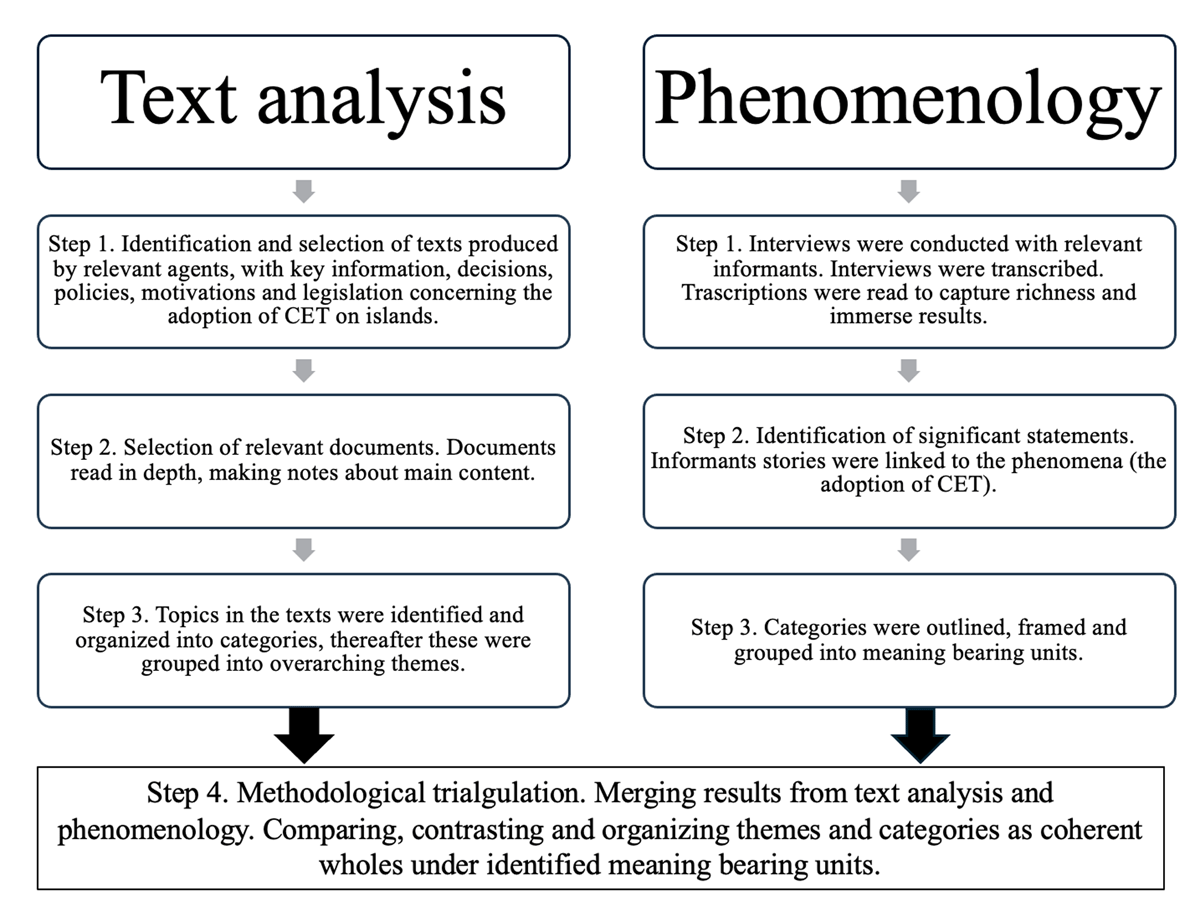
Figure 2
Data analysis workflow.
Data is composed of semi-structured interviews with nine experts and decision-makers, 3 municipality officials from Norrtälje (I1), Värmdö (I2) and Österåker (I3); two officials from national authorities, Energimyndigheten (I4), Energimarknadsmyndigheten (I5) and Vattenfall (I6), the holder of the regional energy monopoly (Table 1). Three interviews were conducted with entrepreneurs who run their own island-based energy production facilities in the archipelago and who also have professional expertise in energy issues, two run small-scale solar energy parks (I7; I9) and the third runs a small-scale wind power plant (I8). Interviews were recorded and transcribed; detailed workshops and meeting minutes were collected and transcribed by the authors. Places mentioned in the article have been marked on the map (see Figure 1).
Table 1
Overview of the data, origin of informants and codes.
| INTERVIEWS | CODE | WORKSHOPS | CODE | REPORTS AND DOCUMENTS | CODE | ARTICLES TIDNINGEN SKÄRGÄRDEN | CODE |
|---|---|---|---|---|---|---|---|
| Municipality officials | I1 (Österåker) I2 (Norrtälje) I3 (Värmdö) | Workshop 1 | WS1 | EU level | RAP1-RAP8+RAP10-RAP12 | Articles with examples of locations and different uses of CET | T1-T52 |
| National Energy Agency (Energimyndigheten) | I4, I5, I6 (all from national agencies) | Workshop 2 | WS2 | State level | RAP13-RAP15+RAP17-RAP20+RAP23-RAP25 | ||
| Island entrepreneurs | I7 (Möja) I8 (Ljusterö) I9 (Nämdö) | Workshop 3 | WS3 | Regional level | RAP21-RAP22+RAP26-RAP30+RAP35-RAP37 | ||
| Municipal level | RAP34 |
[i] Note: I-interview, WS-workshop, RAP-reports and documents, T-articles from Tidningen Skärgården.
We used minutes from two national workshops in which islanders from the Stockholm archipelago presented their perceptions about the adoption of CET; one was held on Åstol (Bohuslän archipelago) and the second on Nämdö (Stockholm archipelago) (WS1; WS2). In total, 87 people participated in workshops, of which 35 are full-time or part-time inhabitants in the Stockholm archipelago, and three were participants from regional authorities and who work with archipelago issues. A third workshop (WS3) gathered experts in the energy industry (from Eon energy company, Swedish Energy Agency, Ministry of Climate and Industry, the Energy Market Inspectorate) and in which technical solutions and legislative issues related to different technical solutions were discussed (WS3). After each workshop, authors reviewed notes, merging them into one document before the content was elaborated. Transcripts were supplemented with the presentations’ content and documents presented during the meetings. Stated facts were triangulated with official data and legislation. All informants have orally given informed consent for using their answers in this research. According to the Ethical Review Act this research does not require ethical review, since it does not concern humans, and no personal information, or personal data is processed, or in any way used.1 While the reports (RAP1-37) were used to understand policy issues, policy debates, and different technological aspects, the articles from Tidningen Skärgården (T1-T52) were used to identify energy uses, projects, and solutions in different parts of the archipelago (Appendix A, B).
4. Results
The analysis identified five meaning-bearing units (Table 2). Interviews disclosed dilemmas and different perspectives related to the adoption or potential adoption of CET, while texts underlined the role of innovations and technologies, in-depth insight of institutional contradictions, actual adoption of CET, and spatial aspects related to the adoption process.
Table 2
Overview of results from text analysis and phenomenology analysis – theoretical concepts, themes, and categories.
| THEORETICAL CONCEPTS | MEANING-BEARING UNITS | EMPIRICAL CATEGORIES |
|---|---|---|
| Technological context | Systemic issues | Grid and off grid; grid capacity, existing and incipient grid solutions. Large-scale vs. small-scale. Feasible solutions, capital issues. Types of energy. Seasonal variations in consumption and production. |
| Industrial context | Energy monopoly (Vattenfall) | Energy types. Power in the energy industry. Land ownership. Stakeholder perspectives: Archipelago Foundation; Swedish Fortifications Agency; Swedish Church; private landowners. Archipelago businesses – push and pull factors. |
| Institutional context | Government, governance, formal and informal institutions | Government structures: EU, state, region, 7 municipalities, island organizations, other key stakeholders – Vattenfall, Waxholmsbolaget transport company, National Traffic Authority. Monopoly regulations. Shoreline Protection Act. Building regulations. Energy regulations and permits. Territorial organization rules (e.g., core islands). Local, regional, national and EU government, directives, governance and implementation of energy legislation, directives and regulations. |
| Social context | Networks, social capital and agency | Variations in the organizational degree of civil society. Conflicting interests including conservatism. Decision-making gaps. Polarization (mainland versus island). |
| Spatial context | Geography and infrastructure | Geographical fragmentation. Distance to the mainland. Infrastructural variations and grid capacity. |
[i] Sources: Own elaboration of I1-I9, WS1-WS3, RAP1-RAP37, T1-T52.
Below, the results are presented to highlight technological, industrial, institutional, social, and spatial contexts.
4.1 Technological context
The debate about which CET to adopt includes many perspectives. Some sources focus on decreasing emissions from ferries and boats by either shifting to electricity-driven boats, or by decreasing emissions of existing boat fleets using different types of biofuels with low carbon dioxide emissions, or natural gas (RAP7; RAP17; RAP21). Other sources highlight the need for existing or new businesses to shift to CET, or to improve energy efficiency of existing technologies and practices (T2; T5; T8; T9; T11; T20; T22; T24; T28; T39; T41; T46; T48).
Two technologies are highlighted as most suitable for the Stockholm archipelago in the data; these are solar energy and wind power (I7; RAP1-2; RAP4; RAP32; RAP35; T1-T52). Most identified examples of CET include solar panels (T1-T52), some of these include energy for grocery stores (Väddö, T28), for farms (Ornö, T2) and for producing electricity for taxi boats (Möja I7, Nämdö I9). One energy installation company (Blidö) specializes in installing solar panels for households in Blidö, Yxlan and parts of Roslagen (T29). Authorities have promoted solar cell installations by subsidizing them (RAP25). Some informants argue that the adoption of solar cells is fairly easy to understand, and they don’t require additional investments as even micro-scaled solar plants can be connected to the grid, and excess energy can be sold to the regional energy monopoly in periods of surplus production (I4; I7; I9). Some sources highlight that installing solar cells might take time because solar cells are in high demand everywhere (T29; T30). However, we could identify at least one company that works installing solar cells. Consequently, we identified challenges related to the adoption of solar cells, but also opportunities.
Wind energy is also presented by informants (I7; I8; WS2) as a suitable CET for the archipelago. Wind power plants can benefit from the geographical conditions of the archipelago. Civil society representatives have therefore calculated that large scale wind power plants can increase energy sovereignty for the entire region, while generating employment opportunities (Lagerström and Fogelström, 2022). There was one wind power station on Utö, but the permit was withdrawn and was therefore disassembled in 2015. Another wind power station was built on Oaxen but disassembled by its owner Telge Energi (I7; I8; I9). The only remaining wind energy plant is a privately owned, small-scale wind power plant on Ljusterö (I8; RAP35). Required investments for adopting wind energy are substantial. Furthermore, adopting wind power requires a necessary complementary investment, namely batteries or building an energy storage facility to convert excess energy to hydrogen gas (RAP4) or to store it (e.g. using sand) (T48), which increases the cost for adopting wind power (RAP35). It is argued by informants that small-scale wind power plants need to be connected to energy storage facilities, and it seems that if there is no support for them, it makes no sense in establishing such plants (WS2; WS3). An additional discussion related to wind power is the need for storing wind power energy locally, especially to support the electrification of commercial vessels or ferries (RAP8; I7). Market regulations clarify that selling surplus energy to the grid owner is possible. However, this is currently not considered an option for wind energy, and the reasons for this remain unclear.
A recent decision that makes wind power plants prohibited in the archipelago, at least for the time being, is a government decision from 2024 to deny permits for wind power plants in the Baltic Sea arguing that these will compromise the country’s defenses (RAP18; RAP19). Regardless of the reason for prohibiting wind energy facilities, it is reasonable to assume that the political reluctance to allow the establishment of more cost-efficient energy production alternatives, such as large-scale wind energy parks, puts a strain on incentives to modernize and improve the grid capacity in the archipelago.
The largest CO2 emissions from the archipelago emanate from transport, therefore the County Board of Stockholm prioritizes finding more sustainable transport solutions. A challenge seems to be that changing energy sources for ferry traffic, using CET, is dependent on large scale infrastructural investments, for example charging stations (T24). Private boats are also a major source of emissions. There are thousands of boats powered by diesel-driven two-stroke engines (Lagerström and Fogelström, 2022). Some sources highlight that it is necessary to continue developing new and more energy efficient small boats, especially since current electric boats have limited range (I7; T10). A larger problem is the lack of charging possibilities (T34).
The County Board proposed alternative solutions to partially decrease emissions from transport while waiting for solutions, which are easier to adopt at a larger scale to become more affordable. One suggestion is using HVO fuels (Hydrated Vegetable Oil); another is using alkylate gasoline for two-stroke engines. The latter require only small adjustments of current infrastructure, but they can only marginally decrease emissions (RAP25).
Regardless of which CET is suitable for adoption, some sources reveal that a key challenge is that access to energy is unevenly distributed across the archipelago. The grid is strongest in the inner archipelago and is more vulnerable in the outer archipelago (Lagerström and Fogelström, 2022; RAP14; RAP36). The grid needs to cope with substantial seasonal variations with low consumption in the off-season period and extremely high consumption during the summer, which creates systemic instability (WS1; WS2; I7–I9). Some informants argue that existing electricity centrals have maximum load capacity limitations, especially when its load is at its greatest (RAP25). Informants criticize Vattenfall for their unwillingness to improve the grid in the archipelago (I1; I8–I9). However, Vattenfall is currently testing new solutions together with local inhabitants on Arholma to improve grid performance by using smart technologies (T52) and prototyping the first Swedish micro-grid on the same island (T30).
4.2 Industrial context
Since 1996 the energy market has been divided between trade with electricity (exposed to open competition); and electricity transmission (organized under regulated monopolies). The electricity grid is a multilevel construction. The main grid is owned and operated by the state, while the regional and local grid-owners that deliver electricity to end-users are privately-owned. There are three main grid operators, e.g., Vattenfall Eldistribution, Eon, Ellevio, and around 155 local electricity companies (RAP9). In the Stockholm archipelago, the grid and electricity deliveries are handled by Vattenfall. The monopoly position of Vattenfall is quite relevant for the adoption of CET. Informants argue that households, firms and small-scale energy producers in the archipelago require approval from Vattenfall for any type of energy project (I7; I8; I9). At national level there seems to be an economic logic to how the energy market is organized. For small scale energy producers, the monopoly constitutes a major challenge. Informants argue that Vattenfall’s customer service is overburdened and difficult to reach, permits and other matters are inadequately handled and connection to Vattenfall’s network is unreasonably delayed (I7; I8; Hässler, 2022; Lagerström and Fogelström, 2022). While the energy industry is regulated and monopolized, the consumers and potential adopters of CET are quite varied (RAP9). The potential adopters of CET are households, companies that install charging stations in existing marinas and service stations, and island-based businesses and organizations.
Data indicates growing household interest in solar cells, as this technology could satisfy energy needs and support seasonal self-sufficiency (I7; T2; T28; T29). Financial incentives such as tax deductions (20% before August 2024, 15% thereafter) and subsidies for batteries (50% deduction) are designed to encourage investment (RAP18; RAP19). However, informants report that obtaining the necessary building permits is often difficult. There are often several referral bodies that are allowed to intervene in building permit applications. The municipal units that are supposed to handle permits seldom communicate with each other, even within the same municipality. Changes in existing building structures are prohibited under the “Plan and Building Code” and some building environments are protected because of their “high cultural value” (I6; I8; I9; RAP24). One example is that housing, or roof design, can be protected according to the Heritage Conservation Act (1988:950) and therefore it might be prohibited to install solar cells (WS1).
“Getting an application approved through all the authorities can take a lot of time” (I6).
An additional potential group of CET-adopters is island-based firms and organizations. This group is influenced by societal demands and emerging legislation that both pushes and creates incentives to reduce environmentally damaging emissions. The government assigns responsibility for initiating CET projects to the private sector, encouraging private actors to produce renewable energy and develop innovative energy storage solutions (RAP1; RAP7). In the archipelago context this becomes especially evident (RAP4; RAP8). A general difficulty is that while authorities, and especially the EU, has a strategy to support island-based clean energy transition, these strategies were developed to support large ventures on large islands, at least, islands that are much larger than those on the archipelago (RAP1; RAP2; RAP4; RAP6; RAP10; RAP21; RAP22).
The data indicates that the adoption of CET is also influenced by practical limitations. Informants highlight that local basic infrastructure is often undersized (WS1; I6). Often, islanders need to start small island-based companies to solve infrastructural problems when society falls short. But, adopting and establishing CET on islands might be difficult if the adoption is based on ad-hoc, locally based solutions (I6; I9). One informant highlights that a key challenge is that it is difficult to find “a solution that meets the needs of all end-users” (I8).
Furthermore, except for selling surplus energy to Vattenfall, selling energy at the local level is not allowed, as independent local energy markets (so-called energy islands) are not permitted under current legislation (WS3). Regulations currently lead to large delays between small-scale investments and the possibility of realizing investments (I6; I9).
It is reasonable to assume that market inertia created by market regulation, combined with shortages in grid capacity, constitute substantial obstacles for adopting CET. Some informants put forward that institutional change is needed to enable the adoption of CET (WS2; WS3). It is expected that forthcoming new legislation will allow the establishment of so-called “energy islands”, e.g., locally closed markets for production, selling and consuming energy (RAP35; WS3). Energy islands are currently being tested and one such test is being conducted on Arholma (T30). If this initiative succeeds, Vattenfall plans to establish micro-grids that can supply up to 250 inhabitants and local businesses in the archipelago (RAP35).
The only known large CET initiative in the archipelago is a joint venture between Candela (electric boat company) and Nordsol (energy company), who installed charging stations for electric boats at some Strömma ferry line stops, and on Saltsjöbaden, Sandhamn, Fjäderholmarna and Utö. This initiative initially offered free charging for Candela boat owners, to create incentives for investments in electric boats and for shifting the engine of sailboats into electric engines (T30; I7). The expansion of charging capacity is seen as one of the basic requirements for a successful CET transition on islands (RAP7).
Despite the obstacles to adopt CET, some informants recognize that adopting CET can generate competitive advantages in all industries, but especially for the tourism industry (I8). This is confirmed by previous research that confirms that adoption of environmentally friendly solutions opens opportunities for archipelago businesses, for example, by obtaining sustainability certificates and strengthening the image of companies, or for developing more sustainable business models (Rytkönen et al., 2019). Furthermore, rising energy prices in recent years have created economic incentives to transition away from fossil fuels and expensive forms of electricity (I7).
4.3 Institutional context
Multilevel perspectives influence the adoption of CET in the archipelago (Figure 3). The EU has specific goals promoting the adoption of CET on islands, expecting CET to contribute to fuel innovations and strengthen local economies (RAP4-RAP8). At the national and regional levels, authorities promote climate and energy transition goals to decrease CO2 emissions from public transportation, encourage innovation, and make local businesses more resilient. In a report from the regional archipelago organization, SIKO, the adoption of CET can potentially generate competitive advantage for the tourism industry where measurable sustainability indicators are increasingly important for securing income (Lagerström and Fogelström, 2022). Policies are implemented through projects initiated by public offices to promote CET in the archipelago. The most relevant is the County Board of Stockholm, where concrete actions are being taken (RAP26-RAP30). All informants agree that current legislation needs to change if the adoption of CET is to succeed. Under current legislation, the energy market and energy distribution are constructed around large-scale companies and large-scale solutions, which makes commercial small-scale production difficult (WS3).
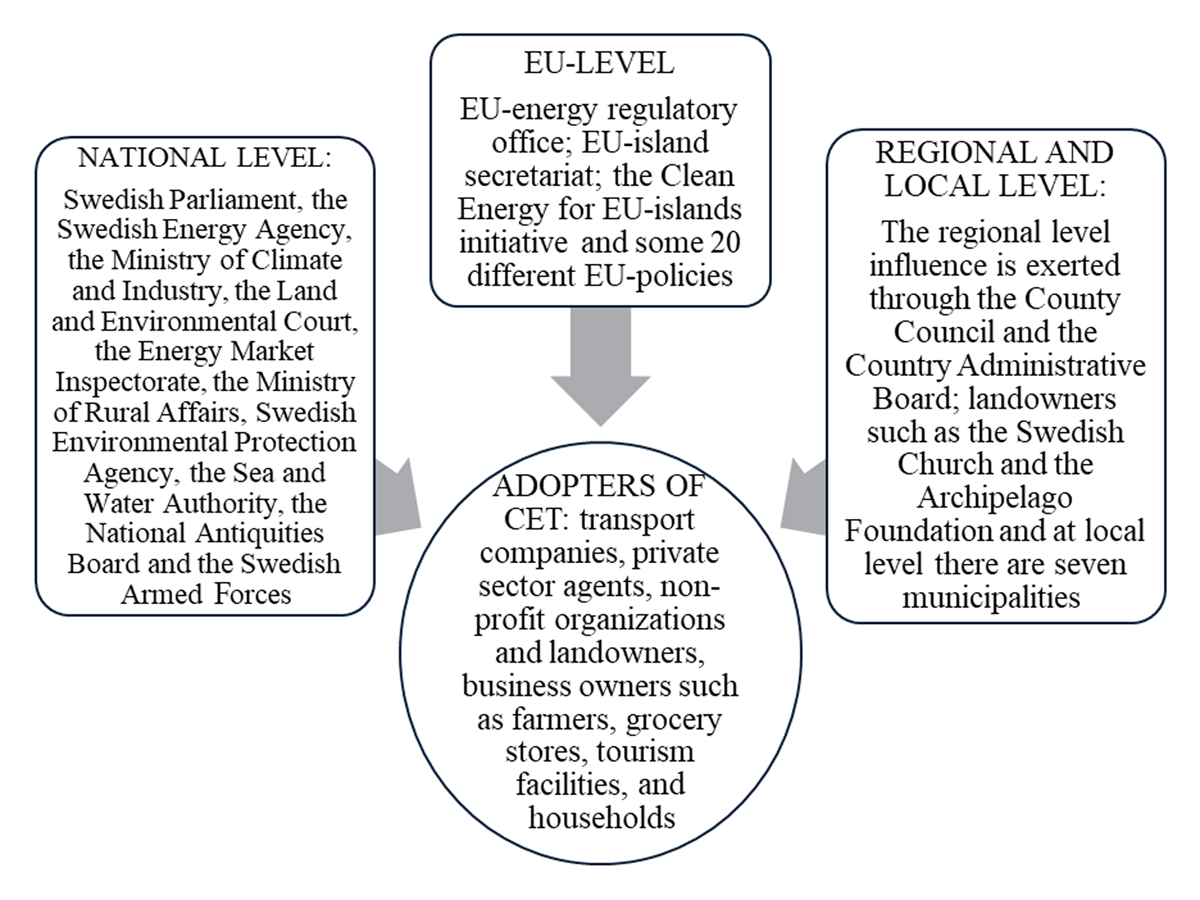
Figure 3
Overview of regulatory bodies and policies involved in CET-adoption processes and permits.
Source: I1-I9, WS1-3, RAP1-RAP8.
The lack of island- and archipelago-specific legislation in Sweden seems to create ambiguities concerning CET adoption. Several sources argue that the responsibility over permits needs to include regulations suitable for small-scale CET solutions (Lagerström and Fogelström, 2022; Hässler, 2022). Policy documents identify the private sector as being responsible for adopting CET (RAP4; RAP7). Investors and adopters are supposed to apply for permits from the municipality, the County Board, and different national authorities. However, officials working with such permits express that they are difficult to process as their responsibility does not stretch to the archipelago. “Applications might be sent around within the same authority 10 times” (I4), which informants consider to be inefficient and time consuming (I4). Several informants argue that to succeed it is easier to employ a consultant. I5 argues that different types of applications have different requirements, and that a good practice could be to coordinate the processing of an application with all involved stakeholders. Such an approach can generate well-founded ideas and avoid delays before a final decision is made (I5). Ambiguities in public decision-making are well-known (Rytkönen et al., 2019). In the absence of a guiding legislation, one of the seven archipelago municipalities, Värmdö, established an archipelago council and the “archipelago package”, to establish dialogue between the municipality and islanders, avoid inefficient decisions and reach holistic solutions to challenges in the archipelago (RAP34). Departing from the interviews and discussions in WS2, such organized dialogue seems to decrease center-periphery tensions between the archipelago and the mainland. Permit applications are subject to an appeal processes in which all the above, but also the public and potential stakeholders are allowed to influence the result, which often translates into a negative decision or a delay (I6).
4.4 Social context
Informants argue that islanders have different views about adopting CET in the archipelago. In WS2, many participants argued that permanent inhabitants on islands are more inclined to accept new technical solutions than part-time inhabitants, even though the former might also have hesitations (WS2). Informants express frustration about how slow the adoption of CET is (I7–I9). Research shows that part-time inhabitants want to preserve a sense of an idyllic place, rejecting changes and modernization (Widholm, 2019), which can explain resistance to wind power plants especially.
“Mainlanders oppose the establishment of wind parks because it will ruin their view over the horizon, even when the wind parks will be placed so far away that they will not be seen from the mainland, nor from the islands.” (WS2).
Opposition to wind power is not new. Previous research denominates this specific type of opposition as the NIMBY-syndrome (Smith and Klick, 2007). However, the adoption of other energy sources was not discussed at length, except for storage of energy on the islands, which informants argued is needed for the electrification of boats (I7–I9; WS2).
Informants refer to their experience of solving infrastructural problems by establishing associations or businesses to solve issues that on the mainland are solved by public authorities. Some examples are garbage disposal infrastructure, water and sewage (I7–I9; WS2), installation of internet cables (Rytkönen et al., 2019), and a temporary covid-vaccination center in 2021 (Merouani et al., 2023). We found no such organizations for the establishment of CET, but civil society organizations have taken interest in gathering information and discussing feasible technical solutions and the impacts that these could lead to (Lagerström and Fogelström, 2022; Hässler, 2022).
“We established a firm that takes care of water purification and another to pull the internet cable. This is what we do, we start companies to solve societal functions. We will probably need to establish a local company to shift to renewable energy. Ideally, local electrician companies would expand and establish small-scale energy companies.” (I7).
Mainland authorities link energy modernization to increasing tourism. Tourism is the authority’s most frequent recipe for economic development in the archipelago (Merouani et al., 2023). In contrast, islanders highlight that while generating seasonal income, tourism causes many challenges. Islands in the archipelago have only a few inhabitants most of the year, and several hundreds or thousands during the summer season. This has vast social, cultural, economic, and infrastructural consequences (Rytkönen et al., 2024).
A key feature that gives rise to socio-economic differences between islands in the Stockholm archipelago is the ability of local island communities to mobilize social capital, which in turn is related to the degree of organization of local communities. This differs between islands (Rytkönen et al., 2019). Island communities are often forced to solve infrastructural and organizational problems when society lacks solutions for islands (Merouani et al., 2023). Overall, these dynamics illustrate how divergent interests and inconsistent levels of engagement in the islands complicate collective efforts toward CET implementation.
4.5 Spatial context
Understanding the spatial context is necessary for any study conducted in the archipelago. The energy needs of the archipelago resemble those of central Stockholm, but the geography poses challenges. Geographical features translate into infrastructural challenges, and the strength of the electrical grid decreases with the distance from the mainland. This puts great demands on early CET-adopters (I7–I9).
Distances from the mainland to any island might be short if distance is measured in kilometres, but substantial if measured in time. For example, from Gustavsberg, the closest mainland locality to the island of Möja, the distance is only 26.4 km, however, in time, the distance is 125 minutes (RAP37). Additionally, EON, one of the largest energy companies, argues that “it is necessary to have a permanent connection to an island, either a bridge or a permanent commuter ferry to make it profitable to install solar cells in the archipelago” (T52). This is confirmed in previous research that concluded that any new building or installation made in the archipelago is time-consuming and more costly than on the mainland because of the advanced logistical solutions required (Rytkönen et al., 2019).
Furthermore, the location of the archipelago in the Baltic Sea makes this an area of special interest for strategic defence purposes. A recent application to establish a wind farm in the area, the Baltic Offshore Delta wind farm, was therefore denied since the armed forces assessed that: “the Baltic Offshore Delta wind farm North’s impact on national interests for the military part of total defense” (RAP18). Thus, location limits the adoption of CET alternatives to solar power and micro-scale wind power plants.
5. Discussion and conclusions
Our results indicate that technological, industrial, institutional, social, and spatial contexts are equally crucial to understand the adoption of clean energy technologies in the archipelago. And in this specific context, at present only wind power and solar cells are seen as suitable technologies. Theoretically, our study validates the need for context-sensitive frameworks in CET transitions. Contextual dimensions (Welter, 2011) are highly interdependent in geographically fragmented settings. The interplay between these contextual perspectives creates a specific “archipelago condition” that shapes technological adoption pathways. Our analysis reveals that the adoption of CET in the Stockholm archipelago is a function of technological availability and a complex socio-technical process fundamentally mediated by the unique, fragmented, and multilayered archipelago context.
The CET adoption is a technological shift conditioned by a deep political process of renegotiating governance and power. Results indicate that the archipelago is highly influenced by multidimensional governance structures (e.g., EU, Nation, Region, Municipality, energy companies and islanders). Adoption is conditioned by multicentric power structures (Stratford et al., 2011), which is especially evident concerning the adoption of wind power, in which companies, policies, licensing authorities and private citizens can stop the adoption or operation of existing wind-power plants. Institutional tension emerges from the interaction between formal governance structures and the archipelago’s multicentred institutional reality. Policy frameworks support CET adoption, but they do not adequately address archipelago-specific contexts.
CET adoption is generally slow across the archipelago as a whole. This can be explained by the absence of island-specific legislation, combined with the systemic inertia generated by regional energy monopolies and practices that limit bottom-up initiatives, constraining local agency. This makes the adoption of CET and other sustainability-oriented shifts more difficult in the archipelago than on the mainland. We differ from previous claims of archipelagos being characterized by “prevailing hegemonic narratives” (Stratford et al., 2011), showing that there are many different interpretations of reality, which is underscored by the lack of coordination and policies that support decision-making. Without addressing the intertwined contextual dimensions, policies risk being ineffective. The archipelago’s path to sustainability therefore relies on the capacity to create new socio-technical systems that are adoptive and resilient.
When studying the adoption of new technologies, the latter are often seen as neutral. But technology has its own agency. Our study shows that the type of technology and the adoption model play an important role on whether intended technologies are adoptable or not. The archipelago’s conditions act as a selective filter limiting adopters to solar panels, which aligns with the epidemic model (Bergman, 2017). Solar panels require minimal new infrastructure, fitting existing rules and individual economies. In contrast, CETs that follow threshold model (for example, large-scale wind farms) are filtered out because they demand major infrastructural investment, challenge existing energy monopolies, require community consensus and new institutional approaches. Technology is thus a key contextual dimension (Schmidt and Sewerin, 2017). Infrastructure requirements and the scale of adoption, whether individual or collective, fundamentally determine a technology’s compatibility with local conditions and its likelihood of success. Additionally, technological feasibility emerges from the interplay between the technology’s characteristics and the broader socio-political and institutional context. Regulatory frameworks, grid limitations, and industrial structures do not merely influence technology adoption, they actively shape which technologies become viable options, illustrating how technology is both shaped by and shapes the archipelago context.
Results indicate that the structure of the energy market is not suited for promoting CET in archipelagos. The monopoly structure creates social challenges and power imbalances that can stifle local innovation and impose limitations to potential small-scale energy producers. The regional energy monopoly creates a critical socio-technical bottleneck, constraining technological choices and social organization, imposing a centralized utility model for mainland into a fragmented seasonal geography where small-scale community-oriented solutions are more appropriate. We conclude that the industrial structures can stop communities from building the kind of local, resilient future energy systems they need.
The adoption of CET is also connected to conflicting and competing imaginaries (Skjølsvold et al., 2020). For islanders and entrepreneurs, CET are often imagined as tools for modernization, resilience and economic viability. For many part-time inhabitants, the archipelago is primarily imagined as a recreational space, thus, modern CET facilities can be perceived as threats to landscape and tranquillity. These differences in imaginaries can bring conflicts in the multicentric decision-making process, where part-time residents can affect policymaking within municipal planning systems. Consequently, the CET adoption process becomes a question about technology, and about the identity and future purpose of the archipelago. This highlights that “sense of place” or islandness (Foley et al., 2023), in an archipelago includes many different feelings. Such differences about what archipelagos are, combined with a demographic structure in which small permanent populations are outnumbered by seasonal residents, makes it difficult to build the united community and stable leadership required to make major energy changes successful. The spatial dimensions of the archipelago are especially important for large-scale socio-technical transformations such as CET. Technologies, solutions, and legislation often lack an understanding of the type of place an archipelago represents. We argue that the involvement of local communities in CET can help overcome existing challenges and improve understanding of the spatial characteristics of the archipelago. The roles of insularity, which is related to island culture, and islandness, which is linked to islanders’ sense of place, remain less clear. Both concepts reflect local dynamics that may vary considerably between islands within the archipelago (Rose and Polis, 2000; Stratford et al., 2011). Insularity and islandness can influence the readiness to adopt new technologies. We therefore identify a need for further scrutiny of the effects of islandness and insularity in future studies, and CET processes provide an excellent case for problematizing these concepts.
In sum, the archipelago’s path to a sustainable energy future depends on the availability of CET, and on strategically adapting to fixed conditions and actively reshaping malleable ones. While spatial and geographical constraints are largely fixed, institutional frameworks, governance structures and social engagement can be reformed. This requires: (i) adaptive governance structures capable of aligning municipal fragmentation, international law and archipelago specificity; (ii) regulatory reforms and adjustments to support local energy communities, and local and flexible market models; (iii) inclusive negotiations to navigate competing imaginaries and build shared understanding of the archipelagos’ future. By engaging with the intertwined contextual perspectives highlighted in this study, policymakers, businesses, and archipelagos’ communities can co-create energy transitions that are equitable, resilient and rooted in the unique archipelago context.
Finally, in this study we highlight tensions caused by various contextual aspects in the archipelago. However, we envision the need to conduct comparative studies that dig deep into dynamics between islands in the archipelago, linking CET adoption processes to central concepts of island research and highlighting differences between islands.
Additional File
The additional file for this article can be found as follows:
Notes
[3] https://etikprovningsmyndigheten.se/wp-content/uploads/2024/05/Guide-to-the-ethical-review_webb.pdf accessed 27 November, 2025.
Competing Interests
The authors have no competing interests to declare.