
1. Introduction
Islands have historically been a link in the geopolitical relations between countries and continents and important trading centers. In recent decades, islands have become increasingly important places of recreation through the rise of tourism while traditional livelihoods, e.g., fisheries and agriculture, have declined (Parra-López and Martínez-González, 2018; Tunón et al., 2019).
In EU articles 174 and 349, the EU recognizes islands as territories with certain geographical specificities that create a clear legal basis for special measures (EC, 2023). Local development on islands is challenged by insularity, e.g., the sense of isolation that appears because of a combination of geographical characteristics of islands, with a physical distance to mainland areas, limited resources, and declining population (Deidda, 2016). Insularity can be interpreted or defined differently depending on whether it’s defined from the perspective of the islander or of the mainlander. It can contribute to creating a cultural and socio-economic distance between island communities and mainland society (Hall, 2010), but that can also be turned into an asset (Deidda, 2016). Consequently, the EU has developed specific policies to promote island development (EC, 2021). The intention is to counteract depopulation and promote fair living conditions. Island policies address the consequences of remoteness for island communities, while they recognize islands as territories especially suited for innovation development and as ‘locomotives in the European energy transition’ (EC, 2023).
Island studies are becoming more common in Swedish research. In the international context, it was established in recent decades. Some milestones are the establishment of the International Small Island Studies Association in the 1990s and the launching of the Island Studies Journal in 2006. Islands need to be studied in their own right as they are more vulnerable to environmental risks and climate change (Duvat et al., 2017; Fernández-Palacios et al., 2021). Islands are highly sensitive to demographic changes of both humans (Parra-López and Martínez-González, 2018) and other species (Fernández-Palacios et al., 2021). In Sweden, island studies have been conducted in various disciplines. Some key previous contributions need special recognition, for example, Ås, Bengtsson and Ebenhard (1997), who tried to conceptualize Swedish and Finnish islands; Ronström (Uppsala University), with several publications, has explored central concepts of island research with a Swedish and Gotlandic perspective (Ronström, 2013; 2021); Urban Nordin and Roger Marjavaara (Marjavaara, 2007; Nordin, 1997; Nordin and Marjavaara, 2012), who have highlighted spatial, political, and social impacts and the role played by second homeowners in the Stockholm archipelago. Another key contribution was made by Anders Källgård, an island enthusiast, who with great accuracy mapped all inhabited islands in Sweden (Källgård, 2022). Substantial contributions are also made by the natural and ecological sciences, especially by the Swedish University of Agricultural Sciences, the Department of Aquatic Resources, and the Swedish Biodiversity Centre, with a wider ecological perspective focusing on biodiversity, traditional knowledge, marine life, and marine environment in and around islands. Similar research is conducted at Havet, Gothenburg University, where near-shore environments on Sweden’s Western coast are studied.
This article is the result of a participatory and collaborative project in which Swedish scholars and representatives of island organizations set out to, from a small-island perspective, define what Swedish island research is, and identify imminent research gaps. The article answers the following questions: 1) Which key research gaps can be identified in Swedish small-island research? and 2) How can we relate Swedish island research to the international field of island research?
1.1. Study area
With more than 260,000 islands, Sweden has more islands than most countries in the world. Most of these islands are small, except for Gotland and Öland. Around 93,000 people are permanent residents on over 500 islands that lack a fixed land connection (SCB, 2023a). The number of people who have holidayed on an island or have archipelagos as recreational destinations is quite substantial. Some are second homeowners (Nordin and Marjavaara, 2012), while others just enjoy shorter trips. Many island tourists are Swedish, and thousands come with their own boats from other countries, especially from nearby European countries such as Finland, Germany, and Norway. Small islands generate tourism income for their respective municipalities, and they are also a showcase for the image of Sweden that each municipality, region, or the Swedish state are all too keen to convey (Rytkönen et al., 2022b).
1.2. Literature review and theoretical concepts
Many islands are also the outermost inhabited border locations of countries. In times of unrest islands can also be safe havens. Historically, fisheries and farming, especially livestock farming and trade, have been key economic activities on islands. In recent decades, the primary economic activities of islands have declined, and tourism is becoming the predominant economic activity (Ruggieri, 2014).
1.3. Island studies, islandness and archipelagic relations
The interdisciplinary field of island studies is rapidly expanding (Baldacchino, 2006; Ronström, 2021; Stratford, 2015). Within this field, different approaches and perspectives from economic, political, social, cultural, and historical perspectives are making an impact. Several disciplines are linked with the intent to improve our understanding of the complexity and specificity of island and island communities. Common topics are insularity, remoteness, resilience, and vulnerability (Battisti et al., 2022).
Island research has had two main focuses: 1) Highlighting the economic factors and limitations in human, financial and physical capital that might affect island communities in a negative way; and 2) The complex spatial fragmentation of archipelagos, peripherality, insularity and remoteness and how this influences island communities, also denominated as islandness (Hall, 2012). Forces behind fragmentation and peripherality are reinforced by the physical characteristics of islands and their spatial relation to mainland-areas. Islands’ resources and opportunities depend on their geographical location and characteristics (Conkling, 2007). Previous research conceptualizes institutional and geographical fragmentation of islands. Some scholars highlight islandness and how it either marginalizes island communities or fuels development by mobilizing social capital (Foley et al., 2023; Rytkönen et al., 2019; Vannini & Taggart, 2013), either analyzed departing from the socio-economic, political, and cultural distance of islands to the core mainland, or from the islanders’ perspective ‘as an important metacultural phenomenon that helps maintain island communities’ (Conkling, 2007:200).
Additional topics are archipelagic relations and the socio-institutional fragmentation that archipelagic geography leads to (Stratford et al., 2011), and a sort of dysfunctional polycentric governance, a mode of governance in which island communities sometimes have the power to decide over themselves, while on other occasions, they are exposed to the consequences of decisions made by others who might lack an island perspective (Gaini and Priested Nielsen, 2021).
Starc and Stubbs (2014) stated that both islandness and modes of governance imposed from outside are central in island studies. However, recent studies have raised questions about human agency by altering the previous deterministic view of islands as victims of external factors. Instead, research has been focusing on both real and imaginative qualities of islands, and the resourcefulness of their inhabitants, from a participatory development planning perspective (Starc and Stubbs, 2014).
The following analysis, motivated by the nature and geography of small, near-shore Swedish islands, will depart from three concepts, e.g., islandness (Hall, 2012); archipelagic relations (Stratford et al., 2011); and polycentric governance (Gaini and Priested Nielsen, 2021).
2. Methods and sources
The main method used in this study is the community-based participatory approach (CBPR). In CBPR projects, researchers and members of the community are equal partners and collaborate on all aspects of a research project. The purpose of CBPR is to empower local communities by acknowledging their role as experts in their own reality. CBPR is firmly based on ethical principles by implementing reciprocity, equity, and partnership. Therefore, CBPR is considered especially suitable for sustainability-oriented research (Ajaps and MBah, 2022). Participatory research is also endorsed by the UN’s Agenda 2030, emphasizing the crucial role of highlighting sustainability challenges in an efficient and ethical way (Keahey, 2021). CBPR has gained momentum in formulating precise questions, obtaining richer answers, and transforming results into realistic solutions (Fritz et al., 2019). All of this is central in this study. There are several ethical challenges connected to applying CBPR (Tunón, Rytkönen, and Bele, 2021). In this case, there was a clear risk of blurring boundaries between the different roles in the collection and elaboration of data. We reached a common understanding with the studied community already before starting the study, in this case with island organizations about what they can expect from us as professional researchers and about their role as co-producers of the study. This has proved to be fruitful and facilitated a dialogue around both the results and how the results were interpreted. Furthermore, there is an imminent risk of conflict and different perceptions of the truth between islanders. We addressed this by being transparent about the purpose of the study and by inviting all island participants to take part in and discuss the results so that misunderstandings could be avoided. In cases of competing interpretations, the differences have been highlighted.
This research started in 2021, when four scholars and 67 representatives of island associations on 13 Swedish islands from all of Sweden, and the National Archipelago Confederation (NAC) met around an analysis of the impact of the Covid pandemic on island tourism. Islanders and researchers formulated the research questions answered in this article in late 2021. Data was collected in 2022 through two national workshops held in Åstol (Bohuslän archipelago) and Nämdö (Stockholm archipelago). Prior to the workshops, island participants were informed that the results were to be used for this article and for a short report in Swedish. They were also asked to give informed consent at the start of each workshop. Participants originated from 15 coastal islands and archipelagos from North to South, West to East, and two inland lake islands (Figure 1). Furthermore, representatives from three municipalities and one region were present. In total, 87 people participated on site and 34 participated online. Furthermore, five digital workshops were held with islanders from all over Sweden and authority representatives from national governmental agencies that generated data. Additionally, 144 people participated in the digital workshops, with islanders from the regions: Gothenburg, Jönköping, Uppsala, Skåne, Stockholm, Västerbotten, Örebro, and Östergötland. The selection of islanders is biased towards permanently inhabited, near-shore, small-islands which are not connected to the mainland by a bridge. This excludes large islands, e.g., Gotland and Öland and most lake-based islands, potentially affecting the generalizability of the study. Furthermore, researchers agree that there are contextual and actual, geographical, biological, cultural, and other differences between islands that influence local life and local development. We have triangulated with well-selected scientific sources, while reflecting the voices of participating islanders.
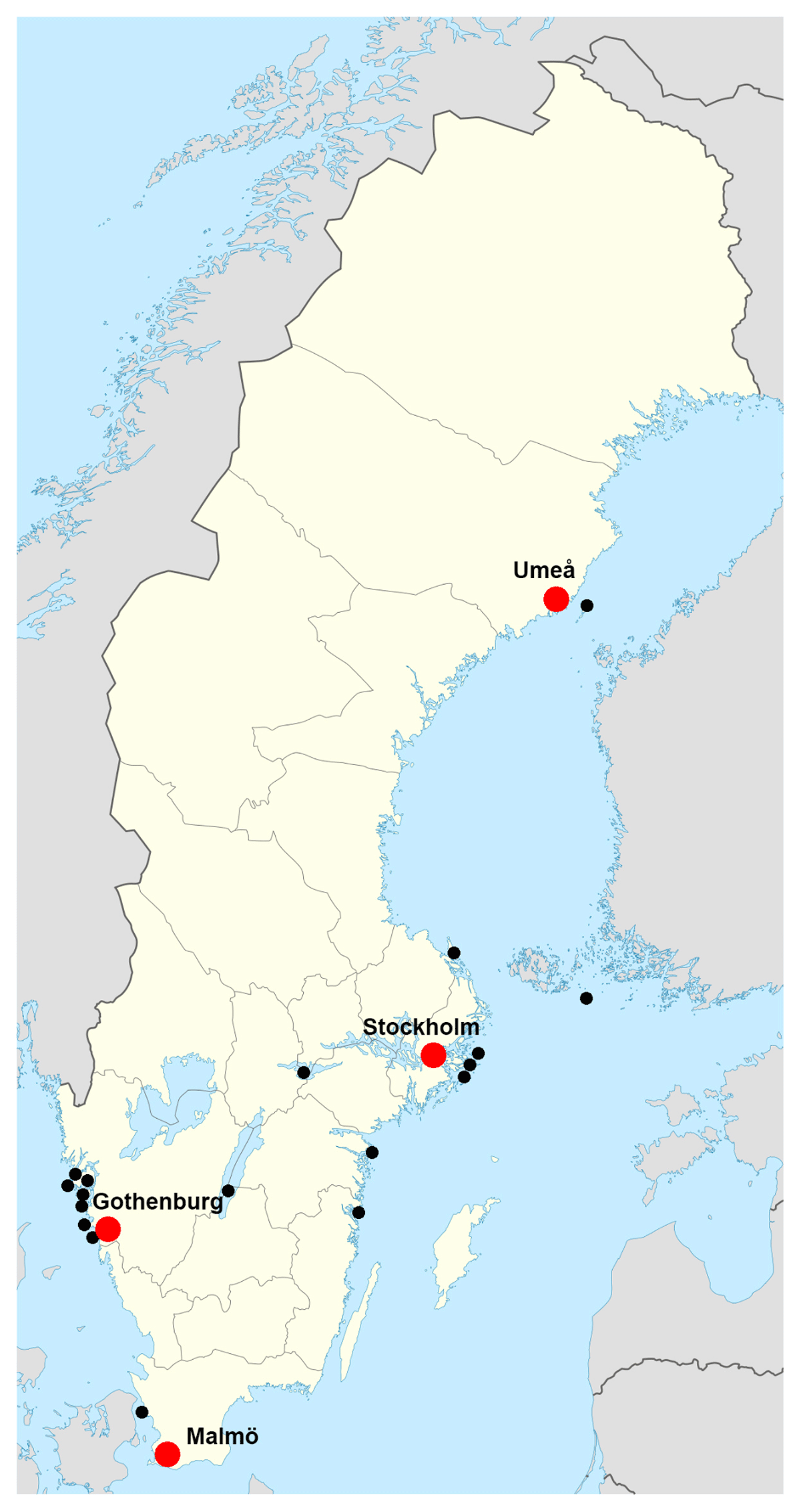
Figure 1
Map over Sweden. Black dots represent islands of residence of island participants and red dots some reference cities. Illustration: H. Tunón).
Data elaboration followed practices from phenomenography, by categorizing, thematizing, and contrasting results to theory (Hajar, 2021). The purpose of using phenomenography is to identify commonality and variation in the answers of island participants in relation to selected theoretical concepts. The project implemented ethical practices throughout the process by implementing CBPR and implementing ethical principles and sound research practices found in The European Code of Conduct for Research Integrity (ALLEA, 2023). The CBPR process included the following steps: 1) Formulation of research questions by islanders and researchers; 2) Data collection through digital and real-life workshops. Topics to discuss were proposed by islanders. Researchers documented; 3) Elaboration of data by researchers; 4) Researchers presented and discussed results with islanders through an open online workshop and a process of common revision of results, corrections, and additions made by islanders at the beginning of 2023; 5) Presentation and discussion of the first version of the article with researchers and islanders was conducted in October 2023; 6) Rewriting and editing by scholars; 7) Review and approval of final article by islander co-authors before submission in March 2024.
3. Results
Results generated five main overarching themes and 13 main categories, which are reported in Table 1 below. As far as possible, input from islanders was triangulated with external sources.
Table 1
Identified themes and categories.
| THEMES | CATEGORIES |
|---|---|
| Democracy deficit | Fragmented government |
| Lack of island policies | |
| Dialogues and lack of dialogue | |
| Marginalization, justice, and social capital | Institutions |
| Health care and welfare | |
| Environmental issues | Climate change, islands as future habitats |
| Natural resources, knowledge, and citizen research | |
| Island culture | Changing livelihoods |
| Identities and cultural diversity | |
| Perspectives | Image and perceptions |
| Knowledge gaps | |
| Tourism, for better and worse | |
| Seasonality and schizotopic aspects of islands |
[i] Source: Own elaboration.
3.1. Democracy deficit
Respondents expressed what they identified as a democracy deficit. After doing further elaboration and looking at background information, this proved to be the most important topic, because how islands are governed influences all aspects of life on islands. The democracy deficit was partly caused by the implementation of the Municipal Division Reform implemented between 1952 and 1975. Before that, there were 2,365 municipalities, many with too few inhabitants. This was not financially sustainable; therefore, municipalities were merged into today’s 290 (SCB, 2023b). For small islands this meant that most were placed under the jurisdiction of a mainland-based municipality. Today there are four island-based municipalities, e.g., Öckerö (the only small-island based municipality with 10 islands), Gotland, and Borgholm and Mörbylånga on Öland. In 2008, there were 574 inhabited islands without a bridge to the mainland. Of these, 524 were sea-based and were located in 52 municipalities scattered over 13 regions, while 50 were in the six biggest inland-lakes (Glesbygdsverket, 2008).
Furthermore, the presence of the state in archipelago areas was gradually dismantled through the automatization of lighthouses, weather stations, and pilot positions. Many jobs previously staffed by islanders disappeared. Island-based defense facilities were gradually centralized and downgraded and service to remaining facilities was relocated to the mainland (Motion till Riksdagen 1987/88: A405). The fishing industry and agriculture became increasingly centralized. All previously mentioned changes acted as a vehicle for depopulation, which gradually reduced the bargaining power of islanders vis-à-vis mainland-based authorities.
Finally, the construction of the nation, with a strong state as a fundamental pillar of society, influences how islands and archipelagos are defined and administered. The slogan ‘levande landsbygd’ (inhabited rurality, author’s translation), is reproduced by all political strands and public agencies. This idea has been translated into several initiatives, especially within the frame of regional policies. While this has been studied in other contexts (Blomqvist and Bergman, 2010), there is still a gap in knowledge in the context of islands and archipelagos.
3.1.1. Fragmented government and lack of island policies
Sweden lacks a coherent island and archipelago policy, which several island participants argue enhances the democracy deficit. Island and archipelago issues are subordinated to rural policies, which obstructs island development. Therefore, the island and archipelago perspective is often forgotten when policies are designed. The main consequence of a lack of coherent island and archipelago policies is a lack of political and institutional tools to handle island and archipelago issues, and substantial knowledge gaps amongst politicians and civil servants on island conditions and what it means to live or run a business on an island. There is some political awareness about this institutional gap. Between 1962 and 2017 the issue of developing an island and archipelago policy was discussed by parliament on 173 occasions and 87 times it was raised as a formal request (Sveriges Riksdag, 2023). Several island participants highlighted the need to educate civil servants and decision-makers about the conditions on islands and archipelagos. Islanders argue that: ‘When a new civil servant is employed, they know nothing, it is the same thing every time. But after a few years, when they come to understand islands, they move on to new jobs and we get to start all over again with a new person.’
During the data collection process, islanders proposed that researchers should develop an island course for civil servants and decision-makers. Island participants argue that the lack of knowledge leads to decisions that cannot solve problems on islands. This affects accessibility to islands, transport services, health care, schools, environmental issues, garbage recycling, building permits, business permits, tax policies, and availability of public resources.
There are a few examples on how lack of island policies creates challenges for livelihoods and well-being on islands. One example is the combined impact of building regulations and waste management regulations. Current regulations require that restaurants build separate garbage rooms, but construction permits are restricted by the shoreline protection regulation (Rytkönen et al., 2019). Another example concerns health care. During the pandemic, public health restrictions led to several dilemmas for islanders. For example, islanders were advised to go the mainland to get the Covid vaccine, however, this meant a risk of getting infected on the ferries. Furthermore, it was forbidden to board some ferries if people had Covid-symptoms, while the Infection Protection Act imposed that people with symptoms should seek medical care on the mainland (Rytkönen et al., 2022a).
3.1.2. Dialogues and lack of dialogue
Most island participants highlight the importance of dialogues between islanders and decision-makers, and the potential consequences of lack of communication. Recently, the NAC has been invited to national-level dialogues. Simultaneously, examples of lack of dialogue are highlighted. One example is the Swedish Environmental Protection Agency’s decision to establish a marine national park in the Nämdö archipelago. In line with official procedure, an impact assessment was conducted by the local municipality. Islanders contributed to the assessment. But the state has disregarded the knowledge provided by local people in its decision-making process. Island participants argued that: ‘They (Swedish Environmental Protection Agency) invite us locals to meetings because they need to tick it off their list. But they are not really interested in what we have to say.’
International research highlights dialogue between decision-makers and islanders as a key to success when addressing local and environmental challenges on islands (Keahey, 2021; Plante, et al., 2009).
Several island participants argue that national authorities in general consider that islanders don’t know what is good for them. They often experience that representatives of the state have a condescending attitude towards islanders. Numerous island participants complained that there is a lack of awareness of what it means to live permanently on islands.
When we present an argument or information about a challenge for islanders in general, we are dismissed with the argument that we represent only ourselves and that it is only the experience of one person or of the island we live in. We are dismissed as ignorant, even though many of us have university degrees and perform quite advanced tasks in our daily activities.
Island participants repeatedly raised lack of research as an underlying cause behind this challenge. They argue that decision-makers need knowledge validated through systematic and unbiased research.
Some areas in which there is an urgent need for research are the local and regional administration of islands and archipelagos, and environmental issues. Islanders highlight how they can contribute to such research with more cost-efficient and accurate results, for example by contributing with nature inventories and sharing experiences of ecosystems, wildlife, changes in nature, phenomena in the water, etc. in their everyday lives. This argument is backed by recent research in which citizen science is seen as essential for achieving the United Nations’ Sustainable Development Goals (Fraisl et al., 2020). The practice of citizen science is still incipient in Sweden.
Island participants argue that, instead of cooperating with islanders, actions of authorities that focus on local and regional management, especially in relation to natural resources and environmental issues, often lead to conflicts. Such conflicts arise at municipal, regional and national level. Therefore, islanders also argue that there is a need to develop mechanisms to solve conflicts.
There are also contradictions between permanent inhabitants and second homeowners. The former often are prone to development, while the latter often want to maintain ‘the idyll’ and oppose change and modernization. It can also be the other way around. Some island participants argue contradictions are fueled by official resident classifications. Permanent residents are officially registered at their island addresses, while second homeowners are often registered in another municipality. Thus, permanent residents pay taxes that can generate benefits for the island, while second homeowners often do not. This is confirmed by previous research (Nordin and Marjavaara, 2012; Rytkönen et al., 2022a). Another example raised is that second homeowners often appeal building permit applications, the establishment of new port facilities, or other changes that might spoil their view. Some second homeowners complain against island farming, because animal manure smells.
3.2. Marginalization, justice, and social capital
The democracy deficit inevitably leads to a discussion about social justice, highlighting the existence, or lack, of equal opportunities and privileges (Miller, 2001) for islanders compared to mainlanders. Results indicate that many of the challenges faced by island communities, especially about social and health services, are part of what island participants argue is a democracy gap. This is, of course, not unique to islands, but island participants in this study highlight this issue as especially important. For example, on some islands, senior citizens who need elderly care are forced to move to the mainland, where their entire existence changes. This sense of injustice is confirmed by research about the impact of the pandemic on island communities. Decisions about basic services are almost always made from a mainland perspective (Sebastián, et al., 2023; Rytkönen et al., 2022b). Furthermore, this lack of social justice, or democracy gap is unevenly distributed. In some regions the gap is bigger, while on single islands, such as Visingsö, the gap is much less prominent.
Issues concerning the marginalization of different peripheral contexts have previously been researched (Finkbeiner et al., 2018; Perez-Ramos et al., 2021; Putri and Salim, 2020). Marginalization is also highlighted within island studies, especially in research that highlights the dichotomy between island and mainland (Baldacchino, 2006). Results in this study indicate that adding a justice perspective when studying island communities’ marginalization can contribute to capturing and visualizing for example environmental justice (Celata and Sanna, 2012), or social justice (Karides and Rodríguez-Coss, 2023; Sebastián, et al., 2023). Island participants argue that marginalization and justice need to be balanced by reflections on how islanders willingly solve problems and bridge gaps on their respective islands. They do not want to be seen as victims. The resourcefulness of islanders is confirmed by research, where islanders are described as equilibrists in creating livelihoods, working with limited resources (Baldacchino, 2015), and solving critical and even wicked problems (Petzold and Ratter, 2015).
Results indicate that existing democracy deficits, justice gaps, and marginalization are partly caused by islandness, but also by the institutional gap created by lack of island policies.
3.2.1. Institutions
Institutional gaps, informal institutions that influence decision-makers of island communities, or contradictory formal institutions and regulations, cause poor decisions and sometimes even an unproductive allocation of resources. People’s general perception of islands is related to the mediated image of islands as summer paradises. A telling example of informal institutions concerns mainlander’s perceptions of islanders as resource consumers, or were unaware of their existence: ‘I often encounter decision-makers on the mainland who are surprised about me living permanently on an island. They ask: “Is it true that people live year-around on islands? I had no idea!”’ Another frequent comment is: ‘They (mainland inhabitants and decision-makers) only see us as demanding, they don’t see at all the contributions we make, for example by being there to provide service when they want to go on an excursion or holiday on an island.’ An additional source of confusion is:
Decision makers see us as miniature societies. As we are alike. On the one hand they might think that we have a little bit of everything on the island and that we therefore don’t lack anything. On the other hand, they fail to recognize the differences between islands.
Formal institutions also contribute to creating problems. An important reason for this is that laws and regulations are drawn up from a mainland perspective, which is natural since most people do not live on islands. However, there is a lack of guidance for applying different types of regulations on islands. Sweden lacks island legislation and has no administrative guidance for the implementation of regulations on islands. Most island participants highlight building regulations as examples. Regulations limit the construction of new homes at lower prices that young permanent resident families can afford. Building permits, which are compulsory for any type of construction, often collide with other legislation, for example, the Shore Protection Act (Strandskyddet). The latter indicates that building permits for properties located closer than 100 meters from water can only be granted in exceptional cases and when there are compelling reasons (Naturvårdsverket, 2023). Island participants argue that the Shore protection Act contributes to making islands more attractive as it ensures public access to shores and beaches; however, regulations inhibit entrepreneurship, especially in smaller islands. One island participant reflects on regulatory overload and regulatory gaps in the following way: ‘The Parliament says that all of Sweden must be inhabited (“hela Sverige ska leva”), but when it comes to islands this is bullshit, they just do not want to fix existing problems.’
Since experiences of institutional gaps and challenges are contextual and vary between islands and regions, island participants recommend that collaborative research projects are promoted, grasping the variety of contexts on different islands. Island participants also argue that major state, regional, or municipal initiatives can benefit from being scrutinized by research. Such approaches can ensure learning, and that many perspectives are included, especially when measuring policy impact on different island communities. Collaborative research can increase knowledge about the role of civil society on islands (Keahey, 2021; Schensul, 2019). A specific example related to building regulations is: ‘If we cannot change the law, maybe new forms of ownership can be accepted. I mean, if we are allowed to test new, potential solutions, under controlled forms, and find innovative solutions concerning expensive and delicate issues, like sewage, we could reach new solutions.’
The discussion about institutional gaps and shortcomings is connected to the democracy gap. Some island participants argue that an increased degree of self-governance can provide a solution to many problems.
3.2.2. Healthcare and welfare
Healthcare challenges and welfare services are often a challenge for municipalities and regions with islands. Swedish regions are mainly responsible for key healthcare services. However, municipalities are responsible for assisted living facilities for the disabled, retirement homes, and specialized home care for the islanders. Municipalities are also responsible for most of the social services. These are dependent on the municipalities’ tax base and the number of citizens with official addresses on the islands. However, there is a large proportion of second homeowners who pay taxes to another municipality. This creates challenges for the municipalities. Island participants express their understanding of this; however, they argue that while authorities focus on lack of funding, many solutions that could be developed and implemented at a lower cost, including new logistical solutions, employment of locals, or solving problems together with islanders are disregarded by public office.
Healthcare also includes mental health. Humans are social creatures and depend on interaction with others. It is a basis for living a good life. Socially sustainable development on islands in Sweden’s archipelagos is, unfortunately, an under-prioritized area for national, regional, and municipal authorities. Trusting relationships, meaningful outdoor activities, sports and culture, participation, health, and equality are social prerequisites for sustainable development and reaching UN Global Goals, Agenda 2030. Likewise, it is rarely a focus in island research. It is usually civil society’s private individuals who drive island issues with scarce resources, and psychosocial health can become difficult to prioritize.
3.3. Environmental issues
As unique environments, islands face a varied number of environmental challenges, since islands have limited resources and are, due to their geographical location, exposed to external pressure. Islanders understand the immediate dangers for their way of life due to wicked problems and raise their concern for some topics highlighted in public debate and previous research (Connell, 2018; Polido et al., 2016; Tunón et al., 2019). For example, sea level rise (Kapsi et al., 2023), climate change (Strandmark et al., 2015), loss of, or changes in biodiversity (Dobrzycka-Krahel and Bogalecka, 2022), overfishing (Sandström et al., 2019), scarcity of sweet water (Sandin et al., 2020), risk of invasive species (Kapsi et al., 2023), environmental impact of tourism, and issues related to limited space, for example waste management, energy production, and limited resources (Kaldellis and Zafirakis, 2020). Island participants highlight that, while these issues are present in international research, they feel that Swedish research lacks coordination and that the knowledge gap between Sweden and other countries has increased over time.
3.3.1. Climate change, islands as future habitats
Due to their complexity, wicked problems raise many concerns. Environmental research is conducted in various universities and research centers; however, there is a need to coordinate research results and find ways to raise awareness among decision makers, islanders, and other stakeholders with interest on Swedish islands. Valuable data is gathered by municipalities, authorities and companies, for example the Swedish Meteorological and Hydrological Institute. (SMHI, 2024). Furthermore, researchers from various disciplines approach environmental issues relevant to islands from different perspectives (Zellentin, 2015). Island participants argue that there is an urgent need to coordinate sustainability research and that an emphasis on future scenarios is needed. Municipalities, Regional authorities, and islanders need to plan, and to adjust regulations to include a different approach to accessibility and highlight new ways of thinking, to avoid raising concerns about sustainability into opposition to progress and development. Island participants argued that, through their presence on islands, they can contribute to environmental and climate research.
The possibility of living on islands is dependent on the viability of livelihoods:
Livelihoods and businesses are dependent on sustainability. Everything is connected to the environment and biodiversity. One can get benefits by including this in societal development planning. Sustainability can generate new businesses and employment opportunities. This is an important angle to research.
3.3.2. Natural resources, knowledge, and citizen research
Within these categories three areas of interest were identified: economic, environmental, and sociocultural issues. Coastal fishing, archipelago agriculture, animal husbandry, hunting and other economic activities related to the use of natural resources are seen by public office as unprofitable (Tunón et al., 2019). However, the economic calculation is solely focused on the prices that the products, e.g., fish, meat, or berries can generate, but other values created by the basic industries are not considered. Agriculture in small islands, for example, is often based on animal husbandry. While being costly, grazing animals generate open landscapes, contribute to local food security, and contribute to biodiversity. Additionally, open landscapes are essential for tourism, ‘no tourists want to visit a forested island!’ This is confirmed by recent research on Swedish small-island tourism (Rytkönen et al., 2022a). Open landscapes are also essential for maintaining the image of islands and archipelagos that is so central in the mediated image of Sweden. They are part of the social and cultural identity of mainlanders and islanders. Still, farmers in small islands claim that they receive less agricultural subsidies than other European islanders and that current subsidies are neither enough to move animals between islands, nor to cover the increased costs involved in farming on a small island. Because of small islands’ limited land, output is also lower than that of farms on the mainland, or in large islands. EU-subsidies are not generally designed for micro-farming (EC, 2022).
Island participants highlighted that industrial trawling for forage fish generates revenue for sales and receives various EU subsidies, which has led to a decimation of the fish stocks on which local small-scale fisheries depend. This is well-known (Havet, 2023). Consequences may vary between islands and industries. Small-scale archipelago fishing provides recreational and commercial opportunities, it also contributes to making islands more attractive for tourists and islanders.
3.4. Island culture
3.4.1. Changing livelihoods, identities, and cultural diversity
During the last century, the livelihoods of islanders in Sweden, but also in other parts of the world, have changed. This shift is linked to the decline of agriculture and forestry, and the rise of tourism (Salmi, 2018; Widholm, 2019). A substantial share of previous research relates current expressions of island culture to ancient history and traditions. Island participants highlight that island culture and history are highly related to previous and current livelihoods. Culture has been shaped by geography, climate, history, interactions with other cultures, and connection to the natural environment. Around the world, island culture is influenced and shaped by indigenous beliefs (Rodriguez Lopez, 2016; Weiner, 2002) and above all by the locus of islands (Ronström, 2013; 2021). Some define island culture as identity linked to population dynamics and the island’s geographical position in the sea (Åbo Akademi, 2022).
Island participants highlight that the shift in livelihoods affects what people do, which in turn leads to new traditions. Many people run their own businesses, they have diversified economic activities and people are involved in the local communities. Island participants argue that, ‘We need to know what we are losing and how our culture and identity is changing’ and ‘Our island identity is an important topic for research, but how does the changing culture influence our self-image?’
While reality on islands changes, the image and perception of mainland inhabitants and mainland-based decision-makers about what they can expect when they visit islands is characterized by unchanging romanticism mediated by popular culture. One island participant argued that ‘Everyone has cultural-historical expectations of islanders, and you must always live up to the expectations of others, and it must always be possible to get locally caught fish, but no one gets fishing licenses, and no one can make a living out of fishing!’
Furthermore, culture is influenced by the decreasing residential foundation of islands. People who once lived on islands left for the cities but kept their island home as a holiday home. Moreover, wealthy people, especially in the Stockholm and Gothenburg archipelagos, purchase or build new residences, which might be used only a couple of weeks per year. However, part-time inhabitants might also be important and contribute to social and economic development on islands. On Holmön, the local association has worked with the development of a new conceptualization of island inhabitants. They developed the concept ‘residence basis’ (vistelseunderlag). According to their methodology, they mapped and classified the population in five different categories based upon the number of days per year they spend on the island (from permanent residents to just weekends and summer). This offers them a tool to understand the purchasing power on the island, the need for infrastructural investments, and also knowledge needed to influence population development in a positive way (Holmömodellen, 2020). This links back to previous arguments about the need to develop new ways to calculate the demography of islands.
3.5. Perspectives
The last main theme is related to varying perspectives. Island participants highlight how their perspective might not be included and how their perspective differs from that of others on issues that concern their daily life.
3.5.1. Images and perceptions
Many decisions that concern archipelagos and islands are made without the participation of islanders. Therefore, what an island is and what islanders do is many times ignored, or just assumed due to lack of knowledge. One islander summarizes this in the following way: ‘An unbalanced focus is placed on the hospitality industry, but we do many other things” It’s not because the islanders need more tourists, it’s because mainlanders want to keep their summer holiday paradise.’
Moreover, the image of islands and archipelagos is often equal to social media images from vacation experiences and marketing images used by companies and authorities, in which there is always summer, and landscapes are often idealized and empty of people. This adds to a misunderstanding of islands being depopulated and about what is possible when living on an island. The ‘urban archipelago image is different from reality.’
3.5.2. Educational gaps
There is a knowledge gap concerning how it is to live on an island and nature and natural life in and around islands. One island participant argued that ‘If we mean maintaining islands as inhabited spaces and life on islands and around islands below the water, we need to communicate scientific knowledge.’ Children were highlighted as an important target group for bridging knowledge gaps. Island participants also highlight that they, daily, see changes in the environment. But how can this knowledge be communicated in an accessible format to improve nature conservation? Much of the knowledge is there, but it needs to be conveyed to the public. It is also necessary to make environmental research and nature inventories more efficiently and avoid doing things repeatedly. Island participants argue that the use of Citizen Science can contribute to resource efficiency in research, while meeting the challenges caused by wicked problems (Fritz et al., 2019).
3.5.3. Tourism, for better or for worse
Results indicate that there is a one-sided image amongst public authorities that tourism, and especially summer tourism is essential for island economies (see, for example, Landskrona Stad, 2017; Region Östergötland, 2024; Umeå kommun, 2024; Västsverige, 2014; Visit Karlskrona, 2024; WSP, 2022). Island participants argue that there are many other actual and possible economic activities on islands. Tourism is undeniably important; however, second homeowners are potentially more important than day tourists. Second homeowners employ construction companies to renovate or build summer houses, use local transport services, buy groceries from the local grocery store, and are more likely to return to local restaurants and local establishments than day tourists. Lessons from the pandemic indicate that digitalization and telework enable white-collar workers to work from home if there is a good internet connection. Therefore, second homeowners could be on the islands for longer periods. Some made their second home into their permanent residence; others now spend more time on their islands. Second homeowners are potential permanent residents, which was shown not the least during the Covid-19 pandemic (Rytkönen, et al., 2022a). Yet, island participants argue that all initiatives from authorities and from outside focus on short-term summer tourism.
3.5.4. Seasonality and schizotopic aspects of islands
The archipelago life is according to one of the island participants as a ‘Schizotopic reality.’ Due to summer tourism, island communities and island infrastructure are expected to cope with sharp variations. During most of the year an island might have 100 inhabitants and during a summer day the island needs to cope with several hundred people.
Socially, this might cause some challenges; however, challenges are multiplied when focusing on infrastructure. The amount of available sweet water might be limited and many things, from the energy grid to sewage systems, are seriously undersized. ‘We are used to being thrifty when using resources, but mainlanders might shower three times a day and use a lot of energy to cool down the wine fridge.’
Effects of seasonal variations have been discussed before (Nicely and Palakurthi, 2012) and are well documented in research (Parra-Lopez and Martínez-Gonzalez, 2018). However, island participants feel that the negative impact of seasonality is put to the edge by climate change and over-tourism. The latter is endorsed in international research and overtourism has increasingly taken place in the public debate and research (Butler and Dodds, 2022).
4. Conclusions
A key conclusion is that perceptions of different issues vary between island participants and as island participants originate from different islands and regions, a reasonable conclusion is that the reality of different islands in Sweden is highly contextual. A call for highlighting different contexts has also been underlined when empirical conclusions are linked to theoretical concepts. A call for highlighting contexts is in line with suggestions made by previous research (Baldacchino and Starc, 2021; Foley, et al., 2023)
Starting from phenomenography, in Table 2 (below) commonality and variation between key research concepts and our results are illustrated.
Table 2
Commonality and variation between theory and results.
| CONCEPTS | FOCUS ON | COMMONALITY | VARIATION |
|---|---|---|---|
| Islandness | Peripherality and remoteness | Social and economic peripherality is influenced by various degrees of accessibility. | Peripherality can be addressed through dialogue built on mutual benefit. |
| Easily solved issues, for example gathering information and data to help island societies prepare for climate change are left without action. | Schizotopic aspects of islandness cause infrastructural, social, and economic challenges. | ||
| Local knowledge about social, economic, and especially environmental issues and natural processes, remains unrecognized. | |||
| Physical, cultural, and economic distance to mainland-areas | Lack of island policies reinforces the democracy deficit. | Democracy deficit and justice have not really been addressed before. | |
| Archipelagic relations | Relations within islands | Social capital, local agency and in-depth knowledge of local problems and potential solutions | Multilevel decision-making tends to neutralize islander’s agency and put islanders on the sideline. |
| Relations between islands | n.a. | n.a. | |
| Relations between island/islands and mainland. | Causes fragmentation. Mutually beneficial relations increase in the presence of only one mainland authority and decrease in the presence of many partners. | Misunderstanding, lack of knowledge and democratic deficit influence negatively. | |
| Polycentric governance | Polycentric decision-making | Fuels fragmentation regarding public and private investments, resource optimization and hampers local development. | |
| Multilevel governance | Lack of coordination between levels of governance. | Local agency can partly counteract inefficient decision-making. | |
| Centre-periphery (CP) relations | Lack of island policies reinforces island participant’s perception of dichotomous relations. | True dialogue and mutual knowledge exchange can counteract CP relations. |
In relation to Islandness, results indicate that peripherality, remoteness, and different types of distance between islands and mainland areas are contextual. Challenges can be addressed in different ways and while some issues are seen as challenges on one island, on another they are handled as opportunities. A focus on archipelagic relations illustrates social and economic fragmentation and different conditions for local development between islands with seemingly similar location and resources. This is, however, not always the case. When studying single islands, and lake-based islands not located in archipelagos, it might be more fruitful to use concepts from islandness and polycentric governance. The concept of polycentric governance is quite useful in the Swedish context. A focus on polycentric governance, as proposed by Gaini and Priested Nielsen (2021), needs more exploration, using different islands and contexts as empirical examples.
4.1. Implications for policy
The examples highlighted in this article show that there is a need for new knowledge to support decision-making. The democracy deficit and institutional fragmentation influence island development, but also the possibility of promoting sustainability challenges and utilizing the resources and opportunities offered by island societies, not least through tourism.
The development of island-specific policies can guide decision-makers in how to include the island perspective. There is also a need to improve dialogue and knowledge exchange between various levels of governance and islanders. Including islanders and their knowledge in formal decision-making can generate long-term actionable solutions, and promote the implementation of Agenda 2030, which ‘envisages peaceful, just and inclusive societies where all human beings can fulfill their potential in dignity and equality’ (UNESCO, 2022).
4.2. Implications for research: A roadmap for future research
In the lines below, we summarize six recommendations for future research:
R1. There is a clear need, motivated by theory, but also by the needs of island communities and decision-makers, to make a thorough research overview of island research in Sweden, perhaps in comparison with research about countries with similar island geography, for example, Finland and Croatia. Such action can contribute to conceptualizing islandness and the specific island contexts in Sweden.
R2. In-depth analysis of the consequences of the democratic deficit and its expressions in various Swedish regions, but also the role of the state, the idea of Sweden as a strong state, and how it is translated into actual island and archipelago policies or lack of policies, needs further scrutiny. Furthermore, the identified perception of varying democratic conditions in different regions indicates that there are several inputs to future studies. It is necessary to explore all mentioned avenues to understand how the democratic deficit is constructed, how it can be addressed, and how island policies can be outlined.
R3. Case studies from different contexts and geographies. In each region, challenges and opportunities, as well as realities differ from each other. Embracing the variety of contexts through research in various island geographies can strongly contribute to a better understanding of island challenges in the Swedish as well as the EU context.
R4. Compilation of environmental and climatic data, making it available for citizen science research. This is necessary to develop community strategies to meet climatic and environmental challenges.
R5. Interdisciplinary studies from political sciences, geography, natural resource management, and especially climate research can contribute to valuable new knowledge, enrich the research area, and contribute to informed policy decisions.
R6. Historical studies, especially contemporary history interdisciplinary studies, can shed light on the processes behind changing livelihoods, local identities, and cultural diversity in the specific Swedish and Nordic geographical context. Such research can contribute to the development of the international research area island studies.
Acknowledgements
The authors are grateful to Skärgårdarnas Riksförbund, Skärgårdens Intresseföreningars Kontaktorganisation, all islanders, representatives of municipalities, regional authorities, and others that have contributed with perspectives during the project. The authors are also grateful to all islanders and others that have contributed with perspectives during the project.
Funding Information
The project was funded by Uppdrag landsbygd. https://www.slu.se/institutioner/stad-land/samverkan/uppdrag-landsbygd/.
Competing Interests
The authors have no competing interests to declare.
Author Contributions
All authors contributed to the design of the study and data collection. Rytkönen was responsible for the lion’s share of the conceptual and proof outline. Responsibility for the methodological outline was shared by Rytkönen and Tunón. Elaboration of data and analysis, as well as writing of the manuscript was mainly conducted by Rytkönen, Tunón, and Bohlin (in mentioned order), and to a lesser degree by other authors. All authors contributed with comments during the editing of the manuscript.