
Introduction
Recent studies on how landscape imaginaries have been impacted by the introduction of social media, like Instagram, suggest that the new medium have the power to remold established imaginaries and the way we act on these. Thus, it has been claimed that the attention economy of social media platforms accelerates negative impacts of tourism (Parris-Piper et al., 2023); that its visual conventions rejuvenate once dormant colonial aesthetics (Smith 2018; Smith 2021); and that particular social media interfaces steers its user to look at the landscape in certain ways (Oh 2022). In line with this growing field of research, the present study focuses on the case of Stockholm archipelago and how established imaginaries of the region have been impacted by Instagram posts representing the archipelago.
Stockholm archipelago is a sparsely populated rural region that stretches eastwards, about 70 kilometers, from Stockholm city. The north-south axis is about 150 kilometers long and it consists of thousands of islands (see Figure 1). Its inner parts, closest to the mainland, are characterized by relatively easily accessible forested islands while its outer parts consist of smaller, barren islands and islets. Public transport operates in archipelago even though a majority of the islands are only accessed by private transportation and icy conditions during winter can make transport challenging. Today it is first and foremost a recreational region and a hot spot for second home owners (Back and Marjavaara 2017) with one of the highest property values in Sweden (svt.se). A significant number of Swedes are probably acquainted with the natural geography and material conditions of the archipelago due to its vicinity of the capital. However, since it has been portrayed in popular culture as an iconic landscape for more than a century, and thus has become a part of the Swedish national narrative, most Swedes can, most likely, visualize its landscape only by looking at the two words, Stockholm archipelago. Due to conventions within popular culture to visually represent the archipelago as an Arcadia, the region has been intertwined with an imaginary landscape that is largely appealing. The region’s symbolic value has thus become potent: it has had a huge impact on its real estate market; it has served as an abundant marketing material source for the tourism industry around Stockholm; and it has also served as a prosperous source for content in various popular culture genres in general—in films, literature, visual art, commercials, etc.
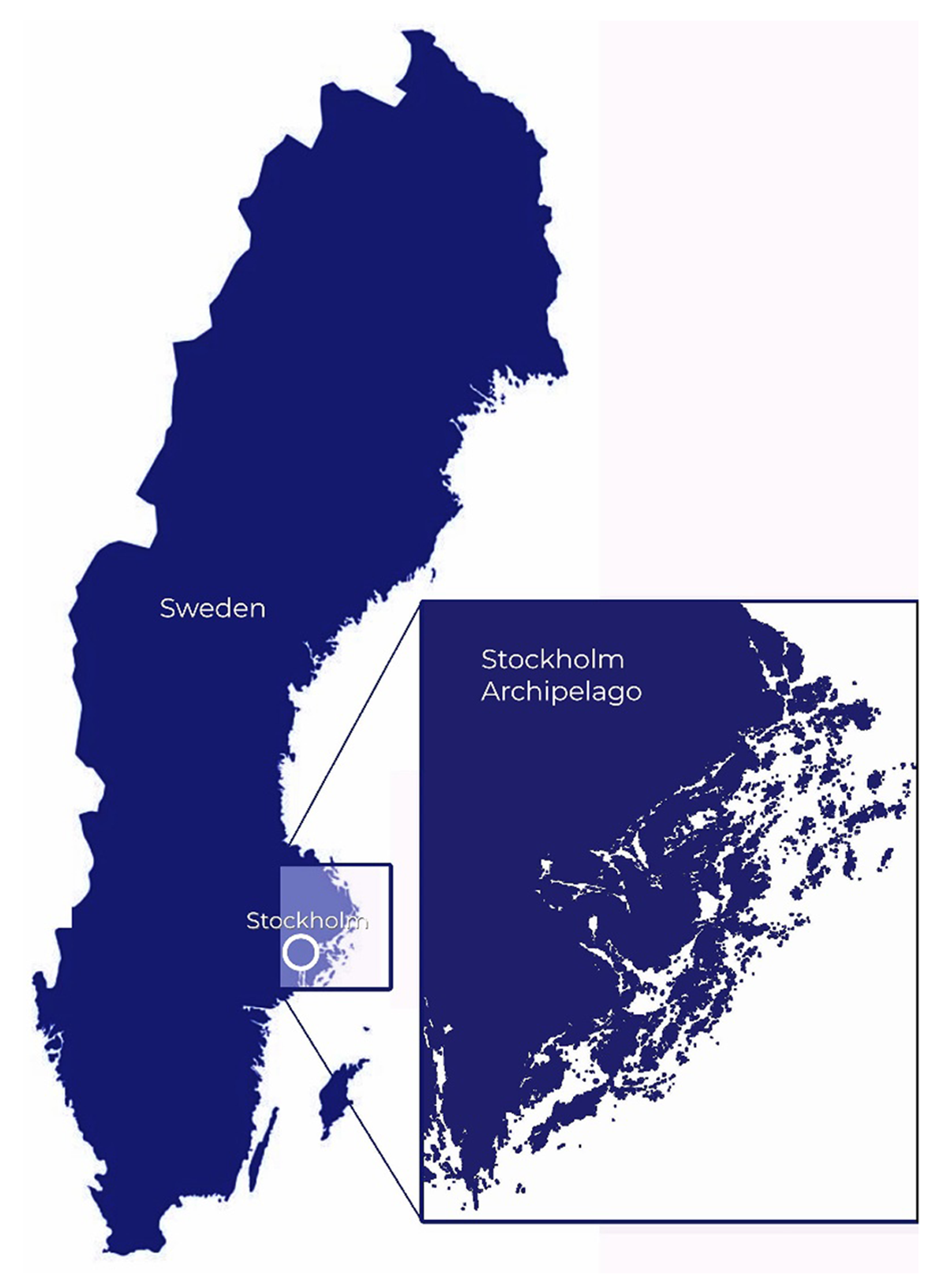
Figure 1
Design: Author.
Nevertheless, research on the landscape imaginaries of Stockholm archipelago is surprisingly scarce except for a few studies where it has served as a backdrop of diverse importance (Heldt Cassel 2003; Åberg 2010; Englund 2011; Syrjäla 2022). However, in two seminal articles, by the human geographer Urban Nordin (2005a; 2005b), the subject has been investigated more systematically. Nordin’s works were, however, published before the advent of social media. Thus, a retake on the case of Stockholm archipelago is justified for several reasons. First, given Stockholm archipelago’s continued symbolic importance in the Swedish national narrative it deserves more attention. Second, the number of disseminated archipelago representations have skyrocketed with the advent of social media. Third, apart from the heightened production and dissemination of archipelago images, social media has also introduced new tecno-cultural elements (e.g., hashtags, geotags, likes, etc.) which have resulted in hitherto unseen, but not necessarily apparent, interventions in the imaginaries. How have the established landscape imaginaries of Stockholm archipelago been impacted by the advent of social media visualizations?
By utilizing Instagram posts pertaining to Stockholm archipelago as a case study, present enquiry aims to investigate how established landscape imaginaries appear in the light of visual conventions, online environment, and social codes that accompany social media. The analytical approach stems from the concept of landscape imaginaries, i.e., how collective understandings and representations of landscape render space (Walsh 2020; cf. Gieseking 2017; Pettenati 2023). This social constructionist concept emphasizes human induced aspects of what we usually treat as natural. However, even though the analysis only touches upon the question of machine-made elements (e.g., algorithms), it also aspires to exhibit that even non-human actors influence the production of culture in contemporary online society (Gillespie 2015). The analysis focuses on pictures (photography), symbols (emojis), and text (captions, hashtags, and comments). Due to Instagram’s emphasis on photography, significant attention will be given to visual analysis which is centered around the meaning-making of posted photographs.
Romantic landscapes
The spatial concept of landscape is intensely visual (Cresswell 2015, p. 17). The landscape as a motif, in its own right, dates back to the seventeenth century (Wells 2011, p. 27). Introduced during the Enlightenment, an Arcadian vision of the rural, where order and harmony ruled, started to take hold. English country houses were constructed, first by the aristocracy then the industrialists, as a ‘natural’ place from which to look out, to contemplate views (Wells 2011, p. 28–9, 46). This conservative and uncritical landscape vision was adopted when new media was introduced. Thus, it came to accompany the mass printed photography in newspapers and magazines around the turn of the 20th century (Wells 2011, p. 32). By the time of industrialization and urbanization pictures and texts of the rural idyll became popularized and disseminated through mass printed reproductions, predominantly in Great Britain (Wells 2011, p. 33, 45). The notion of the romantic landscape was thus established. Eventually, tourism industry was able to make big business of visual appealing landscapes from the second half of the 20th century and onwards (Chylińska 2019; Urry 1995; Urry and Larsen 2011). A similar process eventually took place in Sweden where paintings and the illustrated mass media began to popularize the rural idyll during the modernization process around the turn of the 20th century. At that time, Stockholm archipelago was one of the rural regions that were given special attention (Nordin 2005a).
Yet, maritime regions, that were being romanticized parallel with mainland rural idyll, came with additional layers of meaning (Wells 2011, p. 23). Here, the Western master metaphor of the island played a crucial role (Gillis 2004, p. 3). It has been argued that representations of rural islands, molded from the master metaphor, makes up a ‘mindscape’ of the ‘summer island’ (Lönnroth and Ronström 2018). It is composed of ideas about remoteness (cultural, social, temporal, and spatial distance) archaism (an emphasis on the old, unique, and authentic); boundedness (uniqueness, peculiarity, and distinctiveness); endemism (an emphasis on isolation, independency, the self-contained, identity, and pride) (Ronström 2013). Thus, the mindscape of the summer island shared characteristics with the notion of mainland rural idyll, but perhaps a stronger emphasis was given to the element of remoteness and isolation.
Stockholm archipelago of the mind
In Sweden, the symbolic currency of Stockholm archipelago and the discursive trajectory of the region matches that of the Lake District in UK; rural New England in USA, and the Highlands in Scotland (Brown 1995; McDonald 2002, p. 54–74; Urry 1995; Wells 2011, p. 45). As such it can be labelled an iconic landscape (Edensor 2002, p. 40; Nordin 2005b). It has been carved out in popular culture since the late 19th century.
In 1887, the author August Strindberg introduced Stockholm archipelago for a wider Swedish audience with his book Hemsöborna (The People of Hemsö). The novel presented a satirical view of the slightly backward life in the archipelago simultaneously as it praised the inhabitant’s ability to survive in a harsh natural environment. At the beginning of the 20th century the author and illustrator, Albert Engström, continued to popularize the archipelago through his comical depictions of the traditional island inhabitants whom he portrayed as rough and heavy drinkers and at the same time skilled and lovable. Strindberg, Engström and Bruno Liljefors, who painted naturalistic wildlife tableaus, were three prominent authors and artists around the turn of the 20th century to popularize the emerging imaginary archipelago (Åberg 2010; Nordin 2005a; Nordin 2005b). Soon, an idyllic haven, where affluent Swedish town dwellers enjoyed playful activities and celebrated Midsummer, started to emerge.
From the 1930s, Swedish radio broadcasts of the so-called Archipelago Waltz began to cement the imaginary Stockholm archipelago. The central figure of this genre was the poet and songwriter Evert Taube (Åberg 2010; Nordin 2005a). Taube’s songs are concise accounts of beautiful archipelago settings during the summer. Taube, perhaps along with Strindberg, is one of few pioneer image producers of the archipelago who, still today, is cherished and widely used to signal romantic imaginaries of Stockholm archipelago.
During the 1940s and the 1950s a specific film genre, the Archipelago film (an agrarian-romantic idealization of the rural), helped popularize the archipelago. Several of these movies were based on Strindberg’s book Hemsöborna and Engström’s comical depictions of the island inhabitants (Åberg 2010). And even though figurative paintings may have gone out of fashion among most academic artists during the 50s, traditional and slightly romantic, paintings of the archipelago did not decrease in popular culture during this period. One of the more noticeable archipelago painters from the 50s and throughout the second half of the 20th century was Roland Svensson, whose visualizations of the region were reproduced in several major Swedish monthly magazines (Lidén 2022). In the late 50s, Svensson was one of the founders of Skärgårdsstiftelsen (The Archipelago Foundation), which is a publicly funded institution that influences Stockholm archipelago still today, mostly through its preservationist projects.
From the 1960s, TV series, like Vi på Saltkråkan (The Children of Salty Crow) became successful (Åberg 2010). According to the cinematographer Åberg, The Children of Salty Crow staged Stockholm archipelago as a combination of the egalitarian ‘Peoples Home’ and a utopian Arcadian space (Åberg 2010). The Children of Salty Crow eventually resulted in four feature films. The films were all among the ten top grossing films of the 60s (Åberg 2010). During the following decades, the Arcadian archipelago was replicated in several TV series and radio broadcasts.
Though popular culture has been fundamental in the production and diffusion of the imaginary landscapes of Stockholm other spheres have been beneficial as well. The Archipelago Foundation, mentioned above, has been one important actor. Others are, like public officials in their reports on various questions pertaining to the archipelago, and the Swedish tourism industry. ‘Close, yet a world away,’ says the publicly funded online portal stockholmarchipelago.se, attempting to attract international and domestic tourists to Stockholm archipelago (stockholmarchipelago.se). The different kind of world referred to, thus, recycles the established landscape imaginaries of Stockholm archipelago.
Instagram affordances and landscape imaginaries
Some years into the new millennium social media alleviated the possibility for others than artists, film makers, TV, and radio producers to present their view of the archipelago. The new terrain gave room for practically anyone to present their individual version of the region. However, the supposed democratization came with flaws. Social media platforms are usually only open and democratic in the rhetoric about themselves since they have the right to remove any content considered inappropriate (Bishop 2018; Gillespie 2015; Pietrobruno 2013; Widholm 2022). In addition, the platform companies only provide rudimentary insight to how algorithms influence the use and content of the platforms (Bishop 2018; Reider et al., 2018). And, as Smith (2018) and Oh (2022) have indicated, the platforms’ anticipated individualization of popular discourse, where each and every one posts according to their unique will, has not yet been realized.
Erz et al. (2018) state that Instagram in general is a stage for individual self-presentation. According to their line of reasoning, a post on Instagram is not for the sake of community, but for the individual users themselves. Consequently, Erz et al. (2018) present the assumption that suggests a connection between Instagram use and certain personality traits, specifically narcissism. This seems to be exacerbated by Instagram’s ‘attention economy’ which is optimized for the maximum accumulation of ‘likes’ (Smith 2018). The pursuit of ‘likes’ and followers consequently steers its users and transforms posted images into commodities that can be exchanged for ‘likes’ (Smith 2018). The hashtag functions, however, seem to have the ability to counter these not so attractive traits.
Hashtags were first developed on Twitter to facilitate the grouping together of tweets on similar topic and to enable searching (Conti and Heldt Cassel 2020; Scott 2018). Hashtags have a broadcasting function which increases visibility of content. Besides facilitating increased reach of content, the hashtag functions as a keyword or a string of words, to make it a hyperlink. Clicking on a hashtag enables the user to scroll through pictures that have been posted in connection with a hashtag. Adding hashtags serves connecting, coordinating, and promoting content. Thus, hashtags work as a relationship-enacting function at the same time as its semiosis can guide the reader towards an intended interpretation of a post (Erz et al., 2018).
Studies exploring how social media have influenced landscape imaginaries are still emerging. Significant for present study, are Smith’s analyses (2018; 2021) on how dormant aesthetics motifs, like colonial ones in Smith’s case, have been re-energized on Instagram. Other relevant studies are Oh (2022) and Parris-Piper et al. (2023) who have studied how Instagram posts pertaining to rural Asian destinations (in South Korea and the Philippines) rapidly have changed both its material and imagined landscapes the last ten years. Worth mentioning, though it lacks a clear connection to imaginary landscapes, is also a netnographic and interview study, by Conti and Heldt Cassel (2020), which suggests that Instagram can offer a space for creative identity constructions within rural tourism.
Smith shows how Instagram visualizations co-create imaginary rural landscapes of the Global South. Both his studies on the subject connect to the visual canons of the colonial picturesque and the romantic sublime to illustrate how Instagram users today represent landscapes (Smith 2018; 2021). Smith argues that consistent visual norms and motifs on Instagram echo a colonial iconography that sees tourist destinations as available for possession and consumption (Smith 2018, see also Edensor 2001; Urry and Larsen 2011). The visualizations, paired with textual captions and hashtags present tourists as rightful occupants and users of local spaces. With a similar analytical approach, Oh (2022) and Parris-Piper et al. (2023) point to Instagram’s ability reshape specific destinations. In Oh’s study, the concept of ‘Instagramism’ is used to highlight how aesthetic aspects of a place (a rural South Korean island) overshadow lived experiences. And in Parris-Piper et al. it is analyzed how the ‘attention economy,’ orchestrated by platform logics and user conventions, takes command over a place (a rural seaside destination in the Philippines) with visualizations of seemingly empty landscapes that boxes out local branding efforts which try to represent the destination in a balanced way. The case of Stockholm archipelago on Instagram shows several points of contact with mentioned studies’ point of departure even though the geographical setting differs. First, present study takes seemingly banal social media posts seriously. Second, the present study adheres to the view that how a landscape is visualized can have significant effects on how we act upon it. Third, where and how the visualizations are created and disseminated is crucial (there are e.g., obvious differences between the context of the famous painter who depicted and exhibited a landscape during 19th century and that of an ordinary person of today who uses a smartphone to photograph landscape and then posting it on a social media platform). Fourth, although the empirical material in this study is sampled from a twenty-first century digital platform the analysis takes into consideration sedimented historical structures and conventions.
Method
The method combines reflexive thematic analysis (Braun et al., 2019) and netnography to give an overview and a first assessment of Instagram posts and interface characteristics that meet the eye while the subsequent semiotic analysis aspires to unpack the secondary meaning of the content. Focus lies on the themes in the table below (Table 1), but the analysis also refers to some miscellaneous posts which overlap with the main themes. The posts’ account names of individuals have been deleted (except for names of businesses) from following presentation for the sake of research ethics.
Table 1
Examples of noticeable themes on #stockholmsskärgård and #stockholmsarchipelago on Instagram.
| #STOCKHOLMSSKÄRGÅRD | #STOCKHOLMARCHIPELAGO | |||
|---|---|---|---|---|
| Sampled posts in total | 529 | 438 | ||
| Romantic landscape | 144 | 29% | 118 | 27% |
| Commercials | 120 | 24% | 70 | 16% |
| Pictures including humans | 70 | 14% | 60 | 14% |
| Pictures including boats | 64 | 13% | 37 | 8% |
| Selfies | 10 | 2% | 6 | 1% |
Sampled Instagram posts derives from a method called netnography. Its foundation is online observation, ranging from participation within studied online communities to passive lurking (Costello et al., 2017). The observation here has been passive to the extent that no communication with account curators at studied hashtags took place. The netnographic approach has also been used to explore stylistic conventions and platform specific attributes and their possible influence on the how the archipelago is represented, e.g., how the platform interface, emojis, comments, like selfies, challenge or confirm the established landscape imaginaries of the archipelago.
In addition to the thematic and netnographic analysis, the present study aspires to move beyond the Instagram posts’ superficial message to be able to unpack connotative meanings. This decidedly qualitative method relies more on an acquired awareness of studied phenomenon and theoretical concepts than on clear-cut methodological tools. As such, it is a tentative approach. It borrows concepts and perspectives from the disciplines of Cultural Studies and Semiotics which treat words, pictures, sounds, etc. as meaning-making signs, e.g., a picture of a Swedish wooden sailing boat (signifier) which comes to stand for ‘something else’, e.g., Stockholm archipelago (signified) (Chandler 2007; Hopkins 1998). The Cultural Studies scholar Stuart Hall has said that ‘we give things meaning by how we represent them … the stories we tell about them, the images of them we produce’ (Hall 1997, p. 3). Thus, there are choices among available options to communicate. This includes, e.g., technical and aesthetic options relating to camera work (Fairclough 2003, p. 24). Consequently, it is not possible to separate out ‘what is said’ from ‘how it is said’ and means employed to convince us to see things a certain way (Lister and Wells 2001, p. 89–90). In addition, the present study adheres to the view which questions the possibility of individuals to be the unique source of meaning-making (Hall 1997, p. 25). Rather, collective meaning-making is of interest for the analysis. Thus, the concept of convention is utilized to unpack the Instagram posts (cf. Widholm 2022). Taking photographs with a smartphone is a practice that is enacted in the course of everyday life, and it is guided by social conventions (Thelander and Cassinger 2017). Conventions are safeguarding naturalness and taken-for-grantedness (Lister and Wells 2001, p. 14, 75; Hight 2014). As such, conventions tend to conceal meaning-making processes. Barely noticed, but familiar, conventions express cultural membership and rely on similarity of experience—they are reassuring, they produce conformity and resistance to change (Fiske 1990, p. 56, 77–80).
Sampled Instagram posts
The hashtag #stockholmsskärgård had 113,263 posts on March 22, 2023 and #stockholmarchipelago had 89,658 posts the same date. The 967 selected post is the result of a manual mining of all posts from both hashtags respectively the 15th every month during a sixteen-month period (April 15, 2021 to July 15, 2022). During the sampling period posts on hashtags were chronologically ordered and no supplementary software was used for the mining. However, in early 2023, while working on the manuscript, it became clear that Instagram had changed its hashtag feed. Now it arranges the post according to ‘top posts’ and ‘recent top posts’, which results in an inconsistent chronology. Consequently, an important methodological aspect to keep in mind is the fluid characteristics of the Instagram ‘archive’ (cf. Bishop 2018).
The geotag function on Instagram (e.g., connecting a post to a specific city) can be used as an option to sample representations from a place. This function, however, is not suited for an investigation of a vast, and somewhat vaguely enclosed, region like Stockholm archipelago. By way of example, the location for the English geotag, ‘Stockholm archipelago’, was, at the time of the study, oddly specific. It was placed at a tiny spot in the inner parts of the archipelago (Strömma). And the Swedish geotag was off the chart, located in one of Stockholm’s mainland suburbs (Rågsved). Interestingly, the latter place does not connote a rural idyll. Quite the opposite.
Most of the posts contained only still pictures, however, there were video clips present as well (46 out of 967). These were analyzed as still pictures since they were sampled through screenshots. When it comes to the thematization of the posts, it stems from their visual content in terms of visual genre (e.g., landscape photography, selfie, commercial) and reoccurring elements, or lack thereof, in several pictures (e.g., pictures including boats and pictures including humans, or lack of humans). Most of the posts include landscape photography. This theme has been termed ‘romantic landscape’. These visualizations are generally appealing since they stage a picture-postcard landscape (see Wells 2011 and Chylińska 2019 above).
The Table 1 below shows a thematization and quantification of themes which are either salient because of their evident frequency or because of being conspicuously scarce. The neat table, however, only gives an illusion of qualitative distinct themes (cf. Braun et al., 2019). So, e.g., a commercial post can make use of photographs that overlap with another theme, e.g., romantic landscape. In that case it is counted as belonging to both themes. Note that the table only offers a brief overview of visual patterns since the aim of the study is not to fully categorize or conduct precise quantification of Instagram posts pertaining to Stockholm archipelago. In addition, the analysis will also refer to uncategorized posts from the hashtags, beside the themes of the table, that are considered meaningful in relation to the Landscape imaginaries of the archipelago.
Stockholm archipelago on Instagram
Visual inertia
Sampled posts are not evenly distributed over the period. For example, 83 posts were published on #stockholmarchipelago on the 15th of July 2021, whereas the same hashtag only had five posts on the 15th of February 2022. Thus, the overall content in the posts tends to emphasize the notion that the archipelago is mainly a summer landscape. This seasonal aspect offers the romantic landscape specific qualities (see Table 1 for the quantity of posts including a romantic landscape on respective hashtag).
A typical romantic landscape picture among studied posts can be composed accordingly: blue sky, still sea, calm weather, a patinated jetty, no people in sight (see Figure 2). Another example reads: sunset, still sea, calm weather, islets, sailing boats at an anchorage (see Figure 3). The overall picture evokes a scenic place. Even though seascapes can be unforgiving, awe-inspiring depictions (e.g., winter storms) are absent. The text messages accompanying the photos are often redundant, just describing what the pictures (and perhaps geotags) already have shown. Like in Figure 5 where the caption says ‘På svaj i björkskärs skärgård’ (At anchor in Björkskär’s archipelago). They can also add meaning to the post, like the caption in Figure 2, ‘God morgon! [sun-emoji] Lugnet innan dagen drar igång’ (Good morning! [sun-emoji] The calm before the day starts). The message might not seem that significant, but together with inserted hashtags—#morgondopp (morning swim), #svensksommar (Swedish summer), #stockholmsskärgård (Stockholm archipelago)—a recreational summer Arcadia is induced.
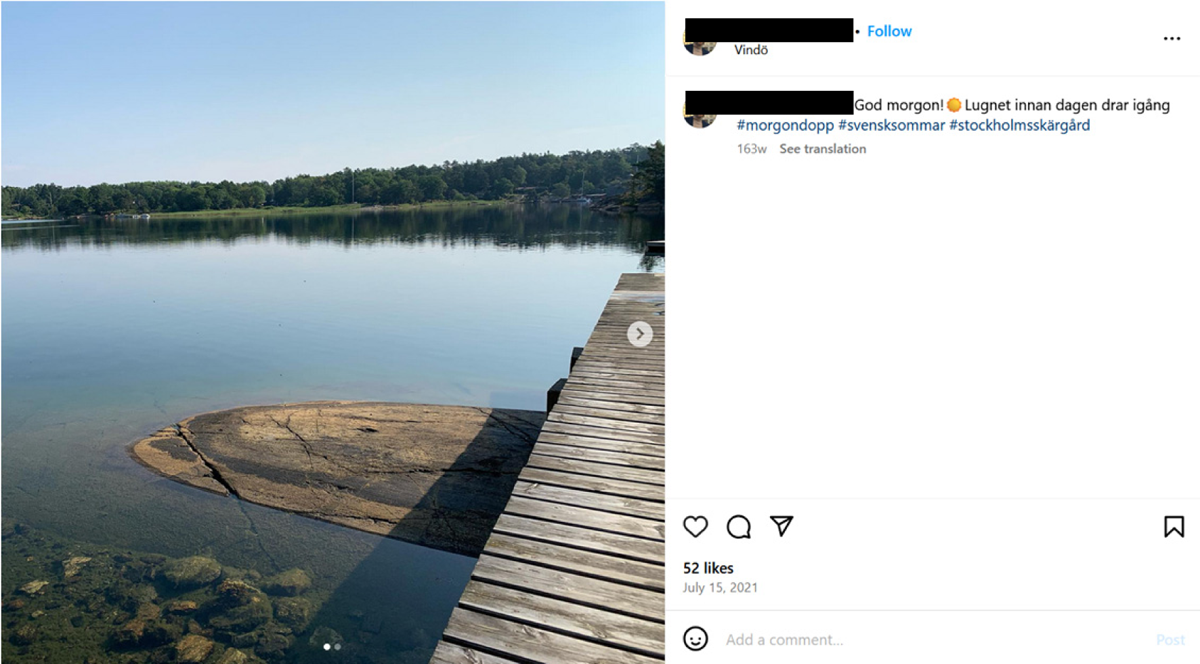
Figure 2
Instagram post from #stockholmsskärgård.
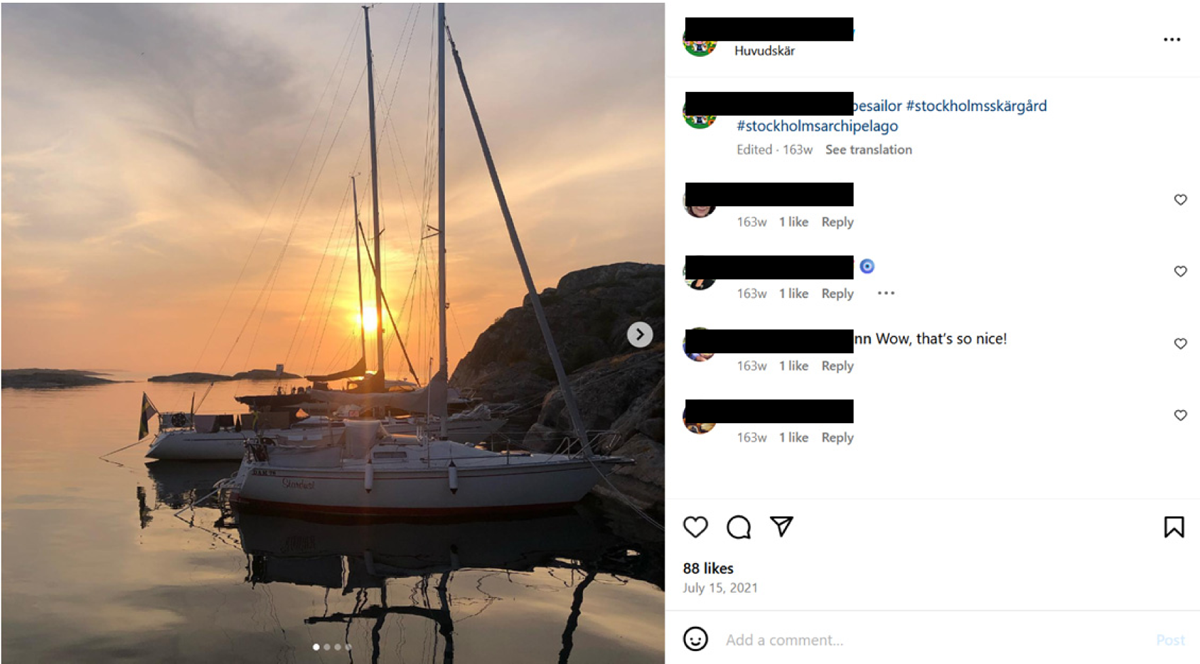
Figure 3
Instagram post from #stockholmsskärgård.
These landscape photos borrow their form and content from the genre of picture-postcard landscape paintings. Interestingly, the Swedish hashtag (#stockholmsskärgård) includes a handful of posts from (what seem to be amateur) artists promoting their paintings of archipelago landscapes, through photos, which takes this odd theme to a meta-level (Figure 4). The more than a century old visual tradition reproduced in these photos show a technique that was used already at the inception of the imaginary archipelago. By way of example, these posts point out an inertia when it comes to possible ways to visualize Stockholm archipelago. The photos all allude to an Arcadian space (Åberg 2010; Wells 2011), the idealization of the rural seaside. The romantic landscape has migrated over different kinds of media platforms since its initiation, and right now it is thriving on Instagram. The knee-jerk habit of representing the archipelago with beautiful sceneries was in place already before the smartphone and social media, but earlier the habit was limited by the length of the analogue film roll. No such limits exist today. Consequently, even without knowing the exact numbers on archipelago visualizations before the age of social media it would be safe to say that the number of romantic landscape representations today is climbing sharply. The low number of ‘likes’ (Figure 5) these romantic landscape pictures obtain, suggests a fatigue towards its aesthetics. However, the force of habit seems stronger than the social media logic which suggests that the currency of ‘likes’ stands in direct relation to the content of a post (Smith 2018).
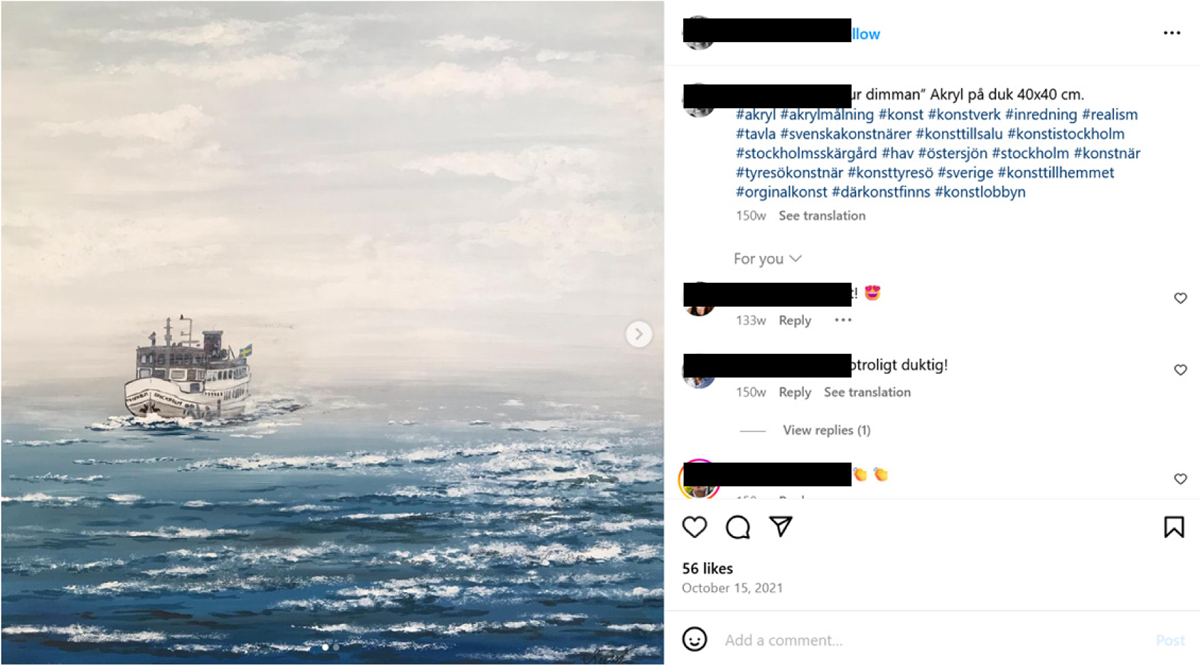
Figure 4
Instagram post from #stockholmsskärgård.
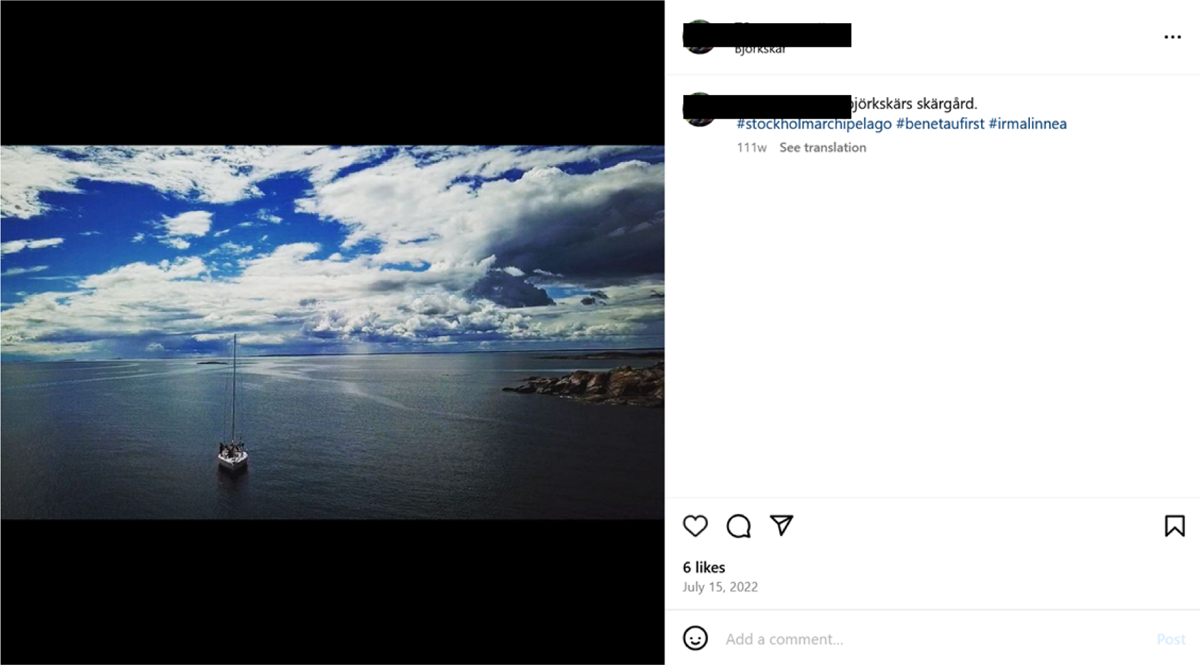
Figure 5
Instagram post from #stockholmarchipelago.
The romantic landscape theme preferably consists of nostalgic objects. The patinated jetty, commented on above, is one example. Other examples are photographs on old school commuter vessels (like the photograph of the painting in Figure 4) which still is in operation today to some extent; the traditional three-wheel moped; red painted cottages and boathouses. When it comes to pictures on boats it is the old commuter vessels that represent nostalgia. Photographs on pleasure boats (both sailing boats and motorboats) seldom display old wooden ones (see Table 1 for the quantity of posts with pictures including boats on respective hashtag). This defies the retro aesthetics of contemporary professional photographers who tend to include wooden, i.e., so-called authentic, boats in their photographs when Stockholm archipelago is being romanticized in coffee table books (Nordin 2005a). Thus, the photographs of pleasure boats do not easily fit in with the theme of romantic landscape. Nevertheless, taken together, the objects that accompany the theme resonate of the term ‘Country Cute’ which denotes ‘an imitated and gentrified version [of a pre-modern life and] aesthetics where past … hard living conditions have withered with time’ (Salomon 2006, in Lagerqvist 2014). Leaving the outdoor scenes for a moment, the ‘Country Cute’ aesthetics is also on display in scattered posts showing off meticulously preserved (or restored) interiors of residences (most likely second homes) in the archipelago region.
The romantic landscape on the Instagram hashtags is peculiarly empty of human beings. The permanent population in the vast Stockholm archipelago is about 10,000. In that sense it is a meagerly populated region which is reflected in sampled posts. However, during summer, when most of the landscape photographs are posted, Stockholm archipelago’s more than two million brief visitors and second home-owners flock to the region (Franklin and Ölfvingsson 2022). So, despite the statistics that tell us that Stockholm archipelago is far from desolate during summer, the myriads of photographs from the region reassure us that the region is almost devoid of human beings.
According to Parris-Piper et al. (2023) a ‘murkily defined algorithm’ could explain the proliferation of the aesthetics of emptiness. In 2016 Instagram introduced a new way of organizing users’ feeds which acted on predictions of the likelihood the user would engage with the content. Popularity of the image together with users’ previous activity and conventions among account curators with a lot of followers (i.e., influencers) led to a decrease of ‘diverse, place-based images with people’ and an increase of pictures ‘with abstract, highly filtered images without people’ (Parris-Piper et al. 2023). However, the present study has sampled chronologically ordered posts from two hashtags feeds, not individual ones, where few, or perhaps one, so-called influencer was present. So, it is not the case that the aesthetics of emptiness representing Stockholm archipelago in this study is shaped by algorithms and influencers.
Smith (2018), on the other hand, traces the empty landscapes on Instagram to colonial discourses. From his perspective the pictures might be read as acts dominance. The lack of humans echoes of the ‘tabula rasa’ aesthetics of Instagram posts on the rural Global South. The visualization of emptiness, Smith writes, is ‘an imaginative seizure of … destinations from local inhabitants.’ Thus, ‘the framing of scenery becomes an exercise in … domination over’ the locals. This exercise of symbolic power is rooted in tradition—the European paintings from the 18th and 19th centuries, according to Smith (2018). But if we are dealing with the practice of domination in Stockholm archipelago, it is most likely unintentional, just like it is suggested in Smith’s analysis. However, even if it is unintentional, it colors the way the landscape is imagined. In a later study Smith (2021) has brought forth another reading of how to understand the exhibited emptiness which is perhaps more applicable to the posts on the Stockholm archipelago hashtags since the region tends to attract an affluent segment of second home-owners. He suggests that the aesthetics of emptiness today is a convention in luxury tourism advertisements and that ‘emptiness privileges tourists as the sole consumers of a landscape … with its [locals] hidden from view’ (Smith 2021). Thus, the overcrowded spots in the region during summer, like Sandhamn marina or popular anchorage sites, like Northern Nåttarö, are excluded in the posts of the Stockholm archipelago hashtags.
Challenging modern conventions and tradition
When people do appear in the posts from studied hashtags, the assumption that Instagram is a platform for narcissists (cf. Erz et al., 2018) is challenged (see Table 1 for the quantity of posts with pictures including humans on respective hashtag). It has been assessed that 24.2% of images posted to Instagram are selfies, and that it is the largest visual category (Matley 2018). In the 967 posts on the two hashtags pertaining to Stockholm archipelago the number of selfies is, however, insignificant (see Table 1 for the quantity of posts including selfies on respective hashtag). There are ten on the Swedish hashtag and six on the international. Then, what kind of pictures are we dealing with when people appear in them? For example, people steering pleasure boats; portraits of someone looking at the landscape; youngsters jumping into the water from jetties (Figure 6); a group of people paddling kayaks; people having a beach party; passengers on a commuter vessel; portraits of small children in summer landscapes; portraits of men and boys with their fish catch; a group of people having an extravagant dinner and champagne outside a boathouse, etc. Thus, apart from perhaps the last motif, we are not dealing with visualizations that clearly connote self-promotion. Rather, the photographs might indicate the opposite, that the community and the shared place is of greater significance than the self. But does this necessarily mean that the posts are devoid of self-centeredness? Smith (2021) has claimed that the rather specific motif called ‘promontory witness’, which is a landscape picture that portrays a traveler on a bucket-list tour, could be understood as an act of self-aggrandizement. The motif Smith discusses is not a selfie, but it is neither visible among the pictures in present study. Could it be that the narcissistic dimension is latent in these seemingly unselfish photographs, nonetheless? Given the overall romantic representations of the hashtags it would perhaps be possible to suggest, in a somewhat similar vein like Smith (2018) and his ‘promontory witness’, that what we are dealing with is narcissism in disguise. Thus, even if selfies are practically absent from the posts, the Instagram users give way to showing off the seemingly beautiful landscape they are able (or can afford) to consume. Treating the photographs including people that way it could be claimed that self-aggrandizement is at play even without the modern convention of selfies.
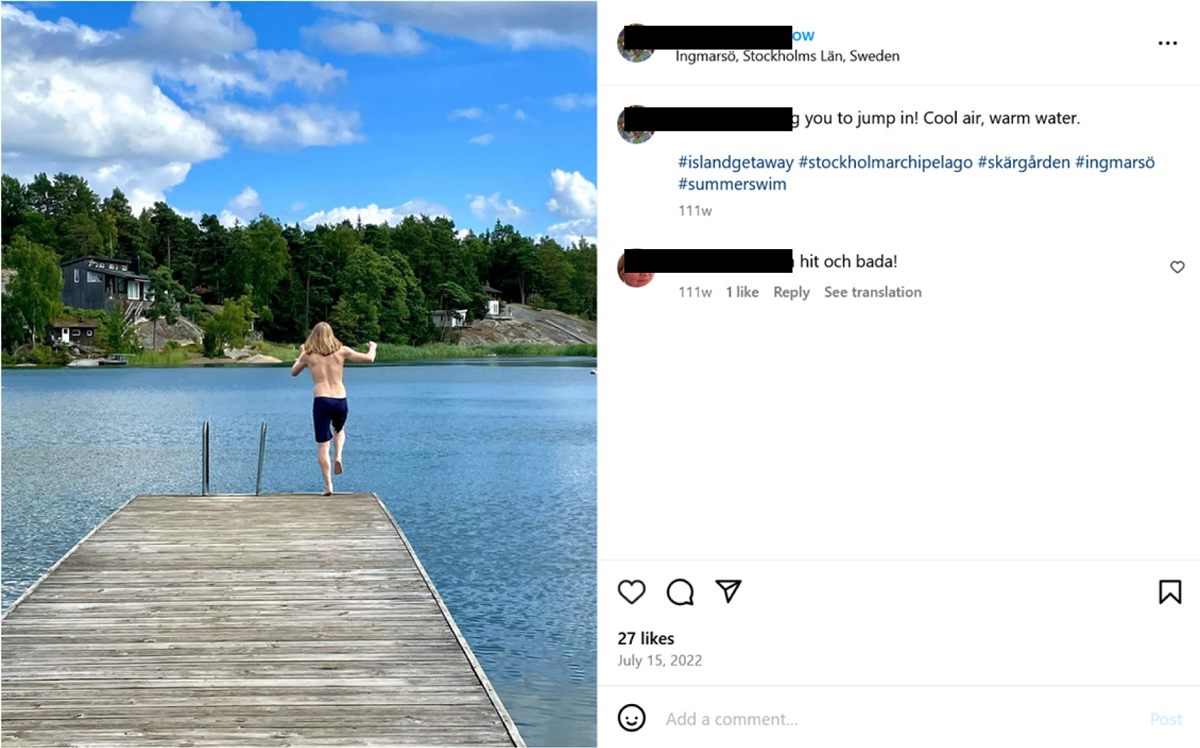
Figure 6
Instagram post from #stockholmarchipelago.
Another theme, which might be said to challenge the traditional visual Arcadia of the archipelago is found in the posts from businesses present on the hashtags (see Table 1 for the quantity of commercial posts on respective hashtag). The commercial value of the Arcadian archipelago did not, however, appear out of the blue with social media. The archipelago has been commodified historically (e.g., it has been beneficial for the music and cinema business since the 1930s) and in that sense the Arcadian archipelago has been, if it is to be imagined as free from commerce, challenged since its inception. But while the commoditization of the archipelago before the age of social media made explicit use of an established imaginary landscape, the commercial posts on the Instagram hashtags sometimes seem arbitrary, even spam-like. Their connection to the archipelago can be hard, or even impossible, to spot, both when it comes to visuals and text. For example, advertisements for car washing products (‘rapidglans’) and certain cosmetics (magnoliagreen.se) exhibit a non-existent connection to the region. We can assume that the appearance of commercial posts with no obvious connection to Stockholm archipelago has to do with the lure of increased reach, with almost no effort, is at play. Thus, the firms are drawn to the hashtags because of the traffic they generate (about 100,000 posts each), i.e., where there are people, there is money.
Then there are advertisements where the connection can be noticed only in the name of the firm’s Instagram account, e.g., ‘skargardensvvs’ (roughly, The Archipelago’s Plumbing) and ‘mojavardshusochbageri’ (Möja’s [an island in the archipelago] Inn and Bakery). Neither the photographs nor the captions of the latter examples suggest any obvious ties to the archipelago. However, the posts are from the Swedish hashtag, and the Swedish speaking user, who is literate in online lingo, that do not separate words with spacing, can probably spot the connection. This is possibly not the most effective way to parasitize on the archipelago’s symbolic value. Advertisements making use of the archipelago’s ‘Country Cute’ elements are perhaps more efficient, e.g., ‘Gustavsbergs auktionskammare’ (Gustavsberg’s antiquities) and the dress shop ‘Linen for life’ (Figure 7). These two firms also seem to be based in municipalities on the edge of the archipelago.
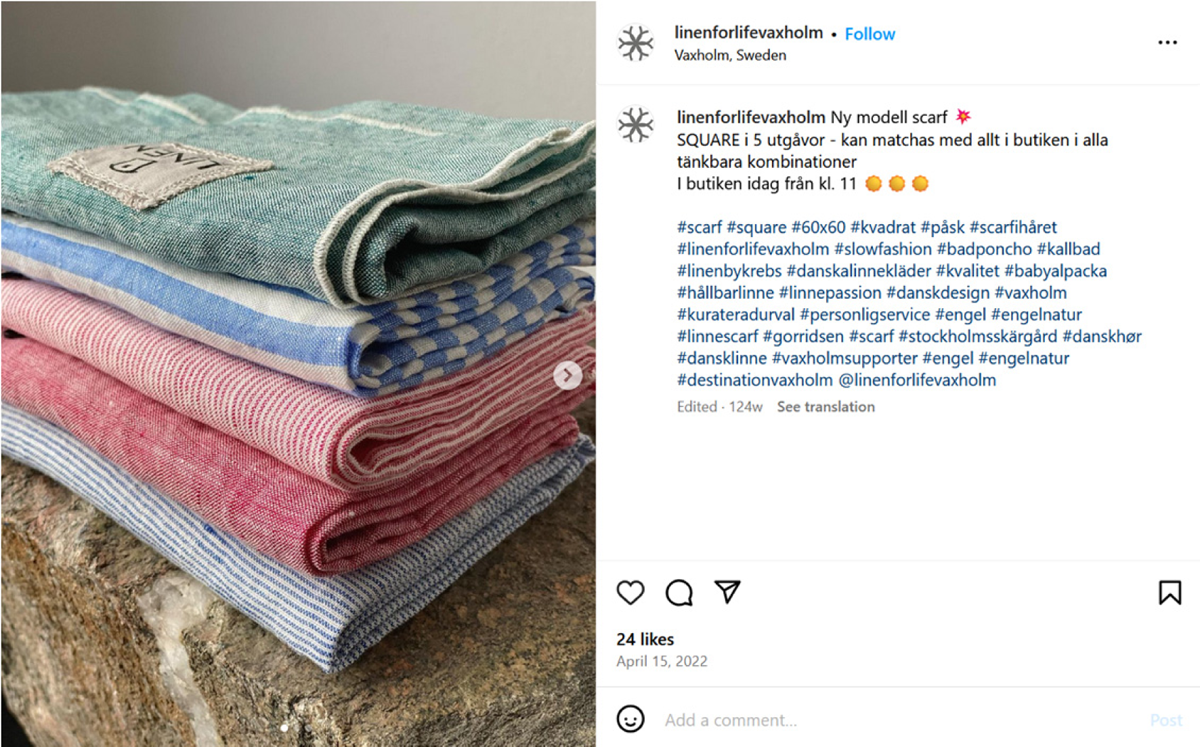
Figure 7
Instagram post from #stockholmsskärgård.
The possible blurring of borders between the non-commercial and the commercial might be intriguing, but perhaps not as mysterious as Conti and Heldt Cassel (2020) propose. In their study of rural tourists’ Instagram use they suggest that due to the commercial posts on Instagram we are witnessing a formation, ‘in sophisticated ways’, of ‘liminal space between the personal/emotional and the commercial’ (Conti and Heldt Cassel 2020). It is unclear whether this implies that Instagram users in general finds it difficult to discern what is commercial or not on Instagram. Nevertheless, judging from the posts on the two archipelago hashtags it is rather easy to decide what is commercial content and instead of liminality, the conditions here more look like a premature online arena where business tries to take advantage of a novel online environment and its devices (e.g., hashtags), in a not so sophisticated way. Let us now consider the hashtag’s collectivization qualities.
A hashtag community of mainlanders?
Landscape imaginaries needs to be social, i.e., shared, to be meaningful. An imagination sealed in the skull of an individual is socially pointless and would not move through time. Besides Oh (2022), and Parris-Piper et el. (2023) explicit discussions about the collective dimension have not been given that much attention in previous studies about Instagram. The tendency to treat Instagram as a platform where individuals practice promotion of self has largely led previous research to view the platform either optimistically: a forum for personal development (cf. Conti and Heldt Cassel 2020), or pessimistic: a forum that nurtures narcissism (cf. Erz et al., 2018) and self-aggrandizement (Smith 2021). Even if mentioned studies also have touched upon the Instagram’s relationship-enacting dimension, the ‘social-networking’ characteristics have been attributed to other platforms, e.g., Facebook (Erz et al., 2018). Furthermore, the seemingly individualistic traits of Instagram have been coupled with discussions on identity as if identity only had to with the individual matters and that collective identity did not exist (cf. Conti and Heldt Cassel 2020). Whether the platform fosters narcissists more than unselfish communities cannot be determined here. Nevertheless, with the hashtag function comes a community building aspect since it ties posts, and thus Instagram users, together. An assessment of the characteristics of possible collective identities on studied hashtags can at least discern that a common denominator among its members is that they share an admiration for the Arcadian version of Stockholm archipelago. As such we might call it a virtual congregation that throughout the calendar, preferably more so during the summer months, sacrifices visual representations in the name of an imaginary archipelago. And due to the shared imaginaries’ visual conventions the posts sustain conformity when it comes to how the archipelago can be depicted. It is not clear whether the community consists of islanders or mainlanders but given that the number of second homes in the region is almost three times higher than the number of permanent inhabitants (Marjavaara 2007); the focus on recreational activities in the posts; and the increase of posts during summer we can assume that the islanders only represent a minority of the Instagram users on the two hashtags.
Concluding Remarks
Previous studies have shown that the landscape imaginaries of Stockholm archipelago, which emerged during late 19th century, have successfully migrated over different media (Åberg 2010; Nordin 2005a; 2005b). So, for more than a century the Arcadian version of the archipelago has been sustained. Hitherto, however, it has not been investigated whether social media has influenced the imaginaries. The aim of this study was to investigate how and if the imaginaries have been influenced by representations on Instagram. Research on Instagram posts’ possible influence on landscape imaginaries pertaining to other regions suggests that it is wide-reaching. Thus, it has been claimed that Instagram induced landscapes have changed the material life in parts of the world, sometimes violently (Oh 2022; Parris-Piper 2023). No such forces or changes can be tied to how Stockholm archipelago is represented on Instagram. Other studies have shown that once criticized landscape imaginaries, e.g., the colonial, have been rejuvenated by Instagram as if the earlier critique was an illusion (Smith 2018; Smith 2021). Again, nothing in the posts in the present study resembles such a process. The imaginary Stockholm archipelago has indeed been scrutinized by some scholars (e.g., Åberg 2010; Nordin 2005a; Nordin 2005b), but in general, within popular culture and the Swedish national narrative, it has remained largely intact—so there is nothing to revive. The conspicuous absence of selfies among the archipelago posts seems indicative of the established imaginaries inertia. However, instead of just sustaining status quo, the accumulating number of Instagram posts representing the archipelago implies that the established imaginaries are not only maintained but reinforced. Thus, the Instagram posts serve the traditionalist view on the region with an overall reassuring picture that defies social media’s anticipated proliferation of a ‘plethora of unique visual styles’ (Oh 2022). The most salient visual theme in present study, termed romantic landscape, among posts on #stockholmsskärgård and #stockholmarchipelago convey a recreational place consisting of beautiful summer landscapes with few people in sight. The aesthetics privileges visitors and second home-owners, as consumers of a landscape while the locals are hidden from view.
Finally, the study only touched upon how the hidden structures of Instagram influenced the landscape imaginaries. However, one rather obvious platform intervention, tied to the black box of algorithms, was revealed by accident. During the end of the study while checking a few already sampled posts it became obvious that Instagram had changed the order of posts in the hashtag feed. The Earlier chronological feed mirrored the calendar and made it possible to track every post in a hashtag feed. While the new obscure feed goes beyond the scope of this study, a quick look at it suggests that it does not seem to render an archipelago that challenges the Arcadia version where harmony reigns. Whether the established imaginary archipelago will continue to thrive on Instagram or not will, however, be the case for future studies to determine.
Acknowledgements
I would like to acknowledge the two anonymous reviewers and Paulina Rytkönen for their insightful comments on earlier drafts of this paper.
Competing Interests
The author has no competing interests to declare.