
The high dropout rate and frequent changing of majors suggest that a sizable number of young people in Iceland are not effectively managing their transition from upper secondary school to higher education. A protracted time to graduation is financially challenging for students, universities, and society in a country where education is largely publicly funded, and tuition free (The Icelandic National Audit Office, 2007). At the largest university, 11–57% of students across departments quit their studies (University of Iceland, n.d.). Only 38% of students completed their bachelor’s degree in the normative three years (Statistics Iceland, 2022). Meta-analytic studies have supported the utility of career interventions for career development, decisions and educational progress (e.g., Brown & Ryan Krane, 2000; Hughes et al., 2016; Whiston et al., 2017). In Iceland, career interventions in compulsory education have been shown to be effective in reducing upper secondary school dropout rates (Vilhjálmsdóttir, 2010) but less is known about the effectiveness of career interventions in upper secondary schools. Outcome studies are essential to establish effective career practices and suitability of career interventions at the upper secondary level.
Career counseling and guidance are recognized as a preventative and legally mandated measure in Iceland (Compulsory School Act no. 91/2008; Ministry of Education, Science and Culture, 2014; Upper Secondary School Act no. 92/2008). Nevertheless, career services have not been effectively implemented for all students throughout the education system. A policy to guide implementation is lacking, the counselor-student ratio is high, and opportunities to provide career education through the education system are scarce (Einarsdóttir et al., 2023; Gunnarsdóttir, 2006; Kjartansdóttir et al., 2015). Past reports suggest that career counselors have primarily conducted individual interviews and placed little emphasis on group interventions (Department of Education and Youth, 2006; Gunnarsdóttir, 2006). Despite the right all students have to receive career counseling in Iceland, it has been difficult for schools to meet the demand. Therefore, this study focused on designing and evaluating short group interventions that can be easily implemented for all graduating upper-secondary students in Iceland.
This study’s purpose was to evaluate the outcomes of two interventions designed to support career development and decisions of graduating upper-secondary school students. This quasi-experimental study with a pre- and post-test control group design (Heppner et al., 2008) also contributes to the empirical knowledge on effectiveness of career interventions. Career interventions in outcome studies often lack clear theoretical underpinnings (Whiston & Rose, 2015). We therefore sought to compare two theoretically based career interventions and evaluate both short-term outcomes, and often neglected long-term effects in intervention studies (Whiston & Rahardja, 2008).
Two Theoretically Based Interventions and their Outcomes
Traditionally, upper-secondary schools in Iceland offer so-called graduation courses (ice: útskriftaráfangi, lokaáfangi) for students in their last semester to prepare them for coming transitions. Administrators often teach them and include informal advice and some labor market information, but the course content is neither theory-based nor intended as a professional career intervention. In a few schools this course is in the hands of a career guidance counselor. An example of best practices of group career interventions in upper secondary schools is a long-standing career education course designed by a professional (licensed) career counsellor (Sveinbjörnsdóttir, 2011). This course is composed of assignments drawn from several career theories (e.g., Holland, 1997; Savickas, 2005; Super, 1990) and served as a foundation for one of the short class interventions tested in the current study called the Icelandic developmental-focused Intervention (IDI). Given the lack of available career education programs at the upper secondary level in the Icelandic school system, we also decided to look for an alternative intervention to the best practice IDI course. The career education course offered focuses on developmental issues, but an intervention assisting students in dealing with the imminent transition and decisions they face when completing the matriculation exam may be needed. Cognitive information processing (CIP) theory-based career interventions focus on the decision-making process and content and have been used and shown to be effective in different countries and cultures (e.g., Garis et al., 2023; Sampson et al., 2023). A short CIP theory-based group intervention was therefore chosen as an alternative to the developmentally focused intervention, to be evaluated.
Career Development Intervention
IDI is based on the semester-long career course (Sveinbjörnsdóttir, 2011) founded in person-environment fit theories (Dawis & Lofquist, 1984; Holland, 1997), developmental theories (Gottfredson, 2005; Super, 1990) and Savickas’s (2005) career construction theory. The aim was to reduce career indecision through increased self- and occupational knowledge, support goal setting and increase awareness of the role of social influences, agency and importance of decision-making through the personal career development journey. Consequently, the objectives stated that students should (Sveinbjörnsdóttir, 2011): (a) increase their self-knowledge, e.g. by considering their interests, values, self-confidence, strengths, and weaknesses; (b) know educational options and requirements and learn about occupations and work opportunities in Iceland. (c) learn at least two decision-making methods; (d) write a CV. The person-environment fit theories were used as bases for self, educational and occupational explorations along with Super’s perspective which focuses on life-long career development and Gottfredson’s social influences of gender and status. The students wrote about events from their life story, to construct their career narrative based on Savickas theory, considered their dream jobs and situated themselves in their decision-making and transition process.
The intended outcome of the semester long course had not been systematically tested. However, the effectiveness of similar career development courses has been evaluated among undergraduate students in the USA (Reardon, Peace, & Burbrink, 2024). Although diverse in their design and theoretical foundations, studies indicate they have positive influence on decision-making difficulties (Fouad et al., 2009), and graduation rates (Reardon et al., 2015). Some studies show an increase in career decision-making self-efficacy (Fouad et al., 2009; Scott & Ciana, 2008; Talib et al., 2015), but others found none (e.g., Grier-Reed & Skaar, 2010). Career education in general as a systematic attempt to support student’s career development has been shown to influence skills and competence for navigation of careers (Hughes & Gration, 2009), also improving economic and psychological well-being (Mann et al., 2021). Many of the studies on career courses and career education lack a clear theoretical foundation and rigorous research design, especially use of control groups (Osborn et al., 2020; Whiston & Rose, 2015) and results are rarely reported in terms of effect sizes. The Icelandic career development course is based on multiple theories of career development and choice, and a control group quasi-experimental design was used in this study to test its effectiveness.
The IDI course was used to design a short group intervention. The number of sessions was four, based on prior research for an optimal number of sessions for effective career interventions (Brown, 2015; Brown & Ryan Krane, 2000). To fit the IDI intervention into the four-session time frame in the current study, we decided to choose assignments related to these aims that included, at least four (out of five) critical ingredients shown to increase a career intervention’s effectiveness: written exercises, support, feedback, modeling, and occupational information (Brown et al., 2003). The assignments mainly focused on increasing self-knowledge and organized career explorations, and were selected because they were based on known and established theoretical foundations.
Career Decision-Making Intervention
CIP theory can be applied to the imminent transitions and decision-making students face at graduation and is suitable for group or class interventions (Reardon, Lenz et al., 2024; Sampson et al., 2023). Two main parts of CIP theory, the Pyramid of Information Processing domains and the CASVE cycle, present the content and the process of career choice respectively (Sampson, et al., 2023). The Guide to Good Decision-Making Exercise (Sampson, et al., 1992) contains activities from the two main parts of the CIP approach, the pyramid (composed of executive processing, decision-making skills, and knowledge domains – self and occupational). The Individual Learning Plan (ILP) is used for defining student goals, specifying useful activities, and estimating time needed. This approach also integrates the use of an interest inventory based on Holland’s theory (Reardon & Lenz, 2015) providing a framework for content which is well-known, and already used by Icelandic counselors to help students reflect on their interests and related occupations (Ægisdóttir & Einarsdóttir, 2009). A key goal of a CIP theory-based intervention is to assist students in solving their current career problems, i.e., choosing a study program (or entering the labor market), as well as learning improved career problem-solving and decision-making skills for future career decisions (Sampson et al., 2023).
The effectiveness of CIP theory-based interventions has been evaluated in a few countries. In the USA a brief staff-assisted CIP intervention for university career center drop-in clients (Osborn et al., 2016) increased participants’ knowledge and confidence about their next steps and decreased their anxiety regarding career concerns (effect sizes d = .51, .31, –.26 respectively). A semester-long career development course increased university students’ career decision-making self-efficacy; cognitive information processing (CIP) skills and knowledge of next steps and decreased perceived career decision difficulties and anxiety about current career concern (Osborn et al., 2020; Reese & Miller, 2006, 2010; effect sizes for career decision making self-efficacy were .55–1.09). A four-week CIP-based class intervention using the CTI Workbook and an intervention where participants explored a chosen occupation had a positive impact on Pacific Island college students. The intervention reduced participants’ negative career thoughts as measured by the Career Thoughts Inventory (CTI), particularly the use of the CTI Workbook intervention. (Effect sizes were d = .60, .43, and .12; respectively; Thrift et al., 2012).
Two studies also indicate that a CIP theory-based intervention may have a lasting effect. A CIP-based career workshop of two sessions in a Swiss secondary school increased students’ performance in career decidedness, career planning, career exploration, and vocational identity. Effect sizes between treatment and control groups were in the range of d = .30 to .59 at post-test and d = .07 to .39 at a three-month follow-up (Hirschi & Läge, 2008). Turkish high school students maintained their decrease in career decision-making difficulties eleven weeks after a career decision-making guidance program (Dogan & Bacanli, 2012). Participants’ decrease in career decision difficulties (Perdrix et al., 2012) and increase in goal self-efficacy self-awareness and career self-directedness (Verbruggen & Sels, 2008) lasted for six to twelve months after their counseling sessions. Furthermore, most participants implemented their career plans within one year (Perdrix et al., 2012), pursued further education, and/or changed occupations within 12 months (Healy, 2001).
In the current study, the CIP intervention was adapted to fit into the four-session time frame in the upper secondary schools; the main objective for students was to learn what they needed to know and do to move forward in their current decision-making process. The emphasis was on two important parts of the CIP approach, the pyramid and the CASVE cycle (Sampson et al., 2023), by using Icelandic translations of the Guide to Good Decision-Making Exercise (Sampson et al., 1992) and ILP/Individual Action Plan.
The Present Study
The graduation courses offered in the last semester of upper secondary schools provide an opportunity to conduct an intervention study using pre-existing groups to evaluate the effectiveness of the career interventions. However, the student population can vary between upper secondary schools in a way that may influence career development and decision-making due to their admission standards (e.g., compulsory school grades). The pre-test-post-test nonequivalent groups design with two intervention groups and a control group (taking only a graduation course) is therefore most useful in this context. It makes it possible to compare whether the groups differed before the intervention on the dependent variables and other assessed variables (e.g., demographics and grades) that may influence the outcomes (Heppner et al., 2008).
Meta-analytic studies indicate career interventions are effective and research on career development courses and career education yield positive results (e.g., Fouad et al., 2009; Osborn et al., 2020; Whiston et al., 2017). Career intervention studies have focused mainly on short-term effects (Whiston & Rahardja, 2008). Two examples provide some indications of the lasting effect of a CIP theory-based intervention (Dogan & Bacanli, 2012; Hirschi & Läge, 2008) for up to 1-year (Perdrix et al., 2012; Verbruggen & Sels, 2008). Super’s (1990) theory also implies that increased self- and occupational knowledge and awareness of influences on one’s career development should increase career maturity in the long run. We therefore expected both types of interventions, the IDI and CIP, to be effective in the short- and longer-terms. We decided to do a follow-up one year later when students were likely to have gone through the transition from upper secondary school to higher education. Three hypotheses were tested:
H1. Participants in the IDI and CIP intervention groups will demonstrate more progress than control group participants in career indecision, career decision self-efficacy, and global life satisfaction one week after the interventions (post-test).
H2. The CIP intervention group will demonstrate fewer negative career thoughts than both the IDI and control group (post-test).
H3. Participants in the IDI and CIP intervention groups will show more progress than control group participants in career indecision, career decision self-efficacy, and global life satisfaction one year after the interventions (follow-up).
Method
We conducted the study in graduation courses using a pre-test-post-test nonequivalent groups design (Heppner, et al., 2008) with a one-year follow-up. We randomly assigned the seven participating schools to the three cells of the study: students in two schools received the CIP intervention, students in two schools received the IDI intervention and students in three schools formed the control group. The participants in all groups responded to career outcome measures at pre-test, post-test and follow-up. The Data Protection Authority in Iceland (S5100/2011) approved the study.
Participants
The original student population in the seven participating schools consisted of 640 students finishing their matriculation exam and registered in graduation courses. At the pre-test, 468 participants responded to the measures, then 336 at the post-test, and 225 completed a web-based measure at the one-year follow-up. Attrition was 28% from pre-test to post-test and 52% from pre-test to follow-up. Only 167 participants or 36% responded at all three time points. The attrition was mainly due to non-attendance and students’ failure to participate in the follow-up research activities.
The participants’ age ranged from 17 to 28 (M = 19.6, SD = 1.6) years old. The participants’ mean age was slightly higher in the IDI group than in the CIP group for those who responded at pre-test (M = 19.99 vs 19.35) and post-test (M = 20.14 vs 19.36) and slightly higher than in the control group (M = 20.14 vs 19.49) at post-test (Univariate ANOVA p < .01; η2 = .021 and η2 = .035; Games-Howell post hoc tests p < .01 to p < .05). The proportion of women was higher than men in all three groups (ranging from 53.6% to 68.9% between the IDI, CIP, and control groups. An overwhelming majority (ranging from 89% to 94% between intervention groups) were born in Iceland. The control group was higher than both the CIP and IDI groups on self-reported norm-referenced grades from compulsory school Icelandic (Games-Howell post hoc tests p < .001 to p < .01) and parents education level (mothers at post-test χ2 (4) = 9.757, p < .05 fathers at pre-test χ2 (4) = 14.152, p < .01).
Measures
The two interventions share similar aims especially in the content areas of self- and occupational knowledge. They differ, however, in their emphasis, approaches and tools except for the use of interest inventories. The CIP theory-based approach emphasizes supporting the imminent decision-making process while the IDI approach focuses more on awareness of the internal and external long-term influences on each person’s career development and personal agency. Both approaches are designed with the purpose of increasing readiness for decision-making, or conversely, decreasing career indecision. Theoretically specific measures such as the CTI, for assessing (negative) career thoughts (Sampson et al., 2000) and general measures of readiness, indecision, and career decision-making self-efficacy have been applied in outcome studies of CIP-based interventions (e.g., Hirschi & Läge, 2008; Reese & Miller, 2010; Thrift et al., 2012) and career development courses (e.g., Grier-Reed & Skaar, 2010; Scott & Ciana, 2008). We measured outcomes that are broadly defined and captured the common aims of these two interventions to decrease career indecision, increase career decision self-efficacy and general life-satisfaction. In addition, we examined the impact of the course activities on students’ negative career thoughts, specifically aimed at in the CIP intervention.
The Career Indecision Profile – Icelandic version (CIP- 56; including 56 items of the CIP- 65 Abrams et al., 2013), which measures participants’ degree of career indecision, is based on a comprehensive model that includes diverse sources of career problems (Brown & Rector, 2008). Individuals respond to the items on a six-point scale (strongly disagree = 1 to strongly agree = 6), e.g., I am uncomfortable committing myself to a specific career direction, with higher scores indicating greater career indecision. In the current study, the reliability (Cronbach’s alpha) of the total scale scores were from .94 to .95 at pre-test, post-test, and follow-up.
The Career Thoughts Inventory CTI (Sampson et al., 1996) measures participants’ negative thoughts related to career problem solving. The instrument consists of 48 items responded to on a four-point scale (in this study: strongly disagree = 1 to strongly agree = 4), e.g., I will never understand myself well enough to make a good career choice. A higher total score indicates more negative career thoughts and lower readiness. In the present study, Cronbach’s alpha ranged from .95 and .96.
The Career Decision Self-Efficacy Scale – Short Form (CDSE-SF; Betz et al., 2005) consists of 25 items on a five-point scale (no confidence at all = 1 to complete confidence = 5), e.g., Select one major from a list of potential majors you are considering, with higher scale scores indicating greater self-efficacy related to career choice tasks. In the present study, the reliability of the CDSE-SF total scale scores (Cronbach’s alpha) was .94 and .95.
The Satisfaction with Life Scale (SWLS; Diener et al., 1985) assesses the students’ degree of global life-satisfaction. The SWLS can be used to assess non-career-specific impacts on participants in career intervention studies (Perdrix et al., 2012). The instrument consists of five items, e.g., So far I have gotten the important things I want in life, on a seven-point scale (strongly disagree = 1 to strongly agree = 7) with a higher score indicating greater satisfaction with life and the feeling that things are going well. Cronbach’s alpha for this first Icelandic version of the SWLS for the present sample was .85–.88.
Procedure
Career guidance counselors carried out the IDI and the CIP interventions once a week for four weeks in 50–60-minute-long classes. Experienced counselors with master’s degree in career counseling and guidance delivered the two different interventions in class, as a part of students’ graduation courses. The counselor providing IDI sessions developed the semester long course the four sessions were based on and had taught it in an upper secondary school for a decade. The counselor providing the CIP sessions had participated in the translation and development of a similar program provided in smaller groups for university students. She had one-year experience in delivering the program. A third career guidance counselor, with decades of career counseling experiences and use of interest assessments in a university setting oversaw the administration and interpretation of the interest inventory in all classes in both groups. Finally, participants in the control group followed the regular curriculum of the graduation course at their school. Although the graduation courses do not include professional career interventions, they do aim to educate students on their options after graduation by providing career-related elements such as educational and occupational information.
Participants responded to the measures one week before (pre-test), one week after (post-test), and 12–15 months after the intervention period (one-year follow-up). At the pre-test, the first author explained the study’s purpose, participants signed the informed consent form and responded to demographic questions and the four outcome measures (CIP-56, CTI, CDSE-SF, SWLS). At the post-test, participants responded again to the four outcome measures. At the one-year follow-up, data was collected by e-mail. We limited the number of measures to three the CIP-56, CDSE-SF, and SWLS at follow-up to reduce attrition. The primary considerations were the longer test-taking time, as well as the cost associated with administering the CTI. We attempted to limit dropout from the study by sending e-mails with the measures to students who did not attend class at post-test, and at follow-up we made phone calls and sent e-mail reminders to pre-test participants. Participation was voluntary at all times, but monetary and gift incentives (lottery tickets) were used to motivate students to participate and reduce attrition between assessments.
Data analysis
Since the rate of missing values was mostly low, 3% (Schafer & Graham, 2002), 5% (Graham, 2009) or less, as was the case in the present study, the missing values were replaced with a single imputed value as recommended. The missing values per item on the CIP-56, CDSE-SF, CTI, and SWLS measures were from 0.0 to 3.7% within each group. Missing values for compulsory school grades in Icelandic and mathematics were more problematic, with the rate ranging from 9 to 20%. A non-parametric method, missForest, specifically suited to impute missing values in data with continuous and categorical variables was applied (Stekhoven, 2016; Stekhoven & Buehlmann, 2012). To explore the equivalence of the CIP, IDI, and control groups (Heppner et al., 2008), we examined the differences in outcome variables at pre-test only, as well as demographic variables and grades across all three time points. To decrease bias and increase power, we chose to include the imputed data in the comparisons, but the results were similar with and without imputations.
MANOVA analyses on participants’ pre-test responses for the four outcome measures, CIP-56, CDSE-SF, CTI, and SWLS, did not indicate statistically significant differences (p > .05) across groups at any of the three waves (Wilks’s lambda: F(8, 924) = 1.671; F(8, 660) = 1.330; F(8, 438) = 1.453), see Table 1. Additionally, the 336 students who continued at post-test did not differ significantly on the pre-test measures (CIP-56, CDSE-SF, CTI, SWLS) from the 132 who dropped out (Wilks’s lambda: F(4, 463) = 2.301, p > .05; Pillai’s trace p > .05), and the 225 students who responded at follow-up did not differ significantly from the 243 students who dropped out after pre-test (Wilks’s lambda: F(4, 463) = .354, p > .05; Pillai’s trace p > . 05). The analyses indicate there is no difference on the measured outcomes and important demographics between the groups before the intervention.
Table 1
Groups’ Average Pre-Test Scores, After Imputation, for Participants Responding at Pre-Test, Pre-Test and Post-Test, and Pre-Test and Follow-Up.
| MEASURE | CIP | IDI | CONTROL |
|---|---|---|---|
| Pre-test respondents (N = 468) | |||
| CIP-56 | 168.0 | 167.1 | 171.4 |
| CDSE-SF | 91.8 | 91.7 | 89.6 |
| CTI* | 88.6 | 93.0 | 90.9 |
| SWLS | 26.9 | 27.2 | 26.3 |
| N | 112 | 112 | 244 |
| Pre- and post-test respondents (N = 336) | |||
| CIP-56 | 166.5 | 166.7 | 170.2 |
| CDSE-SF | 92.3 | 91.5 | 89.9 |
| CTI* | 89.1 | 94.0 | 91.3 |
| SWLS | 26.7 | 27.2 | 26.3 |
| N | 74 | 87 | 175 |
| Pre- and follow-up respondents (N = 225) | |||
| CIP-56 | 168.4 | 167.2 | 168.5 |
| CDSE-SF | 91.2 | 91.5 | 91.1 |
| SWLS | 26.6 | 27.3 | 26.7 |
| N | 51 | 52 | 122 |
[i] Note. CIP-56 = Career Indecision Profile, CDSE-SF = Career Decision Self-Efficacy-Short Form, CTI = Career Thoughts Inventory, SWLS = Satisfaction With Life Scale.
*CTI mean scores are calculated from a 1 to 4 response scale, but not the traditional 0 to 3 scale.
In the main analysis we applied a MANCOVA to test if participants in the IDI and CIP intervention groups progressed more than control group participants in career indecision, negative career thoughts, career decision self-efficacy, and global life satisfaction with gender, age, parents’ education, and grades as covariates. According to a priory analysis (GPower 3; Faul et al., 2007) the minimal total sample size N required to detect MANOVA global effects given α level (.05), power level (1-β = .95), and the size of the effect (f2 = .25), with number of groups (3) and response variables (4) included was 51. The study total sample size was considerably larger and thus believed to be adequate for the main analyses. Furthermore, we used the Games-Howell post hoc test in the MANCOVA analyses for unequal sample sizes (Ruxton & Beauchamp, 2008; Toothaker, 1993).
To directly assess the study’s key questions, we used difference scores between pre-test and post-test and pre-test and follow-up. To account for increased alpha error due to testing on two difference scores, the criterion for statistical tests was set at .025 instead of .050 as required by a Bonferroni adjustment (Tabachnick & Fidell, 2013).
Results
Short-Term Outcomes of The Two Career Interventions
As expected, MANCOVA analysis revealed a significant main group effect, Wilks’s lambda F(8,644) = 2.791, p < .01, η2 = .034 (Pillai’s trace F(8,646) = 2.793, p < .01, η2 = .033). The results of univariate ANCOVAs indicated a significant group effect for career decision self-efficacy and satisfaction with life, but not for career indecision and career thoughts (see Table 2).
Table 2
Short Term Effects of Group on Participants’ Progress on Four Outcome Measures (Univariate ANCOVAS).
| MEASURE | F | DF | P | η2 |
|---|---|---|---|---|
| CIP-56 | 2.682 | 2, 325 | .070 | .016 |
| CDSE-SF | 5.192 | 2, 325 | .006 | .031 |
| CTI | 1.031 | 2, 325 | .358 | .006 |
| SWLS | 5.957 | 2, 325 | .003 | .035 |
[i] Note. CIP-56 = Career Indecision Profile, CDSE-SF = Career Decision Self-Efficacy-Short Form, CTI = Career Thoughts Inventory, SWLS = Satisfaction With Life Scale.
N = 336.
Pairwise comparisons between groups, with Bonferroni adjustment, revealed more progress (i.e., a larger difference score) in career decision self-efficacy (CDSE-SF) among students in the CIP intervention group, as compared to those in the control group (mean difference 4.79 p < .01) one week after the intervention (see Table 3). Similarly, pairwise comparisons between groups indicated significantly more progress in global life satisfaction (SWLS) among participants in the CIP intervention group, as compared to the IDI intervention group (mean difference 2.13 p < .01). Additionally, control group participants seemed to progress more in global life satisfaction compared to IDI participants (mean difference 1.28 p < .05). Participants who scored higher on career decision self-efficacy and global life satisfaction at post-test, as compared to pre-test, demonstrated progress (i.e., an increase) on the two measures which resulted in positive difference scores. Participants with lower scores on career indecision and negative career thoughts at post-test, as compared to pre-test, demonstrated progress (i.e., a decrease) on the two measures which resulted in negative difference scores. Table 3 shows adjusted mean difference scores on each of the four measures for the CIP, IDI, and control groups.
Table 3
Adjusted Mean Difference Scores by Group at Post-Test (N = 336).
| MEASURE | CIP (N = 74) | IDI (N = 87) | CONTROL (N = 175) |
|---|---|---|---|
| M (SE) | M (SE) | M (SE) | |
| CIP-56 | –12.36 (2.63) | –4.90 (2.31) | –6.70 (1.74) |
| CDSE-SF | 6.30 (1.32)a | 2.32 (1.16) | 1.51 (.87)a |
| CTI | –.4.89 (1.99) | –1.31 (1.75) | –3.52 (1.32) |
| SWLS | 1.96 (.49)b | –.16 (.43)bc | 1.12 (.32)c |
[i] Note. CIP-56 = Career Indecision Profile, CDSE-SF = Career Decision Self-Efficacy-Short Form, CTI = Career Thoughts Inventory, SWLS = Satisfaction With Life Scale.
SE = Standard Error. Progress from pre-test is indicated by lower scores for CIP-56 and CTI and higher scores on CDSE-SF and SWLS.
ap < .001. bp < .01. cp < .05.
The difference scores for the CIP group on the CDSE-SF and SWLS measures (see Table 3) equaled more than half of the standard deviation for the control group (CDSE-SF) and the IDI group (SWLS) respectively, although the latter varied between groups. Finally, the difference scores for the control group on global life satisfaction (SWLS) equaled less than half a standard deviation for the IDI group, but according to the set criterion of p < .025, the difference between the two groups was not significant. In terms of the CDSE-SF score, we concluded that receiving the CIP intervention, based on CIP theory (Sampson et al., 2023), resulted in small positive changes in participants’ career decision self-efficacy as compared to the control group. Furthermore, for the SWLS score, there were indications that the CIP intervention had a small positive impact on participants’ life satisfaction, as compared to the IDI intervention. The MANCOVA results did not reveal significant main effects for the control variables indicating that participants’ gender, age, grades, and parents’ education did not contribute to the outcome measure differences found across the groups at post-test.
Long-Term Outcomes of The Two Career Interventions
To test whether influences from the group interventions were still evident one year later, we conducted MANCOVA analyses on the difference scores between pre-test and follow-up. Contrary to expectations, MANCOVA analyses did not indicate a significant main effect for the group variable, Wilks’s lambda F(6, 424) = .730, p > .05, η2 = .010 (Pillai’s trace F(6, 426) = .732, p > .05, η2 = .010). Table 4 shows corrected mean difference scores on each of the four measures for the CIP, IDI, and control groups. Thus, the results did not support lasting positive intervention effects. None of the control variables had significant main effects (Wilks’s lambda p > .05) at follow-up.
Table 4
Adjusted Mean Difference Scores by Group At Follow-Up (N = 225).
| LIST | CIPa | IDIb | CONTROLc |
|---|---|---|---|
| M (SE) | M (SE) | M (SE) | |
| CIP-56 | –12.39 (4.78) | –4.01 (4.59) | –2.50 (3.32) |
| CDSE-SF | 1.75 (1.96) | –.25 (1.88) | –.32 (1.36) |
| SWLS | –.24 (.66) | –1.13 (.64) | –.49 (.46) |
[i] Note. CIP-56 = Career Indecision Profile, CDSE-SF = Career Decision Self-Efficacy-Short Form, SWLS = Satisfaction with Life Scale. Progress from pre-test is indicated by lower scores for CIP-56 and higher scores on CDSE-SF and SWLS.
SE = Standard Error.
na = 51. nb = 52. nc = 122.
Following the main analyses, we charted group mean scores over the three time points to provide a visual representation of the results. Figure 1 shows the trends for changes in the groups’ mean at pre-test (N = 468), post-test (N = 336), and follow-up (N = 225) for the IDI, CIP, and control groups on career decision self-efficacy (CDSE-SF), global life satisfaction (SWLS), and career indecision (CIP-56), respectively. In the CIP group at post-test, the participants’ mean score on career decision self-efficacy and life satisfaction had increased, indicating changes confirmed in the MANCOVA results already reported. The mean on career indecision had also decreased for the CIP group at post-test (see Figure 1), although the MANCOVA results did not support statistically significant differences between groups. The trends across the three phases of the study are similar for all groups and measures but differ in size as captured in the main analysis.
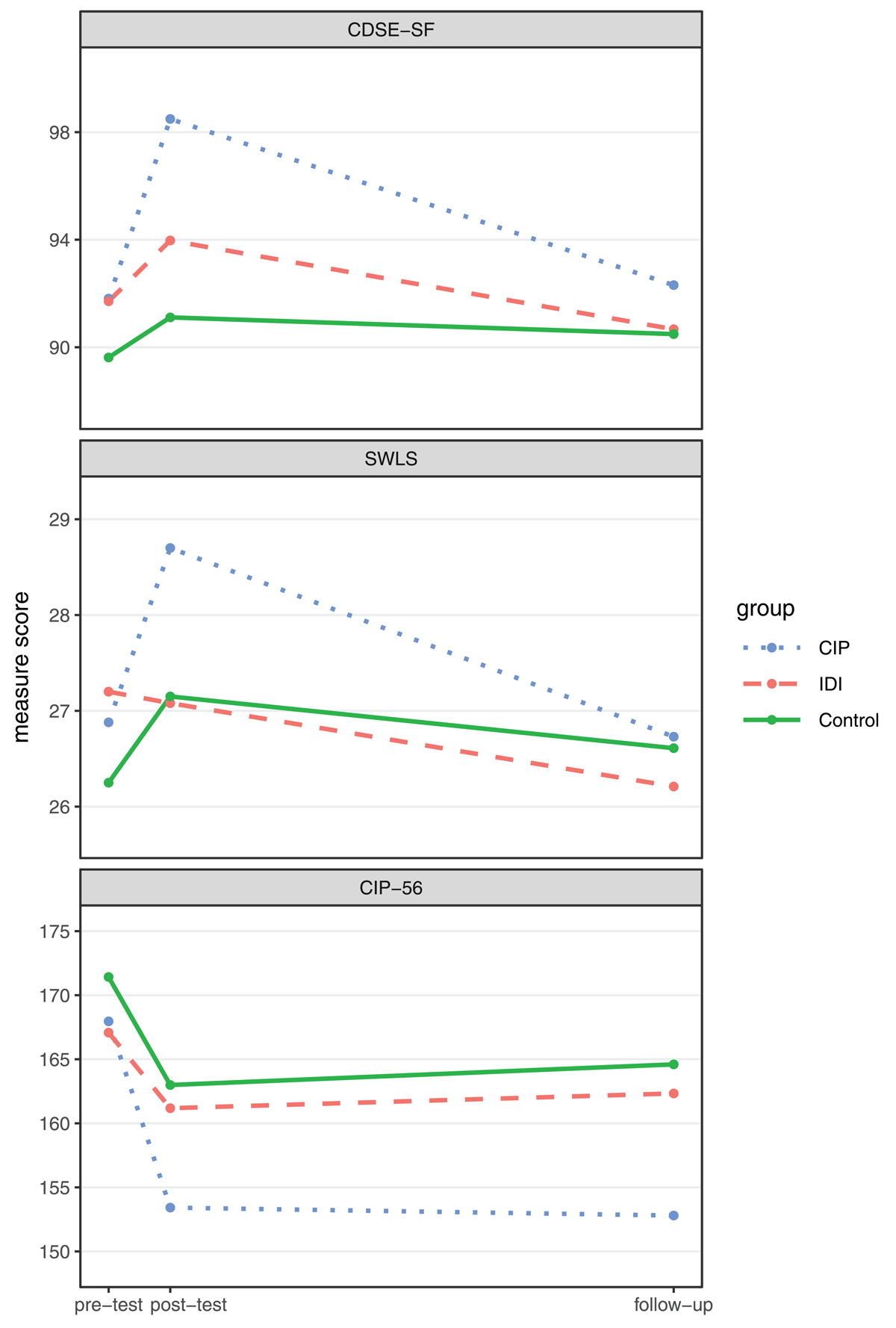
Figure 1
Group means on CSDSE-SF, SWLS and CIP-56 at Pre-Test, Post-Test and Follow-Up.
Discussion
Short-term effects were detected on all the outcome measures, except negative career thoughts (CTI). The results indicated that the career intervention based on the CIP theory-based approach was more effective than both regular graduation courses (control group) and the IDI one week after intervention. Contrary to expectations, students in the IDI group did not demonstrate significant changes on any of the outcome measures at the post test. Finally, the results did not support long-term effects of the interventions at follow-up. The IDI and CIP intervention groups did not show significant changes as compared to the control group on any of the three measures (CIP-56, CDSE-SF, SWLS) one year after intervention.
The structured CIP theory-based approach, which includes a decision-making model, seems to have been effective for Icelandic upper secondary school students facing an imminent transition to higher education or labor market. In the short term, participants who received the CIP-based intervention increased their belief that they could successfully complete tasks necessary for career decision-making (CDSE-SF; Betz et al., 2005). Accordingly, they had more confidence in performing or executing career-related behaviors to make accurate self-appraisals, gather occupational information, make career choices and plans. CIP participants were also more satisfied with their life in general after the intervention. The significant progress in the CIP group on the career decision self-efficacy (CDSE-SF) and satisfaction with life (SWLS) measures at post-test exceeded the third of a standard deviation minimum improvement assumed for career interventions (Brown & McPartland, 2005). These effect sizes are similar to those detected in previous studies on CIP theory-based interventions (Osborn et al., 2016; 2020; Reese & Miller, 2010). In the Icelandic educational context, that is a substantial possible cost-effective gain, especially considering the disadvantageous counselor-student ratio in the school system and lack of career guidance services and education (Department of Education and Youth, 2006; Einarsdóttir et al., 2023; Gunnarsdóttir, 2006).
The lack of change in the CTI results for the CIP group were unexpected but may be due to the following. First, students only worked with negative career thoughts in one session. According to the counselor responsible for the CIP intervention, students engaged less in the assignment about negative career thoughts than in other assignments, raising questions about student motivation in this part. Second, this study did not use the CTI Workbook which has been shown to have a positive impact on reducing on college students’ negative career thoughts (Thrift et al., 2012).
The results did not support hypothesis about participants’ progress in career indecision, career decision self-efficacy beliefs, career thoughts, or life satisfaction after the IDI intervention. This contrasts with recent, mainly developmentally focused intervention studies college exploration courses (Fouad et al., 2009; Reese & Miller, 2010; Talib et al., 2015). One possible reason might be time- and content-related, because the IDI intervention focused on career development and, in that context, four sessions in four weeks was a short amount of time both for the counselors’ input and participants’ progress. The emphasis on examining participants’ careers from past to present and considering diverse factors likely to affect people’s career decisions might have raised students’ awareness of many important issues without providing sufficient time or clear guidelines for how to potentially deal with them. The IDI intervention was also less structured than the CIP intervention, which might partially explain its lack of impact (Vilhjálmsdóttir, 2010; Whiston et al., 2003).
We did not establish any long-term effects for the IDI and CIP interventions. Previous studies have demonstrated impact after three months including a CIP-based career workshop (Hirschi & Läge, 2008) and a career decision-making guidance program (Dogan & Bacanli, 2012). This research suggests that the effects may have dissipated after one year, which represented an extended time frame compared to previous career intervention studies.
Limitations
This study’s main limitations lie in the fact that this was a quasi-experimental field design using entire school courses. We compensated for the nonequivalence of the groups by randomly assigning the seven schools to the different intervention conditions and determining that they did not differ significantly on the main outcome measures prior to the interventions. Although considerable attrition occurred between assessment time points, nothing indicated systematic differences across groups: those who continued did not differ significantly on the outcome variables at pre-test from those who quit. We cannot rule out the effects of counselors’ attributes, although counselors for the IDI and CIP interventions were selected based on their commitment to and skill in delivering their assigned intervention (Heppner et al., 2008). Finally, the control group received some career-related information in class as part of the school curriculum, had more educated parents and higher grades, which might have diminished post-test differences between the groups. Nevertheless, short term effects were detected for most outcome measures.
This study did not assess the effectiveness of the entire semester-long career course on which the IDI intervention was based (Sveinbjörnsdóttir, 2011), thereby possibly not doing justice to its original purpose. Outcome measures that capture various developmental aspects (e.g., vocational identity, occupational, knowledge) could be included in future studies and might provide different results. Despite these limitations, this study shows that a short, structured, theory-based intervention, focused on the decision-making process, was helpful for students facing imminent transitions in the Icelandic school system.
Theoretical and Practical Implications
The study has important theoretical and practical implications. From a theoretical perspective, the results of the two interventions indicated that the CIP theory-based approach was useful for Icelandic upper secondary school students facing an important transition following graduation. Progressing systematically through key components of CIP theory using the Guide to Good Decision-Making Exercise (Sampson et al., 1992) and the ILP increased students’ scores on measures of self-efficacy in career decision-making and life satisfaction. The results underscore the importance of using structured theory-based critical ingredients (e.g. written exercise) in practice. In general, the limited impact of the IDI intervention on participants might be related to the intervention’s overall goal for them to enter the imminent decision-making process at the end of upper secondary school with an open mind. A brief and structured intervention can make a difference, but career guidance professionals need to carefully align the chosen theoretical basis with the goals of the intervention, use well developed approaches with accompanied resources (e.g., workbooks, occupational information) suitable for the organization and context.
It appears that Icelandic upper secondary school students about to graduate want, or at least need, very direct and practical support with their career choices. However, because they only received short interventions in this study, they continued to have uncertainty related to their career goals a year later. This may be because career development involves many different decision points, completing one decision (e.g., taking gap year) may postpone or open up to another decision. Systematic career education, shown to be effective (e.g., Hooley, 2014; Reese & Miller, 2010; Talib et al., 2015) but lacking throughout compulsory and upper secondary education in Iceland (Einarsdóttir et al., 2023), may be needed to provide enough continuous support in young people’s career development process.
Acknowledgements
We thank the students, headmasters, teachers, and career guidance counselors in the seven schools for their participation in this study. We also express our gratitude to Ingveldur Sveinbjörnsdóttir and Hrafnhildur V. Kjartansdóttir career guidance counselors who delivered the career interventions. Finally, we thank Betsy Goldstein and Helgi Guðmundsson for their contribution to the manuscript and analysis.
Funding Information
This study was supported by Rannís the Icelandic Center for Research grant nr. 101010001
Competing Interests
One of the authors has been an editorial board member of NJTCG journal since 2020. The authors have no other conflict of interests to note.
Author Contributions
The study was conducted as a part of María Dóra’s Björnsdóttir doctoral dissertation. She designed the study, conducted it and did all the analysis in close cooperation with her supervisors Sif Einarsdóttir and Guðbjörg Vilhjálmsdóttir (Professor emeritus) whom we thank for her substantial contribution and cooperation. The other authors all served on María Dóra’s dissertation committee. Guðmundur Bjarni Arnkelsson contributed mainly to the study design, data analysis and interpretation of results. Janet Lenz and Marie Hammond contributed to the study design, theoretical foundation and implication of the study mainly. All the authors were involved in writing up the manuscript led by Sif Einarsdóttir.