
For the last 30 years, career guidance in Norway has been delivered through the compulsory school system and forms the background for the emergence of career education in the country. The development of career education and guidance (CEG) is characterised by different discourses, as proposed in political documents, research, curricula, and evaluation reports. Discourse analysis focuses on understanding how language is organized into discourses, that are “culturally specific and whose availability depends upon social, historical and cultural context” (Willig, 2014). By analysing the historical development of different discourses in career guidance and career education, this article contributes to providing insight into the meaning-making that has been ongoing in legal and policy debates and practices in this field.
The context for CEG in Norway is a comprehensive welfare state which is characterized by universal welfare rights (Haug et al., 2020b). For young people growing up in Norway, career guidance is legally regulated through the Educational Act § 9.2 (Forskrift til opplæringslova, 1998). This act states that every student has the right to necessary counselling on education, vocations, vocational choices, and social matters. Career guidance is available to students through career guidance counselling in both lower and upper secondary schools. Furthermore, since 2008, career education in compulsory school has been provisioned through an obligatory curricular subject called `Educational Choice` (in Norwegian, utdanningsvalg). Moreover, in this article the terms ‘counselling’ and ‘guidance’ are used interchangeably and are continuously developing in the Norwegian context.
The background for this article is that CEG in modern times often entail an economic and political orientation towards people’s lives (Hooley et al., 2017; Plant & Kjærgård, 2016; Røise, 2020; Sultana, 2014). This includes, for example, the personal choice of profession, work, or career. According to Kjærgård (2012), career services are not primarily created by virtue of a legal right but appear anchored in a certain knowledge–economic rationale. Today, within this logic, such welfare services and education are provided to all students in the Norwegian schooling system. This indicates how societal needs and political priorities regulate specific strategies to achieve the goals of the authorities or the government (Kjærgård, 2012, s. 7). A closer look into the emergence and development of CEG in schooling in Norway can contribute to a more nuanced understanding of the discourses that have imprinted this development. In this article, we aim to investigate the following question: Which discourses can be identified in the development of career education and guidance in Norwegian schools since 1990?
Articulating such meaning-making through identifying discourses can stimulate the understanding of shared narrative on CEG in Norway, which can be useful in the future development of policy, research, and evaluations. First, we present the political development in Norway in the fields of CEG) since 1990. Thereafter, we investigate previous overviews and present our methodological approach. Then, we proceed to present the findings and discuss the five discourses we have identified. In the last part of the article, we conclude and look at the future of the field of CEG in Norwegian schools.
Policy Developments Since the 1990s
To understand the Norwegian career guidance system, one should know that the official administration of career guidance programmes and policies in the educational sector today involves two different directorates under the Norwegian Ministry of Education and Research. The legal administrative responsibility for career guidance and career education in compulsory education lies with the Directorate of Education, which is the executive body of the Ministry of Education and Research for kindergartens, schools, and vocational training. Moreover, the national responsibility for career guidance at the system level lies with the Norwegian Directorate for Higher Education and Skills, which was established in 2021. The is goal of the Directorate for Higher Education and Skills is to increase access to, provide a better quality of, and ensure professionalism in career guidance services across the sector and from a lifelong perspective for young people and adults. Even though there is a clear division of labour and goals between these two systems, it also appears to be complex to cooperate on central policy matters.
Since the 1990s, from an educational policy perspective, several reforms have formed the background of the development of career guidance and career education in Norwegian schools. The 1990s were characterised by a major educational reform (Reform 94) (NOU 1991: 4) and a strong gender perspective on educational choices and the labour market. Reform 94 determined that every citizen between the ages of 16 and 19 years should have the statutory right to three years of upper secondary education. This reform focused on progression in vocational subjects, and the number of courses in upper secondary school was reduced. Therefore, the choices students made after lower secondary school had less consequences than earlier. However, after Reform 94, part of the process of educational and vocational choices was transferred to the upper secondary school (Birkemo, 1997).
From 1997 to 2000, a project entitled ‘informed educational choices’ was implemented in lower secondary schools in four county councils (in Norwegian, Bevisste utdanningsvalg) (Buland & Havn, 2001). The project aimed to reduce gender differences in educational choices. In general, the 2000s were characterised by an increased political focus on dropout and completion in addition to the formalisation of career education. In 2002, a report from the Organisation for Economic Cooperation and Development (OECD) sheds light on several shortcomings in Norway’s offer of career guidance in schools and for adults (OECD, 2002). The report indicated a lack of services, a lack of management and development of the field, and a lack of comprehensive knowledge of the connection between work and education. This OECD report formed part of the political background for the next school reform on new curricula in all subjects, called LK06 (in Norwegian, Kunnskapsløftet) (Meld. St. 16 (2006–2007), 2007). This new reform enhanced focus on students’ transition to upper secondary school, which relates to the organisation and role of counselling services in schools. As Mathiesen and Gunnarsdottir (2021, p.3) notes the counselling services in Norwegian schools have two defined functions: (1) educational welfare guidance and (2) career guidance. The aim of career guidance is to provide pupils with information and guidance regarding educational and vocational choices, whilst the aim of educational welfare guidance is to help pupils experience social and academic success. As a result of the reform, an increasing number of schools have chosen to implement a separate counselling service (Buland & Mathiesen, 2008). With regard to resources for guidance, it is reported that the tasks are too numerous and too large in relation to the resources available for counsellors. The formulation of ‘counselling as the entire school’s responsibility or task’ is presented as an integral part of the school’s core activity. In Norway, this holistic development relates to the introduction of programme subjects for electives in upper secondary school (in Norwegian, programfag til valg) in vocational studies (Buland & Mathiesen, 2008). In the period 2006–2016, this was replaced by a subject called ‘In-depth study project’ (in Norwegian, Prosjekt til fordypning), and from 2016 onwards it was called ‘In-depth vocational studies’ (in Norwegian, Yrkesfaglig fordypning). In 2008, a mandatory subject called ‘Educational choice’ (in Norwegian, utdanningsvalg), with its first curriculum in 2008 (The Norwegian Directorate for Education and Training, 2008) was launched in lower secondary school. This marked the emergence of formalised career education in compulsory school.
In 2009, the following was specified in the Educational Act of 1998 (Forskrift til opplæringslova, 1998): ‘The right to necessary counselling means that the student must be able to receive information, guidance, follow-up, and help to settle in at school and make decisions in relation to future career and educational choices. Counselling can be both individual and in groups. The student’s needs and wishes will determine the form that will be used; (Forskrift til opplæringslova, 2009, our translation). Hence, the right is two-folded and includes both help to settle in at school and help to make decisions regarding future career and educational choices.
In 2020, a third educational reform on completion was implemented (in Norwegian, Fullføringsreformen) (Meld. St. 21 (2020–2021)). A key move in this reform was to give everyone an extended right to receive education until they passed upper secondary education (not merely the right to upper secondary education for a certain number of years). This represented a massive focus on completion after many years, with reducing dropouts from secondary school high on the agenda.
Previous Overviews
Previous historical and literature overviews from the Nordic countries are relevant to this article. In their literature review of research on educational and vocational guidance in the Nordic countries, Plant et al. (2003) covered the main Nordic guidance research issues. They concluded that Nordic research in guidance has focused mainly on the sociological aspects of guidance and its societal links and possible impact. As noted by Haug et al. (2019), educational and vocational guidance received increased attention in terms of policymaking in the Nordic countries between 2003 and 2016. These two reviews focus on the research conducted in the Nordic countries in the field of career guidance. Furthermore, central in the Nordic research field of career guidance and career education is the anthology entitled Career and Career Guidance in the Nordic Countries (Haug et al., 2020a). In this, contributions are made to summing up the historical development of career guidance. The introduction (Haug et al., 2020b) sets the Nordic career guidance in context and proposes the four ‘Cos’ of Nordic career guidance; context, community, co-construction, and collaboration.
Further, Bakke (2020) elaborates on how the centrality of work frames the concept of career in the Nordic countries. Loven (2020) digs into the history and development of Swedish career guidance and concludes that career guidance in many ways is far away from the goals and guidelines decided in the parliament. Examining the development of the guidance system in the Danish educational system, Jensen (2020) finds that emphasis has moved towards benefits for society and away from benefits for the individual. Røise (2020) sums up some of the research on career education in the Nordic countries and reveals the similarities and differences between the countries.
Thus, this short view of the extant literature reveals the rich descriptions and analyses of policy and research development in the field of career guidance and career education in different Nordic countries. Moreover, regarding the Norwegian context, a few specific historical presentations are relevant to this study. Buland and Mathiesen (2008) provided a knowledge overview of the field of vocational and educational counselling, educational welfare counselling, and follow-up services in Norwegian schools. This overview covers both a historical review and an overview of relevant research prior to 2008. A historical overview was presented as part of the national evaluation of counselling services in Norwegian schools (Buland et al., 2011). Here, the political development in the field from 1959 to 2010 are presented, with an emphasis on the development of career guidance. An overview of research on career guidance in Norwegian schools by Haug (2016, s. 14) reveals that research on this topic has been based on two theoretical approaches: both a societal perspective (with concepts such as social class and reproduction of social inequality) and an individual perspective (with concepts such as identity development and choice maturity). In his thesis, Haug (2016) investigates the assumption that different actors and professional systems will have different interests and views on what quality in career guidance entails.
The research field of CEG has, at large, departed from policy developments and has developed into an independent body of research. For example, in the last few decades, extensive research reports have been commissioned by the Directorate of Higher Education and Skills. These reports are not regarded as policy but depart from policymakers’ need for knowledge. Parallel to this development, independent research on career guidance and career education has grown—for example, through an increasing number of doctoral theses (Kjærgård, 2012; Haug, 2016; Bakke, 2021; Dalene, 2022; Mathiesen, 2022; Røise, 2022) and several in progress.
Despite these different overviews and independent research, an overview of the development of career guidance and the emergence of career education in Norway appears lacking. Analysing the processes of discursive construction (Willig 2014) in legal and policy debates and practices in this field, can give insight into discourses that have dominated in the context of career guidance and career education in Norway the last 30 years. This is the gap in research we aim to reduce through this article.
Method
To identify discourses in the development of CEG in Norwegian schools since 1990, the present study drew on content analysis (Patton, 2015) and thematic analysis (Braun & Clark, 2006) and consisted of three main phases. Initially, in the beginning of our analysis, our applied methods were similar to the process of content analysis (Patton, 2015). This implies that there was a preparation phase in which the first author collected and synthesized reports, evaluations, research articles, policy documents and curriculum, all of which dated back to 1990. This resulted in a comprehensive presentation of the historical development in the field for this period. Following the logic of content analysis, a process of identification of core consistencies and implications in this historical presentation constituted a preliminary analysis. This phase was characterized by a discovery approach to the discursive patterns that were revealed from the data (Patton, 2015).
In the second phase, the second author focused on verifying and elucidating what appears to be emergent, applying a more deductive approach to data collection and analysis. Here the second author worked through the historical overview to ensure its characteristics were maintained. Thereafter, the overview was extended and deepened where necessary. Through a process of snowballing, more documents were included. Table 1 presents an overview of the documents we examined. Thirty-eight documents were investigated.
Table 1
Overview of documents.
| DOCUMENTS | NUMBER |
|---|---|
| Policy documents | 8 |
| Research reports | 14 |
| Laws and regulations | 2 |
| Books | 1 |
| Book sections | 3 |
| Doctoral theses | 5 |
| Journal articles | 5 |
| Total | 38 |
To limit the scope of this article, we did not emphasise the development at the ministry level. The aim of this article is not to present a full review of research but to concentrate on identifying discourses through a process of mapping political documents, research, curricula, and evaluation reports. Methodological literature has been excluded. Furthermore, the analysis concentrated on school as a context, and, for example, the emergence of partnerships and career centres was not included. Although we acknowledge the possible gap between descriptions in policies and how CEG are experienced and practised in Norwegian schools, this gap was not the focus of this analysis.
In the final phase, the authors discussed the literature overview together and various discursive concepts were tested to discuss the data. The authors collaborated on interpreting and assigning meaning to discourse patterns by naming the discourses with terminology that connotes the pattern (Patton, 2015). This resulted in a thick descriptive and chronological narrative. Drawing on thematic analysis, with the aim of interpreting meaning and connections, we identified thematic discourses as specific patterns of shared meaning. By invoking such a perspective on discourse in this article, we drew attention to the meaning-making which takes place in legal and policy debates and practices regarding CEG in the Norwegian context. Five dominant discourses were identified as they appear in policy, evaluations, curricula, and research. These discourses arose as a combination of both the CEG field and the Norwegian career guidance policy context. The discourses shed light on how the aim of career guidance and career education in Norway is politically and contextually framed.
Findings and Discussion
Focusing on the meaning-making which occurs in legal and policy debates and practices on CEG in the Norwegian context, the following discourses of CEG in Norwegian schools were identified: (1) completion, (2) gender equality, (3) resources, (4) professionalisation and quality, and (5) whole school’s responsibility.
The Completion Discourse
Since Reform 94, which emphasized the completion of education, an educational system was established in which those who do not apply for upper secondary education, or do not accept an offer, or are in danger of dropping out must also be registered and followed up with. The second reform, LK06 (in Norwegian, Kunnskapsløftet) (Meld. St. 16 (2006–2007)) emphasises the transition to upper secondary school with the intent of preventing students from dropping out. Hence, dropping out and completion have been a central point of attention in the development of the Norwegian educational policy.
The regulations specify the following aspects with regard to the overall aim of counselling provided to students by the school: ‘Counselling should contribute to equalizing social inequality, prevent dropouts and integrate ethnic minorities (…). The student must get the help he/she needs to develop further and utilize his/her own resources, regardless of traditional gender roles’ (Forskrift til opplæringslova, 2009, our translation). The potential role of career guidance and career education in combating early school leaving is discussed by Haug and Plant (2015). They present two important roles for guidance. First, advocacy understood as speaking on behalf of the student, and feedback understood as guidance, should provide feedback to the system. Since the early 2000s, the axis of educational policy development in schools and counselling services has been dropout issues (Hernes, 2010). Here, we identify that in many ways, the counsellor has been portrayed as the answer to students making better choices, and better choices have been perceived as vital for higher completion rates. In 2020, a third educational reform is implemented, on completion (in Norwegian, Fullføringsreformen) (Meld. St. 21 (2020–2021)). As a key move in this reform, everyone is given the extended right to receive education until they have passed upper secondary education (not just the right to upper secondary education for a certain number of years). Thus, this reform emphasizes completion, qualification, and lifelong learning. With this third reform, the discourse of completion continues.
In many ways, these reforms over the last 30 years have shaped the framework conditions for career guidance in schools. School as a context for these practices has become more comprehensive and long-lasting. Moreover, education has, to an even greater extent, become an entrance ticket to more education, the labour market, adult life, and lifelong learning. Official Norwegian Reports NOU (2016: 7) deals with the relationship between career guidance and dropout prevention: ‘Good career guidance can contribute to fewer dropouts and fewer re-selections in both basic education and higher education’ (NOU, 2016: 7, p. 10). They put forward an expectation regarding the coherence between good-quality guidance and the prevention of dropouts. In addition, we identified a discourse on completion, where career guidance and career education entails ‘… a significant element of system coercion towards the individuals, and where one can easily get associations with the role of dog catcher, as we know it from cartoons from Disney’ (Støren et al., 1998, s. 226, our translation). This discourse frames CEG with the aim of being a tool for policy to obtain the goal of a higher completion rate in upper secondary school.
In conclusion, the completion discourse in career guidance and career education can be understood as a remedy to obtain a higher percentage of completion of education in upper secondary school. Following this discourse, career guidance counsellors and teachers are required to prioritise and work towards education completion in systematic and individual career guidance and career education in school; their choices of activities and approaches will be selected in keeping with this aim.
The Gender Equality Discourse
In the 1990s, policy on CEG emphasized career choices, and policy had a strong focus on gender and equality. Important backgrounds for this were both the Norwegian emphasis on being an egalitarian society (Haug et al., 2020b) and a highly gender-differentiated labour market (Reisel & Teigen, 2014). Career guidance was perceived as a central remedy to influence youths in their educational and career choices (Schulstok & Wikstrand, 2020). As noted above, the regulation specifically notes that guidance should be given ‘regardless of traditional gender roles’ (Forskrift til opplæringslova, 2009). Thus, guidance on gender-untraditional occupations is presented as a remedy to counteract the gender-differentiated labour market. Despite gender equality being high on the agenda, Schulstok and Wikstrand (2020) argue that the underlying strong ideology of individual free choices creates a dilemma for career practitioners on how to approach the issue of gender guidance. In the late 1990s, the political intention was to expand students’ room for action regardless of gender through a focus on gender distribution and recruitment (Birkemo, 1997). As a part of Reform 94, vocational counselling was linked to an equality perspective (Birkemo, 1997, s. 73). From 1997 to 2000, a project called ‘Informed educational choices’ was implemented in four counties (in Norwegian, Bevisste utdanningsvalg) (Buland & Havn, 2001). The project aimed to reduce gender differences in educational choices. It indicated the political objective that young people should make their choices not based on traditionally determined guidelines but based on free will, with an emphasis on an emancipatory purpose. Several reports indicate that work with gender issues and equality is not very visible, either in the subject of educational choice (Røise, 2020) or career guidance (Buland et al., 2011; Mathiesen et al., 2010; Mathiesen, Buland and Bungum, 2014) despite the fact that it is explicitly stated in the regulations (Forskrift til opplæringslova, 2009). Mathiesen, Buland and Bungum (2014) stated that it is a democratic challenge for the educational sector that gender and social background remain central structures that influence young people’s career and education choices. The notion of individualised career choices made counsellors and youths unwilling to address the gender perspectives on career choices; therefore, gender remained an invisible social premise (Mathiesen, Buland and Bungum, 2014).
By the late 2010s, the identified discourse of gender and equality appeared to have subsided and became a softer focus point in policy and practice of career guidance and career choices. As an example, the description of the political goals for career guidance in NOU (2016: 7) (p.22) does not mention the gender-differentiated labour market as an explicit goal to counteract in guidance activities.
We conclude that the gender equality discourse in career guidance and education is brought forward as a remedy to create better gender equality in education and the labour market. This second discourse frames career guidance with the aim of being a tool for policy to improve gender equality in society. Within this discourse, career guidance counsellors and teachers are required to develop activities and ask questions to broaden the youth’s choice horizon to bring to light possible non-gender-traditional educational choices.
The Resources Discourse
In the last 30 years, expectations of what guidance in school must accomplish have increased. The national evaluation of vocational and educational counselling, social educational counselling, and the follow-up service in Norway has revealed the development and increased quality of counselling in Norwegian schools, but counsellors have reported that resources for counselling have been insufficient and the tasks increasingly extensive (Buland et al., 2011). Other reports also indicate the frustration amongst counsellors regarding limited resources (Buland et al., 2014, 2020; Mordal et al., 2015, 2022; Teig, 2000). The combined counselling services for career guidance and educational welfare guidance in upper secondary education in Norway are calculated to one man-year per 500 pupils (NOU, 2016: 7). If we build on the logic that career guidance and educational welfare guidance split the resources equally, this would imply that one fully employed career guidance counsellor has the responsibility for providing career guidance to 1000 pupils (Holm-Nordhagen et al., 2022). These limited resources have remained unchanged since 2006, but they represented a certain increase from the last provision in 1963 (NOU 2016: 7). In our content analysis, we identified an ongoing debate around how counselling tasks are too extensive for one person. This also aligns with a debate on how a vaguely formulated regulation, which encompasses numerous tasks and goals without being specific on how a school counsellor is supposed to prevent dropout or help integration (Mathiesen, 2022).
In the beginning of the 2020s, the Norwegian Directorate for Higher Education and Skills commissioned several reports on career guidance and career education in school, evaluating resources, collaboration, and quality. One survey indicates that quality development and quality assurance in career guidance are not a high priority in schools (Mordal et al., 2022). Career guidance in schools has a limited framework, scarce resources, and competes with other aims for schools (Mordal et al., 2022). Moreover, 70% of the schools allocate more resources than those indicated in the minimum regulations (Buland et al. 2020), which is a strong indicator that the regulated resources are considered too scarce in relation to the expectations from counselling services. Mathiesen (2022) indicated that the combination of ambiguous policy, high expectations, and limited resources may result in greater differences between what kind of services students receive in career guidance and career education at different schools.
Moreover, there appears to be a discrepancy between how career guidance is framed as important in achieving policy goals and the resources allocated to the job. Nevertheless, it is noteworthy that the implementation of educational choice as a subject can be seen as an addition of both resources and responsibility for career guidance; this has also nudged the counsellor’s role in school towards a more comprehensive role as the leader of career guidance for the whole school (Mordal et al., 2015).
In conclusion, the third discourse deals with the resources allocated to career education and guidance in schools. This discourse is rooted in the long debate on the allocation of resources for career guidance and career education in school and how the tasks continue to increase without any resources being added to compensate for such an increase.
The Professionalisation and Quality Discourse
The fourth discourse that is evident is the focus on professionalisation in career guidance practices. Several research reports indicate the specialist demands on counsellors’ competencies. Teig (2000) indicates educational measures for counsellors to strengthen counsellors’ competencies and the quality of counselling. This perspective is strengthened by the two following reports. First, the OECD indicated several shortcomings in Norway’s offer of career guidance in schools and for adults (OECD, 2002). The report indicated a lack of services, a lack of management and development of the field, and a lack of comprehensive knowledge of the connection between work and education. Second, the background for the governmental report entitled ‘Norway in transition—career guidance for individuals and society’ (NOU, 2016: 7) was that the Norwegian economy was in a restructuring phase where unemployment was increasing, and career guidance was considered an effective tool for restructuring and integration. In this report, reference was made to the influence of the EU’s goals for 2020, which indicated a need to develop more holistic career guidance. The committee recommended the establishment of a quality framework for career guidance that included national competence standards and training for career guidance counsellors in line with competence standards. Parallel to this, the initiation of a master’s course in career guidance in Norway in 2014 illustrates a political focus on skills development. Moreover, based on this governmental report (NOU, 2016: 7), a national quality framework was developed as a tool for developing quality in career guidance. Career guidance in schools is included as one of the developmental sectors (Bakke et al., 2020). Here, a shift in policy development towards quality in career guidance becomes apparent as a move towards more systematic and quality-oriented career guidance in school. Haug’s (2016) doctoral thesis on quality in Norwegian schools’ career guidance also feeds into this professionalisation and quality discourse by investigating the varied understanding of quality in career guidance in schools. Official reports and evaluations focus on competence standards for counsellors and teachers in career education (Bakke et al. 2020) mark the relevance of this discourse today.
Furthermore, increasing demands for expertise were part of the discussion on the division of the counsellor’s work area. The debate before the trial project of providing separate counselling services was centred around how one could ensure quality in career guidance when guidance practitioners had two major areas of expertise to cover—career guidance and educational welfare guidance (Buland & Havn, 2003; Mathiesen & Gunnarsdottir, 2021).
In conclusion, this discourse of insufficient resources is rooted in the policy stakeholders’ requirements for increased quality and professionalisation in career guidance and education without an increase in available resources (Buland et al., 2020). The need to work and develop policy guidelines that enhance and bring forward a more specialised practice in career guidance in schools has been a pivot point in the development of the field. Within this discourse, career guidance counsellors and educational choice teachers will likely attempt to orient themselves to what is required to provide good quality guidance and how practice can be altered in this regard.
Furthermore, we identify the discourse of professionalisation and quality in opposition to the fifth discourse—the holistic ‘whole school’ approach to career guidance. As discussed by Mathiesen and Gunnarsdottir (2021), counsellors in Norway have a different understanding of the holistic approach to career guidance; some relate it to the pupil, and some to a collective holistic guidance practice in school. From the viewpoint of the professionalization discourse, we raise the question how the entire professional community can take responsibility for a service that requires specialist competencies.
The Whole School’s Responsibility Discourse
The fifth discourse that emerges from this analysis has its origin in the political guideline on how career guidance should be the task and responsibility of the entire school. Counselling as the responsibility of the whole school has been a slogan from the project on separate counselling services (Buland et al., 2011). This project builds on the vision of strengthening the guidance work if many actors in the school were involved in the guidance activities (particularly the leader) and guidance activities were incorporated into the school’s plans (Buland & Havn, 2003; Buland et al., 2011). Action research in a Norwegian upper secondary school reveals that ‘teachers’ attendance and participation is a resource in the planning and implementation of career guidance’ (Holm-Nordhagen, 2021, s. 4). However, the whole school’s responsibility discourse includes a fundamental contradiction in the field of career guidance. This contradiction is between career guidance as a profession in need of specialised competence and the fact that the government wants the entire school staff to participate in it. Perhaps as a result of this contradiction, research reveals that career guidance as the whole school’s responsibility remains more a slogan than established practice (Buland et al., 2011; Mordal et al., 2022). In addition, this might be the reason that this perspective is also included in the new ambitions for career guidance in school (Holm-Nordhagen et al., 2022). The whole school has the task of engaging in the ambition of a holistic integration of career guidance in the activities of the whole school and every teacher teaching, which the introduction of the subject of educational choice can be seen in light of. However, educational choice appears to engage and involve the whole school staff in career guidance.
In conclusion, the discourse of career guidance and education as the whole school’s responsibility has been emphasised in several policy documents; career guidance should be the whole school’s task and responsibility (Forskrift til opplæringslova, 2009; NOU, 2016: 7). The underlying understanding here is that career guidance should not be the counsellor’s responsibility alone, which—as noted earlier—stands as a paradox regarding the professionalisation and quality discourse.
The Discourses on a Timeline
With these five identified discourses, a contribution is made to a more nuanced understanding of the development of CEG in the Norwegian school system since the 1990s. The emergence of the discourses can be illustrated on a timeline over these three decades (see Figure 1). Here, the discourses are marked according to when they appear in the analysed documents.
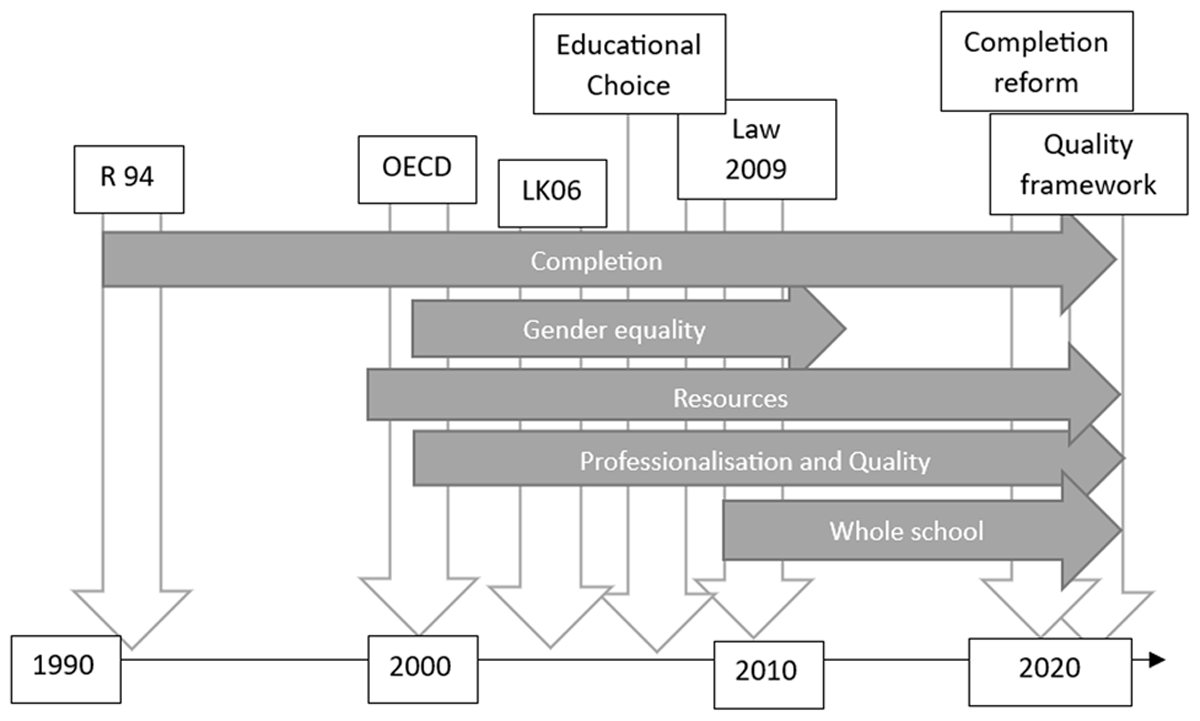
Figure 1
Discourses in the Development of Career Guidance and Career Education in Norway Since 1990.
Figure 1 can be viewed as an illustration of the development in career guidance and career education since 1990 and approximately where in this historical development different discourses can be placed.
Moreover, in our view, these discourses are not mutually exclusive, and counselling and educational practice will likely vary between discourses depending on the students’ needs, the local context, and the focus of different stakeholders. Furthermore, the discourses may all be affecting the practice of career guidance and education at once in the Norwegian schools.
Conclusion
The identified discourses in this paper shed light on societal needs and political priorities to achieve governmental goals, thereby expanding on the knowledge-economic rationale (Kjærgård, 2012). The historical lines presented illustrate how CEG in schools relates to ongoing educational policy developments. The discourses on education completion and gender equality have a solid viewpoint of the output of CEG for the students and the society, which are rooted in perceived needs for societal development. However, the professionalisation and quality, resources, and whole school’s responsibility discourses have a different point of departure. They are more rooted in the development of career guidance with a proactive focus on quality in CEG. As we perceive it, gender equality is no longer a discourse that is high on the agenda, and education completion is on the agenda as an overall framework for the whole school system. In contrast, the professionalisation and quality, resources, and whole school’s responsibility discourses are very much in play today, thereby framing policy and practice development.
Emergence of Career Education
The identified discourses elucidate the background for the emergence of career education. The curriculum for the subject of educational choice has been adapted in parallel with policy developments. During its introduction in 2008, it has emphasised choice and completion of secondary education (The Norwegian Directorate for Education and Training, 2008). Subsequently, in 2015, it included gender and equality perspectives as well (The Norwegian Directorate for Education and Training, 2015). Finally, in 2020, career competence skills were also incorporated (The Norwegian Directorate for Education and Training, 2020). These changes can be understood from a professionalisation perspective (of both the teachers and students). Further, in the discussion on resources for career guidance in Norwegian schools, the historical development shows no real increase in allocation of resources (NOU, 2016: 7). However, the introduction of compulsory career education in 2008 can be regarded as an additional resource that supports career guidance. However, this ideology is challenged by the insufficient implementation of the subject (Røise, 2022).
The Rising Concept of a Career
Examining the historical highlights causes us to ponder if there is an emerging discourse driven at the policy level on the broad concept of career. The broad concept of career arises at the intersection of where Norwegian research and policy levels meet the international career guidance field. This has led to a shift from discussing educational and vocational guidance to discussing career guidance and is highly emphasised in current policy documents (Bakke et al., 2020; NOU, 2016: 7, 2016). But, as Bakke (2021) discusses, the concept remains an uncomfortable one in the educational sector. A broadened understanding of the concept of career does not appear to be fully implemented in the educational sector in Norway, but it appears to be on the rise in the current policy development in Norway. Here, the role of counsellors in school is developed in tandem with relational, contextual, and political expectations and demands an intricate balancing act to operationalise policy into practice, as discussed by Mathiesen (2022). Furthermore, Røise (2022) indicates the need to strengthen pedagogical professionalism in career education. Both elucidate the challenges in the implementation of policy development in career guidance and career education, which need to be addressed in the future.
Looking Ahead
From a social justice perspective, career guidance should emphasise the acknowledgement and expansion of the awareness of those who seek career guidance of how structures in the society affect and shape people’s career choices. School reforms are an expression of what society values and affect the mandate for CEG. The discourses identified in this study elucidate the connection among the school system, the school’s goals, and societal function on the one hand and CEG on the other. When the career counsellor is not rooted in established methods, techniques, or tradition, their work tasks and relationships may not be self-evident but reflect the beliefs of the institution of which he/she is a part. There may be reason to look for the fixed points of reference that prevent the counsellor from losing his/her distinctive character and being pushed so far and long that he/she becomes ‘oil in any school machinery’ (Forsøk og reform i skolen, 1969, p. 41, our translation).
These discourses reveal that the organization of career guidance has developed into a more specialist service, at least on paper, with a focus on quality assurance and development. But unless schools have a clearer mandate and the resources for the service are increased, career guidance in schools could remain ‘oil in any school machinery’. As we saw during the COVID-19 pandemic, numerous counsellor tasks were redefined with the argument that career guidance was not of sufficient importance (Buland et al.,2020). This can be understood as a symptom of a weak professional position for career guidance in schools. The school system does need oil in the machinery, but we question if career guidance and career education should uphold this role rather than be authorized to pursue their own defined goals to a much larger extent.
Moving forward, new policy developments will set the framework for CEG. An announced new Educational Act is expected to take effect in 2024 (NOU, 2019: 23). As of today, it is unclear whether the right to career guidance in schooling will remain. This could potentially radically change the integration of CEG in Norwegian schools in the future. In 2014, Kjærgård wrote that career guidance in schools may, in the future, become a chameleon-like service that follows changing political winds and seeks to meet society’s diversely expressed needs (Kjærgård, 2014). Perhaps there is another development scenario, where increased quality assurance and competence measures help to strengthen policy and contribute to the provision of a more knowledge-based practice in the future. But this would depend on the development of a clearer policy on what, how, and by whom, with what competence, CEG in school should be provided in order to help counsellors and teachers to manoeuvre between the numerous discourses and expectations in the educational system that compete to be prioritised in everyday practises in schools.
Funding Information
The collaboration on this article took place as part of the NOS-HS project The future of Career Education in the Nordic countries and self-governing areas and was made possible by NOS-HS workshop grant 335097, 2020.
Competing Interests
The authors have no competing interests to declare.