
Table 1
Measuring upper secondary students’ school subject preferences, study field interest and mathematic and verbal self-efficacy beliefs.
| I PREFER THE FOLLOWING SCHOOL SUBJECTS… | I AM INTERESTED IN THE FOLLOWING STUDY FIELDS… | WHAT DO YOU THINK ABOUT THE FOLLOWING STATEMENTS? |
|---|---|---|
| Mother tongue and literature | Education | I am good in mathematics. |
| Swedish | Arts and culture | I am interested in mathematical problem solving. |
| English | Humanities | I am good in my mother tongue. |
| Other foreign language | Social sciences | I like writing. |
| Mathematics | Economics, Administration, law | Mathematics requires effort from me, but I will learn all the necessary issues. |
| Biology | Natural sciences | I do not think I am good in mathematics. |
| Geography | Information technology and Electrical engineering IT communication | I get good grades from mathematics. |
| Physics | Technology | I learn mathematics fast. |
| Chemistry | Agriculture, forestry | I have always believed that mathematics is one of my strongest school subjects. |
| Philosophy | Medicine | In mathematics class, I can solve the most difficult problems. |
| Psychology | Health and well-being | |
| History | Service sector | |
| Social studies | Military sector | |
| Religion or ethics | ||
| Health education | ||
| Physical education | ||
| Music | ||
| Visual arts | ||
| Student counselling | ||
[i] Note: Measured with Likert scale 1–5, 1 = not at all 5 = very much.
Table 2
The results of the factor analyses of study field interests and mathematical and verbal self-efficacy beliefs scales used in the study.
| SCALES | FACTOR 1 | FACTOR 2 | FACTOR 3 |
|---|---|---|---|
| Interest in study fields | |||
| F1: Interest in science and technology fields (3 items; eigenvalue = 2.27; alpha = .75) | |||
| Technology | .86 | ||
| Information technology and electrical engineering | .79 | ||
| Natural sciences | .55 | ||
| F2: Interest in service, health and education fields (4 items; eigenvalue = 2.19; alpha = .69) | |||
| Health science and well-being | .88 | ||
| Service fields | .57 | ||
| Medicine | .55 | ||
| Education | .48 | ||
| F3: Interest in economics and social science fields (2 items; eigenvalue = 1.74; alpha = .81) | |||
| Social science | .87 | ||
| Business, administration, law | .77 | ||
| Mathematical and verbal self-efficacy beliefs | |||
| F1: Mathematical self-efficacy beliefs (6 items; eigenvalue = 4.18; alpha = .93) | |||
| I am good in mathematics. | .90 | ||
| I learn mathematics fast. | .85 | ||
| In mathematics class I can understand the most difficult tasks. | .83 | ||
| I have always believed that mathematics is one of my strongest subjects. | .82 | ||
| I get good grades in mathematics. | .82 | ||
| I am interested in mathematical problems. | .78 | ||
| F2: Verbal self-efficacy beliefs (2 items; eigenvalue = 1.40; alpha = .79) | |||
| I enjoy writing. | .95 | ||
| I am good in mother tongue. | .70 | ||
[i] * ML factoring with promax rotation was used.
Table 3
Summary of the simple regression analyses for variables predicting interest in science and technology (N = 559).
| VARIABLE | B | SE B | β |
|---|---|---|---|
| Physics | 0.21 | 0.03 | 0.32*** |
| Gender | –0.54 | 0.06 | –0.28*** |
| Geography | 0.13 | 0.03 | 0.16*** |
| Mathematics | 0.12 | 0.03 | 0.16*** |
| Chemistry | 0.07 | 0.03 | 0.10* |
| History | 0.05 | 0.02 | 0.07* |
| R2a | 0.50 | ||
| F | 92.31*** |
[i] * p < .05, ** p < .01, *** p < .001.
Table 4
Summary of simple regression analyses for variables predicting interest in service, health studies and education (N = 559).
| VARIABLE | B | SE B | β |
|---|---|---|---|
| Health studies | 0.20 | 0.03 | 0.31*** |
| Gender | 0.40 | 0.06 | 0.23*** |
| Psychology | 0.12 | 0.02 | 0.16*** |
| Biology | 0.10 | 0.02 | 0.16*** |
| Student counselling | 0.10 | 0.03 | 0.14*** |
| Physical education | 0.06 | 0.02 | 0.09* |
| Swedish | 0.04 | 0.02 | 0.07* |
| R2a | 0.42 | ||
| F | 59.62*** |
[i] * p < .05, ** p < .01, *** p < .001.
Table 5
Summary of simple regression analyses for variables interest in economics and social sciences (N =559).
| VARIABLE | B | SE B | β |
|---|---|---|---|
| Social studies | 0.45 | 0.02 | 0.65*** |
| Physical education | 0.06 | 0.02 | 0.09** |
| English | 0.07 | 0.03 | 0.09** |
| Gender | –0.19 | –0.10 | 0.08** |
| Swedish | 0.05 | 0.02 | 0.08* |
| R2a | 0.50 | ||
| F | 112.74*** |
[i] * p < .05, ** p < .01, *** p < .001.
Table 6
Self-efficacy belief cluster membership by gender.
| GENDER | ||
|---|---|---|
| CLUSTER | MALE | FEMALE |
| High math–low verbal (n = 131) | 74 (56.5%) | 57 (43.4%) |
| Low math–high verbal (n = 162) | 44 (27.2%) | 117 (72.8%) |
| High math–high verbal (n = 111) | 42 (37.8%) | 69 (62.2%) |
| Low math–low verbal (n = 155) | 54 (34.8%) | 101 (65.2%) |
[i] χ 2(3, 559) = 27.65, p < .001, Cramer’s V = .22.
Table 7
The effect of gender and self-efficacy belief cluster membership on further study fields interests.
| SS | df | MS | F | |
|---|---|---|---|---|
| DV: Interest in science and technology fields | ||||
| Gender | 76.95 | 1 | 76.95 | 133.99*** |
| Cluster membership | 37.623 | 3 | 12.53 | 21.81*** |
| Gender * Cluster membership | 3.27 | 3 | 1.09 | 1.90 |
| Error | 316.63 | 551 | .58 | |
| Total | 465.50 | 558 | ||
| DV: Interest in service, health, and education fields | ||||
| Gender | 36.81 | 1 | 31.49 | 41.24*** |
| Cluster membership | 3.50 | 3 | 1.17 | 1.53 |
| Gender * Cluster membership | .59 | 3 | .19 | .24 |
| Error | 420.64 | 551 | .75 | |
| Total | 457.58 | 558 | ||
| DV: Interest in economics and social science fields | ||||
| Gender | 22.40 | 1 | 22.40 | 29.31*** |
| Cluster membership | 15.81 | 3 | 5.27 | 6.89*** |
| Gender * Cluster membership | 4.82 | 3 | 1.61 | 2.11 |
| Error | 421.19 | 551 | .76 | |
| Total | 463.87 | 558 | ||
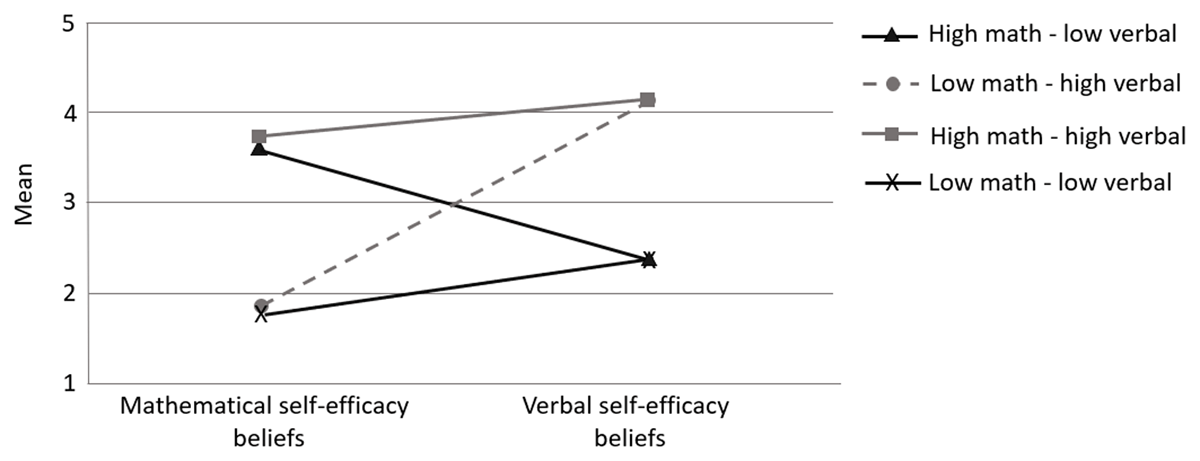
Figure 1
Mean score of the clusters.