
Introduction
Making study field choices has become more complex than before: plethora of options, rapidly changing job market and uncertainty about the future make it difficult for students to choose what to study next (Maj-Waśniowska et al., 2023; Schwab 2017). Study field choices are recognized as some of the most crucial decisions in a person’s life (Galotti, 1999). These choices bear substantial consequences not only for individuals but also for society. Selecting a study field is a complex process influenced by personal interests, passions, and family expectations. As a result, educational transitions have garnered research attention across diverse fields, encompassing education, psychology, sociology, and economics (Kim & Beier, 2020; Litalien et al., 2013; Salmela-Aro, 2020). This paper examines, through the lens of educational psychology, the underlying factors of general upper secondary (GUS) students’ study field interest. Its focus is to examine the relationships between students’ subject-specific preferences, mathematical and verbal self-efficacy beliefs, and gender in relation to their evolving interests in future study fields, before making their actual choices. The influence of these factors on disciplinary interests has received limited attention in prior research, making this study a valuable contribution that illuminates the factors influencing real-life decisions. In this study, we employ a cross-sectional research design to explore the foundational factors contributing to study field interests. Our investigation encompasses a cohort of 601 students drawn from ten GUS schools in Oulu, Finland.
Study field choice predicts career choice (Lent et al., 1994; Morris, 2016; Rounds & Su, 2014), work satisfaction and performance (Lent & Brown, 2006; Morris, 2003), subjective well-being (Harris & Rottinghaus, 2017), and life-satisfaction (Litalien et al., 2013). Making a study field choice is a complex and social process rather than an isolated individual event (Holmegaard et al., 2014) and the choice of further study field is influenced by several factors such as gender, self-efficacy beliefs, interest, values, identity, and attitudes towards different school subjects (Lavonen et al., 2008; Louis & Mistele, 2012; Nagy et al., 2006; Osborne et al., 2003; Schreiner & Sjøberg, 2007). Students’ social-cultural and socio-economic background factors such as parental support and occupational role models (Porter & Umbach, 2006), socio-economic status (Ulriksen et al., 2015) and regional location (Helland & Heggen, 2018) have been also found to influence students’ study field choices. Studies in U.S. have focused on examining the impact of students’ background factors (ethnicity, gender, and social background) on study field choice (Iloh, 2018) while British studies have focused on understanding how students’ different backgrounds such as their social class influences on study field choices and access to higher education (Ball, 2003; Reay et al., 2005). While the study field choice and its subsequent implications have been extensively explored, our emphasis lies in examining the fundamental aspects of disciplinary interest, which can vary significantly across different cultures. (e.g., Guan et al., 2015; Mau, 2000). Remarkably, the Nordic contexts present distinctive challenges concerning educational choices (Einarsdóttir & Rounds, 2020). Despite being globally recognized as some of the most egalitarian countries, these nations still grapple with significant gender segregation in both education and the workforce (World Economic Forum, 2020). The concept of the The “Nordic gender equality paradox” concept (Minelgaite et al., 2020) is often discussed in international comparisons, shedding light on the phenomenon where certain forms of gender segregation appear to be more prominent in highly gender-egalitarian and affluent countries (Stoet & Geary, 2018; Sund, 2015). This phenomenon is characterized by two distinct forms of segregation: 1) vertical segregation, where few women occupy top positions, and 2) horizontal segregation, marked by gender divisions among occupations and disciplines. This pattern seems to contradict the notion of gender equality as a widely acknowledged and embraced value (Corneliussen, 2021).
In our exploration of the underlying factors influencing GUS students’ educational interests, we employ the Social Cognitive Career Theory (SCCT) as our foundational framework. SCCT is a relatively new theory that is aimed at explaining three interrelated aspects of career development: (a) how basic academic and career interests develop, (b) how educational and career choices are made, and (c) how academic and career success is obtained. The theory incorporates a variety of concepts (e.g., interests, abilities, values, environmental factors) that appear in earlier career theories and have been found to affect career development. SCCT is based on Albert Bandura’s general social cognitive theory, and developed by Robert W. Lent, Steven D. Brown, and Gail Hackett in 1994. It is an influential theory of cognitive and motivational processes that has been extended to the study of many areas of psychosocial functioning, such as academic performance, health behaviour, and organizational development (SCCT in Greenhaus & Callanan, 2006).
Within SCCT, three fundamental variables, self-efficacy beliefs, outcome expectations, and goals, serve as the foundational “building blocks.” The theory also posits that individuals acquire career-related information from their social environment, including parents, teachers, peers, and role models. This information, in turn, shapes their self-efficacy, outcome expectations, and personal goals. The goals are assumed to be affected by exposure to contextual supports and barriers, such as gender or ethnic background (Inda et al., 2013), and presence of support and the relative absence of barriers can directly and indirectly enhance choice goals. For understanding the supports and barriers behind educational choices, this study analyses the role of gender in study field interests. To date, only a few studies have examined the influence of gender on the cognitive-person variables of the SCCT model (Peña-Calvo et al., 2016). Previous studies indicate that outcome expectations were built through experience and gender might have more influence in shaping disciplinary interest among GUS students (Falco & Summers, 2019; Sadler et al., 2012). Hence our focus in this study is to investigate the role of gender in study field interests.
The role of interest in students’ disciplinary choices
Harackiewicz et al. (2016) articulated the term “interest” in educational contexts as a robust motivational force that invigorates learning, directs academic and career journeys, and plays a vital role in academic achievement. Interest is both a psychological state of attention and affect toward a particular object or topic, experienced in a particular moment (situational interest) and a continuing tendency to reengage over time (individual interest; Hidi & Renninger, 2006). Interest is a promising concept for analysing the foundations of disciplinary choices as it is an important internal factor energizing learning, guiding academic and career choices, essential to academic success, and directing the path of education as well as characterizing the individuals as unique persons (Vulperhorst et al., 2020). In their study Mikkonen et al. (2009) found that university students explained their disciplinary choices with their interest, however, studies suggest educators do not have a clear understanding of their potential role in helping students to develop interest (Hidi & Harackiewicz, 2000). In fact, it often has been misinterpreted in education that students either have or do not have interest, and not recognized that significant efforts could be directed at developing students’ study and career interest (Kim & Beier, 2020; Nye et al., 2012; Smit et al., 2021).
Hanna and Rounds (2020) conducted a quantitative review of interest measures in the context of disciplinary choices to assess their validity in relation to interests and career decisions. Their study showed that interest inventories possess considerable validity for predicting career choice, reinforcing their value in research, education, and work contexts. Regarding the underlying factors of evolving interest, previous studies demonstrate that students’ disciplinary interests are shaped by several individual and situational factors (Britner, 2008; Britner & Pajares, 2006; Hidi & Renninger, 2006; Lavonen et al., 2008; Louis & Mistele, 2012), and this research extends these previous findings by examining the significance of subject-specific preferences, mathematic and verbal self-efficacy beliefs, and gender on the further study field interests of Finnish GUS school students.
GUS students’ school subject-specific preferences and their relation on further study interests
Subject-specific preferences, as evidenced in various studies (Barone, 2011; Cardador et al., 2021; Lent et al., 1994; Palmer et al., 2017), serve as predictive factors for both future academic pursuits and career interests. These preferences are highly individualized and are influenced by personal interests, past experiences, and future aspirations. Students’ subject preferences can encompass specific school subjects (e.g., biology) or specific topics and activities within a subject area (e.g., studying the human brain’s structure), a particular discipline (e.g., physiology), or even a specialized research field (e.g., ocean research) (Krapp & Prenzel, 2011). Additionally, students’ preferences for particular school subjects (e.g., mathematics, languages) can vary depending on their willingness to engage with these subjects (Tempelaar et al., 2007). Hence, subject-specific preferences have been regarded as predictors of both educational and career interests (Lent et al., 1994). Additional research is required to investigate the connection between school subject preferences and future study interests. As Lavrijsen et al. (2021) suggest, studying subject preferences in younger individuals is particularly important, as the earlier students establish a clear understanding of their interests, the better equipped they will be to make informed study choices throughout their educational journey (p. 2).
In 2022, Leyva et al. surveyed college students to explore their interest in mathematics and various STEM careers, along with their perceptions of mathematics’ role in those careers. They found that math interest predicted interest in many STEM careers but not all and that students’ views on math’s relevance to their chosen career influenced their interest in math and some STEM fields.
In a 2015 study by Linnansaari et al. on student participation in science classes, they found that girls generally favored life science over physical science, while boys had a stronger preference for physical science but were less inclined towards life sciences. Expanding on these prior findings, our initial investigation aims to evaluate students’ subject preferences within the GUS education school curriculum. Students were asked to indicate their preferences for each school subject by rating them on a Likert scale from 1 to 5. (See Table 1).
Table 1
Measuring upper secondary students’ school subject preferences, study field interest and mathematic and verbal self-efficacy beliefs.
| I PREFER THE FOLLOWING SCHOOL SUBJECTS… | I AM INTERESTED IN THE FOLLOWING STUDY FIELDS… | WHAT DO YOU THINK ABOUT THE FOLLOWING STATEMENTS? |
|---|---|---|
| Mother tongue and literature | Education | I am good in mathematics. |
| Swedish | Arts and culture | I am interested in mathematical problem solving. |
| English | Humanities | I am good in my mother tongue. |
| Other foreign language | Social sciences | I like writing. |
| Mathematics | Economics, Administration, law | Mathematics requires effort from me, but I will learn all the necessary issues. |
| Biology | Natural sciences | I do not think I am good in mathematics. |
| Geography | Information technology and Electrical engineering IT communication | I get good grades from mathematics. |
| Physics | Technology | I learn mathematics fast. |
| Chemistry | Agriculture, forestry | I have always believed that mathematics is one of my strongest school subjects. |
| Philosophy | Medicine | In mathematics class, I can solve the most difficult problems. |
| Psychology | Health and well-being | |
| History | Service sector | |
| Social studies | Military sector | |
| Religion or ethics | ||
| Health education | ||
| Physical education | ||
| Music | ||
| Visual arts | ||
| Student counselling | ||
[i] Note: Measured with Likert scale 1–5, 1 = not at all 5 = very much.
The relation of mathematical and verbal self-efficacy with university study field interest
Psychologist Albert Bandura defined self-efficacy as individuals’ belief in his or her ability to succeed in specific situations or accomplish a task (Bandura et al., 1999). Self-efficacy beliefs shape youths’ aspirations and career paths, guiding their choices of potential careers and those they reject (Bandura et al., 2001). Self-efficacy has been shown to govern aspirations and development of educational and occupational interests (Betz & Hackett, 1997; Lent et al., 1994), and decades of research have demonstrated the power of self-efficacy on educational outcomes and performance (DiBenedetto & Schunk, 2018; Honicke & Broadbent, 2016; Louis & Mistele, 2012; Schunk & Pajares, 2004). In educational research, self-efficacy beliefs have received increasing attention regarding, for example, studies of academic motivation and self-regulation (Schunk et al., 2012).
Self-efficacy beliefs have been extensively studied in relation to mathematical skills (Seyranian et al., 2018; Vincent-Ruz & Schunn, 2018). Mathematical self-efficacy beliefs reflect students’ confidence in their ability to perform specific academic tasks (Hackett & Betz, 1989; Pajares & Miller, 1995). Parker et al. (2014) discovered that self-efficacy independently and strongly predicts tertiary entrance ranks at the conclusion of GUS education. Extensive research has explored the link between mathematics self-efficacy and academic pathways, yet there remains a significant gap in understanding how self-efficacy beliefs relate to university study field interests. Our study addresses this gap by examining both mathematical and verbal self-efficacy beliefs and their connection to university study field interests. Field-specific gender segregation in higher education and occupations.
Gender is a well-recognized factor that significantly influences students’ educational and career interests (Diekman et al., 2010; Kang et al., 2019; Kriesi & Imdorf, 2019). These influences are evident from early adolescence, as boys are more inclined to select mathematics and science tracks, while girls often opt for non-science tracks (Pinxten et al., 2012). Steegh et al. (2019) suggest that gender-based interest patterns in mathematics and science can manifest early in childhood, evolve over time, and impact course choices in GUS education. Within science subjects, boys often favour mathematics and ‘hard science subjects’ such as physics and chemistry, and girls prefer biology and geography (Eccles & Wang, 2016; Lavonen et al., 2008; Nagy et al., 2006; Schreiner & Sjøberg, 2007). Moreover, females often show less interest in STEM fields than males in many countries (Gaspard et al., 2019; Kaleva et al., 2019; Kriesi & Imdorf 2019; Wang & Degol, 2016). Research on gender segregation in specific fields in Iceland and Finland, despite their high rankings on international gender equality indices, reveals that both countries have some of the world’s most gender-segregated labor markets (Einarsdóttir & Rounds, 2020). Since GUS student gender, especially in Nordic countries, has consistently proven to be a significant predictor of university study field and career interests (Mustosmäki et al., 2021), we incorporated this factor into our subsequent analysis.
The present study
In Finland, basic education spans from grades 1 to 9, mandatory for all children aged 7 to 17. Municipalities primarily provide free compulsory education, while private or state schools, though available, serve less than two percent of comprehensive school pupils (Ministry of Education and Culture, 2021). With the implementation of the compulsory education reform in August 2021, students now must apply for post-comprehensive school education at the end of their comprehensive schooling. They have the option to choose between General Upper Secondary Education (GUS) or vocational education. As its name suggests, GUS provides general education and does not qualify students for any occupation. GUS education usually takes three to four years to complete. At the end of GUS education, students take a national school-leaving examination known as the Finnish matriculation examination. Those who pass the examination are eligible to apply for further studies at universities or universities of applied sciences (Ministry of Education and Culture, 2021).
Our study focused on the GUS students in their second grade, a year before they apply to postsecondary education, addressing the questions: 1) How do GUS students’ preferences on school subjects relate to university study field interest across genders? 2) What kinds of self-efficacy belief clusters (mathematical and verbal) can be found across genders? 3) How do these mathematical and verbal self-efficacy beliefs relate to university study field interest across genders?
Previous studies have shown that school subject preferences are connected to study and future career interest (e.g., Palmer et al., 2017), therefore we formed and tested the following hypotheses: H1) Preferences in GUS subjects have a relation to further study field interest. As previous research show that self-efficacy beliefs are related to further study field interest, (e.g., Bandura et al., 1999; Betz & Hackett, 1997; Lent et al., 1994), we formed a following hypotheses: H2a) mathematical and verbal self-efficacy belief clusters can be detected among GUS students, and it is related to university study field interests. As it is well known that gender is related to university study field interests (Diekman et al., 2010; Kang et al., 2019; Kriesi & Imdorf, 2019; Mozahem et al., 2020), we also hypothesized that H2b) clusters differ from each other’s also by gender and it has a relation to university study field interest.
Methods
Data and participants
We used convenience sampling to recruit participants in one of Finland’s largest cities. To enhance school diversity, we collected data from all ten schools in both rural and urban areas. A total of 643 GUS students participated, resulting in a 39% response rate. After excluding 42 respondents who didn’t provide consent for their responses to be used in research, we had 601 responses for analysis. Approximately 60% of the participants were female, with an average age of 17 (SD = 0.97), which closely aligns with the target population (60% female, mean age 17). Cohort data was collected via an online survey in spring 2018 during school hours under teacher supervision. The survey included both quantitative (Likert scales) and qualitative (open-ended questions) data and took 20 to 40 minutes to complete. Respondents participated with their consent, following research ethics clearance procedures in their jurisdiction.
Measures
The survey measured the relation of GUS students’ school subject (19 items) preferences and mathematic and verbal self-efficacy beliefs (10 items) on the interest on university study fields (13 items). University study fields were drawn from the Fields of Education and Training classification (Unesco Institute for Statistics, 2013) (See Table 1).
Data Analysis
We initially screened the data for missing values and outliers with the aim of checking assumptions of statistical techniques. No outliers were observed. Regarding the normality assumption, both skewness and kurtosis coefficients were determined, and the coefficients were in an acceptable normal distribution range. In order to test the assumption of multicollinearity, we checked Pearson correlation values among dependent and independent variables and the variance inflation factor (VIF) and tolerance values (Tabachnick & Fidell, 2007). Test of assumptions yielded acceptable outcomes, meaning that the assumptions were met in term of regression and k-means cluster analysis. To explore the underlying factor structure of university study field interests and mathematics and verbal self-efficacy beliefs scales, a series of exploratory factor analyses (EFA) were conducted using the maximum likelihood (ML) extraction method with both varimax and promax rotations. Regarding university study field interest, the scale results suggested that the three factors (see Table 2) explaining 55.2% of the variance, should be retained. These factors represented three broad educational directions in university: science and technology fields, service, health, and education fields and economics and social science fields. Therefore, our further analysis focused on these factors although it excluded certain university fields, for example, the humanities or agriculture and forestry, that have more minor student intakes. The analyses indicated that for the mathematical and verbal self-efficacy beliefs scale, a two-factor solution explaining 69.6% of the variance of the empirical variables seemed the most plausible (see Table 2).
Table 2
The results of the factor analyses of study field interests and mathematical and verbal self-efficacy beliefs scales used in the study.
| SCALES | FACTOR 1 | FACTOR 2 | FACTOR 3 |
|---|---|---|---|
| Interest in study fields | |||
| F1: Interest in science and technology fields (3 items; eigenvalue = 2.27; alpha = .75) | |||
| Technology | .86 | ||
| Information technology and electrical engineering | .79 | ||
| Natural sciences | .55 | ||
| F2: Interest in service, health and education fields (4 items; eigenvalue = 2.19; alpha = .69) | |||
| Health science and well-being | .88 | ||
| Service fields | .57 | ||
| Medicine | .55 | ||
| Education | .48 | ||
| F3: Interest in economics and social science fields (2 items; eigenvalue = 1.74; alpha = .81) | |||
| Social science | .87 | ||
| Business, administration, law | .77 | ||
| Mathematical and verbal self-efficacy beliefs | |||
| F1: Mathematical self-efficacy beliefs (6 items; eigenvalue = 4.18; alpha = .93) | |||
| I am good in mathematics. | .90 | ||
| I learn mathematics fast. | .85 | ||
| In mathematics class I can understand the most difficult tasks. | .83 | ||
| I have always believed that mathematics is one of my strongest subjects. | .82 | ||
| I get good grades in mathematics. | .82 | ||
| I am interested in mathematical problems. | .78 | ||
| F2: Verbal self-efficacy beliefs (2 items; eigenvalue = 1.40; alpha = .79) | |||
| I enjoy writing. | .95 | ||
| I am good in mother tongue. | .70 | ||
[i] * ML factoring with promax rotation was used.
A series of linear simple least squares regression analyses were run to assess the relative importance of subject preferences for the three university study fields interest subscales. To divide the sample into meaningful subgroups according to mathematical self-efficacy beliefs and verbal self-efficacy beliefs, a K-means cluster analysis was carried out. In the K-means cluster procedure, the number of clusters is chosen by the researcher, and cases are grouped into the cluster with the closest centre. Two-, three-, four- and five-cluster solutions were tested and evaluated based on both statistical criteria and the interpretability of the results. Based on the sample, we detected four separate clusters: 1) high math–low verbal, 2) low math–high verbal, 3) high math–high verbal and 4) low math–low verbal. A chi-square test along with Cramer’s V was used when exploring the relationships of gender and cluster membership. We used a two-way analysis of variance along with Gabriel’s post hoc test to examine the data.
Results
To test the first hypothesis, H1) Preferences in GUS school subjects have a relation to university study field interest, we performed a series of simple linear regression analyses where we predicted the GUS students’ interest towards three main university study fields: 1) Science and technology, 2) service, health and education and 3) economics and social sciences with school subject preferences and gender, which were entered in the models as a dummy variable.
As for GUS students’ interest in science and technology -fields, the more the respondent preferred the school subjects of physics, geography, mathematics, history, and chemistry, the more interested she or he was in studying science and technology at university. For male students, studying science and technology appeared to be more interesting than females (see Table 3).
Table 3
Summary of the simple regression analyses for variables predicting interest in science and technology (N = 559).
| VARIABLE | B | SE B | β |
|---|---|---|---|
| Physics | 0.21 | 0.03 | 0.32*** |
| Gender | –0.54 | 0.06 | –0.28*** |
| Geography | 0.13 | 0.03 | 0.16*** |
| Mathematics | 0.12 | 0.03 | 0.16*** |
| Chemistry | 0.07 | 0.03 | 0.10* |
| History | 0.05 | 0.02 | 0.07* |
| R2a | 0.50 | ||
| F | 92.31*** |
[i] * p < .05, ** p < .01, *** p < .001.
Students’ interest in the study fields of service, health and education was predicted by their preferences in the following GUS school subjects: health studies, psychology, biology, student counselling, physical education and Swedish. Also, for females, the study fields of service, health and education were more interesting than for males (see Table 4).
Table 4
Summary of simple regression analyses for variables predicting interest in service, health studies and education (N = 559).
| VARIABLE | B | SE B | β |
|---|---|---|---|
| Health studies | 0.20 | 0.03 | 0.31*** |
| Gender | 0.40 | 0.06 | 0.23*** |
| Psychology | 0.12 | 0.02 | 0.16*** |
| Biology | 0.10 | 0.02 | 0.16*** |
| Student counselling | 0.10 | 0.03 | 0.14*** |
| Physical education | 0.06 | 0.02 | 0.09* |
| Swedish | 0.04 | 0.02 | 0.07* |
| R2a | 0.42 | ||
| F | 59.62*** |
[i] * p < .05, ** p < .01, *** p < .001.
Finally, the third regression analysis revealed that students’ interest in the study fields of economics and social sciences was predicted by their preferences in the following school subjects: social studies, physical education, English, and Swedish. In this analysis, male students were more interested in studying economics and social sciences than female students (see Table 5).
Table 5
Summary of simple regression analyses for variables interest in economics and social sciences (N =559).
| VARIABLE | B | SE B | β |
|---|---|---|---|
| Social studies | 0.45 | 0.02 | 0.65*** |
| Physical education | 0.06 | 0.02 | 0.09** |
| English | 0.07 | 0.03 | 0.09** |
| Gender | –0.19 | –0.10 | 0.08** |
| Swedish | 0.05 | 0.02 | 0.08* |
| R2a | 0.50 | ||
| F | 112.74*** |
[i] * p < .05, ** p < .01, *** p < .001.
Next, we tested the second hypotheses H2a) mathematic and verbal self-efficacy belief clusters can be detected among GUS school students and H2b) such clusters differ from each other’s by gender, and they relate to university study field interest. First, we explored what kinds of self-efficacy belief clusters (mathematical, verbal, high–low) can be found among GUS students by performing a K-means cluster analysis on the two self-efficacy beliefs subscale scores (mathematical self-efficacy and verbal self-efficacy beliefs). We performed several analyses with one through five classes and selected a four-class solution that was content wise and, in terms of parsimony, the best option.
The first self-efficacy belief cluster culled from our analysis was high math—low verbal (n = 134, 23.5%). On average, members of this group had a high scale score on mathematical self-efficacy beliefs and a relatively low scale score on verbal self-efficacy beliefs. The members of the second self-efficacy belief cluster (n = 164, 28.7%), low math—high verbal, typically scored low on mathematical self-efficacy beliefs and high on verbal self-efficacy beliefs. The third cluster, high math—high verbal (n = 113, 19.8%), had high average scores on both mathematical and verbal self-efficacy beliefs, whereas the members of the fourth group, low math—low verbal self-efficacy belief (n = 160, 28.0%), typically scored low on both self-efficacy belief subscale scores.
A chi-square test along with Cramer’s V was performed to detect the differences between gender and self-efficacy belief clusters. We found a statistically significant relationship between gender and cluster membership. The distributions of the genders and the results of the test are presented in Table 6.
Table 6
Self-efficacy belief cluster membership by gender.
| GENDER | ||
|---|---|---|
| CLUSTER | MALE | FEMALE |
| High math–low verbal (n = 131) | 74 (56.5%) | 57 (43.4%) |
| Low math–high verbal (n = 162) | 44 (27.2%) | 117 (72.8%) |
| High math–high verbal (n = 111) | 42 (37.8%) | 69 (62.2%) |
| Low math–low verbal (n = 155) | 54 (34.8%) | 101 (65.2%) |
[i] χ 2(3, 559) = 27.65, p < .001, Cramer’s V = .22.
As can be seen from Table 6, most members of the high math–low verbal cluster are males, whereas the majority of the low math–high verbal cluster are females. As for the third and fourth clusters, females have a relatively larger proportion in both. However, it is important to note that the total of female participants (n = 344) is higher than the total of male counterparts (n = 214).
Tests of between-subjects’ effects
We used a two-way analysis of variance to examine the combined effect of gender & cluster membership and the interest towards science and technology fields, service, health, and education fields and economics and social science fields. None of the analyses showed a significant effect of gender combined with self-efficacy belief cluster membership on the interest in the study fields. There was no significant interaction in any of the analyses when the effects of gender and self-efficacy belief cluster membership were combined with the dependent variables (see Table 7).
Table 7
The effect of gender and self-efficacy belief cluster membership on further study fields interests.
| SS | df | MS | F | |
|---|---|---|---|---|
| DV: Interest in science and technology fields | ||||
| Gender | 76.95 | 1 | 76.95 | 133.99*** |
| Cluster membership | 37.623 | 3 | 12.53 | 21.81*** |
| Gender * Cluster membership | 3.27 | 3 | 1.09 | 1.90 |
| Error | 316.63 | 551 | .58 | |
| Total | 465.50 | 558 | ||
| DV: Interest in service, health, and education fields | ||||
| Gender | 36.81 | 1 | 31.49 | 41.24*** |
| Cluster membership | 3.50 | 3 | 1.17 | 1.53 |
| Gender * Cluster membership | .59 | 3 | .19 | .24 |
| Error | 420.64 | 551 | .75 | |
| Total | 457.58 | 558 | ||
| DV: Interest in economics and social science fields | ||||
| Gender | 22.40 | 1 | 22.40 | 29.31*** |
| Cluster membership | 15.81 | 3 | 5.27 | 6.89*** |
| Gender * Cluster membership | 4.82 | 3 | 1.61 | 2.11 |
| Error | 421.19 | 551 | .76 | |
| Total | 463.87 | 558 | ||
However, we found that both gender and self-efficacy cluster membership had a statistically significant main effect on the two dependent variables: science and technology fields, economics and social science fields. As for gender, there was a statistically significant difference (p < .001) between males (M = .54, SD = .90) and females (M = –.34, SD = .74) on interest in science and technology fields. According to Gabriel’s post hoc test, there was a statistically significant (p < .001) difference between the clusters:
between the high math-low verbal (M = .46, SD = .93) and the low math-high verbal (M = –.32, SD = .74) clusters,
between (p < .001) the high math-low verbal (M = .46, SD = .93) and low math-low verbal (–.30, SD = .85) clusters,
between (p > .001) the low math – high verbal (M = –.32, SD = .74) and the high math – high verbal (M = .33, SD .93) clusters,
between (p > .001) the high math – low verbal (M = .46, SD = .93) and the low math – low verbal clusters (M = –.30, SD = 85) and
between (p > .001) the high math – high verbal (M = .33, SD .93) and low math – low verbal (M = –.30, SD = 85) clusters (see Figure 1).
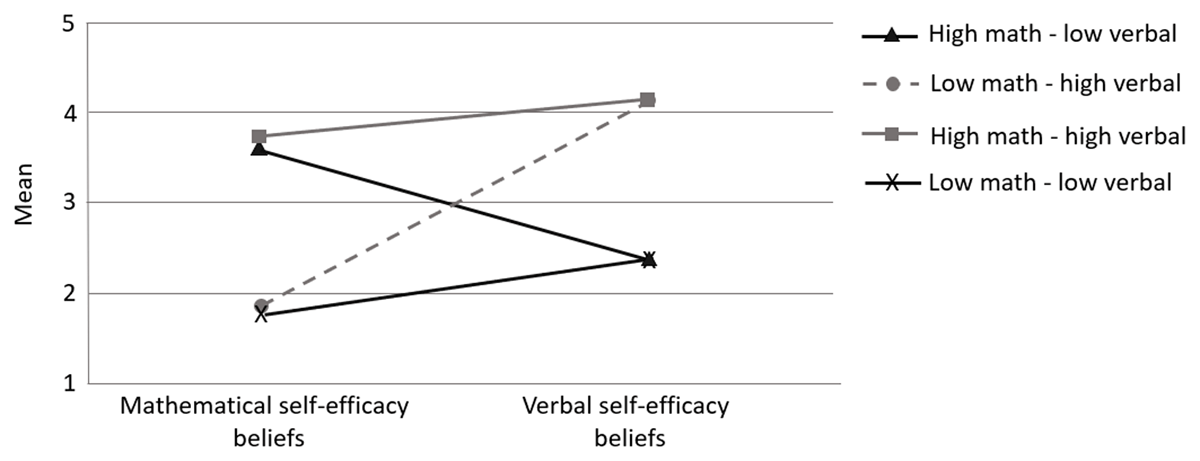
Figure 1
Mean score of the clusters.
We found statistically significant main effects of gender on interest in service, health, and education. On average, females (M = .20, SD = .91) had a higher mean score on the interest in service, health, and education (p < .001) than males (M = –.29, SD = .81), (4 items; eigenvalue = 2.19; alpha = .69). Cluster membership did not have a significant effect on interest in service, health, and education fields.
Finally, separately the gender and membership clusters explained a statistically significant portion of the variation in the interest in the economics and social science fields subscale score. On average, males (M = .22, SD = .86) scored higher (p > .001) on interest in economics and social science fields than females (M = –.13, SD = .91). A post hoc analysis with Gabriel’s test indicated that there was a statistically significant difference (study field interest. p < .01) between the high math–low verbal (M = –.09, SD = .84) and low math–high verbal (M = .23, SD = .91) clusters and between (p < .0019 the low math–high verbal (M = .23, SD = .91) and low math–low verbal (M = –.19, SD = .92) clusters. Overall, the results support our hypothesis that the clusters differ from each other in terms of university study field interest.
Discussion
The aim of this study was to examine the significance of GUS students’ subject preferences, mathematical and verbal self-efficacy beliefs, and gender for the further study field interests. The main achievements, including contributions to the field can be summarized as follows: First, we found that interest towards science and technology -fields was predicted by preferring physics, geography, mathematics, history, and chemistry. Further, the interest towards service, health and education -fields was predicted with the school subjects of health education, psychology, biology, student counselling, physical education and Swedish. Additionally, economics and social sciences fields were predicted by preferring social studies, physical education, English and Swedish. Consistent with the result of the current study, previous research also evidenced positive relationship between science domains and interests in science and technology (Naukkarinen et al, 2021). Interestingly, history and geography were found to be positive predictors of science and technology interest.
Second, regarding students mathematical and verbal self-efficacy beliefs, among our sample we detected four self-efficacy belief clusters that differ from each other: 1) high math–low verbal, 2) low math–high verbal, 3) high math–high verbal and 4) low math–low verbal. A further analysis regarding the gender of students’ self-efficacy beliefs clusters showed that most members of the high math–low verbal cluster were males, whereas most of the low math–high verbal clusters were females. As for the high math–high verbal and low math–low verbal clusters, females constitute the largest proportion of both self-efficacy belief clusters. Similarly, McCabe et al (2019) found that females had more diverse, greater math and verbal abilities than males. Further, Wang et al. (2013) found in their study that that the group with high math skills and high verbal ability included more females than males, and their study provided evidence that it is not a lack of ability that causes women to pursue non-STEM careers but rather the greater likelihood that females with high math ability also had high verbal ability and thus could consider a wider range of occupations than their male peers with high math ability who were more likely to have moderate verbal ability.
Third, regarding mathematical and verbal self-efficacy beliefs’ relation to university study field interest, we found a statistically significant relationship between gender and self-efficacy belief cluster membership, but none of the analyses showed a significant interaction effect of gender combined with self-efficacy belief cluster membership on the interest in the university study fields. That finding indicates that the interaction stem from gender with self-efficacy in math and verbal is not enough to explain the variance in university study field interest. Many researchers have attempted to better understand university study field interest through numerous variables (Blotnicky et al., 2018; Makarova et al., 2019; Mellén & Angervall, 2021). Since students` interests are regarded as complex psychological structures to predict, it is not easy to explain with combined effect from some variables (Jüttler et al., 2021). However, we found that both gender and self-efficacy cluster membership separately had a statistically significant main effect on the two dependent variables: science and technology fields, and economics and social science fields. Gender, examined with students mathematical or verbal self-efficacy beliefs, showed to be an overarching factor that impacted the study field interest: males were more interested in science and technology and females displayed more interest in service, health and education study fields than males. Addressing the gender gap in science and technology fields remains a concern (Cardador et al., 2021). Studies show that males are more inclined to opt for mathematics and science tracks, whereas females often gravitate toward non-science tracks (e.g., Pinxten et al., 2012). Even when females have interests aligned with STEM fields, the prospect of gender bias (Chen & Moons, 2015) can make them hesitant to pursue technology and science-based fields (Cardador et al. in 2021). According to our results, regardless of the other tested factors, subject preferences or math-verbal self-efficacy beliefs, students’ gender overarchingly impact on GUS students’ university study field interests.
Our key findings suggest regardless of the other variables we investigated—such as subject preferences and self-efficacy beliefs in math and verbal skills—students’ gender remains the dominant factor influencing the university study field interests of GUS students.
Strengths and limitations
The sample size was adequate for obtaining more precise mean values and detecting potential outliers that might distort the data in a smaller sample, resulting in a reduced margin of error. Nevertheless, it is crucial to acknowledge certain limitations when interpreting the findings of this study. Our results are based on a single measurement of interest that may change over time depending on, for example, the respondents age and incidents that impact their life paths (Bandura, 1982). This study examines certain factors related to GUS students’ second-year university field interests but does not reveal their eventual third-year choices. Further longitudinal studies could provide deeper insights. Additionally, in our measures, the focus is more on studying mathematics, and within the self-reported data, there was only a limited amount of information about verbal self-efficacy issues.
Conclusions and implications
Our findings suggest that, above all else, students’ interest in pursuing university study fields is primarily influenced by their gender, regardless of their self-efficacy beliefs or subject preferences. It is an important notion that despite students’ individual subject preferences or their educational strength, students tend to choose the traditional gendered pathways in Finland as well as on other Nordic countries (Einarsdóttir & Rounds, 2020; Mustosmäki et al., 2021). Recently in Finland, many cities, educators, and work-life representatives have started to develop out-of-school programmes to assist in the wider offering of educational and occupational pathways. Falco & Summers (2019) suggest that the improvement of career decision self-efficacy by means of career development interventions to students could serve as an effective way to foster awareness of the impact of a gender in career development. Their findings further suggested the need for student counsellors to incorporate gender and other sociocultural issues into career counselling with adolescents.
Educational and vocational choices are critical decisions for individuals (Kim & Beier, 2020) as they have a far-reaching impact on individuals’ lives (Lent et al., 1994; Morris, 2016; Rounds & Su, 2014), on work satisfaction and performance (Lent & Brown, 2006; Morris, 2003) and on individuals’ subjective well-being (Harris & Rottinghaus, 2017). It is therefore important to ask, should the current counselling system be expanded? For example, knowledge of work life could play a more important role in educational paths from previous years and be more closely linked to the subjects studied at different education levels.
Work life has changed tremendously in recent years and current career counselling systems face the challenge of providing up-to-date information on changing and fragmented working life. Although the student counsellors are responsible for guiding students’ vocational and educational choices, what would happen if also subject teachers would take part on collaborating more with working life with the GUS students? At least for a single student, it would open more and wider opportunities to see what skills and knowledge are currently needed in their working life. Moreover, it would serve the goals of teachers to motivate students to engage in subject studies when the connection would become more visible from school subjects to working life.
In Finland, the integration of school and work life collaboration into curricula began in 2004 following the Ministry of Education’s introduction of entrepreneurship education strategies. Over the years, efforts to strengthen collaboration with the working world have been made. However, recent studies indicate that cooperation still lacks coordination and a systematic approach, and it often relies on informal interactions between individual stakeholders and institutions. As our society has become increasingly dependent on science (Palmer et al., 2017) and the need particularly for STEM skilled people constantly grows, teachers have central role in stimulating students’ interests (Pinxten et al., 2012). According to previous studies, educators may not have a clear understanding of their potential role in helping students to develop interest (Hidi & Harackiewicz, 2000), and often it is misinterpreted that students either have or do not have interest. Studies have emphasized the potential for significant efforts in fostering students’ study and career interests (Kim & Beier, 2020; Nye et al., 2012; Smit et al., 2021). Consequently, we propose further exploration of this prospect for nurturing students’ interests, potentially employing methods like school and work life interventions.
Research has demonstrated that formal or informal STEM learning environments, along with collaborations involving young individuals, can ignite their enthusiasm for STEM subjects. As an example, science teachers could take more frequent opportunities to integrate work-life collaboration into their teaching. Engaging in discussions with STEM professionals from the workforce could help stimulate students’ interest in science. Such collaborations, whether in work or academic contexts related to science subjects, offer students a two-fold advantage: they provide a wider perspective on STEM career possibilities and direct learning about the requisite subjects and skills from industry or academic professionals.
Our findings highlight the dominating impact of gender on study field interests and the necessity for developing gender-sensitive career guidance methods. To reduce the gender gap in education and work life, it is essential to investigate and promote gender-sensitive methods to encourage students to follow their interests and competencies instead of taking the traditional gender-segregated occupational and educational paths.
Data Accessibility Statement
The data that support the findings of this study are available on request from the corresponding author. The data are not publicly available due to privacy or ethical restrictions.
Funding Information
This study has received project funding from Finnish Ministry of Education and Culture (OKM/197/523/2016) and the Academy of Finland Profilation 7 project (352788). It also received funding grants from Finnish Cultural Foundation and the University of Oulu Scholarship Foundation.
Competing Interests
The authors have no competing interests to declare.