
Table 1
Items from the questionnaire included in the recognition index.
| SECTION | RESPONSE FORMAT | ITEM | ITEMS SERVING AS INDICATORS |
|---|---|---|---|
| How important are the following for NAS’ opportunities to succeed in the Swedish school? Success in school equals completing education with at least passing results | Four-step Likert scale ranging from Not at all important to Very important. | Validation of students’ previously acquired knowledge | X |
| Working methods to counteract discrimination and racism | X | ||
| How important is it for the school that opportunities are created for NAS to establish a self-perception as … | Four-step Likert scale ranging from Not at all important to Very important. | Competent individuals with abilities that can contribute to the continuity and development of society | X |
| Individuals with political rights and responsibilities | X | ||
| Individuals with opportunities and rights, on equal footing with other members of society | X | ||
| How would you like to describe your workplace? Our workplace is characterized by … | Four-step Likert scale ranging from Not at all to Completely | Tolerance for a diversity of norms and values | |
| Daily work is carried out to minimize discrimination and racism | |||
| Teaching is conducted based on an intercultural pedagogy. The history, traditions, and perspectives of other groups are included in the content we teach | |||
| Attention is given to democratic principles (e.g. freedom of opinion, freedom of expression, equality before the law and the principle of majority) | X | ||
| To what extent is the support adapted based on changes in the student group, such as… | Four-step Likert scale ranging from Not at all to Completely | Based on the level of knowledge |
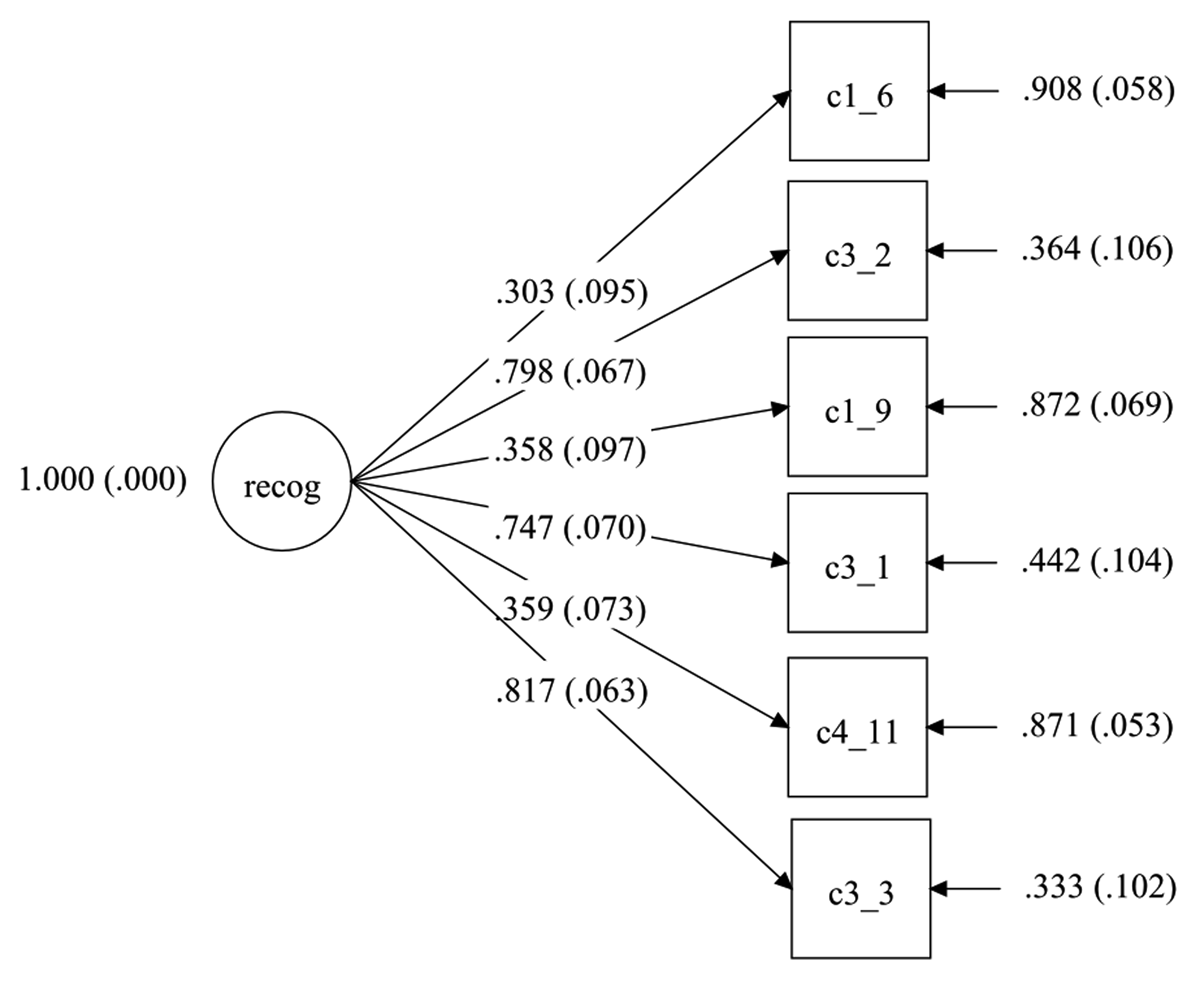
Figure 1
Measurement model of the latent construct recognition. Paths represent standardized factor loadings, with standard errors in parentheses, linking the latent construct to six observed indicators (c6, c2, c9, c1, c11, c3).
Table 2
Spearman’s rho correlations (two tailed).
| RECOG_INDEX | PEDAGOGICAL DESIGN | RESOURCES | LOCAL GOALS | CONTENT | |
|---|---|---|---|---|---|
| Recog_Index | 1.000 | .219** | .200* | .200* | .177* |
| Pedagogical design | .219** | 1.000 | .447** | .491** | .722** |
| Resources | .200* | .447** | 1.000 | .613** | .296** |
| Local goals | .200* | .491** | .613** | 1.000 | .422** |
| Content | .177* | .722** | .296** | .422** | 1.000 |
[i] Significance level, *p < .05, **p < .01.
Table 3
Recognition index score and number of participants (n).
| YES | NO | SIGNIFICANT DIFFERENCE | |
|---|---|---|---|
| Information regarding educational programs in upper secondary schools | 21.50 (115) | 21.95 (22) | NS |
| Get information on how to identify jobs with manpower shortage | 21.74 (109) | 21.92 (12) | NS |
| Get information about where it is easy to get a job | 21.68 (120) | 20.14 (7) | (one sided) <.05 |
| Identify knowledge and competences that are relevant for the future professional life | 21.73 (107) | 19.63 (8) | <.05 |
| About different professions and where you can work | 21.74 (141) | 18.50 (2) | <.05 |
| About labor law and work environment issues. | 22.02 (83) | 21.18 (28) | <.05 |
| About college and university (e.g., range, what it is like to study at college | 21.70 (136) | 18.67 (3) | <.01 |
[i] Note. Several categories contain small cell sizes (e.g., n = 2–8), and the results should therefore be interpreted with caution.