
Introduction
The educational system plays a key role in the social inclusion of NAS by providing essential knowledge about the receiving context (Nilsson & Bunar, 2016). However, it is also a complex structure that can be difficult to navigate, making system literacy crucial (Sundelin & Hertzberg, 2022). In Sweden (Swedish National Agency for Education, 2013), as in many other countries, this responsibility largely falls on CGC. In schools, counsellors are tasked with clarifying the system’s opportunities, challenges, and risks—they are the designated experts. Yet CGC extends beyond education, as career guidance involves trajectories into the labour market and working life, requiring counsellors to develop expertise in these areas as well (cf. Cedefop, 2009). Thus, CGC professionals are central to the inclusion of NAS into both educational and social systems (cf. Sultana, 2021), and CGC itself holds significant potential for fostering social inclusion (Hertzberg, 2015). Against this background, the aim of the article is to describe and analyse the significance of recognition in the organisation and management of career guidance counselling (CGC) for NAS.
What happens in CGC practice is not solely determined by the counsellors themselves. Like any other professional group, they are embedded in an organizational structure that requires them to follow guidelines and directives, carry out specific tasks, and fulfil a set of institutional goals. Consequently, the enactment of CGC is dependent on leadership and management. Accordingly, several studies on the organization of counselling activities in schools have directly or indirectly highlighted the importance of school leadership and its qualities. For example, Ponec and Brock (2000) as well as McConnell et al. (2020) argue that the effectiveness of counselling programmes is largely determined by school leadership. In the same vein, Leuwerke, Walker and Shi (2009) emphasize the importance of a positive and supportive relationship between counsellors and principals, and stress that shared understandings of appropriate guidance and learning activities are required (Leuwerke et al., 2009; McConnell et al., 2020).
In certain contexts, support from and collaboration with school leadership become crucial. When policy promotes the development and expansion of CGC activities (cf. OECD 2004; Watts & Fretwell 2004; SOU 2019:4), specific demands are placed on leadership. Any pedagogical expansion requires leaders to understand its content and aims, and to implement the necessary organizational changes. Since schools are workplaces where professional groups may compete for limited resources, leadership must also legitimize such changes (Leuwerke et al., 2009). In Sweden, these leadership dimensions gained prominence during the 2015 so-called “refugee crisis,” when a large number of NAS led to rapid and extensive changes in primary and secondary education (Nilsson & Bunar 2016). This required a swift expansion of pedagogical activities and attention to specific needs, posing challenges not only for teachers and counsellors but also for principals (Mock-Muñoz de Luna et al., 2020).
Apart from these developments, the leadership question has been decisive for the execution of CGC in Sweden during the last decades, due to the implementation of New Public Management (NPM) in the school system (Lundahl & Nilsson 2009, Lovén 2020). The shift toward decentralization, consistent with New Public Management (NPM), combined with vague, goal-based directives in policy documents, gave local school leaders and municipal authorities a far-reaching discretion and a considerable autonomy from central government. A number of effects for the deliverance of CGC has been noticed (Lundahl & Nilsson 2009, SOU 2019:4). Many school-leaders do not make use of their discretion, leaving many CGC activities unguided (SOU 2019:4). Many schools refrain from setting up local CGC goals (SOU 2019:4), and school-leaders delegates goal fulfilment responsibilities downwards, to the practice level (Lovén 2020). In effect, the intentions explicated in steering documents remains unimplemented (Swedish National Agency for Education, 2017), and an increased fragmentation in delivery can be discerned, which severely has jeopardized the central end goal of equity (Lundahl & Nilsson 2009).
In order to counteract fragmentation and declining equity, tendencies toward recentralization in educational policy have been discernible over the past fifteen years (Sundberg 2020). Examples include the implementation of various control and evaluation instruments, as well as the continued publication of soft governance but non-binding general guidelines, such as those concerning the execution of CGC (Swedish National Agency for Education, 2013). Nevertheless, the extensive discretion of school principals in CGC matters has remained largely intact (Nilsson & Hertzberg, 2022). Given these circumstances, the agency of local school leaders in the organization and management of CGC constitutes a relevant object of study. In line with these considerations, the aim of this article is to examine the management and organization of CGC for NAS, with particular attention to the significance of recognition in this context.
The concept of recognition
This article foregrounds the principle of recognition, school leaders’ adherence to it, and the implications this has for the organization and management of CGC. The primary reason for doing so is that the concept provides an ethical yardstick for evaluating, discussing, and developing pedagogical practices and educational settings (as well as other social arenas; cf. Smith, 2012, p. 6). Recognition concerns how both the universality and particularity of individuals should be addressed in order to support the development of a practical social identity. Many theories of recognition, notably those developed by Honneth (1995) and Taylor (1994), argue that such acts of recognition are necessary for a person to develop a functional social identity, and that individuals depend on affirmation from others and from society as a whole (McQueen, 2020). Following Smith (2012, p. 6), one might say that “modern morality has its basis in its claim to provide a social infrastructure – in terms of recognition – that enables all individuals, no matter their particular identity or place in society, to lead their own lives well.” This applies to everyone, but particularly to those in vulnerable positions or transitional states, such as newly arrived migrants (and students). The perspectives of Taylor and, above all, Honneth form the theoretical framework of this article, although minor deviations from this framework will also be addressed.
As a polyvalent concept, its scope varies among philosophers and educators, and the object of recognition differs across theoretical traditions. In this article, the analysis is primarily based on the theory of recognition developed by Axel Honneth (1995). Drawing on Hegel’s philosophical anthropology, Honneth argues that humans have a fundamental need for love, respect, and esteem, which correspond to three social spheres: the family, the state, and civil society. The family provides love, the state affirms legal and civic status, and civil society offers esteem. In civil society—a social context marked by informality, voluntariness, and mutuality—recognition involves acknowledging actual competencies and abilities, as well as the capacity to contribute socially through their expression.
The latter dimension is of primary relevance for CGC. Honneth emphasizes the importance of fair conditions for the development of competencies and abilities, and for being approached as a person capable of contributing to the collective good. In this regard, Honneth draws attention to an object of recognition also found in the policy field of “recognition of prior learning” (RPL). RPL can be defined as “a practice that reviews, evaluates and acknowledges skills and knowledge that adults gain through experiential, formal or self-directed learning and formal education” (Sandberg 2012). It is a process of structured assessment, evaluation, documentation, and recognition of knowledge and competences, regardless of where they have been acquired. In the context of schooling for NAS, similar procedures of acknowledgement and assessment are present. Here, RPL is primarily reflected in the assessment and mapping of prior learning in schools, used to determine appropriate placement within the school system and to inform the design of teaching based on these assessments and mappings.
Moreover, Charles Taylor’s (1994) definition of recognition is also relevant here. In his work, recognition denotes the need for dominant groups to acknowledge and respect the values and worldviews of subordinated minorities, in addition to their civic, political, and economic rights. Minority cultures matter, Taylor argues, because culture is central to identity formation—it is through culture that individuals develop a sense of self and of being a self among others. When the meaning-making of individuals or groups is relegated to a second-rate position and assigned a lower value, this may lead to a distorted self-image and a diminished sense of agency (Taylor 1994). Taylor’s conception of recognition runs parallel to the tenets of intercultural pedagogy, which promotes a curriculum in which minority ethos, traditions, and histories are visible and exert influence on teaching. With its focus on actuality, it affirms the values, standpoints, and worldviews of subordinated minority students, along with the traditions from which they draw (Gundara 2000).
However, the outcomes of the pursuit of recognition may diverge. In the pedagogical philosophy of Herbart, recognition targets the student’s potential rather than his or her actual existence (Uljens 2014). Bildung and self-realization are emphasized, with the development of autonomy and individual judgement as central aims. The goal is an individual capable of acting and reflecting independently, free from illegitimate influence. These divergent conceptions may clash in pedagogical practice (Uljens 2014), for example when collectivist values that challenge the ideal of autonomy are recognized. This tension is crucial for CGC practice in diverse contexts, as its pedagogy and policy often emphasize independent and autonomous choice (Hertzberg 2024).
In earlier texts, we have argued for the adherence to the principle of recognition in CGC for NAS (Hertzberg, 2024, Sundelin & Hertzberg, 2022). Primary objects of recognition are the knowledge and the competence of the NAS, as well as their norms and values – above all those related to the realms of education, work, vocations and future plans. CGC should have an intercultural outlook, and a readiness to understand the logic and ethical fairness of norms and values that deviate not only from her/his own, but also from the ethical premises implicated in the pedagogy of career counselling. These considerations, which by and large follows from Taylors theoretical focus, aligns with the guidelines for multicultural CGC methodology (cf. Peavy & Li, 2003; Launikari & Puukari, 2005), where the ethics of Taylor appears to enjoy fairly broad acceptance.
A similar observation can be made regarding the reception of multicultural ethics in research on school leadership. When school leaders actively adopt and embody principles of multiculturalism, it is claimed that schools become more equitable (Brown et al, 2022), teachers become more inclusive (Musadad & Adha, 2022; Boudreaux, 2024), and students from minority backgrounds experience better academic and social outcomes (Brown et al, 2022). Many scholars seem to defend the idea that school leaders should adhere to the principle of recognition as put forth by Taylor (1994).
Explicit references to Honneth’s perspective on recognition appear to be notably fewer. This is evident, for example, in Shields’ (2024) account of transformative educational leadership, which she positions as a moral and justice-oriented practice aimed at fostering inclusive and identity-affirming school cultures. Central to this approach is the cultivation of relationships grounded in dignity, respect, and dialogue—elements that closely parallel Honneth’s (1995) theory of recognition. By and large, Shields’ conception of transformative leadership operationalizes recognition theory in educational settings by translating ideas closely akin to Honneth’s into concrete leadership practices oriented toward equity and social justice; still, there is not a single reference to Honneth. Nevertheless, both empirical research and normative educational philosophy highlight the importance of school leaders being attentive to the principle of recognition. However, none of these texts address school leadership in relation to CGC activities.
To analyze the significance of recognition in the organization and management of CGC for NAS, we constructed a “recognition index” based on questionnaire data from principals in upper secondary and adult education. The index incorporates elements from Honneth (1995), Taylor (1994), and RPL policy. In line with Honneth’s account of legal recognition (pp. 107–121), we consider principals’ attention to NAS’s political rights and democratic principles in general; and following his civil-sphere recognition (pp. 121–130), we highlight their concern for conditions enabling NAS to develop an identity as competent contributors to the common good. Consistent with RPL policy, we also note principals’ interest in validation practices and their implementation in schools. Finally, in accordance with Taylor’s (1994) “Politics of Recognition,” we include measures aimed at counteracting racism. Thus, the index operationalizes recognition along two lines: a Honneth-inspired axis concerned with rights, competence, and contribution, and a Taylor -inspired axis concerned with the integrity of migrants and the counteraction of racism. Against this conceptual background, we address the following research questions: (1) Do the principals’ opinions on recognition relate to professional or demographic criteria such as years in service, gender, number of NAS, and changes in the number of NAS? (2) Do the principals’ opinions of the principals in this matter also relate to the ways in which they organized and governed CGC? The construction of the index is described in the next section.
Design, method and analysis
We have adopted a quantitative research strategy and a cross-sectional design and selected a questionnaire as our primary methodological tool (Bryman, 2018). Our aim has been to examine the prevalence of a positive and affirming attitude toward the principle of recognition among school leaders in Sweden, as well as the relationship between this attitude and their approach to career and educational guidance, both in general and specifically for NAS. Our analysis has primarily focused on demographic data, information regarding working conditions, professional experience, modes of practice, and positions on issues related to recognition (a detailed account is provided below). The questionnaire was distributed to all school leaders at the compulsory and upper secondary levels as well as in adult education (“Komvux”) across Sweden, in both public and independent schools.
Participants and procedure
The target population consisted of principals from Swedish schools with experience of working with NAS. The research area is relatively narrow, so we expected participation from principals that could provide valid information based on their knowledge and practical experience. In 2021–2022, Sweden had approximately 1300 upper secondary schools, of which about 800 were municipal and 500 independent (Swedish National Agency for Education, 2022). Adult education institutions (Komvux) were also included.
Several steps were taken to collect cross-sectional data from the target population, namely principals from upper secondary schools both from the municipal and private sectors, as well as principals from the adult education. After contacting the Swedish National Agency for Education, we obtained a list of email addresses, which was cleaned to remove duplicates. This resulted in 1255 email addresses for upper secondary schools and 502 for adult education institutions, all of which were invited to participate in a digital questionnaire. Participation in the second stage relied on self-selection, as recipients assessed whether they possessed the relevant knowledge or experience to complete the questionnaire. In total, 152 principals participated: 53 from municipal upper secondary schools, 29 from private schools, 63 from adult education, and 7 from special schools. The response rate for principals from upper secondary schools was approximately 7 percent, while the corresponding response rate for principals from adult education providers was approximately 14 percent. The overall response rate was therefore approximately 8.5 percent (152 of 1,757 invited). Non-response may therefore reflect self-selection processes, whereby principals with greater interest in or relevance to the study topic were more likely to participate. Data collection was conducted digitally through Umeå University’s DIP platform. This platform is designed for handling information with significant or high protection requirements in terms of confidentiality and accuracy.
Instrument
The instrument used to obtain information required information involved operationalisation of the theoretical domain previously presented as recognition. One section of the instrument included items on background information, such as years of experience as principal, as well as items related to the school context, including the number of students, daily routines, and available resources such as staff competencies. Other sections included items concerning the pedagogical approaches adopted by the school and the prioritisation of efforts to achieve educational goals. One section also described the resources available for this specific group of students. The response format used included fixed-choice alternatives based on numerical categories, dichotomous response options, and Likert-type scales ranging from three to four levels of agreement.
Data analysis
A “recognition index” was constructed based on our theoretical understanding of the concept of recognition in the context of CGC, drawing on various elaborations of recognition in both philosophy and policy. However, fully operationalising the concept of recognition in its entirety was not feasible, and some aspects were therefore partly backgrounded, particularly those developed by Taylor (1994). Thus, item A connects to the tenets of RPL policy, item B relates to the “politics of difference” as developed by Taylor (1994), and items C, D, E and F are derived from the formal ethics of Honneth (1995). In the latter case, C and F relate to recognition in civil society, while items D and E relate to recognition by the state in the public sphere. It is important to note that the framework proposed by Honneth (1995) constitutes the central focus of our index.
The recognition index was developed in several steps. First, we included items closely connected to the theoretical framework and conducted a series of analyses. The intention was to develop a valid and reliable index based on the response patterns of the participants, with items identified as representing assumptions about recognition in relation to achieving pedagogical goals in society. Hence, our index attends to both the recognition of actuality and potentiality (cf. Uljens, 2014). Items were drawn from different sections in the questionnaire, as presented in Table 1.
Table 1
Items from the questionnaire included in the recognition index.
| SECTION | RESPONSE FORMAT | ITEM | ITEMS SERVING AS INDICATORS |
|---|---|---|---|
| How important are the following for NAS’ opportunities to succeed in the Swedish school? Success in school equals completing education with at least passing results | Four-step Likert scale ranging from Not at all important to Very important. | Validation of students’ previously acquired knowledge | X |
| Working methods to counteract discrimination and racism | X | ||
| How important is it for the school that opportunities are created for NAS to establish a self-perception as … | Four-step Likert scale ranging from Not at all important to Very important. | Competent individuals with abilities that can contribute to the continuity and development of society | X |
| Individuals with political rights and responsibilities | X | ||
| Individuals with opportunities and rights, on equal footing with other members of society | X | ||
| How would you like to describe your workplace? Our workplace is characterized by … | Four-step Likert scale ranging from Not at all to Completely | Tolerance for a diversity of norms and values | |
| Daily work is carried out to minimize discrimination and racism | |||
| Teaching is conducted based on an intercultural pedagogy. The history, traditions, and perspectives of other groups are included in the content we teach | |||
| Attention is given to democratic principles (e.g. freedom of opinion, freedom of expression, equality before the law and the principle of majority) | X | ||
| To what extent is the support adapted based on changes in the student group, such as… | Four-step Likert scale ranging from Not at all to Completely | Based on the level of knowledge |
Second, all items were examined to ensure that they reflected the same directional meaning, either a high or low level of recognition before conducting the analyses. Several items were included in the initial index, and others were subsequently added to assess their suitability. Third, a one-dimensional construct of recognition was developed using latent variable modelling. The model was evaluated with a range of commonly applied fit indices (Hu & Bentler, 1999). Chi squared test, where a non-significant p-value indicates good model fit (p > .05). The Root mean of square of approximation (RMSEA), with a cut-off value of .08 indicating an acceptable fit, although this should be interpreted with caution considering the small sample size and low degrees of freedom (Kenny, Kaniskan & McCoach 2015). The Comparative fit index (CFI), for which values above .90 are required, and the alternative gamma hat index, often considered more stable (Fan & Sivo, 2007). Another commonly used fit index included was the standardized root mean square residual (SRMR) with a cut-off value of .08 (Hu & Bentler, 1999). The estimator used was robust maximum likelihood (MLR) which handles potential deviations from normality. With six remaining items, each coded on a four-point scale, the recognition score ranges from a minimum of six, if a respondent selects the lowest possible value for every item, to a maximum of 24 when the highest value is selected across all items. The index is interpreted such that higher values indicate stronger endorsement of recognition principles, and all items are coded in the same direction.
The index was then used to examine group-level differences based on the mean score. Group differences were tested using independent-samples t-tests when groups were defined by dichotomous variables, such as gender. The t-tests were two-tailed unless otherwise specified, and the significance level was set at p < .05. Relationships with continuous variables were investigated using Pearsons r, with the significance level set at p < .05. When analysing categorical variables, Spearman’s rho was used as an alternative, also with the significance level set at p < .05. In addition, one-way Anova was conducted for variables with more than two categories. Some analyses may lack information from all participants for various reasons. Responses indicating lack of knowledge or experience, or selecting options that did not provide analysable information, were coded as internally missing data. These cases were handled using listwise deletion, meaning that participants with missing values on any variables included in a specific analysis were excluded from that analysis. Missing data levels varied only slightly across items, and resulting differences in sample sizes are indicated where applicable. Analyses were conducted using SPSS (version 26) and Mplus Version 8.10 (Muthen and Muthen, 1998–2017).
Results
As previously mentioned, the development of the recognition index was guided by theory. A model with six items was retained, yielding the following fit indices: chi square was significant, χ²(9) = 28.097, p < .01; CFI = .88; gamma hat index .96; RMSEA = .12. SRMR = .057. The RMSEA should be interpreted with caution given the small degrees of freedom and sample size. Overall, the model fit was judged to be acceptable in light of the relatively small sample of participants (n = 152). Reliability, in terms of internal consistency, yielded a Cronbach’s α coefficient of .71 and an omega of .71. The indicators (items) had loadings ranging from .303 to .817, all of which were statistically significant (Figure 1). Four items were excluded, as they did not contribute additional information and were likely to overlap with other items, or because they had weak loadings, indicating insufficient correlation with the remaining items. Such issues are commonly related to how items are formulated and interpreted by respondents. The recognition index ranged from 16 to 24, Mean = 21.62, SD = 2.03.
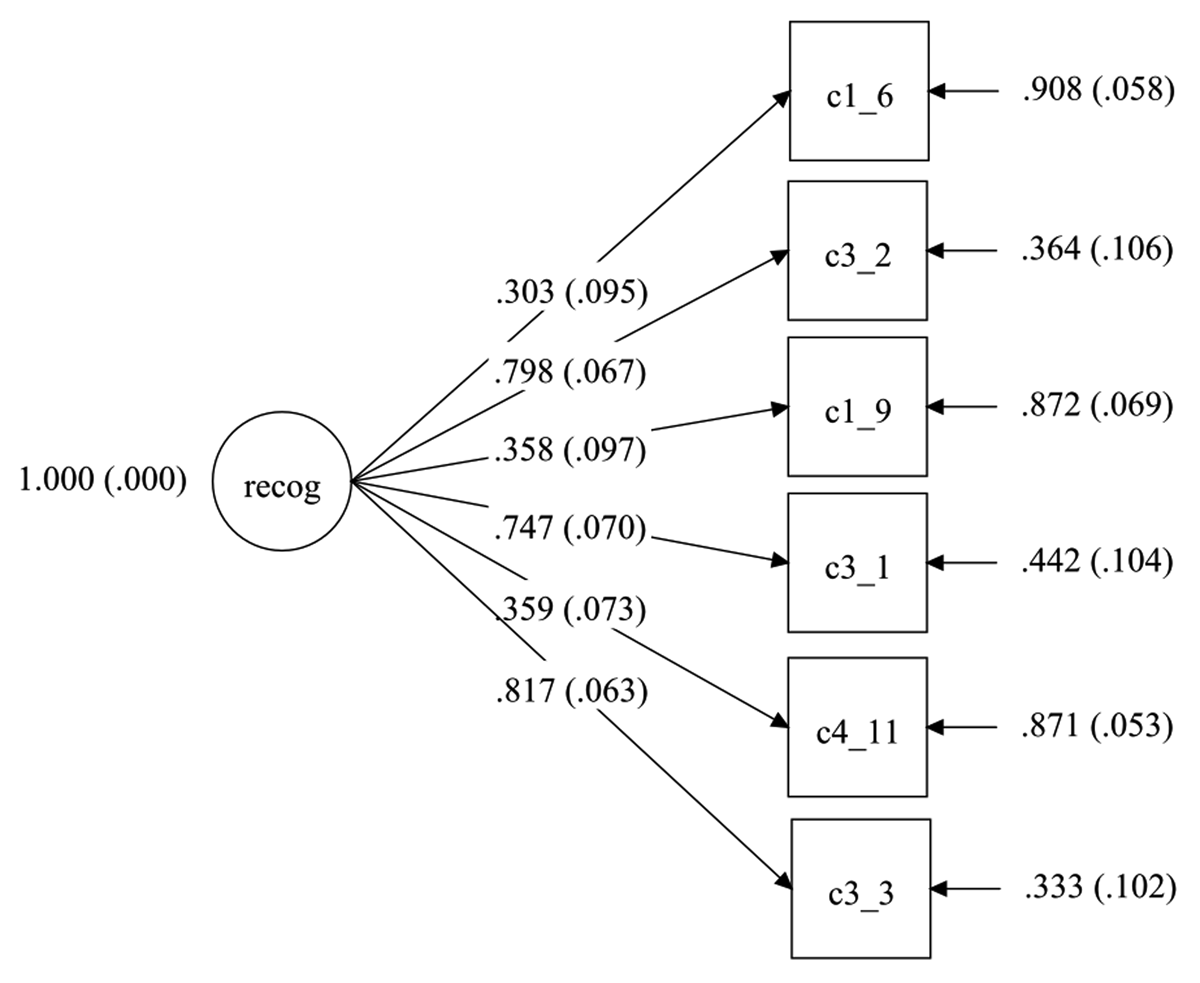
Figure 1
Measurement model of the latent construct recognition. Paths represent standardized factor loadings, with standard errors in parentheses, linking the latent construct to six observed indicators (c6, c2, c9, c1, c11, c3).
Differences on the recognition index: demographic and professional variables
A significant gender difference was found. Females (M = 21.92, SD = 1.85) reported significantly (p < .05) higher scores in the recognition index than males (M = 21.24, SD = 2.19), t(140) = –2,10, p = .04. Apart from gender, none of the examined variables (years in service, number of NAS, or large fluctuations in the number of NAS) showed a significant relationship with the recognition index.
Differences on the recognition index: the organization of career guidance counselling
When it comes to the organization of career guidance, the relevance of the recognition index was difficult to estimate. It appeared to matter in some cases but not in others. One notable finding from our questionnaire was a statistically significant relationship between school leaders who employed CGC with a special focus on counselling NAS and adherence to the principles of recognition. A Spearman’s rho correlation indicated a weak association rs (150) = .20, p = < .05. Hence, school leaders who were more inclined to endorse these principles were also more likely to acknowledge the pedagogical needs of these students when recruiting CGC.
The principle of recognition also proved to be important for how school leaders organized and managed CGC, particularly in relation to how evaluations were conducted. School leaders who scored higher on the recognition index, were more inclined to use internal evaluations of CGC to monitor the fulfilment of goals outlined in central policy documents. There was a statistically significant difference between the two groups, users (M = 22,13, SD = 1,73) and those reporting not using them (M = 21,30, SD = 2,15), t(121) = –2,4, p = .02.
Furthermore, adherence to the principles of recognition also had some impact on the organization and resource allocation for competence development for CGC. Although the majority reported that competence development was considered when allocating resources to activities such as training courses, collegial networks or conferences, a significant difference in the recognition index was found for participation in conferences. Specifically, there was a significant difference between those who reported participation (M = 21,70, SD = 1,98) and those who did not (M = 20,58, SD = 2,04, t(136) = –2,3, p = .02). Hence, school leaders who embraced the principles of recognition were more likely than others to send away their guidance counsellors to conferences. Tentatively, this variation may be explained by differences in costs.
When investigating the relationship between recognition and the conditions for working with CGC, a measure based on the following indicators was developed; a) having regular contact with career counsellors regarding resource allocation; b) providing counsellors with the financial resources needed to deliver adequate CGC; c) ensuring that counselling is of high quality and accessible to all students at the school; d) ensuring that the CGC function is based on a clear and well-articulated job description; and e) maintaining regular contact with counsellors regarding the design and nature of their professional tasks. This measure correlated significantly with school leaders’ adherence to the principles of recognition, r(150) = .22, p = .001. These indicators provide an approximation of the quality of CGC management, and adherence to the principles of recognition appears to have a modest but statistically significant association in this regard.
When it comes to other factors that also condition the execution and delivery of CGC, the significance of the index is illustrated in Table 2. Counsellors working in schools where school leaders embrace the principles of recognition were able to influence the following four investigated areas: the design of pedagogical activities, allocation of resources, local goals, and content. All correlations between the index and these areas (measured on a four-step agreement scale) were significant, with pedagogical activities (pedagogical design) showing the strongest correlation. This indicates that school leaders perceived counsellors as having the ability to influence these areas.
Table 2
Spearman’s rho correlations (two tailed).
| RECOG_INDEX | PEDAGOGICAL DESIGN | RESOURCES | LOCAL GOALS | CONTENT | |
|---|---|---|---|---|---|
| Recog_Index | 1.000 | .219** | .200* | .200* | .177* |
| Pedagogical design | .219** | 1.000 | .447** | .491** | .722** |
| Resources | .200* | .447** | 1.000 | .613** | .296** |
| Local goals | .200* | .491** | .613** | 1.000 | .422** |
| Content | .177* | .722** | .296** | .422** | 1.000 |
[i] Significance level, *p < .05, **p < .01.
Lastly, adherence to the principle of recognition appeared to be of some importance with regard to the content of CGC activities (Table 3). In this question, school leaders were able to select from a number of items to describe the content of the CGC at their school. Only one item (labor law and work environment) showed a significant difference, with an acceptable sample size in both categories. Categories represented by small sample sizes have low statistical power, which limits the interpretability of non-significant results.
Table 3
Recognition index score and number of participants (n).
| YES | NO | SIGNIFICANT DIFFERENCE | |
|---|---|---|---|
| Information regarding educational programs in upper secondary schools | 21.50 (115) | 21.95 (22) | NS |
| Get information on how to identify jobs with manpower shortage | 21.74 (109) | 21.92 (12) | NS |
| Get information about where it is easy to get a job | 21.68 (120) | 20.14 (7) | (one sided) <.05 |
| Identify knowledge and competences that are relevant for the future professional life | 21.73 (107) | 19.63 (8) | <.05 |
| About different professions and where you can work | 21.74 (141) | 18.50 (2) | <.05 |
| About labor law and work environment issues. | 22.02 (83) | 21.18 (28) | <.05 |
| About college and university (e.g., range, what it is like to study at college | 21.70 (136) | 18.67 (3) | <.01 |
[i] Note. Several categories contain small cell sizes (e.g., n = 2–8), and the results should therefore be interpreted with caution.
Discussion
The aim of this article was to describe and analyze the significance of recognition in the organization and management of CGC for NAS. Regarding our first research question — whether principals’ views on recognition relate to professional or demographic factors such as years in service, gender, number of NAS, or changes in that number — our main finding suggests that only gender mattered. No other variable seemed to be associated with principals’ views. Neither the number of NAS at a school nor leadership experience during the 2015–2016 “refugee crisis” had any discernible effect. Although earlier research indicates that the rapid influx of NAS affected educators’ working conditions (Mock-Muñoz de Luna et al., 2020) and their ability to meet these students’ pedagogical needs (Nilsson & Bunar, 2016), such challenges do not appear to influence principals’ acceptance or rejection of recognition-related principles.
Our findings on the correlation between gender and adherence to recognition principles align with research on gendered value formation. Kriesi (2010) identifies a “new cultural divide” between GAL (green, alternative, libertarian) and TAN (traditional, authoritarian, nationalist) values. GAL values—emphasizing freedom and a break with tradition—correspond more closely to recognition principles than TAN values, which stress national identity and tradition (Modood 2013). Gender plays a role: like European women generally (Abendschön & Steinmetz 2014), Swedish and Scandinavian women are more inclined to embrace GAL and post-materialist values (Inglehart & Harris 2003; Oskarsson & Ahlbom 2021). Since post-materialist values overlap with GAL orientations and emphasize self-determination and personal development, they resonate with recognition theory. Thus, the higher recognition-index scores among women in our study may indicate broader political value trends. Female principals’ stronger orientation toward recognition is in line with long-term patterns in value formation (Inglehart & Harris 2003; Kriesi 2010).
Regarding our second research question—whether principals’ attitudes toward recognition relate to how they organize and manage CGC—our analysis suggests that leaders who embrace recognition principles are more likely to allocate resources to CGC that addresses NAS’s pedagogical needs. Most notably, adherence to recognition seems to be linked to employing CGC staff specifically for NAS, and these leaders are also somewhat more inclined to support counsellors’ professional development. This may suggest a commitment extending beyond staffing alone. This pattern is theoretically plausible: CGC practice aligns with several objects of recognition, including the mapping and valuing of prior knowledge; the use of a client-centered, attentive pedagogy that grants counselees the right to define their own situation; and, in line with Honneth (1995, ch. 6), the fostering of an identity grounded in a belief in the counselees’ societal contribution.
Moreover, we also found an association between adherence to the principle of recognition and (a) the management and organization of CGC, and (b) the nature of the relationship between school leaders and guidance counsellors. First, principals who scored higher on the recognition index were more likely to use internal evaluations of CGC to monitor goal fulfilment in key policy documents, such as the Education Act, the “General Advice” – i.e., recommendations for the application of laws and regulations from the Swedish National Agency for Education (SNAE), and the national curricula (Swedish National Agency for Education; 2011a, 2011b, 2013). Second, these principals were also more inclined to maintain regular contact with counsellors regarding resource allocation and task design. More than other respondents, they also tended to report that CGC at their schools operated within a clear and well-defined framework of responsibilities, and that their counsellors had the financial resources necessary to deliver adequate CGC, with services that were well-resourced and accessible to all students.
Thus, our findings suggest that adherence to recognition influences how CGC is organized and managed. As highlighted in prior research (McConnell et al., 2020), and particularly within the Swedish context (Lundahl & Nilsson, 2009; Lovén, 2020), this is an important matter, not least given the fact that the previously mentioned elements (e.g., the presence of internal evaluations, regular contact with counsellors, clear responsibilities, and adequate resources) are recurrently recognized as indicators of quality in career guidance (Plant, 2004; Watts, 2014; Almeida et al., 2014). In Sweden, shortcomings in these areas have been noted in evaluations and government reports (Swedish Schools Inspectorate, 2013; SOU 2019:4) as well as in academic studies (Lundahl & Nilsson, 2009; Rosvall & Eshaghbeigi-Hosseini, 2023). Our findings indicate that school leaders who adhere to principles of recognition manage CGC in ways that uphold these quality indicators, thereby – following Lundahl and Nilsson’s (2009) argument – creating the conditions for a less fragmented CGC that is better equipped to meet policy demands for equity.
Nevertheless, the relationship between the management of CGC and the embrace of recognition requires further elaboration. When the focus is placed on CGC for NAS, the relevance of a recognizing mindset appears self-evident, as recognition, among other things, denotes the acceptance and approval of the meaning-making, competences, and life-forms expressed by minorities and/or migrants (Andersson & Fejes, 2010). But what about the relationship between recognition and the management of CGC more generally? For example, why are school leaders who report higher levels of recognition more inclined to use internal evaluations to monitor the fulfilment of goals stated in central Swedish target documents? With regard to the pursuit of recognition in Swedish CGC policy, the multiculturalist strand of Taylor’s (1994) “politics of recognition” is largely absent. Earlier research has shown that priority is given to supplying competence and manpower to the labour market (Bergmo-Prvulovic, 2014) and to fostering social inclusion (Lundahl & Nilsson, 2009; Rosvall & Eshaghbeigi-Hosseini, 2023), whereas social-justice concerns are addressed more sparsely (Bergmo-Prvulovic, 2014).
Moreover, the Swedish national curricula also state that students should be able to make informed decisions about further study and vocational orientation based on accumulated experience and knowledge (Swedish National Agency for Education, 2011a, 2011b). This is in line with the Herbartian tradition (Uljens 2014), where the individual’s capacity for self-activity and autonomy is the primary object of recognition, and autonomy is a central aim of schooling. In relation to Taylor’s (1994) definition of recognition, it is also important to note that the curriculum’s emphasis on autonomy is partly motivated by the requirement that CGC counteract restrictions in educational and vocational choice based on gender, social background, and cultural background (Swedish National Agency for Education, 2011a). Here, the multiculturalist “politics of recognition” is rejected rather than embraced. Whether recognition is present in these policy documents depends on which object of recognition is foregrounded. Still, principals’ strong tendency to monitor goal fulfilment in key documents cannot be interpreted as adherence to Taylor’s multiculturalist view of recognition. Thus, the relation between a) the adherence to principles of recognition and b) the use of internal evaluations for the control of goal-fulfilment remains theoretically unexplained.
For the sake of argument (and construct validity), it must be re-emphasized that our recognition index favors Honneth’s (1995) definition of the concept, which foregrounds equal standing and self-development over the politics of difference or autonomy. This is relevant when discussing the relationship between scoring high on the recognition index and the design of CGC activities. As noted above, school leaders who scored low on the recognition index may be associated with a more pragmatic, receiver-oriented approach to CGC, favoring activities aimed at rapid insertion into the education system and immediate labor-market inclusion (Table 2). In contrast, higher scores may be associated with prioritizing not only short-term inclusion but also learning for long-term school-to-work transitions (e.g., vocational content, qualification criteria, higher education) and for individual development and rights (e.g., labor law, working-environment issues). In schools with high-score principals, CGC involved fostering fair career development and self-actualization rather than merely facilitating system entry. The recognition of prior knowledge and equal rights was emphasized, as were the conditions for developing social esteem—particularly an identity as someone able to contribute to the common good (Honneth, 1995). These findings suggest a theoretically plausible link between recognition and CGC management, but the empirical basis remains somewhat limited. As noted earlier, only one item—labor law and working environment—showed a significant difference with an adequate sample size (Table 2).
The form of recognition highlighted by Honneth (1995) thus appears to be relevant for how school leaders relate to CGC for NAS. They strive to create favourable conditions for a pedagogical practice that can offer these students an opportunity to be included in Swedish society, with due attention to both equal standing and self-development. Their positions and ways of leading the work appear to align with recognition within both the public sphere and civil society. The extent to which their work aligns with Taylor’s (1994) understanding of recognition is more difficult to assess. On the one hand, their support for dedicated career guidance for NAS can be seen as a concern for these students’ meaning-making, and above all for the project of developing study and career aspirations grounded in their own convictions and competences. On the other hand, the CGC policy goals that they are more inclined to follow than other school leaders partly run counter to Taylor’s “politics of difference.” (This is also, in part, a methodological issue, which will be addressed below.)
Limitations
Because the target population principals with relevant experience, is relatively small, and the research area is narrow, the number of respondents remained limited despite several follow-up attempts. Consequently, analyses followed a robust but non-complex approach suited to the available sample size. The study nonetheless succeeded in collecting cross-sectional data from principals across municipal, private, and adult education sectors, providing insight into how schools with NAS are organized and led.
The recognition index shows several measurement constraints. Although reliability reached an acceptable threshold (α = .71), it remains modest, and one item loaded weakly, indicating limited contribution to the construct. These issues suggest that the index should be interpreted cautiously. In addition, the analyses involving group differences were affected by substantial imbalance and small cell sizes in several items, with “No” responses ranging from n = 2 to n = 8. This limits statistical power and makes it unclear whether non-significant findings reflect a true absence of differences or simply insufficient sample size. While the conceptual grouping of items is reasonable, conclusions should emphasize that patterns across items are tentative and constrained primarily by the limited subgroup sizes. Future research should evaluate the recognition index in larger and more balanced samples, allowing for a more robust assessment of its internal structure and reliability. Increasing subgroup sizes would also strengthen the examination of group differences and provide clearer insight into whether the trends observed here reflect meaningful patterns. However, it is important to note that our findings are closely tied to the way the recognition index is constructed—primarily with reference to Honneth’s (1995) approach to recognition, in which capabilities, competences, and civic rights are emphasized. Other aspects or definitions of recognition, most notably Taylor’s (1994) “politics of difference,” may therefore have been downplayed.
Conclusion
The aim of this article was to analyse the significance of recognition in the organization and management of CGC for NAS. Two research questions guided the study: (1) whether principals’ views on recognition relate to professional or demographic factors such as years in service, gender, or the number of NAS; and (2) whether these views correspond to how they organize and manage CGC. Regarding the first question, we found a gender difference: female principals reported significantly higher recognition-index scores, while no other demographic or professional variables seemed to be of relevance. Concerning the second question, principals who adhered to recognition principles were more likely to allocate resources to CGC that address NAS’s pedagogical needs and to manage CGC in ways that may be beneficial for certain quality indicators. These principals also tended to use internal evaluations to monitor goal fulfilment in central policy documents, were more likely to maintain regular contact with counsellors about resources and task design, and more often reported ensuring that counsellors had sufficient financial means. They also tended to place greater emphasis on long-term transitions, individual development and social rights and were more likely to report that CGC was well-resourced and accessible to all students. By contrast, principals scoring low on the recognition index tended to adopt a pragmatic, receiver-oriented approach, prioritizing immediate educational and labor-market inclusion.
It should be noted that the relationship between (a) adherence to recognition and (b) school leaders’ gender, their allocation of resources to CGC for NAS, may be associated with upholding certain quality indicators in CGC practice, and manage CGC with a focus on long-term transitions, individual development, and social rights. Our finding may also have some implications for CGC practice. It is reasonable to assume that a school leader who adhered to recognition principles is more prone to allocate resources to CGC which is attentive to the pedagogical needs of NAS, and to manage CGC in a way that safeguards certain quality indicators and creates opportunities for quality in delivery. It is also more likely that CGC in schools led by principals who embrace the principle of recognition focuses on learning from a long-term perspective on school-to-work transition, individual development, and social rights.
Data Accessibility Statement
The data that supports the findings of this study are available from the corresponding author, upon reasonable request.
Ethics and Consent
We have obtained ethical approval from the ethics support function, Department for research and collaboration support, Stockholm University. Our research has been conducted within the ethical guidelines of Swedish Research Council (VR).