
Introduction
The configuration of global production chains has been a defining feature of capitalist accumulation since the 1970s, expanding steadily into the early twenty-first century (Dicken 2015; Gereffi 2018). However, the 2008 global crisis disrupted this trajectory, and subsequent developments —including rising trade tensions among major industrial powers and East Asia, the COVID-19 pandemic, and the war in Ukraine— have further undermined the dynamism of globalized production while reinforcing protectionist trends (WTO 2019; WB 2020; Barbieri et al. 2020; Rosales 2022; Cimoli 2023). Amid this shifting context, global production networks have become increasingly regionalized, reflecting broader deglobalization dynamics (Baldwin & López González 2015; Pegoraro et al. 2020; WB 2020).
By the early 2010s, the world’s major “factories” —North America, Europe, and Asia— had reinforced intra-regional trade linkages while maintaining extra-regional connections (WB 2020). Latin American countries, with the exception of Mexico —which has been integrated into the “Factory North American”— have remained largely excluded from these production networks and have yet to consolidate a “Factory Latin America” (Zaclicever, 2017; Amar & Torchinsky Landau, 2019; WTO, 2019). Since the mid-1990s, the region’s participation in global production chains has increased, particularly through its growing interdependence with “Factory Asia”. However, this insertion has reinforced specialization in natural-resource-based and low-wage sectors, characterized by limited technological sophistication and modest value added, thereby maintaining the region’s subordinate position within the global economy (Lauxmann et al. 2021; Lauxmann & Fernández 2023). Regional linkages have also intensified during this period, although substantial progress is still required for Latin America to move toward the consolidation of a regional factory (Zaclicever 2017; Amar & Torchinsky Landau 2019; Marcato 2022; Brondino et al. 2023).
This scenario highlights the potential of regional productive integration as a development strategy to strengthen Latin America’s position within the global economy. These ideas are deeply rooted in Latin American economic thought, particularly within the Economic Commission for Latin America and the Caribbean (ECLAC). In the 1950s, Structuralist approaches promoted it as a means to foster industrialization and reduce external dependency (CEPAL 1951a; 1951b; 1959; Prebisch 1959), while late-twentieth-century neo-structuralist perspectives emphasized “open regionalism” and, into the early twenty-first century, continue to underscore the relevance of “strategic” or “pragmatic” regionalism as a path toward overcoming the region’s peripheral position (CEPAL 1994; 2014).
Building on this longstanding tradition of Latin American thought, this article argues that the ongoing regionalization of global production presents a historical opportunity for Latin America to foster development by establishing a regional manufacturing hub. Seizing this opportunity requires situating the analysis within the contemporary geopolitical and geoeconomic context and undertaking a critical reassessment of Latin American structuralist and neo-structuralist thought. To explore this hypothesis, the article employs a critical literature review approach that integrates theoretical insights with recent empirical evidence to reinterpret these frameworks in light of twenty-first-century transformations.
Accordingly, the article has three main objectives: (a) to analyze the contemporary capitalist context and the insertion of Latin America within it; (b) to reassess the contributions and limitations of structuralist and neo-structuralist approaches regarding regional integration as a development strategy; and (c) to propose an updated conceptualization of regional productive integration -grounded in a critical recovery of ECLAC’s thought- that promotes Latin America’s development within the current dynamics of regionalization amid ongoing deglobalization trends.
The paper is structured as follows. The first section examines the particularities of the contemporary capitalist system and Latin America’s position within it. The second section provides a critical discussion of the theoretical contributions of structuralist and neo-structuralist thought on regional integration. The third section reassesses and adapts key insights from these traditions to outline strategies that could strengthen Latin America’s role in the current global economy.
1. The Global Productive Configuration and Latin America’s Position
As the first two decades of the twenty-first century came to a close, contemporary capitalist dynamics revealed a slowdown in the globalizing trends that had prevailed since the late twentieth century (WTO 2019; Pegoraro et al. 2020; García-Herrero 2020; WB 2020). The liberalization process initiated in the 1970s led to a profound reconfiguration of global production and trade, giving rise to a “new” international division of labor (Fröbel et al. 1977). Large, vertically integrated, and bureaucratically managed firms that had characterized post-war accumulation gradually fragmented their production structures, while advances in information and communication technologies facilitated the outsourcing of activities to geographically dispersed locations (Milberg & Winkler 2013). This organizational shift underpinned what has been termed the “trade in tasks” (Grossman & Rossi-Hansberg 2008), laying the foundation for global production chains (Baldwin & López González 2015; Dicken 2015; Gereffi 2018; Coe & Yeung 2019). Key analytical frameworks —such as global value chains, global production networks, global commodity chains, and global factories— emerged to conceptualize this phenomenon (Kano et al. 2020).
The fragmentation of production into global chains has been a defining feature of capitalist accumulation since the 1970s, expanding steadily until the early twenty-first century. However, the 2008–2009 financial crisis curtailed this dynamism (WB 2020), further compounded by trade wars between United States and China (García-Herrero & Tan 2020; Rosales 2022), the COVID-19 pandemic, and the war in Ukraine. These developments have intensified protectionist tendencies, particularly among core industrial countries seeking to safeguard their competitiveness and ensure access to strategic inputs (Barbieri et al. 2020; Cimoli 2023).
A notable feature of this period has been the growing regionalization of global production networks, with processes such as reshoring, nearshoring —bringing production back to national or regional territories— and the more recent trend of friendshoring —relocating production to geopolitically allied countries— reshaping the geography and governance of production (Tate 2014; Zhai et al. 2016; Cimoli 2023).
Before delving further into the growing regionalization of global production chains, it is important to note that, although most countries participate in these networks, the nature and intensity of their involvement vary significantly. The literature identifies three major global “factories”: North America, centered on the United States; Europe, led by Germany; and Asia, currently driven by China. Together, these factories account for a substantial share of global production, underscoring the strong regional character of contemporary global production networks (Durán Lima & Zaclicever 2013; Baldwin & López González 2015; WTO 2019).
The World Bank’s World Development Report 2020 highlights that, within each of these “factories”, global production has expanded through a mix of regional and global forward and backward1 linkages, though with varying degrees of emphasis (see Figures 1 and 2 below). For instance, “Factory Europe” has progressively strengthened regional linkages by integrating Eastern European countries into the European Union, while maintaining extra-regional ties, particularly with Asia. In both figures, it is evident that Germany’s connections are stronger within Europe than with any other region, while extra-regional linkages with Asia have gained strength over the period analyzed. “Factory North America” continues to exhibit significant intra-regional integration through the North American Free Trade Agreement (NAFTA) and its successor, the United States–Mexico–Canada Agreement (USMCA). However, global connections —especially with Europe and Asia— remain central, as can be observed in both figures, particularly regarding forward linkages. “Factory Asia” has shown the highest dynamism, combining strong intra-regional connections with significant inter-regional ties, as illustrated in Figures 1 and 2. Initially led by Japan, the rise of this factory relied on intra-regional linkages, following a “flying geese” pattern (Kasahara 2013). Its dynamism was bolstered by an influx of foreign investment from the United States and Europe within the context of the aforementioned global productive reconfiguration (Gereffi 1999; Glassman 2011). China’s gradual opening from the late 1970s and subsequent integration into the Asian regional dynamic significantly enhanced this factory’s influence (Kasahara 2013), positioning the region as a key player on the global stage.
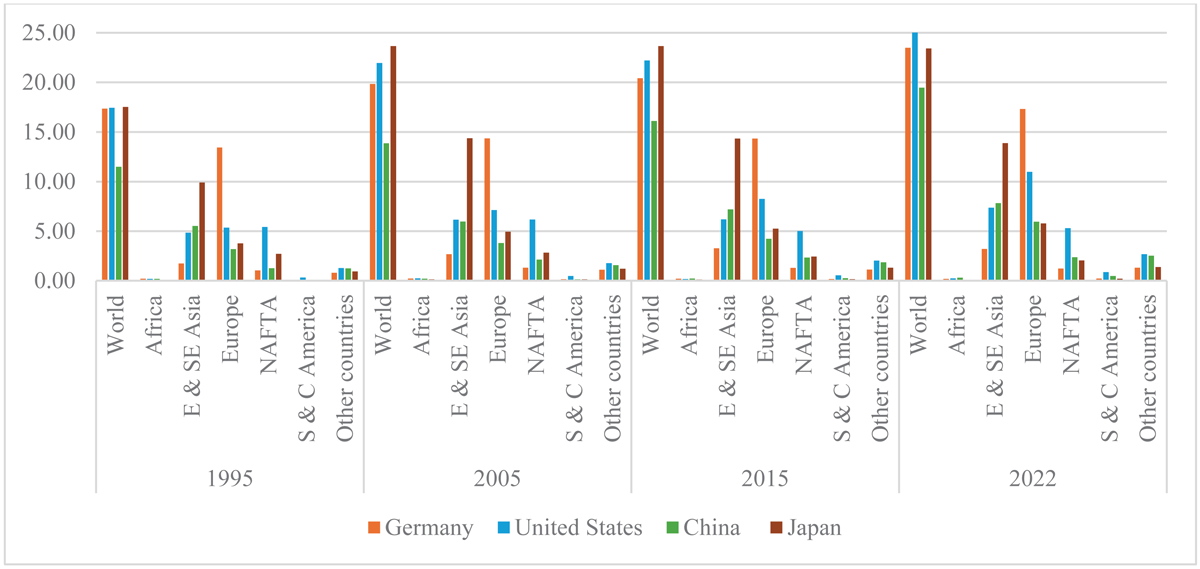
Figure 1
Evolution of Forward Participation of Major Global Factories’ Central Hubs. Domestic Value Added in Foreign Gross Exports, by Exporting Partner Shares, 1995, 2005, 2015, and 2022.
Source: Author’s elaboration based on OECD TiVA database (2025).
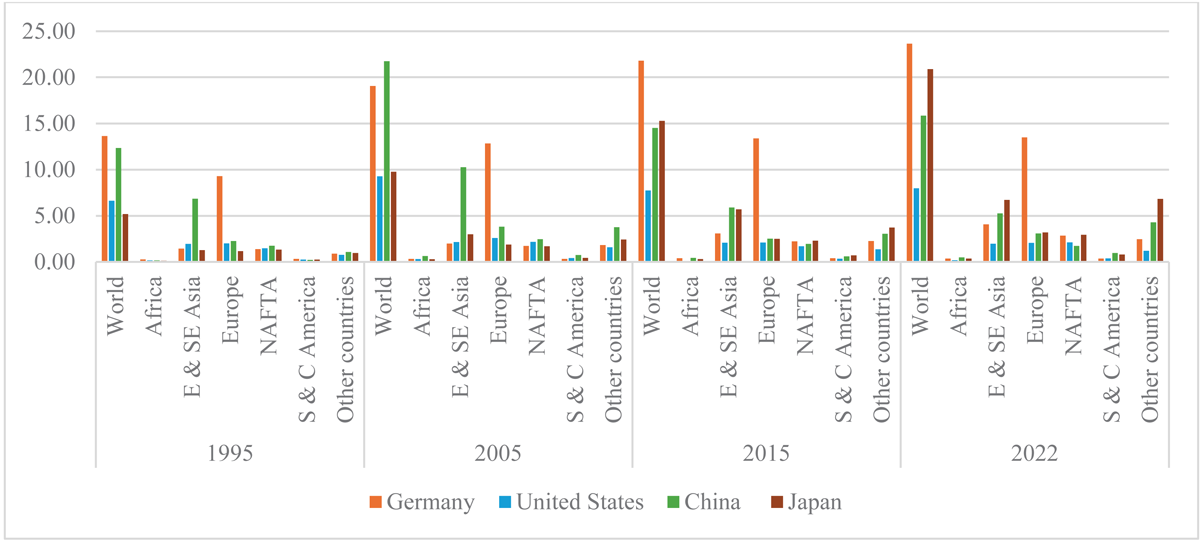
Figure 2
Evolution of Backward Participation of Major Global Factories’ Central Hubs. Foreign Value Added in Gross Exports by Origin Partner Shares, 1995 and 2022.
Source: Author’s elaboration based on OECD TiVA database (2025).
Originally, “Factory Asia” participated in globalized production through labor-intensive, low-wage activities that required minimal skills, limited technological capacities and generated low value added (Gereffi 1999). However, strategic State intervention —first in Japan, then in the “Asian Tigers”, and later in China— fostered the development of a dynamic and technologically sophisticated manufacturing base, enabling upward mobility within global production and trade (Amsden 1989; Wade 1990; Evans 1995; Chibber 2003; Kohli 2004; Gabusi 2017; Hauge 2020; Chang & Zach 2019). This upgrading allowed these countries to move from the low-end segments of global production chains to stages involving R&D, design, and marketing and to expand into technologically advanced production networks (Lee et al. 2014; Yeung 2014; Horner & Nadvi 2018; Dunford & Liu 2024). This manufacturing development has positioned East Asia —under China’s leadership— as a pivotal hub in global production.
The performance of “Factory Asia” has redefined global productive dynamics and hierarchies, challenging other factories and expanding into regions previously marginalized from globalized production. China has pursued an offensive strategy to sustain and expand Factory Asia’s influence. Alongside continued regional integration —now encompassing countries like Vietnam and Malaysia (Yuzhu 2011; Kasahara 2013)— China is building domestic production chains leveraging its massive scale (SCC, 2015) and projecting globally by competing with core countries and fostering integration with peripheral regions such as Latin America and Africa (Yao 2018).
Meanwhile, “Factory Europe” and “Factory North America” have increasingly adopted defensive strategies in response to China’s growing influence, aiming to retain leadership in strategic and high-technology sectors while securing access to critical inputs amid heightened geopolitical tensions (Tate 2014; Zhai et al. 2016; Barbieri et al. 2020; García-Herrero & Tan 2020; Gereffi 2020; Cimoli 2023). Processes such as reshoring, nearshoring, and friendshoring —although driven by diverse corporate motivations (Tate 2014; Zhai et al. 2016)— can also be understood as components of this broader defensive strategy and of ongoing deglobalization trends.
Regarding Latin America —the main focus of this study— the growing influence of “Factory Asia” on the global stage since the early twenty-first century has led to greater participation of its countries in global production chains. Yet the region’s overall involvement remains limited and uneven, with low levels of intra-regional integration (Durán Lima & Zaclicever 2013; Zaclicever 2017; Amar & Torchinsky Landau 2019; Marcato 2022; Brondino et al. 2023). An analysis of the integration of Latin American countries —Argentina, Brazil, Chile, Colombia, Costa Rica, Mexico, and Peru, for which data is available from the OECD Trade in Value Added (TiVA) database2— reveals two distinct patterns of integration into global production.
First, the South American countries —Argentina, Brazil, Chile, Colombia, and Peru— show significant forward integration, while backward linkages are more limited. For example, Chile exhibits a high degree of forward participation in global production chains, associated with the extraction and export of minerals, particularly copper, through the mining sector and/or basic metal manufacturing (Cadestin et al. 2016; Amar & Torchinsky Landau 2019). Colombia and, to a greater extent, Peru also display significant forward integration linked to their role as exporters of natural resources, primarily mining —both energy and non-energy products— used in subsequent production processes in destination countries to manufacture export goods (Cadestin et al. 2016; Amar & Torchinsky Landau 2019). Argentina also stands out for its forward insertion, though it has a lower level of participation in global production chains compared to the aforementioned countries. This reflects its specific natural resource endowment, positioning this country as an important producer of agricultural goods and food products that often serve as final or intermediate goods for consumption in destination markets, rather than inputs for re-exported manufacturing (Amar & Torchinsky Landau 2019). Brazil, the largest economy in the region, also exhibits low levels of backward integration. Its participation, like that of other South American countries, is driven mainly by natural resource exports, many of which are further processed in third countries and subsequently re-exported (Callegari et al. 2018; Amar & Torchinsky Landau 2019).
Regarding the destination of exports involved in global production chains, much of Latin America’s value-added exports in the mid-1990s were directed toward “Factory Europe” and “Factory North America”, with the United States emerging as the main individual recipient according to the TiVA database. Countries within “Factory Asia,” such as Japan and South Korea, were also relevant markets. Over time, the prominence of the United States and European countries has declined, while “Factory Asia” has become the main destination of these exports by the end of the 2010s, largely driven by China’s dynamism (Lauxmann & Fernández 2023). Figure 3 illustrates this trend, highlighting the regions that capture the largest shares of value-added originating from Latin American countries and subsequently incorporate it into their exports, with 1995 and 2022 as reference points.
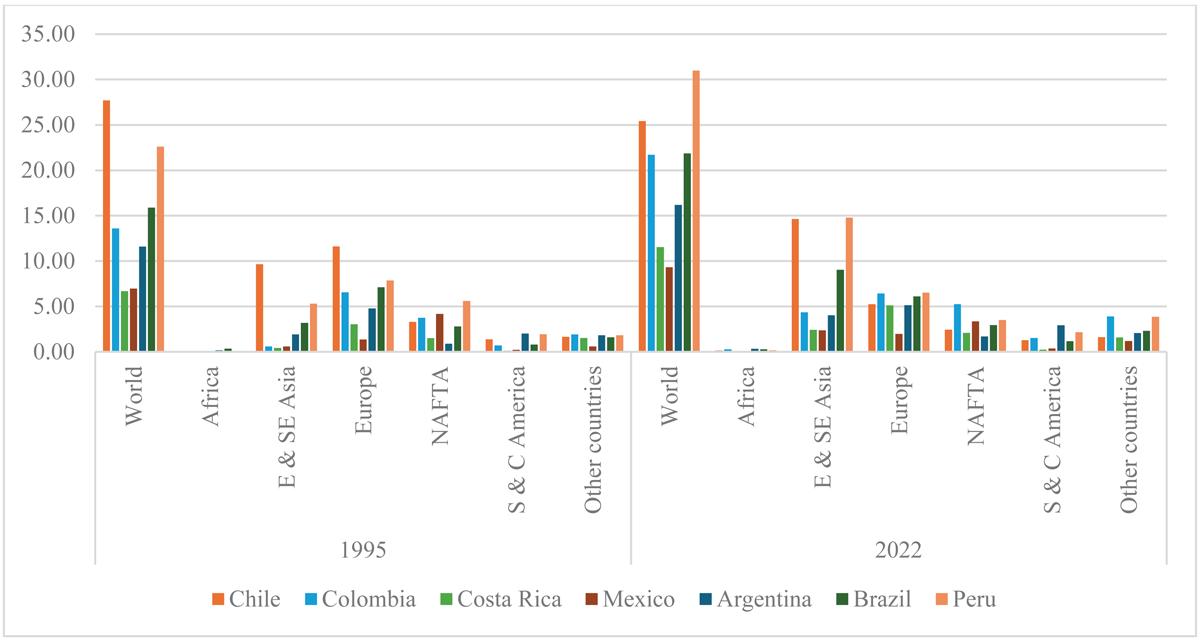
Figure 3
Evolution of Forward Participation of Latin American Countries. Domestic Value Added in Foreign Gross Exports, by Exporting Partner Shares, 1995 and 2022.
Source: Author’s elaboration based on OECD TiVA database (2025).
For their part, Central and North American countries —notably Costa Rica and Mexico— are integrated into “Factory North America” and display a different pattern of participation in global production. These countries exhibit significant backward linkages in global production chains. Owing to relatively low labor costs and geographical proximity to the U.S. market, they specialize in assembling and processing intermediate goods to manufacture final products that are exported to the United States. In Costa Rica, notable examples include the assembly of computers and electronic and optical equipment, while in Mexico, backward linkages are particularly significant in automobiles, computer equipment, electronics, and electrical machinery (Cadestin et al. 2016; Zaclicever 2017). The United States remains the primary supplier of intermediate goods, although East Asia has begun to play an increasingly important role (Lauxmann & Fernández 2023). This pattern is evident in Figure 4, which shows the regions from which the foreign value added incorporated into these countries’ exports originates.
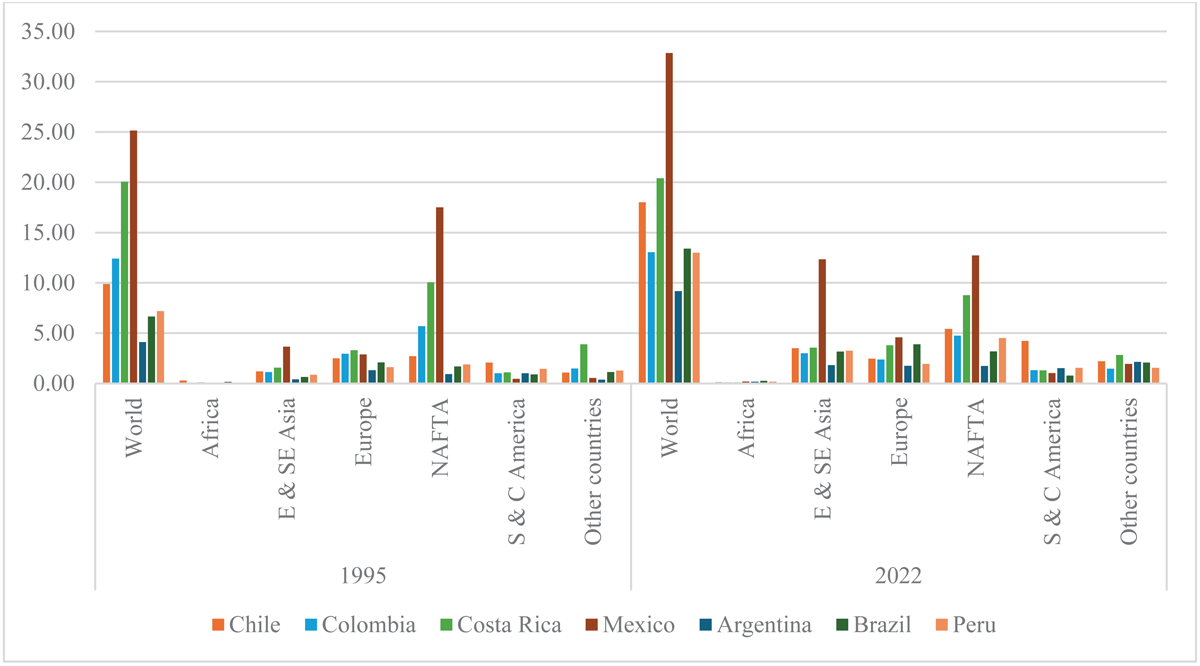
Figure 4
Evolution of Backward Participation of Latin American Countries: Foreign Value Added in Gross Exports by Origin Partner Shares, 1995 and 2022.
Source: Author’s elaboration based on OECD TiVA database (2025).
This scenario highlights that Latin America’s integration into global production chains, sustained and increased in the early twenty-first century through a more significant connection with “Factory Asia”, has had limited developmental impact. In South America, participation in globalized production tends to reinforce productive heterogeneity and specialization in sectors associated with primary products. Meanwhile, in Central and North America, integration largely relies on assembly activities, capitalizing on low-wage labor, which hinders the emergence of a technologically sophisticated and dynamic manufacturing base capable of driving development.
To recapitulate, regional productive spaces have been gaining increasing significance as privileged loci for accumulation in the globalized production era. The exceptional economic performance of East Asia —rooted in the configuration of a technologically sophisticated and dynamic industrial sector— illustrates the strategic role of regional spaces and advanced manufacturing in driving structural change processes that enable development in the contemporary world order. Conversely, Latin America exhibits a non-qualified integration into globalized production and limited intra-regional linkages. In this context, debates on Latin American integration processes acquire renewed relevance as potential pathways to development in an increasingly regionalized world economy (CEPAL 2014). As previously introduced, structuralist and neo-structuralist thought provide valuable insights for such an endeavor. The next section revisits these contributions to identify elements that can be updated and enhanced to conceptualize integration processes capable of advancing the region’s position within the contemporary capitalist system.
2. Regional Integration in Latin American Structuralism and Neo-structuralism
ECLAC’s foundational analyses, which laid the groundwork for Latin American structuralism, conceptualized the global capitalist system as inherently hierarchical and unequal, structured around core and peripheral countries. The differences between these groups of countries stemmed from their unequal capacities to generate and appropriate the fruits of technological progress. These disparities, attributed to original technological gaps, were maintained and reinforced by the prevailing system of international relations (Prebisch 1949; CEPAL 1951b).
These unequal capacities were reflected in distinct productive structures. Core countries exhibited a diversified and homogeneous productive structure in which technological progress permeated various sectors, enabling widespread high-productivity employment and relatively high income levels. In contrast, peripheral countries presented a heterogeneous and specialized productive structures, where technological advances were confined to specific sectors, resulting in lower average productivity and income (Prebisch 1949; CEPAL 1951a).
To address these structural disparities —and specifically to promote structural change in the Latin American periphery— ECLAC advocated a deliberate process of State-led industrialization throughout the region (Kay 1989; Larraín 1989). Within the structuralist framework, manufacturing was considered as the main vehicle for technological progress, and State promotion of this sector was expected to narrow productivity and income gaps with core countries, thereby improving Latin America’s position in the international order (Rodríguez 2006). Indeed, State-led industrial policies yielded significant growth rates in the post-war period. Between 1945 and 1955, per capita GDP increased by an annual average of 2.7% (CEPAL 1959; Prebisch 1954). However, as industrialization reached its final “light” phase in the mid-1950s, manufacturing expansion slowed and GDP growth rates declined, with per capita growth averaging only 1.1% between 1955 and 1958 (CEPAL 1959).
Against this backdrop, the idea of establishing a Latin American common market gained traction as a strategy to sustain industrialization (Briceño Ruiz 2017). Unsurprisingly, Latin America’s early industrialization and structural transformation processes were predominantly national in scope. Following the post-World War II order, under U.S. hegemony, capital accumulation took place within relatively closed national spaces supported by Keynesian welfare States (Jessop 2008). State intervention to promote industrial development was aligned with the vision of State-administered, nationally based capitalism (Briceño Ruiz & Álvarez de Flores 2006). Nevertheless, ECLAC’s early writings acknowledged that some inefficiencies in industrialization stemmed from high tariff barriers among Latin American countries and the limited size of their domestic markets, which hindered optimal production scales (Prebisch 1949; CEPAL 1951a). As the transition from “light” to “heavy” industrialization progressed, national market constraints became a critical obstacle for structural change. Specifically, Latin American structuralism argued that isolated national spaces, highly and inefficiently protected, constituted a significant obstacle to sustained growth driven by industrialization processes (CEPAL 1959; Prebisch 1959; Prebisch 1963).
This recognition led to the proposal to establish a Latin American common market (Prebisch 1959). Its primary goal was not the complete elimination of tariffs among the region’s countries, but rather the creation of a preferential zone with lower intra-regional tariffs to stimulate trade and production, while maintaining flexibility in external trade policies (Prebisch 1959). In this regard, trade liberalization was conceived as part of a program to expand the industrial sector across the region, ensuring continuity in Latin America’s industrialization process and fostering specialization and complementarity in manufacturing among national economies (CEPAL 1959; Prebisch 1963).
In this manner, based on Latin America’s industrial development, the common market aimed to deepen and enhance the region’s integration into world trade and thereby move beyond its peripheral status (Briceño Ruiz 2017). ECLAC viewed the Latin American common market as a potential “learning space” for the countries of the region, allowing them to improve their competitiveness and integrate into global markets not merely as exporters of primary products but also as exporters of manufactures (Prebisch 1963).
Several regional integration initiatives followed -the Central American Common Market (1960), the Latin American Free Trade Association (1960), and the Andean Pact (1969)- but their outcomes in promoting structural change and development were limited (Briceño Ruiz & Álvarez Flores 2006; Pizarro 2008; Briceño Ruiz 2017). A detailed examination of the various agreements and their consequences fall beyond the scope of the present study.3 Nonetheless, several factors help explain their limitations, including the structural heterogeneity of Latin American economies, which made practical integration among highly diverse countries difficult, and the tendency of political elites to prioritize national interests over those of the regional bloc, among others (Briceño Ruiz & Álvarez Flores 2006; Briceño Ruiz 2017). In this scenario —what Fajnzylber (1983) described as “truncated industrialization”— the formation of a common market lost its centrality as a development strategy in Latin American thought.
It is worth noting that the decline in the momentum of regional integration was not solely the result of the limited outcomes of these initiatives. The international crisis of the late 1960s and early 1970s, together with the rise of neoclassical economics and neoliberal policies, reshaped the global intellectual and policy landscape (Buch-Hansen & Lauridsen 2012), and also influenced ECLAC (Leiva 2008; Gaitán 2014). The specific contexts of political instability, coupled with internal and external economic challenges —including, most notably, the debt crisis that marked the region— gave rise to the “lost decade” and further intensified the questioning of Latin American structuralism’s development agenda (Ocampo & Ros 2011). In this context, national economies became increasingly internationalized, paving the way for the formation of global production chains, as discussed in the previous section.
At the onset of the globalization of production, regional integration did not occupy a strategic place in development agendas. By the late twentieth century, however, it regained significance in ECLAC’s thinking, spurred by the deepening of trade linkages among neighboring countries in the context of broader liberalizing trends (Caldentey 2014). In the aftermath of the “lost decade”, ECLAC revisited its development agenda, consolidating the neo-structuralist paradigm. In doing so, the institution sought to advance a proposal that would transcend postwar structuralism while simultaneously offering an alternative to the neoclassical policies embodied in what Williamson (1990) termed the “Washington Consensus”. Within this renew structuralist framework, regional integration was positioned as a central development strategy under the concept of “open regionalism” (CEPAL 1995; Leiva 2008; Bielschowsky 2009; Briceño Ruiz 2017).
Neo-structuralist ECLAC positioned itself as an alternative to the neoliberal development strategy promoted by Washington-based international organizations, which advocated economic liberalization and deregulation as pathways to greater competitiveness through the proper function of market mechanisms. ECLAC’s divergence from the neoliberal agenda was reflected in its emphasis on regional integration as a means of promoting a development model that combined economic growth with social equity. In Transformación productiva con equidad (1990), ECLAC argued that Latin America’s participation in the global economy should be mediated by strategic State intervention aimed at improving the efficiency and effectiveness of national economic systems, strengthening their competitiveness, and deepening integration into global markets in ways that would enable growth with equity (Sunkel & Zuleta 1990; Bielschowsky 2009).
Specifically, neo-structuralism emphasized not only the role of the State in ensuring the proper functioning of markets, but also recognized the importance of its active participation in enhancing regional competitiveness and strengthening Latin America’s integration into global production and trade. In this regard, the State’s role in providing transport and communication infrastructure, developing human resources, advancing scientific and technological capabilities, promoting long-term capital markets, and fostering both private and public cooperation to stimulate collective learning was deemed fundamental (Sunkel & Zuleta 1990; Guillén Romo 2007; Bielschowsky 2009; Ocampo & Ros 2011).
In this line, regional integration was considered as a strategic instrument to enhance the competitiveness of the region and improve the quality of their integration into the global economy. It was seen as a means to consolidate and complement the gains from trade liberalization experienced by Latin American countries, by capitalizing on: economies of scale —particularly when protectionist practices hindered their realization in global markets; reductions in transaction costs— achievable through the creation of institutional frameworks that lowered the economic, political, geographic, and social barriers between the region’s countries; and enhanced innovation outcomes —potentially fostered by the reduction of trade barriers, the harmonization of regional standards and regulations, and the promotion of joint infrastructure projects, among other measures (CEPAL 1994: 9–10). In other words, integration processes were expected to contribute to the generation and diffusion of technological progress across the economies of the region and to advance productive transformation processes that would enhance their competitiveness, improve their integration into the capitalist system, and, in turn, address what Fajnzylber (1992) identified as Latin America’s “empty box” of development.
Through this strategy, neo-structuralist ECLAC sought to move beyond the earlier structuralist framework and adapt its ideas to the new international context (Briceño Ruiz 2017). In this regard, the institution emphasized an “open” approach to regional integration, aiming to prevent potential obstacles to the proliferation of free trade agreements between Latin American countries and the rest of the world that could arise from incompatibilities within intra-regional commitments (CEPAL 1995).
This effort to overcome structuralist thought was reflected in the regional integration strategy promoted by the neo-structuralist ECLAC to foster structural change, which emphasized competitiveness and technological upgrading over the consolidation of an integrated manufactured base. As shown in the previously referenced text, ECLAC recognized the need to increase the competitiveness of the region’s countries through the generation and incorporation of technological progress into their productive structures. In line with this, the regional integration process was not primarily focused on promoting the articulation and complementarity of the manufacturing activity at the macro-regional level; rather, it was one of several sectors to be stimulated under this integrationist strategy, which aimed to enhance the competitiveness of the region’s economies (CEPAL 1990: 14) based on the generation of “authentic” comparative advantages associated with technological development (Fajnzylber 1992).
The signing of agreements such as the Southern Common Market and other regional commitments, including the association of country groups —Central America and Mexico, the Caribbean Community (CARICOM) and Venezuela, and the Group of Three, formed by Colombia, Mexico, and Venezuela— can be seen as aligned with these strategies of “open regionalism” (Fuentes 1994). Their results were also limited in terms of development. Far from promoting a qualified insertion into the global economy, Latin America remained in a subordinate position, relying on the “spurious” comparative advantages of natural resources and/or low labor costs (Fajnzylber 1992), as presented in the first section.
By the early twenty-first century, most regional schemes established under the logic of “open regionalism” were facing crises (Briceño Ruiz 2017). The limitations of these strategies, combined with the rise of center-left governments (Briceño Ruiz 2014) and the remarkable success of East Asia’s State-led industrialization (Chang & Zach 2019), opened space to rethink development and integration globally (Pieterse 2012) and in the region (Gaitán 2014; Briceño Ruiz 2017). Within ECLAC in particular, significant progress was made in reformulating the objectives of regional integration, which in this context came to be described as “strategic” or “pragmatic” (Caldentey 2014).
In the early twenty-first century, ECLAC advanced the notion of “strategic” or “pragmatic” regionalism, centered on the creation of regional production chains oriented toward both Latin American and global markets (Duran Lima & Zaclicever 2013; CEPAL 2014). This approach posed the challenge of deepening trade and productive integration among the region’s economies through the implementation of a comprehensive set of public policies, including industrial policies (CEPAL 2014: 68).
The resurgence of industrial policies in ECLAC’s discourse appears to make rhetorical references to Latin American structuralism (Briceño Ruiz 2017), however it represents a reformulation of neo-structuralist thought. The industrial policy envisioned in this context had a broader scope: rather than focusing solely on manufacturing, it sought to promote higher-productivity activities across various economic sectors —including manufacturing, natural resources, and services— to enhance the quality of the region’s integration into the international economy (CEPAL 2014: 70). Thus, the proposal to implement industrial policies to foster the creation of regional production chains can be associated with the objective of improving the overall competitiveness of the economies of the region and upgrading its international insertion, a hallmark of neo-structuralism.
In this regard, “pragmatic” or “strategic” regionalism encompasses policies aimed at improving economic competitiveness rather prioritizing sectoral development. As a result, both the open regionalism model of the 1990s and the subsequent approach to integration into global and regional production chains advanced by neo-structuralist ECLAC after the first decade of the twenty-first century reflect a form of State intervention that, rather than establishing market-guiding mechanisms to foster the configuration of a technologically sophisticated and dynamic industrial sector that enables a structural change conducive to development, has primarily focused on promoting and optimizing market performance. This orientation ultimately reinforced reprimarization and deindustrialization processes, constraining Latin America’s capacity to overcome its peripheral position in the global economy.
3. Final Considerations: Challenges and Opportunities for Strategic Regional Integration to Drive Development in Latin America
The contemporary scenario, characterized by the slowdown of global production growth following the 2008 financial crisis, further intensified by escalating trade disputes between core industrial countries and China, and disrupted once more by the 2019 pandemic, underscores the critical role of regions as pivotal spaces for capital accumulation and development. It also highlights the continued relevance of manufacturing as a driver of technological progress and as means of narrowing productivity and income gaps with core economies, as emphasized by Latin American structuralist thought. East Asia’s remarkable development trajectory provides empirical support for this argument. Initially integrated into global production chains in a subordinate position, “Factory Asia” has progressively expanded its influence within international trade and production networks. Through strategic State intervention, East Asian countries have successfully steered their integration into the global economy, fostering the emergence of a dynamic, technologically sophisticated industrial base and progressively upgraded their position within global value chains. In this sense, the centrality of manufacturing in promoting structural change remains undeniable, as reinforced by multiple academic contributions. This centrality stems from the distinctive features of manufacturing that make it a powerful driver of development. Manufacturing offers distinct advantages for capital accumulation: it is among the most capital-intensive sectors —alongside mining, construction, and utilities— and allows for significant economies of scale. Moreover, manufacturing plays a strategic role in technological development, both by producing capital goods that embody and disseminate technological progress and by generating and diffusing non-embodied technologies. Its strong backward and forward linkages, as well as its cross-sectoral spillover effects, position manufacturing as a key engine of structural transformation and long-term development (Szirmai 2013; Andreoni & Chang 2016; Hallward-Driemeier & Nayyar 2018).
The performance of the Asian region contrasts sharply with that of Latin America. Despite increasing its participation in global production chains, Latin America has been unable to alter its subordinate position within the international economy. On the contrary, its involvement in globalized production has reinforced its specialization in resource-based and low-wage, labor-intensive activities, which exhibit limited technological sophistication and generate modest value added, thereby relegating the region to a peripheral position in the contemporary capitalist system.
This paper does not aim to conduct a comparative analysis of the specific trajectories of these two regions, nor to examine in depth their diverse underlying causes. However, it is worth emphasizing that, unlike East Asia, Latin America has not established a regional factory capable of developing a manufacturing hub to improve its international integration.
Several strategies for regional integration have long been debated in Latin America. Although various agreements have been signed, productive integration conducive to regional development remains elusive. Latin American structuralism, through Prebisch’s original analyses, highlighted the importance of the regional space for deepening industrialization in the post-war period and fostering the diversification and homogenization of productive structures, thereby promoting structural change and enhancing participation in the world economy.
Subsequently, neo-structuralism sought to update structuralist ideas and adapt them to the context of economic liberalization that characterized the late twentieth century, proposing an “open regionalism”. This approach emphasized regional integration as a strategy for technological progress, enhance competitiveness, and improve the quality of the region’s insertion into the global economy. Within this framework, manufacturing activity lost its centrality within integration processes and the focus shifted toward boosting aggregate productivity across the region’s economies to strengthen their international competitiveness.
At the beginning of the twenty-first century, particularly with the growing regionalization of global production networks after the 2008 crisis, a form of “strategic” or “pragmatic” regionalism emerged within neo-structuralist thought. While ECLAC rhetorically advocated industrial policies to promote productive integration, these initiatives were not directed specifically at the manufacturing sector. Instead, they aimed to develop higher-productivity activities across diverse sectors —manufacturing, natural resources, and services— to improve Latin America’s global economic integration.
Amid this context of increasing regionalization and deglobalizing trends —partly driven by the defensive strategies of core industrial countries in response to East Asia’s emergence— it is essential to reconsider regional productive integration, understood as the development of forward and backward linkages in the regional industrial sector as well as cross-sectoral articulation, as a strategic instrument for Latin America’s development. Revisiting and updating ECLAC’s contributions, in light of current geoeconomic and geopolitical context, could offer valuable insights for renewed development strategies. Establishing a dynamic and technologically sophisticated regional manufacturing base was a central pillar of Latin American structuralism’s postwar integrationist agenda and helps explain East Asia’s remarkable performance in the contemporary global economy.
Considering the defining features of manufacturing production in the global context, the current regional integration agenda should aim to create of a “Factory Latin America”. This entails strengthening intra-regional linkages to enable the production of competitive goods at the regional and/or global level. It requires the development and articulation of different activities along the production chain —and, consequently, increased trade in tasks— of specific products among the countries of the region, rather than relying on specialization and complementarity across industrial sectors entirely developed in diverse countries, as proposed by ECLAC in the postwar period. Such articulation would allow countries to participate in the production of a variety of industrial goods while sharing tasks across the value chain. The ultimate goal is the establishment of a dynamic and technologically sophisticated manufacturing base across countries, fostering structural change that diversifies and homogenizes Latin America’s productive structures and helps overcome its peripheral position in the global economy.
This agenda underscores the need to build States capable of effectively driving productive integration processes at the regional level and actively participating in the formation of a regional institutional framework that addresses the political and economic fragmentation among Latin American countries. Meeting these challenges will not be an easy task. Therefore, advancing the study and design of strategies to confront them is essential for regional development and opens promising avenues for future research.
Notes
[1] Forward linkages refer to the added value produced in a country that forms part of the exports of third countries that receive it. In contrast, backward linkages are associated with the foreign added value incorporated into a country’s exports.
[2] The OECD TiVA database provides measures of trade flows in terms of value added rather than gross exports, capturing each country’s contribution along global production chains and distinguishing between domestic and foreign value added. The current edition (2025) includes indicators for 80 economies, covering all OECD members, EU countries, G20 economies, and most East and Southeast Asian countries. In Latin America, coverage is limited to the seven countries referenced in the text.
[3] To explore this further, see: Wionczek 1970; Briceño Ruiz & Álvarez Flores 2006; Pizarro 2008; Briceño Ruiz 2017.