
Table 1
Inclusion and exclusion criteria.
| INCLUSION | EXCLUSION | |
|---|---|---|
| Type of institution | Public university. | All other types of institutions, including private universities and university colleges. |
| Scale of the institution | University with 10,000 or more enrolled students or the largest university in the country. | University with fewer than 10,000 enrolled students, which is not the largest in the given country. |
| Country | The Nordic and Baltic countries. | Non-Nordic and Baltic countries. |
| Learning Design practice | The Learning Design concept is used to describe an educational development practice that aligns with Mor and Craft’s definition (2012). | The concept is not used to describe an educational development practice and/or it is difficult to determine whether the practice aligns with Mor and Craft’s definition (2012) or the five generic characteristics (Godsk, 2023). Learning Design research projects without a practical implementation are excluded. |
| Language | Practices described in English or Scandinavian (except Faroese). | Practices not described in English or Scandinavian (except Faroese) languages. |
| Year | Ongoing or recently discontinued (less than five years ago). | Practices discontinued more than five years ago. |
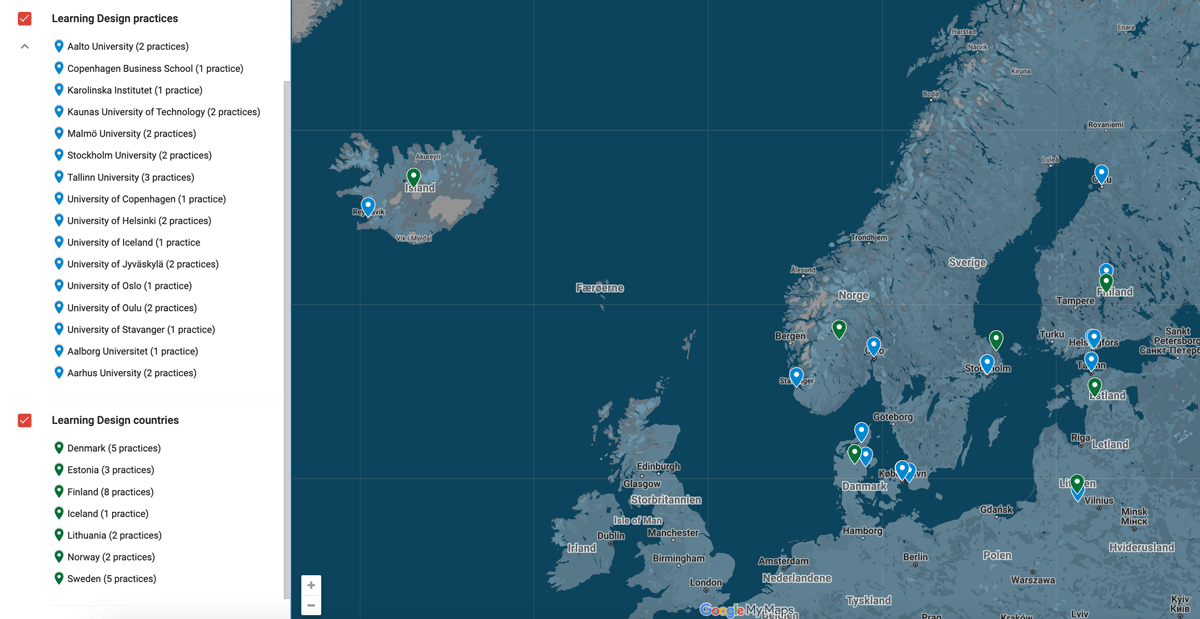
Figure 1
The Nordic and Baltic Learning Design map. © 2024 Google.
Table 2
Overview of Learning Design practices and tools in the Nordic and Baltic countries.
| INSTITUTION | LEARNING DESIGN PRACTICES | LEARNING DESIGN TOOLS | REFERENCES |
|---|---|---|---|
| Aalborg University, Denmark | ABC Learning Design as DIY for blended learning and educational development in general. (open) | ABC Learning Design method | Aalborg University (n.d.) |
| Aalto University, Finland | Flexible DIY workshop-based approach (open) & Design student hackathons as a LD practice for development-focused events | Teaching Lab Design Kit incl. the Splash model, The Design Book for Online Learning incl. the Learning Design Toolkit, Visual Toolbox for Designing Online Learning, & Education Experience Canvas | Aalto University (n.d.) |
| Aarhus University, Denmark | Educational development methodology at the university pedagogical programme (facilitated) & Blended learning workshops and courses based on the STREAM model. (semi-open) | Activity profiler & LDTool (Wollongong) & Efficient Learning Design for assessing designs & the STREAM model | Aarhus University (n.d.) |
| Copenhagen Business School, Denmark | DIY, research-based guidance with practical tools. (open) | Course design models | Copenhagen Business School (n.d.) |
| Helsinki University, Finland | LD projects that often involve students in the process. Focus on emerging educational technologies (e.g., AI) (facilitated) | Learner-centered design framework | Helsinki University (n.d.); Saadatmand (2017) |
| Karolinska Institutet, Sweden | Workshop and several self-paced courses (open, semi-open, and facilitated) | Blended Learning Design Toolkit & ABC Learning Design method & Toolkit for designing assessment | Karolinska Institutet (n.d.) |
| Kaunas University of Technology, Lithuania | Course on design-based thinking approach to teaching and learning. (semi-open) & Masterclass on leading and (re)design of study programs. (semi-open) | Twente education model | Kaunas University of Technology (n.d.) |
| Malmö University, Sweden | Digital transformation of writing skills (open) & Diverse practices of educational development (open/semi-open) | Flip and write & PESTEL | Malmö University (n.d.) |
| Stockholm University, Sweden | LD as a module of a course (semi-open) & Open ABC workshops (semi-open) | Learning design patterns & ABC Learning Design method | Stockholm University (n.d.) |
| Tallinn University, Estonia | Digitally Transforming Teachers (semi-open) & Digiloping Teachers program (facilitated) & Design thinking in Higher Education (facilitated) | Hands-on activities with robots & Guidebook and e-learning courses. | Tallinn University (n.d.) |
| University of Copenhagen, Denmark | Extended ABC Learning Design workshops for programme development (involving students). (semi-open) | ABC Learning Design method | University of Copenhagen (n.d.) |
| University of Iceland, Iceland | Workshops for educators (semi-open) | ABC Learning Design method | University of Iceland (n.d.) |
| University of Jyväskylä, Finland | Learning environment design (facilitated) & JYULearn: designing learning spaces, multi-sited and digitally supported (facilitated) | No specific tools. | University of Jyväskylä (n.d.) |
| University of Oslo, Norway | Learning Analytics visualisations to support educators’ Learning Design choices. (open) | Dashboard with visualisations based on online discussions | Kaliisa et al. (2022), Kaliisa & Dolonen (2023). |
| University of Oulu, Finland | Innovating Learning Design in Higher Education (iLed) (facilitated) & iLed workshop using Balanced Design Planning (BDP) tool (facilitated) | BDP Tool | University of Oulu (n.d.) |
| University of Stavanger, Norway | Learning design for flexible education (FLeD) | Learning design patterns | University of Stavanger (n.d.) |
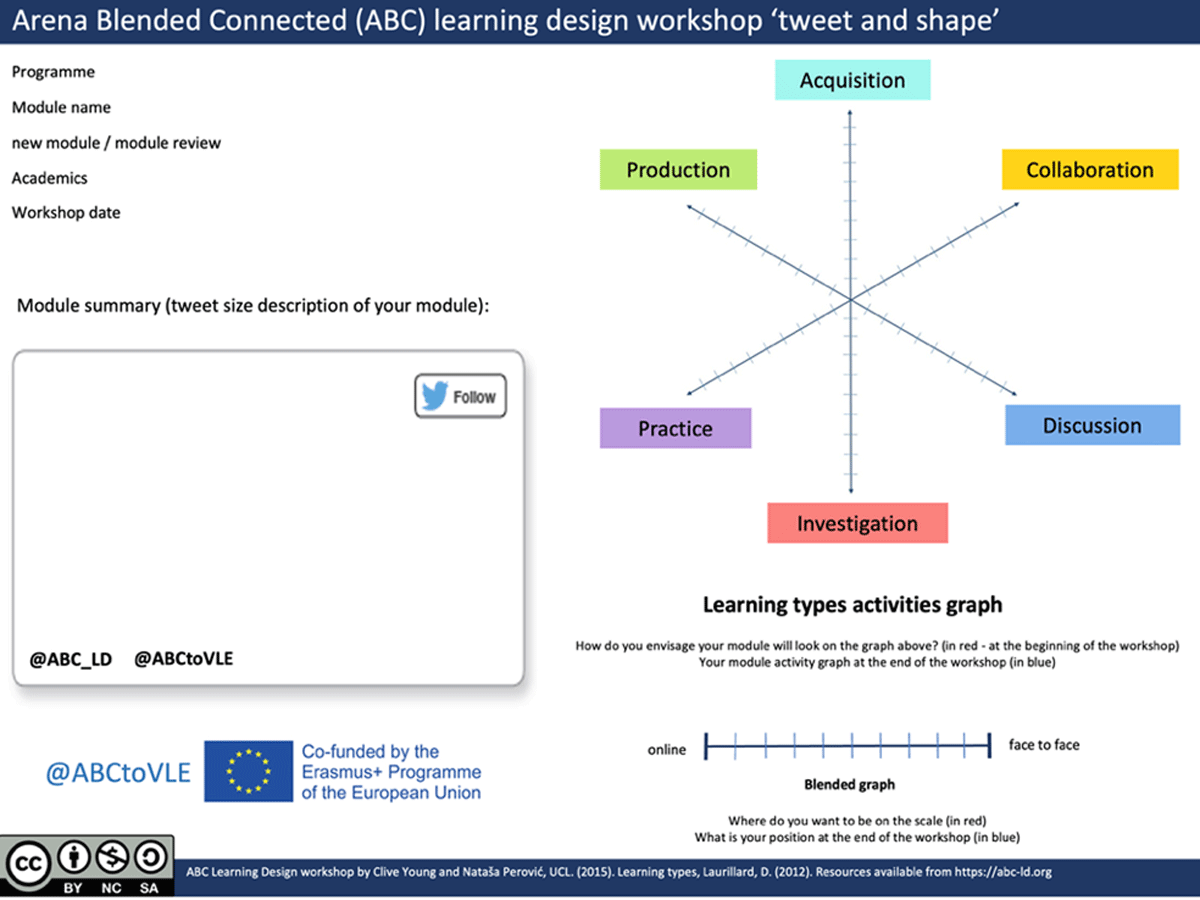
Figure 2
ABC Learning Design’s tool for analysing learning types (Young & Perović, 2016).
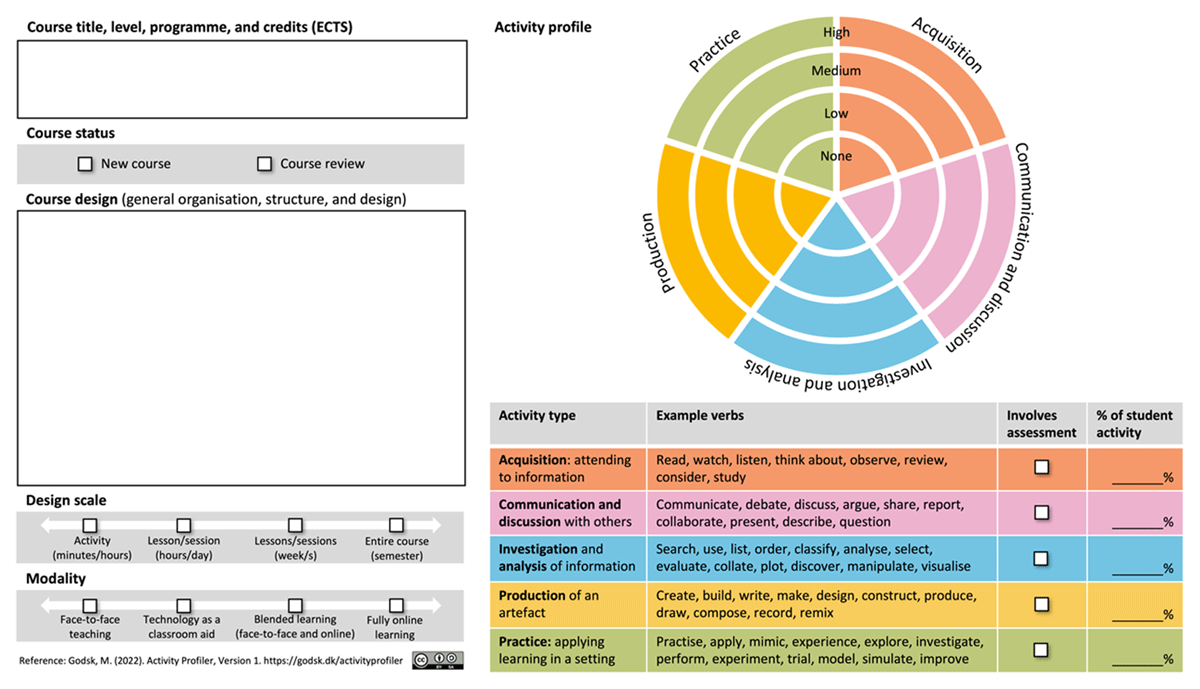
Figure 3
Activity Profiler (Godsk, 2022a) based on Open University’s Activity Types (Open University, 2021).
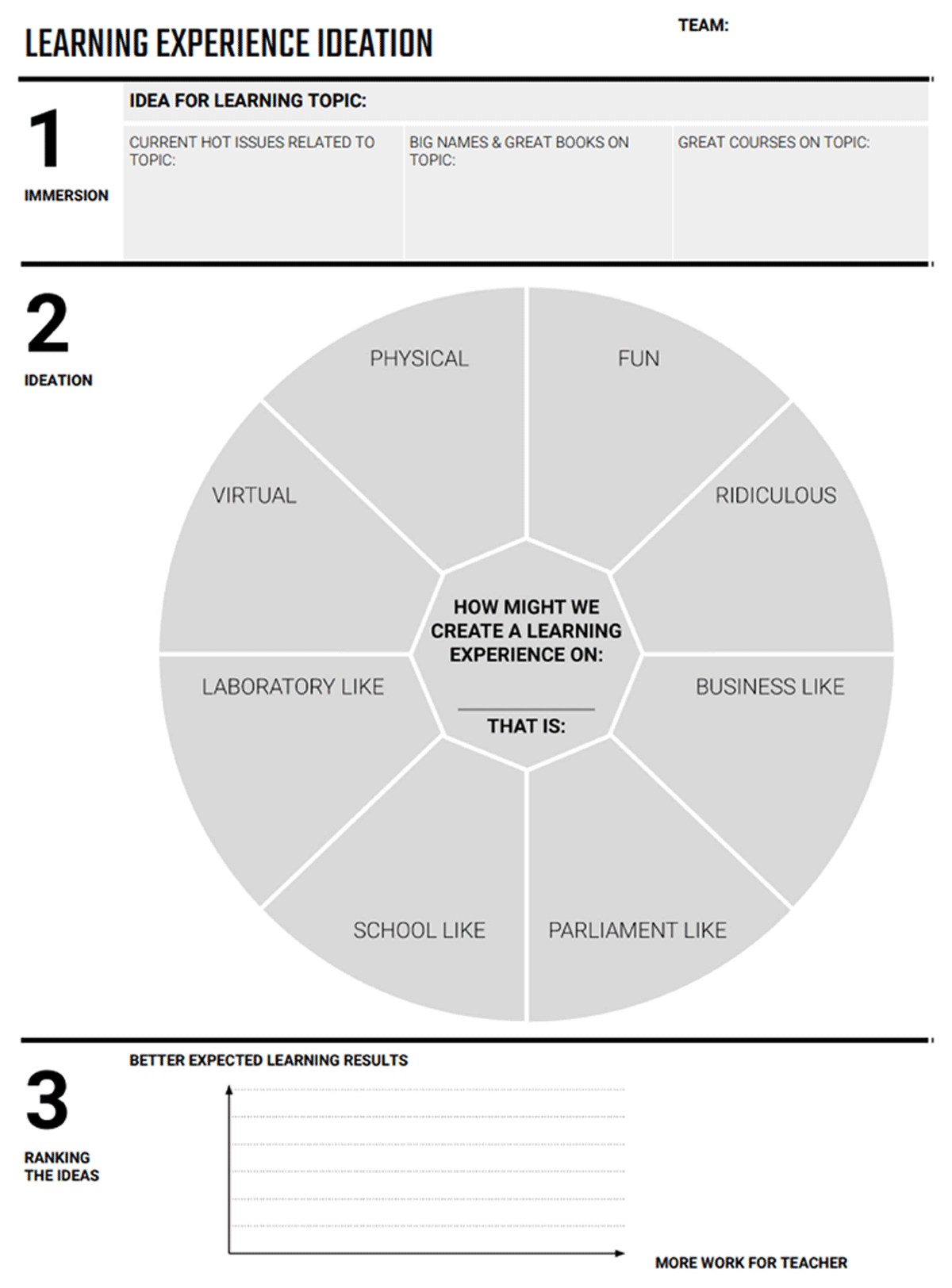
Figure 4
Learning Experiences ideation (Huhtanen, 2019, p. 19).
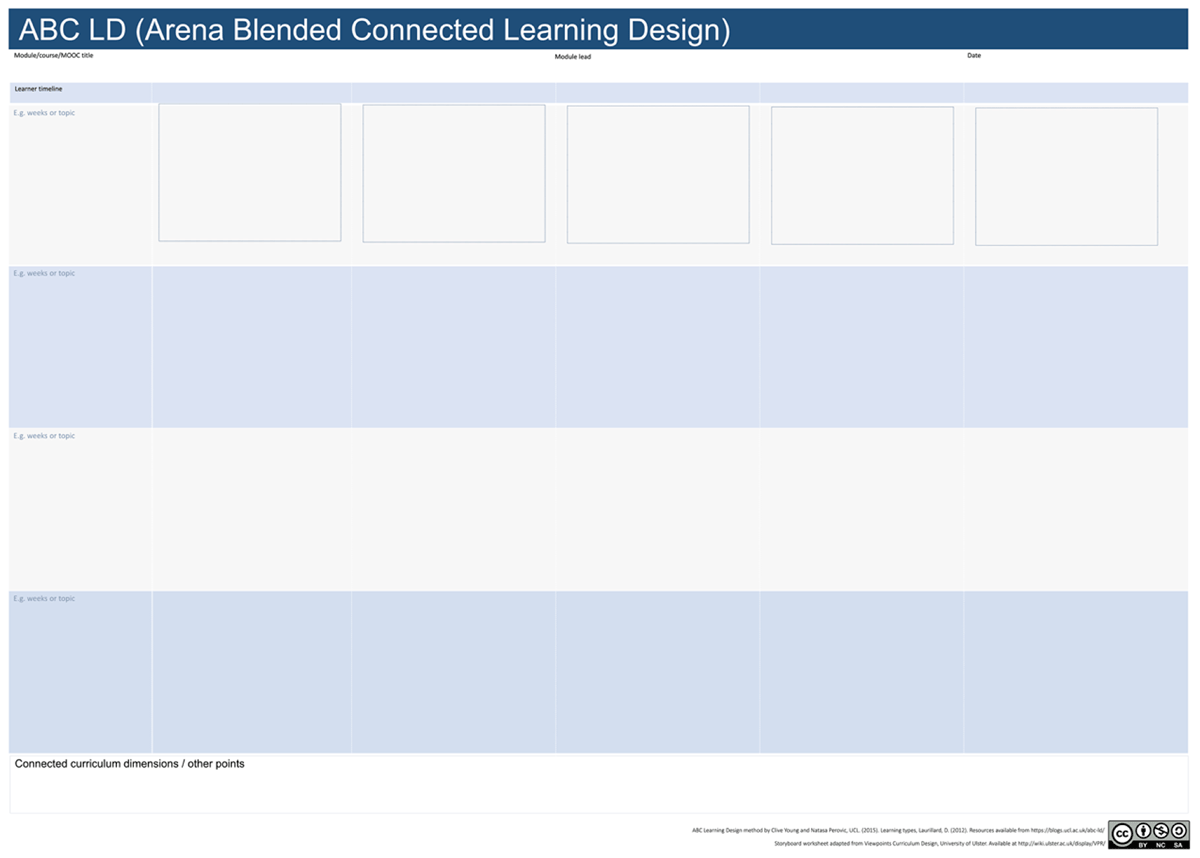
Figure 5
ABC Learning Design’s storyboard tool for representing learning designs (Young & Perović, 2016).
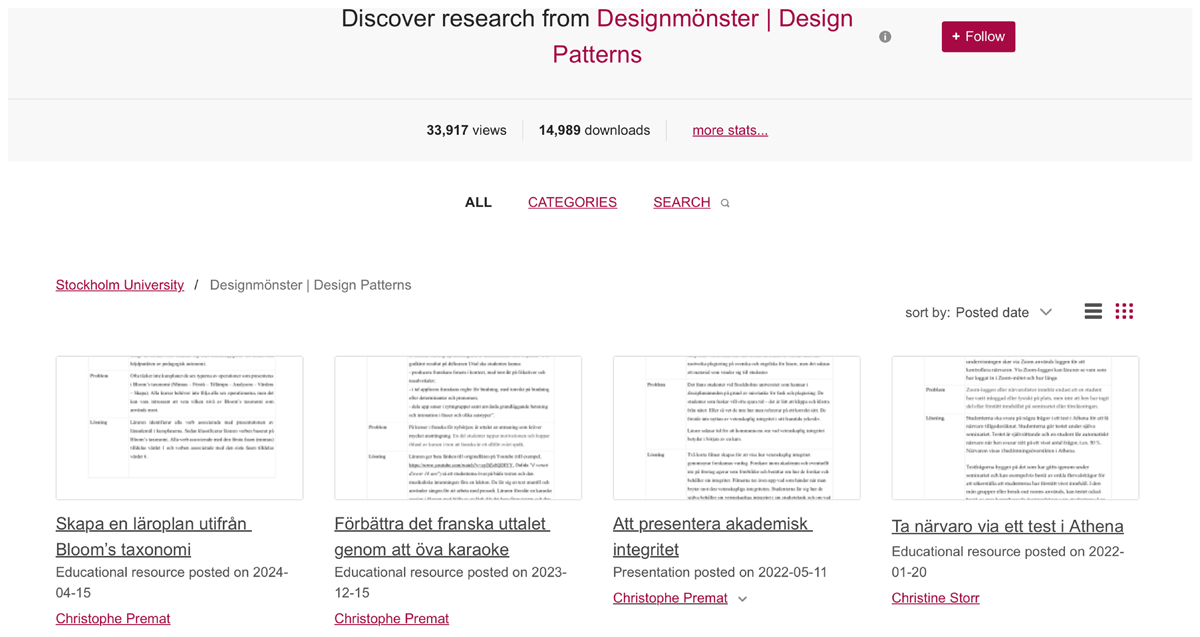
Figure 6
Design patterns collected and shared in Figshare at Stockholm University.
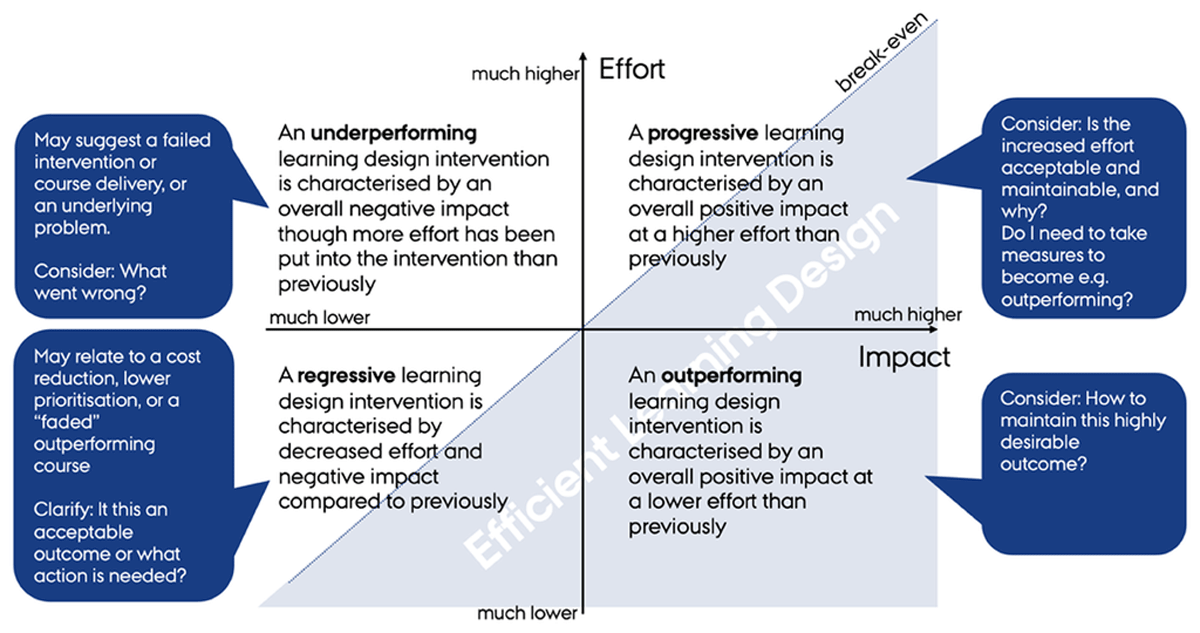
Figure 7
Efficient Learning Design method for discussing the efficiency and sustainability of learning designs at Aarhus University (Godsk, 2022b).
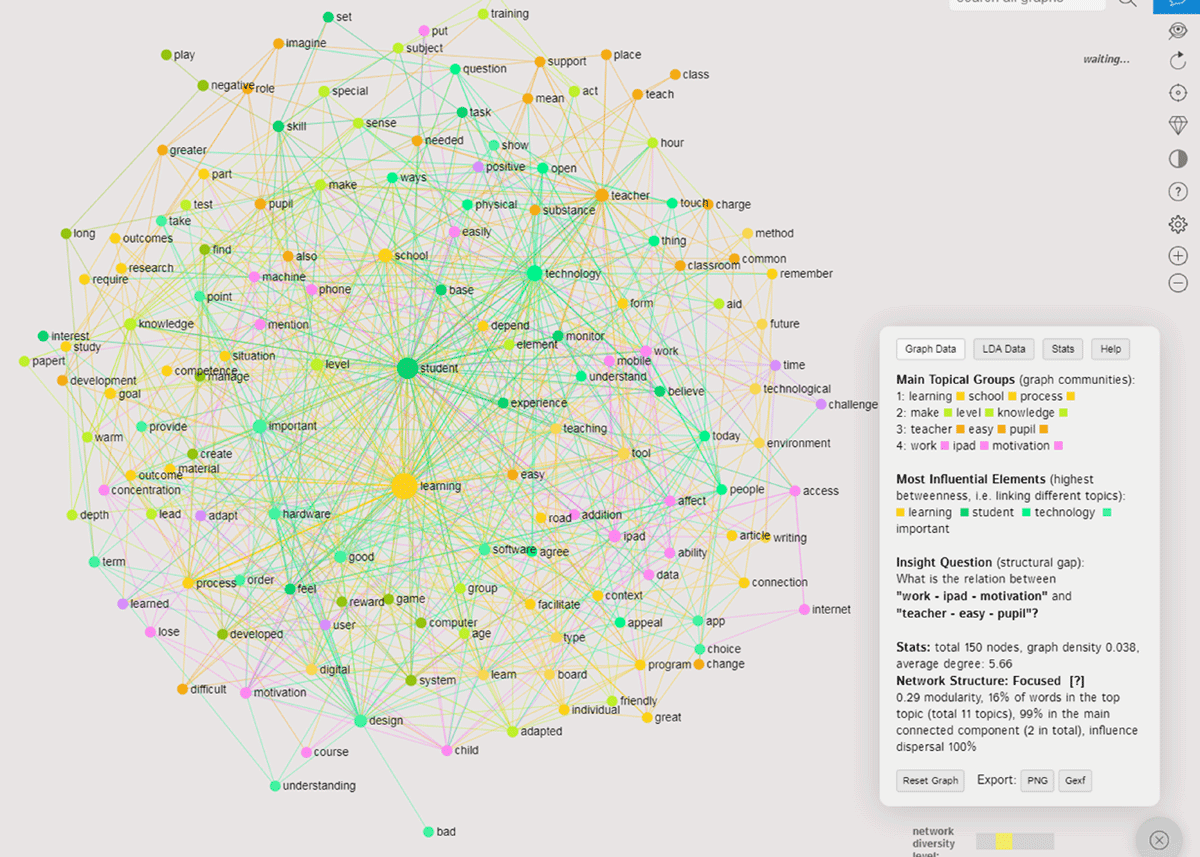
Figure 8
Network analysis for informing learning designs and their delivery at University of Oslo (Kaliisa et al., 2020).