
Introduction
This article addresses how the design of digital assessments influences students’ agency in demonstrating their knowledge in higher education. Agency in the educational context is a concept that has attracted the attention of many scholars and its meaning has varied depending on the perspective chosen (Matusov et al., 2016). Kullenberg et al. (2023) argue that there is a knowledge gap regarding student agency in the Swedish educational context. There is also a knowledge gap about the extent to which and how the design of different forms of summative assessment approaches affects students’ ability to demonstrate their knowledge (Nieminen & Lahpenperä, 2021). Given that many of today’s teaching and assessment practices are changing (e.g., due to students’ access to ChatGPT and fears of cheating), methods of examination are moving towards monitoring and control (Pargman et al., 2024). There are also concerns that students’ academic freedom is being curtailed and that the design of assessments by teachers is counteracting students’ influence on how they demonstrate their knowledge (Macfarlane, 2017). In higher education, assessment design can take different forms depending on the purpose of the assessment (Chirumamilla & Sindre, 2017). However, there is a relatively limited understanding of how teachers actually design assessments intended to summatively validate student knowledge for examinations and grading. While there has been some research on assessment design from the perspective of teachers (Bearman et al., 2017), there is a lack of research, such as this study, that focuses primarily on the representation of assessment design. This study aims to highlight how different assessment designs affect the opportunities for students to engage in the production of different forms of knowledge. In this study, the concept of assessment design refers to the material associated with the description of the design elements of the tasks used to assess students’ knowledge for summative purposes (cf. Bearman et al., 2023, p. 293). An assessment design that incorporates digitally mediated resources can provide multimodal arrangements of content through the use of written, visual and auditory elements (Ross et al., 2020). The use of different modes in assessment design can realize different potentials for how students make sense of assessment designs. Multimodality deals with the representation of knowledge through symbolic resources such as words, sounds, and pictorial illustrations (Boistrup & Selander, 2022, p. 24). The study of assessment design provides insights into the types of knowledge that students are likely to display during their assessments, and how these designs can enable their agency in demonstrating their knowledge (cf. Anderson & Krathwohl, 2001). Thus, scholars argue that, when designing assessments, it is important to consider the targeted knowledge and cognitive processes, as well as the expected level of student agency and knowledge-driven participation during the assessment (Heikkilä et al., 2023). Students are often seen either as mere reproducers of knowledge or as independent thinkers who demonstrate agency, autonomy, engagement, knowledge-driven behavior and strategic thinking (Robertson et al., 2020). Ørevik (2023) also argues that students should be given the opportunity to present multimodal texts during their assessment, as it gives them a wider repertoire for making meaning and promotes their ability to act on the subject matter. With this in mind, this article explores how digital assessment designs in higher education influence students’ ability to demonstrate their knowledge and realize their agency.
The study addresses the following research questions:
RQ1: What knowledge is in focus in the digital assessment designs? and
RQ2: How do different digital assessment designs enable students’ agency?
Assessment designs in higher education
To our knowledge, there is relatively little research into the actual design of summative assessment tasks in practice. Although there is a substantial body of research on assessment design from the teacher’s perspective, university teachers typically demonstrate well-developed thinking about assessment-related issues. Bearman et al. (2017) point out that the design of assessment by teachers is influenced by the traditions and activities within the teacher’s own discipline. Based on qualitative interviews with a mix of university teachers, the analysis showed that assessment design is influenced by some kind of impetus for change, either environmental influences or professional influences consisting of various factors that teachers bring to the design process. Another study (Bennett et al. 2017) on understanding assessment design through a disciplinary mix of university teachers’ experiences shows that new forms of technology-enhanced assessment have led to unexpected challenges. In particular, two challenges emerged, one related to the tension between the need to improve and streamline assessment while introducing new and innovative pedagogies. The second related to keeping up with developments and anticipating challenges in assessment design, and thus having the opportunity to make adjustments and improvements (Bennett et al. 2017). In a cross-institutional case study of digital assessment practices, Chase et al. (2017) show that student engagement and motivation increased when assessment tasks were clearly defined, designed and aligned with the digital environment, and were authentic, relevant and engaging. Teachers found that working together around common principles improved the quality of assessment.
Enabling digital assessment designs, where students can use computers either on site (bring your own device) or at home, to take supervised synchronous closed-book exams or to contribute continuously and asynchronously to learning experiences through open-book exams, provides opportunities to promote different forms of assessment practices (Durning et al. 2016; Johanns et al. 2017). Research on open-book and closed-book exams, highlight both opportunities and challenges for these two forms of assessment. Deep learning tendencies, such as synthesis and high-level reasoning, could be identified in closed-book exams (Durning et al. 2016) as well as in open-book exams (Stowell, 2015). According to Johanns et al. (2017), research in the field of medicine, particularly in nursing education, emphasizes the value of using a mix of examination forms throughout the program. A teacher’s choice of examination in a course influences students’ preparation work, and both open-book and closed-book examinations, combined with collaborative testing, can even help students develop different types of knowledge and skills for learning.
In addition, the transformation of summative assessment designs into more authentic forms through digital technology has also attracted considerable research interest. In a critical review of the literature on authentic assessment, Nieminen et al. (2023) examined how digital elements have been integrated into assessment design. Their findings suggest that digital tools not only improve the efficiency of assessment but also enhance authenticity and support the development of students’ digital skills. For example, they found that the digital environment enabled students to use various media (such as images, audio clips and video) in an authentic way, thus enriching the assessment process (Nieminen et al., 2023, p. 534). Building on this perspective, Ross et al. (2020) analyzed students’ digitally mediated multimodal work, further highlighting how digital tools can shape assessment practices. Their study provides valuable insights into how to communicate expectations and assess student learning in today’s digital landscape. By presenting a framework for assessing multimodal work, they highlight the importance of criticality, cultivating creativity, holism and valuing multimodality in assessment. In line with the findings of Nieminen et al. (2023), Ross et al. (2020) emphasize the need to recognize and appreciate multimodal expression as a key aspect of digital assessment, encouraging the exploration of new ways of integrating technology into teaching and assessment.
Theoretical and analytical approaches
This study uses perspectives on knowledge and agency in education as a theoretical basis for analyzing digital assessment designs.
Perspectives on knowledge in education
In recent years, there has been an increasing focus on determining what constitutes legitimate knowledge in different forms of professional education. Several studies have focused on policy texts and assessment practices (Bearman et al., 2017) and on what kinds of knowledge should be prioritized in different professional education (Sjöberg, 2019; Park et al., 2021). However, there are many forms of knowledge that commonly appear in discourses about knowledge in academic and professional education (Blom, 2009). Defining what constitutes relevant professional knowledge is central to any education system, and areas of assessment require an “agreed upon” version of knowledge (Aubusson & Schuck, 2013). One discourse that has influenced professional programs, including those in Sweden (Higher Education Ordinance, 1993: 100), is the taxonomic system developed by Anderson and Krathwohl (2001), which can be used to understand how different forms of knowledge are formalized and represented in education. The taxonomy consists of two dimensions: a knowledge dimension with four categories, and a cognitive process dimension with six categories. According to Anderson and Krathwohl (2001), the knowledge dimension is described using noun phrases. Factual knowledge encompasses basic elements within a subject area, conceptual knowledge represents a more complex and abstract level, procedural knowledge relates to subject-specific skills and methods, and metacognitive knowledge covers cognition, self-awareness, planning, setting goals and solving problems. The cognitive dimension, expressed in verb form, outlines the cognitive processes that handle content of varying complexity. Remembering involves recognizing and recalling relevant information from long-term memory. Understanding includes processing information in various ways. Applying refers to executing and implementing knowledge in specific situations. Analyzing entails processing understanding by differentiating, organizing, and attributing information. Evaluating includes checking and critiquing content, and making judgments based on internal and external criteria. Creating involves generating, planning, and producing new content and structures, and requires the integration of multiple sources into a new whole. When it comes to professional judgment knowledge, Bornemark (2020) argues that ‘wise action’ (cf. Anderson and Krathwohl’s metacognitive knowledge) is required in all interpersonal professions – especially professional education. However, aspects of acting wisely, such as listening, empathy and judgement, can be difficult to assess. Wise action cannot be based solely on evidence-based knowledge, but must also address what we do not yet know. Bornemark (2020, pp. 25–28) refers to what we do not yet know as the “horizon of not-knowing” because the world is constantly changing, knowledge never ends, and there are always new things to explore. Professional education must also be general enough to be applicable in the future as the profession changes. It is therefore important that education offers tools to relate to horizon of not-knowing, rather than having a ready-made pattern of action to fit into. Bornemark (2020) believes that the knowledge of judgement is the ability to relate to horizon of not-knowing and to be open to their infinite possibilities. Another discourse on knowledge can be framed through the perspective of multimodality, which highlights how the communication and representation of knowledge extends beyond verbal language, to include a range of modalities that can work together or even counteract each other (Boistrup, & Selander, 2022). From a multimodal perspective on assessment design, it is important to understand how different assessment designs afford students the opportunity to demonstrate their knowledge and to become unique, agentic individuals with their own voices through various communicative means. Depending on the assessment design, different aspects of knowledge can be foregrounded or made salient (Selander & Kress, 2010, p. 36). All communication relies on different semiotic resources and representations to emphasize key aspects of a message and to shape how and what kind of knowledge is perceived and acted upon (cf. Lindstrand, 2022). In any given assessment design, the communicative resources available will influence how students interpret and engage with the assessment. Within a given assessment design, the available resources may afford, or lend themselves to, specific actions that shape students’ possible repertoire of communication (Lindstrand, 2022).
Perspectives on agency in educational research
The concept of agency is widely used in educational research, and is seen as complex and multifaceted, recognizing students’ ability to influence their own learning and make choices in social and educational situations (Archer, 2003). Agency is also related to decision-making (Eteläpelto et al., 2013) and to how students act on their opportunities in a given situation and take an active and productive stance towards knowledge (epistemic agency) (Heikkilä et al., 2023). Matusov et al. (2016) map different forms of student agency based on educational research over the years, identifying different educational discourses on agency that are influenced by different theoretical perspectives. As we are interested in exploring how different assessment designs give rise to agency, it is valuable to introduce these types of agency, the different aspects they foreground, and how they contribute to different forms of creativity and engagement. The first agency is instrumental, which is “an instrument for the activity’s success and nicely fits into the technological framework of education” (Matusov et al., 2016, p. 426). Here, agency is the individual’s ability to successfully perform tasks, and it becomes a tool for achieving predetermined goals that fit well into an academic and technological framework of education. In relation to this type of agency, a relational form of instrumental agency is advocated which recognizes that individuals support each other to achieve predetermined curriculum goals. Matusov et al. (2016, p. 427) relate this approach to Kant’s universal rationalism. They also contrast instrumental agency with practices where goals and knowledge skills emerge in the course of activity rather than being predetermined. In this context, instrumental agency is seen as independent of the student’s different goals, desires, and motivations. They argue that instrumental agency can lead to instrumental learning without deeper conceptual engagement. In instrumental learning, the agent is not an independent producer of knowledge, but rather serves predetermined goals and perceived quality of action. The second type is effortful agency, which emphasizes “how to make students willingly study and learn the curricula preset by society in a sustained and energetic manner” (Matusov et al., 2016, p. 428). This concept focuses on the individual’s own desire and commitment to perform predetermined actions, despite internal and external resistance. In a progressive educational context, for example, effortful agency aims to get students to willingly accept and follow society’s curricula by making them into “educated subjects” (Matusov et al., 2016, p. 429). In this type of agency, the student’s engagement and commitment to action is focused on the overall policies and objectives, and guides and shapes effortful agency. Again, there are various aspects of effortful agency, but despite the student’s own motivation, desire, and commitment, the effort is directed towards creating and maintaining a desired motivation in the student (Matusov et al. 2016, p. 428). The third agency focuses on “a dynamic emergent process that brings something new, innovative and creative” (Matusov et al., 2016, p. 432). This dynamically emergent agency emphasizes the process of creating something new and innovative through dynamic and often collective interactions. This discourse builds on theories such as affordances and interactionism that see agency as a material process. The world presents itself to the subject by offering various possibilities for action or meaningful content to react to, which are known as affordances. This concept has been useful in analyzing affordances, drawing attention to the material possibilities and constraints for creativity. They argue that material conditions can create agentic creativity, or create “negative liberty” that limits agency (Matusov et al., 2016, p. 433). The fourth and final concept is authorial agency, which emphasizes the unique ability of individuals to create and change culture. The focus is on empowering students to define their own agency, rather than simply reproducing existing cultural norms. The concept is rooted in dialogical and ethical approaches, as well as the belief that education should help students develop their unique capacities rather than conform to predetermined cultural norms. According to Matusov et al. (2016), the concept can be traced back to sociocultural and activity theory researchers who work on transformative learning and collective change. Furthermore, they relate the concept to Bakthin’s concept of dialogue, where the subject is encouraged to seek dialogue around differences rather than striving for consensus and one-sided truths.
Methodological approach
The methodological approach of this study is anchored in a design for learning perspective (Boistrup & Selander, 2022), and it has shaped our overarching understanding of learning and how resources can be used for learning and in assessment practices. The design for learning perspective refers to how materials and processes can be produced and organized for learning and assessment in education. The concept of design is central to the understanding of how assessment designs are made visible, and how students are enabled to demonstrate their knowledge that is relevant to learning outcomes in professional programs in higher education. Design refers to how assessment descriptions are organized with resources to facilitate the expected knowledge in the curriculum. By integrating “available designs” through resources such as writing, visual framing, images and oral instructions, assessment designs can emphasize what needs to be communicated. Assessment designs can serve different purposes by emphasizing specific aspects through the arrangement of modes and resources and in what way they are constructed and made accessible.
Method and material
A text analytical approach (Danielsson & Selander, 2021) is used to address the research questions. This recognizes multimodal text for the purpose of analyzing what knowledge is in focus and how different digital assessment designs realize students’ agency within the three studied higher education programs.
Context of study and data material
This qualitative and practice-based study was conducted in the faculties of law, medicine, and social sciences at two universities in Sweden. A purposive sampling approach (Campbell et al., 2020) was used to select three professional programs, one per faculty, along with a total of six courses (two per program) with digital assessment designs. Selection was based on availability: law had only one option, while social sciences and medicine had several, from which one was randomly selected. Courses were selected based on the placement – one at the beginning and one later in the program, excluding thesis courses. For each course syllabus, under the heading “Examination”, it is stated what the basis of the assessment will be. From each course, syllabi, course descriptions, and exams with multimodal materials were collected from the Learning Management System (LMS) and the Assessment Management System (AMS).
Eight examinations were included from courses in The Study Program in Law (270 ECTS). One course was the Introductory Course in Law (10.5 credits) from the first semester, with a total of nine intended learning outcomes (ILOs) on a basic level and four examinations. The other course, Legal Theory (9 credits), was from the sixth semester and had a total of seven ILOs on an advanced level, which provided in-depth knowledge of areas introduced in the first course and four examinations.
Four examinations were included from courses in the bachelor program Bachelor of Arts in Study and Career Guidance (180 ECTS). The first course was Psychological Perspectives on Career Development (7.5 credits), which had two ILOs and two examinations. The other course was Research Theory and Methods III (7.5 credits), which had three ILOs defined in the syllabus and two examinations.
Eight examinations were included from the medical faculty from two courses in the bachelor program Biomedical Laboratory Science (180 ECTS). The first course, The Structure, Function and Dysfunction of the Human Body’ (16 credits), was from the first semester and focused on theoretical knowledge of anatomy, physiology and pathology and had 9 ILOs and five examinations. The course Applied Biomedical Laboratory Science 1 (7.5 credits) was from the last year (fifth semester) and had ten ILOs and three examinations.
Data analysis
To address the research questions, the representations of assessment designs of all twenty examinations were analyzed. By going through the course documents and syllabi, it was possible to see how the examinations were structured within the different assessment pathways of the courses – both at the beginning and at the end of each program. In the analysis, we examined all twenty examinations and then focused on those that used some form of digital resource in the assessment process or that required students to use computers or electronic devices to complete the tasks. In some examination descriptions the assessment consisted of several elements, including non-digital formats such as group discussions or oral presentations in seminars. These design elements were included in the analysis to clarify the scope and nature of the assessment as a whole, even if only parts of it were digital. We focused on what the different texts were about and how the content of the assessment was arranged cohesively. This iterative analysis of going through the general structure and thematic orientation of the design elements (Danielsson & Selander, 2021, p. 29) led to the identification of six categories of assessment design, which are presented in the results. Out of twenty examinations, we excluded five examinations that did not include any digital elements, such as mandatory seminar attendance and clinical assessment followed by an oral examination. Within our six thematically generated categories of assessment design, three examinations related to “digital quizzes with multiple-choice questions,” one to a “digital practical test using a digital resource,” three to “digital closed-book exams with open-ended questions and MCQs”, two to “mixed assessment design including digital writing and oral opposition”, four to “home exams with digital submission” and two to “digital discussions”.
It was then necessary to identify the ILOs defined in the selected courses and analyze which knowledge was the focus of each category of assessment design. This required analyzing the knowledge requirements in the courses’ ILOs in terms of the types of knowledge (factual, conceptual, procedural and metacognitive) and cognitive processes (remembering, understanding, applying, analyzing, evaluating and creating) (cf. Anderson & Krathwohl, 2001). The analysis of the verbs and nouns used in the ILOs enabled the identification of the specific types of knowledge emphasized. For instance, in one of the social science courses, the ILO “explain basic psychological perspectives, theories, and central concepts” was examined. The verb “explain” aligns with the cognitive process of understanding, indicating that students had to demonstrate their level of comprehension through their explanations. In terms of the knowledge dimension, “basic psychological perspectives, theories, and central concepts” were categorized as conceptual knowledge.
The focus was then on how specific design elements in the assessment designs (such as the wording of questions and visual resources) enabled students to “make” knowledge representations (Selander, 2022) and to be active knowledge designers by expressing different forms of making knowledge. In this analysis of question wording, the focus was on how the question design lent itself to (Lindstrand, 2022) particular types of knowledge (cf. Anderson & Krathwohl, 2001). The categories of knowledge types and cognitive processes guide our interpretation of the texts and should not be seen as rigid or mutually exclusive. Instead, they could just as easily overlap and be intertwined in the account of question design.
As a final step, all of these assessment designs were analyzed in terms of how they provide agency (Matusov et al., 2016) to the students taking the assessments and help them construct knowledge representations. Assessment design can either enable (shaped by material affordances) or hinder students’ ability to actively participate in knowledge construction and formation (Selander, 2022). The design elements of a particular assessment can theoretically influence what can be interpreted and responded to. Depending on how the multimodal resources are structured, they could facilitate certain forms of engagement by emphasizing certain types of knowledge and shaping opportunities for student agency. In analyzing the various design elements, we specifically considered whether the design promoted predetermined learning outcomes or fostered more open-ended, unpredictable aspects of learning through different forms of agency (Matusov et al., 2016). Although the assessment design does not determine how students will actually engage with the content, it does provide a framework that shapes the types of agency available to them. For example, a written multiple-choice question (MCQ) linked to an ILO is designed to require students to select a single correct answer from a list of alternatives. This question design limits the student’s ability to actively participate in the knowledge construction. We interpreted such a question design as serving an instrumental form of agency, since both the goal and the answer are predetermined.
Ethical approval
Ethical approval was granted for this study by the Swedish Ethical Review Authority. No personal data is processed as part of this study.
Results
This section presents an analysis of which aspects of knowledge are emphasized and how different design elements shape the potentials and constraints for students’ agency in digital assessments designs.
Digital quizzes with multiple-choice questions
The quizzes in the Law and Biomedical Laboratory Science programs were mainly written, automatically graded MCQs with true or false answers. The quizzes in the law course were designed to monitor students’ understanding of the facts, concepts and procedures covered in lectures and seminars. Short MCQs based on factual and procedural knowledge regarding “legal research and management of legal sources” were created from ILOs in the law course. Students had to demonstrate their ability to identify the correct answer from a list of alternatives or to show understanding of the appropriate procedures for finding the correct answer by using options from different legal sources. For example, the question “Which of the references below is correct?” was designed to assess recall of specific elements of factual knowledge. This type of question design restricted students’ authorial agency and assessed only their instrumental ability to recognize information presented with knowledge from long-term memory. The limited response space prevented students from developing their response, as the required knowledge is determined by the learning objectives. Another question, “What does the main legal commentary say about the legal role that you identified in question 1? Paste the first paragraph below!”, related to understanding procedural knowledge and encouraged the agentic practice of searching for legal information and applying legal method, with an emphasis on legal source management and legal information searching.
Digital practical test using a digital resource
As part of the law course, a practical test consisting of ten open-ended questions that were automatically corrected was conducted in AMS (Inspera). The students answered written questions while searching for information in a digital database. This assessment design encouraged the students to adopt procedural skills recognized as important for the legal profession and elsewhere. An example of how the students’ agency was afforded can be seen in this question “A section in the MBL deals with notice fees. Which paragraph is it? Enter only the paragraph! NOTE: The question is automatically corrected so make sure you spell it right!” The students needed to find and insert the exact citation of the paragraph in the search engine. Although the question design required cut-and-paste responses, students were given agency through active use of the search engine. In such an assessment design, students were able to demonstrate the ability to successfully complete procedural tasks, even though they were only “cut-and-paste” tasks related to predetermined goals. To find the right answer, students needed to know how to search, make the right maneuvers in the digital database, and have knowledge of the terms and concepts associated with legal research. The question design encouraged an instrumental agentic stance and provided authentic activities through which students could demonstrate both conceptual knowledge and procedural skills.
Digital closed-book exam with open-ended questions and MCQ
One assessment design from the law course was aligned with the ILO “show basic ability for jurisprudential analysis and scientific critical reflection”. The open-ended questions assessed various forms of knowledge, and their design facilitated student agency by requiring different representations, including factual and conceptual knowledge. For instance, the question “Does the case in the Supreme Court concern criminal or civil matters?” aimed to evaluate the student’s understanding of conceptual knowledge by asking them to explain its meaning and demonstrate its practical application.
Another closed-book exam in the Law program consisted of two parts. One part was a time-limited, closed-book exam with MCQs conducted in the AMS (Inspera). The other part was a written home exam administered by the LMS. The MCQ exam consisted of ten newly written and ten reused questions retrieved from restored content in the AMS. Each question was a description of a problem and had a set of four alternatives as distractors. Half of the questions had to be answered correctly to pass the exam, and a minimum pass was required to take part in the home exam. The home exam consisted of three questions to be answered in an essay format using information in the LMS. The students were randomly assigned different questions, ensuring that each student answered only one of them. The assessment design of the closed-book exam, with its MCQs such as “According to Herbert L. A. Hart legal rules are a type of: A) Moral rules, B) Secondary rules, C) Primary rules, D) Social rules” lent itself to an evaluation of remembering and understanding legal method and jurisprudence. However, the design of the written question also constrained authorial agency by providing alternatives that prompted recall of previously learned knowledge rather than independent recall of that knowledge.
One assessment design of an exam in the program of Biomedical Laboratory Science consisted of a total of fifty questions divided into MCQs, cross questions, and essay questions. The assessment designs of the four essay questions, for example “Describe how the three different types of muscle cells, cardiac muscle cells, skeletal muscle cells, and smooth muscle cells, each in their own way, participate in the regulation of blood pressure” made descriptive and explanatory answers possible, which also enabled student agency in an elaborative way. In contrast, the MCQ below (Figure 1), realized a constrained student agency by requiring students to demonstrate their understanding of factual knowledge by giving a number for each muscle shown in the picture. They had the option of leaving blank the muscles that were not numbered in the picture.
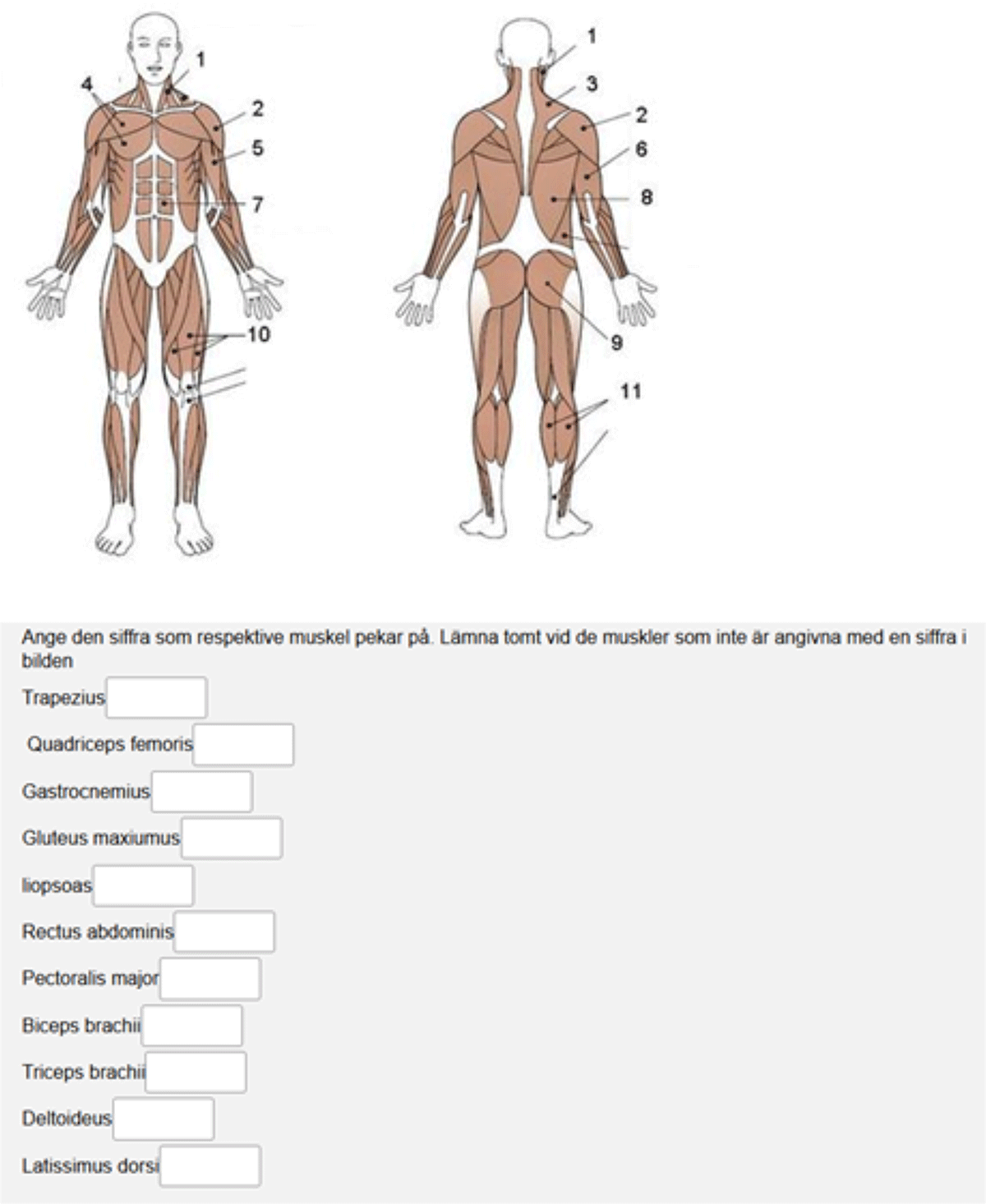
Figure 1
Example of a multimodal MCQ using visual, written, and numerical resources in a closed-book exam. Students write the number each muscle points to and leave muscles if no number is shown in image.
Mixed assessment design including digital writing and oral opposition
The design of this assessment in the Law program was realized through an examination practice defined in the syllabus as the “writing and presentation of two written group assignments (memoranda).” As a first step in the assessment design, the students were divided into groups and each group needed to prepare and upload the written assignment in the LMS before the oral presentation of the group work. The second step was aligned with the ILO and was demonstrated in the syllabus by the procedural knowledge of doing an “opposition on other students’ group assignments”, which took place during an oral session at a seminar. Specific criteria for this were specified in the course description. During the seminar, students had to present their own group work orally and give oral feedback on the projects of other groups. The requirements of being able to understand, apply and evaluate conceptual knowledge, as well as being able to remember, analyze, evaluate and create procedural knowledge were all covered in the exam. The ability to apply metacognitive knowledge was also addressed in the oral opposition. All parts of this assessment design empowered student agency, demonstrating both individual and social responsibility, as well as an intertwined mix of acknowledging the predetermined goals while incorporating elements of personal interpretation and application made possible through oral dialogue. Pre-written instructions within the LMS prompted the students to engage in the discussion in specific ways, while also empowering them to take responsibility for their own knowledge development and represent knowledge according to the requirements. They were required to ask questions about each other’s presentations and display independent analysis and argumentation. The written criteria, which also were provided in advance, prompted quality aspects of knowledge to consider in the presentation.
Home-exam with digital submission
In one assessment design in the bachelor program Study and Career Guidance, which was handed in digitally in the LMS, the students were supposed to write a longer text. The students were to use the course content in a reflection on a person’s career choice. They were able to choose the person themselves, so it could be their own experiences and choices, or someone else close to them such as a family member or friend. They could write about a shorter period of time in the person’s life and focus on a specific situation, or describe a longer period of the person’s life. The important thing was not to give a completely correct picture of how it actually was, but to show how psychological concepts and theories could be used. The text was to show how psychological phenomena and processes can have an impact on the choices a person makes. The students were required to use concepts that highlighted individual psychological, group psychological and existential dimensions of their example, keeping in mind that the meaning of the concepts had to be clarified and explained. With its emphasis on applying conceptual knowledge, the assessment design promoted student agency and gave the students opportunities to elaborate on how psychological phenomena and processes can impact the choices that affect people on individual psychological, group psychological and existential levels. The question design empowered students’ agency and they were able to engage in more knowledge-rich activities such as representing their understanding and evaluation of conceptual knowledge in relation to themselves and others.
Digital discussion
In one assessment design in the program Biomedical Laboratory Science, there were two digital discussions through the LMS that assessed the ILO “Discuss the concepts of sustainable development, global health and equal conditions from a health perspective and in relation to the profession.” The students were required to reflect upon a film clip, a digital tool, or provided written material by responding to open questions in a discussion forum. An example of a question was “Describe the change in the proportion of NCDs/communicable diseases in the region you selected. Discuss what could be the reason why the distribution between NCDs and infectious diseases has changed from the 20th century to the present in the region you have chosen. Investigate gender differences, age differences, change over time, regional differences in this disease.” The assessment design required students to respond to inquiries and challenge each other’s comments, which promoted understanding, applying and evaluation of conceptual knowledge. The assessment design also allowed free discussion and empowered students’ agency, allowing them to develop their thoughts, ask questions, respond to queries, and challenge each other’s comments. While the written instructions and materials constrained the students’ agency, they also helped students focus their discussions, which gave students agency and responsibility for their own knowledge.
Discussion and implications
This section discusses our findings in relation to previous research and perspectives on knowledge and agency, noting that different assessment designs are shaped by the types of knowledge valued and recognized in the professional programs, which in turn influence the framing of student’s agency. We also highlight potential implications for higher education.
What knowledge is in focus in the digital assessment designs?
As a starting point, we found that a wide range of knowledge requirements were emphasized in digital assessment designs, reflecting the increasing complexity of knowledge types and cognitive skills required in the courses (Anderson & Krathwohl, 2001). Lower cognitive skills, such as factual recall and comprehension, as well as theoretical and procedural knowledge, were assessed through a variety of digital formats, including quizzes, practical tests, discussions, and exams, with or without access to books. Higher cognitive skills, such as analysis and synthesis, were more pronounced in assessments that used mixed assessment designs, combining written and oral exams.
Higher cognitive skills were prioritized, especially in mixed assessment designs for ILOs involving complex professional knowledge (Sjöberg, 2019; Park et al., 2021). Both written and oral assessment designs requiring longer responses promoted higher cognitive functions such as analyzing, evaluating, and creating procedural knowledge (Chirumamilla & Sindre, 2017; Nieminen et al., 2023). These findings support research showing that digital assessment designs can enhance the development of a range of knowledge and skills (Durning et al., 2016; Johanns et al., 2017) and that different assessment designs can provide affordances across modes, tools and resources (Ross et al., 2020; Boistrup & Selander, 2022). However, the application of metacognitive knowledge as a communication skill for professional knowledge (Bornemark, 2020) was not explicitly recognized in digital assessment designs that focused on MCQs or design elements that provided visual opportunities. Metacognitive skills were only recognized in oral assessments.
How do different digital assessment designs enable students’ agency?
In answering this research question, we will first say that, in general, the assessment practices in the three faculties, through their policies and management systems, emphasize and encourage student’s motivation and engagement in the pursuit of becoming professionals within their chosen program (Blom, 2009). These practices reward students’ effortful agency, which is shaped by both intrinsic motivation and external regulations such as grading (Matusov et al., 2016, p. 428). In the pursuit of socially and professionally desirable outcomes, students’ own choices and goals may be constrained. The practice of assessment itself is directed towards predetermined course objectives. Within the assessment system, whether digital or not, students act as effective agents, primarily performing predetermined actions within the framework of instrumental agency (Matusov et al., 2016, p. 427).
Furthermore, the results showed that assessment designs such as MCQs limited students’ agency, whereas open-book home examinations and oral oppositions allowed for greater autonomy. Due to their structured nature, MCQs primarily assessed factual and conceptual knowledge at lower cognitive levels (Anderson & Krathwohl, 2001), thereby limiting students’ opportunities to develop and express their own voice, an aspect of authorial agency (Matusov et al., 2016, p. 434). In contrast, open-ended questions in mixed assessment designs that include multimodal opportunities (Boistrup & Selander, 2022) can engage students in more complex cognitive processes. By combining different materials of knowledge representation, writing, and oral presentation, these assessment designs can provide opportunities that promote greater authorial agency, which can foster something new and creative.
In the early stages of the Law and Biomedical Laboratory Science programs, digital quizzes with MCQs and closed-book exams predominated. Later stages incorporated digital writing assignments, oral oppositions and open-book exams, providing more opportunities for student agency. In the Study and Career Guidance program, open-book exams at both the beginning and end allowed for greater agency, likely due to the inherent connection of the topic to students’ prior experiences. However, the design of the questions played a critical role, open-ended formats allowed students to integrate their own perspectives, while restrictive MCQs still limited the personal contribution. Instead, such an assessment design served an instrumental agency (Matusov, et al. 2016, 427).
Instrumental agency was evident where the design of digital assessments was closely aligned with curricular goals, using agency as a means to ensure that students achieved ILOs (Matusov et al., 2016, p. 426). For example, in the Study and Career Guidance program, students could write hypothetically or from experience to apply psychological theories on a homework assignment, while in Law, a digital practice test integrated search engines as a tool for instrumental agency. While these were early program examples, later in the Study and Career Guidance program, a home exam fostered relational and authorial agency (Matusov et al., 2016, p. 434), where students collaborated for mutual support and reflected on authentic cases, such as people’s career choices (Nieminen et al., 2023).
We found that authorial agency, characterized by responsiveness, accountability and innovation over consensus (Matusov et al., 2016, p. 438), was particularly evident in mixed assessment designs that included written and oral oppositions, home exams, and digital discussions. These designs may engage students’ diverse cognitive processes and allow them to take a more active role in constructing knowledge. To foster creativity and innovation in relation to the “horizon of not knowing” (Bornemark, 2020, p. 16), some were assessment designs, such as the mixed assessment design that included written and oral oppositions, that considered material affordances and structural elements (Lindstrand, 2022) that supported the open production of knowledge and skills that were not predetermined. In such assessment designs the design of questions did not constrain agency (negative liberty), but instead opened up to the unpredictable in student performativity (Matusov, 2016, p. 433). This also includes recognizing the goals and representations of knowledge that emerge through the activities themselves and, to a greater extent, are shaped by the students (Boistrup & Selander, 2022).
Implications
These findings underscore the importance of well-structured assessment designs that actively enable students’ intellectual engagement and agency across multiple formats of assessment practices, both digital and non-digital. One implication for practice is the need to develop an awareness of how different designs shape student agency. By integrating an awareness of affordances for student agency, policy makers and assessment designers can create designs that support students’ intellectual autonomy and capacity for critical thinking and originality (Nieminen et al., 2023). A balance between instrumental and authorial agency is essential (Matusov, 2016), as it enables the incorporation of process-related multimodal aspects such as subjectivity, engagement and innovation into the ILOs and assessment criteria.
Another implication that needs to be addressed is how the availability of AI (Pargman et al., 2024) will affect assessment designs that seek to foster student agency while ensuring fair and reliable assessments (Nieminen et al., 2023). The apparent risk of unethical behavior associated with AI may lead to an increased emphasis on proctored exams at the end of a course. As digital assessment design increasingly relies on automated scoring of MCQ, there is a risk that assessments will prioritize simpler cognitive processes, not because they are the most valuable, but because they are the easiest to assess. We argue that this challenge can be addressed through design variations, including a combination of proctored and non-proctored exams, high-stakes and low-stakes assessments, varied question types, authentic tasks and the construction of multimodal assessment pathways that emphasize both the processes and products of student learning (Boistrup & Selander, 2022).
Finally, a key challenge is to design assessments for the unknown (Bornemark, 2020), recognizing tasks in which students not only demonstrate academically sanctioned knowledge (Aubusson & Schuck, 2013), but also actively contribute new perspectives and unique, innovative representations of knowledge that reflect the competencies and skills required in future professional workplaces. At times, universities need to rethink assessment design as a whole, moving beyond the control-focused reproduction of standardized knowledge to encourage greater student participation, promoting unpredictability, dialogue and reflection skills in relation to higher-order thinking skills. This implies that assessment in higher education should protect and, where possible, more fully recognize the higher levels of the cognitive taxonomy.
Data Accessibility Statement
The research data is not publicly available due to the data privacy agreement.
Competing Interests
The authors have no competing interests to declare.
Author Contributions
The first author initiated and designed the research project, conducted the literature review, developed the theoretical and methodological framework, and performed the formal analysis and interpretation of the data presented in the manuscript. All authors contributed to data collection and analysis, as well as to the critical revision of the manuscript’s intellectual content.