
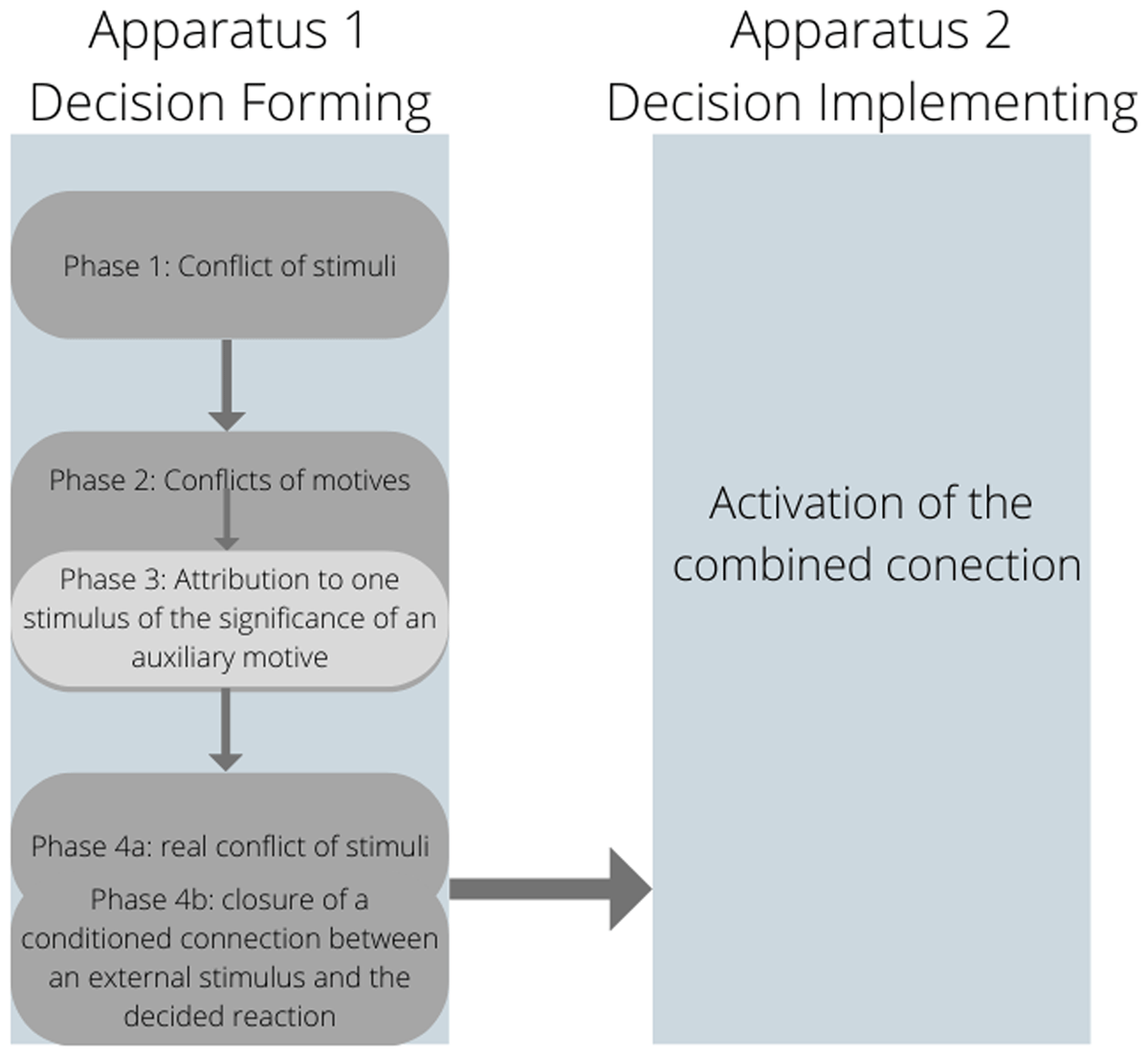
Figure 1
The double stimulation model of the emergence of volitional action (Sannino, 2015), based on Vygotsky’s (1997) text on self-control.
Table 1
Summary of the Change Laboratory sessions.
| DATE | PURPOSE OF THE SESSION | FIRST STIMULI SECOND STIMULI | |
|---|---|---|---|
| 3.9.2019 | Workshop 1 Introduction to CT in mathematics at K-2 level. | ||
| 25.9.2019 | Session 1
| The educational staff’s digital competence. | Expansive learning cycle. |
| 13.11.2019 | Session 2
| Analog artefact. Preparation of teaching. Technology as a supporting artefact. | Activity theory triangle, 1st generation. |
| 29.1.2020 | Session 3
| New ways of teaching. Problem-solving in Scratch Jr. | CT-concepts. Activity theory triangle, 2nd generation. |
| 1.9.2020 | Workshop 2 Introduction to CT in mathematics a K-3 level. | ||
| 21.10.2020 | Session 4
| Students’ development of mathematical learning in Scratch Jr. CT development in traditional math teaching. | Expansive learning cycle. Didactical cycle. |
| 2.12.2020 | Session 5
| How CT emerges in the new model. | Didactical cycle. Activity theory triangle. 2nd generation |
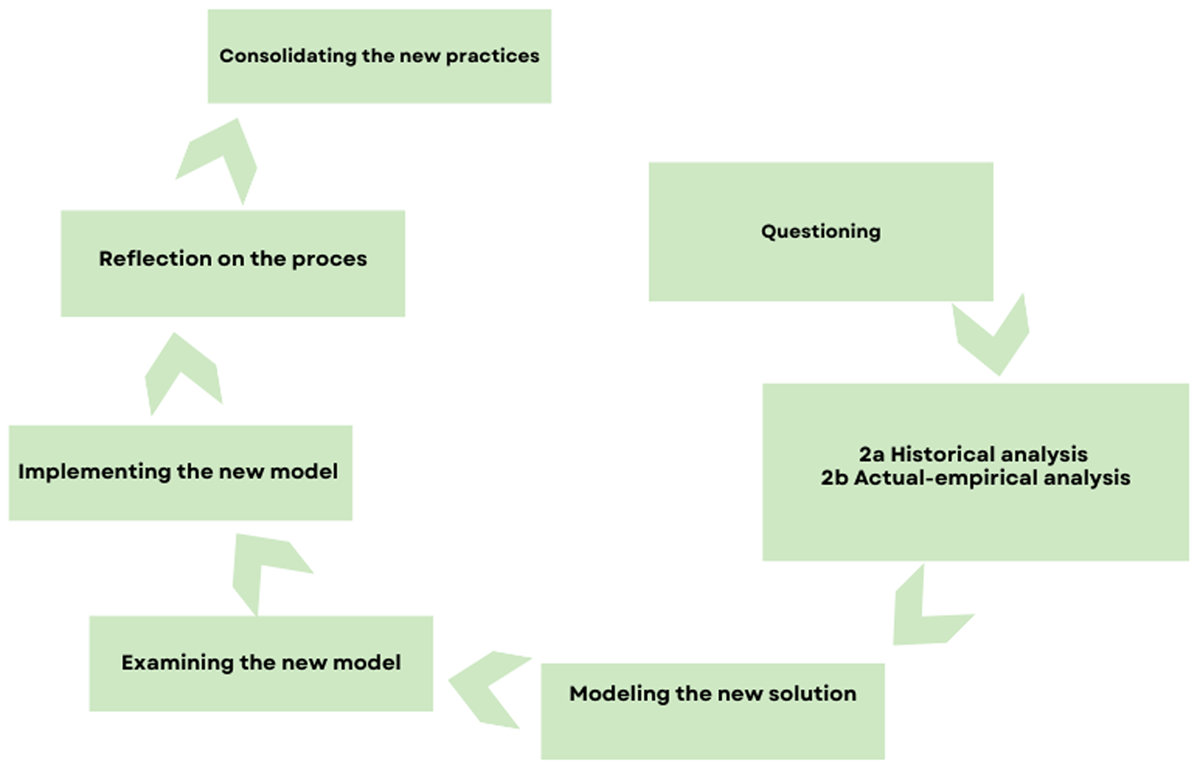
Figure 2
The ideal-typical cycle of expansive learning (Engeström, 2015).
| Phase 1 | a problem related to the object of the activity, or the unit of analysis observed by the researcher or the participant |
| Phase 2 | a conflict of motives articulated by the researcher or the participant and dealing with the object of the activity |
| Phase 3 | a possible auxiliary motive that helps to overcome the problem in Phases 1 or 2 such as an idea or a concept, etc. |
| Phase 4 | a plan for implementation of the model, which could be coordination of the process or who should complete certain tasks related to the object of the activity. |
Table 2
Quotes that capture Apparatus 1 and the expansive learning action.
| PHASE | QUOTE | LEARNING ACTION | CL SESSION | SPEAKING TURN |
|---|---|---|---|---|
| 1 | It was troublesome. I agree that the student should program the robot, but it should not be challenging to add two numbers together. | Questioning | 1 | 128 |
| It’s just when we have no more hours left for preparation; then we have to stop the project. It’s no longer than that if he (the headmaster) has chosen that we should do it. | Questioning | 2 | 156 | |
| Phase 2 | For some, there is a lack between the two robots (Beebot and Ozobot) to the mathematical content. | Analysing | 2 | 50 |
| At least I wish we had more collective preparation hours and more math lessons together (the educational staff becomes aware that it becomes easier to create meaningful tasks together). | Analysing | 3 | 271 | |
| Phase 3 | Should we try to look at what it might look like if you were to work with these BeeBots, for example? | Modelling | 1 | 163 |
| Can we use a diary? | Reflection | 3 | 300 | |
| Phase 4 | I’m writing straight away to her (the teacher had to write to a mom to get some material for a task). | Modelling | 1 | 212 |
| We promise. Or so I promise. | Analysing | 5 | 237 |
Table 3
Summary of the result of expansive learning action and the four phases of Apparatus 1.
| LEARNING ACTIONS | SESSION 1 | SESSION 2 | SESSION 3 | SESSION 4 | SESSION 5 | TOTAL | TOTAL OCCURRENCES IN % |
|---|---|---|---|---|---|---|---|
| Question | 5 | 4 | 3 | 2 | 0 | 14 | 6,2 |
| Analysis | 25 | 19 | 20 | 17 | 17 | 98 | 43,4 |
| Modelling | 14 | 5 | 6 | 6 | 9 | 40 | 17,7 |
| Examining | 1 | 7 | 4 | 7 | 7 | 26 | 11,5 |
| Implementation | 0 | 4 | 4 | 11 | 11 | 31 | 13,7 |
| Reflection | 1 | 3 | 7 | 2 | 5 | 18 | 8,0 |
| Consolidation | 0 | 0 | 0 | 0 | 0 | 0 | 0 |
| Learning action total | 46 | 42 | 44 | 45 | 49 | 226 | |
| Non learning action | 2 | 2 | 1 | 2 | 1 | 8 | |
| Apparatus 1 | |||||||
| Phase 1 | 11 | 14 | 21 | 11 | 15 | 72 | 33,6 |
| Phase 2 | 9 | 9 | 17 | 6 | 11 | 52 | 24,8 |
| Phase 3 | 12 | 10 | 15 | 11 | 18 | 66 | 30,8 |
| Phase 4 | 4 | 3 | 5 | 2 | 9 | 23 | 10,7 |
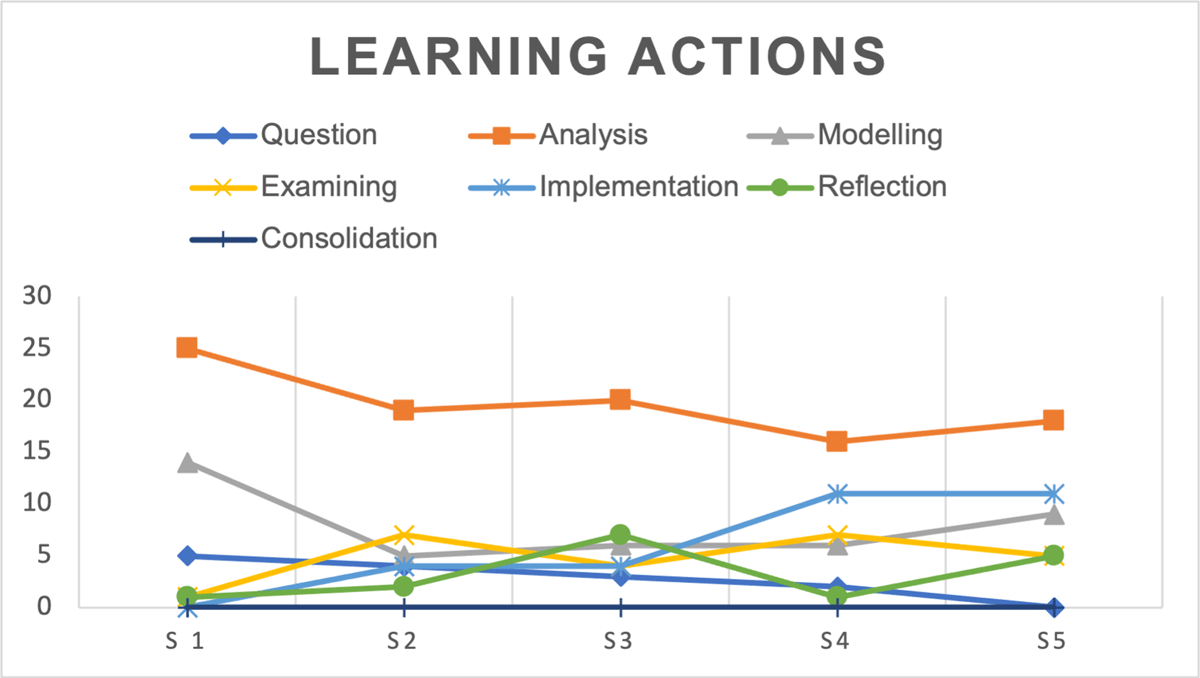
Figure 3
Learning action through the five CL-sessions.
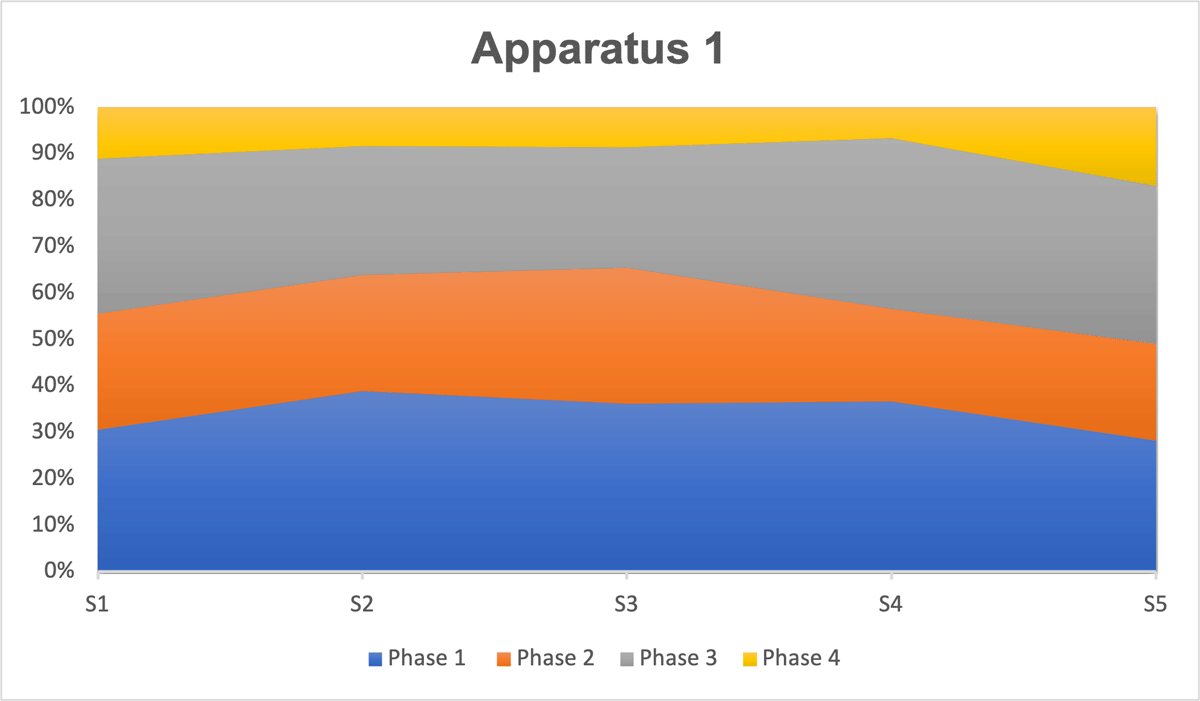
Figure 4
The four phases in Apparatus 1 through the five CL-sessions.
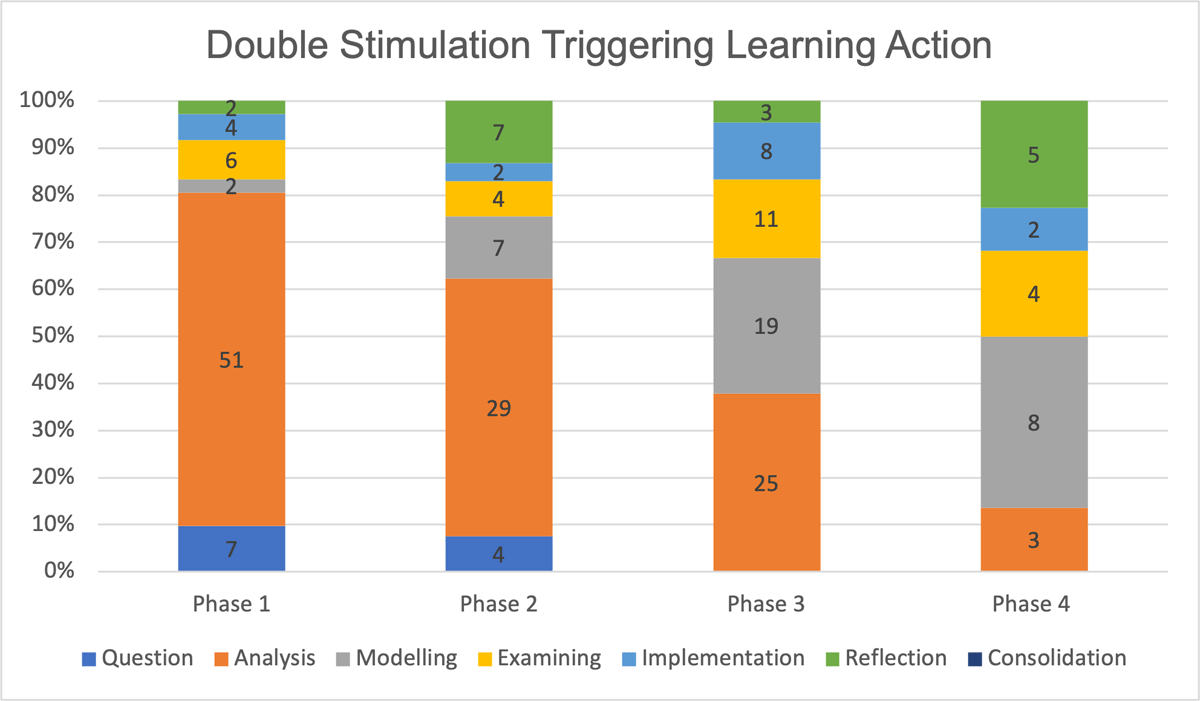
Figure 5
The connection between the Apparatus 1 and expansive learning action.