
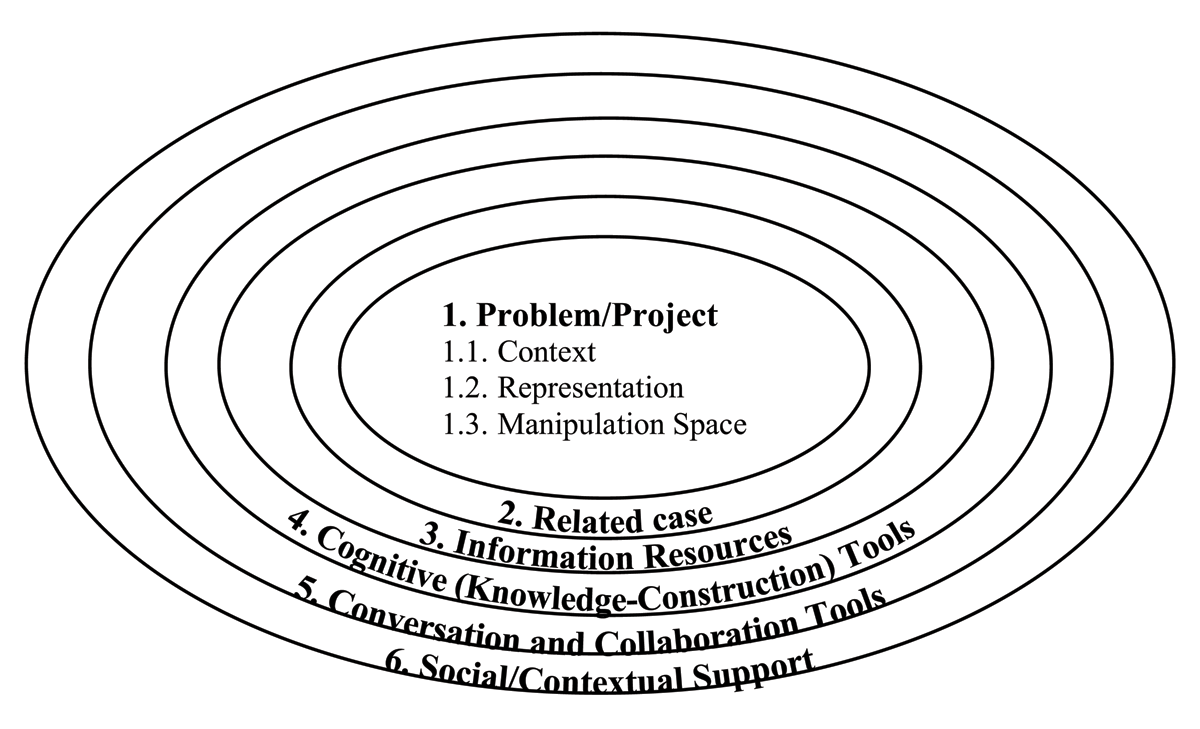
Figure 1
Jonassen’s Framework for a Constructivist Learning Environment (Jonassen, 1999).
Table 1
Study Group Daily Computer and Internet Usage Situations.
| Daily Computer Usage | Daily Internet Usage | |||
|---|---|---|---|---|
| frequency | Percent(%) | frequency | Percent(%) | |
| Less than 1 hour | 76 | 50 | 21 | 13.8 |
| 1 hour | 25 | 16.4 | 35 | 23 |
| 2 hour | 18 | 11.8 | 30 | 19.7 |
| 3 hour | 9 | 5.9 | 16 | 10.5 |
| More than 4 hours | 24 | 15.8 | 50 | 32.9 |
| Total | 152 | 100 | 152 | 100 |
Table 2
Technological Competency Areas Achieved as a result of Literature Review.
| CLEs Framework | Technology Competency Areas Related to The Framework | Related Literature |
|---|---|---|
| 1.Problem/Project | ||
| a. Problem Context | Video Display, Problem Database Websites | (Guo et al., 2014), (Dershowitz & Treinen, 1998) |
| b. Problem Representation | Podcasting, Concept Maps, Virtual Communities of Practice | (Besser et al., 2021), (Mitchell et al., 2021), (Moryl, 2013), (Novak, 1990), (Brown et al., 1989), (Brondfield et al., 2019), (Marzano & Miranda, 2021), (Shin & Jeong, 2021) |
| c. Manipulation Space | Simulation tools, Data Analysis Software, Electronic Spreadsheet Software | (Jonassen, 1999) |
| 2.Related Case | Search Engines, Video Search Engines | (Lazonder, 2001), (Mracek, 2019), (Clifton & Mann, 2011), (Palla & Sheikh, 2020), (Ruggieri, 2020), (Halpern et al., 2020), |
| 3.Information Resources | Digital Library Databases, Google Scholar, E-Museums, Online Questionnaires, RSS | (Borgman et al., 2000), (Cothran, 2011), (Çalık et al., 2016), (Neill, 2008), (Sue & Ritter, 2011) |
| 4.Cognitive (Knowledge-Construction) Tools | Language Translation Software, Office Software, Pdf Editing Software, Audio and Video Editing Software, Digital Calendar Application, Digital Note-Taking Application | (Chung & Ahn, 2021), (Lee & Briggs, 2021), (Muzdalifah & Handayani, 2020), (van Rensburg et al., 2012), |
| 5.Conversation And Collaboration Tools | Social Media, E-Mail, Online Communication Applications, Cloud Technologies, Google Doc, Wiki, Forums, Blogs, E-Portfolios, Video Conference Software, Reference Management Software, Geographical Information Systems, Learning Management Systems, 3-D Virtual Worlds | (Bozanta & Mardikyan, 2017), (Zhang et al., 2016), (Warschauer, 1995), (Cassany et al., 2019), (Kapoor et al., 2019), (Ngaleka & Uys, 2013), (So, 2016),(Bouhnik & Deshen, 2014),(El Mhouti et al., 2016), (Arroyo et al., 2020), (Bakla, 2020), (Gurung et al., 2016), (Savelyeva et al., 2021), (Lin et al., 2014), (Ishtaiwa & Aburezeq, 2015), (Duffy & Bruns, 2006), (Kim & Kim, 2020), (Li et al., 2021) (Trocky & Buckley, 2016), (Ioannou et al., 2015), (Shana, 2009), (Erdogdu & Eskimen, 2020), (Gurer, 2020), (Noel, 2015), (Amir et al., 2011), (Habeeb & Ebrahim, 2019), (Lam, 2020), (Luchoomun et al., 2010), (Jimoyiannis & Tsiotakis, 2016), (Nilsen, 2011), (Basri & Patak, 2015), (Sokolik, 2011), (Lonn & Teasley, 2009), (Warburton et al., 2009), (Dickey, 2003) |
| 6.Social/Contextual Support | Social/Contextual Support | (Chen & He, 2013), (Europass, 2015), (European Commission, 2013), |
Table 3
Technological Competency Areas as a Result of Field Expert Review.
Table 4
Technological Competency Areas and Application Examples Related To These Areas.
| Technological Competency Areas | Favorite Application Example |
|---|---|
| Search Engines | Google, Yandex, etc. |
| Office Software | Microsoft Word, Microsoft Excel, Microsoft PowerPoint, Microsoft Access, etc. |
| Social Media | Facebook, Twitter, Instagram, etc. |
| Google Gmail, Microsoft Outlook, etc. | |
| Online Communication Applications | WhatsApp, Google Hangout, etc. |
| Cloud Technologies | Google Drive, Microsoft OneDrive, Dropbox, etc. |
Table 5
Technological Competency Areas Organized as a Result of the Focus Group Interview.
| CLEs Framework | Technology Competency Areas Related To The Framework | Related Literature |
|---|---|---|
| 1.Problem/Project | ||
| a. Problem Context | Problem Database Websites | (Dershowitz & Treinen, 1998) |
| b. Problem Representation | Podcasting, Concept Maps | (Besser et al., 2021), (Mitchell et al., 2021), (Moryl, 2013), (Novak, 1990), (Brown et al., 1989), (Brondfield et al., 2019), (Marzano & Miranda, 2021), (Shin & Jeong, 2021) |
| c. Manipulation Space | Simulation Tools (Packet tracer, OrCad, Proteus etc.), Electronic Spreadsheet Software (Microsoft Excel, etc.) | (Jonassen, 1999) |
| 2.Related Case | Video Search Engines (YouTube, etc.) | (Clifton & Mann, 2011), (Palla & Sheikh, 2020), (Ruggieri, 2020), (Halpern et al., 2020) |
| 3.Information Resources | Search Engines (Google, Yandex, etc.), E-Museums, Online Questionnaires, Web Feeds (RSS) | (Lazonder, 2001), (Mracek, 2019), (Çalık et al., 2016), (Neill, 2008), (Sue & Ritter, 2011) |
| 4.Cognitive (Knowledge-Construction) Tools | Language Translation Software (Google Translate, etc.), Office Software (Microsoft Word, Microsoft Excel, Microsoft PowerPoint, Microsoft Access etc.), Creating/Editing Multimedia, Digital Calendar Application | (Chung & Ahn, 2021), (Lee & Briggs, 2021), (Muzdalifah & Handayani, 2020), (van Rensburg et al., 2012) |
| 5.Conversation And Collaboration Tools | Social Media (Facebook, Twitter, Instagram, etc.), E-Mail (Google Gmail, Microsoft Outlook, etc.), Online Communication Applications (WhatsApp, etc.), Cloud Technologies (Google Drive, Microsoft OneDrive, Dropbox), Wiki (Wikimedia, etc.), Forums, Blogs (WordPress, etc.), E-Portfolios, Video Conference Software (Adobe Connect, Skype, etc.), Geographical Information Systems (Google Maps, Yandex Maps, etc.), 3-D Virtual Worlds. | (Bozanta & Mardikyan, 2017), (Zhang et al., 2016), (Warschauer, 1995), (Cassany et al., 2019), (Kapoor et al., 2019), (Ngaleka & Uys, 2013),(So, 2016),(Bouhnik & Deshen, 2014),(El Mhouti et al., 2016), (Arroyo et al., 2020), (Bakla, 2020), (Gurung et al., 2016), (Savelyeva et al., 2021), (Lin et al., 2014), (Ishtaiwa & Aburezeq, 2015), (Duffy & Bruns, 2006), (Kim & Kim, 2020), (Li et al., 2021) (Trocky & Buckley, 2016), (Ioannou et al., 2015), (Shana, 2009), (Erdogdu & Eskimen, 2020), (Gurer, 2020), (Noel, 2015), (Amir et al., 2011), (Habeeb & Ebrahim, 2019), (Lam, 2020), (Luchoomun et al., 2010), (Jimoyiannis & Tsiotakis, 2016), (Nilsen, 2011), (Basri & Patak, 2015), (Sokolik, 2011), (Lonn & Teasley, 2009), (Warburton et al., 2009), (Dickey, 2003) |
| 6.Social/Contextual Support | Social/Contextual Support | (Chen & He, 2013), (Europass, 2015), (European Commission, 2013), (Brown et al., 1989). |
Table 6
KMO and Bartlett Test Values.
| CLEs Framework | Technology competency areas related to the framework | Item No | KMO | Barlett | ||
|---|---|---|---|---|---|---|
| Chi-Square | df | Sig. | ||||
| PROBLEM/PROJECT (1–19) | Problem Context | 1–4 | 0.789 | 183.161 | 6 | .000 |
| Problem Representation | 5–11 | 0.864 | 364.515 | 21 | .000 | |
| Manipulation Space | 12–19 | 0.886 | 497.761 | 28 | .000 | |
| RELATED CASE (20–24) | Video Search Engines | 20–24 | 0.754 | 279.483 | 10 | .000 |
| INFORMATION RESOURCES (25–40) | Search Engines | 25–28 | 0.798 | 221.587 | 6 | .000 |
| E-Museums | 29–31 | 0.741 | 264.863 | 3 | .000 | |
| Online Questionnaires | 32–36 | 0.856 | 356.270 | 10 | .000 | |
| Web Feeds (RSS) | 37–40 | 0.768 | 295.677 | 6 | .000 | |
| COGNITIVE (KNOWLEDGE-CONSTRUCTION) TOOLS (41–59) | Language Translation Software | 41–43 | 0.704 | 201.205 | 3 | .000 |
| Office Software | 44–47 | 0.823 | 331.317 | 6 | .000 | |
| Creating/Editing Multimedia | 48–56 | 0.848 | 919.431 | 36 | .000 | |
| Digital Calendar Application | 57–59 | 0.726 | 196.967 | 3 | .000 | |
| CONVERSATION AND COLLABORATION TOOLS (60–121) | Social Media | 60–64 | 0.850 | 329.331 | 10 | .000 |
| 65–70 | 0.842 | 533.527 | 15 | .000 | ||
| Online Communication Applications | 71–75 | 0.899 | 509.148 | 10 | .000 | |
| Cloud Technologies | 76–84 | 0.919 | 1287.437 | 36 | .000 | |
| Wiki | 85–91 | 0.918 | 945 | 137 | .000 | |
| Forums | 92–97 | 0.904 | 763.727 | 15 | .000 | |
| Blogs | 98–103 | 0.912 | 939.931 | 15 | .000 | |
| E-Portfolios | 104–108 | 0.843 | 578.537 | 10 | .000 | |
| Video Conference Software | 109–114 | 0.900 | 906.020 | 15 | .000 | |
| Geographical Information Systems | 115–117 | 0.694 | 214.042 | 3 | .000 | |
| 3-D Virtual Worlds | 118–121 | 0.818 | 388.586 | 6 | .000 | |
| SOCIAL/CONTEXTUAL SUPPORT (122–131) | Social/Contextual Support | 122–131 | 0.917 | 1094.918 | 45 | .000 |
Table 7
Communalities Extraction, Component Matrix, Total Variance Explained, and Cronbach’s Alpha Values.
| CLEs Framework | Technology competency areas related to the framework | Items | Communalities Extraction | Component Matrix | Total Variance Explained | Cronbach’s alpha | |
|---|---|---|---|---|---|---|---|
| Cumulative | Number of factors | ||||||
| PROBLEM/PROJECT (1–19) | Problem Context | 1–4 | >0.639 | >0.799 | 67.980 | 1 | 0.942 |
| Problem Representation | 5–11 | >0.456 | >0.676 | 58.543 | 1 | ||
| Manipulation Space | 12–19 | >0.620 | >0.729 | 60.518 | 2 | ||
| >0.760 | 75.499 | ||||||
| RELATED CASE (20–24) | Video Search Engines | 20–24 | >0.495 | >0.703 | 59.271 | 1 | 0.817 |
| INFORMATION RESOURCES (25–40) | Search Engines | 25–28 | >0.574 | >0.758 | 69.254 | 1 | 0.953 |
| E-Museums | 29–31 | >0.831 | >0.912 | 85.678 | 1 | ||
| Online Questionnaires | 32–36 | >0.456 | >0.675 | 70.824 | 1 | ||
| Web Feeds (RSS) | 37–40 | >0.678 | >0.823 | 75.513 | 1 | ||
| COGNITIVE (KNOWLEDGE-CONSTRUCTION) TOOLS (41–59) | Language Translation Software | 41–43 | >0.689 | >0.830 | 77.611 | 1 | 0.953 |
| Office Software | 44–47 | >0.692 | >0.832 | 77.933 | 1 | ||
| Creating/Editing Multimedia | 48–56 | >0.707 | >0.783 | 65.162 | 2 | ||
| >0.874 | 79.368 | ||||||
| Digital Calendar Application | 57–59 | >0.743 | >0.862 | 80.048 | 1 | ||
| CONVERSATION AND COLLABORATION TOOLS (60–121) | Social Media | 60–64 | >0.596 | >0.772 | 70.022 | 1 | 0.989 |
| 65–70 | >0.539 | >0.734 | 68.178 | 1 | |||
| Online Communication Applications | 71–75 | >0.695 | >0.833 | 77.629 | 1 | ||
| Cloud Technologies | 76–84 | >0.634 | >0.797 | 80.405 | 1 | ||
| Wiki | 85–91 | >0.784 | >0.885 | 84.024 | 1 | ||
| Forums | 92–97 | >0.788 | >0.888 | 82.091 | 1 | ||
| Blogs | 98–103 | >0.806 | >0.898 | 85.968 | 1 | ||
| E-Portfolios | 104–108 | >0.808 | >0.899 | 85.344 | 1 | ||
| Video Conference Software | 109–114 | >0.828 | >0.910 | 87.367 | 1 | ||
| Geographical Information Systems | 115–117 | >0.760 | >0.872 | 80.632 | 1 | ||
| 3-D Virtual Worlds | 118–121 | >0.742 | >0.862 | 82.110 | 1 | ||
| SOCIAL/CONTEXTUAL SUPPORT (122–131) | Social/Contextual Support | 122–131 | >0.586 | >0.765 | 71.192 | 1 | 0.953 |