
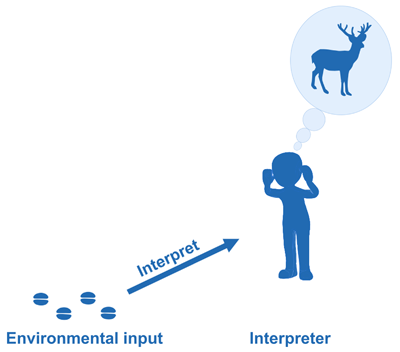
Figure 1
An individual making meaning from environmental input.
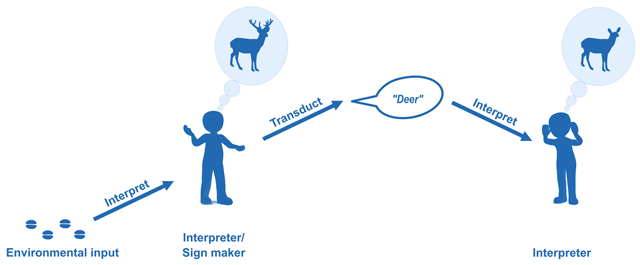
Figure 2
Transduction of visual environmental input to a spoken word, which is then interpreted by a second individual.
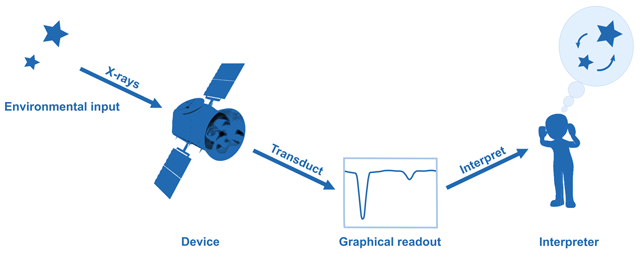
Figure 3
Transduction with a device in physics.
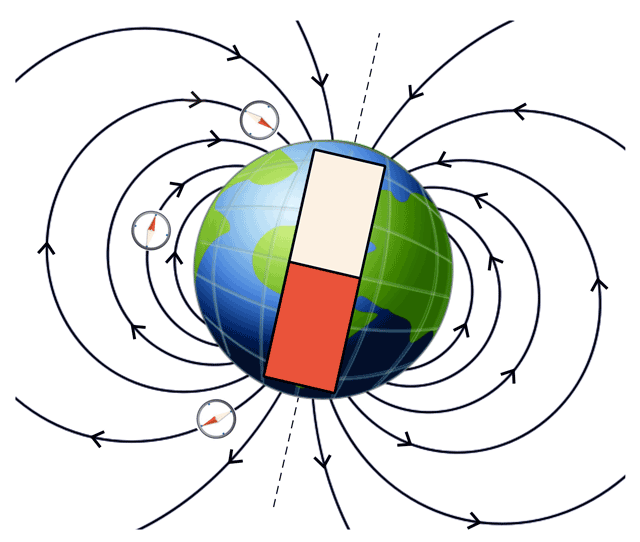
Figure 4
The Earth’s magnetic field modelled in terms of a large bar magnet within the Earth. Notice the compass needles are aligned with the imaginary field lines.
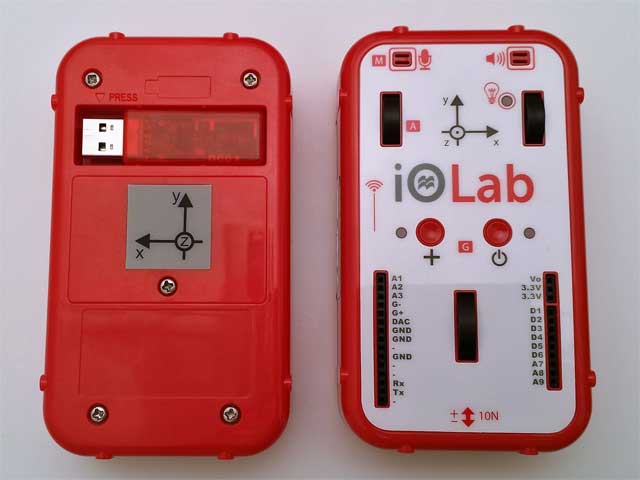
Figure 5
The IOLab device. Note the printed sets of axes on the top and bottom surfaces. The USB stick is for wireless data transmission between the IOLab device and a computer.
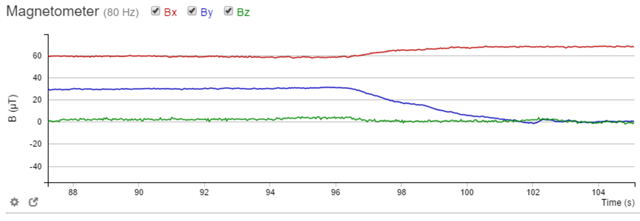
Figure 6
A screenshot of the transducted, three-component-plot of the magnetic field on the computer screen as the IOLab is moved. In the learning sequence documented for this study our intention was for students to learn something about the Earth’s magnetic field by using this device.
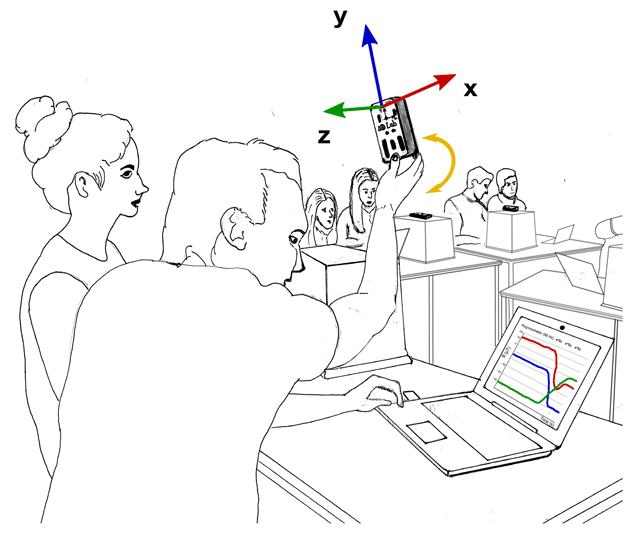
Figure 7
Diagram of the classroom setup.
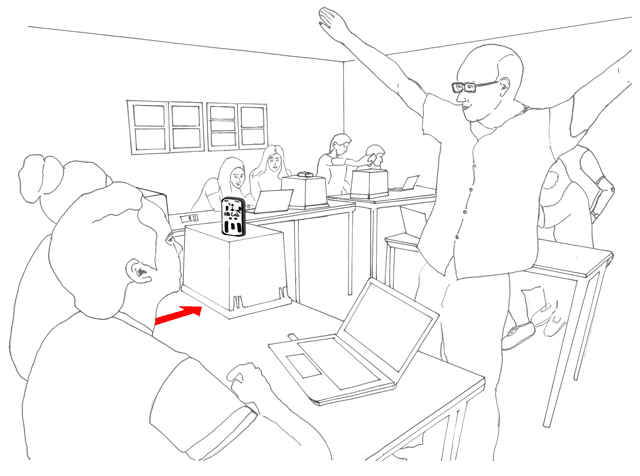
Figure 8
Transduction made by a facilitator—purposeful bodily gesture accompanied by questions.
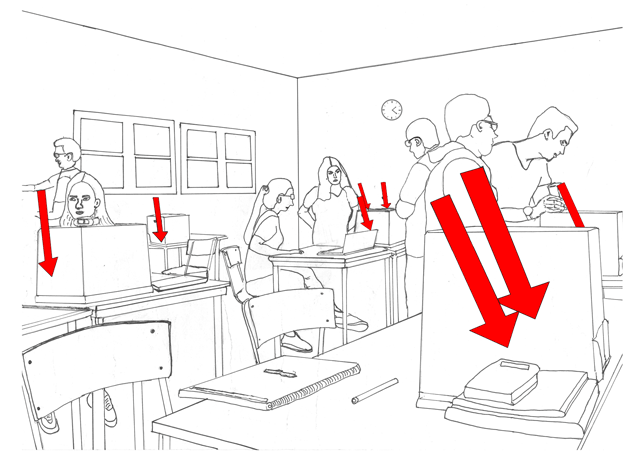
Figure 9
The red arrow serves as a persistent placeholder for previously transducted meanings.
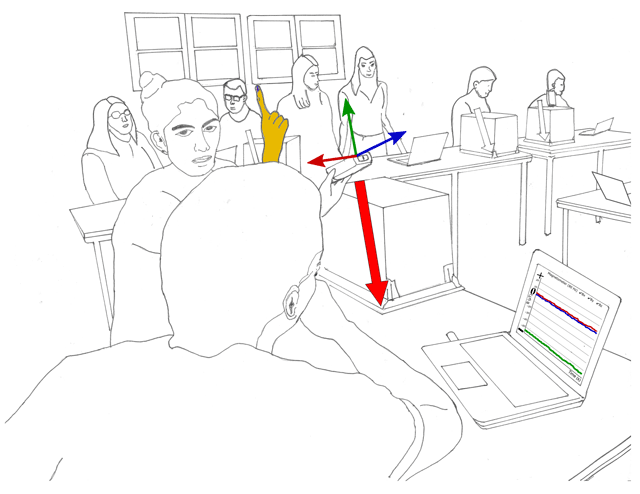
Figure 10
Introduction of a new resource (gesture). The red arrow functions as a coordinating hub.
| G: | We should be showing the direction of this… |
| [G grabs cut-out red arrow] | |
| B: | I don’t know, how do we read that, how do we know that? |
| [B looks at screen] | |
| G: | (reading instruction sheet)“…and to fix the arrow that represents the direction” |
| [G chuckling and looking at screen] | |
| {holds and dangles red arrow in front of screen} | |
| B: | Ohh, I guess, I don’t know, mmm, what happens if we move it. Oh S#!t, look at that … |
| [B grabs IOLab and rotates IOLab while looking at screen, …both look at screen] | |
| G: | chuckles (hah, hah, hah) |
| B: | Holy crap, holy crap … Ummh, yeah, moving it changes it of course, so I guess we could figure out by the amount… |
| G: | No, I guess… |
| [G takes hold of IOLab and rotates it] | |
| B: | You see the blue line went up to the top |
| [G is still rotating IOLab] | |
| [B points at graph on screen] | |
| G: | Yeaah, ok. |
| B: | Yeah, I don’t really know what this tells us. |
| G: | You want z- to be zero? |
| B: | Yah, I’m trying to get both of them zero at the same time. |
| [B now takes hold of device on top of box and looks at screen; G peers over outstretched arm of B at screen.] | |
| B: | Isn’t that z-? I don’t understand, that should be z-. |
| [B moves device towards him slightly and looks at screen] | |
| {The +z-axis on the device is in a line away from B, the y-axis is still pointing up, and the x-axis points to his left} | |
| G: | That should be z? |
| B: | It’s not moving. |
| // a short while later: | |
| G: | … but if, if … if we tilt it this way, then z- changes, see … |
| [G swivels the device about the x-axis] | |
| {x-axis pointing perpendicular to field which gives a zero reading for the x-component on the graph} | |
| B: | Yeah |
| G: | If I put it on the horizontal… way; see now it gets, x, no, y is zero. |
| {At end of G’s manipulation, the device is held so that the y-axis is pointing almost perpendicular to the magnetic field, i.e. almost horizontal} | |
| B: | But how? |
| G: | But why is it, why is y- zero? |
| [G looks around class (for assistance?), smiles, then looks directly at camera] | |
| {G is still holding device in position where y-value is zero} | |
| B: | I don’t know… by my logic it shouldn’t be working like that, or I don’t know … |
| G: | {laughs}…could we get help, …see… he explains …OK. |
| [G points to a facilitator across the room] | |
| {G looks around class (for assistance?), smiles, then looks directly at camera, still holding device in position so that y-value is zero.} |
| F1: | OK, … good, now that you have the blue line; so what’s the blue line? It’s the y- right? |
| [F1 points at screen, then comes closer to screen] | |
| B: | Yeah |
| G: | Yes. |
| F1: | So the y one, No, actually, no… the red one is zero right now, I’m sorry. |
| [F1 corrects himself by pointing at screen] | |
| B: | Yeah, … or close to zero it is. |
| F1: | …close to zero, yes. So what does that mean for the field; in which direction is it not pointing? |
| B: | Umm… |
| F1: | You’ve eliminated one, one family of directions … which family would that be? |
| [F1 uses hands in encircling motion (“family of directions”)] | |
| G: | MM-mm … the horizontal… |
| F1: | All the horizontal …or just … |
| B: | Wouldn’t it be this way? |
| [B moves hand back and forth in line of x-direction with index finger pointing in +x-dir’n] | |
| F1: | Yes, exactly… |
| G: | …yeah, yeah, true. |
| F1: | So, if you want to align (emphasis) this vector to this vector, what should you do? |
| [F1 points in order at axes labels (printed on IOLab) in direction of +z, then at red arrow] | |
| G: | Ah-hah! This way … ah, OK, |
| [G grabs IOLab (smiles broadly) and holds device with {+z pointing up at an angle directly opposite to dir’n of red arrow}] | |
| [B extends hand towards device (but G grabs it first), then withdraws hand to mouth and watches screen] | |
| F1: | Yahh… |
| [F1 looks at B (to check if B also gets it)] | |
| G: | Yeah, ah-hah, [indistinct] its a negative [indistinct] because it’s pointing this way and … |
| [G looks at screen to look at value for Bz; explains negative screen value for z- with hand and finger first gesturing along dir’n of red arrow (down at angle), then opposite] | |
| B: | Yeah |
| [B nods head up and down] | |
| F1: | What if you flipped it around? It’s positive? |
| [F1 points at IOLab, and then makes a flipping gesture with right hand and two fingers in V-shape] | |
| [G flips device about y-axis so that +z now points in direction of red arrow, looks at screen and smiles] | |
| B: | Yeah, it’s positive 50. |
| [B’s right hand first over mouth (closed, loose fist); looks at screen and confirms z-value, right hand now first strokes hair over right ear lightly, then rests fingers against neck and chin, and starts pinching at cheek gently, touches ear etc.] | |
| F1: | Makes sense? |
| [F1 looking at B intently] | |
| B: | …Yeah. |
| G: | Mm-mm … That’s pretty cool. I mean that is cool. |
| B: | Yeah, ah yeah. |