
Table 1
PICO for Formulating Review Question
| Domain | Definition |
|---|---|
| Population | Hospitals, Indonesia, Nigeria |
| Intervention | Intervention on and recommended intervention to drug administration errors |
| Comparison | Nil |
| Outcome | Nil |
[i] The review question: What are the interventions on and recommended interventions to medication administration errors in hospitals in Indonesia and Nigeria?
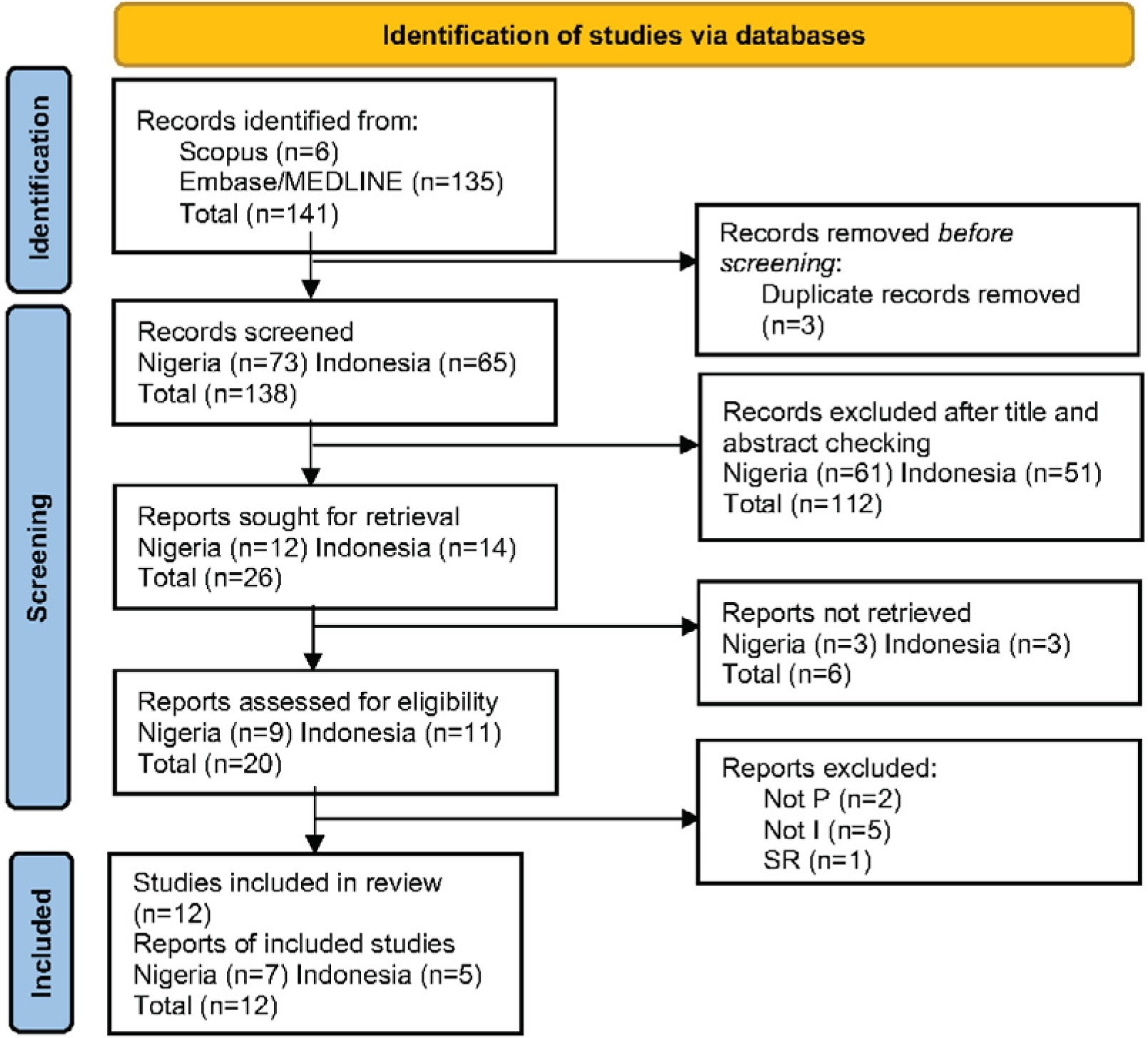
Figure 1
PRISMA flow diagram
Table 2
Included Studies for Review
| Country | Author (Year) | Study Aim | Setting | Study Design |
|---|---|---|---|---|
| Indonesia | Mahendra (2021) [31] | Explored the rate of medication errors reporting | Dr. Soeradji Tirtone- | Retrospective and goro General Hospital descriptive Medical Center |
| Musharyanti et al. (2019) [32] | Explored Indonesian nursing students’ perceptions of the types and causes of medication errors in clinical rotations. | A closed discussion room | Descriptive qualitative study | |
| Mulatsih et al. (2018) [33] | Determined the effects of the implementation of MSP in chemotherapy on the incidence of medication errors | Dr. Sardjito Hospital | Quasi-experimental study with pre- and post-intervention without control | |
| Lumbantobing et al. (2017) [34] | Assessed the effect of pharmacist intervention on the number and types of drug-related problems in outpatients undergoing hemodialysis | Indonesia Christian University Hospital | Pre- and post- prospective study | |
| Ernawati et al. (2014) [35] | Determine frequency of medication errors during medication delivery processes the nature | Public teaching hospital geriatric ward in Bali | Prospective study | |
| Nigeria | Adeleye et al. (2021) [36] | Explored inappropriate use of mannitol (medical error) amongst head injury (HI) patients | Neurosurgery unit | Cross-sectional study |
| Bello (2021) [37] | Assessed adherence to medication administration guidelines among nurses | State Specialist Hospital Akure | Cross-sectional study | |
| Ayorinde and Alabi (2019) [38] | Assessed perception and contributing factors to medication administration errors | University College Hospital Ibadan | Quantitative descriptive design | |
| Johnson and Ebirim (2017) [39] | Assessed the frequency of drug administration errors by anaesthetists, the drugs commonly involved, and the effects of such errors. | – | Cross-sectional study | |
| Ilesanmi et al. (2016) [40] | Examined the methods of reporting medication administration errors (MAEs) by nurses | University College Hospital, Ibadan | Cross-sectional study | |
| Nwasor et al. (2014) [41] | Studied the incidence of medication errors among anesthesia practitioners | Secondary and tertiary hospitals in Kaduna State | Cross-sectional study | |
| Ogboli-Nwasor (2013) [42] | Highlighted the significance of medication errors and discussed the best methods of prevention | Teaching hospital | Case report |
Table 3
Interventions on and Recommended Interventions to Medication Administration Errors for Prevention or Elimination
| Category | Interventions / Recommended interventions | Country(s) where intervention was recommended | Author | |||||||||||
|---|---|---|---|---|---|---|---|---|---|---|---|---|---|---|
| [31] | [36] | [37] | [32] | [38] | [33] | [34] | [39] | [40] | [41] | [35] | [42] | |||
| Intervention | Medication Safety Practice (MSP) training | Indonesia | √ | |||||||||||
| Pharmacist-led intervention in haemodialysis room | Indonesia | √ | ||||||||||||
| Recommended intervention | Education/Training | Indonesia and Nigeria | √ | √ | √ | √ | √ | √ | ||||||
| Reporting system | Nigeria | √ | √ | √ | √ | |||||||||
| Proper drug labeling and packaging | Indonesia and Nigeria | √ | √ | √ | √ | √ | √ | |||||||
| Provision of in-hospital clinical pharmacy services | Indonesia | √ | √ | √ | ||||||||||
| Adequate staffing | Indonesia and Nigeria | √ | √ | |||||||||||
| Ensure double-checking of drugs/drug labels | Indonesia and Nigeria | √ | ||||||||||||
| Color coding of syringes | Nigeria | √ | √ | |||||||||||
| Vigilance | Nigeria | √ | √ | |||||||||||
| Timeliness of drug supply towards | Indonesia | √ | ||||||||||||
| Develop a universal medication procedure/protocol | Nigeria | √ | ||||||||||||
| Enabling environment for reporting | Nigeria | √ | ||||||||||||
| Address the interdisciplinary communication problem | Nigeria | √ | ||||||||||||
| Pharmacists collaborate with other healthcare professionals | Indonesia | √ | ||||||||||||
| Improve drug ampoule design | Nigeria | √ | ||||||||||||
| Organisation of drug drawers and workspaces | Nigeria | √ | ||||||||||||
[i] Notes. Keys:
[ii] [31]: Mahendra (2021)
[iii] [36]: Adeleye et al. (2021)
[iv] [37]: Bello (2021)
[v] [32]: Musharyanti et al. (2019)
[vi] [38]: Ayorinde and Alabi (2019) [33]: Mulatsih et al. (2018)
[vii] [34]: Lumbantobing et al. (2017) [39]: Johnson and Ebirim (2017)
[viii] [40]: Ilesanmi et al. (2016)
[ix] [41]: Nwasor et al. (2014)
[x] [35]: Ernawati et al. (2014)
[xi] [42]: Ogboli-Nwasor (2013)