
Introduction
Globally, patient harms occur in healthcare institutions.1,2,3 Such harms are a threat to patient safety. They are being experienced in both developed and developing countries. Therefore, the World Health Organisation came up with strategies to address these harms.4,5 Guidelines were developed to be adopted or adapted by nations to address the menace of patient harm in their healthcare system.
Threats to patient safety are more prevalent in developing countries than in developed countries.6 Access to quality healthcare services and the availability of infrastructure are not optimal in these countries.7 These, among other factors, exposed them to the experience of more prevalent patient harm.
Medication error is one of the leading causes of patient harm.8,9,10 Medication errors can occur in any of the stages of the medication use process (MUP).9 The MUP stages include prescribing, transcribing, dispensing, administration, and monitoring. All stages have witnessed medication errors resulting in patient harm.
Medication administration errors are a major problem in healthcare institutions.11 Some interventions have been made to solve the problem of medication administration error, but the problem persists.12-16 A multi-approach intervention may be needed to curb the menace of medication administration errors to prevent, reduce, or eliminate them. Prevention of these harms should be the most preferred.
Developing countries abound in Africa and Asia.17-19 Nigeria and Indonesia are typical examples of these countries. Both are lower-middle-income countries (LMIC) and densely populated. Indonesia is the fourth most populous country in the world and the third highest in Asia.20 Nigeria has the sixth-highest population in the world and the highest population in Africa.21 Both countries provide a blend of geographical location, population, and income status of developing countries.
Previous reviews on interventions for medication administration errors have a global focus with attention more on developed countries.22-29 There is no review on interventions on medication administration errors conducted specifically in Asian and African countries. It means that no review has been conducted in Nigeria and Indonesia. The researchers are based in the two countries. Therefore, the review is needed for the appropriate implementation of interventions by the researchers in the future.
There is a need to conduct a review of interventions on and recommended interventions to medication administration errors in Asia and Africa for evidence-based decision-making. Indonesia and Nigeria, having a high ranking among countries that have high populations in the world, serve as good references and starting points for the selection of the two developing countries for commencing efforts towards eradicating medication administration errors in the Asian and African regions. Comparing the interventions in these countries will also give a brief depiction of the intervention practices on or intervention recommendations to medication administration errors for probable implementation of context-applicable interventions across the two countries.
The study aims to review interventions on and recommended interventions to medication administration errors in Indonesia and Nigeria using a narrative review methodology. The interventions on medication administration errors will be determined, recommended interventions examined, and a comparison will be made.
Methods
Research Design
The research design is a mixed-method review. Both quantitative and qualitative studies were selected for the review to help obtain all information available on interventions on and recommendations to medication administration errors.
Identification of the Review Question
The PICO (Population, Intervention, Comparison, Outcome) was used for formulating the review question. The domains of the PICO used are in Table 1.
Table 1
PICO for Formulating Review Question
| Domain | Definition |
|---|---|
| Population | Hospitals, Indonesia, Nigeria |
| Intervention | Intervention on and recommended intervention to drug administration errors |
| Comparison | Nil |
| Outcome | Nil |
[i] The review question: What are the interventions on and recommended interventions to medication administration errors in hospitals in Indonesia and Nigeria?
Criteria for Considering Studies for The Review
All studies conducted on medication administration errors in Nigeria and Indonesia were considered for the review. The included studies were peer-reviewed. There was no restriction on the study design. Only studies conducted in the English Language were eligible. The exclusion criteria include studies that were not peer-reviewed and studies conducted in languages other than English. Reviews and preprints were excluded.
Search Strategy
An electronic literature search was conducted on two databases, Scopus and Embase/Medline, to identify eligible articles based on the inclusion and exclusion criteria. The search was conducted on 8th, 9th, and 10th December 2024. The keywords employed in the search include drug administration, intervention, medication error, hospital, Nigeria, and Indonesia. A combination of these keywords using Boolean operators AND and/or OR resulted in the search output.
Study Selection
All studies were exported to EndNote. EndNote was employed for screening, reviewing, and selecting eligible studies for review. Screening of eligible studies by title and abstract and full texts for inclusion was conducted independently by two reviewers. The screening process is summarized using the PRISMA flow diagram in Figure 1 below.
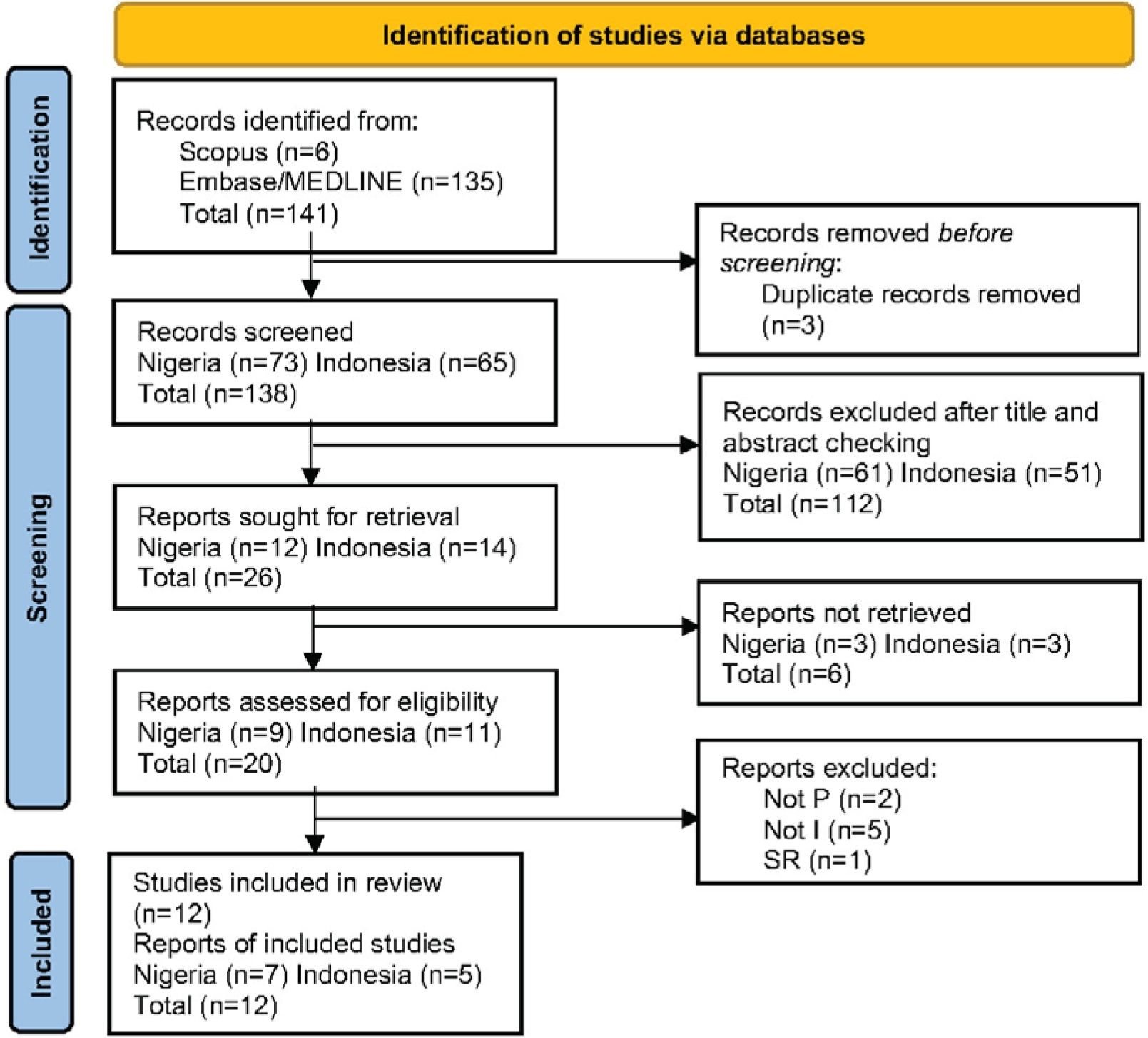
Figure 1
PRISMA flow diagram
Data Extraction
Data extraction of characteristics of studies, results, intervention on, and recommended interventions to medication administration errors was done using a purposefully designed data extraction table.
Ethics Statement
The study is a review. It does not deal with human participants or animals.
Results
Description of Included Studies
There were twelve studies included in the review. Five of the studies (41.67%) were from Indonesia, while seven (58.33%) were from Nigeria (Table 2). Eleven of the studies (91.67%) were quantitative research, and one (8.33%) was qualitative. Two of the studies (16.67%) had a reported intervention, while the other ten (83.33%) recommended interventions for medication administration error prevention or reduction. Studies conducted focused on patients, nurses, anaesthetics, clinical nursing students, and prescriptions for sourcing information on medication administration errors.
Table 2
Included Studies for Review
| Country | Author (Year) | Study Aim | Setting | Study Design |
|---|---|---|---|---|
| Indonesia | Mahendra (2021) [31] | Explored the rate of medication errors reporting | Dr. Soeradji Tirtone- | Retrospective and goro General Hospital descriptive Medical Center |
| Musharyanti et al. (2019) [32] | Explored Indonesian nursing students’ perceptions of the types and causes of medication errors in clinical rotations. | A closed discussion room | Descriptive qualitative study | |
| Mulatsih et al. (2018) [33] | Determined the effects of the implementation of MSP in chemotherapy on the incidence of medication errors | Dr. Sardjito Hospital | Quasi-experimental study with pre- and post-intervention without control | |
| Lumbantobing et al. (2017) [34] | Assessed the effect of pharmacist intervention on the number and types of drug-related problems in outpatients undergoing hemodialysis | Indonesia Christian University Hospital | Pre- and post- prospective study | |
| Ernawati et al. (2014) [35] | Determine frequency of medication errors during medication delivery processes the nature | Public teaching hospital geriatric ward in Bali | Prospective study | |
| Nigeria | Adeleye et al. (2021) [36] | Explored inappropriate use of mannitol (medical error) amongst head injury (HI) patients | Neurosurgery unit | Cross-sectional study |
| Bello (2021) [37] | Assessed adherence to medication administration guidelines among nurses | State Specialist Hospital Akure | Cross-sectional study | |
| Ayorinde and Alabi (2019) [38] | Assessed perception and contributing factors to medication administration errors | University College Hospital Ibadan | Quantitative descriptive design | |
| Johnson and Ebirim (2017) [39] | Assessed the frequency of drug administration errors by anaesthetists, the drugs commonly involved, and the effects of such errors. | – | Cross-sectional study | |
| Ilesanmi et al. (2016) [40] | Examined the methods of reporting medication administration errors (MAEs) by nurses | University College Hospital, Ibadan | Cross-sectional study | |
| Nwasor et al. (2014) [41] | Studied the incidence of medication errors among anesthesia practitioners | Secondary and tertiary hospitals in Kaduna State | Cross-sectional study | |
| Ogboli-Nwasor (2013) [42] | Highlighted the significance of medication errors and discussed the best methods of prevention | Teaching hospital | Case report |
Interventions and Recommended Interventions on Medication Administration Errors
Table 3 reveals the interventions that have been conducted on medication administration errors and recommended interventions in Nigeria and Indonesia.
Table 3
Interventions on and Recommended Interventions to Medication Administration Errors for Prevention or Elimination
| Category | Interventions / Recommended interventions | Country(s) where intervention was recommended | Author | |||||||||||
|---|---|---|---|---|---|---|---|---|---|---|---|---|---|---|
| [31] | [36] | [37] | [32] | [38] | [33] | [34] | [39] | [40] | [41] | [35] | [42] | |||
| Intervention | Medication Safety Practice (MSP) training | Indonesia | √ | |||||||||||
| Pharmacist-led intervention in haemodialysis room | Indonesia | √ | ||||||||||||
| Recommended intervention | Education/Training | Indonesia and Nigeria | √ | √ | √ | √ | √ | √ | ||||||
| Reporting system | Nigeria | √ | √ | √ | √ | |||||||||
| Proper drug labeling and packaging | Indonesia and Nigeria | √ | √ | √ | √ | √ | √ | |||||||
| Provision of in-hospital clinical pharmacy services | Indonesia | √ | √ | √ | ||||||||||
| Adequate staffing | Indonesia and Nigeria | √ | √ | |||||||||||
| Ensure double-checking of drugs/drug labels | Indonesia and Nigeria | √ | ||||||||||||
| Color coding of syringes | Nigeria | √ | √ | |||||||||||
| Vigilance | Nigeria | √ | √ | |||||||||||
| Timeliness of drug supply towards | Indonesia | √ | ||||||||||||
| Develop a universal medication procedure/protocol | Nigeria | √ | ||||||||||||
| Enabling environment for reporting | Nigeria | √ | ||||||||||||
| Address the interdisciplinary communication problem | Nigeria | √ | ||||||||||||
| Pharmacists collaborate with other healthcare professionals | Indonesia | √ | ||||||||||||
| Improve drug ampoule design | Nigeria | √ | ||||||||||||
| Organisation of drug drawers and workspaces | Nigeria | √ | ||||||||||||
[i] Notes. Keys:
[ii] [31]: Mahendra (2021)
[iii] [36]: Adeleye et al. (2021)
[iv] [37]: Bello (2021)
[v] [32]: Musharyanti et al. (2019)
[vi] [38]: Ayorinde and Alabi (2019) [33]: Mulatsih et al. (2018)
[vii] [34]: Lumbantobing et al. (2017) [39]: Johnson and Ebirim (2017)
[viii] [40]: Ilesanmi et al. (2016)
[ix] [41]: Nwasor et al. (2014)
[x] [35]: Ernawati et al. (2014)
[xi] [42]: Ogboli-Nwasor (2013)
Interventions on Medication Administration Errors
There were no reported interventions on medication administration errors in Nigeria. Two reported interventions on medication administration errors in Indonesia were retrieved. The retrieved interventions on medication administration errors included Medical Safety Practice (MSP) training for nurses and pharmacist-led intervention in a haemodialysis unit. The pharmacist-led intervention entailed adjustments to the dose of drugs, administration frequency, and administration time. Information on drug side effects or simultaneous drug administration effects was rendered. Drug monitoring was also done.
Recommended Interventions on Medication Administration Errors
Fifteen (15) recommended interventions were obtained from the studies. The most recommended intervention was education/ training on medication administration errors and their negative effects on patients and practice. This was followed by having a reporting system for medication administration errors (to learn from them) and proper drug labelling and packaging. The provision of in-hospital, clinical pharmacy services and adequate staffing were the third-most recommended interventions.
Comparison of Recommended Interventions in Indonesia and Nigeria
Four out of the fifteen recommended interventions (26.67%) of the included studies had the same recommendation from Indonesia and Nigeria. The recommendations were education/training on medication administration errors, proper drug labelling and packaging, adequate staffing, and ensuring double-checking of drugs/drug labels before administration.
Eight of the fifteen recommendations (53.33%) were from studies in Nigeria. These included a reporting system for medication administration errors, color coding of syringes, being vigilant, and developing universal medication procedures/protocols. Others are creating an enabling environment for reporting, addressing interdisciplinary communication problems, improving drug ampoule design, and organizing drug drawers and workspaces. Three of the fifteen recommendations (20%) were from Indonesian studies only. They were the provision of in-hospital clinical pharmacy services, the timeliness of drug supply to wards, and pharmacists collaborating with other healthcare professionals.
Discussion
Patient safety is an emerging field in developing countries and has not garnered the necessary attention that it is worth.43 In the same vein, medication administration errors have garnered minimal attention in healthcare institutions. A reflection of this claim is revealed in the fact that there have been no studies that have conducted interventions on and given solutions to medication administration errors in hospitals in Nigeria. Indonesia, on the other hand, had two interventional studies on medication administration errors. This is low when compared to the high prevalence rate of medication administration errors in healthcare institutions in developing countries .44,45,46,47 Both countries are lagging in the area of interventional studies on medication administration errors.
Medication Safety Practice training is important to address medication administration errors.32 It will ensure awareness is created about the harm caused to patients due to medication administration errors and their prevalence in healthcare institutions. Healthcare professionals will be trained on ways to reduce these errors. This will, in turn, make healthcare services in hospitals safer for patients.48,49
A pharmacist, being a drug expert, is key to addressing medication administration errors.50,51 It was reflected in the study where pharmacists were part of the medication administration team in a haemodialysis room and improvement in medication administration safety was recorded.33 Therefore, it is expedient that pharmacists are assigned tangible roles in inpatient wards and are involved in ward rounds to avert potential medication administration error dangers.
Patients’ and healthcare professionals’ reports of the incidence of medication administration errors are a good way of sourcing data on medication administration errors for informed decision-making. As both are stakeholders in medication administration, necessary information can be gathered from them. The hospital management and leaders, therefore, must learn from these medication errors and prevent their further occurrence in the future. A Critical Incident Reporting system and committee can be created to look into these errors to learn from them.52 Institutional structures, such as Drug and Therapeutics Committees (DTCs), that offer regular forums for collaborative review and learning across disciplines are also recommended.53 These committees’ roles in preventing prescribing and dispensing errors can be part of a holistic approach to reducing medication administration errors.
The revealing of fifteen (15) recommended interventions from the studies in the review attests to the fact that multiple approaches are needed to tackle medication administration errors. Intervention should come from all stakeholders involved in medication administration.54,55 All stakeholders have a role to play. For instance, pharmaceutical industries need to improve the design of ampoules, drug labelling, and packaging of manufactured drugs; it will decrease the likelihood of errors that come from look-alike, sound-alike medications.56 Healthcare professionals need to be vigilant , pay attention to details, and report any incident of medication administration errors to learn from them.41,42 The healthcare institution needs to address the errors systemically through the provision of necessary training, employment of adequate staff, and creation of a just and trusting culture, among others.31,32,36,37,38,57
Education and/or training are the most recommended interventions needed to address medication administration errors from the studies in the two countries.31,32,36,37,40,41 This is the first critical step needed to proffer solutions to medication administration errors. Awareness has to be created on medication administration errors and their untoward effect on patient safety. Healthcare professionals need to be trained on practices that will ensure medication administration errors are averted. Also, it will be good to provide the necessary education on medication errors to students in the healthcare discipline to prepare them ahead for the prevention or reduction of the errors in their professional practice.4
Creating a reporting system for medication administration errors was highly recommended by studies from the two countries.38,40,41,42 A reporting system will permit learning from incidents to prevent future occurrences and harm.52 Proper drug labelling and packaging were also highly recommended.31,34,38,42 This can help ensure the error will not be due to illegibility or look-alike medicines.56 The proper labelling and packaging will ensure that a design has been made that will prevent healthcare professionals from making errors. Such a design is the basis of the importance of ergonomics in healthcare.58,59
The need for integration of pharmacists into clinical rotation in the ward has been recommended in developed and developing countries.60,61,62,63 It was recommended by three studies in Indonesia for the prevention of medication administration errors.31,34,35 Therefore, attention should be drawn to the integration of pharmacists into clinical rotation in developing countries as is the experience in some developed countries.61,62,63 Also, adequate staffing recommended by studies from Indonesia and Nigeria is essential to prevent medicine administration errors.31,38,41 It will ensure enough staff are available and prevent errors that might occur from the fatigue of a short-staffed institution.
Having four agreements in recommended interventions on medicine administration errors reveals that the occurrence of these errors has some similar root causes in the two countries involved. It attests to the fact that medication administration error is a global menace and has no boundaries.8,11 However, there may be some peculiarities with the healthcare system of the countries involved. This is revealed by the recommendations that were singly received from studies in each country.
Limitation
All identified settings in the included studies are in the secondary and tertiary healthcare level categories. Therefore, the review did not factor primary healthcare into consideration. It implies the recommendations may not be practical or feasible in lower-income healthcare settings because pharmacy personnel are most times unavailable in these settings.
Conclusion
There were identified interventions on medication administration errors from the included studies in Indonesia. Recommended interventions for medication administration errors were seen in the included studies in Nigeria and Indonesia. As medication administration errors still abound in these countries, a combination of any of these interventions should be employed to prevent, reduce, and eliminate medication administration errors in their healthcare institutions.
Competing Interests
The authors have no conflict of interest.
Acknowledgements
The University of Edinburgh Patient Safety and Clinical Human Factors (PSCHF) team is acknowledged for the training of the first author. Edinburgh Surgery Online Scholarship is acknowledged for the scholarship awarded to the first author for the training.
Authors’ Contributions
Conceptualization: Dosunmu OO. Data curation: Dosunmu OO. Formal analysis: Dosunmu OO, Dwinta E, and Fatimah FS. Funding acquisition: None. Methodology: Dosunmu OO, Dwinta E. Project administration: Dosunmu OO, Dwinta E, and Fatimah FS. Writing – original draft: Dosunmu OO. Writing – review and editing: Dwinta E, and Fatimah FS.