
Introduction
Background of the Study
Nursing education is built on theories learned from professional lectures and the practical component acquired in their clinical learning environment, which plays a significant role in developing competent nurses. These experiences enable students to gain hands-on skills, learn from professionals, and develop critical thinking abilities in real-world settings within their clinical learning environment, such as hospitals, clinics, community settings, schools, or institutions. The practical training in a clinical setting presents a unique set of challenges that are often absent in the traditional classroom environment.1
Students often perceive clinical placements as stressful and rewarding, yet they are widely regarded as the most crucial aspect of nursing education.2 The dynamic and complex nature of the hospital environment, with its diverse patient populations and interdisciplinary healthcare teams, necessitates that students adapt quickly and effectively. It differs significantly from the controlled environments in on-campus, simulation rooms, which is challenging for students.3 Furthermore, effective communication and collaboration with the interdisciplinary professionals are essential for providing coordinated and comprehensive patient care. Moreover, the presence of real patients, each with unique, healthcare needs and emotional states, adds a layer of complexity that requires students to develop strong interpersonal and communication skills.4 Alharbi found that the most critical factor affecting their clinical experiences is their relationship with the staff.5 Therefore, the healthcare team should actively contribute to the development of competence of student nurses.3 This contribution can take many forms aside from traditional lectures, including mentoring, role modelling, simulations, film viewing, case studies, and providing constructive feedback. In the Philippines, the competency-based curriculum emphasizes communication skills and collaboration within interdisciplinary teams, requiring students to integrate knowledge, skills, and attitudes to deliver patient-centred care within a complex, clinical environment.
Statement of Problem
This study examined the clinical experiences of student nurses at a public university in Northern Luzon, Philippines, to identify the challenges affecting their learning and performance, as well as the coping strategies they employ to address them. It also identified the teaching strategies used by clinical instructors (CIs) during their clinical rotations. While the existing literature acknowledges the challenges student nurses face in clinical settings, this study specifically addresses a gap in understanding student nurses’ experiences at this institution, as no prior research has been conducted. In our observation, students often encounter negative experiences during their clinical exposure, including limited opportunities to perform nursing procedures, numerous requirements, negative interactions with the Clinical Instructor (CI), staff nurses, and patients, and financial burdens, which can lead to stress. Currently, no specific research has been found on these issues within this particular institution.
Research Objectives
It aimed to investigate the experiences of student nurses during their clinical duties. Specifically, it aimed to identify the challenges affecting student nurses’ clinical learning experiences and clinical performances they encountered during their exposure; explored their coping strategies; and identified teaching strategies that enhanced student nurses’ learning in the clinical area.
Significance of the Study
The study will provide valuable insights into enhancing nursing education, promoting student well-being, and ultimately improving patient care. Recommendations could be developed to enhance the curriculum and the clinical environment, supporting and improving the clinical learning environment for student nurses.
Literature Review
This study was grounded in Abraham Maslow’s Hierarchy of Needs, particularly in the Context of Human Motivation, and the developmental theory of Sister Callista Roy’s Adaptation Model. Accordingly, Maslow proposed the five core needs that form the basis for human behavioral motivation. It includes physiological, safety, love, belongingness, esteem, and self-actualization needs, respectively.6 The physiologic needs are the most basic human needs, like food, water, sufficient rest, clothing, shelter, overall health, and reproduction. People are supposed to sleep at least 6-8 hours a day. When students go for their rotational duty, can they still attain this? Do students have sufficient food when they go for rotational duty? The second level, safety and security needs, includes protection from violence and theft, emotional stability and well-being, health security, and financial security. Third, love and belongingness deal with how we relate to each other. The need for interpersonal relationships motivates behavior, and therefore, belonging to a group is essential in meeting this need. Fourth is self-esteem, which Maslow classified into two categories: esteem for oneself (dignity, achievement, mastery, independence, or confidence in one’s potential) and the desire for reputation or respect from others (e.g., status, prestige). Lastly, self-actualization refers to realizing a person’s potential, self-fulfillment, and seeking personal growth and peak experiences. According to this theory, you need to have a reasonable degree of satisfaction for each level before the next level becomes your motivator.
Sister Callista Roy’s Adaptation model states that the environment has “all conditions, circumstances and influences that surround and affect the development and behavior.” Her models have three basic concepts: the human being, adaptation, and nursing. The human being is viewed as a biopsychosocial being who continually interacts with the environment and whose goal is adaptation.7
According to Maslow, student nurses ought to have a harmonious relationship with their working environment to achieve love and belongingness, the third level in Maslow’s hierarchy. When they feel accepted and loved in the workplace, their self-esteem is also uplifted, leading to self-actualization and attaining the highest level in Maslow’s hierarchy of needs. Additionally, Sister Roy emphasized that self-esteem and self-respect are essential for preventing anxiety in the clinical setting.7
Materials and methods
This study employed a qualitative descriptive research design to explore the clinical experiences of these student nurses. Qualitative research is a valuable approach for gaining in-depth insights into experiences, such as those of student nurses in the clinical setting. The study gathered data through key informant interviews with student nurses and Clinical Instructors (CIs), who were selected purposively.
Participants and Setting
The research was conducted in a public university in Northern Luzon, Philippines. A total of eleven Level III and IV student nurses and 6 CIs participated in this study. Regrettably, three potential participants had to decline involvement in the study, citing a lack of time amidst their demanding schedules and numerous academic requirements. The student participants were those who were currently enrolled in the new curriculum, as outlined in the Commission on Higher Education (CHED) Memorandum Order (CMO 15), were willing to participate, and had experience with hospital rotations. On the other hand, level 2 students were excluded since they were the 1st batch of the enhanced curriculum. For the CIs, those who completed clinical rotations were interviewed to gather their observations of students’ experiences. Their observations confirmed the students’ experiences. The teaching strategies of the clinical instructors were also assessed, and the students evaluated their effectiveness. This triangulation of data sources enhanced the validity and reliability of the study findings. The research was conducted at the institution where the researchers work as CIs. To ensure participant comfort, interviews were conducted either at the university or in the student participants’ homes, as preferred by each individual. Light refreshments were offered to them after the interview at their house. Furthermore, to protect the participant’s privacy and ensure focused data collection, we limited interview attendance to the participant and the researcher(s) only.
Data Collection
A semi-structured interview approach was used with general and open-ended questions. Semi-structured interviews are a qualitative data collection method that uses a predetermined set of questions while allowing flexibility and follow-up questions based on participants’ responses. These questions were provided by the authors and scrutinized by the panel members during the defense proposal, who approved their utilization. Both sets of participants were asked similar questions, but the Clinical instructors’ questions focused on their observations of the student nurses’ experiences during their clinical experiences.
The interviews were conducted face-to-face, with 3 of the 4 authors conducting them individually or in pairs. Only the 3 female researchers, who were also faculty members of the same institution, conducted the interview since the current Dean was also the only male researcher. These researchers were wellequipped to conduct interviews, having attended research training and seminars. Moreover, their credentials included three with Master of Arts in Nursing (MAN) degrees and one in the process of completing her master’s degree.
Data Analysis
A thematic content analysis was conducted in four stages: comprehending, synthesizing, theorizing, and recontextualizing.8 Comprehending involved the researchers familiarizing themselves with the data by playing back the audio recording while transcribing the interview. The data was then synthesized by examining patterns. This was done by cutting the coded transcriptions and grouping them into similar groups. Themes and subthemes were then deduced, a process that involves synthesizing. The coding process involved two researchers who independently analyzed the transcripts. The team then convened to discuss interpretations, compare coding, and collaboratively develop a set of overarching themes, ensuring a rigorous and consensus-driven analysis.
Ethical Considerations
The institution’s Research and Development Unit (RDU) had issued clearance and approved this study. Participants were screened to ensure eligibility. A pre-interview was conducted to explain the study, the contents of the consent form, and the availability of the participants. Prior to the set date, they were contacted via Messenger or their contact number to remind them of the interview. Informed consent was obtained from each participant, who was again informed of the study’s purpose, the possible risks and benefits, their rights, and the use of audio recording. Informed consent is a process by which participants are provided with all the necessary information to make an informed decision about whether to participate in the study. They were informed at the outset they could withdraw from the study if they did not wish to continue. Furthermore, they were assured their grades would not be affected or that they would be treated differently if they withdrew from the study, thereby ensuring their autonomy and comfort. These points were reiterated to the students, as some of them knew the researchers from their previous roles as lecturers in one of their professional subjects, from orientations, or from endorsements by other students. However, the researcher/s did not handle them during their clinical rotation duty to avoid data manipulation and lend objectivity to the interpretation of the data. For the teacher, participants were well aware of the researchers, as they were their colleagues. Lastly, the goal and purpose of the study were given to these participants: to evaluate and improve the clinical education program and teaching approaches based on student experiences.
Information was kept confidential, used solely for research, and not disclosed to unauthorized persons. Personal identifying information was removed to maintain confidentiality and anonymity. Color codes were used in the study for the principal participant, while the teacher participants were coded as “Teacher” plus a corresponding color (“TeacherBlue”). A conflict-of-interest disclosure form was requested at RDU and signed by the researchers. Moreover, face-to-face validation and clarification were done, and the study results were presented to the participants. Participants were assured of the confidentiality of their responses, as the data were stored on a password-protected USB drive. All raw data was also stored in a locked location, accessible only to the researcher. Lastly, ChatGPT, ciciAI, and Grammarly were used to reword sentences and phrases and to check the paper’s tone and grammar, while Research Rabbit was used to explore related literature.
Trustworthiness
Trustworthiness was established in accordance with Lincoln and Guba’s criteria.9 Credibility was established through member checking, where transcriptions and interpretations were reviewed with participants to ensure accuracy and validity. Providing a detailed description of the study context enhanced transferability, while dependability was ensured through an audit trail that documented all analytic decisions. Confirmability was maintained through a reflexive journal that documented the researcher’s assumptions and reflections throughout data collection and analysis. To minimize bias, strategies such as data triangulation (including the clinical instructors’ perspectives), adherence to strict ethical guidelines, and explanation of their voluntary and active participation in the study were employed. Lastly, the Consolidated Criteria for Reporting Qualitative Research (COREQ) checklist was utilized to ensure transparency and rigor in study design, data collection, and analysis.10
Reflexivity
As researchers and faculty members at the same university as our participants, we leveraged our insider knowledge of the nursing program to investigate student nurses’ clinical experiences. With this, we acknowledge our dual positionality and the potential for bias due to pre-existing relationships with our participants and a vested interest in program improvement. Reflexive journaling was conducted by the researchers and referenced after each interview to facilitate a well-informed interpretation of the findings, thereby, ensuring a bias-free analysis. It helped us balance our emotions with that of our critical interpretation, strengthening the ethical integrity and interpretive depth of the study.
Results
This study derived two main themes: the challenges and coping strategies.
Figure 1 below illustrates the conceptual map outlining the themes explored in this study.
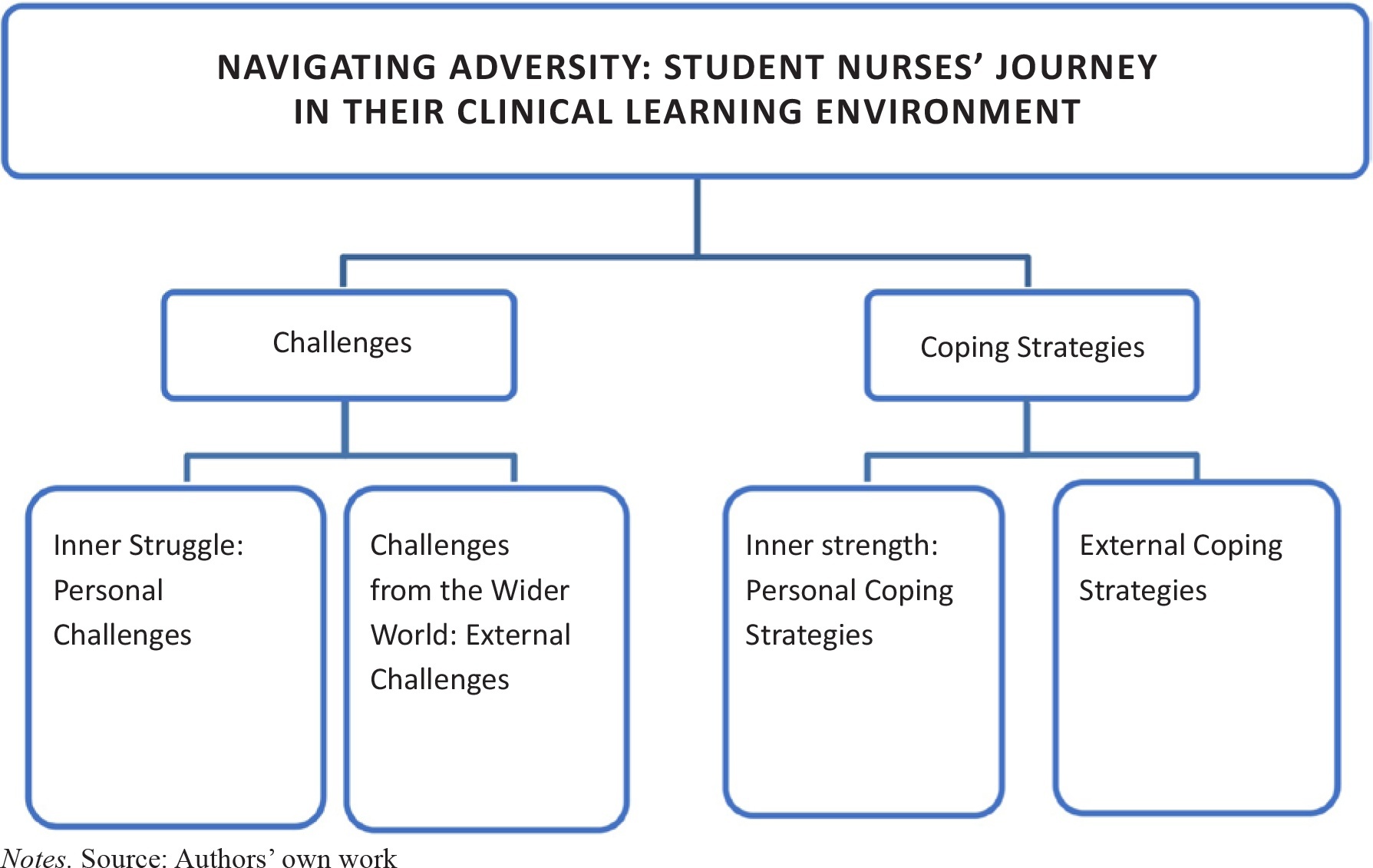
Figure 1
Themes and subthemes
Challenges
The students encountered numerous challenges during their clinical exposure at the different affiliating hospitals, encompassing both personal or inner struggles and external challenges from their wider world.
1. Inner Struggle: Personal Challenges
Student nurses faced significant “challenging experiences” (Blue and Red) that impact their well-being and performance, stemming from emotional/psychological strain and knowledge/skill deficiencies. Participant Navy Blue, Orange, Blue, Lime Green and Black reported “stress, burnout, self-doubt, and nervousness” during clinical rotations, with first-time procedures causing “acute anxiety” (Lime Green and Black). The overwhelming nature of rotations and the diversity of patients contributed to these feelings. As participant Orange stated, “It was overwhelming.” Balancing patient care, the “bulk of requirements” (Grey) and personal needs proves difficult with some feeling as if in the statement of Orange, “I cannot balance patient care and requirements with my own needs,” applied. Working part-time added to the burden, leading to exhaustion and an increased risk of errors. Financial difficulties also played a role, with students sometimes unable to attend duty due to “insufficient allowance,”(TeacherOrange) “Lack of confidence,” (Red, Orange and Peach) and “fear of making mistakes,” (Orange) further hindering their progress, echoing the sentiment that “sometimes we doubt ourselves” (Black). “Lack of sleep at the staff house due to clinical requirements,”was mentioned by TeacherOrange. Another challenge for student nurses was “insufficient knowledge and skills”(Red, Orange and Peach), which is crucial for effective patient care. Students like Blue and Violet admitted, “there are some procedures that we are not adept with,” while Orange cited “lack of knowledge.” Teachers corroborated this with TeacherBlue noting “knowledge is not solid” and TeacherRed observing “no knowledge! maybe because it is their first time.” A lack of initiative and critical thinking is also evident, even in “simple things.” Communication difficulties and time constraints further impeded learning. Students reported “communication difficulties” and a “lack of communication…because of fear to ask” (Orange). Also, she mentioned “time constraint,” making it difficult to “grasp the problems and the procedures to be performed fully.” Difficulty applying learned skills is another hurdle. TeacherOrange observed students struggling with the “application of skills learned at school,” while Black laments, “Without time to practice it, we do not get to practice or apply it.” Further, specific areas of weakness included medication computation, as TeacherBrown notes, “They are having a hard time computing medications,” and establishing a therapeutic “nurse-patient relationship.” Medication errors were also a concern. These were the inner struggles the students experienced, as observed by the CIs.
2. Challenges from the Wider World: External Challenges
External factors from various sources significantly contributed to the challenges student nurses faced. These factors were categorized based on their interactions with patients, staff nurses, group members, clinical instructors, and the hospital.
Student nurses faced challenges interacting with the hospital environment, staff, CIs, and groupmates. Patients’ unique needs and sometimes “rude” (Gray) attitudes, coupled with students’ “miscommunication” (Blue), shyness and “difficulty in establishing a nurse-patient relationship” (Blue), created difficulties. TeacherViolet added, “Some students do not know how to approach their patients”. Students felt overburdened by patients’ complexities and attitudes, such as “uncooperativeness” (Gold and Black), which caused “difficulty in establishing their relationship” (Gray). Wards vary, and high student-patient ratios, i.e., “6 patients were assigned to each student” (Navy Blue) added to the burden. Also, “communication barriers exist” (Lime green, blue and black) for their patients and also among the watchers.
Negative interactions with staff nurses impacted student morale, with some nurses keeping silent about errors or rushing paperwork. Staff attitudes, “their attitude is not good,”(Gold) and inconsistencies between academic procedures and actual practice further complicated learning. Peach divulged, “In our return demo, they are different… in the actual setting.” Students were also “scared to ask” (Blue) for help since students “do not know how to approach them” (Blue and Gold). Also, staff nurses do not teach since they are too “busy” (Blue) and claimed that “student nurses have their CI to teach them” (Blue and Violet).
Clinical instructors used different approaches when dealing with students, which sometimes becomes a point of comparison among students. “Strict CIs” and inconsistencies posed challenges. With this, students “feel pressured” (Green) and scared of the CIs (Violet). TeacherBlue and TeacherGreen corroborated this. “Lack of supervision” was also cited by Participant Orange as a challenge, and TeacherBrown admitted, “We do not have the luxury of time to teach and supervise the 12 students.” Group dynamics also presented issues, including “groups with negative attitude” (TeacherOrange) and a “lack of teamwork,” (Green, Black, and Gray) leading to dependence and selfishness.
Coping Strategies
Two subthemes also emerged from this: inner strength or personal coping strategies and external coping strategies.
1. Inner strength: Personal Coping Strategies
Coping strategies employed by these students included managing their emotional and psychological strain and addressing their knowledge and skill deficiencies. To manage emotional and psychological strain, students were encouraged to “manage time wisely” (Peach, Gold, Violet, LimeGreen, and Orange) for clinical requirements and “adapt to the problems or situations” (Blue, Gray, and Gold). TeacherViolet suggested getting “accustomed to the stress,” while TeacherBlue emphasized “loving the profession.” This love is translated to positive feelings, such as Orange’s excitement in performing procedures and Navy Blue’s “outstanding and great” clinical experience.
Proactive learning was the key in addressing knowledge and skill deficiencies. Students like Violet, Orange, and Gray used “reading” as a coping mechanism. TeacherBlue highlighted the importance of “having the initiative,” while Black learned best through “active participation after the observation” and procedures done “on the spot.” Self-regulation techniques, such as mindfulness and seeking support from friends and family, also played a role in coping.
2. Support from the Wider World: External Coping Strategies
The external environment served as both a challenge and a coping strategy for student nurses. Positive patient interactions enhanced learning, as stated by Violet, “We appreciate the real scenario…” TeacherBrown suggested policies allowing for earlier post-conference time.
Supportive staff nurses were crucial, with participants affirming that “approachable, calm and kind staff enhanced my learning.” Discussion in the ward was also helpful, “nurses willing to give lectures within the area”.
Clinical instructors played a key role through mentorship and teaching strategies. LimeGreen noted, “They do not let the students be pressured…They patiently discuss/instruct/ advise.” Teachers emphasized the importance of continuous monitoring and adapting the teaching to students’ levels. “It depends, so assess them first,” TeacherOrange and TeacherBlue. “Pre-conference as a great coping strategy,” as mentioned by Violet, Black, and Lime Green, “ward orientation,” “one-on-one case presentation,” and “bedside learning” were effective methods. “Regular feedback from instructors… and debriefing sessions and post-evaluation” were crucial for assessing learning.
Positive group dynamics were also essential, with NavyBlue highlighting “peer to peer learning” and Green noting that they “teach and help each other.”
Discussion
Challenges
Stress is a physiological and psychological response to a perceived threat or challenge.11 The most common sources of stress are academic workload, fear of unknown situations, mistakes with patients, or handling of technical equipment, not knowing how to communicate with patients, and lacking care skills.12 Findings from previous studies state that higher levels of anxiety are displayed by students with more experience since they feel that their teachers and other nurses expect more from them as they are more experienced and, therefore, more knowledgeable students.13,14 Although high levels of stress are not beneficial, student nurses were able to manage it at a manageable level, which can offer benefits by serving as a motivational force for students, fostering resilience and encouraging the development of effective coping strategies.10,11 Further, according to Yasmin et al., clinical stress referred to workplace- or clinical site-related stress among nursing students.11,12 It is due to the overlapping demands of clinical instructors, requirements, patients, and staff. In addition, the first experience in clinical practice includes stressors such as fear of making mistakes, handling emergencies, irregularities in clinical practice, and visiting specialized units.14,15 Furthermore, the volume of clinical coursework, assignments, and clinical expectations added to clinical stress. Their fear of failure during clinical procedures may stem from low self-confidence. It was stated that lack of self-confidence was a primary source of worry and anxiety for nursing students and affected their communication.16 Moreover, the other factors leading to stress are lack of quality free time, difficulty in time management, inconsistent faculty responses to their concerns about the gap between theory and practice, and lack of clinical supervision.12 Accordingly, clinical supervision and support of learners in the CLE form an optimal clinical learning experience, as learners should be satisfied with aspects of personalization in clinical learning.17
In our study, some students also hold parttime jobs, which leads to their failure to submit requirements on time. The leading cause of stress for the participants was their feeling of a lack of professional knowledge and skills18 or a lack of care skills.12 Moreover, in their study, students felt insecure about their clinical competence due to a lack of clinical skills development and a perceived lack of practical skills. This leads to procedural anxiety, which is the common source of anxiety.13 Without the opportunity for practice, procedural skills operator confidence has been shown to degrade, leading to skill atrophy19 due to lack of use, often caused by forgetfulness and infrequent practice.14
The emotional burden these students face from the outside world, particularly in their efforts to provide high-quality patient care, often leads to stress. They frequently encounter difficult situations in patient care and in dealing with family members.14 In addition, interpersonal problems with patients and not knowing how to help patients with emotional problems were cited as challenges to student nurses.12 Moreover, communication with patients,18 expectations from various parties, such as patients and patients’ relatives, which they had to navigate, and patients’ attitudes towards “rejecting” nursing students or patients’ refusal of their help were among the sources of stress of our participants and had affected their self-confidence. They were expected to know and perform procedures and tasks upon request, but they are not confident in doing so or don’t know how. Additionally, hospital policies vary in their affiliations with specific agencies. Other staff will also not allow student nurses to perform procedures.16 The restrictive environment causes student nurses to feel isolated and deprives them of the opportunity to learn the skill. Further, a lack of clinical support and poor attitudes among clinical staff posed a challenge. This was also supported by two studies, which found that conflicts with other staff may arise from poor communication among staff.12,18 Staff nurses have multiple expectations of our participants, including performing a variety of nursing tasks. This leads to feelings of disconnection from the students, as they are unable to meet these tasks and expectations. Some participants reported that other nurses in the clinical unit did not allow them to participate in nursing procedures and would perform them in secret, which was considered a significant impediment to their clinical learning. Moreover, unwelcoming clinical staff and a lack of sense of belonging negatively impact students’ clinical learning.16 Some participants also noted that nursing staff are a significant source of stress for students, as they feel like they are constantly being watched and evaluated. Additionally, time pressure was a factor that added to the stress they were expected to work under during their clinical placement. Staff nurses expect students to work quickly and want results instantly.12 According to Dias et al., involving chief nursing officers of clinical facilities promotes collaboration between academia and clinical practice, ensuring alignment between educational objectives and the needs of the clinical setting.16 Additionally, poor communication between teachers and nursing students, as well as a lack of support in their training, was viewed as crucial and expected to increase feelings of frustration and dissatisfaction among nursing students.12 Communication factors included fear, the teachers’ voice, the CI’s poor attitude, and lack of clinical support. These exacerbated the students’ inability to verbalize their concerns. In addition, participants reported a lack of clinical supervision,20 negative feedback from clinical instructors during their clinical placement,12 and inadequate briefing or orientation. Also, unfriendly clinical tutors and their high expectations made the students feel stressed and out of place.16 Lastly, time was also reported as a challenge among the clinical instructors in conducting post-conferences.
Coping strategies
Participants developed their knowledge and skills through direct experience, observation of others, consultation with educators, staff, higher-grade students, and older classmates, thereby, becoming proficient in procedures and patient care.18 The participants reported that procedures sometimes differ from what they learned or what is taught on campus. The established process of “see, do, teach”21 is already being utilized today. It is in this area that Clinical Instructors reconcile what is being practiced with the textbook’s ideal procedure. It is also essential to allow students to perform procedures, as experience is the best teacher. According to the participants, a hands-on approach is vital for learning. Aside from this, participants utilized problem-solving, transference (efforts to maintain a positive attitude toward the stressful situation), and unrelenting optimism.22 With this approach, they enhanced their knowledge and skills. These also included advanced reading, reading or watching content on YouTube and other websites, taking the initiative, asking for support, and actively participating.
Winning a patient’s trust is crucial to providing effective care.18 Participants mentioned that when patients are supportive of their presence, the flow of their duties is enhanced, allowing students to apply procedures to their patients with ease. Additionally, students’ learning is enhanced when hospital restrictions are removed, allowing them to perform nursing procedures under the supervision of staff nurses or clinical instructors. Most participants also stated that communication is vital to resolving conflicts in the clinical setting.18
Clinical staff should foster an environment that promotes individualized learning while helping students develop confidence and competence in their nursing skill repertoire, including critical thinking, problem-solving, and communication.16 In our study, participants reported that some staff nurses are supportive and would allow them to do procedures while guiding them. These positive attitudes have a positive impact on students’ learning in clinical settings, as nurses adhere to Republic Act 9173,23 and they also play a significant role in motivating students and offering positive reinforcement.
Also, simulation-based, hands-on training has become a standard for introducing new procedures,19 and this approach was reported to be an excellent strategy for students. Moreover, instructors support students in developing professional competency.18 Their presence, supervision, and guidance are essential motivating components in the clinical learning process, offering positive reinforcement.16 In guiding the students, the rapid correction of incorrect actions by students showed the importance of patient safety to them,18 where students feel secure with the CI’s presence and guidance. In addition, organizing orientation days at clinical facilities helps students familiarize themselves with the clinical environment, identify potential stressors, and introduce interventions to enhance professionalism, social skills, and coping skills.16 Students feel at ease when they are aware of their environment, and they already know what is expected in the area. They also reported that incidental learning, post-evaluation discussions, and feedback had a significant influence on their learning. Moreover, the clinical instructor has also used biofeedback.14 Furthermore, reflection enhanced students’ self-awareness, mental adaptability to experiences, and problem-solving skills.18 Lastly, available student support structures16 were also seen as a coping strategy. CI’s assigned group leaders can facilitate the group and serve as a point of contact for individuals unable to communicate their concerns to their clinical instructor.
These coping strategies demonstrated a strong commitment to self-improvement and a determination to overcome their challenges. Several researchers found that the most useful coping strategies are problem-solving, transference (efforts to maintain a positive attitude toward the stressful situation), and unrelenting optimism.23 In addition, students employed a self-confident, an optimistic, and a social support-seeking approach to reduce stressors. Moreover, positive thinking, commonly used by students, does not alter the actual situation but instead changes the person’s interpretation of it. Students also reduced their stress by doing their favourite activities.18 Lastly, essential strategies reportedly used to cope with stress were time management, good preparation for clinical practice, and positive thinking, including faith in God, as well as engaging in physical activity and self-motivation.16
Stress from group members influences nursing students. This is associated with their personal behavior and the bond made within the group. Additionally, communication with groupmates18 was reported as a challenge. Lack of teamwork also leads to feelings of isolation, an inability to complete assigned tasks, and a failure to learn skills from procedures conducted in the hospital. On the other hand, the initiative to strengthen their bond is rooted in Maslow’s theory, in which they long for belonging and safety within the group, not only with their groupmates but also with the hospital environment and with the healthcare team. Others also take the initiative to solve their own problems, and others offer their support to their group mates17,6 to handle the situation in the clinical area.
These narratives shared by our students during their hospital duty depicted a vivid picture of their challenges, coping strategies, and the attainment of Abraham Maslow’s Hierarchy of Needs. Some participants have achieved Level 1 by working part-time, while others are supported by their parents. Most maintain their overall health by adapting to their clinical environment and the situation, as stated by Sister Calista Roy.7 Additionally, with this adaptation strategy, students also attained emotional stability. On the one hand, students felt detached from their environment in the clinical setting if their external support did not contribute to their academic growth. Students felt safe in an environment where they could practice or perform procedures with the assistance of clinical instructors and staff nurses, as well as support from patients and watchers. To belong to their environment in the hospital, students learned to cope with the challenges, and some of them achieved a sense of love and belonging. Some strengthened their interpersonal relationships through effective communication, as Sullivan mentioned. Lastly, students’ self-esteem and self-respect were essential for preventing anxiety in the clinical setting, as demonstrated by students who met these needs.
Conclusion
During clinical learning experiences, student nurses faced many challenges that significantly impacted their emotional and professional development. The emotional and psychological strain was considerable, with many students that reported feelings of stress, anxiety, and fear. These issues were often compounded by perceived knowledge and skill gaps, resulting in a lack of confidence, particularly in communication and procedural performance. This deficiency could have hindered their ability to form effective interpersonal relationships, which are essential in healthcare. Their unpreparedness further intensified their personal challenges that made the clinical environment a daunting experience for many. However, the external support available to student nurses played a vital role in mitigating these difficulties. Mentorship from clinical instructors, staff nurses, supportive peer relationships, and cooperative patients greatly enhanced the learning experience. Positive interactions with staff, instructors, and patients can foster a sense of belonging and competence. Conversely, inadequate supervision, unsupportive attitudes, challenging patient interactions, and a lack of teamwork can exacerbate students’ challenges. The effectiveness of clinical instructors is particularly significant, as teaching strategies such as constant supervision, tailored instruction, structured discussions, and thorough evaluations significantly influence students’ ability to cope with their anxieties. While some students thrive under these conditions, others may still feel overwhelmed.
To navigate these challenges, student nurses employed various personal coping strategies. These included adopting a more positive attitude, increasing self-confidence, and demonstrating determination. Proactive learning strategies, such as self-directed learning, mindfulness, deep breathing exercises, and seeking additional guidance, also played a crucial role in personal growth and self-improvement. By employing these strategies, students could gradually develop resilience and improve their ability to deliver quality care.
Implications of the study
Student nurses faced a labyrinth of challenges that they could overcome through personal regulatory mechanisms and support from the outside world. However, the effectiveness of these strategies varies, highlighting the need for tailored support and training.
Limitations and recommendations for future research
One of the primary limitations of this study is its qualitative design, the number of participants, and the area in which it was conducted. This limits the generalizability of the results to other nursing programs or institutions, particularly those with different curricula or student demographics. Participants may have selectively emphasized specific experiences. Additionally, a study could be conducted that includes all aspects of the clinical learning environment for these students. Another approach would be to consider the perspectives of key stakeholders, such as staff nurses and patients, who may provide a more comprehensive understanding of the factors influencing student nurses’ clinical experiences. Finally, a longitudinal or correlational design may establish causal relationships between the identified challenges, coping strategies, and student outcomes.
Acknowledgements
The four authors crafted the research manuscript, from its conceptualization to its analysis.
The researchers would like to thank the individuals who contributed to this study. To the Lord who made it possible for the success of this study. Thank you for giving them the courage and wisdom to face the challenges along the research process, for the continuous blessings and good health, and for touching the hearts of certain people to contribute to the accomplishment of this study. To the members of the panels for sharing their time and valuable ideas, and for extending their knowledge and expertise to improve our manuscript. To our participants who spared their time to be part of this academic journey, and for their cooperation and outstanding contributions. Finally, we thank our families, who have guided and motivated us to succeed in this quest. To God be the glory!
Funding Statement
The supplies used in the research were provided by the Research and Development Unit of Mountain Province State University, the school where the researchers were working. The rest was shouldered by the researchers, including the publication of this manuscript.
Conflict of interest
We declare no conflict of interest.