
Tab. 1.
Search string
| Database | Search string / Boolean combination | Coverage period | Date of access | Filters applied |
|---|---|---|---|---|
| Scopus | TITLE-ABS-KEY((„point of care ultrasound” OR„POCUS”) AND (trauma* OR injury*)) AND PUBYEAR > 2019 AND PUBYEAR <2025 AND (LIMIT-TO(DOCTYPE,„ar”)) AND (LIMIT-TO(LANGUAGE,„English”)) AND (LIMIT-TO(PUBSTAGE,„final”)) | 2020–2024 | 20 October 2024 | Peer-reviewed journal articles, English only |
| Web of Science (WoS) | („point of care ultrasound” OR„POCUS”) AND (trauma* OR injury*) (All Fields) AND (2020–2024) (Publication Years) AND Article (Document Types) AND English (Languages) | 2020–2024 | 24 October 2024 | Peer-reviewed journal articles, English only |
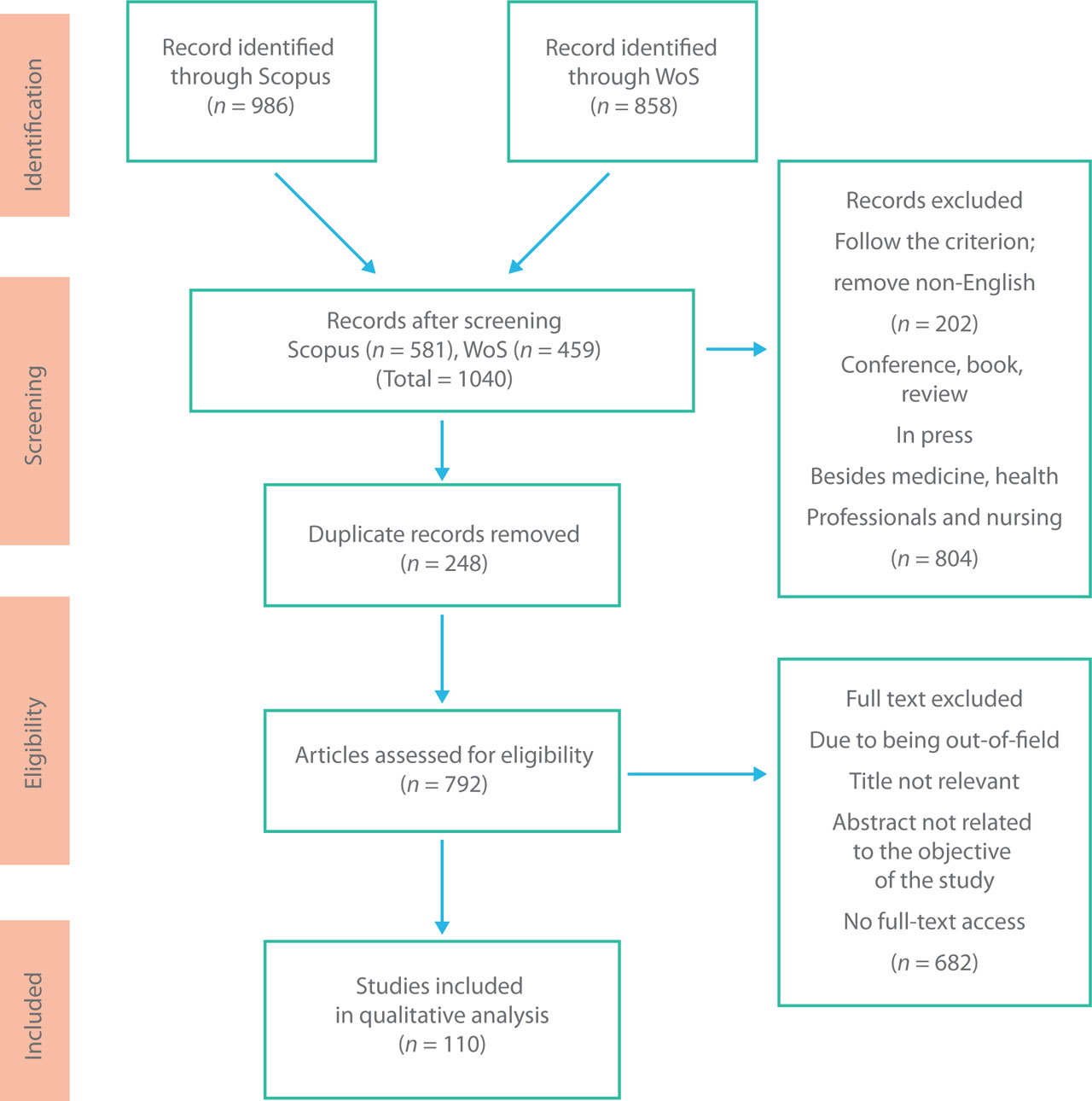
Fig. 1.
Flow diagram of the proposed search study
Tab. 2.
Selection criteria
| Criterion | Inclusion | Exclusion |
|---|---|---|
| Language | English | Non-English |
| Timeline | 2020–2024 | <2020 |
| Literature type | Journal (Article) | Conference, book, review |
| Publication stage | Final | In press |
| Subject | Medicine, health professionals, and nursing | Besides medicine, health professionals, and nursing |
Tab. 3.
Quality appraisal
| Yes | No | Total | Comments | |||||||||
|---|---|---|---|---|---|---|---|---|---|---|---|---|
| Expert | Expert | Agreement | ||||||||||
| 1 | 2 | 3 | 4 | 5 | 1 | 2 | 3 | 4 | 5 | |||
| Section A: Are the results valid? | ||||||||||||
| Was there a clear statement of the aims of the research? | / | / | / | / | / | 100 | Excellent | |||||
| Was the research method appropriate? | / | / | / | / | / | 100 | Excellent | |||||
| Was the research design appropriate to address the aims of the research? | / | / | / | / | / | 100 | Excellent | |||||
| Was the recruitment strategy appropriate to the aims of the research? | / | / | / | / | / | 100 | Excellent | |||||
| Was data collection appropriate for the research issues? | / | / | / | / | / | 100 | Excellent | |||||
| Section B: What are the results? | ||||||||||||
| Was the data analysis sufficiently rigorous? | / | / | / | / | / | 100 | Excellent | |||||
| Is there a clear statement of findings? | / | / | / | / | / | 100 | Excellent | |||||
| Section C: How valuable is the research? | ||||||||||||
| How valuable is the research? | / | / | / | / | / | 100 | Excellent | |||||
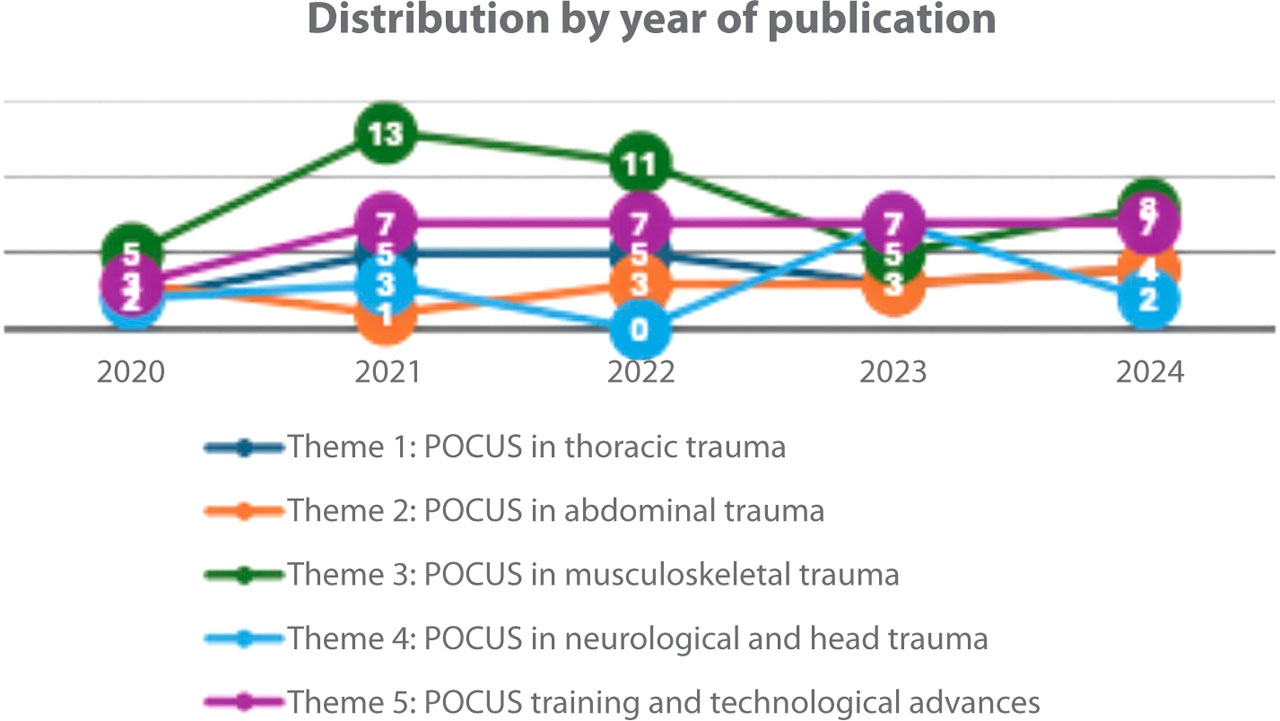
Fig. 2.
Annual trends in POCUS in trauma publications across themes
Tab. 4.
Study characteristics
| Category | Variables | Number of studies | Percentage (%) |
|---|---|---|---|
| Study design | Observational | 69 | 59 |
| Interventional/Experimental | 8 | 7 | |
| Diagnostic accuracy | 14 | 12 | |
| Training and workflow | 9 | 8 | |
| Consensus and development | 4 | 3 | |
| Feasibility and validation | 7 | 6 | |
| Surveys and exploratory analyses | 6 | 5 | |
| Study setting | Adult Emergency Departments (EDs) | 18 | 19 |
| Pediatric Emergency Departments (EDs) | 14 | 14 | |
| Prehospital and air medical | 12 | 12 | |
| Trauma centers | 20 | 21 | |
| Critical care and ICU | 9 | 9 | |
| Orthopedic and rehabilitation clinics | 5 | 5 | |
| Academic and training | 8 | 8 | |
| Primary care and general settings | 5 | 5 | |
| Austere and resource-limited settings | 6 | 6 | |
| Compared modalities | CT | 15 | 17 |
| CXR | 6 | 7 | |
| X-rays | 18 | 20 | |
| MRI | 9 | 10 | |
| Clinical exam | 6 | 7 | |
| Special techniques | 21 | 24 | |
| Other modalities | 13 | 15 | |
| Trauma category | Respiratory & thoracic | 15 | 12 |
| Abdominal & pelvic | 7 | 6 | |
| Musculoskeletal | 30 | 24 | |
| Neurological & head | 13 | 10 | |
| Multisystem | 22 | 17 | |
| Pediatric | 21 | 17 | |
| Cardiac & circulatory | 2 | 2 | |
| Trauma with other conditions | 13 | 10 | |
| Special or rare trauma | 3 | 2 | |
| Primary outcome | Diagnostic performance | 45 | 42 |
| Procedural outcomes | 17 | 16 | |
| Clinical utility | 29 | 27 | |
| Training impact | 16 | 15 |
Tab. 5.
Diagnostic accuracy metrics of POCUS in trauma
| Study (year) | POCUS application | Sensitivity (%) | Specificity (%) | PPV / NPV (%) | Comparator | Key findings |
|---|---|---|---|---|---|---|
| Thoracic trauma | ||||||
| De Mond et al., 2024(50) | Pericardial effusion | 96.4 | 100 | PPV 100 / NPV 99.9 | Clinical diagnosis | High diagnostic precision for life-threatening effusion |
| Çelik et al., 2021(49) | Rib fracture | 91.2 | 72.7 | – | CT scan | Reliable low-cost bedside alternative |
| Jahanshir et al., 2020(45) | Pneumothorax / hemothorax | 75–100 | 100 | PPV 100 / NPV 95 | CT scan | Excellent pneumothorax detection; moderate for hemothorax |
| Robbins et al., 2024(46) | Post-thoracostomy Pneumothorax | 100 | 95 | PPV 60 / NPV 100 | Chest X-ray | Effective post-procedure surveillance |
| DeMasi et al., 2023(6) | Traumatic pneumothorax | 87 | 100 | PPV 81 / NPV 100 | CT scan | Outperformed chest X-ray in trauma diagnosis |
| Yazıcı et al., 2023(47) | Repeated eFAST | 100 | 98.7 | – | Single e-FAST | Repetition improved evolving injury detection |
| Jelyani et al., 2023(48) | Rib fracture & complications | 81.6 | – | – | CT scan | Consistent with CT; supports bedside use |
| Abdominal trauma | ||||||
| Jensen et al., 2024(61) | FAST in pelvic trauma | 75 | 98 | PPV 84 / NPV 96 | CT scan | Reliable for intra-abdominal bleed |
| Riera et al., 2021(62) | Paediatric cFAST | 89 | 99 | PPV 89 / NPV 99 | CT scan | High accuracy; radiation-sparing |
| Yates et al., 2022(112) | Prehospital eFAST | 100 | 96.6 | PPV 100 / NPV 96.6 | CT scan | Effective for early triage |
| Nti et al., 2024(65) | Serial FAST | 66.7 | 93.8 | – | CT scan | Sequential scans enhance detection |
| Kim et al., 2022(12) | Multi-system eFAST | 90 | 95 | – | CT scan | Robust across thoraco-abdominal zones |
| Musculoskeletal trauma | ||||||
| Snelling et al., 2024(71) | Pediatric forearm fracture | 91–100 | 82–95 | – | X-ray | Excellent accuracy; avoids radiation exposure |
| Crombach et al., 2020(75) | Ankle / metatarsal fracture | 80–83 | 90–99 | PPV 70–97 / NPV 94–95 | X-ray | Comparable to radiography |
| Wood et al., 2021(113) | Distal radius fracture | 100 | 64 | PPV 86 / NPV 100 | X-ray | Accurate pre-/post-reduction tool |
| Şik et al., 2021(82) | Elbow fracture | 97 | 97 | PPV 97 / NPV 97 | X-ray | Reliable in pediatric trauma |
| Pohl et al., 2021(114) | Forearm fracture | 100 | 95.8 | – | X-ray | High sensitivity with brief training |
| Varga et al., 2021(115) | Elbow injury | 97 | 97 | – | X-ray | Consistent results across operators |
| Şik et al., 2021(82) | Reduction adequacy | 95.8 | 95.8 | PPV 98.5 / NPV 88.4 | X-ray | Accurate post-reduction verification |
| Caroselli et al., 2021(78) | Pediatric fracture | 91.7 | 88.9 | PPV 89.2 / NPV 91.4 | X-ray | Reliable with structured training |
| Ahmadi et al., 2024(69) | Meniscus tear (MSK variant) | 88.8 | 89.7 | PPV 91.9 / NPV 85.9 | MRI | High concordance with MRI |
| Neurological / Head trauma | ||||||
| Huang et al., 2023(86) | Pediatric skull fracture | 91.7 | 98.6 | PPV 84.6 / NPV 99.2 | CT scan | Accurately detects skull fractures; lowers CT need |
| Şik et al., 2023(116) | Skull fracture + ONSD | 93.7 | 96.8 | PPV 95.7 / NPV 95.3 | CT scan | ONSD correlates with raised ICP |
| Strony et al., 2022(63) | HEMS trauma triage | 53 | 98 | – | CT scan | Enables rapid operative triage |