
Introduction
Trauma encompasses a broad spectrum of experiences, ranging from individual injury to large-scale events, often involving life-threatening conditions that result in lasting physical and psychological consequences(1). It remains a major global cause of death and disability, with road traffic crashes, falls, drowning, burns, and violence contributing substantially to morbidity and economic burden(2,3). Beyond mortality, trauma imposes significant healthcare costs and productivity losses, underscoring the need for efficient diagnostic and treatment strategies.
Point-of-care ultrasound (POCUS) has transformed trauma care by enabling rapid, non-invasive, and portable bedside assessment(4,5). Its real-time imaging capabilities allow clinicians to identify life-threatening conditions, guide resuscitation, and monitor patient progress in emergency departments (EDs), intensive care units (ICUs), and prehospital settings(6,7). The Focused Assessment with Sonography for Trauma (FAST) and extended FAST (eFAST) protocols remain fundamental tools, offering high sensitivity and specificity for detecting pneumothorax, hemothorax, and intra-abdominal bleeding(8,9,10,11,12). Their inclusion in Advanced Trauma Life Support (ATLS) guidelines and endorsement by professional societies highlight POCUS’s central role in modern trauma care(13).
Despite a growing body of evidence, evolving trauma patterns and technological advances call for an updated synthesis of the literature. Earlier reviews mainly addressed single protocols or specific settings(14,15,16,17,18), whereas emerging studies on musculoskeletal, neurological, pediatric, and prehospital applications now demand a broader appraisal.
Over the past decade, research has expanded the use of POCUS beyond thoracoabdominal trauma to musculoskeletal, cardiac, and neurological injuries, showing comparable or superior diagnostic accuracy to conventional imaging(19,20,21,22). Its portability further enhances triage and facilitates early intervention in low-resource and prehospital environments(23,24,25,26), reinforcing its global relevance across diverse healthcare settings.
However, challenges persist. The accuracy of POCUS remains operator-dependent, influenced by variations in training and supervision(27,28,29,30,31,32). While structured curricula and simulation programs improve competence, inconsistencies in credentialing and assessment hinder standardization(33,34). Medico-legal concerns and the absence of unified protocols further limit widespread adoption(35,36,37,38). Diagnostic limitations also persist for hollow viscus and retroperitoneal injuries, for which computed tomography (CT) remains the reference standard(10,11,12).
Emerging technologies offer promising solutions. Artificial intelligence (AI)-assisted interpretation and handheld ultrasound devices may reduce operator dependency and expand access, particularly in resource-limited environments(39). These innovations align with global efforts to promote precision, portability, and equitable access in trauma imaging.
Accordingly, this systematic review synthesizes recent literature to address three aims: (1) evaluate the diagnostic performance of POCUS compared with standard imaging modalities; (2) assess its role in reducing radiation exposure and unnecessary testing; and (3) examine the influence of training and technological innovations on clinical outcomes. By consolidating current evidence and identifying ongoing gaps, this review seeks to inform best practices and optimize the role of POCUS within contemporary trauma care systems.
Material and methods
Review protocol
This systematic review was conducted in accordance with PRISMA guidelines to ensure transparency and reproducibility. Research questions were structured using the PICOS framework, defining the study population, intervention, comparison, outcomes, and study design, thereby improving focus and relevance. The review process comprised identification, screening, and eligibility phases to minimize bias and ensure comprehensive coverage. Study quality was appraised using the Critical Appraisal Skills Program (CASP) checklist, a validated tool for assessing methodological rigor and reliability(40,41). Data from eligible studies were extracted into a standardized form and synthesized using inductive thematic analysis to identify key patterns and themes. The integration of PRISMA, PICOS, and CASP provided a robust framework for analyzing the role of POCUS in trauma care and informed the development of evidence-based recommendations. This review was not preregistered in PROSPERO or any other public registry.
Formulation of research questions
Research questions were structured using the PICOS framework, specifying the population (trauma patients), intervention (POCUS), comparison (standard imaging), outcomes (diagnostic accuracy, time to diagnosis, radiation exposure, and patient outcomes), and study design (quantitative, qualitative, and mixed methods). This framework ensured that the questions were directly aligned with the objectives of the review and guided study selection.
Identification
A systematic literature search was conducted using Scopus and Web of Science (WoS), both of which comprehensively index peer-reviewed journals in emergency and ultrasound medicine, including those listed in PubMed. These databases were selected to ensure broad coverage, avoid duplication, and maintain accurate citation mapping(42,43,44). Search terms were developed using controlled vocabulary and Boolean operators combining “point of care ultrasound” OR “POCUS” AND “trauma” OR “injury.” The search was limited to English-language journal articles published between January 2020 and December 2024. The final search was conducted on 24 October 2024, which remains current for this field given the stable publication trend in trauma-POCUS research. The complete search strategy, including Boolean strings, applied filters, and database-specific parameters, is presented in Tab. 1. This process identified a total of 1,844 records, which were subsequently imported into Mendeley Reference Manager (Version v2.138.0; Elsevier, London, UK) for reference management and duplicate removal before proceeding to screening. The complete selection process is illustrated in Fig. 1.
Tab. 1.
Search string
| Database | Search string / Boolean combination | Coverage period | Date of access | Filters applied |
|---|---|---|---|---|
| Scopus | TITLE-ABS-KEY((„point of care ultrasound” OR„POCUS”) AND (trauma* OR injury*)) AND PUBYEAR > 2019 AND PUBYEAR <2025 AND (LIMIT-TO(DOCTYPE,„ar”)) AND (LIMIT-TO(LANGUAGE,„English”)) AND (LIMIT-TO(PUBSTAGE,„final”)) | 2020–2024 | 20 October 2024 | Peer-reviewed journal articles, English only |
| Web of Science (WoS) | („point of care ultrasound” OR„POCUS”) AND (trauma* OR injury*) (All Fields) AND (2020–2024) (Publication Years) AND Article (Document Types) AND English (Languages) | 2020–2024 | 24 October 2024 | Peer-reviewed journal articles, English only |
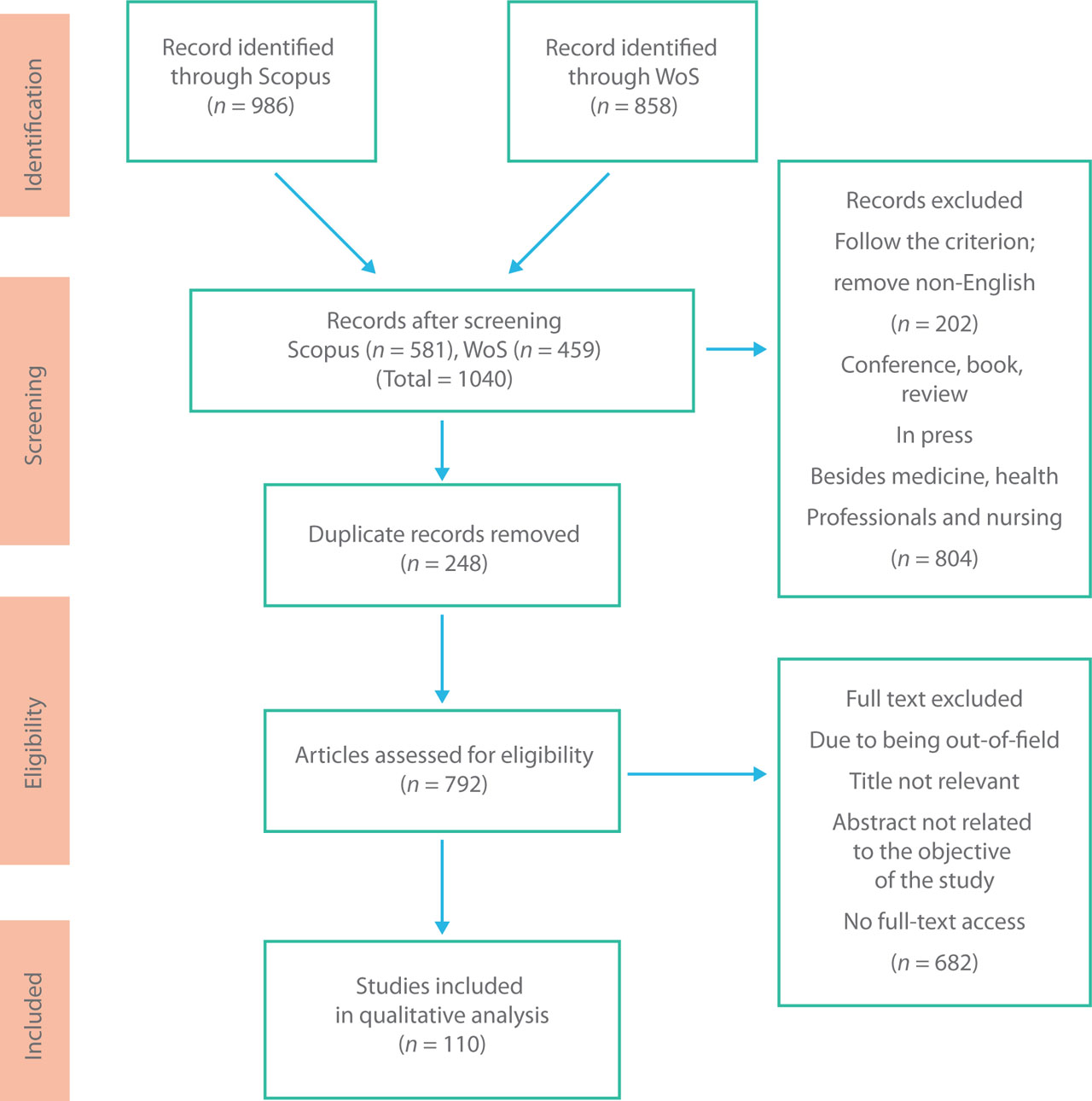
Fig. 1.
Flow diagram of the proposed search study
Screening
Of the 1,844 records identified from all databases, 804 that did not meet the predefined inclusion criteria were excluded during the initial screening phase. Subsequently, 248 duplicate records were removed, leaving 792 unique records for further evaluation in the eligibility stage. The complete screening process is illustrated in Fig. 1.
Eligibility
Following the screening phase, a total of 792 records were assessed for eligibility through full-text review. During this stage, 685 articles were excluded for not meeting the inclusion criteria (Tab. 2), leaving 107 studies for final review. The complete eligibility process is illustrated in Fig. 1.
Quality appraisal
Five experts in emergency medicine, traumatology, and critical care independently appraised the 107 studies using the CASP checklist(40,41). The tool was selected for its adaptability across diagnostic, observational, and educational designs, ensuring consistent and transparent evaluation of methodological rigor. Given the heterogeneity of the included studies, CASP provided a unified appraisal framework. Each study was rated as excellent, good, or moderate, with discrepancies resolved through discussion. Overall quality ratings are summarized in Tab. 3.
Tab. 3.
Quality appraisal
| Yes | No | Total | Comments | |||||||||
|---|---|---|---|---|---|---|---|---|---|---|---|---|
| Expert | Expert | Agreement | ||||||||||
| 1 | 2 | 3 | 4 | 5 | 1 | 2 | 3 | 4 | 5 | |||
| Section A: Are the results valid? | ||||||||||||
| Was there a clear statement of the aims of the research? | / | / | / | / | / | 100 | Excellent | |||||
| Was the research method appropriate? | / | / | / | / | / | 100 | Excellent | |||||
| Was the research design appropriate to address the aims of the research? | / | / | / | / | / | 100 | Excellent | |||||
| Was the recruitment strategy appropriate to the aims of the research? | / | / | / | / | / | 100 | Excellent | |||||
| Was data collection appropriate for the research issues? | / | / | / | / | / | 100 | Excellent | |||||
| Section B: What are the results? | ||||||||||||
| Was the data analysis sufficiently rigorous? | / | / | / | / | / | 100 | Excellent | |||||
| Is there a clear statement of findings? | / | / | / | / | / | 100 | Excellent | |||||
| Section C: How valuable is the research? | ||||||||||||
| How valuable is the research? | / | / | / | / | / | 100 | Excellent | |||||
Data extraction and analysis
Data from the 107 included studies were extracted into a standardized form and analyzed using ATLAS.ti (2024). An inductive thematic analysis was applied to identify recurrent patterns and themes. Two independent experts in emergency medicine and trauma POCUS reviewed the coding process, with discrepancies resolved by consensus.
Result and findings
Study characteristics
A total of 107 studies were included in this systematic review following the screening and eligibility assessment of 792 records retrieved from an initial pool of 1,844 database results (Fig. 1; Suppl. 1). Research output increased markedly in 2021 and resurged in 2023–2024 (Fig. 2). Most studies were observational in design (59%), with smaller proportions addressing diagnostic accuracy (12%), training and workflow (8%), and interventional approaches (7%), while the remainder comprised feasibility studies, consensus statements, and surveys (Tab. 4). Research was conducted in diverse clinical environments, most commonly trauma centers (n = 20) and emergency departments, both adult (n = 18) and pediatric (n = 14 each). Prehospital and air medical services (n = 12) and intensive care units (n = 9) were also frequently represented, with additional contributions from orthopedic clinics, training centers, primary care, and resource-limited settings (Tab. 4).
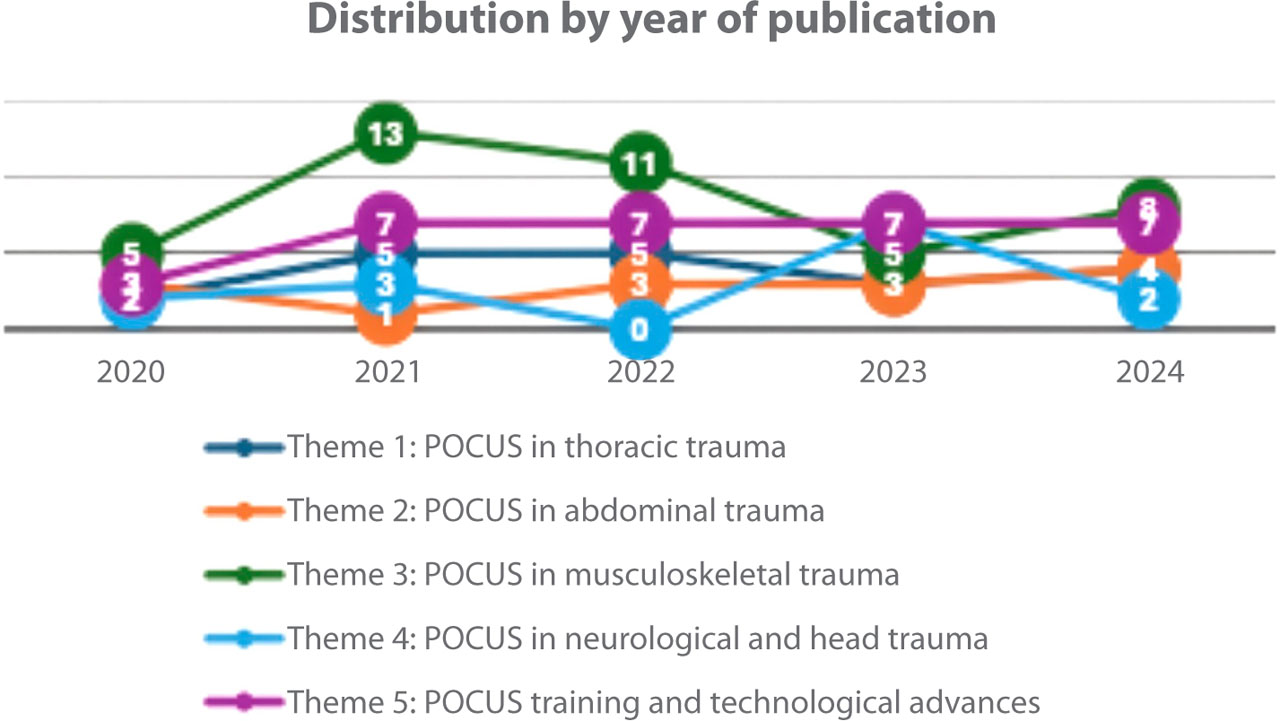
Fig. 2.
Annual trends in POCUS in trauma publications across themes
Tab. 4.
Study characteristics
| Category | Variables | Number of studies | Percentage (%) |
|---|---|---|---|
| Study design | Observational | 69 | 59 |
| Interventional/Experimental | 8 | 7 | |
| Diagnostic accuracy | 14 | 12 | |
| Training and workflow | 9 | 8 | |
| Consensus and development | 4 | 3 | |
| Feasibility and validation | 7 | 6 | |
| Surveys and exploratory analyses | 6 | 5 | |
| Study setting | Adult Emergency Departments (EDs) | 18 | 19 |
| Pediatric Emergency Departments (EDs) | 14 | 14 | |
| Prehospital and air medical | 12 | 12 | |
| Trauma centers | 20 | 21 | |
| Critical care and ICU | 9 | 9 | |
| Orthopedic and rehabilitation clinics | 5 | 5 | |
| Academic and training | 8 | 8 | |
| Primary care and general settings | 5 | 5 | |
| Austere and resource-limited settings | 6 | 6 | |
| Compared modalities | CT | 15 | 17 |
| CXR | 6 | 7 | |
| X-rays | 18 | 20 | |
| MRI | 9 | 10 | |
| Clinical exam | 6 | 7 | |
| Special techniques | 21 | 24 | |
| Other modalities | 13 | 15 | |
| Trauma category | Respiratory & thoracic | 15 | 12 |
| Abdominal & pelvic | 7 | 6 | |
| Musculoskeletal | 30 | 24 | |
| Neurological & head | 13 | 10 | |
| Multisystem | 22 | 17 | |
| Pediatric | 21 | 17 | |
| Cardiac & circulatory | 2 | 2 | |
| Trauma with other conditions | 13 | 10 | |
| Special or rare trauma | 3 | 2 | |
| Primary outcome | Diagnostic performance | 45 | 42 |
| Procedural outcomes | 17 | 16 | |
| Clinical utility | 29 | 27 | |
| Training impact | 16 | 15 |
Comparisons with other imaging modalities varied across studies. POCUS was most frequently evaluated against specialized techniques (n = 21), X-ray (n = 18), and CT (n = 15), with fewer studies using MRI (n = 9) or clinical examination (n = 6) as comparators (Tab. 4). Across these contexts, outcomes were clustered into four domains: diagnostic performance, procedural outcomes, clinical utility, and training impact (Tab. 4). Diagnostic accuracy was consistently high for pneumothorax, fractures, and intracranial pathology (45 studies). Procedural outcomes demonstrated improved success rates and fewer complications for interventions such as thoracostomy and needle decompression (17 studies). Clinical utility was reported in 29 studies, highlighting reduced reliance on CT and X-ray, lower radiation exposure, and improved decision-making, particularly in pediatric and prehospital care. Finally, 16 studies showed that structured training programs enhanced diagnostic accuracy, confidence, and skill acquisition, although variability in performance persisted (Tab. 4).
Tab. 5.
Diagnostic accuracy metrics of POCUS in trauma
| Study (year) | POCUS application | Sensitivity (%) | Specificity (%) | PPV / NPV (%) | Comparator | Key findings |
|---|---|---|---|---|---|---|
| Thoracic trauma | ||||||
| De Mond et al., 2024(50) | Pericardial effusion | 96.4 | 100 | PPV 100 / NPV 99.9 | Clinical diagnosis | High diagnostic precision for life-threatening effusion |
| Çelik et al., 2021(49) | Rib fracture | 91.2 | 72.7 | – | CT scan | Reliable low-cost bedside alternative |
| Jahanshir et al., 2020(45) | Pneumothorax / hemothorax | 75–100 | 100 | PPV 100 / NPV 95 | CT scan | Excellent pneumothorax detection; moderate for hemothorax |
| Robbins et al., 2024(46) | Post-thoracostomy Pneumothorax | 100 | 95 | PPV 60 / NPV 100 | Chest X-ray | Effective post-procedure surveillance |
| DeMasi et al., 2023(6) | Traumatic pneumothorax | 87 | 100 | PPV 81 / NPV 100 | CT scan | Outperformed chest X-ray in trauma diagnosis |
| Yazıcı et al., 2023(47) | Repeated eFAST | 100 | 98.7 | – | Single e-FAST | Repetition improved evolving injury detection |
| Jelyani et al., 2023(48) | Rib fracture & complications | 81.6 | – | – | CT scan | Consistent with CT; supports bedside use |
| Abdominal trauma | ||||||
| Jensen et al., 2024(61) | FAST in pelvic trauma | 75 | 98 | PPV 84 / NPV 96 | CT scan | Reliable for intra-abdominal bleed |
| Riera et al., 2021(62) | Paediatric cFAST | 89 | 99 | PPV 89 / NPV 99 | CT scan | High accuracy; radiation-sparing |
| Yates et al., 2022(112) | Prehospital eFAST | 100 | 96.6 | PPV 100 / NPV 96.6 | CT scan | Effective for early triage |
| Nti et al., 2024(65) | Serial FAST | 66.7 | 93.8 | – | CT scan | Sequential scans enhance detection |
| Kim et al., 2022(12) | Multi-system eFAST | 90 | 95 | – | CT scan | Robust across thoraco-abdominal zones |
| Musculoskeletal trauma | ||||||
| Snelling et al., 2024(71) | Pediatric forearm fracture | 91–100 | 82–95 | – | X-ray | Excellent accuracy; avoids radiation exposure |
| Crombach et al., 2020(75) | Ankle / metatarsal fracture | 80–83 | 90–99 | PPV 70–97 / NPV 94–95 | X-ray | Comparable to radiography |
| Wood et al., 2021(113) | Distal radius fracture | 100 | 64 | PPV 86 / NPV 100 | X-ray | Accurate pre-/post-reduction tool |
| Şik et al., 2021(82) | Elbow fracture | 97 | 97 | PPV 97 / NPV 97 | X-ray | Reliable in pediatric trauma |
| Pohl et al., 2021(114) | Forearm fracture | 100 | 95.8 | – | X-ray | High sensitivity with brief training |
| Varga et al., 2021(115) | Elbow injury | 97 | 97 | – | X-ray | Consistent results across operators |
| Şik et al., 2021(82) | Reduction adequacy | 95.8 | 95.8 | PPV 98.5 / NPV 88.4 | X-ray | Accurate post-reduction verification |
| Caroselli et al., 2021(78) | Pediatric fracture | 91.7 | 88.9 | PPV 89.2 / NPV 91.4 | X-ray | Reliable with structured training |
| Ahmadi et al., 2024(69) | Meniscus tear (MSK variant) | 88.8 | 89.7 | PPV 91.9 / NPV 85.9 | MRI | High concordance with MRI |
| Neurological / Head trauma | ||||||
| Huang et al., 2023(86) | Pediatric skull fracture | 91.7 | 98.6 | PPV 84.6 / NPV 99.2 | CT scan | Accurately detects skull fractures; lowers CT need |
| Şik et al., 2023(116) | Skull fracture + ONSD | 93.7 | 96.8 | PPV 95.7 / NPV 95.3 | CT scan | ONSD correlates with raised ICP |
| Strony et al., 2022(63) | HEMS trauma triage | 53 | 98 | – | CT scan | Enables rapid operative triage |
Thematic categorization of studies
The 107 included studies were synthesized into five thematic domains based on clinical focus and reported outcomes: thoracic trauma, abdominal trauma, musculoskeletal trauma, neurological trauma, and training/technology. This framework enabled comparison of diagnostic performance, procedural outcomes, and clinical applications across trauma settings, while also capturing emerging innovations in education and technology.
Theme 1: POCUS in thoracic trauma
POCUS has transformed the diagnosis and management of thoracic trauma, offering unparalleled accuracy and versatility across diverse clinical scenarios (Tab. 5). It has demonstrated exceptional performance in detecting pneumothoraces, achieving 100% sensitivity and 95% specificity(45,46,47). Similarly, its efficacy in identifying rib fractures has been highlighted, with an overall sensitivity of 80 to 90%, especially in severe cases(48,49). Additionally, POCUS has shown 96.36% sensitivity and 100% specificity in diagnosing pericardial effusions in penetrating trauma(50). These studies collectively establish POCUS as an essential diagnostic tool for timely identification of life-threatening conditions and significantly improving patient outcomes.
Beyond diagnostics, POCUS has proven invaluable for guiding therapeutic interventions and enhancing procedural accuracy. In prehospital settings, advanced protocols like repeated extended FAST (r-eFAST) have achieved 100% sensitivity in excluding thoracic and abdominal pathologies in stable trauma patients, reducing reliance on radiation-intensive modalities like CT(47,51). POCUS also plays a critical role in managing dual-cavity injuries from torso stab wounds, facilitating appropriate surgical sequencing and minimizing negative explorations(52). Additionally, it assists in monitoring ectopic chest tube removal, avoiding invasive surgical procedures, while optimizing needle decompression for tension pneumothorax through tailored chest wall thickness assessments(53,54,55).
Despite these advantages, POCUS is not without challenges. Overreliance on imaging, leading to delayed critical interventions, has been highlighted as a concern, emphasizing the need for a balanced approach(56). Operator dependency remains a significant limitation, with missed pneumothoraces reported due to training gaps and variability in diagnostic accuracy, reflecting differing levels of expertise(6,46). Anatomical variations, such as increased chest wall thickness in specific populations, further complicate its use. Tailoring needle decompression techniques to patient-specific anatomy is therefore essential(57,58). Moreover, the need for complementary diagnostic tools, such as CT, in complex cases like hemothorax and lung contusions has been underscored(45).
Emerging innovations are further expanding POCUS’s scope and utility. Advanced protocols like r-eFAST, which integrate thoracic and abdominal assessments, are enhancing trauma management, particularly in resource-limited settings(47,51). POCUS’s role in optimizing needle decompression site selection, improving procedural accuracy, and extending applications to subxiphoid windows for evaluating diaphragmatic and pericardial injuries further demonstrates its growing utility(52,55,57). Prehospital applications, such as Emergency Medical Services (EMS) provider training in ultrasound-guided needle thoracostomy, highlight POCUS’s transformative potential in remote and austere environments(59). Additionally, its precision in ultrasound-guided thoracostomy reduces procedural risks through accurate chest tube placement(60).
Theme 2: POCUS in abdominal trauma
POCUS has established itself as an indispensable tool in the management of abdominal trauma, offering rapid, accurate, and non-invasive diagnostic assessment through the FAST and eFAST protocols, which have revolutionized trauma care. These protocols have demonstrated exceptional diagnostic accuracy and sensitivity for detecting intra-abdominal bleeding and other critical conditions (Tab. 5). For example, FAST has shown a sensitivity of 75% and a specificity of 98% in patients with pelvic fractures, reinforcing its reliability in complex cases(61). Similarly, POCUS has been highly effective in pediatric blunt trauma, with sensitivity and specificity rates of 89% and 99%, respectively, for detecting significant hemoperitoneum(62). The introduction of r-eFAST has further enhanced diagnostic precision, achieving 100% sensitivity and 98.7% specificity, significantly reducing reliance on CT scans in stable patients(47). Prehospital applications have similarly benefited from POCUS, with HEMS showing 98% specificity for eFAST in early identification of life-threatening conditions(63), and paramedics achieving a 97.35% correct interpretation rate with eFAST(64). These studies collectively highlight POCUS’s capacity to deliver high diagnostic accuracy across diverse clinical settings.
Beyond diagnostics, POCUS plays a crucial role in guiding clinical interventions, optimizing decision-making, and improving patient outcomes. r-eFAST has been valuable in stable blunt thoracoabdominal trauma, where serial assessments reduce unnecessary imaging and provide precise monitoring(47). Integrating subxiphoid windows with eFAST has reduced diagnostic uncertainty and improved surgical planning for dual-cavity injuries(52). POCUS has proven indispensable in pediatric trauma, helping assess evolving injuries and rule in significant free fluid, while serial r-eFAST supports dynamic monitoring(62,65). Additionally, POCUS can detect incidental findings, such as renal and pelvic cysts, which, although unrelated to acute trauma, have important diagnostic implications(66).
Despite its strengths, abdominal POCUS faces notable limitations that can impact its effectiveness. Operator dependency remains a critical challenge, with effective interpretation requiring advanced training and experience. Misinterpretation of retroperitoneal hematomas has been reported, emphasizing the need for comprehensive training(61). While FAST shows high sensitivity and specificity in adults, these metrics are lower in pediatric studies(67). This age-specific discrepancy may be attributed to several factors, such as smaller size and anatomical differences in pediatric patients, which make injury detection more challenging. Additionally, variations in tissue composition, such as less fat in children, can affect ultrasound wave penetration, reducing imaging accuracy(12). Smaller abdominal and thoracic structures in pediatric patients further complicate detection, especially for subtle or small injuries. Additionally, variability in user expertise contributes to differences in the quality and completeness of FAST and eFAST exams in pediatric cases(68). Moreover, POCUS has limitations in detecting subtle or non-hemorrhagic injuries. While it can effectively identify significant free fluid, it may miss smaller injuries, making complementary imaging modalities, such as CT, necessary in some cases. Reduced sensitivity in eFAST examinations (66.7%) further underscores the need for adjunctive tools(62,65). Logistical challenges in prehospital and resource-constrained settings also limit POCUS’s utility. Environmental constraints and the low prevalence of specific pathologies hinder broader application in such contexts(64). The identification and communication of incidental findings, especially in resource-limited environments, remain challenging, raising concerns about follow-up care and medico-legal implications(66).
Theme 3: POCUS in musculoskeletal trauma
POCUS has become a transformative tool in musculoskeletal trauma care, providing rapid, precise, and non-invasive imaging for a wide range of injuries. Its versatility has been demonstrated in both diagnostic and therapeutic domains, significantly enhancing clinical workflows in emergency and orthopedic settings. POCUS has consistently shown exceptional diagnostic accuracy for ligament injuries, fractures, and soft tissue trauma (Tab. 5). For example, high sensitivity and specificity have been reported for medial collateral ligament (MCL) tears, and its effectiveness in diagnosing meniscal and collateral ligament injuries has been shown to be comparable to MRI in emergency contexts(69,70). In pediatric cases, the radiation-free imaging capabilities of POCUS have proven particularly advantageous, with superior accuracy compared to radiographs for diagnosing distal forearm fractures(71). Additionally, novel sonographic markers such as the “Pronator Quadratus Hematoma (PQH) Sign” have enhanced its diagnostic utility, achieving 100% sensitivity and specificity for cortical breach fractures(71).
Beyond diagnostics, POCUS plays a key role in guiding therapeutic interventions and streamlining procedural workflows. Its real-time imaging capabilities have revolutionized fracture reduction processes, with outcomes comparable to fluoroscopy but with reduced procedural time and radiation exposure(72). Furthermore, POCUS has facilitated intra-articular injections and verified reduction success in managing shoulder dislocations, eliminating the need for repeated radiographs(73). In pediatric femur fractures, ultrasound-guided femoral nerve blocks have enhanced analgesia and minimized opioid reliance(74).
Emerging applications of POCUS continue to expand its role in trauma care. Advanced diagnostic markers, such as the “POCUS 1-cm Rule,” have improved the diagnosis of Salter-Harris II fractures, reducing reliance on radiographs while maintaining accuracy(71). The use of portable high-resolution devices has extended the utility of POCUS to anatomically challenging areas, such as the ankle and fifth metatarsal, providing detailed imaging even in resource-limited settings(75). POCUS has also been employed in assessing ligament integrity in lateral ankle sprains, supporting more precise treatment planning and reducing unnecessary imaging. Additionally, POCUS has been shown to detect systemic complications, such as right ventricular dysfunction and microembolic signals in fat embolism syndrome, facilitating timely interventions in critical care(76,77).
Despite these advantages, POCUS faces challenges, including operator dependency and technical limitations. Diagnostic accuracy is often influenced by the skill level of the operator, with variability observed between high-skill and standard-skill providers(78). Anatomical complexities, such as open growth plates in pediatric patients, also pose challenges(79,80). Furthermore, the lack of standardized protocols contributes to inconsistencies in clinical application. Studies have emphasized the need for multi-center validation of novel techniques, such as the water bath ultrasound method, and called for uniform sonographic criteria to improve interobserver reliability(81,82).
Theme 4: POCUS in neurological and head trauma
POCUS has emerged as a transformative tool in managing neurological and head trauma, offering a real-time, non-invasive imaging solution that enhances diagnostic, monitoring, and therapeutic capabilities. Its applications span emergency, perioperative, and resource-limited settings, revolutionizing trauma care. However, its widespread adoption faces challenges that require targeted advancements in training, technology, and standardization.
A key application of POCUS in this domain is intracranial pressure (ICP) monitoring through optic nerve sheath diameter (ONSD) measurements. Studies have confirmed a strong correlation between ONSD and ICP, enabling accurate differentiation of injury severity and guiding timely interventions(83,84). POCUS has also been shown to dynamically track changes in ICP during hyperventilation therapy, emphasizing its value for real-time critical care monitoring(85). In pediatric populations, POCUS is highly effective in diagnosing skull fractures, providing a safer, radiation-free alternative to CT. Research has demonstrated its high sensitivity and specificity for skull fracture detection, with values ranging from 91.7% to 93.7% for sensitivity and 96.8% to 98.6% for specificity(82,86). This ability to reduce unnecessary CT scans, particularly in children with minor head trauma, is crucial without compromising diagnostic precision(87). Additionally, POCUS plays a vital role in ocular trauma assessment, where it has shown superiority in detecting conditions such as relative afferent pupillary defects (RAPDs) and globe rupture, where clinical evaluations may be challenging(88,89). It has also proven effective in diagnosing retrobulbar hematomas, enabling timely interventions to prevent vision loss(90). Furthermore, POCUS supports broader neurological evaluations by improving diagnostic precision and therapeutic guidance(91,92).
Despite its potential, POCUS faces several challenges, including operator dependency, variability in measurements, and technological limitations. Variability in ONSD measurements underscores the need for standardized protocols and comprehensive training to ensure reliability(93). Additionally, inconsistencies in image quality across portable devices highlight the necessity of quality benchmarks and the integration of AI to standardize outcomes(94). Addressing these barriers through enhanced training, technological innovation, and the development of evidence-based guidelines will be critical to optimizing the impact of POCUS in trauma care.
Theme 5: POCUS training and technological advances
Effective training is crucial for the successful integration of POCUS across diverse clinical and prehospital settings. Studies emphasize the importance of structured, interdisciplinary, and accessible training programs. Targeted educational sessions for rural EMS staff have significantly improved the accuracy and safety of ultrasound-guided needle thoracostomy, highlighting the benefits of tailored interventions(59). Similarly, a 13-hour prehospital ultrasound training program for paramedics has enhanced decision-making accuracy and confidence in simulated scenarios, underscoring the need for comprehensive training in prehospital care(95).
Standardized definitions and protocols are key to successful training initiatives. Consensus-based definitions for high-quality FAST and eFAST protocols in pediatric trauma have provided a framework for quality assurance and education(68). Significant gains in knowledge and confidence have been observed among both POCUS-naïve and experienced clinicians following hybrid training programs, demonstrating the effectiveness of flexible and tailored approaches(96). However, barriers such as limited access to equipment and curricula in underserved regions highlight the need for increased investment in resources and infrastructure to expand POCUS education globally(97).
Technological advancements continue to expand the reach and utility of POCUS. Portable devices and AI-driven tools have extended POCUS applications into resource-limited and prehospital environments. Deep learning algorithms have been shown to assist novice clinicians in detecting hemoperitoneum during FAST examinations, achieving 95% sensitivity and specificity, thus bridging skill gaps and standardizing interpretations(98). Remote supervision of prehospital POCUS via secure video transmission has enabled real-time expert guidance, demonstrating the feasibility of remote support for clinicians(99). Advances in affordability and usability have also facilitated POCUS adoption in military settings, improving triage accuracy and prioritization in environments with limited surgical resources(100). Additionally, 75% of European Helicopter Emergency Medical Services (HEMS) organizations have incorporated POCUS protocols such as eFAST and RUSH, reflecting widespread acceptance despite training gaps(101). The versatility of POCUS continues to expand across trauma, critical care, and prehospital settings. In Dutch HEMS, POCUS has influenced therapeutic decisions in 40.7% of cardiac arrest cases, demonstrating its importance in real-time decision-making(102). Ultrasound-guided pupillary assessment in patients with altered mental status has also emerged as an objective alternative to traditional methods(91).
Despite these advancements, challenges persist in the widespread adoption of POCUS. Training gaps remain a significant barrier, as many EMS and prehospital providers lack formal education in POCUS techniques. While ultrasound-guided thoracostomy improves procedural accuracy, it requires longer site selection times, highlighting the need for targeted interventions to address learning curves(59). Furthermore, the use of ultrasound in prehospital care may divert physicians’ attention from critical patient monitoring, particularly from standard physiologic monitors. To optimize the benefits of POCUS, efforts should focus on reducing distractions, incorporating human factors training, and standardizing procedures to enhance situational awareness(103). Dedicated training curricula and improved access to equipment are crucial to overcoming barriers in underserved regions(97). Device-related variability and inconsistencies in image interpretation also remain significant challenges. Differences in manual ONSD measurements across portable devices underscore the need for standardized hardware and software integration(98). Connectivity issues in remote supervision further emphasize the importance of robust telecommunication infrastructure to support telemedicine capabilities(99).
Addressing these challenges will require the development of tailored training programs for specific clinical contexts, the incorporation of AI-driven diagnostics, and the standardization of device quality and protocols. Continuous quality improvement programs provide a roadmap for sustaining competency and optimizing the utility of POCUS across diverse settings(104).
Discussion
This systematic literature review sought to explore the role of POCUS in trauma care, focusing on its diagnostic accuracy, time to diagnosis, early detection of life-threatening injuries, reduction of ionizing radiation exposure, and the influence of training and technological advancements on clinical utility. The findings of the review confirm the growing recognition of POCUS as a valuable tool in trauma settings. POCUS has demonstrated high sensitivity and specificity, particularly in diagnosing conditions such as pneumothorax, fractures, and intracranial hemorrhage, which are common in trauma patients. These results align with Cochrane analyses by Stengel et al. (2015) and Stengel et al. (2018), which confirmed high specificity (≈0.95–0.99) but variable sensitivity, particularly in the detection of retroperitoneal and pediatric injuries(14,105). The ability of POCUS to detect such injuries rapidly and at the bedside is critical in acute trauma care, particularly in situations where timely intervention is critical.
The review also highlights the significant advantages of POCUS in reducing exposure to ionizing radiation, particularly in pediatric and pregnant populations, where radiation-related risks are a significant concern. Pediatric adaptations, such as cFAST, have achieved comparable diagnostic accuracy while minimizing radiation exposure, consistent with the systematic review and meta-analysis by Alexandridis et al. (2020)(17). Furthermore, POCUS has been shown to reduce unnecessary diagnostic tests, such as CT scans, thereby optimizing the diagnostic workflow, reducing healthcare costs, and improving patient safety. Collectively, the evidence underscores the growing role of POCUS in both hospital and prehospital settings, where it contributes to faster diagnoses and more informed clinical decision-making.
The findings of this review align with and build upon previous research demonstrating POCUS’s diagnostic utility, particularly in detecting conditions such as pneumothorax and fractures. For thoracic trauma, our findings are consistent with those of Ianniello et al. (2014), who reported near-perfect specificity (≈0.998) for pneumothorax and hemothorax using eFAST compared with CT(106). This review extends these findings by showing that POCUS is increasingly being utilized across multiple trauma domains, including musculoskeletal and neurological injuries. Prehospital evidence aligns with Gamberini et al. (2023), who demonstrated strong rule-in performance for prehospital FAST (specificity ≈0.97) but only moderate sensitivity (≈0.63) for hemoperitoneum, highlighting the need for serial scanning and integration with clinical assessment(18). Additionally, the review reinforces prior research on POCUS’s effectiveness in minimizing radiation exposure and reducing reliance on traditional imaging modalities such as CT.
However, this review also sheds new light on the influence of technological advancements and training on the clinical utility of POCUS. Structured curricula and supervised practice have been shown to improve diagnostic performance(107,108), reinforcing the importance of continuous competency development. The growing integration of portable ultrasound devices and AI-driven image interpretation tools offers promising strategies to address challenges such as operator dependency, thereby improving diagnostic accuracy and expanding access to POCUS, especially in prehospital and resource-limited settings. Sutarjono et al. (2023) showed that contrast-enhanced ultrasound (CEUS) markedly improves sensitivity for solid-organ injury (≈0.93 vs 0.56 with conventional ultrasound)(109). Similarly, Levy et al. (2023) reported that AI-based algorithms can automate image interpretation and reduce operator dependence(110). AI-driven tools can assist in standardizing image interpretation, reducing the impact of individual operator expertise on diagnostic accuracy.
By providing real-time assistance in interpreting ultrasound images, AI can ensure more consistent and accurate results, even in settings with limited access to highly trained clinicians. This technology also enables faster decision-making, which is crucial in time-sensitive trauma cases. In resource-limited environments, where training opportunities and specialist availability may be scarce, AI integration can function as a support system, enhancing the effectiveness of POCUS and improving patient outcomes by making high-quality diagnostics more accessible. In remote and resource-limited areas, such as rural Africa and parts of South America, POCUS has been successfully used to provide rapid, on-site diagnostics where access to advanced imaging technologies like CT is limited. In these regions, portable ultrasound devices have allowed healthcare providers to quickly identify life-threatening conditions such as pneumothorax, internal bleeding, and fractures, thereby improving patient outcomes. Similarly, in prehospital care settings, such as emergency medical services (EMS) in Europe and the United States, POCUS has been instrumental in guiding rapid decision-making for trauma patients, enabling timely interventions before hospital arrival.
The results of this review have both theoretical and practical implications for the field of trauma care. From a theoretical perspective, the findings suggest that POCUS could serve as a complementary diagnostic tool that enhances the accuracy of trauma diagnosis without the limitations of traditional imaging. The rapid, non-invasive nature of POCUS supports its integration into clinical pathways as an initial diagnostic modality. From a practical standpoint, the widespread adoption of POCUS could transform trauma management by enabling healthcare providers to make faster and more informed bedside decisions, particularly in emergency and prehospital care settings. Furthermore, the findings regarding the reduction of ionizing radiation have important implications for clinical practice. By reducing the need for CT scans, POCUS offers a safer diagnostic alternative, particularly for vulnerable populations such as children and pregnant patients. The reduction of unnecessary diagnostic tests also contributes to more efficient healthcare resource management, improving patient outcomes and reducing costs.
This systematic review, while comprehensive, has several limitations that must be acknowledged. First, the reliance on observational studies and the absence of large-scale randomized controlled trials (RCTs) limits the strength of the evidence. Although the studies reviewed consistently demonstrate the potential of POCUS in trauma care, further research with robust experimental designs is required to validate these findings and establish clearer evidence of its efficacy. Despite robust diagnostic evidence, important knowledge gaps persist. Most studies are underpowered to evaluate survival, morbidity, or functional recovery(15,111). Additionally, while POCUS has shown significant benefits in terms of diagnostic accuracy and procedural guidance, the variability in operator proficiency across different settings highlights the need for standardized training programs to ensure consistent performance. Another limitation is the potential for publication bias, as studies with positive outcomes are more likely to be published. This could lead to an overestimation of POCUS’s effectiveness in trauma care. Additionally, the exclusion of non-English-language studies may have limited the comprehensiveness of the review and excluded valuable research from non-English-speaking regions. Furthermore, the omission of gray literature, conference proceedings, and dissertations may have introduced bias by excluding early-stage findings and research from diverse settings.
Future studies should focus on addressing the gaps identified in this review. Specifically, there is a need for more high-quality RCTs to definitively establish the diagnostic and procedural efficacy of POCUS in trauma care. Additionally, future studies should explore the long-term impact of POCUS on patient-centered outcomes, such as survival rates and recovery times, to better understand its clinical benefits in trauma management. Research should also investigate optimal training protocols for healthcare providers, particularly in prehospital and emergency care settings. Given the variability in diagnostic accuracy, standardized, interdisciplinary training programs are essential to improve the consistency and reliability of POCUS across different trauma types and healthcare environments. Standardized training and the integration of POCUS into diverse clinical settings are essential for maximizing its effectiveness in trauma care. Establishing universal training curricula based on internationally recognized guidelines and adaptable to various healthcare contexts ensures that clinicians are well-equipped to use POCUS accurately. Certification programs and competency assessments are necessary to maintain high standards of care. Integrating POCUS into diverse settings also requires strong institutional and policy support. Healthcare institutions must invest in ultrasound devices and training programs, while policies should promote the inclusion of POCUS in formal medical education. Collaboration between institutions, governments, and international organizations is crucial for distributing resources and training materials in underserved regions. Additionally, telemedicine and remote supervision can enhance POCUS training and improve care in resource-limited areas. Finally, technological innovations such as CEUS and AI-driven ultrasound tools should be further explored in clinical trials to assess their impact on diagnostic accuracy and scalability. These innovations could help address the challenges associated with operator dependency and increase the accessibility of POCUS in resource-limited areas.
Conclusions
POCUS is an essential component of modern trauma care, providing rapid, portable, and accurate assessment across diverse clinical environments. It enhances the detection of thoracic and abdominal injuries, guides critical interventions, and reduces reliance on ionizing imaging, especially in resource-limited and prehospital settings. However, variability in performance linked to operator skill and injury complexity highlights the need for standardized training and validation. Strengthening these foundations and integrating AI-driven innovations will further advance evidence-based trauma care globally.