
Introduction
An upper motor neuron lesion negatively affects manipulative function and weigh-bearing function of the hand by limiting motor control, decreasing muscle strength, decreasing ranges of joint mobility and the development of spasticity [1]. Moreover, post-stroke patients have a diminished ability to perform tasks in dual-task training and their coordination is affected [2].
In the case of post-stroke patients, it is significant to carry out objective assessment of the state of a paretic hand, including the intensity of spasticity and the level of motor control. These factors lead to the deterioration of limb function and disability [3–5]. In their research, Keng et al. revealed that 3 months post stroke, spasticity occurred in 33% of the patients [6]. The level of spasticity is usually assessed with Modified Ashworth Scale (MAS) and Modified Tardieu Scale (MTS) [7–15]. MAS is a subjective evaluation method [16], while Tardieu Scale belongs to a group of partly objective tools [4,17]. In turn, objective methods of assessing muscle tension disorders (e.g. spasticity) include electrophysiological tests; however, there does not exist one universal method [17–20]. Hand spasticity is also assessed with USG-based sonoelastography method [21].
It was also revealed that the level of spasticity may be evaluated with the use of muscle architecture parameters (MAP) marked during an ultrasonography examination. The research results indicated that the measurement of such parameters as muscle thickness, fascile length or pennation angle may constitute a valuable addition to MAS assessment, and the combination of both methods improves the sensitivity and objectivity of the assessment [22].
Fugl-Meyer Assessment and Brunnström Approach are useful scales in assessing hand motor control and function [3,11,14,15,17,23,24]. These scales are of subjective character. An objective assessment of hand function also includes the measurement of pincer, lateral and palmar grasp with the use of a dynamometer [1,24]. The above-mentioned methods are recognised as reliable and useful in monitoring therapy effects [1].
The requirements of EBM bring about the need for elaborating, validating and standardising tools which help to assess patients’ state and the effects of the applied therapy. New methods of assessment should meet the requirements of reliability and validity. Reliability means integrity, infallibility and repeatability of the measurements. Validity means that the specificity of the tool fully realises research areas and aims selected by a scientist. A measurement method should be so universal that it may be applied in various cases under analysis. Elaborating such methods is one of the major directions of development of contemporary rehabilitation in Poland and abroad.
In our study we made an attempt at developing a simple and sensitive method of assessing the level of hand motor control with the use of the measurement of pressure generated during a maximal palmar grasp and after its release and using the measurement of palm area with a photometric method. The aim of the study was to assess the usefulness of the measurement of pressure generated during a maximal palmar grasp and after its release for evaluating the level of motor control in post-stroke patients compared to subjective scales.
Material and methods
The research included 12 post-stroke patients (6 males and 6 females) with hemiparesis who were tested at the hospital rehabilitation ward. Mean age was 65 years (standard deviation – 14 years), and a median was 64 years. The majority of patients from the examined group were aged 60 to 80. One patient was much younger (29 years old). Mean time from stroke onset was 55 months (standard deviation – 22 months). The majority of patients from the examined group suffered a stroke a minimum of 5 years before. One person had a stroke 12 months before the research. Median time from stroke onset was 59.5 (tab. 1).
Tab. 1.
Age and time from stroke onset in the examined group
| Analizowane zmienne / Analysed variables | Średnia / Mean | Mediana / Median | Minimum / Minimum | Maksimum / Maximum | Odch. Std. / Standard Deviation |
|---|---|---|---|---|---|
| Wiek [lat] / Age [years] | 65,3 | 64,5 | 29 | 84 | 14 |
| Czas od udaru [m-c] / Time from stroke onset [months] | 55 | 59,5 | 12 | 81 | 22 |
Twelve paretic limbs (6 right and 6 left ones) were examined. Proper tendon reflexes in brachioradialis were noted in 7 patients, in two patients these reflexes did not occur, in three cases they were increased, and in one case a clonal response was observed. Two patients were taking myorelaxant medications. Patients with a score of 2-3 according to Brunnström Approach were included in the study (tab. 2).
Tab. 2.
Characteristics of the participants
| Zmienna / Variable | Liczność / No. of patients | Procent / Percent |
|---|---|---|
| Płeć / Sex | ||
| Kobieta / Female | 6 | 50 |
| Mężczyzna / Male | 6 | 50 |
| Strona porażona / Paretic side | ||
| Prawa / Right | 6 | 50 |
| Lewa / Left | 6 | 50 |
| Lateralizacja / Lateralisation | ||
| Prawostronna / Right-sided | 12 | 100 |
| Lewostronna / Left-sided | 0 | 0 |
| Wdrożona terapia / Implemented therapy | ||
| Fizykoterapia / Physiotherapy | 5 | 42 |
| Masaż / Massage | 7 | 58 |
| Kinezyterapia indywidualna / Individual kinesiotherapy | 10 | 83 |
| Kinezyterapia zespołowa / Group kinesiotherapy | 8 | 67 |
| Odruchy ścięgniste / Tendon reflexes | ||
| Prawidłowe / Proper | 7 | 58 |
| Wzmożone / Increased | 3 | 25 |
| Zniesione / Absent | 2 | 17 |
| Klonusy / Clonuses | ||
| Obecne / Present | 1 | 8 |
| Nieobecne / Absent | 11 | 92 |
| Skala Brunnstrom (bad. 1) / Brunnström Approach (1st examination) | ||
| 2 | 8 | 67 |
| 3 | 4 | 33 |
| Skala Ashwortha (bad. 1) / Ashworth Scale (1st examination) | ||
| 1 | 2 | 17 |
| +1 | 3 | 25 |
| 2 | 5 | 41 |
| 3 | 2 | 17 |
During their hospital stay, the participants of the study realised a rehabilitation programme put forward at the beginning of their stay by a team of therapists. A mean length of stay at the ward was 3 weeks. The rehabilitation programme included individual physiotherapy based mainly on neurophysiological methods and was aimed at improving the range of motion and recovering motor control in an upper limb. Therapeutic procedures were performed by licensed physiotherapists who were experienced in neurological rehabilitation. The programme also included group kinesiotherapy and physical modalities such as Hufschmidt electrical stimulation of flexors and extensors of a paretic hand, whirlpool massage of a paretic upper limb or cryostimulation with nitrogen vapours of a forearm and hand of a paretic upper limb. Total time of therapy per day was 150 minutes and was the same for every patient.
The paretic hand was examined on the first and last day of three-week in-patient rehabilitation with the use of the following subjective scales and objective measurements:
intensity of spasticity – Modified Ashworth Scale (MAS)
hand function – Fugl-Meyer Assessment (FMA)
photometric palm area measurement
the measurement of pressure generated during a maximal palmar grasp – maximum pressure (p max)
the measurement of pressure generated after a release of a palmar grasp – minimum pressure (p min)
While measuring hand function, a part of Fugl-Meyer Assessment regarding a hand was used in which flexion and extension of fingers and the quality of five grasps was evaluated. In total, seven motor tasks were taken into account and 0-2 points were given for each task.
In order to measure palm area and pressure generated during a maximal palmar grasp and after its release, a measuring set with a measurement cylinder equipped with pressure sensor was used (fig. 1).
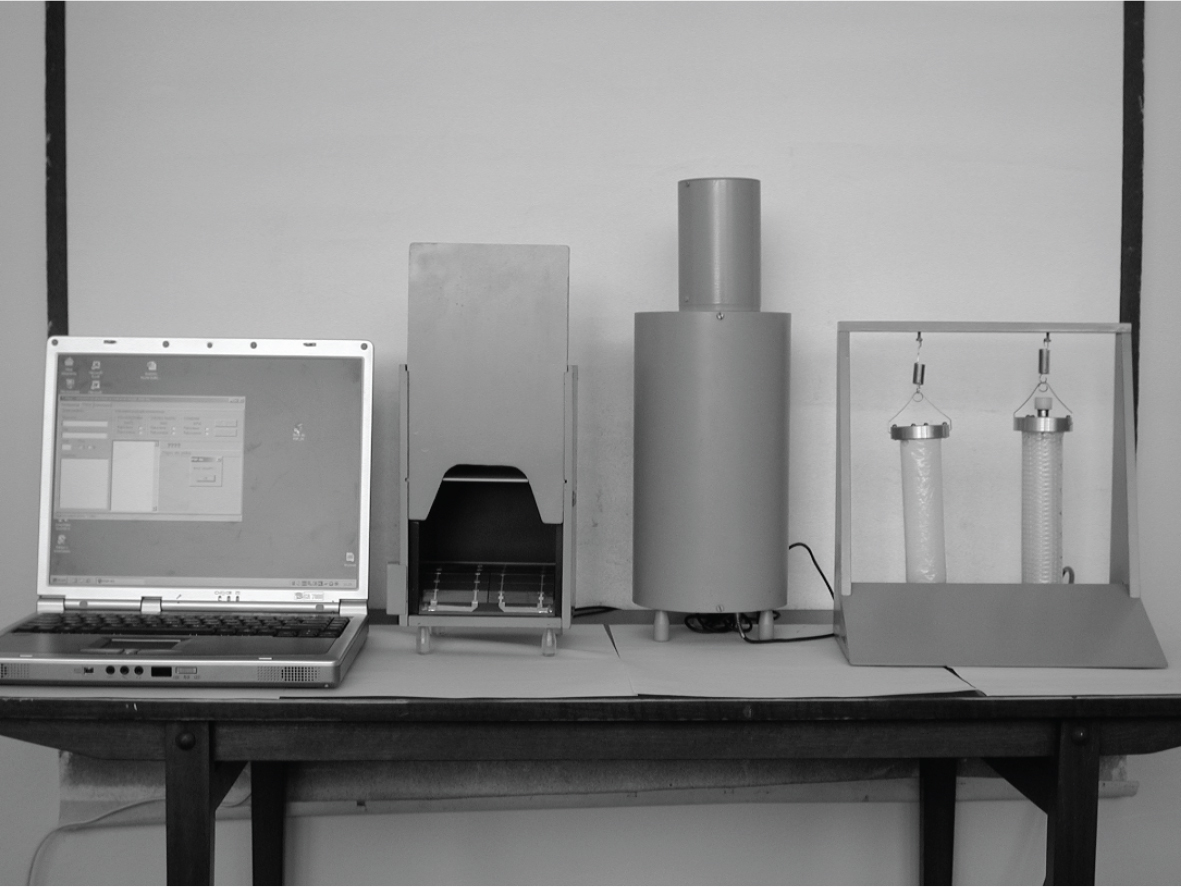
Fig. 1.
Stand for hand examination
The measurement of palm area was made with the use of photovoltaic cells after placing a hand in a measuring case whose base is made of a fragment of a cylinder with a diameter of 160 mm. On a floodlit base, photosensitive cells were fixed. The examined hand was placed freely on these cells and was lit from above with dispersed light. The measured palm area was expressed in mm2.
In order to measure the pressure generated during a maximal palmar grasp and pressure generated after its release, a monolithic semiconductor detector was applied, and the value of the pressure was expressed in kilopascals (a maximum of 120 kPa). During the measurement of the pressure, the patient was first instructed to “press the cylinder as hard as you can” (p max), and after five seconds to “release the grasp” (p min). The value of p max/p min was calculated. The usefulness of combining such methods of assessment was confirmed by the results of research conducted by other authors [22,25].
The analysis of the obtained results included the values of order statistics and the results of Wilcoxon test. A non-parametric Wilcoxon test was applied due to the fact that the values of the majority of the analysed measurements of function in both examinations and changes occurring between the examinations did not have a normal distribution (normal distribution was assessed both on the basis of distribution graphs and the results of Shapiro-Wilk Test). According to the commonly applied rules, the probability value (p < 0.05) was treated as statistically significant. The calculations were made with Statistica v. 12 software.
Results
Mean result in Brunnström Approach was 2.75 in the first examination and 2.83 in the second examination. The difference between the two examinations was not statistically significant. For 11 out of 14 patients, the results were identical in both examinations. The probability value (p = 0.5930) obtained with the use of Wilcoxon test significantly exceeded the value of 0.05.
Table 3 presents the results of Ashworth Scale and scores used in the statistical analysis.
Tab. 3.
The level of hand spasticity according to Ashworth Scale and adopted scoring
| Liczba porządkowa badanych / Patient number | I badanie / 1st examination | II badanie / 2nd examination | ||
|---|---|---|---|---|
| Skala Ashworth / Ashworth Scale | Przyjęta punktacja / Adopted scoring | Skala Ashworth / Ashworth Scale | Przyjęta punktacja / Adopted scoring | |
| 1 | 3 | 5 | 4 | 6 |
| 2 | 1 | 2 | 1 | 2 |
| 3 | 3 | 5 | 2 | 4 |
| 4 | 1+ | 3 | 1+ | 3 |
| 5 | 1+ | 3 | 1+ | 3 |
| 6 | 2 | 4 | 1+ | 3 |
| 7 | 1+ | 3 | 1+ | 3 |
| 8 | 2 | 4 | 2 | 4 |
| 9 | 2 | 4 | 1+ | 3 |
| 10 | 2 | 4 | 2 | 4 |
| 11 | 1 | 2 | 1 | 2 |
| 12 | 2 | 4 | 1+ | 3 |
In the case of 7 patients, no changes after the therapy were noted. A mean level of spasticity according to the adopted scoring was 3.58 in the first examination and 3.33 in the second examination (tab. 4). The result of Wilcoxon test used to compare the level of spasticity in both examinations revealed no statistically significant differences (p = 0.2249).
Tab. 4.
Ashworth Scale distribution of results in the first and second examination
| Poziom spastyczności / Level of spasticity | Skala Ashworth / Ashworth Scale | |||
|---|---|---|---|---|
| Badanie 1 / 1st examination | Badanie 2 / 2nd examination | |||
| N | % | N | % | |
| 1 | 0 | 0% | 0 | 0% |
| 2 | 2 | 17% | 2 | 17% |
| 3 | 3 | 25% | 6 | 50% |
| 4 | 5 | 42% | 3 | 25% |
| 5 | 2 | 17% | 0 | 0% |
| 6 | 0 | 0% | 1 | 8% |
| 3,58 | 3,33 | |||
In the second examination, higher values of the limb function according to Fugl-Meyer Assessment were obtained (mean increase by 1.1 points) (tab. 5). The probability value (p = 0.0587) was close to the assumed level of significance (0.05).
Tab. 5.
The values of descriptive statistics for the results of Fugl-Meyer Assessment (FMA)
| Skala funkcjonalna / Functional scale | N | Me | s | min | max | |
|---|---|---|---|---|---|---|
| Badanie 1 / 1st examination | 12 | 6,8 | 6,5 | 4,1 | 0 | 14 |
| Badanie 2 / 2nd examination | 12 | 7,9 | 8,5 | 3,8 | 1 | 14 |
| Badanie 1 vs. Badanie 2 /1st examination vs. 2nd examination (p = 0,0587) | 12 | 1,1 | 1,0 | 1,7 | -2 | 4 |
| p – wartość prawdopodobieństwa testowego obliczona za pomocą testu Wilcoxona / probability value calculated with Wilcoxon test | ||||||
As the figure below shows, an improvement in the paretic hand function was noted in the majority of patients (fig. 2).
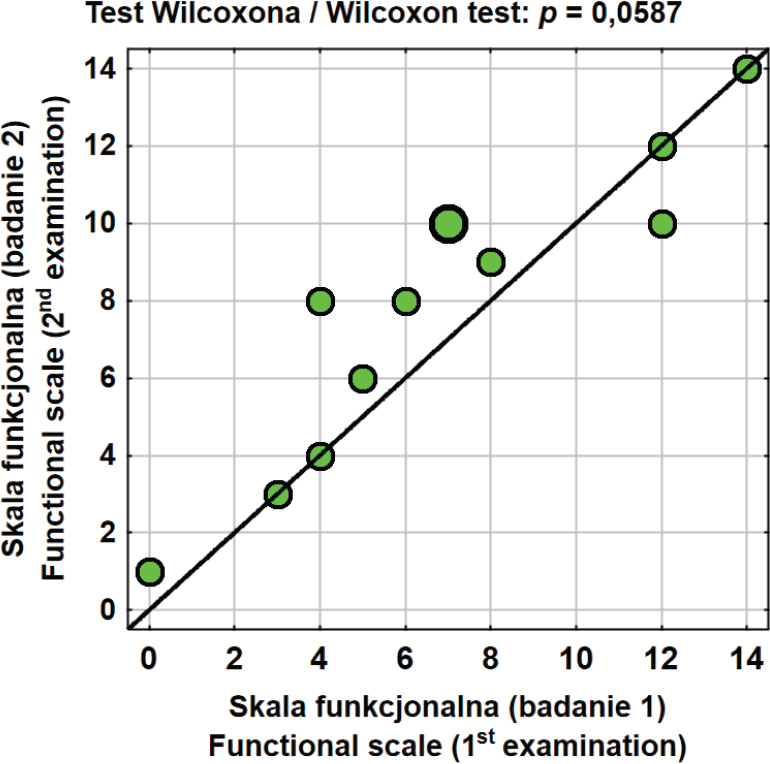
Fig. 2.
Changes in hand function evaluated with Fugl-Meyer Assessment
No significant difference regarding the paretic palm area between the first and second examination was found (p = 0.7221) (tab. 6).
Tab. 6.
Values of descriptive statistics for the measurement of paretic palm area
| Powierzchnia ręki niedowładnej [mm] / Palm area of a paretic limb [mm] | N | Me | s | min | max | |
|---|---|---|---|---|---|---|
| Badanie 1 / 1st examination | 11 | 12 023 | 11 932 | 1 960 | 8 470 | 15 046 |
| Badanie 2 / 2nd examination | 11 | 11 757 | 11 931 | 1 737 | 8 541 | 13 806 |
| Badanie 1 vs. Badanie 2/1st examination vs. 2nd examination (p = 0,7221) | 11 | -266 | 14 | 834 | -2138 | 1 110 |
| p – wartość prawdopodobieństwa testowego obliczona za pomocą testu Wilcoxona / probability value calculated with Wilcoxon test | ||||||
Palm area decreased in half of the patients, while in the other half it increased (fig. 3).
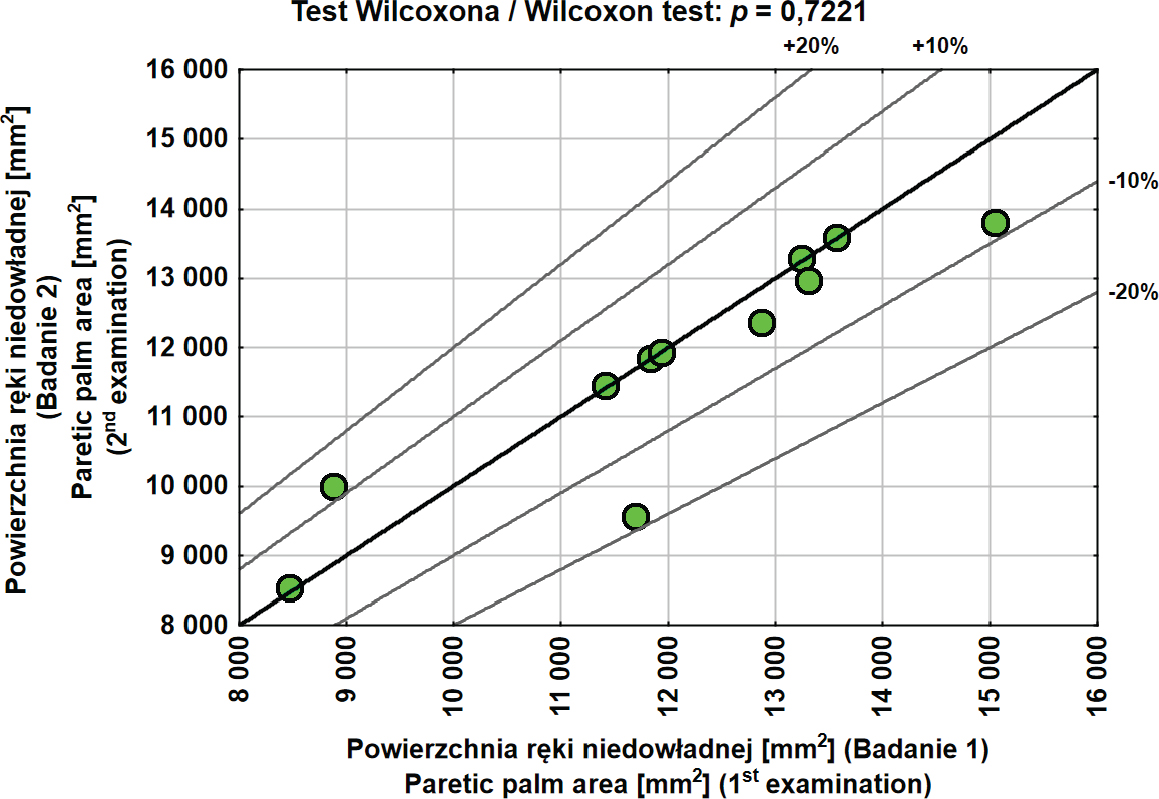
Fig. 3.
Changes in palm area of the examined patients
No regular changes in the value of p max/p min between the first and second examination were noted. In the majority of patients, the value of this indicator increased in the second examination (median of changes was 1.9); however, these changes were not statistically significant (p = 0.2721) (fig. 4, tab. 7).
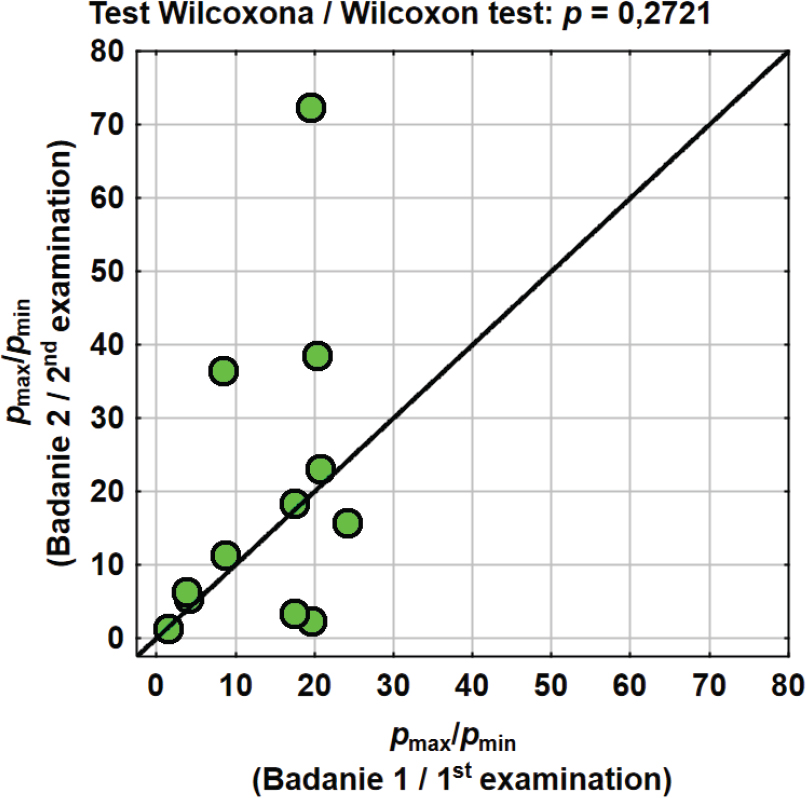
Fig. 4.
Changes in the value of p max/p min
Tab. 7.
Values of descriptive statistics for p max / p min
| p max/p min | N | Me | s | min | max | |
|---|---|---|---|---|---|---|
| Badanie 1 / 1st examination | 12 | 13,8 | 17,4 | 7,9 | 1,5 | 24,1 |
| Badanie 2 / 2nd examination | 12 | 19,6 | 13,5 | 20,9 | 1,4 | 72,4 |
| Badanie 1 vs. Badanie 2/1st examination vs. 2nd examination (p = 0,2721) | 12 | 5,8 | 1,9 | 19,3 | -17,3 | 53,0 |
| p -probability value calculated with Wilcoxon test | ||||||
An empirical analysis of particular cases was carried out. The application of p max/p min indicator allowed us to reveal changes which occurred after the therapy in each of the examined cases (tab. 8) but these changes were not statistically significant (tab. 7). Changes in the results expressed according to Fugl-Meyer Assessment were not statistically significant, either. However, the probability value was close to the assumed level of significance (tab. 5). In seven cases, in which no changes according to Ashworth Scale were revealed, changes in the values of p max/p min were noted. In four cases, in which no changes according to Fugl-Meyer Assessment were revealed, changes in the values of p max/p min were also noted. The direction of changes in these values indicated an improvement in motor control (7 cases) or its deterioration (4 cases).
Tab. 8.
Changes in the values of p max/p min against Fugl-Meyer Assessment and Ashworth Scale
| Liczba porządkowa badanych/Patient number | Zmiana stanu ręki pomiędzy badaniem 1 a 2 / Changes in hand function between the 1st and 2nd examination | ||
|---|---|---|---|
| Skala Ashworth / Ashworth Scale | Skala Fugl-Meyer / Fugl-Meyer Assessment | Wskaźnik / Value p max/p min | |
| 1 | (3/4) nasilenie spastyczności / increased spasticity | 0/1 poprawa / improvement | 19,69/2,36 pogorszenie / deterioration |
| 2 | (1/1) brak zmian / no changes | 14/14 brak zmian / no changes | 19,45/72,43 poprawa / improvement |
| 3 | (3/2) obniżenie spastyczności / decreased spasticity | 3/3 brak zmian / no changes | 1,5/1,39 pogorszenie / deterioration |
| 4 | (1+/1+) brak zmian / no changes | 4/4 brak zmian / no changes | 20,7/23,14 poprawa / improvement |
| 5 | (1+/1+) brak zmian / no changes | 5/6 poprawa / improvement | 8,65/11,38 poprawa / improvement |
| 6 | (2/1+) obniżenie spastyczności / decreased spasticity | 4/8 poprawa / improvement | 8,48/36,46 poprawa / improvement |
| 7 | (1+/1+) brak zmian / no changes | 7/10 poprawa / improvement | 17,38/3,36 pogorszenie / deterioration |
| 8 | (2/2) brak zmian / no changes | 12/10 pogorszenie / deterioration | 20,25/38,6 poprawa / improvement |
| 9 | (2/1+) obniżenie spastyczności / decreased spasticity | 8/9 poprawa / improvement | 4,04/5,44 poprawa / improvement |
| 10 | (2/2) brak zmian / no changes | 6/8 poprawa / improvement | 17,4/18,37 poprawa / improvement |
| 11 | (1/1) brak zmian / no changes | 12/12 brak zmian / no changes | 24,13/15,71 pogorszenie / deterioration |
| 12 | (2/1+) obniżenie spastyczności / decreased spasticity | 7/10 poprawa / improvement | 3,84/6,42 poprawa / improvement |
Discussion
In the clinical studies regarding the effectiveness of the therapy, it is significant to assess active movement and function of a spastic hand [8]. It is recommended to assess hand function in at least a few points of time [4]. Precise measurements of muscle strength, range of motion and limb circumferences may constitute reliable evidence for the effectiveness of the realised therapeutic and rehabilitation process [26].
In our research we assessed a spastic hand with the use of objective methods (palm area measurement, measurement of pressure generated during a palmar grasp and after its release) and subjective scales (Ashworth Scale and Fugl-Meyer Assessment). Particular attention was paid to p min/p max indicator. From among the tools applied in this research, only Fugl-Meyer Assessment revealed changes which occurred between the first and the last day of three-week in-patient rehabilitation. The level of these changes was close to statistical significance (tab. 3).
In the therapy of post-stroke patients with sensorimotor disorders, various therapeutic methods are applied. The effectiveness of these methods needs to be assessed in accordance with the requirements of Evidence-Based Medicine (EBM). Examples of therapeutic methods applied in post-stroke patients used to reduce the disorders of hand motor control are presented below. Treating upper limb focal spasticity post stroke with the use of botulinum toxin type A prevents neurogenic deformity. It should be completed with kinesiotherapy and occupational therapy [27]. Kinesiotherapy methods used in these patients include, for instance, the NDT-Bobath Approach [28], a method of continuous passive motion in radiocarpal joint and hand joints conducted by a stretching device [15] and kinesiotherapy with elements of robotics (Gloreha robot) [29]. Somatosensory electrical stimulation (SES) during which peripheral electrical stimulation below or at the level of sensory threshold is applied is an example of a physical therapy method [30]. Also, functional electrical stimulation (FES) combined with biofeedback based on EMG image visualisation is applied [31]. Electrotherapeutic methods are thought to be effective in treating spasticity and do not have any side effects [20]. Moreover, vibration massage [12] and radial shock wave therapy [14] are used. In other studies on post-stroke patients, transcranial magnetic stimulation (rTMS) was used [32]. Also, repetitive focal muscle vibration (rMV) was applied [33]. In other cases, kinesiotherapy was completed with tonolysis and cryotherapy [24]. The application of orthoses is another acknowledged treatment method [34,35].
In our research, complex rehabilitation including kinesiotherapy and selected thermotherapy, electrotherapy and phototherapy regimes was implemented. The aim of the study was not to assess the effectiveness of the applied therapy, but to assess the usefulness of the measurement of pressure generated during a maximal palmar grasp and after its release and the usefulness of photometric palm area measurement.
In order to assess the effects of treatment, the authors of the above-mentioned studies applied various tools. In several cases, statistically significant changes occurring after the implemented therapies were revealed owing to the application of these tools. In the research regarding the effectiveness of passive stretching of hand and forearm muscles with the use of a stretching device, MAS and FMA scales as well as active range of motion (AROM) in the radiocarpal joint and hand joints were used. Only an increase in active range of motion in carpometacarpal joints was noted, while the usefulness of other tools was not confirmed [15]. In their research, Tsung-Ying Li et al. applied MAS and FMA scales to assess the effectiveness of shock wave therapy and revealed that three shock wave regimes produced better outcomes than one regime [14]. The application of MAS and FMA scales made it possible to reveal an improvement after rTMS therapy [32]. In turn, assessment with the use of MAS and Wolf Motor Function Test (WMFT) allowed for revealing an improvement after rMV [33]. In their research, Mlądzka-Pasternak et al. applied Ashworth Scale, Brunnström Approach, the measurement of grip strength test, thumb opposition test and closed fist test to monitor hand function changes. After 15 days of rehabilitation, an improvement in hand function assessed with Brunnström Approach and an improvement in grip strength and in the results of the tests were noted. After active kinesiotherapy and tonolysis, an improvement in hand function according to Brunnström Approach and a change in grip strength were observed. The change in the results of Ashworth Scale was more notable in the group treated with cryotherapy [24]. In the study by Opheim et al., changes in spasticity and upper limb sensorimotor function in the natural post-stroke process were monitored with the use of MAS and FMA. Assessment was made on the 3rd and 10th day as well as 4 weeks and 12 months after stroke onset. It was revealed that a high level of sensorimotor disorders in an upper limb measured on the 10th day and after 4 weeks is a predictor of the presence of spasticity 12 months after stroke [36]. In their research, Yang et al. assessed changes in muscle tension in post-stroke patients with the use of MAS and structural measurements of a muscle with USG. According to the authors, such a combination of both methods compensates for the imperfections of MAS in terms of reliability and validity and may constitute a valuable addition to clinical diagnostics [22].
The aim of the research by Ansari et al. was to assess the intragroup and intergroup reliability of MAS in assessing patients with spasticity. The obtained results were compared depending on a limb (upper or lower), muscle group (proximal or distal) or an examiner. The authors revealed a limited agreement of the results of this scale in assessing patients with spasticity and highlighted the need for a critical approach to this tool [9].
The methodology applied in the aforementioned studies is partly in line with the methodology used in our research, in which a quantitative assessment of hand function included, inter alia, the measurement of palmar grasp strength. The selection of research tools resulted from the aim of the study, i.e. recommending an easy-to-use, yet objective and sensitive method of assessment. The application of Fugl-Meyer Assessment made it possible to reveal changes occurring after rehabilitation and close to the level of significance, while the use of p max/p min indicator revealed changes in each of the analysed cases (tab. 6). The fact that there were no significant changes in p max/p min indicator as well as the duality of these changes did not allow for confirming the usefulness of this indicator in assessing the level of motor control in a spastic hand. The lack of verification of the repeatability of the measurements may be a study limitation. Moreover, patients included in the assessment constituted a small and not a uniform group (age and time from stroke onset) but they all had hand spasticity after stroke. Despite the fact that the results did not confirm the usefulness of p max/p min indicator, a suggested form of assessing hand motor control may be useful in planning other research projects aimed at developing sensitive and objective research tools that would meet the requirements of Evidence-Based Medicine.
The next research project planned by the authors assumes the inclusion of a bigger group of children aged 6-12 years with hemiparetic cerebral palsy undergoing three-week rehabilitation at a neurological rehabilitation ward. The project mainly aims at evaluating the sensitivity and reliability of a method used for assessing hand motor control, while its realisation with a larger number of participants from particular age groups would make it possible to validate and standardise the recommended method.
Conclusions
Compared to other subjective scales, the usefulness of the measurement of pressure generated during a maximal palmar grasp and after its release for assessing the level of hand motor control in post-stroke patients was not confirmed.
The usefulness of the recommended method of spastic hand motor control assessment needs to be verified in further research carried out according to EBM requirements.