
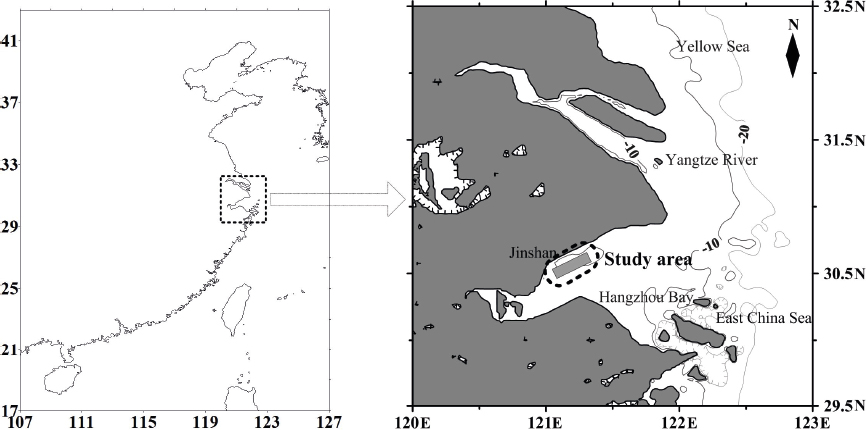
Figure 1
Location of the study area and M. spicatum in Hangzhou Bay
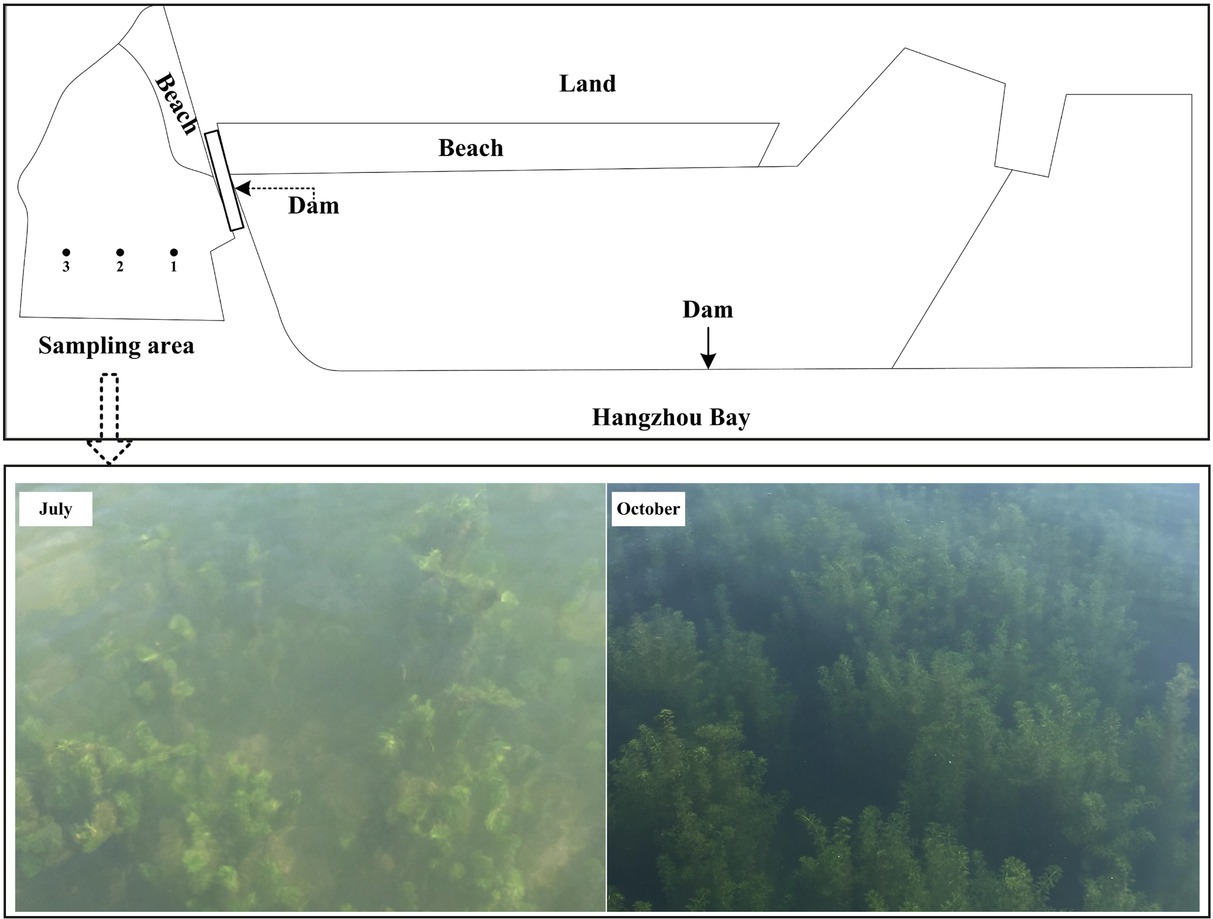
Figure 2
Location of the sampling sites and M. spicatum in July and October 2017
Table 1
Comparison of the number and length of sequences, the number of OTUs, Chao1, ACE and Shannon indices (H’) of bacteria among clone libraries
| Number of sequences | Sequence length | Number of OTUs | Coverage | Chao1 | H’ | ACE | |
|---|---|---|---|---|---|---|---|
| July | |||||||
| Water | 35 205.67 ± 3098.38 | 395.25 ± 0.38a | 221.67 ± 41.43a | 1.00 ± 0.00 | 339.57 ± 42.64a | 3.30 ± 0.12a | 354.01 ± 26.53a |
| Plant | 35 239.33 ± 1685.72 | 395.89 ± 0.39a | 729.00 ± 455.27a | 0.98 ± 0.01 | 1102.33 ± 632.11a | 4.41 ± 0.84b | 1341.48 ± 802.46ab |
| Sediment | 40 443.00 ± 2179.75 | 396.20 ± 0.09a | 1551.67 ± 41.36b | 0.97 ± 0.00 | 2134.17 ± 70.69b | 5.74 ± 0.05c | 2152.08 ± 63.09b |
| October | |||||||
| Water | 42 610.00 ± 1797.65 | 394.47 ± 0.18a | 218.33 ± 20.60a | 1.00 ± 0.00 | 329.53 ± 14.80a | 3.29 ± 0.13a | 417.07 ± 52.55a |
| Plant | 40 254.67 ± 2321.51 | 394.61 ± 0.12a | 709.33 ± 79.53b | 0.98 ± 0.00 | 1192.37 ± 186.94b | 4.60 ± 0.10b | 1397.57 ± 191.63b |
| Sediment | 40 492.33 ± 3063.11 | 396.20 ± 0.14b | 1420.67 ± 5.13c | 0.97 ± 0.00 | 1978.52 ± 68.81c | 5.59 ± 0.10c | 1965.77 ± 68.83c |
[i] Notes: different letters within each column in each month indicate significant (p < 0.05) difference
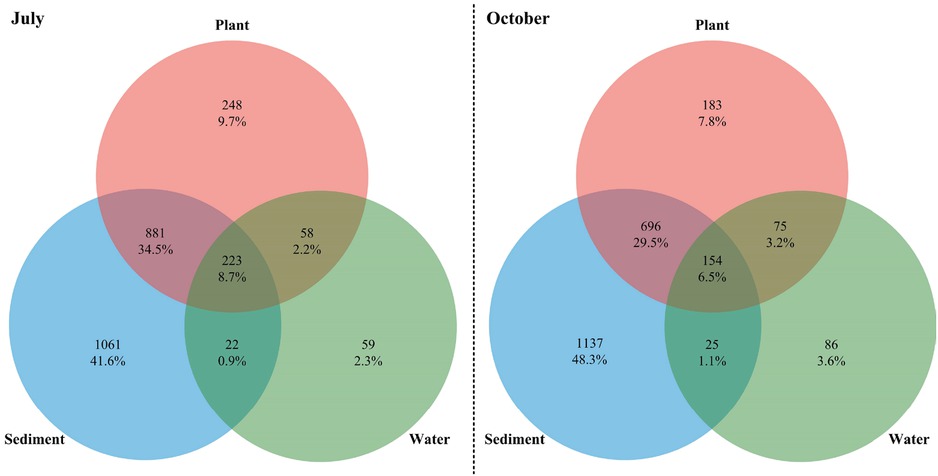
Figure 3
Venn diagram of bacterial OTUs on the surface of plants, in the water column and sediments in July and October 2017 in Hangzhou Bay. The overlapping area corresponds to OTUs shared by two or three samples. The numbers indicate the number of OTUs.
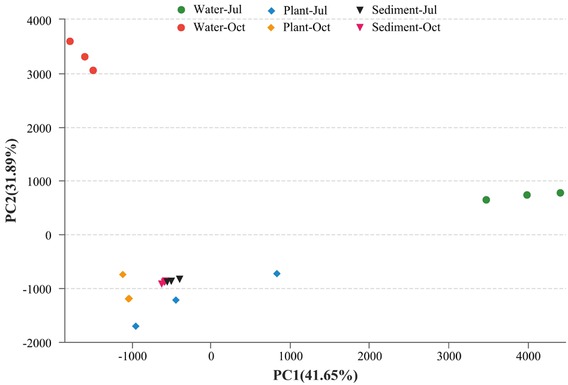
Figure 4
Principal coordinates analysis (PCoA) for OTUs in the water column, plants, and sediments
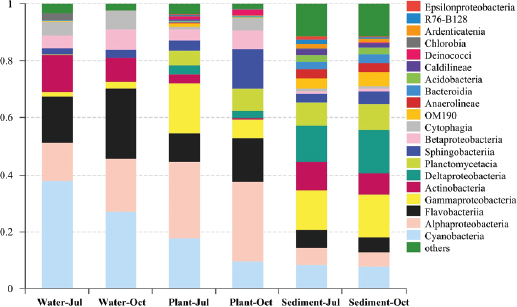
Figure 5
Relative abundance (%) of the main bacterial classes found in the clone libraries of the water column, plants, and sediment collected from Hangzhou Bay
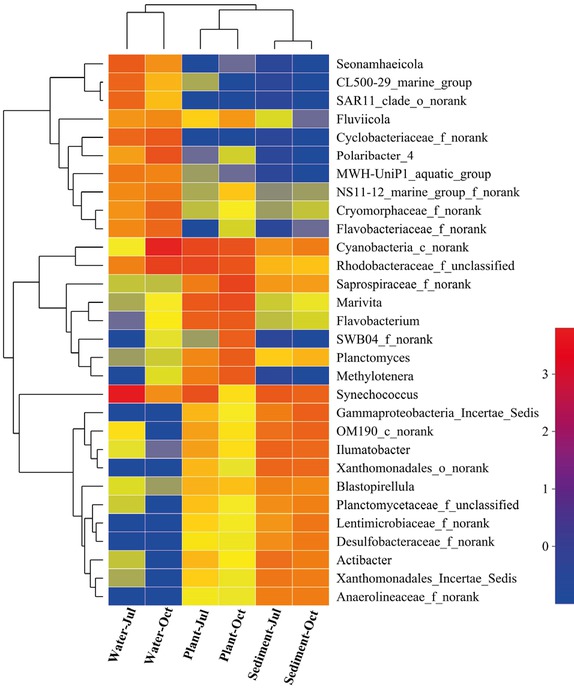
Figure 6
Heat map of the 30 most abundant genera. The color intensity (represented by the log scale on the right) represents the abundance of a genus in a sample. Phylogenetic relationships are shown in the left tree. The top tree shows the clustering relationship of the genera.
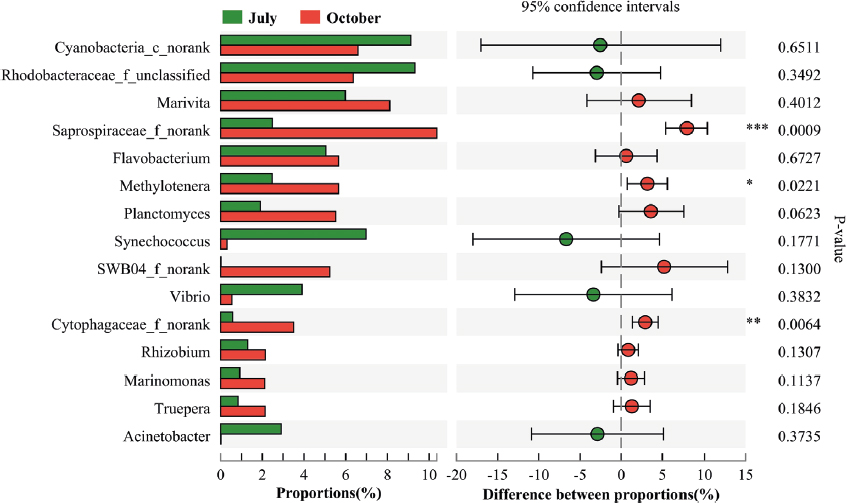
Figure 7
Fifteen most abundant genera of epiphytic bacteria in July and October. * p < 0.05, **p < 0.01, **p < 0.001
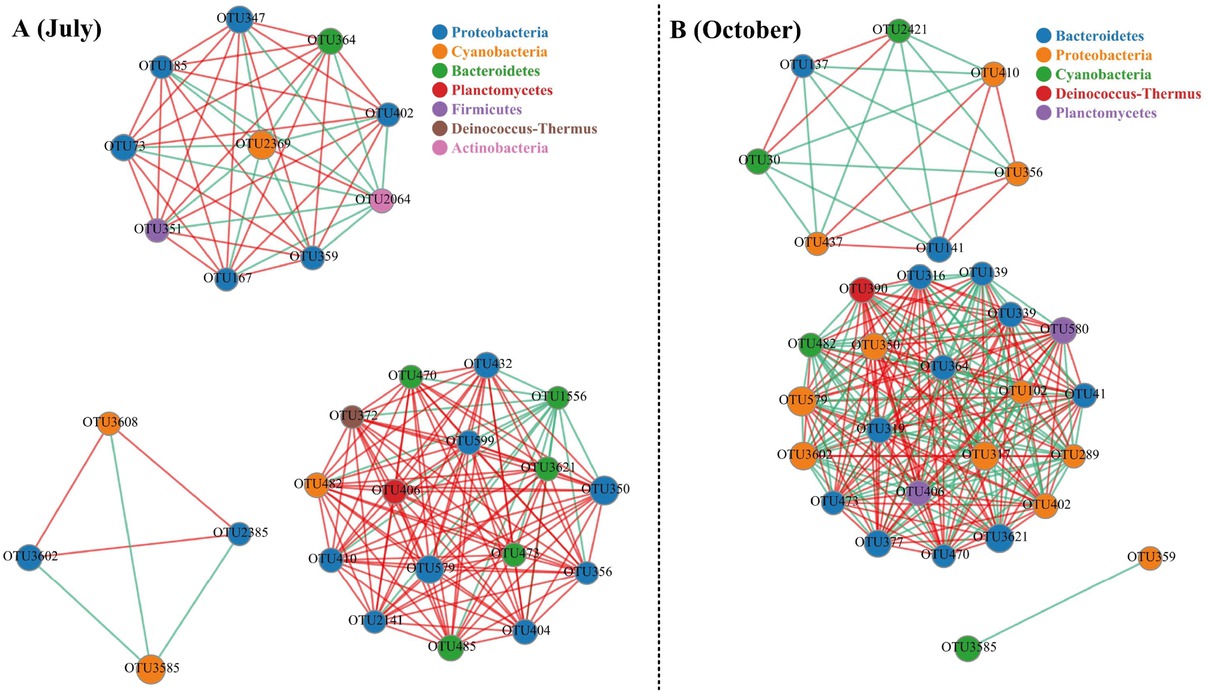
Figure 8
Operational Taxonomic Units (OTUs) network analysis applied to the epiphytic bacteria in July (A) and October (B). The OTUs network analysis shows only the 30 most abundant OTUs with correlations ≥ 0.5. The size of the node is proportional to the abundance of OTUs. The color of the node corresponds to the phylum taxonomic classification. Red lines indicate positive correlations, while green lines indicate negative correlations. The line thickness corresponds to the correlation values.
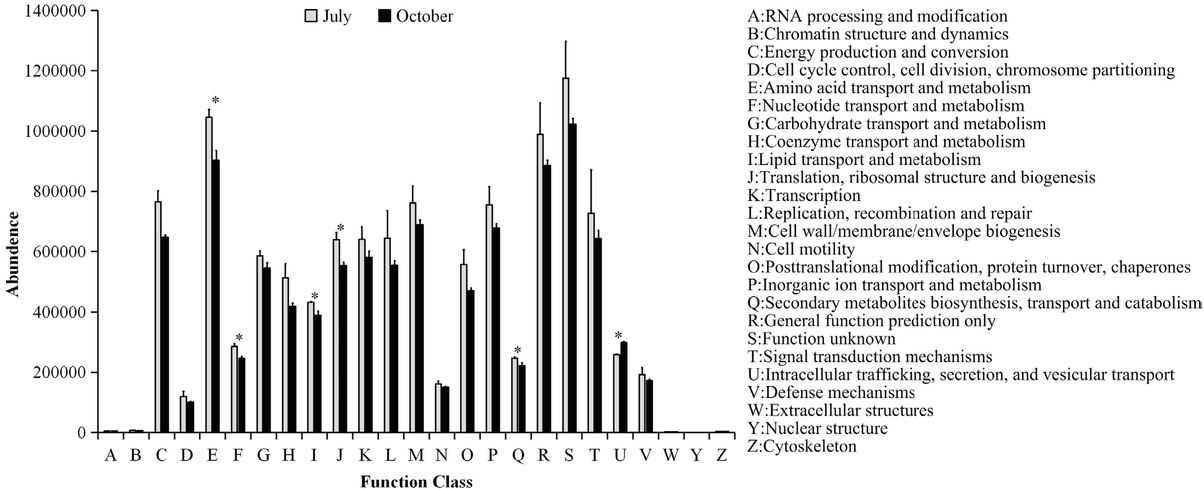
Figure 9
Clusters of orthologous groups and their abundance by PICRUSt in July and October. Asterisks denote significant differences between July and October, Student’s T-test (p < 0.05).