
Introduction
In the last two decades, the health risk associated with the presence of cyanobacteria in lakes, rivers, reservoirs, and ponds has been widely recognized. At least 46 toxin-producing cyanobacterial species were identified (Apeldoorn et al. 2007). Moreover, both toxic and non-toxic strains were identified within a given species in the same habitat (Osswald et al. 2007). Simultaneous production of several variants of hepatotoxic microcystins, the most common group of cyanotoxins, and less common neurotoxic anatoxin-a was also reported (Rantala et al. 2006).
Microcystins are persistent compounds and they accumulate in different compartments of aquatic environments, including fish, mussels and sediment. These compounds are highly toxic and different exposure routes are possible (Chorus 2012). The World Health Organization established a guideline value for the daily intake of microcystin-LR (MC-LR), i.e. the most common and most toxic MC congener (WHO, 2011). In many countries, contact with cyanobacteria at bathing sites is the most probable route of exposure to cyanotoxins and can result in health problems, particularly in children. According to the European Bathing Water Directive 2006/7/EC, when the bathing water profile indicates a potential for cyanobacterial proliferation, an appropriate monitoring program should be implemented (Directive 2006/7/EC).
In Russia, there are over 2.7 million lakes with a total water surface area of about 409 000 km2. The lake area covers about 4% of the territory of the Russian Federation. Most lakes (98%) are small (with the surface area below 1 km2) and shallow (average depth 1.0-1.5 m). Many lakes (14%) are situated in Northwestern Russia. According to hydrobiological data, green algae, diatoms and cyanobacteria dominate in the lakes (Trifonova & Pavlova 2008).
Reports on the occurrence of cyanobacteria and cyanotoxins in Russia are scarce and limited to several presentations at international conferences. Occasional studies on cyanotoxins were conducted in Central Russia, in particular in Volga Reservoirs (Korneva et al. 2014; Sidelev et al. 2015) and Lake Nero (Babanazarova et al. 2011), in lakes of Northwestern Russia, including Lake Ladoga (Gromov et al. 1996) and Karelian Isthmus lakes (Voloshko et al. 2008), and Lake Baikal in East Siberia (Belykh et al. 2015). Different analytical methods (PCR, ELISA, LC-MS) were used in the above-mentioned works to detect and quantify the microcystins. The obtained results showed the presence of toxigenic species and cyanotoxins in the studied water bodies.
Cyanobacterial blooms have also been reported from water bodies located in Saint Petersburg region. Limnologic studies conducted in these lakes during the last 50 years showed a shift in the dominant species from diatoms to cyanobacteria (Trifonova & Pavlova 2008). In addition, an increase in the range and intensity of phytoplankton blooms was observed and attributed to anthropogenic impact and increasing eutrophication. It was shown that phytoplankton biomass in Sestroretskij Razliv Lake increased six to seven times for the last two decades (Trifonova & Pavlova 2008).
Our preliminary studies conducted in two eutrophic lakes located in the territory of Saint Petersburg and Leningrad Region, Razliv and Suzdal, documented the dominance of Microcystis spp. and Planktothrix agardhii in the phytoplankton community (Russkikh et al. 2012). These cyanobacteria belong to the most efficient producers of microcystins (Apeldoorn et al. 2007, Welker 2008), therefore, the use of these water bodies for recreational purposes by the population of the megalopolis can be potentially dangerous.
This paper presents the results of the regular research performed for the first time on the toxin production by cyanobacteria occurring in freshwater reservoirs located in Northwestern Russia, Razliv and Suzdal. The research covered a 3-year period (2010-2012), from May to October. Data on phytoplankton composition, as well as on intra- and extracellular concentration of cyanotoxins were collected. The aim of the study was to assess the potential threat to water users related to the occurrence of toxic cyanobacteria at the examined bathing sites.
Materials and methods
Study site and sampling
The present study was conducted in two shallow, humic, eutrophic lakes with a different nutrient status – Lake Sestroretskij Razliv (Razliv) and Lower Suzdal Lake (Suzdal) – located in Saint Petersburg region, Russia, and used for recreational purposes. Razliv is a large artificial reservoir with a surface area of 1100 ha and average depth of 1.6 m. The surface area of Suzdal is 97 ha and the mean depth is 3.0 m.
Surface water samples (1 l) were collected from these lakes with plastic bottles and phytoplankton biomass was collected with a net (mesh size of 85 μm). Sampling was performed every 2 weeks from May to October in 2010-2012. Altogether, 45 water samples and 40 phytoplankton samples were collected from the two lakes. The water samples in 1 l bottles were fixed with a Lugol-formalin solution. Cyanobacterial material from net samples was transported to a laboratory in screw-cap tubes (Axigen, California, USA) and immediately frozen at –20°C until freeze-drying.
Phytoplankton analysis
Qualitative and quantitative analyses of phytoplankton were carried out under a light microscope (Mikromed-3, LOMO, Saint Petersburg, Russia). The volume of the counting chamber Uchinskaya was 0.1 ml. The biovolume of algae and cyanobacteria was calculated using species-specific geometric formulas (Olenina et al. 2006). The phytoplankton biomass was determined from the total volume of algae according to the counted cell density and the measured average cell density.
Chemicals
Microcystin standards (MC-LR, MC-RR, and MC-YR) were purchased from Sigma-Aldrich (St. Louis, MO, USA) and (+/-) anatoxin-a fumarate was obtained from Tocris Bioscience (Bristol, UK). Acetonitrile (HPLC-grade) and methanol (LiChrosolv hypergrade for LC-MS) were purchased from Merck (Darmstadt, Germany). Water was purified to 18.2 MΩ cm−1 in a Millipore Direct-Q water purification system (Bedford, MA, USA). Formic acid was obtained from Fluka Chemika (Buchs, Switzerland). Membrane filter discs (nylon 66, 47-mm diameter) were obtained from Supelco (Bellefonte, PA).
Sample preparation for LC-MS toxin analysis
Water samples (1 l) for the analysis of extracellular cyanotoxins (AN and MCs) were filtered on a Supelco mobile-phase filtration apparatus (nylon-66 membrane filter discs, 47-mm diameter, Supelco, Bellefonte, PA). Solid phase extraction (SPE) with Oasis HLB cartridges (60 or 200 mg, Waters, Milford, Massachusetts, USA) was used. The toxins were eluted from the cartridges with 10 ml methanol. The collected extracts were dried using a rotary evaporator and stored at –20°C until further analysis. The dried extracts were reconstituted in 1 ml of 80% aqueous methanol and centrifuged (CM-50 centrifuge, ELMI, Riga, Latvia) at 14 000 rpm for 10 min prior to analysis by high-performance liquid chromatography/high-resolution tandem mass spectrometry (LC-HR-MS/MS).
For the extraction of biomass-bound (intracellular) MCs and anatoxin-a, the dry lyophilized cells (10-30 mg) were treated twice with 1 ml of 75% aqueous methanol by sonication in an ultrasound bath (US) for 15 min, and then centrifuged at 14 000 rpm for 15 min. The obtained extracts were combined.
LC- MS
The LC-MS experiments were carried out in the Accela HPLC system (Thermo Finnigan, San Jose, CA, USA) coupled with a Hybrid Ion Trap-Orbitrap Mass Spectrometer – LTQ Orbitrap XL (Thermo Fisher Scientific, San Jose, USA) with the electrospray interface. Separation of the toxins was performed on a Thermo Hypersil Gold RP C18 column (100 × 3 mm, 3 μm) with a Hypersil Gold drop-in guard column (Thermo Fisher Scientific). The mobile phase consisted of water (solvent A) and acetonitrile (solvent B), both containing 0.05% formic acid. The gradient program started at 5% B (held for 10 min), then the content of phase B increased to 75% over 18 min (held for 3 min), and then increased to 95% B over 1 min (held for 5 min). The flow rate was 0.2 ml min−1. The column temperature was 40°C and the injection volume was 25 μl for water sample extracts and 10 μl for biomass sample extracts.
The MS conditions using electrospray ionization were as follows: Ion Spray voltage 3.2 kV, capillary Voltage 20 V, ion-transfer capillary temperature 320°C, tube lens 130 V. The mass spectrometer operated in the positive ion mode at a resolving power of 30 000. A scan function (m/z 500–1200) for the detection of all MC variants was used. The identification of target compounds, whose standards were available (AN and MC-LR, -RR, -YR), was based on the accurate mass measurement of [M+H]+ or [M+2H]2+ ions (accuracy within 5 ppm), the collected fragmentation spectrum of the ions and the retention times (coincidence with the analytical standard within 0.3 min). The detection of anatoxin-a was based on the presence of a peak with m/z at 166.12 and retention time corresponding to the anatoxin-a standard. The structure of the neurotoxin was confirmed using fragmentation spectra (MS/MS) of the precursor ion with m/z 166.12 covering m/z 110-170. Other MC congeners, whose standards were not available, were identified based on the exact m/z values for described brutto formulas (Mayumi et al. 2006; Furey 2008), calculated using the NIST IsoForm program ver. 1.02 (NIST Formula and Isotopic Pattern Generator, NIST, USA) and fragmentation spectra of their pseudomolecular ions.
For quantitative analysis of cyanotoxins, the calibration curves for standards solutions of AN and MC-LR, -RR, and -YR were determined (r2 = 0.996-0.998) within a calibration range of 5-500 ng ml−1. Procedural LODs were 3-6 ng l−1 for water samples (SPE extraction) and 0.08-0.30 μg g−1 DW for freeze-dried biomass (ultrasonic extraction), respectively. Procedural LOQs were 9-20 ng l−1 for natural water samples and 0.27-0.90 μg g−1 for freeze-dried biomass, respectively.
Measurements of the concentrations of the singly charged MC variants, whose standards were not available, were based on the standard curve for MC-LR. As there were large variations in the MS response of the singly charged MCs and the doubly charged ions of different MC-RR congeners, the concentrations of their desmethylated (dm) and methylated counterparts were determined on the basis of the curve drawn for m/z 519.79 of the MC-RR standard.
Results
Hydrochemical parameters
Major hydrochemical parameters for both lakes were similar. The maximum gradients for ammonia nitrogen (0.6-2.0 mg N l−1) and phosphates (0.002-0.600 mg P l−1) were typical of eutrophic lakes of Northwestern Russia. During the study period, the pH values in the lakes changed within the range of 6.2-8.5 in Razliv, and within the range of 7.6-9.0 in Suzdal.
Phytoplankton composition
The seasonal cyanobacterial dynamics in Razliv and Suzdal was determined based on the analysis of 41 phytoplankton samples. The total number of phytoplankton taxa identified in the collected samples was 138. The identified species belonged to nine taxonomic groups of algae, with the dominance of green algae (41% of the total number of species), cyanobacteria (18%), euglenoids (13%), and diatoms (11%). Among green algae, the family Chlorococcoaceae was represented by the largest number of species. The data on the abundance and biomass of the observed taxonomic groups are presented in supplementary tables (Supplementary tables S1A-S1F).
Supplementary table S1
Abundance and biomass of the observed taxonomic groups in the studied lakes in the period of 2010-2012
| S1A | |||||
|---|---|---|---|---|---|
| Sestroretskij Razliv Lake, 2010 | |||||
| Date | Groups | Abundance (×10 cell l ) | Abundance (%) | Biomass (mg l ) | Biomass (%) |
| 16-Jun-2010 | Cyanoprokaryota | 60.8 | 96 | 4.47 | 42 |
| Cryptophyceae | 1.1 | 2 | 2.70 | 26 | |
| All groups | 63.3 | 100 | 10.55 | 100 | |
| 1-Jul-2010 | Cyanoprokaryota | 6.4 | 41 | 0.73 | 2 |
| Cryptophyceae | 1.8 | 12 | 3.73 | 11 | |
| Diatomophyceae | 5.0 | 32 | 9.80 | 29 | |
| Chlorophyta | 2.3 | 15 | 19.47 | 57 | |
| All groups | 15.5 | 100 | 34.13 | 100 | |
| 23-Jul-2010 | Cyanoprokaryota | 8.3 | 43 | 3.19 | 9 |
| Chlorophyta | 10.9 | 56 | 30.89 | 88 | |
| All groups | 19.4 | 100 | 35.09 | 100 | |
| 05-Aug-2010 | Cyanoprokaryota | 72.2 | 86 | 13.96 | 19 |
| Chlorophyta | 10.0 | 12 | 56.71 | 75 | |
| All groups | 83.5 | 100 | 75.26 | 100 | |
| 16-Aug-2010 | Cyanoprokaryota | 62.5 | 67 | 5.44 | 12 |
| Chlorophyta | 12.0 | 13 | 32.28 | 70 | |
| All groups | 93.7 | 100 | 46.36 | 100 | |
| 21-Sep-2010 | Cyanoprokaryota | 15.0 | 89 | 1.05 | 19 |
| Cryptophyceae | 1.5 | 3 | 9.05 | 63 | |
| All groups | 16.9 | 100 | 5.47 | 100 | |
| 7-Oct-2010 | Cyanoprokaryota | 0.2 | 5 | 0.02 | 0.4 |
| Cryptophyceae | 0.8 | 30 | 1.57 | 29 | |
| Diatomophyceae | 2.1 | 65 | 2.98 | 56 | |
| All groups | 3.2 | 100 | 5.34 | 100 | |
| S1B | |||||
|---|---|---|---|---|---|
| Sestroretskij Razliv Lake, 2011 | |||||
| Date | Groups | Abundance (×10 cell l ) | Abundance (%) | Biomass (mg l ) | Biomass (%) |
| 2-Jun-2011 | Cyanoprokaryota | 16.4 | 56 | 2.54 | 33 |
| Cryptophyceae | 10.7 | 37 | 2.14 | 28 | |
| Diatomophyceae | 1.0 | 4 | 1.51 | 20 | |
| All groups | 29.2 | 100 | 7.61 | 100 | |
| 27-Jun-2011 | Cyanoprokaryota | 15.7 | 84 | 2.55 | 29 |
| Cryptophyceae | 1.6 | 9 | 2.93 | 33 | |
| Chlorophyta | 0.8 | 4 | 2.13 | 24 | |
| All groups | 18.8 | 100 | 8.91 | 100 | |
| 18-Jul-2011 | Cyanoprokaryota | 793.9 | 99.9 | 61.94 | 99 |
| All groups | 794.2 | 100 | 62.86 | 100 | |
| 01-Aug-2011 | Cyanoprokaryota | 98.0 | 99 | 15.22 | 82 |
| All groups | 99.2 | 100 | 18.54 | 100 | |
| 22-Aug-2011 | Cyanoprokaryota | 33.2 | 89 | 2.19 | 42 |
| Cryptophyceae | 0.2 | 0.6 | 0.66 | 12 | |
| Chlorophyta | 3.5 | 9 | 0.90 | 17 | |
| All groups | 37.5 | 100 | 5.27 | 100 | |
| 19-Sep-2011 | Cyanoprokaryota | 74.4 | 99.6 | 5.83 | 88 |
| All groups | 74.7 | 100 | 6.61 | 100 | |
| S1C | |||||
|---|---|---|---|---|---|
| Sestroretskij Razliv Lake, 2012 | |||||
| Date | Groups | Abundance, (×106 cell l–1) | Abundance, (%) | Biomass, (mg l–1 | Biomass, % |
| 28-May-2012 | Cyanoprokaryota | 19.3 | 66 | 2.33 | 9 |
| Cryptophyceae | 1.9 | 7 | 5.92 | 23 | |
| Diatomophyceae | 6.8 | 23 | 17.14 | 65 | |
| All groups | 29.5 | 100 | 26.29 | 100 | |
| 14-Jun-2012 | Cyanoprokaryota | 103.3 | 87 | 7.11 | 27 |
| Diatomophyceae | 14.0 | 12 | 16.04 | 62 | |
| All groups | 117.9 | 100 | 25.99 | 100 | |
| 24-Jun-2012 | Cyanoprokaryota | 4.8 | 65 | 0.45 | 9 |
| Cryptophyceae | 0.2 | 3 | 0.63 | 12 | |
| Diatomophyceae | 2.2 | 30 | 2.86 | 56 | |
| Chlorophyta | 0.2 | 2 | 1.06 | 21 | |
| All groups | 7.5 | 100 | 5.15 | 100 | |
| 05-Jul-2012 | Cyanoprokaryota | 16.5 | 97 | 2.10 | 56 |
| Cryptophyceae | 0.3 | 2 | 0.92 | 25 | |
| All groups | 17.0 | 100 | 3.72 | 100 | |
| 20-Jul-2012 | Cyanoprokaryota | 58.7 | 99 | 4.84 | 77 |
| All groups | 58.9 | 100 | 6.29 | 100 | |
| 02-Aug-2012 | Cyanoprokaryota | 20.8 | 98 | 1.43 | 56 |
| Diatomophyceae | 0.4 | 2 | 0.71 | 28 | |
| All groups | 21.3 | 100 | 2.55 | 100 | |
| 13-Aug-2012 | Cyanoprokaryota | 19.0 | 95 | 1.44 | 35 |
| Cryptophyceae | 0.3 | 1 | 0.93 | 23 | |
| Diatomophyceae | 0.6 | 3 | 0.91 | 22 | |
| All groups | 20.0 | 100 | 4.08 | 100 | |
| Cyanoprokaryota | 173.3 | 97 | 11.34 | 54 | |
| 03-Sep-2012 | Cryptophyceae | 1.6 | 1 | 2.75 | 13 |
| Diatomophyceae | 2.5 | 1 | 5.58 | 27 | |
| All groups | 178.1 | 100 | 20.85 | 100 | |
| Cyanoprokaryota | 68.2 | 93 | 4.62 | 29 | |
| 13-Sep-2012 | Diatomophyceae | 4.5 | 6 | 9.60 | 60 |
| All groups | 73.0 | 16.09 | 100 | 100 | |
| Cyanoprokaryota | 29.6 | 98 | 1.97 | 61 | |
| 24-Sep-2012 | Diatomophyceae | 0.7 | 2 | 0.88 | 27 |
| All groups | 30.4 | 100 | 3.24 | 100 | |
| S1D | |||||
|---|---|---|---|---|---|
| Lower Suzdal Lake, 2010 | |||||
| Date | Groups | Abundance (×10 cell l ) | Abundance (%) | Biomass (mg l ) | Biomass (%) |
| 11-Jun-2010 | Cyanoprokaryota | 0.0 | 0.5 | 0.007 | 0.1 |
| Diatomophyceae | 5.6 | 98 | 11.0 | 96 | |
| All groups | 5.8 | 100 | 11.43 | 100 | |
| 28-Jun-2010 | Cyanoprokaryota | 171.5 | 99 | 13.57 | 72 |
| All groups | 174.1 | 100 | 18.80 | 100 | |
| 15-Jul-2010 | Cyanoprokaryota | 103.3 | 98 | 6.87 | 35 |
| Dinophyta | 0.2 | 0.1 | 4.39 | 22 | |
| Euglenophyta | 1.6 | 2 | 6.90 | 35 | |
| All groups | 105.8 | 100 | 19.52 | 100 | |
| 02-Aug-2010 | Cyanoprokaryota | 4.6 | 85 | 0.30 | 16 |
| Dinophyta | 0.0 | 0.2 | 0.59 | 31 | |
| Euglenophyta | 0.1 | 2 | 0.50 | 26 | |
| Chlorophyta | 0.7 | 13 | 0.50 | 26 | |
| All groups | 5.4 | 100 | 1.95 | 100 | |
| 09-Sep-2010 | Cyanoprokaryota | 1.9 | 71 | 0.13 | 2 |
| Dinophyta | 0.0 | 2 | 3.01 | 51 | |
| Euglenophyta | 0.5 | 19 | 1.65 | 28 | |
| Chlorophyta | 0.2 | 7 | 1.05 | 18 | |
| All groups | 2.6 | 100 | 5.90 | 100 | |
| 27-Sep-2010 | Cyanoprokaryota | 0.5 | 8 | 0.03 | 0.3 |
| Euglenophyta | 1.8 | 31 | 5.48 | 50 | |
| Diatomophyceae | 0.5 | 8 | 1.15 | 10 | |
| Chlorophyta | 2.9 | 50 | 4.07 | 37 | |
| All groups | 5.8 | 100 | 11.01 | 100 | |
| S1E | |||||
|---|---|---|---|---|---|
| Lower Suzdal Lake, 2011 | |||||
| Date | Groups | Abundance (×10 cell l ) | Abundance (%) | Biomass (mg l ) | Biomass (%) |
| 06-Jun-2011 | Cyanoprokaryota | 6.8 | 81 | 0.43 | 7 |
| Euglenophyta | 0.7 | 8 | 1.96 | 31 | |
| Diatomophyceae | 0.5 | 7 | 1.13 | 18 | |
| Chlorophyta | 0.4 | 4 | 2.06 | 33 | |
| All groups | 8.4 | 100 | 6.24 | 100 | |
| 04-Jul-2011 | Cyanoprokaryota | 127.1 | 99 | 7.45 | 76 |
| All groups | 128.9 | 100 | 9.76 | 100 | |
| 11-Jul-2011 | Cyanoprokaryota | 50.5 | 97 | 1.78 | 30 |
| Dinophyta | 0.01 | 0.1 | 1.15 | 19 | |
| Cryptophyceae | 0.5 | 1 | 0.90 | 15 | |
| Chlorophyta | 0.7 | 1.4 | 1.54 | 26 | |
| All groups | 51.9 | 100 | 5.87 | 100 | |
| 21-Jul-2011 | Cyanoprokaryota | 211.7 | 99 | 16.72 | 80 |
| All groups | 212.9 | 100 | 20.92 | 100 | |
| 05-Sep-2011 | Cyanoprokaryota | 436.9 | 99 | 7.38 | 58 |
| Dinophyta | 0.0 | 0.01 | 2.37 | 19 | |
| All groups | 438.6 | 100 | 12.68 | 100 | |
| 25-Sep-2011 | Cyanoprokaryota | 346.6 | 99 | 8.78 | 82 |
| All groups | 347.1 | 100 | 10.65 | 100 | |
| S1F | |||||
|---|---|---|---|---|---|
| Lower Suzdal Lake, 2012 | |||||
| Date | Groups | Abundance (×10 cell l ) | Abundance (%) | Biomass (mg l ) | Biomass (%) |
| 05-Jun-2012 | Cyanoprokaryota | 41.6 | 97 | 2.75 | 40 |
| Euglenophyta | 0.3 | 1 | 1.20 | 17 | |
| Diatomophyceae | 1.0 | 2 | 1.66 | 24 | |
| Chlorophyta | 0.1 | 0.2 | 1.26 | 18 | |
| All groups | 43.1 | 100 | 6.89 | 100 | |
| 18-Jun-2012 | Cyanoprokaryota | 309.7 | 98 | 21.02 | 65 |
| Diatomophyceae | 6.5 | 2 | 6.92 | 22 | |
| All groups | 317.6 | 100 | 32.16 | 100 | |
| 06-Jul-2012 | Cyanoprokaryota | 105.9 | 97 | 7.55 | 58 |
| Diatomophyceae | 2.8 | 2.5 | 2.52 | 26 | |
| All groups | 109.5 | 100 | 13.01 | 100 | |
| 23-Jul-2012 | Cyanoprokaryota | 396.6 | 97 | 26.03 | 41 |
| Dinophyta | 0.1 | 0.03 | 13.14 | 21 | |
| Cryptophyceae | 3.4 | 1 | 9.75 | 15 | |
| Diatomophyceae | 5.6 | 1 | 10.93 | 17 | |
| All groups | 407.5 | 100 | 64.17 | 100 | |
| 30-Jul-2012 | Cyanoprokaryota | 284.9 | 96 | 18.64 | 27 |
| Dinophyta | 0.3 | 0.1 | 26.89 | 39 | |
| Diatomophyceae | 9.4 | 3 | 18.38 | 26 | |
| All groups | 297.4 | 100 | 69.47 | 100 | |
| 16-Aug-2012 | Cyanoprokaryota | 6.8 | 42 | 0.44 | 1 |
| Dinophyta | 0.3 | 2 | 27.74 | 51 | |
| Cryptophyceae | 7.4 | 45 | 21.99 | 41 | |
| All groups | 16.2 | 100 | 54.04 | 100 | |
| Cyanoprokaryota | 5.5 | 92 | 0.36 | 4 | |
| 06-Sep-2012 | Dinophyta | 0.1 | 1 | 8.46 | 88 |
| All groups | 5.9 | 100 | 9.56 | 100 | |
Both lakes were described as β-mezosaprobic. During the study period, the phytoplankton biomass varied significantly within and between the seasons and lakes (Fig. 1). Among the identified species, the following were most numerous: Aphanizomenon flos-aquae, Planktothrix agardhii (Cyanobacteria), Aulacoseira ambigua, Aulacoseira islandica, Aulacoseira italica (Bacillariophyta), and Cryptomonas rostrata (Cryptophyta).
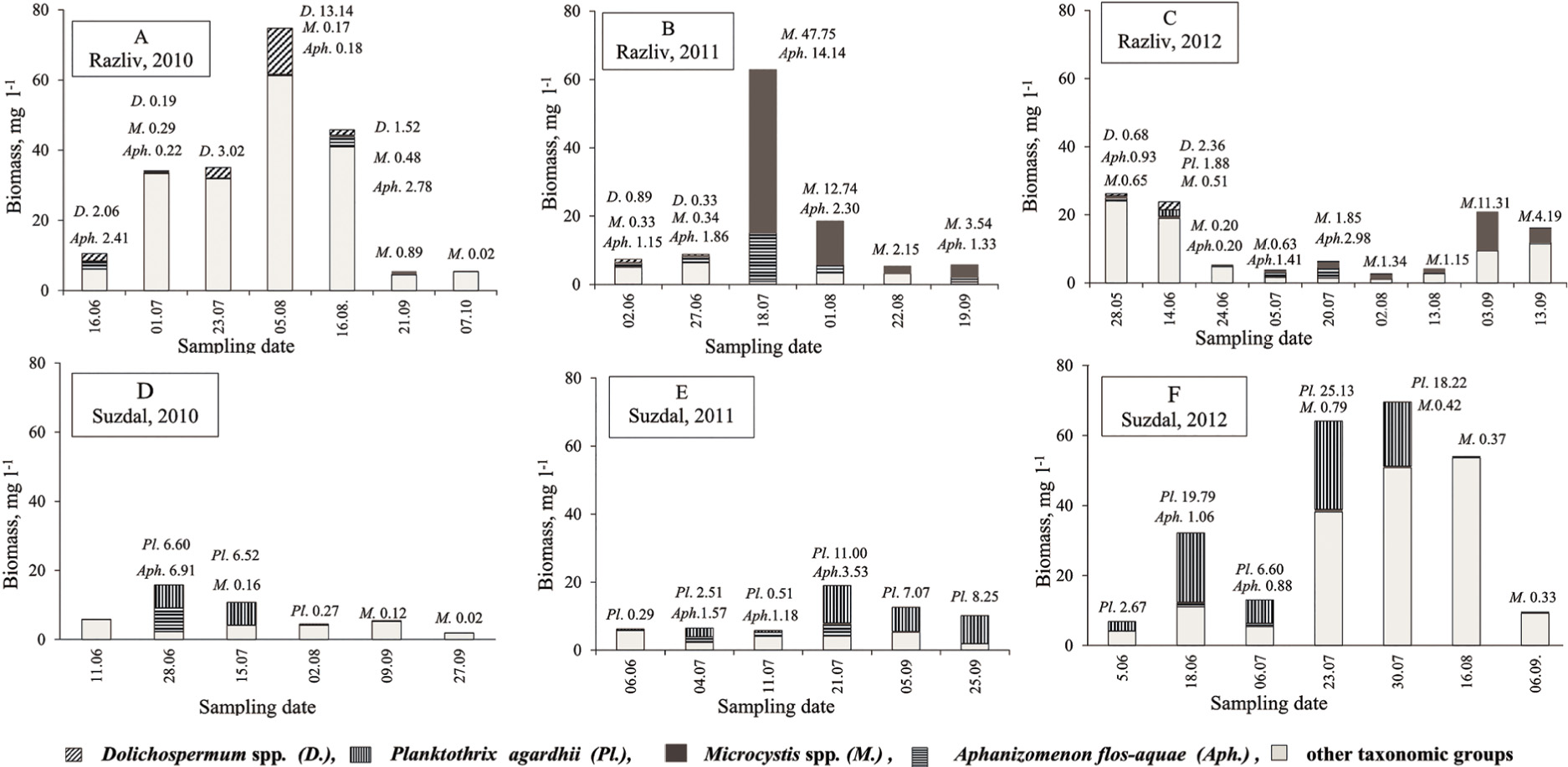
Figure 1
Seasonal changes in the total phytoplankton and cyanobacterial biomass in the studied lakes from May to October 2010-2012. A, B, C, Sestroretskij Razliv Lake in 2010, 2011 and 2012, respectively; D, E, F, Lower Suzdal Lake in 2010, 2011 and 2012, respectively
The highest mean seasonal cyanobacterial biomass was recorded in 2012 in Suzdal (10.97 mg l−1) and in 2011 in Razliv (15.05 mg l−1). The contribution of cyanobacteria to the total phytoplankton biomass varied from 0.4% (0.02 mg l−1) to 99% (61.94 mg l−1) in Razliv and from 0.1% (0.01 mg l−1) to 41% (26.03 mg l−1) in Suzdal (Fig. 1, Supplementary tables S1A-S1F).
In 2010 and 2012, Aph. flos-aquae and Dolichospermum flos-aquae dominated in the plankton community in Razliv at the beginning of the sampling seasons. In summer, the dominance shifted to representatives of the genus Microcystis (M. aeruginosa, M. wesenbergii and M. viridis) (Fig. 1 A, C). In 2011, Microcystis species and Aph. flos-aquae co-occurred almost throughout the whole summer season (Fig. 1B). In Suzdal, the variability in the dominant species composition was not as significant as that in Razliv. In 2010 and 2012, the dominance of P. agardhii and Aph. flos-aquae in the cyanobacterial community at the beginning of the warm season shifted in August-September to Microcystis spp. (Fig. 1D, F). During 2011, the quantitative dominance of P. agardhii over Aph. flos-aquae was observed (Fig. 1 E).
Toxin concentrations
The studies carried out in 2010-2012 showed the occurrence of cyanotoxins both in Razliv and in Suzdal. The concentrations of microcystins exceeding the value of ≥ 0.1 μg l−1 for the extracellular fraction, or 0.1 mg g−1 on a dry-weight (DW) basis for the intracellular fraction, were determined in 54 water and biomass samples (59% of all the collected samples). Extracellular microcystins were detected in 25 of 46 water samples (54% of the water samples) (Tables 1, 2, Supplementary tables S2-S7). AN was present only in 5 water samples from Suzdal (Table 2, Supplementary tables S5, S6).
Table 1
Concentration of extracellular and intracellular cyanotoxins, three main toxin variants, and biomass of dominant species in samples from Lake Sestroretskij Razliv. MC = microcystin, dm = desmethyl, didm = double desmethyl, *denotes trace concentration (below 50 pg per injection), nd = values below LOD, DW = on a dry-weight basis
| Sampling period (number of events) | Concentration of extracellular cyanotoxins in water (µg l ) | Concentration of intracellular cyanotoxins in biomass (µg g DW) | Dominant species according to the number of cells | Cyanobacterial biomass (mg l ) | ||
|---|---|---|---|---|---|---|
| Total | Three main toxin variants | Total | Three main toxin variants | |||
| 2010 | seasonal median 1.61 (min. 0.11, max 41.37, N=8) | seasonal median 132 (min. 8, max 380, N=8) | ||||
| June-July (2) | 0.10-0.19 | dmMC-LR (0.01-0.06), MC-LR (0.03-0.15), MC-YR * | 8-51 | MC-RR (4-20), MC-LR (2-20) | Dolichospermum flos-aquae, Aphanizomenon flos-aquae, Microcystis wesenbergii, Dolichospermum planctonica | 0.73-4.47 |
| July-Aug. (2) | 0.16-2.60 | dmMC-RR (0.01-1.03), MC-LR (0.08-0.87), MC-YR (nd-0.24) | 11-23 | MC-RR (6), didmMC-RR (nd-6) | Dolichospermum planctonica | 3.19-13.96 |
| Aug.-Sept. (3) | 0.61-41.37 | dmMC-RR (0.46-38.54), dmMC-LR (0.05-1.65), MC-LR (0.03-1.41) | 213-380 | MC-RR (51-100), MC-LR (34-80), didmMC-RR (14-104) | Dolichospermum planctonica, Microcystis spp., Aphanizomenon flos-aquae | 1.00-5.44 |
| Oct. (1) | 13.38 | dmMC-RR (6.54), MC-LR (2.80), MC-RR (2.16) | 255 | dmMC-LR (133), MC-LR (74), dmMC-YR (15) | Aulacoseira italica | 0.02 |
| 2011 | seasonal median 0.08 (min.< 0.003, max 0.70, N=7) | seasonal median 463 (min. < 0.08, max 2095, N=7) | ||||
| June-Sept. (7) | < 0.10-0.70 | MC-RR (nd-0.26), MC-LR (nd-0.21), dmMC-RR (nd-0.28) | < 0.08-2095 | MC-LR (nd-306), MC-YR (nd-345), dmMC-RR (nd-1245) | Microcystis spp., Aphanizomenon flos-aquae | 2.19-61.94 |
| 2012 | seasonal median 0.06 (min.< 0.003, max 1.24, N=9) | seasonal median 490 (min. 45, max 2294, N=8) | ||||
| May (1) | 0.06 | MC-LR (0.02), MC-RR (0.04) | 1377 | MC-RR (578), dmMC-RR (349), MC-LR (244) | Microcystis spp., Aphanizomenon flos-aquae | 2.33 |
| mid-June (1) | 1.24 | MC-RR (0.74), MC-LR (0.50) | 1859 | MC-LR (734), MC-RR (807), MC-LF (112) | Planktothrix agardhii | 7.11 |
| end of June (1) | 0.12 | MC-LR (0.07), MC-RR (0.05) | 298 | MC-RR (215), MC-LR (78) | Microcystis spp. | 0.45 |
| July (2) | <0.10-0.87 | MC-LR (0.01-0.31), MC-RR (0.03-0.44), MC-YR (0.01-0.06) | 260-489 | MC-LR (51-116), MC-RR (186-334), MC-YR (20-36) | Aphanizomenon flos-aquae, Microcystis spp. | 2.10-4.84 |
| Aug.-Sept. (4) | <0.10-0.92 | MC-LR (nd-0.40), MC-RR (nd-0.29), MC-YR (0.06-0.23) | 45-2294 | MC-RR (6-995), [L-Ser ]MC-RR (nd-973), MC-LR (8-344) | Microcystis spp. | 1.43-11.34 |
Table 2
Concentration of extracellular and intracellular cyanotoxins, three main toxin variants, and biomass of dominant species in samples from Lower Suzdal Lake. MC = microcystin, AN = anatoxin-a, dm = desmethyl, *denotes trace concentration (below 50 pg per injection), nd = values below LOD, DW = on a dry-weight basis.
| Sampling period (number of events) | Concentration of extracellular cyanotoxins in water (µg l ) | Concentration of intracellular cyanotoxins in biomass (µg g DW) | Dominant species according to the number of cells | Cyanobacterial biomass (mg l ) | ||
|---|---|---|---|---|---|---|
| Total | Three main toxin variants | Total | Three main toxin variants | |||
| 2010 | seasonal median 0.44 (min. 0.01, max 2.89, N=7) | seasonal median 18 (min. 1, max 234, N=7) | ||||
| mid-June (1) | 0.39 | [L-Ser ]-MC-RR (0.18), MC-LR (0,14), dmMC-LR (0.05) | 7 | MC-LR (5), MC-RR (2) | Aphanizomenon flos-aquae (0.5%) | 0.01 |
| end of June-Aug. (4) | <0.10-1.68 | dmMC-RR (0.01-0.36), [L-Ser ]-MC-RR (0.01-0.32), AN (nd-0.54) | 4-234 | MC-RR (2-98), MC-LR (2-7), MC-WR (2-8) | Planktothrix agardhii, Aphanizomenon flos-aquae | 0.30-13.57 |
| Sept. (2) | 0.56-2.89 | [L-Ser ]MC-RR (0.13-0.87), dmMC-RR (0.26-0.95), dmMC-LR (0.12-0.45) | 1-18 | dmMC-RR (nd-12), dmMC-YR (nd-6) | Microcystis spp. | 0.03-0.13 |
| 2011 | seasonal median 0.02 (min. 0.01, max 0.40, N=7) | seasonal median 120 (min.< 0.08, max 700, N=7) | ||||
| June-July (4) | <0.10-0.40 | AN (nd-0.27), MC-RR (0.01-0.20), dmMC-RR (nd-0.14) | < 0.08-698 | MC-LR (nd-225), MC-YR (nd-351), MC-LW (4-7), AN (nd-30) | Aphanizomenon flos-aquae, Planktothrix agardhii | 0.43-16.72 |
| Aug.-Sept. (3) | <0.10-0.24 | AN (nd-0.24), MC-RR*, dmMC-RR* | 121-142 | MC-LR (28-41), MC-RR (31-32), dmMC-RR (34-35) | Planktothrix agardhii | 7.38-8.78 |
| 2012 | seasonal median 0.05 (min.< 0.003, max 0.71, N=8) | seasonal median 250 (min. 50, max 1800, N=8) | ||||
| June-July (5) | <0.10-0.70 | dmMC-RR (0.05-0.60), MC-RR (nd-0.22), MC-LR (nd-0.21) | 51-470 | MC-RR (33-318), MC-LR (8-121), dmMC-RR (1-97) | Planktothrix agardhii | 2.75-26.03 |
| Aug.-Sept. (3) | <0.10 | MC-RR*, MC-LR* | 50-1796 | MC-RR (15-1345), MC-LR (26-353), MC-YR (9-116) | Microcystis spp. | 0.36-0.44 |
Supplementary Table 2
Detected concentrations of extracellular MCs in wat er and intracellular MCs in biomass samples, cell number and biomass of obse rved cyanobacterial species in Sestroretskij Razliv Lake in 2010.
| Sestroretskij Razliv Lake, 2010 | MC-LR | dmMC-LR | didmMC-LR | [L-Ser7]MC-LR | [L-MeSer][-MC-LR] | MC-RR | dmMC-RR | didm-MC-RR | [L-Ser]-MC-RR | MC-YR | dmMC-YR | MC-LF | MC-HtyR | MC-YA | Total MCs | Cell number of cyanobacterial species, × 106 cells l–1, (N,%) | Biomass of cyanobacterial species, mg l–1, (B,%) | |
|---|---|---|---|---|---|---|---|---|---|---|---|---|---|---|---|---|---|---|
| 16 Jun | Water, µg l–1 | 0.153 | 0.009 | 0.006 | 0.014 | 0.007 | 0.189 | Aph. flos-aquae 36.8 (58 %), D. flos-aquae 20.8 (33%), D. planctonica 1.3 (2%), D. spiroides 1.05 (2%), D. crassum 0.8 (1 %), Snowella lacustris* | Aph. flos-aquae 2.41 (23 %), D. flos-aquae 1.36 (13%), D. planctonica 0.29 (3%), D. spiroides 0.23 (2%), D. crassum 0.18 (2 %), Snowella lacustris* | |||||||||
| Bio, µg g–1 dw | 20 | 3 | 3 | 20 | 1 | 1 | 1 | 51 | ||||||||||
| 01 Jul | Water, µg l–1 | 0.028 | 0.055 | 0.003 | 0.025 | 0.111 | M. wesenbergii 4.40 (28%), Aph. flos-aquae 1.00 (6%), P. agardhii 0.60 (4%), D. planctonica 0.26 (2%), D. spiroides *, D. crassum * | M. wesenbergii 0.29 (1%), Aph. flos-aquae 0.22 (1%), P. agardhii*, D. planctonicum*, D. spiroides* | ||||||||||
| Bio, µg g–1 dw | 2 | 2 | 4 | 8 | ||||||||||||||
| 23 Jul | Water, µg l–1 | 0.054 | 0.028 | 0.012 | 0.094 | D. planctonica 5.6 (29%), D. spiroides 1.05 (5%), Aph. flos-aquae 0.4 (2%), Limnothrix planctonica 0.4 (2%), M. aeruginosa 0.52 (3%), M. wesenbergii 0.36 (2%) | D. planctonica 2.93 (8%), D. spiroides*, Aph. flos-aquae*, Limnothrix planctonica*, M. aeruginosa*, M. wesenbergii * | |||||||||||
| Bio, µg g–1 dw | 3 | 2 | 6 | 1 | 11 | |||||||||||||
| 05 Aug | Water, µg l–1 | 0.874 | 0.238 | 0.053 | 0.158 | 1.032 | 0.241 | 0.003 | 2.599 | D. planctonica 52.00 (62%), Limnothrix planctonica 9.20 (11%), Aph. flos-aquae 2.80 (3%), D. crassum 2.70 (3 %), M. wesenbergii 2.40 (3%), Cuspidothrix issatschenk 1.80 (2%), D. spiroides 1.10 (1%), M. aeruginosa * | D. planctonica 11.49 (15%), D. crassum 1.49 (2%), Limnothrix planctonica*, Aph. flos-aquae*, M. wesenbergii*, Cuspidothrix issatschenk*, D. spiroides*, M. aeruginosa * | |||||||
| Bio, µg g–1 dw | 3 | 2 | 1 | 23 | ||||||||||||||
| 16 Aug | Water, µg l–1 | 0.830 | 0.945 | 0.042 | 0.840 | 38.542 | 0.165 | 0.006 | 41.370 | Limnothrix planctonica 18.60 (20%), D. planctonica 15.70 (17%), Aph. flos-aquae 12.60 (13%), D. spiroides 7.50 (8%), M. wesenbergii 4.80 (5%), M. aeruginosa 2.50 (3%), P. agardhii 0.75 (1%) | Aph. flos-aquae 2.78 (6%), D. planctonicum 1.03 (2%), Limnothrix planctonica 0.61 (1%), D. spiroides 0.49 (1%), M. wesenbergii*, M. aeruginosa*, P. agardhii * | |||||||
| Bio, µg g–1 dw | 80 | 0 | 100 | 49 | 8 | 19 | 3 | 256 | ||||||||||
| 06 Sep | Water, µg l–1 | 1.410 | 1.650 | 0.020 | 0.451 | 12.490 | 0.036 | 16.057 | NA | NA | ||||||||
| Bio, µg g–1 dw | 34 | 53 | 1 | 51 | 14 | 10 | 14 | 36 | 213 | |||||||||
| 21 Sep | Water, µg l–1 | 0.030 | 0.050 | 0.055 | 0.017 | 0.459 | 0.611 | M. wesenbergii 7.20 (43%), M. aeruginosa 6.40 (38%), P. agardhii 0.60 (4%), Aph. flos-aquae 0.48 (3%), Planktolyngbya limnetica 0.3 (2%) | M. wesenbergii 0.47 (9%), M. aeruginosa 0.42 (8%), Aph. flos-aquae 0.11 (2%), P. agardhii*, Planktolyngbya limnetica * | |||||||||
| Bio, µg g–1 dw | 47 | 27 | 90 | 104 | 33 | 13 | 65 | 380 | ||||||||||
| 07 Oct | Water, µg l–1 | 2.802 | 1.425 | 2.160 | 6.543 | 0.248 | 0.200 | 13.378 | M. aeruginosa 0.08 (3%), D. spiroides 0.06 (2%), Aph. flos-aquae * | M. aeruginosa*, D. spiroides*, Aph. flos-aquae* | ||||||||
| Bio, µg g–1 dw | 74 | 133 | 3 | 14 | 3 | 14 | 15 | 255 | ||||||||||
Supplementary Table 3
Detected concentrations of extracellular MCs in water and intracellular MCs in biomass samples, cell number and biomass of observed cyanobacterial species in Sestroretskij Razliv Lake in 2011. * denotes to cell number or biomass <1%. Aph. = Aphanizomenon, M. = Microcystis, D. = Dolichospermum, P. = Planktothrix; NA = data not available, ND = not detected (concentration below LOD)
| Sestroretskij Razliv Lake, 2011 | MC-LR | dmMC-LR | [D-Glu-OCH MC-LR] | MC-RR | dmMC-RR | MC-YR | MC-WR | MC-LW | Total MCs | Cell number of cyanobacterial species, x 10 cells l , (N,%) | Biomass of observed cyanobacterial species, mg l , (B,%) | |
|---|---|---|---|---|---|---|---|---|---|---|---|---|
| 02 Jun | Water, µg l | 0.004 | 0.003 | 0.070 | 0.077 | Aph. flos-aquae 5.20 (18%), M. aeruginosa 4.80 (16%), D. smithii 1.20 (4%), D. sp. 1.10 (4%), D. circinale 0.80 (3%), D. spiroides 0.80 (3%), Limnothrix planctonica 0.80 (3%), Aphanocapsa planctonica 0.60 (2%), D. crassum 0.50 (2%), M. wesenbergii 0.28 (1%), D. flos-aquae 0.28 (1%) | Aph. flos-aquae 1.15 (15%), M. aeruginosa 0.31 (4%), D. smithii 0.27 (3%), D. spp. 0.24 (3%), D. spiroides 0.18 (2%), Aphanocapsa planctonica 0.13 (2%), D. crassum 0.11 (2%), D. circinalis 0.08 (1%), M. wesenbergii*, D. flos-aquae*, Limnothrix planctonica* | |||||
| Bio,µg g dw | ND | |||||||||||
| 27 Jun | Water, µg l | ND | Aph. flos-aquae 8.40 (45%), M. aeruginosa 4.20(23%), D. spiroides 0.98 (5%), M. wesenbergii 0.96 (5%), Woronichinia naegeliana 0.60 (3%), D. smithii 0.50 (3%), D. circinale* | Aph. flos-aquae 1.86 (21%), M. aeruginosa 0.27 (3%), D. spiroides 0.22 (2%), D. smithii 0.11 (1%), M. wesenbergii*, Woronichinia naegeliana*, D. circinale * | ||||||||
| Bio,µg g dw | ND | |||||||||||
| 18 Jul | Water, µg l | 0.211 | 0.086 | 0.044 | 0.341 | M. aeruginosa 576.00 (73%), M. viridis 96.00 (12%), Aph. flos-aquae 64.00 (8 %), M. wesenbergii 57.60 (7%), D. planctonica*, D. spiroides*, Woronichinia naegeliana* | M. aeruginosa 37.70 (60%), M. viridis 6.28 (10%), Aph. flos-aquae 14.14 (23 %), M. wesenbergii 3.77 (6%), D. planctonica*, D. spiroides*, Woronichinia naegeliana* | |||||
| Bio,µg g dw | 264 | 20 | 8 | 188 | 20 | 62 | 17 | 10 | 593 | |||
| 01 Aug | Water, µg l | 0.008 | 0.022 | 0.018 | 0.048 | M. wesenbergii 45.60 (46%), M. aeruginosa 40.80 (41%), Aph. flos-aquae 10.40 (10%), Woronichinia naegeliana*, D. smithii*, D. crassum*, D. spiroides*, Snowella lacustris*, D. circinalis * | M. wesenbergii 10.07 (54%), M. aeruginosa 2.67 (14%), Aph. flos-aquae 2.30 (12%), Woronichinia naegeliana*, D. smithii*, D. crassum*, D. spiroides*, Snowella lacustris*, D. circinalis * | |||||
| Bio,µg g dw | 119 | 7 | 5 | 84 | 7 | 29 | 9 | 2 | 266 | |||
| 22 Aug | Water, µg l | 0.024 | 0.025 | 0.049 | M. aeruginosa 21.60 (58%), M. wesenbergii 11.20 (30%), Aph. flos-aquae 0.20 (1%), Woronichinia naegeliana*, Cuspidothrix elenkinii*, D. crassum* | M. aeruginosa 1.41 (29%), M. wesenbergii 0.73 (14%), Aph. flos-aquae*, Woronichinia naegeliana*, Cuspidothrix elenkinii*, D. crassum* | ||||||
| Bio,µg g dw | 196 | 5 | 5 | 175 | 1 | 62 | 19 | 463 | ||||
| 19 Sep | Water, µg l | 0.066 | 0.017 | 0.071 | 0.004 | 0.014 | 0.172 | M. aeruginosa 45.60 (61%), Aphanocapsa planctonica 12.00 (16%), M. wesenbergii 8.40 (11%), Aph. flos-aquae 6.00 (8%), P. agardhii 2.10 (3%), D. crassum*, M. viridis*, D. spiroides* | M. aeruginosa 2.98 (45%), Aph. flos-aquae 1.33 (20%), Aphanocapsa planctonica 0.79 (12%), M. wesenbergii 0.55 (8%), P. agardhii 0.14 (2%), D. crassum*, M. viridis*, D.spiroides* | |||
| Bio,µg g dw | 159 | 11 | 335 | 1245 | 345 | 2095 | ||||||
| 22 Sep | Water, µg l | 0.046 | 0.012 | 0.263 | 0.278 | 0.097 | 0.696 | NA | NA | |||
| Bio,µg g dw | 306 | 21 | 142 | 43 | 29 | 541 | ||||||
Supplementary Table 4
Detected concentrations of extracellular MCs in water and intracellular MCs in biomass samples, cell number and biomass of observed cyanobacterial species in Sestroretskij Razliv Lake in 2012. * denotes to cell number or biomass <1%. Aph. = Aphanizomenon, M. = Microcystis, D. = Dolichospermum, P. = Planktothrix; NA = data not available, ND = not detected (concentration below LOD)
| Sestroretskij Razliv Lake, 2012 | MC-LR | dmMC-LR | MC-RR | didmMC-RR | dmMC-RR | ]MC-RR [L-Ser | MC -YR | dmMC-YR | MC-LF | Total MCs | Cell number of cyanobacterial species, x 10 cells l , (N,%) | Biomass of cyanobacterial species, mg l , (B,%) | |
|---|---|---|---|---|---|---|---|---|---|---|---|---|---|
| 28 May | Water, µg l | 0.015 | 0.035 | 0.050 | M. aeruginosa 8.40 (28%), Aph. flos-aquae 4.20 (14%), D. circinalis 3.80 (13%), M. wesenbergii 1.60 (5%), D. spiroides 0.41 (1%), D. planctonica 0.40 (1%), Cuspidothrix elenkinii 0.40 (1%), Limnothrix planctonica*, D.crassum * | M. aeruginosa 0.55 (2%), Aph. flos-aquae 0.93(4%), D. circinale 0.37 (1%), M. wesenbergii*, D. spiroides*, D. planctonica*, Cuspidothrix elenkinii*, Limnothrix planctonica*, D. crassum* | |||||||
| Bio, µg g dw | 244 | 71 | 578 | 16 | 349 | 81 | 37 | 1 | 1377 | ||||
| 14 Jun | Water, µg l | 0.495 | 0.735 | 0.005 | 0.008 | 1.243 | Limnothrix planctonica 43.20 (37%), P. agardhii 28.80 (24%), Planktolyngbia spp. 8.00 (7%), D. spiroides 7.20 (6%), M. aeruginosa 4.20 (4%), D. circinalis 4.00 (3%), M. wesenbergii 3.60 (3%), D. planctonica 2.40 (2%), D. crassum 1.10 (1%), Aph. flos-aquae 0.80 (1%) | Limnothrix planctonica 1.84 (7%), P. agardhii 1.88 (7%), D. planctonica 1.26 (5%), D. spiroides 0.47 (2%), D. circinalis 0.39 (2%), M. aeruginosa 0.27 (1%), Planktolyngbia spp. 0.34 (1%), M. wesenbergii*, D. crassum*, Aph. flos-aquae * | |||||
| Bio, µg g dw | 743 | 78 | 807 | 12 | 89 | 6 | 22 | 112 | 1859 | ||||
| 24 Jun | Water, µg l | 0.067 | 0.054 | 0.121 | M. wesenbergii 2.80 (38%), Aph. flos-aquae 0.90 (12%), D. spiroides 0.55 (7%), M. aeruginosa 0.30 (4 %), Limnothrix planctonica 0.20 (3%), D. viguerii 0.06 (1%), P. agardhii * | M. wesenbergii 0.18 (4%), Aph. flos-aquae 0.20 (4%), D. spiroides*, M. aeruginosa*, Limnothrix planctonica*, D. viguerii*, P. agardhii* | |||||||
| Bio, µg g dw | 78 | 215 | 5 | 298 | |||||||||
| 5 Jul | Water, µg l | 0.014 | 0.030 | 0.009 | 0.053 | Aph. flos-aquae 6.40 (38%), M. aeruginosa 4.80 (28%), M. wesenbergii 4.80 (28%), D. spiroides 0.43 (3%), Cryptomonas rostrate 0.14 (1%), D. planctonica *, Synechocystis crassum* | Aph. flos-aquae 1.41 (38%), M. aeruginosa 0.31 (9%), M. wesenbergii 0.31 (9%), D. spiroides*, D. planctonica*, Synechocystis crassum* | ||||||
| Bio, µg g dw | 116 | 334 | 3 | 36 | 489 | ||||||||
| 20 Jul | Water, µg l | 0.315 | 0.438 | 0.053 | 0.061 | 0.867 | Aph. flos-aquae 30.40 (52%), M. wesenbergii 13.60 (23%), M. viridis 10.40 (18%), M. aeruginosa 4.20 (7%), P.agardhii*, D. planctonica*, D. spiroides* | Aph. flos-aquae 2.98 (47%), M. wesenbergii 0.89 (14%), M. viridis 0.68 (11%), M. aeruginosa 0.27 (4%), P. agardhii*, D. planctonica*, D. spiroides* | |||||
| Bio, µg g dw | 51 | 186 | 3 | 20 | 260 | ||||||||
| 2 Aug | Water, µg l | 0.399 | 0.289 | 0.228 | 0.916 | M. viridis 10.80 (51%), M. wesenbergii 6.00 (28%), M. aeruginosa 3.60 (17%), Aph. flos-aquae 0.40 (2%), D. spiroides*, Synechocystis crassa* | M. viridis 0.71 (28%), M. wesenbergii 0.39 (15%), M. aeruginosa 0.24 (9%), Aph. flos-aquae 0.09 (3%), D. spiroides * | ||||||
| Bio, µg g dw | 308 | 880 | 2 | 973 | 131 | 2294 | |||||||
| 13 Aug | Water, µg l | ND | M. aeruginosa 8.00 (40%), M. wesenbergii 8.00 (40%), M. viridis 1.60 (8%), Aph. flos-aquae 1.30 (7%), Limnothrix planctonica* | M. aeruginosa 0.52 (13%), M. wesenbergii 0.52(13%), Aph. flos-aquae 0.29 (7%), M. viridis 0.10 (3%), Limnothrix planctonica* | |||||||||
| Bio, µg g dw | 344 | 995 | 2 | 1 | 124 | 1466 | |||||||
| 3 Sep | Water, µg l | 0.058 | 0.058 | M. viridis 76.80 (43%), M. wesenbergii 57.60 (32%), M. aeruginosa 38.40 (22%), Aph. flos-aquae* | M. viridis 5.03 (24%), M. wesenbergii 3.77 (18%), M. aeruginosa 2.51 (12%), Aph. flos-aquae* | ||||||||
| Bio, µg g dw | 14 | 2 | 35 | 11 | 7 | 1 | 70 | ||||||
| 13 Sep | Water, µg l | ND | M. wesenbergii 43.20 (59%), M. aeruginosa 16.00 (22%), M. viridis 4.80 (7%), Aph. flos-aquae 4.00 (5%), D. crassum*, Woronichinia naegeliana* | M. wesenbergii 2.83 (18%), M. aeruginosa 1.05(7%), M. viridis 0.31 (2%), Aph. flos-aquae 0.39 (2%), D. crassum*, Woronichinia naegeliana* | |||||||||
| Bio, µg g dw | 8 | 7 | 6 | 1 | 14 | 3 | 6 | 45 | |||||
Supplementary Table 5
Detected concentrations of extracellular MCs in water and intracellular MCs in biomass samples, cell number and biomass of observed cyanobacterial species in Lower Suzdal Lake in 2010. * denotes to cell number or biomass <1%. Aph. = Aphanizomenon, M. = Microcystis, D. = Dolichospermum, P. = Planktothrix; NA = data not available
| Lower Suzdal Lake, 2010 | MC- LR | dmMC-LR | ]MC-LR [L-Ser | MC-RR | dmMC-RR | ]MC-RR [L-Ser | MC-YR | dmMC-YR | MC-WR | Total MCs | Anatoxin-a | Cell number of cyanobacterial species, x 10 cells l , (N,%) | Biomass of cyanobacterial species, mg l , (B,%) | |
|---|---|---|---|---|---|---|---|---|---|---|---|---|---|---|
| 11 Jun | Water, µg l | 0.135 | 0.047 | 0.022 | 0.006 | 0.176 | 0.386 | Aph. flos-aquae 0.03 (1%) | Aph. flos-aquae * | |||||
| Bio, µg g dw | 5 | 2 | 7 | |||||||||||
| 28 Jun | Water, µg l | 0.007 | 0.007 | 0.014 | 0.160 | P. agardhii 100.80 (58%), Aph. flos-aquae 70.40 (40%), D. planctonica*, M. aeruginosa*, Merismopedia punctate* | Aph. flos-aquae 6.91 (37%), P. agardhii 6.60 (35%), D. planctonica*, M. aeruginosa*, Merismopedia punctate* | |||||||
| Bio, µg g dw | 2 | 2 | 4 | |||||||||||
| 15 Jul | Water, µg l | 0.089 | 0.079 | 0.255 | 0.021 | 0.357 | 0.315 | 0.564 | 1.680 | 0.540 | P. agardhii 99.60 (94%), M. wesenbergii 2.40 (3%), D. planctonica 0.65 (1%), Aphanocapsa planctonica 0.60 (1%), Synechocystis crassa* | P. agardhii 6.52 (33%), M. wesenbergii 0.16 (1%), D. planctonica 0.14 (1%), Aphanocapsa planctonica*, Synechocystis crassa* | ||
| Bio, µg g dw | 5 | 3 | 2 | 11 | 7 | 2 | 30 | |||||||
| 02 Aug | Water, µg l | 0.010 | 0.036 | 0.023 | 0.005 | 0.230 | 0.304 | P. agardhii 4.20 (78%), M. wesenbergii 0.33 (6%), Cuspidothrix elenkini*, D. planctonica* | P. agardhii 0.27 (14%), M. wesenbergii 0.02 (1%), Cuspidothrix elenkini*, D. planctonica* | |||||
| Bio, µg g dw | 3 | 3 | 6 | 6 | 1 | 2 | 8 | 29 | ||||||
| 16 Aug | Water, µg l | 0.035 | 0.078 | 0.047 | 0.018 | 0.081 | 0.079 | 0.098 | 0.436 | NA | NA | |||
| Bio, µg g dw | 67 | 10 | 98 | 1 | 22 | 31 | 5 | 234 | ||||||
| 09 Sep | Water, µg l | 0.031 | 0.115 | 0.025 | 0.262 | 0.131 | 0.564 | M. wesenbergii 1.80 (68%), Aph. flos-aquae 0.04 (1%), P. agardhii 0.02 (1%) | M.wesenbergii 0.12 (2%), P. agardhii*, Aph. flos-aquae* | |||||
| Bio, µg g dw | 1 | 1 | ||||||||||||
| 27 Sep | Water, µg l | 0.049 | 0.454 | 0.123 | 0.199 | 0.954 | 0.874 | 0.089 | 0.143 | 2.885 | M. wesenbergii 0.30 (5%), P. agardhii 0.15 (3%), Aph. flos-aquae*, D. planctonica* | Aph. flos-aquae*, M. wesenbergii*, P. agardhii*, D. planctonica* | ||
| Bio, µg g dw | 12 | 6 | 18 | |||||||||||
Supplementary Table 6
Detected concentrations of extracellular MCs in water and intracellular MCs in biomass samples, cell number and biomass of observed cyanobacterial species in Lower Suzdal Lake in 2011. * denotes to cell number or biomass <1%. Aph. = Aphanizomenon, M. = Microcystis, D. = Dolichospermum, P. = Planktothrix; NA = data not available
| Lower Suzdal Lake, 2011 | MC-LR | dmMC-LR | MC-RR | dmMC-RR | MC-YR | dmMC-YR | MC-LW | Total ??s | Anatoxin-a | Cell number of cyanobacterial species, x 10 cells l , (N,%) | Biomass of cyanobacterial species, mg l , (B,%) | |
|---|---|---|---|---|---|---|---|---|---|---|---|---|
| 6 Jun | Water, µg l | 0.006 | 0.008 | 0.002 | 0.016 | P. agardhii 4.50 (54%), M. aeruginosa 1.38 (17%), Aph. flos-aquae 0.60 (7%), M. wesenbergii 0.15 (2%), Aphanocapsa planctonica 0.12 (1%) | P. agardhii 0.29 (5%), M. aeruginosa 0.09 (2%), Aph. flos-aquae 0.04(1%), M. wesenbergii*, Aphanocapsa planctonica* | |||||
| Bio, µg g dw | ||||||||||||
| 4 Jul | Water, µg l | 0.007 | 0.007 | 0.139 | Limnothrix planctonica 67.20 (52%), P. agardhii 38.40 (30%), Aph. flos-aquae 16.00 (12 %), Aphanocapsa incerta 2.40 (2%), M. wesenbergii 1.80 (1 %), Cuspidothrix elenkinii 1.20 (1%), D. planctonica* | Limnothrix planctonica 2.86 (29%), P. agardhii 2.51 (30%), Aph. flos-aquae 1.57 (16 %), Aphanocapsa incerta 0.16 (2%), M. wesenbergii 0.12 (1 %), Cuspidothrix elenkinii 0.20 (2%), D. planctonica* | ||||||
| Bio, µg g dw | 1 | 3 | 4 | 30 | ||||||||
| 11 Jul | Water, µg l | 0.008 | 0.008 | 0.266 | P. agardhii 31.20 (60%), Aph. flos-aquae 18.00 (35%), M. wesenbergii 0.60 (1%), Aphanocapsa planctonica 0.42 (1%), Limnothrix planctonica*, D. planctonica*, D. spiroides* | P. agardhii 0.51 (9%), Aph. flos-aquae 1.18 (20%), M. wesenbergii*, Aphanocapsa planctonica*, Limnothrix planctonica*, D. planctonica*, D. spiroides* | ||||||
| Bio, µg g dw | 4 | 4 | ||||||||||
| 21 Jul | Water, µg l | 0.054 | 0.009 | 0.203 | 0.138 | 0.404 | P. agardhii 168.00 (79%), Aph. flos-aquae 16.00 (8%), Limnothrix planctonica 16.00 (8%), Cuspidothrix elenkinii 6.40 (3%), M. wesenbergii 4.80 (2%), D. planctonica*, D. spiroides* | P. agardhii 11.00 (53%), Aph. flos-aquae 3.53 (17%), Limnothrix planctonica 0.68 (3%), Cuspidothrix elenkinii 1.09 (5%), M. wesenbergii 0.31 (2%), D. planctonica*, D. spiroides* | ||||
| Bio, µg g dw | 225 | 17 | 71 | 24 | 351 | 3 | 7 | 698 | ||||
| 5 Aug | Water, µg l | 0.006 | 0.006 | 0.012 | 0.240 | NA | NA | |||||
| Bio, µg g dw | 33 | 15 | 28 | 23 | 16 | 5 | 121 | |||||
| 5 Sep | Water, µg l | 0.0011 | 0.007 | 0.018 | 0.029 | 0.065 | P. agardhii 432.00 (98.5%), M. aeruginosa 2.40 (1%), M. wesenbergii*, Aphanocapsa planctonica*, Woronichinia naegeliana*, Snowella lacustris*, D. circinalis* | P. agardhii 7.07 (56%), M. aeruginosa 0.16 (1%), M. wesenbergii 0.10 (1%), Aphanocapsa planctonica*, Woronichinia naegeliana*, Snowella lacustris*, D. circinalis* | ||||
| Bio, µg g dw | 41 | 13 | 32 | 35 | 19 | 142 | ||||||
| 29 Sep | Water, µg l | 0.070 | 0.007 | P. agardhii 336.00 (97%), Aphanocapsa planctonica 4.80 (1%), Woronichinia karelica 3.90 (1%), Aphanocapsa holsatica*, M. aeruginosa*, M. wesenbergii* | P. agardhii 8.25 (77%), Aphanocapsa planctonica 0.31 (3%), Woronichinia karelica 0.13 (1%), Aphanocapsa holsatica*, M. aeruginosa*, M. wesenbergi* | |||||||
| Bio, µg g dw | 28 | 26 | 31 | 34 | 2 | 121 | ||||||
Supplementary Table 7
Detected concentrations of extracellular MCs in water and intracellular MCs in biomass samples, cell number and biomass of observed cyanobacterial species in Lower Suzdal Lake in 2012. * denotes to cell number or biomass <1%. Aph. = Aphanizomenon, M. = Microcystis, D. = Dolichospermum, P. = Planktothrix; NA = data not available
| Lower Suzdal Lake, 2012 | MC- LR | MC -RR | dmMC-RR | MC- YR | Total ??s | Cell number of cyanobacterial species, x10 cells l , (N,%) | Biomass of cyanobacterial species, mg l , (B,%) | |
|---|---|---|---|---|---|---|---|---|
| 05 Jun | Water, µg l | 0.002 | 0.045 | 0.047 | P. agardhii 40.80 (95%), M. aeruginosa 0.60 (1%), Aph. flos-aquae * | P.agardhii 2.67 (39%), M.aeruginosa*, Aph.flos-aquae* | ||
| Bio, µg g dw | 21 | 33 | 97 | 10 | 161 | |||
| 21 Jun | Water, µg l | 0.010 | 0.618 | 0.628 | P. agardhii 302.40 (95%), Aph. flos-aquae 4.80 (2%), M.aeruginosa*, M. wesenbergii* | P.agardhii 19.79 (62%), Aph.flos-aquae 1.06 (3%), M.aeruginosa*, M.wesenbergii* | ||
| Bio, µg g dw | 8 | 33 | 5 | 5 | 51 | |||
| 06 Jul | Water, µg l | 0.031 | 0.124 | 0.528 | 0.022 | 0.705 | P. agardhii 100.80 (92 %), Aph. flos-aquae 4.00 (4%), M.wesenbergii 0.60 (1%), M. aeruginosa*, Snowella lacustris* | P. agardhii 6.60 (51 %), Aph. flos-aquae 0.88 (7%), M.wesenbergii*, M.aeruginosa*, Snowella lacustris* |
| Bio, µg g dw | 69 | 221 | 11 | 13 | 315 | |||
| 23 Jul | Water, µg l | 0.010 | 0.048 | 0.058 | P. agardhii 384.00 (94%), M. aeruginosa 12.00 (3%), Cuspidothrix elenkinii*, Aph. flos-aquae*, Limnothrix planctonica*, Synechocystis crassa* | P. agardhii 25.13 (39%), M. aeruginosa 0.79 (1%), Cuspidothrix elenkinii*, Aph. flos-aquae*, Limnothrix planctonica* | ||
| Bio, µg g dw | 121 | 318 | 1 | 30 | 470 | |||
| 30 Jul | Water, µg l | 0.208 | 0.218 | 0.099 | 0.020 | 0.545 | P. agardhii 278.40 (94%), M. aeruginosa 6.40 (2%) | P. agardhii 18.22 (26%), M. aeruginosa 0.42 (1%) |
| Bio, µg g dw | 46 | 131 | 2 | 12 | 191 | |||
| 16 Aug | Water, µg l | 0.002 | 0.002 | M. aeruginosa 5.60 (35%), Snowella lacustris 0.60 (4%), P.agardhii 0.27 (2%), Limnothrix planctonica 0.20 (1%), Cuspidothrix elenkinii *, Aph. flos-aquae*, Oscillatoria tenuis *, Synechocystis crassa* | M. aeruginosa 0.37 (1%), Snowella lacustris*, P.agardhii*, Limnothrix planctonica*, Cuspidothrix elenkinii*, Aph. flos-aquae* | |||
| Bio, µg g dw | 26 | 15 | 9 | 50 | ||||
| 06 Sep | Water, µg l | 0.003 | 0.003 | 0.006 | M. aeruginosa 3.60 (61%), M. wesenbergii 1.40 (24%), P. agardhii 0.30 (5%), Snowella lacustris 0.12 (2%), Aph. flos-aquae 0.04 (1%) | M. aeruginosa 0.24 (3%), M. wesenbergii 0.09 (1%), P.agardhii *, Snowella lacustris*, Aph. flos-aquae* | ||
| Bio, µg g dw | 353 | 1345 | 2 | 96 | 1796 | |||
| 12 Sep | Water, µg l | 0.004 | 0.004 | NA | NA | |||
| Bio, µg g dw | 262 | 695 | 2 | 116 | 1075 | |||
The median seasonal and maximum concentrations of the total MCs, extracellular and intracellular MCs concentrations, and the concentrations of the three main toxins identified in the two water bodies by LC-MS/MS in each sampling period are shown in Tables 1 and 2. The sampling periods are highlighted in the tables according to the change in the dominant species. The total number of detected MCs variants during our three-year study was 14 in Razliv, and 9 in Suzdal. The number and structures of microcystin congeners identified in the lakes are presented in Table 3.
Table 3
The number and structure of microcystin (MC) variants identified in Sestroretskij Razliv and in Lower Suzdal Lake in 2010–2012
| Year | MCs in Razliv (total variants 14) | MCs in Suzdal (total variants 9) |
|---|---|---|
| 2010 | dmMC-LR MC-LR didmMC-RR dmMC-RR MC-RR MC-YR, [L-Ser7]MC-LR [L-MeSer7]MC-LR MC-YA MC-HtyR MC-LF | dmMC-LR MC-LR [L-Ser7]MC-LR dmMC-RR MC-RR [L-Ser7]MC-RR MC-YR MC-WR |
| 2011 | dm-MC-LR MC-LR dm-MC-RR MC-RR MC-YR MC-WR MC-LW | dm-MC-LR MC-LR dm-MC-RR MC-RR dmMC-YR MC-YR MC-LW |
| 2012 | dmMC-LR MC-LR didmMC-RR dmMC-RR MC-RR [L-Ser7]MC-RR dmMC-YR MC -YR MC-LF | MC-LR dmMC-RR MC-RR MC-YR |
Although cyanobacterial biomass was not high in 2010 (Fig. 1A, 1D), the median values for total extracellular toxins reached their maxima in Razliv (1.61 μg l−1) and Suzdal (0.44 μg l−1) (Tables 1, 2). The maximum extracellular MCs concentrations in each water body for the whole study period were recorded in the same season. In Razliv, the maximum extracellular MCs concentration (41.37 μg l−1 mainly due to 38.54 μg l−1 of desmethyl-MC-RR) was determined in August 2010 (Table 1, Supplementary tables S2). The maximum concentration of extracellular MCs in Suzdal was noted in September 2010 and it amounted to 2.89 μg l−1 (Table 2, Supplementary tables S5). Concentrations of intracellular MCs were low during this sampling season in both lakes, their median values were 132 μg g−1 DW in Razliv and 18 μg g−1 DW in Suzdal (Tables 1, 2).
In 2011, in spite of higher cyanobacterial biomass and higher contribution of cyanobacteria to the phytoplankton community than in 2010 (Fig. 1 B, E), the values of median concentration of extracellular MC were low in both lakes (Tables 1 and 2). The maximum dissolved MCs concentrations recorded this season were also low in both lakes and amounted to 0.70 μg l−1 in Razliv (Table 1, Fig. 1B, and Supplementary Table S3) and 0.40 μg l−1 in Suzdal (Table 2, Fig. 1F, and Supplementary table S6). On the other hand, the intracellular MC content was high and reached 2095 μg g-1 in Razliv and 698 μg g−1 in Suzdal.
The highest median concentrations of intracellular MCs in both lakes were recorded in 2012. At the beginning of August 2012, the maximum concentration of intracellular MCs for the entire study period (2294 μg g−1 DW) was recorded in Razliv. In Suzdal, peak values of intracellular MCs concentrations (1075-1796 μg g−1 DW) were recorded in September (Table 2, Supplementary table S7).
Neurotoxic AN was detected only in Suzdal. It was found in water samples collected from late June to early August 2010 and 2011 (Table 2, Supplementary tables S5, S6). Extracellular concentration of AN in filtered water samples was in the range of 0.16-0.54 μg l-1 (2 samples) in 2010 and 0.14-0.27 μg l−1 (3 samples: two samples in the sampling period June-July and one in August) in 2011 (Table 2, Supplementary table S5). Intracellular AN (30 μg g−1 DW) was recorded only in one biomass sample at the beginning of July. The presence of P.agardhii and Aph.flos-aquae was observed in all anatoxin-positive samples, Dolichospermum spp. was present only in a trace amount (Table 2, Supplementary table S6).
Discussion
The occurrence and distribution of cyanobacterial toxins were studied in two lakes typical for Saint Petersburg region: Sestroretskij Razliv Lake and Lower Suzdal Lake. The obtained data showed the constant presence of species able to produce cyanotoxins in both water bodies. However, the phytoplankton structure and dynamics were different between the studied lakes and seasons. In Suzdal, a higher variability of different taxonomic groups of phytoplankton was observed (Supplementary Table S1), whereas in Razliv – mainly Cyanobacteria were present.
The mass occurrence of cyanobacteria, cyanobacterial biomass values and the pattern of changes in their structure were typical for other hypertrophic or eutrophic water bodies and dam reservoirs across Europe (Teubner et al. 1999; Nixdorf et al. 2003; Pawlik-Skowrońska et al. 2004; Stefaniak et al. 2005; Dittmann & Wiegand 2006; Grabowska & Mazur-Marzec 2011; Kokocinski et al. 2011; Ostermaier et al. 2012).
Among the dominant species, the common producers of cyanotoxins were present. Therefore, we found it important to investigate the concentration of microcystins in lake water and phytoplankton samples. The dissolved (extracellular) fraction of cyanotoxins, which is released during bloom events, is sometimes overlooked in environmental studies, even though it may have a significant effect on the current state and quality of the water. Knowledge about the maximum MCs concentrations in reservoirs is of great importance, particularly in recreational areas as health outcomes may also result from exposure through swimming (contact with skin), inhalation or ingestion of cyanotoxin-containing water. Some investigations showed that even low concentrations of MCs may pose a significant health risk during the recreational use of water bodies (Ueno et al. 1996; Chen et al. 2009).
The analysis of biomass-bound (intracellular) cyanotoxins should also be conducted as this fraction of harmful biomolecules could be an additional route of their transfer and/or accumulation in aquatic animals, increasing the potential risk of human exposure through fish consumption.
MCs congeners detected in samples from Razliv and Suzdal are known to be produced by dominant cyanobacterial species present in the lakes. According to the published data, Microcystin spp. usually produce MC-LR, MC-RR and their desmethylated variants (Sivonen et al. 1995; Furey et al. 2008). Two to four arginine-containing MCs variants can be detected in extracts from Dolichospermum species, whereas mostly desmethylated variants of MC-RR or MC-LR dominate in Planktothrix species (Sivonen et al. 1995; Furey et al. 2008). In this study, the increased variety of microcystins congeners in hypertrophic Razliv was likely caused by higher diversity in cyanobacteria and frequent changes in dominant species. As it was observed in other studies, active growth of cyanobacteria and their diversity are promoted in hypertrophic reservoirs (Xing et al. 2007; Pawlik-Skowrońska et al. 2008; Kokocinski et al. 2011).
Some of the microcystin congeners seem to be stable components of the cyanobacterial bloom. They were detected in samples regardless of the season and the investigated water bodies. The identified MCs were mainly hydrophilic arginine-containing counterparts. The main toxin variants were MC-LR, MC-YR, MC-RR and desmethylated-MC-RR. These variants were also the most common MCs in Finland (Spoof et al. 2003), Poland (Grabowska & Mazur-Marzec 2011) and other European countries located at the same latitude (Kokocinski et al. 2011).
Concentrations of extracellular microcystins determined in natural waters are usually in the range of 0.1-10 μg l−1 (Sivonen & Jones 1999; Spoof et al. 2003; Welker 2008). Most of the extracellular MCs concentrations measured in our study were also within this range. Only some of the values determined in August and September 2010 in water samples from Razliv exceeded the guideline value for recreational water (WHO, 2003) and reached the maximum of 41.37 μg l−1 (16 Aug. 2010). The total concentrations of dissolved toxins determined in hypertrophic Razliv (Tables 1 and 2) were generally higher as compared with eutrophic Suzdal.
In our study, the concentration of cyanotoxins in bloom samples only to some extent depends on cyanobacterial biomass (Supplementary table S2). In 2010, when the contribution of cyanobacteria to the total phytoplankton biomass was low in both lakes studied (Fig. 1 A, D), the median values of the extracellular MCs concentration were higher than in the samples from the two other years (Table 1, 2). As it was proved, there are significant differences in toxin profiles and in the intensity of toxin production among cyanobacterial strains (Apeldoorn et al. 2007; Welker 2008; Kurmayer & Christiansen 2009). In spite of the fact that P. agardhii was reported to be a more effective producer of microcystin per dry weight than Microcystis spp. (Fastner et al. 1999), the concentrations of extracellular MCs were low in Suzdal in 2011 and 2012 during the observed prolonged dominance of P. agardhii. In September 2011, the recorded peak value of intracellular MCs concentrations in Suzdal (1075-1796 μg g−1 DW) could be associated with a high contribution of M. aeruginosa after shifting the dominance from P. agardhii. It was proven by chemical and genetic methods that the cyanobacterial population is complex and composed of toxic and non-toxic strains (Lyra et al. 2001; Pawlik-Skowrońska et al. 2004; Briand et al. 2008; Kurmayer& Christiansen 2009; Rohrlack et al. 2009; Bittencourt-Oliveira et al. 2010; Grabowska & Mazur-Marzec 2011). It was also noted that monitoring of different strains of P. agardhii is not sufficient to predict the toxicity of the P. agardhii bloom. Even the toxicity of a single P. agardhii strain is quite variable (Tonk et al. 2005). Under the influence of environmental conditions, the concentration of intracellular toxins may vary several times (Wiedner et al. 2003; van der Merwe et al. 2012; Neilan et al. 2013).
In addition to hepatotoxins, some species of freshwater cyanobacteria can produce neurotoxins. Anatoxin-a (AN) is a secondary amine with potent neurotoxicity. This cyanotoxin is produced by several cyanobacterial genera, including Dolichospermum (Anabaena), Aphanizomenon, Microcystis, Planktothrix (Oscillatoria), Phormidium and Nostoc (Lyra et al. 2001; Osswald et al. 2007; James et al. 2008; Rantala-Ylinen et al. 2011). AN occurs less frequently than MCs. In Europe, the reported values for extracellular AN concentrations ranged from 5 ng l−1 in Greece lakes (Dimitrakopuolos et al. 2010) to 10 μg l−1 in the water of an eutrophic dam reservoir in Poland during the dominance of Dolichospermum spp. (Pawlik-Skowrońska et al. 2004). AN was detected in Lake Veluwemeer (The Netherlands), Lake Kasumigaura (Japan) and Lake Nørre (Denmark) during the dominance of P. agardhii and/or Aph. flos-aquae (Lyra et al. 2001).
In our study, AN was detected only in Suzdal during warm periods in 2010 and 2011. Maximum concentrations of AN were recorded at the beginning of summer seasons when P. agardhii and Aph. flos-aquae dominated. P. agardhii and Aph. flos-aquae are known to be potential producers of anatoxin-a (Lyra et al. 2001; Osswald et al. 2007). It cannot be ruled out, however, that AN was produced in Suzdal by subdominant species of cyanobacteria, such as Dolichospermum planktonica, the trace amounts of which were always observed in AN-containing samples.
Although the maximum concentration of AN in water (0.54 μg l−1) detected in mid-July in 2010 was not high, the occurrence of this “fast-death factor” in freshwater ecosystems should be monitored due to its high toxicity
Conclusion
In this work, the occurrence and distribution of cyanobacterial toxins was studied in two lakes typical for Saint Petersburg region in Russia: Lake Sestroretskij Razliv and Lower Suzdal Lake. The observed cyanobacterial assemblages: “P. agardhii” and “Aph. flos-aquae/ Microcystis spp.” are typical of the hypertrophic shallow lakes in Europe.
During our study, the presence of fifteen different congeners of microcystins, mainly hydrophilic arginine-containing counterparts, and the neurotoxic anatoxin-a was determined. The increased variety of microcystins’ congeners and higher MCs concentration in hypertrophic Razliv was likely caused by higher variability of phytoplankton composition and frequent changes in dominant species.
The measured concentrations of extracellular MCs in the lakes (0.1-10 μg l−1) were mainly within the reported range for natural waters and only sporadically exceeded the guideline value for recreational water.
Further monitoring investigations should be conducted for several seasons to better understand the cyanobacterial response to environmental changes and to better assess the potential risk to water users in Northwestern Russia.
Acknowledgment
The authors would like to acknowledge the European Cooperation in Science and Technology, COST Action ES 1105 “CYANOCOST – Cyanobacterial blooms and toxins in water resources: Occurrence, impacts and management” for adding value to this study through networking and knowledge sharing with European experts and researchers in the field.