
Table 1
Genes associated with dilated cardiomyopathy per ClinGen classification.9 AD: autosomal dominant; AR: autosomal recessive
| GENE | INHERITANCE MODE | LEVEL OF EVIDENCE | |
|---|---|---|---|
| BAG3 | BAG Cochaperone 3 | AD | Definitive |
| DES | Desmin | AD | Definitive |
| DSP | Desmoplakin | AD | Definitive |
| FLNC | Filamin C | AD | Definitive |
| LMNA | Lamin A/C | AD | Definitive |
| MYH7 | Myosin Heavy Chain 7 | AD | Definitive |
| RBM20 | RNA Binding Motif Protein 20 | AD | Definitive |
| SCN5A | Sodium Voltage-Gated Channel Alpha Subunit 5 | AD | Definitive |
| TMEM43 | Transmembrane Protein 43 | AD | Definitive |
| TNNC1 | Troponin C1, Slow Skeletal and Cardiac Type | AD | Definitive |
| TNNT2 | Troponin T2, Cardiac Type | AD | Definitive |
| TTN | Titin | AD | Definitive |
| NRAP | Nebulin-Related Anchoring Protein | AR | Strong |
| PPA2 | Inorganic Pyrophosphatase 2 | AR | Strong |
| PRDM16 | PR/SET Domain 16 | AD | Strong |
| TBX20 | T-Box Transcription Factor 20 | AD | Strong |
| ACTC1 | Actin Alpha Cardiac Muscle 1 | AD | Moderate |
| JPH2 | Junctophilin 2 | AR (DCM) AD (HCM) | Moderate |
| MYLK3 | Myosin Light Chain Kinase 3 | AD | Moderate |
| NEXN | Nexilin F-Actin Binding Protein | AD | Moderate |
| PLEKHM2 | Pleckstrin Homology and RUN Domain Containing M2 | AR | Moderate |
| PLN | Phospholamban | AD | Moderate |
| TNNI3 | Troponin I3, Cardiac Type | AD | Moderate |
| TNNI3K | TNNI3 Interacting Kinase | AD | Moderate |
| TPM1 | Tropomyosin 1 | AD | Moderate |
| VCL | Vinculin | AD | Moderate |
Table 2
| GENE | % OF GENETIC DCM | PHENOTYPE | AGE OF ONSET |
|---|---|---|---|
| TTN | 60% | Relatively good prognosis and low arrhythmia burden | 40–70 |
| DSP | 15% | Biventricular, myocarditis-like “hot phases” | 20–49 |
| LMNA | 15% | High burden of supraventricular arrhythmias and AV conduction abnormalities | 25–55 |
| FLNC | 5% | Arrhythmogenic, initial presentation often similar to myocarditis | 25–60 |
| MYH7 | 5% | Severe, often progresses to end-stage HF with poor response to standard therapies | 20–49 |
| RBM20 | 5% | Highly arrhythmogenic and penetrant | 20–50 |
| TNNT2 | 5% | – | 25–55 |
| BAG3 | < 5% | Early onset, high burden of ventricular arrhythmia | 20–50 |
| DES | < 5% | Frequent AV conduction abnormalities, highly penetrant | 35–60 |
| NRAP | < 5% | Autosomal recessive, often with severe pediatric onset disease10 | 9 months–47 years |
| PPA2 | < 5% | Often triggered by viral illness or alcohol use, can present with sudden cardiac death in pediatric patients11 | |
| PRDM16 | < 5% | Highly variable | 0–60 |
| TBX20 | < 5% | Relatively nonaggressive, with low rate of adverse cardiovascular events12 | – |
| TMEM43 | < 5% | High burden of ventricular arrhythmias, high risk for end-stage heart failure | – |
| TNNC1 | < 5% | Relatively low risk of ventricular arrhythmias | 25–55 |
| SCN5A | < 5% | High burden of supraventricular arrhythmias | 15–25 |
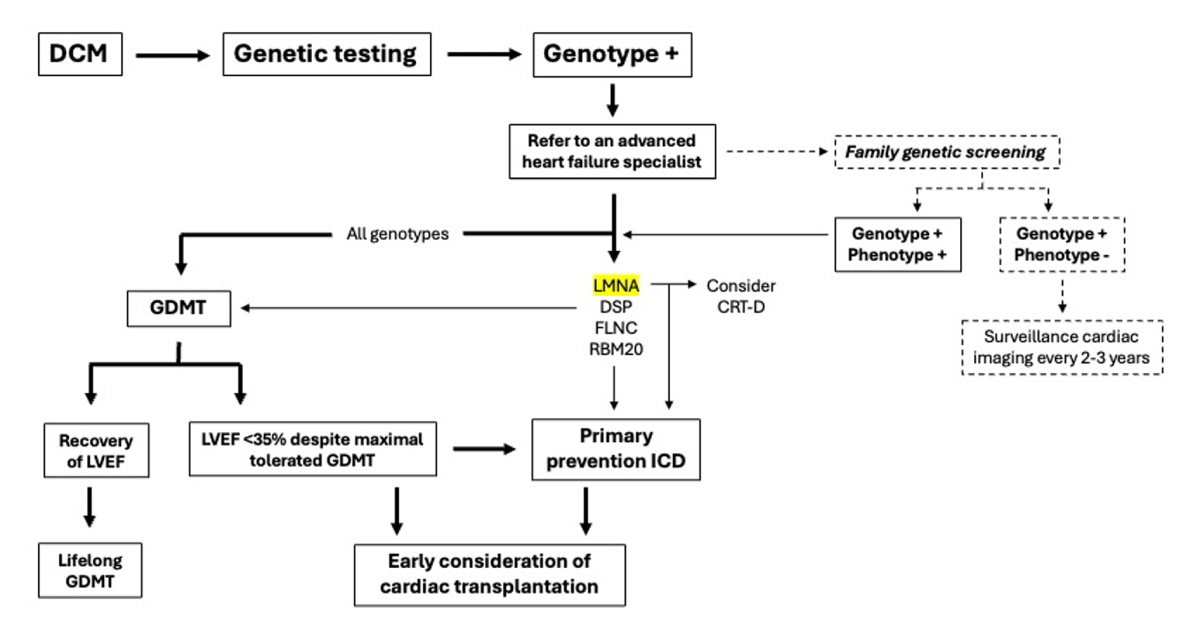
Figure 1
Standard treatment for genetic dilated cardiomyopathy. DCM: dilated cardiomyopathy; GDMT: guideline-directed medical therapy; CRT-D: cardiac resynchronization therapy defibrillator; LVEF: left ventricular ejection fraction; ICD: implantable cardioverter defibrillator