
Introduction
The Utah Cardiac Recovery Symposium (U-CARS), which began in 2013, marked its 12th consecutive year in 2024 and continues to advance the field of myocardial recovery. U-CARS was conceptualized by a University of Utah team that was passionate about advancing myocardial recovery. The conference has drawn healthcare providers and scientists with a broad range of expertise—including basic scientists, clinical researchers, physicians, and practitioners—into the same room to discuss and debate advances in heart recovery. U-CARS is one of a few conferences dedicated to myocardial recovery and has shepherded the task of creating a collective forum where groups interested in this area of work are able to interact and contribute to advances.
The symposium covers a range of topics, from gene therapy to practical treatment approaches, and embodies the founders’ vision of a dynamic, cooperative, and innovative forum. This article is a collaborative effort to capture the proceedings of the U-CARS conference that occurred earlier this year, with input from two teams: (1) Houston Methodist’s Muthu Kumar Krishnamoorthi and Arvind Bhimaraj, who attended the conference, and (2) the University of Utah’s Konstantinos Sideris and Stavros G. Drakos, who contributed in organizing the U-CARS conference.
The U-CARS 2024 was held in Salt Lake City in early February 2024. The keynote address was delivered by Dr. Eric Olson, PhD, from the University of Texas Southwestern, who discussed the potential of CRISPR gene editing for genetic regulation as a crucial original approach in managing heart failure (HF) and recovery. Additionally, the conference featured Clyde Yancy, MD, from Northwestern University, who provided insights on guideline-directed medical therapy (GDMT) for patients with HF with improved/recovered ejection fraction (HFimpEF) and Demetri Yannopoulos, MD, from the University of Minnesota, who delivered a lecture on cardiac arrest that focused on the role of extracorporeal cardiopulmonary resuscitation (ECPR) in treatment.
Pathobiology of Heart Failure and Cardiac Recovery
Genetic Underpinning
Idiopathic dilated cardiomyopathy (DCM) is a HF etiology, where the underlying genetic mechanisms could explicate the potential cause of or susceptibility to HF. Studies on the incidence of DCM revealed that 35% of idiopathic DCM has been attributed as familial,1 exhibiting that a significant proportion of DCM has a genetic origin. While nonischemic cardiomyopathy is a prevalent term, it must be acknowledged that lack of a cause (such as ischemic disease) cannot be a diagnosis and hence indicates a need for further assessment for causality, including DCM as one of the differentials. While genetic underpinning of the causality is emerging, its impact on recovery after HF has not been studied extensively. Data suggests that various genetic variants, such as Titin truncated variants versus Lamin-A mutations versus other variants of unknown significance, have different prognostic and recovery potential with medications,2, 3 but their implications in predicting cardiac recovery or sustainable recovery after durable mechanical circulatory support has not been studied.
Establishing a genetic role of a cardiomyopathy opens the possibility of genetic manipulation to promote myocardial recovery by either enhancing regeneration, genetic silencing, or upregulation or direct genetic reprograming using CRISPR technology.4, 5, 6 In fact, this has become a reality in some mono-genomic disease states, such as Duchenne muscular dystrophy (DMD), which is caused by mutations in the gene encoding dystrophin protein, a membrane-associated protein that is essential for the continuation of muscle structure and function. Patients with DMD suffer from loss of mobility at an early age, leading to premature death from cardiac and respiratory failure. Current treatment strategies have failed to successfully overcome this disease. However, CRISPR gene editing is a promising strategy that has provided novel prospects to improve the disease condition by addressing and eliminating the DMD mutations, thus restoring dystrophin expression throughout skeletal and cardiac muscle. In vitro (human cells) and in vivo (small and large mammals) investigation has corroborated the potential of this method.7, 8, 9 The application of such technology for HF recovery will depend on the ability to identify targets that will yield a clinical benefit.
A broader perspective in understanding the impact of genetics on the incidence of HF could be gained by population genetic studies, such as HerediGENE, which was established in 2018. HerediGENE focused on the genetic analysis of DNA samples to identify and recommend patient testing for genetic risks of cardiovascular diseases. Since its inception, HerediGENE has been used to identify genetic causes of diseases, with some data sets used to exhibit the risk conferred by apolipoprotein B,10 forms of venous thromboembolism,11 and the effects of the complex relationship between genetics and environment on lipid levels and coronary artery disease.12 Studies that focus on HF incidence and recovery in such an early association would be relevant but are currently lacking. Similarly, many genome-wide association studies have identified targets in cardiovascular disease, with one HF analysis identifying 176 risk loci at genome-wide significance for HF.13
Cardiomyocyte regeneration and understanding of the genetic determinants of fetal ability to repair injured hearts has suggested a role of cell cycle regulation. Various aspects of cell-cycle control are being investigated to identify any therapeutic potential to influence cardiomyocyte proliferation to promote HF reversal or some type of recovery. It is evident that the cardiac cell profile reveals a complex interplay between cardiomyocytes and non-cardiomyocytes, and further research is needed to understand the role of genetic control of non-cardiomyocytes in the setting of HF and the potential to influence recovery.
Metabolism in Myocardial Function
The heart has a continuous high-energy demand for optimal contractile function and basal metabolism, which makes energy production and energy source in the cardiac environment paramount. The heart is an omnivore that uses multiple energy substrates such as carbohydrates, lipids, amino acids, lactate, and ketone bodies for ATP production.14, 15 Alterations in metabolic pathways are associated with dysfunctional metabolism that is frequently exhibited in HF.16 Branched chain amino acids play an essential role in energy metabolism. However, impaired branched chain amino acid oxidation is linked to insulin resistance and contributes to cardiac hypertrophy and contractile dysfunction.17 While lipid metabolism contributes significantly to the cardiac energy requirement, defective lipid metabolism can lead to the formation of ceramides, a cardiotoxin that causes lipotoxic cardiomyopathy.18, 19, 20, 21 In addition to cardiomyocytes, dysfunctional lipid metabolism, especially sphingolipid in vascular endothelium, contributes to the development of atherosclerosis.22 Thus, there is a need to understand and explore therapeutic options to regulate cardiac metabolism in HF in order to promote and sustain HF recovery.
Clinical Paradigms of Heart Failure and Cardiac Recovery
American College of Cardiology Stage C: Guideline-Directed Medical Therapy for Heart Failure with Improved/Recovered Ejection Fraction
Heart failure represents a clinical syndrome resulting from multiple myocardial diseases that lead to impaired cardiac output and/or increased intracardiac pressures.23 Traditionally, HF is classified based on left ventricular ejection fraction (LVEF). High mortality rates are prevalent across all types of HF, including those with reduced (HFrEF), mildly reduced, and preserved ejection fractions (HFpEF).24, 25 Recent advancements in HF pharmacotherapy, the introduction of cardiac resynchronization therapy, and better insights into reversible causes of HF have led to significant improvements in LVEF in many patients.23 This improvement has been linked to more favorable outcomes compared to those with stable or declining EF.26 Consequently, a new subgroup was identified as HFimpEF, with the most contemporary definition comprising an initial LVEF < 40% and an increase of ≥ 10% with follow-up measurement > 40%.27, 28 Noteworthy is the fact that HFimpEF is an empiric definition recognized more as a marker of treatment response and favorable clinical outcomes rather than a distinct pathobiological category of HF, considering the diverse causes of the condition.27
While comprehensive guidelines are available for HFrEF populations (which recommend multiple medication and device therapies), recent guidelines have emerged for HFpEF with the benefit of certain agents (ARNI/SGLT2i) in both these types of HF, highlighting the possibility of a continuum of pathobiology contrary to the decades of work that have tried to elucidate the distinctions based on ejection fraction. Current evidence specific to HFimpEF is sparce23, 28; it could be perceived as a continuum towards myocardial recovery/remission, but the true histological and genetic changes with EF improvement have not been studied in humans. Recent animal models have created opportunities to explore the same.29, 30
Various clinical variables have been proposed to predict myocardial recovery,31 and treatment strategy centers around treating any reversible causes of cardiomyopathy as well as initiation and up-titration of GDMT pharmacotherapy. The maintenance of pharmacotherapy in patients who have shown improvement or full recovery of LVEF and symptom relief was investigated in the randomized TRED-HF (Therapy withdrawal in REcovered Dilated cardiomyopathy – Heart Failure) study. It included patients with dilated cardiomyopathy with a full recovery of LVEF from < 40% to ≥ 50% and a normalization of LVEDV and natriuretic peptides level. Patients were randomized to either a stepped withdrawal of drugs or a continuation of treatment. Gradually reducing medication resulted in a relapse of HF in 44% of patients, characterized by a decrease in LVEF > 10% or the resurgence of HF symptoms compared to no relapses in the control group who continued their treatment.32 It is important to note that HFimpEF might be better termed “transient remission of systolic dysfunction” given the frequent recurrence of decreased LVEF.
Studies have shown that in patients with a nonischemic origin of HF, systolic dysfunction reoccurred in nearly 19% of cases, often associated with discontinuation of HF medications.33 Consequently, the current American Heart Association (AHA) Guidelines for managing HF include a Class I, Level B recommendation to continue GDMT that resulted in improved systolic function in patients with HFimpEF.28 Despite the absence of specific evidence for diuretics, a general consensus on weaning and cessation is recommended in patients with HFimpEF. Also, the ability to manage without diuretics may indicate a lower risk of recurrence of HF in HFimpEF patients.27, 34
The recent paradigm of cardiometabolic pathway in HF from trials of SGLT-2 inhibitors shows an expansion from the GLP-1 pathway, with the SELECT “Semaglutide Effects on Cardiovascular Outcomes in People with Overweight or Obesity” trial35 showing benefit in HF outcomes. GLP-1 receptors are ubiquitously expressed in vascular tissue but are lacking in the ventricular myocardium.36 However, animal studies have shown a benefit of GLP-1 agonists to promote LV remodeling and hence opens a frontier to study their role in myocardial recovery.37 In conclusion, HFimpEF is a key indicator of successful treatment and improved outcomes and a reflection of the pathobiology towards recovery. Although there is recent investment in understanding this entity, its management is challenging and highlights the need for future studies. Finally, while the field of HF is identifying pathological and clinical phenotyping instead of an ejection fraction-based classification,38 there might be a need to reinvent the entity of HFimpEF.
American College of Cardiology Stage D: Patients with Mechanical Assist Devices
Patients with durable left ventricular assist devices (LVADs) achieve a significant mortality benefit, and such a support system has been effective in prolonging life and used as a bridge to transplantation. However, using LVADs to recover the myocardium has not gained effective traction in the clinical world. Post-LVAD assessment of myocardial recovery centers around imaging and hemodynamics. Echocardiogram is widely available, and studies have shown a moderate ability to assess filling pressures.39 Effective unloading of the left ventricle while optimizing the right ventricle will be necessary to promote optimal clinical outcomes and perhaps myocardial recovery. Patients continue to have morbidity related to HF despite LVAD use,40 possibly due to ineffective unloading, inadequate systemic perfusion, and underappreciation of LV-RV interactions.41 Accurate assessment of effective unloading might be challenging and needs special consideration42 since most echocardiography criteria historically were validated in patients without LVAD.
Although the current generation of LVADs seem to have a lower incidence of aortic insufficiency compared to the HeartMate II™ (Abbott Cardiovascular),43 accurate assessment of aortic and mitral valve pathologies will be important in the context of cardiac recovery related to surgical planning (device decommissioning versus explantation and need for surgical intervention for valves). Other imaging modalities such as cardiac computed tomography can aid in assessing anatomical relationships of the LVAD, and fluorodeoxyglucose-positron emission tomography can assess infection burden. Such assessments can facilitate thorough surgical planning with regard to myocardial recovery.
Active assessment of myocardial recovery after LVAD placement is not always performed, and there is a need to actively pursue recovery as a desirable goal. Specific strategies such as tools to identify patient cohorts with higher probability of recovery, systematic utilization of invasive hemodynamics to assure effective ventricular and atrial unloading, and appropriate utilization of guideline-directed medical therapy can be implemented to create a “purposeful recovery” program rather than a passive observational strategy.40 Although the percentage of LVAD patients who have undergone device explantation in real world registries is low (approximately 2-3%), studies have shown that the percentage of patients who recover their ejection fraction and have reverse remodeling are 10 times higher in the same registries.44, 45, 46, 47 Furthermore, programs might be incentivized to perform transplantation, and providers could be disincentivized to push the realm of recovery. Further research focused on predictors of successful explant when there is imaging and hemodynamic myocardial recovery after durable LVAD is needed to avoid undue risks and promote physicians to pursue this strategy. The recent International Society for Heart and Lung Transplantation mechanical circulatory support guidelines advocate strongly in favor of pursuing the LVAD bridge-to-recovery strategy in appropriate patients and provide specific guidance on how to manage these patients.48
Surgical planning49 needs to start at the time of initial implant for patients who might be considered for recovery and LVAD explant or decommissioning. Identifying valve pathologies that can be fixed and coronary lesions that might be surgically revascularized at the time of initial implant to maximize recovery potential is currently not established but could be considered. Criteria to establish myocardial recovery to the point of LVAD explant or decommissioning have not been systematically described, but many centers use echo and invasive hemodynamic assessments with LVAD turn down. Some centers also perform cardiopulmonary exercise testing with low-speed settings of the LVAD. Lower speed assessments might need appropriate anticoagulation. Once a determination is made that a patient can tolerate LVAD explant or decommissioning, there is no consensus regarding which technique is better. While the latter poses less surgical risk, a full explant might be needed in situations of infected hardware. Also, the ability to plan a reimplant if needed has not been standardized. Much needs to be done in studies to assess surgical techniques and strategies to optimize myocardial recovery after durable LVAD.
The Role of ECMO in Cardiac Recovery and Survival in Cardiac Arrest Patients
The incidence of unexpected cardiac arrest is notably high in the United States, with approximately 200,000 in-hospital and 350,000 out-of-hospital cardiac arrests occurring annually. Survival rates to hospital discharge following these events are low, ranging from 6% to 26% for in-hospital arrests and typically less than 10% for out-of-hospital arrests.50, 51, 52, 53, 54, 55, 56 Efforts to improve cardiac recovery and overall outcomes in cardiac arrest are increasingly involving the use of extracorporeal techniques to restore circulation.57, 58, 59 One such approach is the use of venoarterial extracorporeal membrane oxygenation (ECMO) during cardiac arrest, which is referred to as extracorporeal cardiopulmonary resuscitation (ECPR).
ECMO-facilitated resuscitation achieves three primary objectives in patients with refractory cardiac arrest: it reliably normalizes perfusion, provides cardiopulmonary support to identify and treat the underlying cause (typically severe coronary artery disease with both chronic and acute coronary occlusions), and ensures consistent access to the catheterization laboratory for angiography and angioplasty when necessary. Additionally, it serves as a bridge-to-recovery in the intensive care unit, mitigating the risk of accelerated deterioration and death from multiorgan injury sustained during prolonged resuscitation efforts.60, 61, 62
Data strongly support the effectiveness of ECPR in improving survival rates and neurological outcomes in patients with refractory cardiac arrest, as evidenced by multiple studies demonstrating significantly better results with ECPR compared with standard cardiopulmonary resuscitation (CPR) or advanced cardiovascular life support (ACLS). Propensity-score matched analyses by Chen et al. and Shin et al. demonstrated significantly better outcomes with ECPR, with Chen et al. reporting a 30.4% survival to discharge rate with good neurological function (Cerebral Performance Category 1-2) compared to 15.2% with CPR,58 and Shin et al. showing 2-year survival rates of 20% for ECPR versus 5% for CPR,57 Ouweneel et al. conducted a meta-analysis of matched pairs and found that 30-day survival with good neurological outcomes was 23% for ECPR compared with 9.7% for CPR. Additionally, a multicenter retrospective study from Lunz et al. demonstrated higher 3-month survival rates for in-hospital cardiac arrest of 34.2% with ECPR compared to 9% for out-of-hospital cardiac arrest.
Yannopoulos et al. compared an ECPR protocol to historical controls, reporting improvement in survival to discharge with good neurological outcomes (Cerebral Performance Category 1-2), achieving 41.9% for ECPR versus 15.3% for standard CPR (OR 4; P < .0001).60 Yannopoulos et al. also conducted a randomized controlled trial comparing ECPR to standard ACLS and found that survival to hospital discharge was 43% for ECPR versus 7% for ACLS; this demonstrated a significant risk difference of 36% and a relative risk of 0.61, with a posterior probability of ECPR superiority at 0.9861.61 These trials collectively reinforce the superior efficacy of ECPR in improving survival and neurological outcomes in refractory cardiac arrest cases. Future studies should focus on refining patient selection criteria, optimizing protocols, and exploring the long-term benefits and risks of ECPR to further validate its efficacy and enhance its implementation in clinical practice.
Commentary on Learnings from the Conference
Myocardial recovery without disease recurrence will become possible when the underlying biology of heart pathology and recovery are understood (Figure 1). The current understanding and hence treatment focuses on cardiomyocytes. For cardiac recovery to manifest, regeneration of functional cardiomyocytes is crucial. Delivery of differentiated and functionally mature pluripotent stem-cell-derived cardiomyocytes or direct reprogramming using CRISPR in native cells of the damaged myocardium could contribute to local or organ-level recovery in physiology and function.
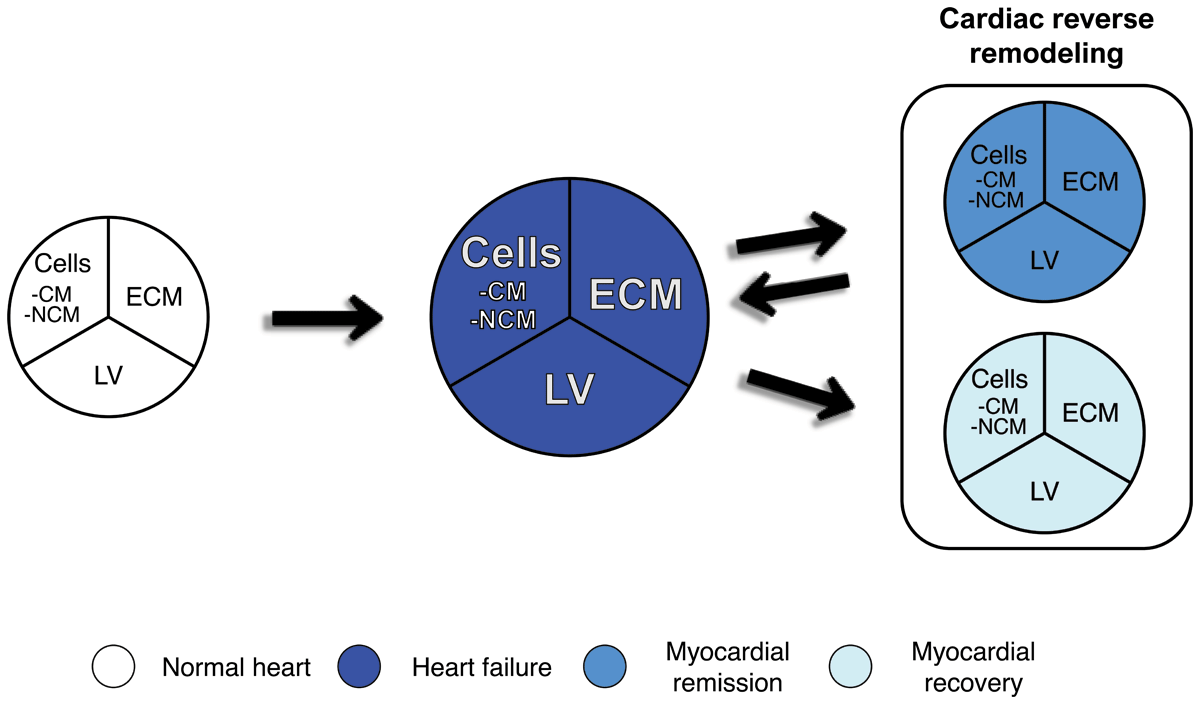
Figure 1
Conceptualization of myocardial recovery. Normal cardiac milieu adaptation during heart failure results in abnormalities of distinct factors such as CM and NCM, the ECM, and the modified LV geometry. Myocardial recovery could manifest in two forms: (1) remission, where further heart failure events can reoccur, or (2) myocardial recovery that is free from further cardiac insufficiencies. Modified from Mann et al.66 CM: cardiomyocytes; NCM: non-cardiomyocytes; ECM: extracellular matrix; LV: left ventricular
Challenges such as precise gene editing, gene delivery mechanisms, and the issue of immune response still exist and require further research. However, recent evidence suggests that non-cardiomyocytes contribute to the progression of cardiac events and hence could be an important therapeutic target. It would be insightful to explore the role of non-cardiomyocyte cells in the cardiac environment, which could lead to better understanding of the disease. The complex interplay between non-cardiomyocytes (eg, resident fibroblasts, microvascular endothelial cells, pericytes, and endocardial endothelial cells), the extracellular matrix, and cardiomyocytes seems to be a dynamic process that changes throughout HF and recovery.29
Myocardial recovery can be conceptualized into two steps: (1) promoting recovery from a pathological state, and (2) maintenance of the recovered heart function for the long term. While clinical parameters to identify recovery potential have been established in database studies, specific biological predictors must be further investigated.31, 63, 64, 65 Currently, all patients receive GDMT to promote recovery while also being assessed for reversible causes. Therapeutic agents targeting dysfunctional metabolic pathways offer a promising strategy for the management of metabolic dysfunction-induced cardiomyopathy. Comprehensive investigation of different metabolites and pathways in heart failure with reduced and preserved ejection fraction would provide useful direction to focus on mitigating metabolism dysfunction.
Personalized treatment strategies will be possible if large-scale genotypic and phenotypic studies are able to identify profiles of patients who might respond better to various strategies. Population genetics study genotypic and phenotypic alterations and can be used to evaluate and monitor specific mutations that lead to cardiovascular diseases. However, there are some limitations in successfully employing this strategy, including adequate patient population data necessary to draw clinically relevant conclusions, and timely follow-up and counseling for patients. Conversely, bolstering the genetic testing and counselling infrastructure would result in population genetics being a powerful tool. Future research should aim to understand the underlying mechanisms of recovery and the potential role of targeted therapies in sustaining heart function and preventing relapse of HFimpEF.
Our understanding of cardiogenic shock has advanced recently, with organized efforts to recover individuals from a shock state. While the physiology of a shock state at the organism level implicates the involvement of various organs, myocardial rest and load have been conceptual frameworks that have revolutionized the field of temporary mechanical support to promote a chance for the heart to recover. Various mechanical support devices can have different physiological implications on the heart when used in patients with cardiogenic shock, and the implications of possible recovery can draw parallels from the learning of long-term support using durable LVADs.
In order for the field of HF recovery to progress, conferences such as U-CARS are necessary so that like-minded researchers, clinicians, and industry partners can gather to learn and exchange information and ideas. The 2024 symposium emphasized the importance of genetic and metabolic research in driving advances in HF management, underscored the need for ongoing research and pharmacotherapy in HFimpEF to prevent relapse, and highlighted the significant role of ECPR in improving outcomes for cardiac arrest patients who may progress to cardiogenic shock. Through collaborative efforts and interdisciplinary discussions, U-CARS demonstrates a commitment to integrating innovative research with clinical practice, fostering the ongoing quest to promote cardiac recovery.
Key Points
Myocardial recovery is possible through a multipronged approach.
Clinical focus on guideline-directed medical therapy and device-based interventions can ameliorate and accelerate cardiac recovery.
Population genetics is a powerful tool that can be explored to aid in early diagnostics and treatment of an at-risk population.
Genetic modifications through targeted approaches like CRISPR would be a promising strategy if accompanied by thorough methodological refinements and efficacy validation in different models.
Active discussion at scientific forums such as U-CARS that promote dialogue between research scientists and clinicians would lead to development of better treatment modalities for myocardial recovery.
Competing Interests
Dr. Bhimaraj is a consultant for Abbott and Abiomed. Dr. Drakos is a consultant for Abbott, conducts research on behalf of Novartis, National Institutes of Health, US Department of Veterans Affairs, and the American Heart Association, and co-organizes the UCARS conference. The other authors have no competing interests to declare.
Author Contributions
Authors Muthu Kumar Krishnamoorthi and Konstantinos Sideris contributed equally.