
Table 1
Clinical trials assessing changes in infarct size with various clinical interventions.8, 9, 10, 11, 12, 13, 14, 15, 16, 17 STEMI: ST-segment elevation myocardial infarction: PCI: percutaneous coronary intervention; SPECT: single-photon emission computed tomography; CMR: cardiac magnetic resonance; IABP: intra-aortic balloon pump
| TRIAL | PATIENTS ENROLLED (N) | TEST FOR INFARCT SIZE | KEY INTERVENTION | PRIMARY END POINT | KEY FINDING |
|---|---|---|---|---|---|
| EMERALD8 | 501 | SPECT | PCI with balloon occlusion and aspiration distal microcirculatory protection system vs angioplasty without distal protection | ST segment resolution after PCI and infarct size measured by SPECT 5–14 days post-intervention | Distal embolic flow did not improve the rate of reperfusion success, reduce infarct size, or enhance event-free survival |
| AMIHOT-II9 | 301 | SPECT | 90-minute intracoronary supersaturated oxygen infusion versus standard of care | Assessment of infarct size and major adverse events at 30 days post-intervention | For patients with anterior STEMI, infusion of super-saturated oxygen results in a significant reduction in infarct size |
| IMMEDIATE10 # | 54 | SPECT | Intravenous administration of glucose, infusion, and potassium in acute coronary syndrome patients versus placebo | Substudy: Assessment of heart failure at 30 days, infarct size, left ventricular function, and beta-natriuretic peptide levels | Substudy: Among patients presenting with ST-segment elevation, infarct size was lower than placebo. |
| APEX-AMI10, 11 # | 99 | CMR | Administration of pexelizumab versus placebo in patients undergoing primary PCI of first myocardial infarction | Substudy: Assessment of infarct size and left ventricular ejection fraction | Substudy: Pexelizumab-treated patients had smaller infarct sizes and high left ventricular ejection fraction |
| LIPSIA-ABCIXIMAB12 | 154 | CMR | Administration of intracoronary vs intravenous abciximab in patients undergoing primary PCI | The primary end point was infarct size and extent of microvascular obstruction on CMR | Intracoronary administration is superior to intravenous administration of abciximab with respect to infarct size and extent of microvascular obstruction |
| LIPSIA-N-ACC13 | 251 | CMR | Administration of N-acetylcysteine versus placebo in patients with STEMI undergoing primary PCI | Changes in serum creatinine level and reduction in reperfusion injury measured as myocardial salvage index | N-acetylcysteine reduces oxidative stress but does provide additional benefit in contrast induced nephropathy and myocardial reperfusion injury |
| LIPISA- STEMI14 | 162 | CMR | Pre-hospital tenecteplase with primary PCI versus primary PCI with antithrombotic comedication in patients with STEMI with long transfer distance | Infarct size assessed by CMR | Fibrinolytic based assisted PCI does not offer improved benefit with respect to infarct size when compared to primary PCI |
| CRISP-AMI15 | 337 | CMR | Insertion of IABP in anterior STEMI prior to primary PCI with continuation for 12 hours versus primary PCI alone | Infarct size measured by CMR 3–5 days post PCI | IABP with primary PCI in STEMI without shock did not improve infarct size vs primary PCI |
| AIDA STEMI16 | 795 | CMR | Intravenous versus intracoronary Abciximab administration in STEMI | Infarct size as determined by CMR | No benefit in intravenous versus intracoronary administration of abciximab with respect to myocardial damage and/or reperfusion injury |
| INFUSE AMI17 | 452 | CMR | intracoronary abciximab versus manual aspiration thrombectomy or both in patients with STEMI | Infarct size at 30 days as determined by CMR | In patients undergoing PCI with bivalirudin, intracoronary abciximab reduced infarct size at 30 days but not with aspiration thrombectomy |
[i] # Substudy of clinical trial
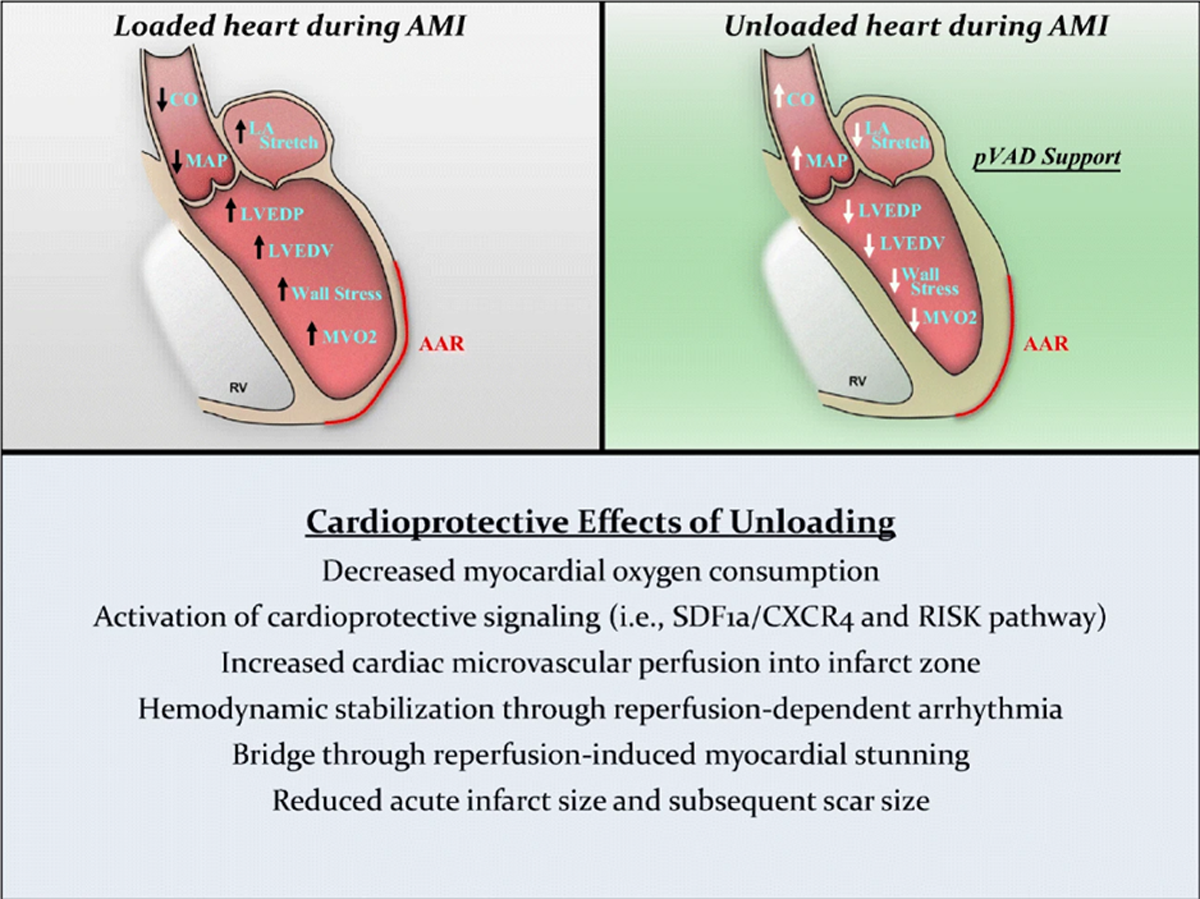
Figure 1
Cardioprotective effects of left ventricular unloading. Image adapted from Curran et al.30 AMI: acute myocardial infarction; VAD: ventricular assist device; RISK: reperfusion injury salvage kinase; CO: cardiac output; MAP: mean arterial pressure; LVEDP: left ventricular end-diastolic pressure; LVEDV: left ventricular end-diastolic volume; MVO2: myocardial oxygen consumption; LA: left atrial; AAR: myocardial area at risk