
STEMI Incidence, Prevalence, and Infarct size
Acute coronary syndrome is a significant cause of morbidity and mortality in the United States—with cardiovascular disease, the leading cause of death, accounting for about 750,000 deaths in 2016.1 Nationwide inpatient demographic trends in ST-elevation myocardial infarction (STEMI) hospitalization from 2004 to 2020 show a decline in inpatient hospitalization from 98.7 per 100,000 to 49 per 100,000.2 Age and sex-adjusted incidence rates during the same period also showed a decrease in mortality, with rates dropping from 25% to 22% for individuals above the age of 85 and from 13% to 10.5% for those aged 65 to 84.2 Data from 1998 to 2008 showed a decreased incidence in the rates per 100,000 person-year for STEMI and an overall decrease in the incidence of myocardial infarctions (combined STEMI and non–ST-elevation acute coronary syndromes).3 With the decline in incidence rates, in-hospital and 1-year mortality rates have also decreased, attributed to advancements in medications, prompt reperfusion therapy, and enhanced detection through improved troponin assays.4, 5 Rapid restoration of flow via fibrinolytic therapy or primary percutaneous coronary interventions has proven to reduce infarct size and improve survival.6
Pooled patient analysis from 10 randomized controlled trials examining the relationship between infarct size 1 month after primary percutaneous coronary intervention (PCI) for STEMI and subsequent mortality, reinfarction, and hospitalization for heart failure revealed a strong independent relationship within 1-year follow-up.7 The study also found that infarct size, measured 1 month after primary PCI, is a strong independent predictor of 1-year heart failure hospitalization, with a graded relationship between infarct size and the occurrence of heart failure hospitalizations. For every 5% increase in infarct size, there was a 19% increase in 1-year all-cause mortality and a 20% increase in 1-year hospitalizations for heart failure.7 This meta-analysis indicates that reducing infarct size could significantly lower the incidence of heart failure hospitalizations (Table 1).8, 9, 10, 11, 12, 13, 14, 15, 16, 17 In a prospective cohort study assessing patients with their first STEMI treated with primary PCI, a direct inverse relationship was found between infarct size greater than 15% and LV ejection fraction.18 Given that systolic dysfunction post-STEMI correlates with poor patient outcomes in both the short and long term, evidence increasingly supports therapies aimed at reducing infarct size to improve heart failure incidence rates.
Table 1
Clinical trials assessing changes in infarct size with various clinical interventions.8, 9, 10, 11, 12, 13, 14, 15, 16, 17 STEMI: ST-segment elevation myocardial infarction: PCI: percutaneous coronary intervention; SPECT: single-photon emission computed tomography; CMR: cardiac magnetic resonance; IABP: intra-aortic balloon pump
| TRIAL | PATIENTS ENROLLED (N) | TEST FOR INFARCT SIZE | KEY INTERVENTION | PRIMARY END POINT | KEY FINDING |
|---|---|---|---|---|---|
| EMERALD8 | 501 | SPECT | PCI with balloon occlusion and aspiration distal microcirculatory protection system vs angioplasty without distal protection | ST segment resolution after PCI and infarct size measured by SPECT 5–14 days post-intervention | Distal embolic flow did not improve the rate of reperfusion success, reduce infarct size, or enhance event-free survival |
| AMIHOT-II9 | 301 | SPECT | 90-minute intracoronary supersaturated oxygen infusion versus standard of care | Assessment of infarct size and major adverse events at 30 days post-intervention | For patients with anterior STEMI, infusion of super-saturated oxygen results in a significant reduction in infarct size |
| IMMEDIATE10 # | 54 | SPECT | Intravenous administration of glucose, infusion, and potassium in acute coronary syndrome patients versus placebo | Substudy: Assessment of heart failure at 30 days, infarct size, left ventricular function, and beta-natriuretic peptide levels | Substudy: Among patients presenting with ST-segment elevation, infarct size was lower than placebo. |
| APEX-AMI10, 11 # | 99 | CMR | Administration of pexelizumab versus placebo in patients undergoing primary PCI of first myocardial infarction | Substudy: Assessment of infarct size and left ventricular ejection fraction | Substudy: Pexelizumab-treated patients had smaller infarct sizes and high left ventricular ejection fraction |
| LIPSIA-ABCIXIMAB12 | 154 | CMR | Administration of intracoronary vs intravenous abciximab in patients undergoing primary PCI | The primary end point was infarct size and extent of microvascular obstruction on CMR | Intracoronary administration is superior to intravenous administration of abciximab with respect to infarct size and extent of microvascular obstruction |
| LIPSIA-N-ACC13 | 251 | CMR | Administration of N-acetylcysteine versus placebo in patients with STEMI undergoing primary PCI | Changes in serum creatinine level and reduction in reperfusion injury measured as myocardial salvage index | N-acetylcysteine reduces oxidative stress but does provide additional benefit in contrast induced nephropathy and myocardial reperfusion injury |
| LIPISA- STEMI14 | 162 | CMR | Pre-hospital tenecteplase with primary PCI versus primary PCI with antithrombotic comedication in patients with STEMI with long transfer distance | Infarct size assessed by CMR | Fibrinolytic based assisted PCI does not offer improved benefit with respect to infarct size when compared to primary PCI |
| CRISP-AMI15 | 337 | CMR | Insertion of IABP in anterior STEMI prior to primary PCI with continuation for 12 hours versus primary PCI alone | Infarct size measured by CMR 3–5 days post PCI | IABP with primary PCI in STEMI without shock did not improve infarct size vs primary PCI |
| AIDA STEMI16 | 795 | CMR | Intravenous versus intracoronary Abciximab administration in STEMI | Infarct size as determined by CMR | No benefit in intravenous versus intracoronary administration of abciximab with respect to myocardial damage and/or reperfusion injury |
| INFUSE AMI17 | 452 | CMR | intracoronary abciximab versus manual aspiration thrombectomy or both in patients with STEMI | Infarct size at 30 days as determined by CMR | In patients undergoing PCI with bivalirudin, intracoronary abciximab reduced infarct size at 30 days but not with aspiration thrombectomy |
[i] # Substudy of clinical trial
Reperfusion injury
Reducing infarct size has traditionally focused on minimizing door-to-balloon time to reperfuse the myocardium as swiftly as possible.19 Although timely reperfusion has decreased 30-day mortality for STEMI, evidence suggests that beyond a certain threshold, further reductions in door-to-balloon time yield minimal additional benefits.20 Despite national improvements in achieving door-to-balloon time, the incidence of heart failure post-index myocardial infarction continues to escalate.21 This trend has shifted focus towards mitigating reperfusion injury, a significant factor in the reperfusion process. Four primary mechanisms of reperfusion injury can impact the myocardium, either reversibly or irreversibly: reperfusion-induced arrhythmias, myocardial stunning, microvascular obstruction, and lethal myocardial reperfusion injury.22 Lethal myocardial reperfusion injury, defined as damage to previously viable ischemic myocardium due to reperfusion, underscores that optimal door-to-balloon times do not always correlate with decreased heart failure hospitalizations.23
Experiments analyzing the effects of reperfusion injury after initial reperfusion found the most notable damage in the subendocardial layer of the LV wall.24 The analysis indicated that microvascular deficits were most consistent with the presence of membrane-bound “blebs” obstructing the endothelial lining of the microvasculature. These changes were localized to areas of endothelial damage. Significant swelling of localized myocytes was also observed, which is hypothesized to cause the no-reflow phenomenon.24 Additionally, these areas of microvascular swelling continued to expand in the first few hours after establishing epicardial vessel flow, suggesting that the no-reflow phenomenon may be related to reperfusion injury.
Factors such as oxidative stress,25 intracellular and mitochondrial calcium overload,23 neutrophil attraction to the infarcted myocardium,26 and mitochondrial PTP channel opening causing cellular destruction have been identified as contributors to lethal myocardial reperfusion injury. Gene-targeted therapies in animal models have addressed the adverse effects of this injury type. For instance, simvastatin application in rat models with left anterior descending artery occlusion showed a reduction in myocardial oxidative stress markers.27 Another study demonstrated that administering recombinant Sonic hedgehog homolog ligand prior to reperfusion significantly reduced infarct size compared to controls.28 Pharmacological and mechanical interventions targeting the reperfusion injury salvage kinase (RISK) pathway—a series of proteins activated during reperfusion to mitigate injury—have proven effective in reducing infarct sizes.29 However, translating these findings from animal models to human trials has been challenging, often due to difficulties in administering treatments and translating lab results to clinical settings.
Left Ventricular Unloading
Left ventricular unloading can be defined as attempts to reduce myocardial oxygen consumption and assist in hemodynamic challenges that overall reduce cardiac remodeling and infarct size. Left ventricular hemodynamics are significantly affected during and following acute myocardial infarction. After myocardial injury, cardiac contractility and ventricular compliance are significantly impacted. The end-systolic pressure-volume relationship, which correlates with cardiac contractility, is greatly reduced. As a result, there is a reduction in pressure generation and a decrease in stroke volume. The end-diastolic pressure-volume relationship, which correlates with ventricular compliance, also experiences change. The compliance curve shifts, with the left ventricle becoming stiffer and less compliant. As a result, there is a reduction in cardiac stroke work, and thus the overall cardiac mechanical work, which is detrimental to end-organ perfusion if persistent.
Overall, given the work-related oxygen consumption deficiencies that occur after acute myocardial infarction, minimization of this detrimental state can be achieved by left ventricular unloading (Figure 1),30 thereby improving LV hemodynamics. Transvalvular microaxial flow devices that are commercially available to provide support at various flow states have been shown to improve LV hemodynamics. These devices can provide LV unloading with various flows ranging from 2.5 to 5.5 L/min. Multiple clinical trials have examined the hemodynamic effects of the transvalvular axial pump. Coronary hemodynamics assessment across angiographically significant lesions by pressure guide wire after Impella CP (Abiomed, Inc.) and Impella 5.0 placement at minimal and maximal LV unloading support found an improvement in coronary perfusion pressure in critical coronary artery stenosis.31 Studies have shown that the use of Impella devices has led to decreased LV end-diastolic pressure and an associated decrease in LV wall tension, thus decreasing microvascular resistance.31, 32 Maximal support provided by these devices has also been shown to improve systemic systolic blood pressure, diastolic blood pressure, and mean arterial blood pressure.31
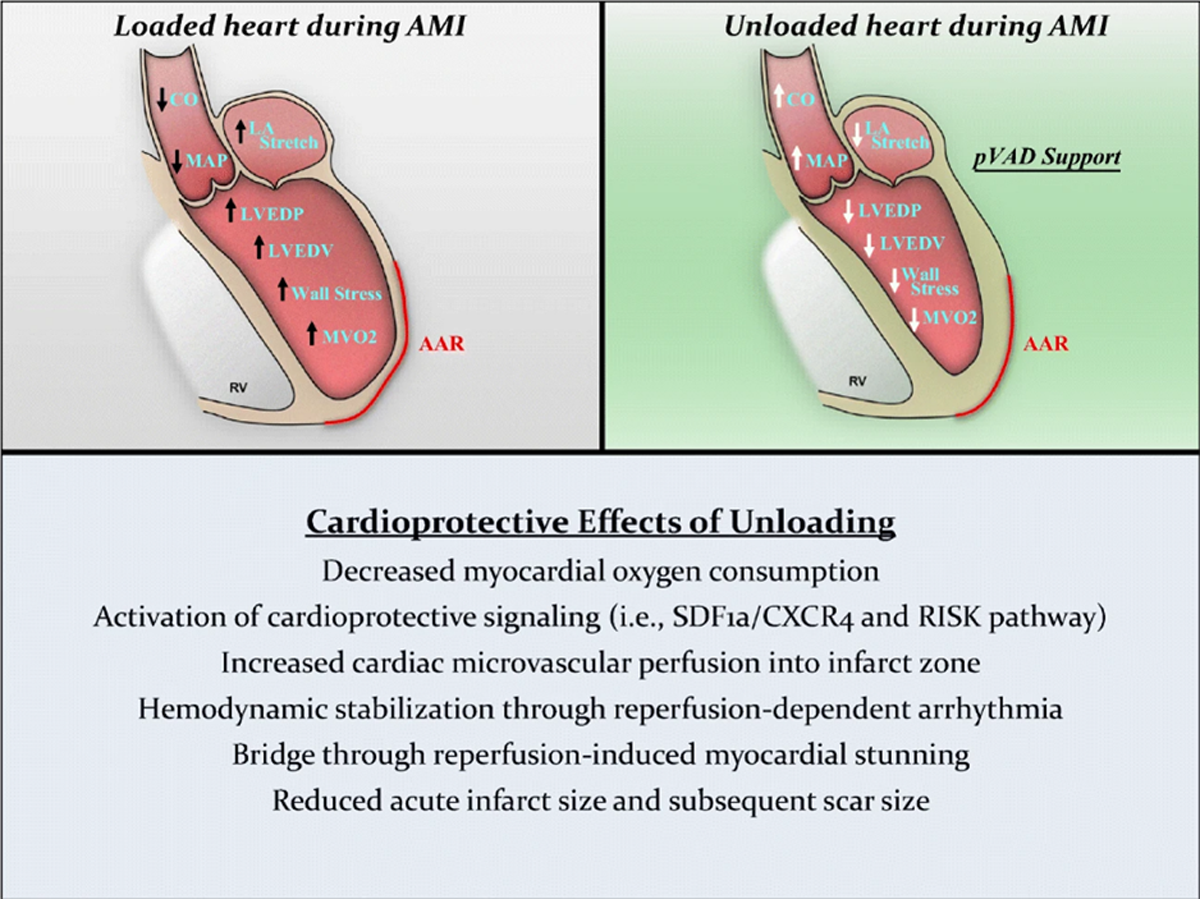
Figure 1
Cardioprotective effects of left ventricular unloading. Image adapted from Curran et al.30 AMI: acute myocardial infarction; VAD: ventricular assist device; RISK: reperfusion injury salvage kinase; CO: cardiac output; MAP: mean arterial pressure; LVEDP: left ventricular end-diastolic pressure; LVEDV: left ventricular end-diastolic volume; MVO2: myocardial oxygen consumption; LA: left atrial; AAR: myocardial area at risk
Given these hemodynamic effects, the use of Impella devices in the management of cardiogenic shock in the setting of acute myocardial infarction has been extensively studied.33, 34 Data obtained from the 2014 USpella Registry, which described the use of the Impella 2.5 device for acute myocardial infarction complicated by cardiogenic shock (AMICS), suggested that early hemodynamic support before PCI has the potential to improve outcomes by stabilizing hemodynamics during the intervention.33 A meta-analysis comparing early versus late initiation of Impella CP devices in AMICS suggested a decrease in in-hospital and 30-day mortality by almost 50% with early initiation of LV unloading using Impella devices.34 A prospective randomized controlled trial has also described Impella CP devices as having a potential clinical indication in the use of high-risk PCI in patients with reduced ejection fraction.35 A matched analysis of over 28,000 patients with acute myocardial infarction complicated by cardiogenic shock, conducted by Dhruva et al., examined outcomes among those undergoing PCI for AMICS treated with mechanical circulatory support devices.36 This propensity-matched, registry-based, retrospective cohort study encompassing patients from October 2015 to December 2017 found that only 6% of patients utilized microaxial LV assist devices compared to 30% who received intra-aortic balloon pumps. The findings indicated that the use of intravascular microaxial LV assist devices during this period was associated with a higher adjusted risk of in-hospital death and major bleeding complications compared to patients treated with an intra-aortic balloon pump.36
Devices and Therapies
Supersaturated Oxygen Delivery
Porcine coronary occlusion models replicating myocardial infarction treated with supersaturated oxygen showed a decreased presence of peroxide radicals, inhibiting leukocyte activation and altering nitric oxide synthase expression.37 Animal models with 60 to 90 minutes of coronary occlusion, followed by 90 minutes of intracoronary aqueous oxygen after 15 minutes of reperfusion, demonstrated improved microvascular blood flow.38 Repeated randomized clinical trials on animals have shown promising results.39 A randomized study assessing patients undergoing hyperoxemic therapy post anterior or large inferior STEMI indicated potential reduction in infarct size for those with anterior infarctions who received reperfusion within 6 hours, as observed in a post hoc analysis.40 Consequently, a prospective multicenter trial was conducted on anterior STEMIs treated within 6 hours of symptom onset with 90 minutes of intracoronary aqueous oxygen infusion compared to standard care.9 The findings included a reduction in infarct size with a noninferior rate of major cardiovascular events at 30 days. Results showed that the absolute reduction, measured by single-photon emission computed tomography imaging using Tc-99 m-sestamibi, was most significant in patients with the largest infarct sizes, who typically have a poor prognosis despite successful, timely PCI.9 The reduction in infarct size was noted to be 10% in patients with a baseline reduced ejection fraction of less than 40%. While the underlying mechanism for these effects remains unclear, it suggests that reperfusion injury and its subsequent improvement with aqueous oxygen therapy may have played a role. However, improvement in survival was not observed in this randomized trial.
Pressure-Controlled Intermittent Coronary Sinus Occlusion
Suboptimal microvascular perfusion post-revascularization of acute myocardial infarction has been related to increases in infarct size, with every 5% increase in infarct size associated with an increase in mortality and hospitalization for heart failure within 1 year.41 To enhance microvascular perfusion and reduce infarct size, pressure-controlled intermittent coronary sinus occlusion (PiCSO) catheter-based technology has been tested to potentially improve coronary microvascular flow.42 The device is a catheter-based system that inflates and deflates cyclically, providing a transient increase in coronary sinus pressure, which redistributes flow from remote to ischemic myocardium. The PiCSO-AMI-I trial randomized therapy in patients with anterior STEMI to conventional PCI versus PiCSO-assisted percutaneous intervention.42 The results of 145 randomized patients did not meet the primary end point of reducing infarct size measured at 5 days by cardiac magnetic resonance imaging (MRI) with intermittent coronary sinus occlusion as adjunctive therapy to PCI. The trial also did not meet any end points at 6 months. There was a significantly high rate of nonresponders noted in the clinical trial, up to 30%, where coronary sinus occlusion did not cause a significant variation in coronary sinus pressure. Contrary to the randomized PiCSO-AMI-I trial, the OxAMI (Oxford Acute Myocardial Infarction)–PiCSO study showed improvement in microvascular function and reduction in ischemic size at 6 months in patients who were noted to have preprocedural microvascular resistance of greater than 40 units.43 Comparatively, patients with pre-PCI microvascular resistance of less than 40 units had a lower infarct size with conventional PCI, suggesting that intermittent coronary sinus occlusion may be a technology reserved for patients with elevated pre-procedural microcirculatory resistance.43
DanGer Shock Trial
There is still significant uncertainty surrounding the use of microaxial flow pumps for routine use in the setting of AMICS and subsequent outcomes. As such, an international open-label multicenter clinical trial was conducted by the Danish–German Cardiogenic Shock (DanGer Shock) investigators to assess whether the use of Impella CP (Abiomed Inc.) pumps in addition to standard of care was associated with reduced mortality in patients with acute STEMI complicated by cardiogenic shock.44 The trial enrolled patients who were hypotensive with systolic blood pressure below 100 mm Hg, had end-organ dysfunction with lactic acid greater than 2.5 mm/L, and LV ejection fraction of less than 45%. Patients underwent 1:1 randomization when cardiogenic shock was diagnosed and underwent PCI with Impella support that was sustained for 48 hours or PCI with the use of inotropes or vasopressors. The 355 patients enrolled were monitored for the primary end point of all-cause mortality up to 180 days. Patient characteristics were median age of 67 years, with median LVEF of 25%, a median lactate of 4.5 mmol/L, and 45% were Society for Cardiovascular Angiography and Interventions (SCAI) shock classification D or E. The results found that at 180 days since randomization, the use of Impella with standard of care was associated with a lower all-cause mortality when compared with standard of care alone (HR 0.74; 95% CI, 0.55–0.99; P = .04). Adverse events noted in the experimental arm were also associated with an increased percentage of moderate or severe bleeding, limb ischemia, renal replacement therapy, and sepsis, 24.0% in treatment arm vs 6.2% in the standard of care group (RR 4.7; 95% CI, 2.36–9.55).
The results of the trial showed that routine use of patients with STEMI-associated AMICS in the specific characteristics of the cohort enrolled in the clinical trial reduced death from any cause. Moreover, it was associated with an increased rate of adverse events. This clinical trial identified the potential opportunity to benefit a specific subset of patients where microaxial flow pump insertion may potentially reduce mortality. The trial also highlights that the treatment arm still experienced 45% mortality at 180 days, suggesting that management of this cohort still needs further exploration.
STEMI Door-To-Unload Pivotal Trial
Testing on the ability of LV unloading in the setting of acute myocardial infarction has found that LV unloading with delayed reperfusion for 30 minutes activates cardioprotective mechanisms, allowing for the reduction of lethal reperfusion injury and promoting myocardial recovery 30 days after the acute myocardial infarction.45 In determining the optimal timing of unloading to achieve cardioprotective effects for the reduction of lethal reperfusion injury, studies on Yorkshire swines showed that reperfusion 30 minutes after initiating the transvalvular pump achieved a statistically significant reduction in myocardial infarct size compared to reperfusion alone.45 Due to these preclinical findings, the STEMI Door-To-Unload (STEMI-DTU) pilot trial was conducted to assess the safety and feasibility of LV unloading prior to reperfusion in the setting of STEMI without cardiogenic shock.46
In a prospective multicenter randomized clinical trial conducted at 14 centers in the United States, 50 patients with anterior STEMI were randomized to undergo LV unloading with immediate revascularization versus LV unloading for 30 minutes with subsequent delayed reperfusion. The goal of the trial was to assess the safety of LV myocardial unloading for 30 minutes prior to reperfusion with PCI. The primary safety end point assessed the composite of major cardiovascular or cerebrovascular events at 30 days along with other additional safety parameters. The primary efficacy end point assessed infarct sizes compared to the total LV mass using cardiac MRI at 30 days post myocardial infarction.
Results assessing the primary efficacy end point showed no statistically significant difference between the two study arms. Infarct size normalized to the area at risk for both the door-to-unload and door-to-immediate revascularization group with Impella also was not observed to have a statistically significant difference. The primary safety end point, which assessed composite 30-day outcomes for major adverse cardiovascular events, showed no statistically significant difference between the two groups. This trial demonstrated that LV unloading with a planned delay of door-to-balloon time by 30 minutes was safe and feasible, with no difference in adverse events. The pilot trial provided the first experimental experience to the paradigm shift towards door to unload in the human population.
Given the safety and efficacy of the door-to-unload strategy in the human pilot trial, the STEMI DTU pivotal trial was initiated47—a prospective randomized multicenter trial comparing LV unloading with Impella CP for 30 minutes prior to reperfusion to the current recommended guideline for primary PCI strategy. The primary trial end point is to compare infarct size as a percentage of LV mass between the door-to-unload group and the primary PCI group. Secondary end points will compare composite rates of 1-year cardiovascular mortality, cardiogenic shock more than 24 hours after PCI, use of surgical LV assist device or heart transplant, heart failure, intracardiac defibrillator or chronic resynchronization therapy placement, and infarct size 3 to 5 days post-PCI. A total of 668 patients are planned to be prospectively randomized with a 1:1 ratio to the primary PCI strategy versus LV unloading with the Impella CP device for 30 minutes prior to primary PCI. Patients will be followed up for 5 years to assess primary and secondary end points with prespecified follow-up visits at various durations. Cardiac MRI assessments will also be performed at 3 to 5 days and at 6 months. The objective of the trial is to examine whether LV unloading via percutaneous transvalvular mechanical support for 30 minutes prior to primary PCI can reduce infarct size and the incidence of heart failure-related clinical events.
Conclusion
This analysis of the underlying basic science data, hemodynamic assessment, recent publications, and upcoming clinical trials hoped to provide insight into the potential shift in the paradigm of how acute coronary syndromes may be managed in the future. Infarct size post-myocardial infarction is a key component in the incidence of heart failure hospitalizations that patients experience after reperfusion. Reperfusion science elaborates on potential biochemical pathways that are responsible for infarct size and the potential of LV unloading leading to improvement in reperfusion injury. A recently published clinical trial has shown promising improvements in mortality with LV unloading in the setting of STEMI complicated by cardiogenic shock. Clinical trials are ongoing to assess the routine use of unloading with microaxial pumps in the setting of STEMI without cardiogenic shock.
Key Points
Infarct size post-percutaneous coronary intervention is a crucial predictor of heart failure hospitalizations and all-cause mortality, emphasizing the need for strategies to reduce infarct size.
Managing reperfusion injury remains a challenge, with ongoing research focused on therapeutic strategies to mitigate its impact and improve long-term outcomes for patients with ST-elevation myocardial infarction (STEMI).
Early initiation of left ventricular unloading before reperfusion has shown promise in reducing infarct size and improving outcomes in STEMI patients, though translating these benefits to clinical practice remains challenging.
Competing Interests
Dr. Kapur receives consulting/speaker honoraria and research funding from Abbott, Abiomed, Boston Scientific, Medtronic, LivaNova, MD Start, and PreCARDIA. The other authors have no competing interests to declare.