
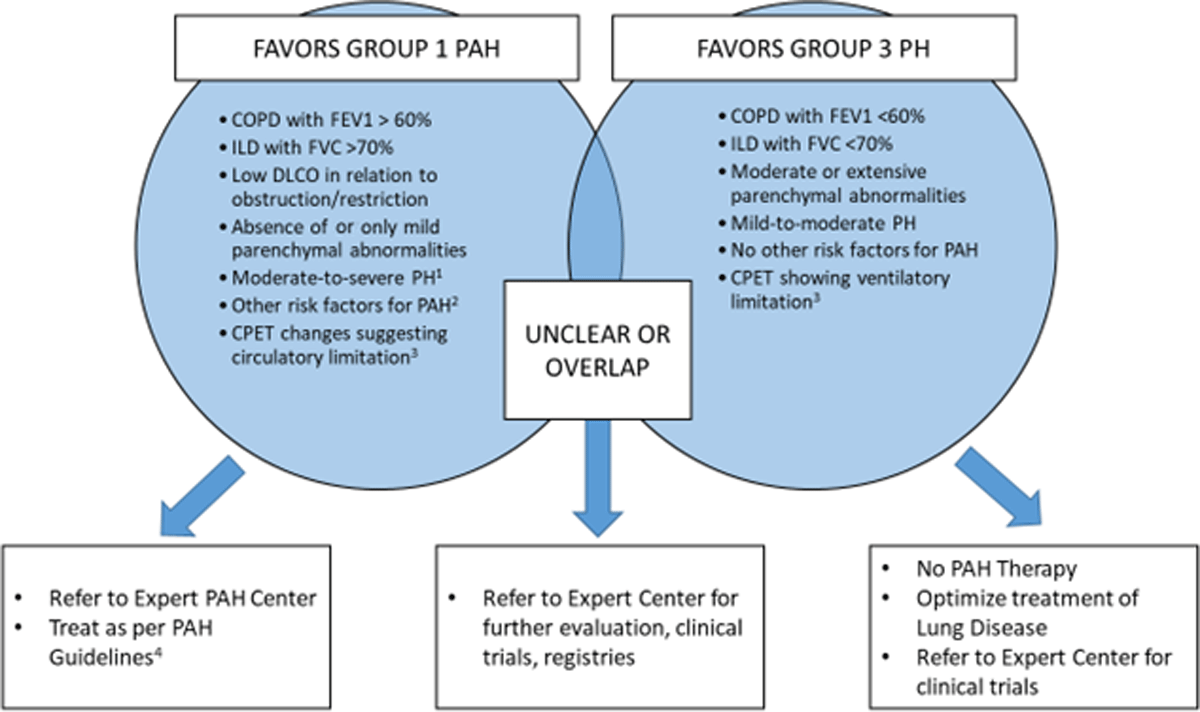
Figure 1
Differentiation between group 1 pulmonary hypertension (PH) and group 3 PH.1 Figure courtesy of authors. COPD: chronic obstructive pulmonary disease; FEV1: forced expiratory volume in 1 second; FVC: forced vital capacity; ILD: interstitial lung disease; PAH: pulmonary arterial hypertension; DLCO: carbon monoxide diffusing capacity test; CPET: cardiopulmonary exercise test
1 Moderate-to-severe PH defined as mean pulmonary arterial pressure ≥ 35 mm Hg, or ≥ 25 mm Hg with a cardiac index < 2.0 L/min/m2
2 Other risk factors include connective tissue disease, portal hypertension, human immunodeficiency virus infection, exposure to definite or probable medications that cause group 1 PH, genetic mutations, congenital heart disease
3 Features of circulatory limitation include preserved breathing reserve, low oxygen pulse, low cardiac output/VO2 slope, no change or decrease in PaCO2 during exercise. Features of ventilatory limitation include low breathing reserve, normal oxygen pulse, normal cardiac output/VO2 slope, increase in PaCO2 during exercise, dynamic hyperinflation.
Table 1
Randomized trials of therapies proposed in the management of chronic obstructive pulmonary disease (COPD)-associated pulmonary hypertension (PH). Table courtesy of authors. PDE5: phosphodiesterase type-5; TID: three times a day; sPAP: systolic pulmonary artery pressure; 6MWD: 6-minute walk distance; VO2: oxygen uptake; QoL: quality of life; mPAP: mean pulmonary artery pressure; BNP: brain natriuretic peptide; PVR: pulmonary vascular resistance; WU: Wood units; BODE: body mass index, obstruction, dyspnea, exercise capacity index; CI: cardiac index; SF-36: Short Form 36; BID: twice daily
| AUTHOR | REF | N | DRUG | SEVERITY OF PH | FOLLOW-UP PERIOD | END POINT(S) |
|---|---|---|---|---|---|---|
| PDE5 INHIBITORS | ||||||
| Rao et al., 2011 | 17 | 33 | Sildenafil 20 mg TID vs placebo | sPAP > 40 mm Hg on echo | 12 weeks | 6MWD: +190 m vs placebo sPAP: decreased |
| Lederer et al., 2012 | 18 | 10 | Sildenafil 25 mg TID vs placebo | No PH | 4 weeks | 6MWD: no effect VO2: no effect QoL: worsened |
| Blanco et al., 2013 | 19 | 60 | Sildenafil 20 mg TID vs placebo in patients undergoing pulmonary rehabilitation | mPAP 31 ± 5 mm Hg | 12 weeks | Cycle endurance time: no
effect 6MWD: no effect VO2: no effect |
| Goudie et al., 2014 | 20 | 120 | Tadalafil 120 mg daily vs placebo | sPAP 42 ± 10 mm Hg (as estimated on echocardiogram) | 12 weeks | sPAP: decreased –12.3 mm
Hg 6MWD: no effect QoL: no effect BNP: no effect |
| Vitulo et al., 2017 | 21 | 28 | Sildenafil 20 mg TID vs placebo | mPAP 25 mm Hg in 68% mPAP 39 ± 8 mm Hg PVR 7 ± 2.6 WU | 16 weeks | PVR: –1.38 WU CI: +0.42 L/min/m2 BODE: improved 6MWD: no effect SF-36: +9.85 units |
| ENDOTHELIN RECEPTOR ANTAGONISTS | ||||||
| Stoltz et al., 2008 | 23 | 30 | Bosentan 62.5 mg BID for 2 weeks followed by 125 mg BID vs placebo | mPAP at rest ≥ 30 mm Hg | 12 weeks | 6MWD: -10 m vs placebo |
| Valerio et al., 2009 | 24 | 32 | Bosentan 125 mg BID vs placebo | mPAP 37 ± 5 mm Hg | 18 months | 6MWD: +65 m mPAP: – 6 mm Hg PVR: –50 dynes·sec·cm–5 BODE index: improved |
Table 2
Randomized trials of therapies proposed in the management of interstitial lung disease–associated pulmonary hypertension (PH). Table courtesy of authors. IPF: idiopathic pulmonary fibrosis; BID: twice daily; RVSP: right ventricular systolic pressure; 6MWD: 6-minute walk distance; QoL: quality of life; FVC: forced vital capacity; TID: three times daily; ILD: interstitial lung disease; IIP: idiopathic interstitial pneumonia; IBW: ideal body weight
| AUTHOR | REF | N | LUNG DISEASE | DRUG | PH PATIENTS INCLUDED? | FOLLOW-UP PERIOD | END POINTS |
|---|---|---|---|---|---|---|---|
| ENDOTHELIN RECEPTOR ANTAGONISTS | |||||||
| King et al., 2008 | 35 | 158 | IPF | Bosentan 62.5 mg BID for 4 weeks followed by 125 mg BID vs placebo | Yes: mild PH on echo (RVSP < 50 mm Hg) included | 12 months | 6MWD: no difference Disease progression: favors bosentan Lung function: no difference Dyspnea and QoL: favors bosentan |
| King et al., 2011 | 36 | 616 | IPF | Bosentan 62.5 mg BID for 4 weeks followed by 125 mg BID vs placebo | Yes | 20 months | Time to IPF worsening or death: no
difference QoL: no difference Dyspnea: no difference Change in FVC: no difference |
| Raghu et al., 2013 | 37 | 494 | IPF | Ambrisentan 10 mg daily vs placebo | Yes, but excluded patients on other long-term PH therapies | 34 weeks | Time to IPF progression: terminated early
due to higher disease progression in ambrisentan
group Hospitalizations: increased in ambrisentan group 6MWD: no difference Lung function decline: no difference |
| Raghu et al., 2013 | 38 | 494 | IPF | Macitentan 10 mg vs placebo | Yes | 12 months | Change in FVC: no difference Time to IPF worsening or death: no difference Dyspnea: no difference Adverse events: no difference |
| SOLUBLE GUANYLATE CYCLASE STIMULATORS | |||||||
| Nathan et al., 2019 | 39 | 147 | IIP | Riociguat, up to 2.5 mg TID vs placebo | Yes | 26 weeks | 6MWD: no difference Time to clinical worsening: no difference |
| PDE5 INHIBITORS | |||||||
| Zisman et al., 2010 | 40 | 180 | IPF | Sildenafil 20 mg TID vs placebo | Yes | 12 weeks | 6MWD improvement of > 20%: no significant difference |
| Han et al., 2013 | 41 | 119 | IPF | Sildenafil 20 mg TID vs placebo | Yes | 12 weeks | 6MWD improvement of > 20%: no
significant difference QoL improvement: no significant difference |
| Behr et al., 2020 | 42 | 177 | IPF | Sildenafil 20 mg TID with pirfenidone vs. placebo with pirfenidone | Yes | 52 weeks | Progression-free survival: no significant
difference 6MWD decline < 15%: no significant difference |
| INHALED MEDICATIONS | |||||||
| Nathan et al., 2020 | 43 | 41 | Fibrosing ILD | Inhaled NO 30–45 μg/kg IBW/h vs. placebo | Subjects stratified as low-, intermediate- and high-probability of PH. Subjects included if PH proven on RHC. | 8 weeks | Moderate/ vigorous physical activity: statistically significant improvement |
| Waxman et al., 2020 | 47 | 326 | Any ILD | Treprostinil 60–72 μg inhaled vs. placebo | Yes | 16 weeks | Mean change from baseline in peak 6MWD
through week 16: +31.12 m (95% CI, 16.85–45.39) NT-proBNP: improved Time to clinical worsening: 39% reduction |
Table 3
Approach to management of lung disease–associated pulmonary hypertension (PH). Table courtesy of authors. COPD: chronic obstructive pulmonary disease; ILD: interstitial lung disease; WHO: World Health Organization
| SUGGESTED INTERVENTIONS FOR PATIENTS WITH GROUP 3 AND GROUP 5 PH1 | |
|---|---|
| All patients | Optimization of the underlying pulmonary condition, including smoking cessation and relevant disease-specific therapies |
| Supplemental O2 therapy in patients with resting hypoxemia | |
| Referral for lung transplantation, if eligible | |
| INTERVENTIONS THAT MAY BE CONSIDERED FOR PATIENTS WITH GROUP 3 AND GROUP 5 PH1 | |
| All patients | Referral to a PH expert center for consideration of invasive diagnostic testing and individualized therapy or enrollment in clinical trials |
| INTERVENTIONS THAT SHOULD NOT BE ROUTINELY CONSIDERED FOR PATIENTS WITH WHO GROUP 3 AND GROUP 5 PH1 | |
| All patients | Phosphodiesterase type-5 (PDE5) inhibitors, endothelin receptor antagonists (ERAs); calcium channel blockers; inhaled nitric oxide; inhaled and intravenous prostacyclins; guanylate cyclase stimulators |
| INTERVENTIONS THAT ARE CURRENTLY UNDER INVESTIGATION OR CONSIDERATION ON AN INDIVIDUALIZED OR EXPERIMENTAL BASIS FOR PATIENTS WITH GROUP 3 AND GROUP 5 PH | |
| COPD-associated PH | PDE5-inhibitors (sildenafil)21,22; inhaled treprostinil (NCT03496623); inhaled soluble guanate cyclase modulator (NCT04370873) |
| ILD-associated PH | Inhaled pulmonary vasodilators, including inhaled treprostinil47 |
| Sarcoidosis-associated PH | Bosentan52,53,55,56; pulmonary artery angioplasty, with or without stenting of focal stenoses58,59 |