
Introduction
Sustainable development has become a central paradigm guiding global action in the 21st century. The United Nations 2030 Agenda, adopted in 2015, introduced the 17 Sustainable Development Goals (SDGs) as a universal call to end poverty, protect the planet, and ensure prosperity for all (United Nations 2015). In an increasingly complex world, achieving these goals requires individuals to develop sustainability competencies – structured sets of knowledge, skills, and dispositions that support effective decision-making and responsible action in professional, educational, and everyday contexts. These competencies integrate cognitive and non-cognitive components and are closely linked to values, attitudes, motivation, and ethical reasoning (Wiek et al. 2011).
The concept of sustainability competencies encompasses both theoretical understanding and practical skills that guide behaviour in real-life situations (European Commission 2000). They combine skills with values and ethical orientations relevant to sustainable development (Cebrián, Junyent 2015). Due to the diversity of definitions of sustainability and of competence itself, no universally mandatory list exists (Mochizuki, Fadeeva 2010). Still, many scholars agree that competencies should enable individuals to envision and shape future scenarios, work collaboratively, diagnose problems, and act strategically in the face of uncertainty (Wals 2010, Haklay et al. 2018, Cichoń et al. 2021). The development of sustainability competencies occurs across formal, non-formal, and informal learning settings, with sociodemographic variables shaping levels of engagement and pro-environmental behaviour (Gifford, Nilsson 2014, Sargisson et al. 2020, Al Husban 2025). Universities, therefore, play an essential role in fostering these competencies and supporting society's progress towards the SDGs (Leal Filho et al. 2019).
Over the past two decades, several frame-works have been proposed to systematise sustainability competencies in higher education (Wiek et al. 2011, UNESCO 2017, Rieß et al. 2018). Other frameworks focus on specific disciplines or professional fields such as engineering or teacher education (Sleurs 2008, Cebrián, Junyent 2015). One of the most influential frameworks is the UNESCO (2017) classification of eight key competencies: systems thinking, anticipatory, normative, strategic, collaboration, critical thinking, self-awareness, and integrated problem-solving. Wiek et al. (2011) identified a closely related set of key competencies – systems thinking, anticipatory, normative, strategic, and interpersonal – that underpin research and real-world problem-solving in sustainability. Notably, competencies related to anticipation have gained prominence in recent years. In the comprehensive European GreenComp framework (Bianchi et al. 2022), anticipatory elements form a distinct domain: Envisioning, Sustainable, Futures (ESF). This domain includes futures literacy, adaptability, and exploratory thinking, enabling learners to conceptualise multiple future scenarios and take proactive steps to shape desirable outcomes. Research further shows that young people from different countries perceive the urgency of specific SDGs differently, underscoring the need to better understand students' futures-oriented competencies (Leiva-Brondo et al. 2022, Zwolińska et al. 2022, Feucht et al. 2024).
Future-oriented thinking is particularly relevant in geography, a discipline that examines interactions between human and natural systems and equips students with tools to address complex, uncertain, and interdependent sustainability challenges (Meadows 2020, Yli-Panula et al. 2020). Scenario development, systems thinking, and collaborative problem-solving are essential elements of social learning processes and of preparing society for long-term decision-making under uncertainty (Johnson et al. 2012). Geography demonstrates strong conceptual and thematic alignment with SDGs (Bagoly-Simó 2014). Powerful geographical knowledge fosters students' capacity to understand environmental change and respond appropriately (Maude 2018, Bagoly-Simó, Kriewaldt 2023). However, relatively little is known about whether university geography programmes effectively prepare future geographers – and especially future teachers – to cultivate these competencies (Cebrián, Junyent 2015).
The degree of SDGs' implementation in geography is shaped by curricula, teaching approaches, and the effectiveness of methods used to address global problems (Saetre 2016, Gress, Tschapka 2017, Piotrowska et al. 2022). Although higher education research typically focuses on formal learning, universities also provide non-formal learning opportunities such as volunteering, student organisations, and campus-based events (Rawlinson et al. 2021). Such experiences promote active engagement and support the development of sustainability competencies (Barth et al. 2007, Hopkinson et al. 2008, Kennedy et al. 2018, Nielsen et al. 2019, O'Connor et al. 2023, Bush, Löns 2024). Informal contexts – including civic engagement, digital participation, and family environments – also contribute significantly to learners' sustainability-related dispositions and behaviours (Bianchi et al. 2022, Jia et al. 2022, Caldana et al. 2023, Lučić, Uzelac 2024). An emerging body of research additionally high-lights the potential of serious games and virtual environments to enhance sustainability competencies (Hajj-Hassan et al. 2024, Ahmadov et al. 2025).
Although the literature recognises the importance of formal, non-formal, and informal learning environments (Lambrechts et al. 2013, Lozano et al. 2019), the interactions between them remain insufficiently understood (Barth et al. 2007, O'Connor et al. 2023, Cichoń, Baarová 2025). This gap is particularly evident in the domain of futures-oriented competencies. Research on ESF within geography education – especially among students who may become future teachers – remains limited. Therefore, this study aims to examine the influence of academic conditions on ESF competence levels among geography students at two universities in Central Europe. Specifically, this study addresses the following research questions:
What ESF competence scores did students achieve, and how did these vary according to university, study programme, study year, gender, and economic status?
Which types of education and learning conditions, according to students, influence their ESF competencies?
Which SDGs do students consider most important, and how are these choices associated with their ESF competence levels?
Materials and methods
Sample
To address the research objectives, two Central European universities were selected. They differ in their size, academic profile, and performance in the QS World University Rankings: Sustainability. The sample consisted of geography students from Adam Mickiewicz University (AMU) in Poznań, Poland, and the University of Ostrava (UO), Czechia. AMU is one of the top ten research universities in Poland, with nearly 29,000 students across first- and second-cycle programmes in more than 140 fields of study. The university carries out broad sustainability-related activities, including sustainable development academies. AMU is placed within the top 500 globally and ranks among the top five Polish institutions in the QS Sustainability Rankings. UO is a public university with approximately 9500 students and a strong sustainability focus. In 2024, UO adopted the Sustainability and Green Transformation Strategy 2025–2030 (Ostravská Univerzita 2025), which prioritises the integration of environmental themes into curricula, community engagement and strengthening environmental awareness. The university is also introducing a new sustainability-oriented geography programme. UO is ranked within the 1501+ category in the QS Sustainability Rankings.
The sample (Table 1) consisted of 55 female respondents (41.7%) and 73 male respondents (55.3%). Four students from AMU did not specify their gender and were, therefore, excluded from gender-based analyses. The majority of respondents were from AMU (n = 76; 57.6%), while the remaining participants were from UO (n = 56; 42.4%). Regarding the type of study programme, the largest proportion of respondents were enrolled in teacher education programmes (n = 57; 43.2%), including the Education module at AMU (n = 24; 18.2%) and the Geography Teaching programme at UO (n = 33; 25.0%). Thematic and General Geography programmes (n = 43; 32.6%) included General Geography at AMU (n = 20; 15.2%) and Political Geography at UO (n = 23; 17.4%). The remaining respondents were enrolled in Environmental Management programmes (n = 32; 24.2%).
Table 1.
Distribution of survey respondents (study programmes are categorised as follows: G – Thematic and General Geography programmes, T – Teacher Education programmes, and M – Environmental Management programmes.
| University | Study programmes | Type of study programmes | Gender | Number of respondents per study year | Economic status (average monthly income) | Total number of respondents | Percentage to all enrolled students in a given study programmes | |||||
|---|---|---|---|---|---|---|---|---|---|---|---|---|
| Male | Female | Other | 2nd | 3rd | 4th | 5th | ||||||
| AMU | General Geography | G | 10 | 9 | 1 | 8 | 4 | 4 | 4 | 444€ | 20 | 31% |
| Environmental management | M | 4 | 26 | 2 | 0 | 11 | 21 | 0 | 512€ | 32 | 32% | |
| Educational module | T | 8 | 15 | 1 | 10 | 6 | 5 | 3 | 272€ | 24 | 63% | |
| UO | Political Geography | G | 18 | 5 | 0 | 5 | 6 | 6 | 6 | 378€ | 23 | 37% |
| Geography teaching | T | 15 | 18 | 0 | 0 | 4 | 18 | 11 | 403€ | 33 | 42% | |
| Totally | 55 | 73 | 4 | 23 | 31 | 54 | 24 | 132 | ||||
For the purposes of subsequent analysis, the study programmes (Table 1) were grouped into three categories based on their orientation: 1) programmes primarily focused on teacher preparation (Teacher-Education programmes), 2) programmes oriented towards environmental management (Environmental Management programmes), and 3) other programmes, including political geography, economic geography and general geography (Thematic and General Geography programmes).
Surveys
To achieve the research objectives, surveys were administered to students in the second- and third-year bachelor's programmes, as well as the first- and second-year master's programmes (i.e., the fourth and fifth years of higher education), across various geography study programmes (Table 1), with or without an educational module preparing students for the teaching profession.
Although the surveys were offered to all students enrolled in the target study programmes (i.e., the entire defined population was invited), participation was voluntary. Consequently, the probabilities of individual students being included in the sample were neither known nor controlled. In total, 132 students completed the survey (Table 1). The data collection was con-ducted using a standardised, anonymous scaled self-assessment questionnaire. This method was selected due to its several advantages, including cost-effectiveness and time efficiency (Redman et al. 2021). To ensure both validity and reliability, the survey was conducted in two stages. The first stage consisted of a pilot study conducted in the spring 2023 with 20 geography students at AMU. The second stage of the survey toot place from 29 February to 7 March 2024 at both AMU and UO.
The questionnaire consisted of 22 questions, including open-ended, closed-ended, semi-open-ended, filtering and metric questions. Several scales were applied, including Likert, dichotomous, nominal and balanced. These scales enabled the collection of data necessary for analysing and interpreting how learning conditions across different education types (Table 2) at the university contribute to the development of competencies related to ESF in the context of sustainable development. The questionnaire was divided into three sub-competences (Future literacy, Adaptability, and Exploratory thinking) in accordance with the area of ESF. For each of the sub-competences, the students were assessed for their level of competences on a scale of 1–5. They were then asked to select one of six learning conditions related to the university environment that they believed had the greatest influence on their sustainability-related competencies. The conditions included ecological solutions in the university space, the content of study programmes, the nature of compulsory classes, optional classes within the university, methods of content delivery and the attitude of academic teachers (Table 2). Additionally, students had the option to choose a non-academic environment as the seventh condition. For each selected condition, students evaluated three learning factors, indicating the extent of their influence on the development of sustainability competencies. Additionally, students were asked to select the five most important goals that the university should promote. The remaining five questions covered personal characteristics (Cichoń, Baarová 2025).
Table 2.
Learning conditions and factors used in the research procedure are divided by education types.
| Education types | Learning conditions | Learning factors |
|---|---|---|
| Formal education | Content of study programmes | The study programme content is focused on career preparation |
| The study programme content is interdisciplinary | ||
| The study programme content is focused on sustainable development | ||
| Types of compulsory classes | Lectures and seminar meetings (consultations) | |
| Classes in training rooms, laboratories and computer labs | ||
| Fieldwork and visits to workplaces | ||
| Learning methods practised during studying | Exercises using modern technology, programmes and applications | |
| Problem-based teaching (problem-solving through hypothesis formulation, discussion, simulation games) | ||
| Project method (developing creative solutions in a group) | ||
| Personal attitude of teachers towards sustainable development | The teacher provides current (but pessimistic) facts about sustainable development | |
| The teacher encourages personal and responsible engagement in sustainable development | ||
| The teacher demonstrates a sustainable lifestyle through their personal attitude and example | ||
| Non-formal education | Types of optional activities outside the study programme | Participation in popular science events (e.g., festivals, meetings with experts, job and internship fairs, GISDay, Earth Day, Sustainable Development Week) |
| Activities for others (e.g., volunteering, charity collections, student council, trips abroad such as AID) | ||
| Activities for science (e.g., Student Science Club, projects/grants conducted in cooperation with scientists, ERASMUS) | ||
| Informal education | Sustainable and eco-friendly university infrastructure | The building infrastructure incorporates ecological solutions (light, water, and heating sensors; wall and window insulation; waste bins) |
| The surroundings include landscaped greenery (e.g., parks, gardens), with rainwater tanks, insect houses, and bird houses | ||
| The campus and accompanying infrastructure are consolidated in one place, minimising resource consumption (e.g., water, fuel, packaging, energy) | ||
| Non-academic environment | Activities in the family home and neighbourhood | |
| Activities in primary and secondary school, and workplaces | ||
| Activities in the virtual world |
Statistical analysis
Data analysis was performed using IBM SPSS Statistics 29.0 (IBM Corporation 2022), which facilitated the calculation and analysis of basic descriptive statistics (Table 3). The sample consisted of students from different programmes with response rates ranging from 31% to 63% (Table 1), influenced by their voluntary motivation to participate. As a result, the sample cannot be considered random, and there is a risk of selection bias.
Table 3.
Summary of descriptive statistics for student self-assessed influences of learning conditions influence on ESF competencies, including mean (M), median (Mdn), standard deviation (SD), skewness (Sk), kurtosis (Kurt), minimum (Min), and maximum (Max) values.
| Learning conditions | M | Mdn | SD | Sk | Kurt | Min | Max |
|---|---|---|---|---|---|---|---|
| Content of study programmes | 2.49 | 2.33 | 0.41 | −0.24 | −0.78 | 1.67 | 3.00 |
| Types of compulsory classes | 2.38 | 2.33 | 0.39 | 0.02 | −0.44 | 1.67 | 3.00 |
| Learning methods practised during studying | 2.56 | 2.67 | 0.47 | −0.58 | −1.08 | 1.67 | 3.00 |
| Personal attitude of teachers towards sustainable development | 2.50 | 2.50 | 0.46 | −0.37 | −1.02 | 1.67 | 3.00 |
| Types of optional activities outside the study programme | 2.37 | 2.33 | 0.43 | 0.16 | −0.43 | 1.67 | 3.00 |
| Sustainable and eco-friendly university infrastructure | 2.70 | 2.33 | 0.51 | −0.68 | 0.62 | 1.33 | 3.00 |
| Non-academic environment | 2.31 | 2.33 | 0.39 | 0.19 | −0.29 | 1.33 | 3.00 |
Due to the lack of random sampling, a prerequisite for the valid use of p-values and confidence intervals, these inferential statistics were intentionally excluded, and the study's conclusions are not intended to support generalisations from the sample to the broader population (Hirschauer et al. 2020).
Nevertheless, to explore potential relationships within the dataset, correlation and effect size coefficients (Spearman's ρ and rank-biserial correlations) were calculated and interpreted solely as exploratory indicators. To examine associations between quantitative variables, Pearson's r or Spearman's rho correlation analysis was applied for ordinal variables. For the relationship between categorical variables, Pearson's χ2 test was used, or Fisher's exact test when expected frequencies were <5. To compare two groups based on quantitative variables, an independent-samples t-test was employed (or its non-parametric equivalent, the Mann-Whitney U test). The analysis explored whether students' prioritisation of specific SDGs was associated with their scores in three ESF competences. Mann–Whitney U test was conducted for each SDG, comparing competence levels between students who selected a particular SDG as important versus those who did not. In cases where more than two groups were compared, a one-way analysis of variance (ANOVA) was conducted, with Tukey's honest significant difference test used as a post hoc analysis.
Throughout the analysis, we explicitly emphasised that all results should be interpreted as illustrative and exploratory findings within this dataset, without implying inferential generalisation to a larger population.
Results
Variation in ESF competency scores among geography students by key socio-demographic factors
The average competence level of ESF among the surveyed students was 3.79. The analysis revealed that female students achieved slightly higher ESF competence (mean = 3.91) compared to their male counterparts (mean = 3.59), with a small effect size (Cohen's d = 0.41; Table 4). In contrast, the effect of university was strong (Cohen's d = 0.82), as AMU students demonstrated, on average, higher competence levels (mean = 4.05) than UO students (mean = 3.44). Differences were also observed across the three types of study programmes (Table 4). The eta-squared value (η2 = 0.17) indicates a large effect size, suggesting that 17% of the variance in ESF competence scores is explained by the type of study programme. Post hoc analysis revealed that students enrolled in Environmental Management programmes exhibited higher competence levels (mean = 4.36) than those in Thematic and General Geography programmes (mean = 3.65) and Teacher-Education programmes (mean = 3.58). Spearman's rho correlation was applied to examine associations between ESF competence and both the year of study and economic status. No strong associations were found for either variable. The corresponding eta-squared values indicate no effects (year of study: η2 = 0.06; economic status η2 = 0.05).
Table 4.
Comparison of ESF competence scores by sociodemographic factors, including gender, university, study programme type, study year and economic status.
| Sociodemografic factors | Variables | Envisioning sustainability futures scores | d Cohena | η2 | |
|---|---|---|---|---|---|
| Mean | Standard deviation | ||||
| Gender | Male (n = 55) | 3.59 | 0.82 | 0.41 | – |
| Female (n = 73) | 3.91 | 0.76 | |||
| University | Adam Mickiewicz University in Poznań (n = 76) | 4.05 | 0.79 | 0.82 | – |
| University of Ostrava (n = 56) | 3.44 | 0.67 | |||
| Study programme | M (n = 32) | 4.36 | 0.56 | – | 0.17 |
| T (n = 57) | 3.58 | 0.80 | |||
| G (n = 43) | 3.65 | 0.76 | |||
| Study year | 2nd (n = 23) | 3.57 | 0.63 | – | 0.06 |
| 3rd (n = 31) | 3.95 | 0.78 | |||
| 4th (n = 54) | 3.94 | 0.78 | |||
| 5th (n = 24) | 3.49 | 0.91 | |||
| Economic status | <200 EU (n = 30) | 3.56 | 0.78 | – | 0.05 |
| 200–400 EU (n = 45) | 3.91 | 0.79 | |||
| 400–600 EU (n = 33) | 3.69 | 0.77 | |||
| 600–800 (n = 13) | 4.10 | 0.90 | |||
| >800 EU (n = 11) | 3.91 | 0.78 | |||
Student-perceived influences on ESF competencies and their relationship to achieved scores
Students from both AMU and UO identified several key factors that they perceive as contributing to the development of their ESF competencies (Table 2). The most frequently mentioned factor was the non-academic environment (e.g., home, neighbourhood, virtual spaces), selected by 41% of AMU students and 38% of UO students. This suggests that informal education plays a significant role in shaping students' perceived growth in sustainability-related competencies. Another notable factor was the content of the study programmes, indicated by 12% of AMU students and 18% of UO students, followed by the types of compulsory classes (9% AMU, 13% UO). In contrast, more specific pedagogical aspects, such as learning methods practised during study and the personal attitudes of teachers towards sustainable development, were mentioned less frequently but still suggest that the instructional approach and educators' commitment to sustainability can positively influence students' competency development (Fig. 1).
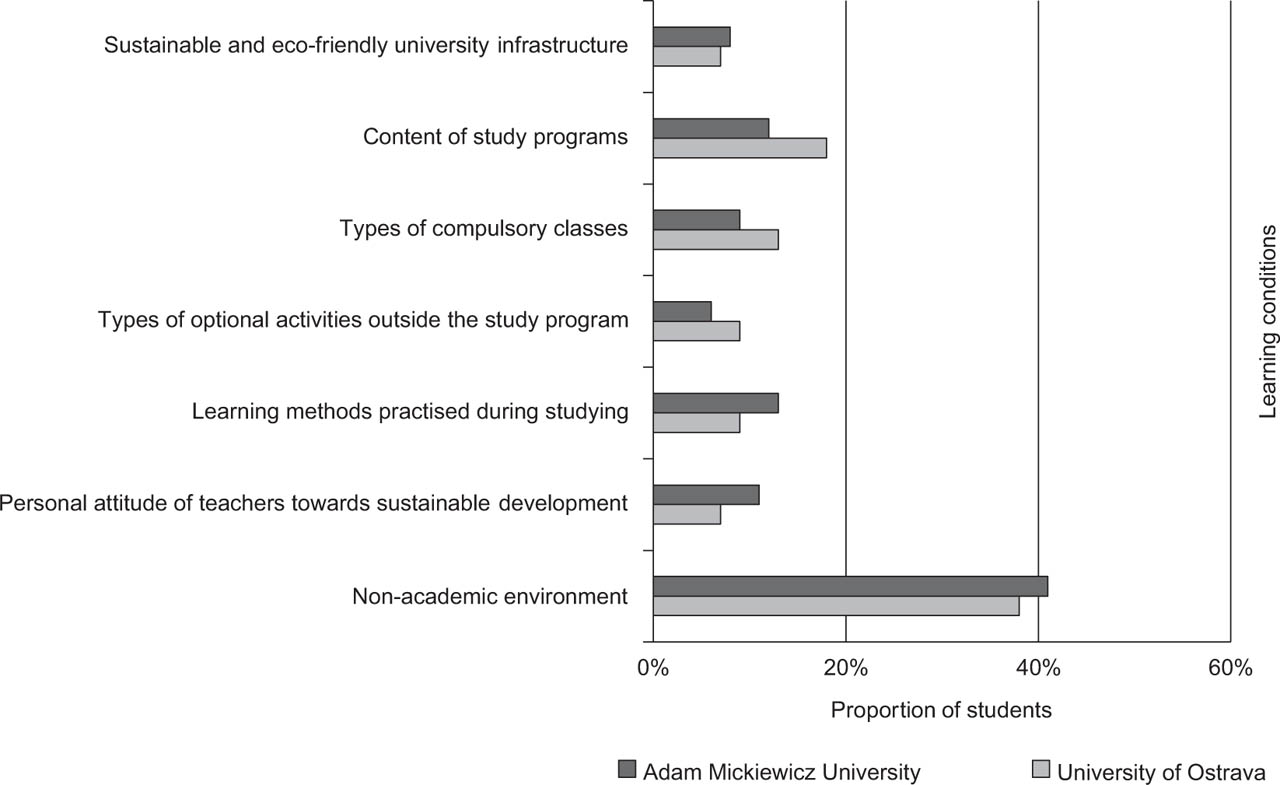
Fig. 1.
Importance of learning conditions for the development of envisioning sustainability futures (ESF) competencies, as perceived by students, categorised by university.
Interestingly, the strong emphasis placed by students on non-academic environments is consistent with correlational findings, which revealed positive relationships between family and neighbourhood activities (rs = 0.43), as well as activities in virtual world (rs = 0.38), and higher ESF competence scores (Fig. 2). These results suggest that students who reported stronger ESF competencies were also more likely to recognise the value of informal and experiential learning settings. Additional learning-related factors that strongly influenced the overall level of ESF competencies included participation in popular science events (rs = 0.79) and problem-based learning methods (rs = 0.64), underlining the importance of interactive and real-world-oriented educational experiences (Fig. 2). On the other hand, a moderate negative correlation was observed for fieldwork and workplace visits during compulsory classes (rs = −0.47).
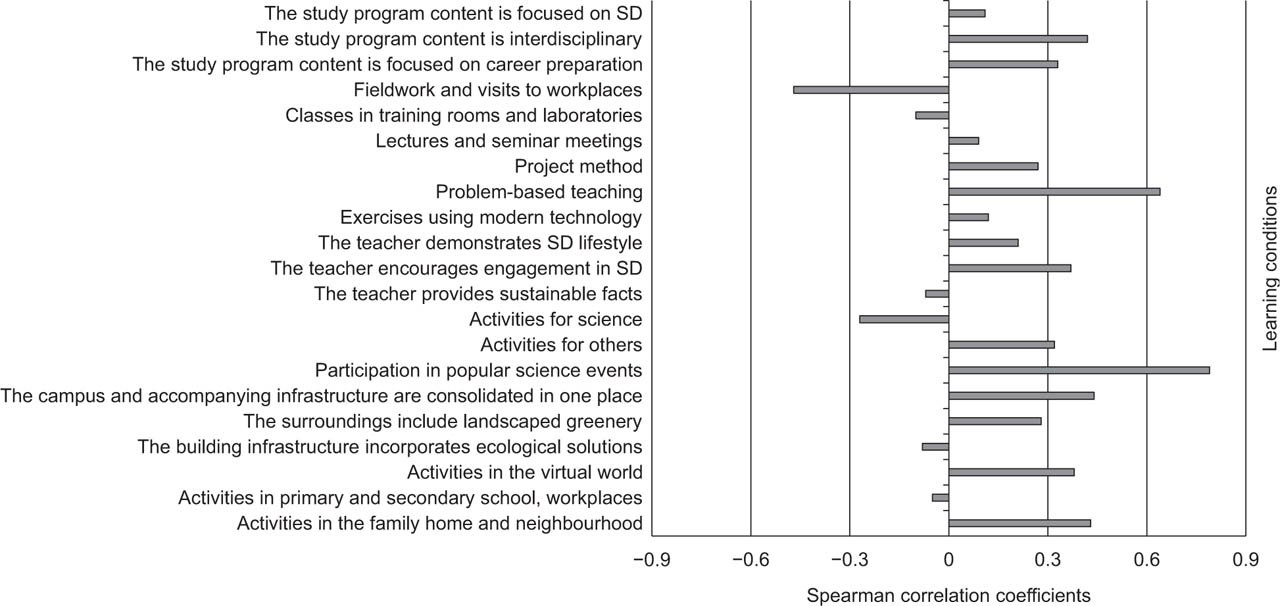
Fig. 2.
Spearman correlation coefficients between learning factors and ESF competence scores. Values between −0.3 and 0.3 indicate no correlation, while values between −0.6 and 0.6 indicate a moderate correlation between variables. As the sample was not randomly selected and participation was voluntary, results should be interpreted solely as illustrative findings within this dataset. The abbreviation SD shown here in the graph stands for sustainable development. A full description of the learning factors is provided in Table 2.
When analysing the data by individual ESF sub-competencies (Fig. 3), moderate correlations were found between self-reported exploratory thinking sub-competence and the learning methods applied during the study period (rs = 0.51), the content of study programmes (rs = 0.46) and the type of study programme (rs = −0.46). We interpret this negative correlation as a misleading association, as these learning conditions are more frequently reported by students with generally lower ESF competence levels. For adaptability sub-competence, moderate associations were identified with engagement in non-academic environments (rs = 0.44) and with the personal attitude of teachers towards sustainable development (rs = 0.48). For futures literacy sub-competence, a strong positive correlation was observed with participation in optional activities outside the study programme (rs = 0.62).
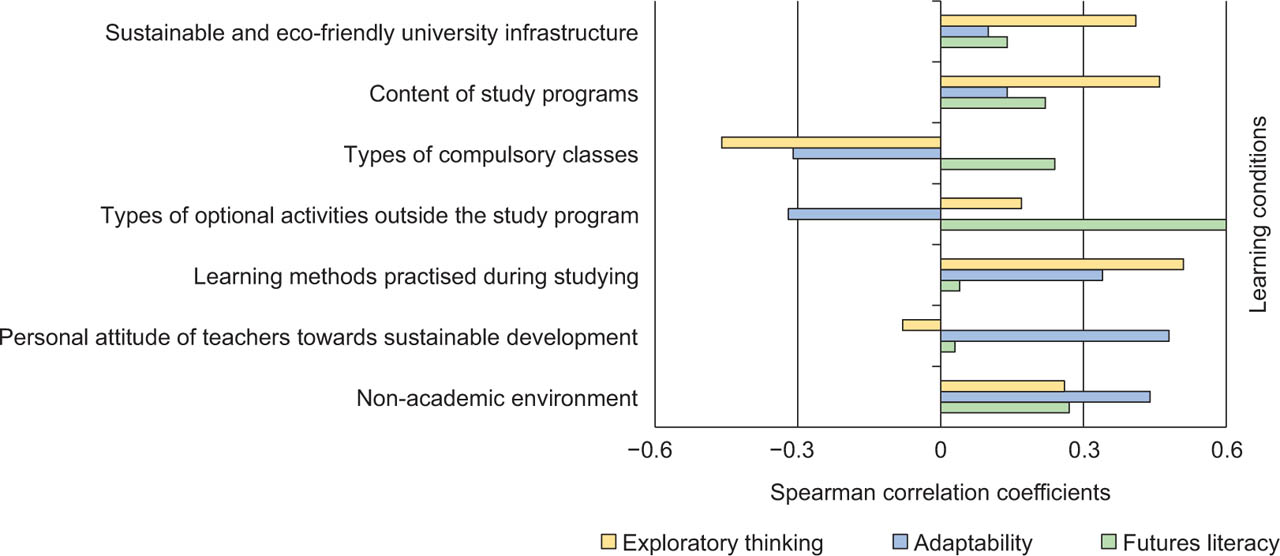
Fig. 3.
Spearman correlation coefficients between learning conditions and the scores of three ESF sub-competencies (exploratory thinking, adaptability and futures literacy) within the dataset. Values between −0.3 and 0.3 indicate no correlation, while values between −0.6 and 0.6 indicate a moderate correlation between variables. As the sample was not randomly selected and participation was voluntary, results should be interpreted solely as illustrative findings within this dataset.
Students' prioritisation of SDGs and its relationship to their ESF competency scores
The analysis of students' selection of SDGs revealed clear patterns in the perceived importance of various global challenges (Fig. 4). Among the 17 SDGs, Goal 3: Good Health and Well-Being was selected most frequently, chosen by 52.3% of respondents. Closely following was Goal 4: Quality Education, selected by 51.5% of students, indicating a strong recognition of the foundational role that education and health play in sustainable development at universities. Notably, the ranking of priorities varied between universities: AMU students most frequently selected goals 3, 13, 4, 1 and 8, whereas UO students prioritised goals 4, 3, 9, 11 and 1. In contrast, the least frequently selected was Goal 17: Partnerships for the Goals, with only 9.1% of students identifying it as a priority. This may point to a lesser awareness of the importance of collaboration and global cooperation in achieving sustainability targets. Overall, the results highlight that while students are highly engaged with social and climate-related issues, there is room to enhance awareness of the inter-connected nature of all SDGs – particularly those focused on ecosystems and global partnerships (Fig. 4).
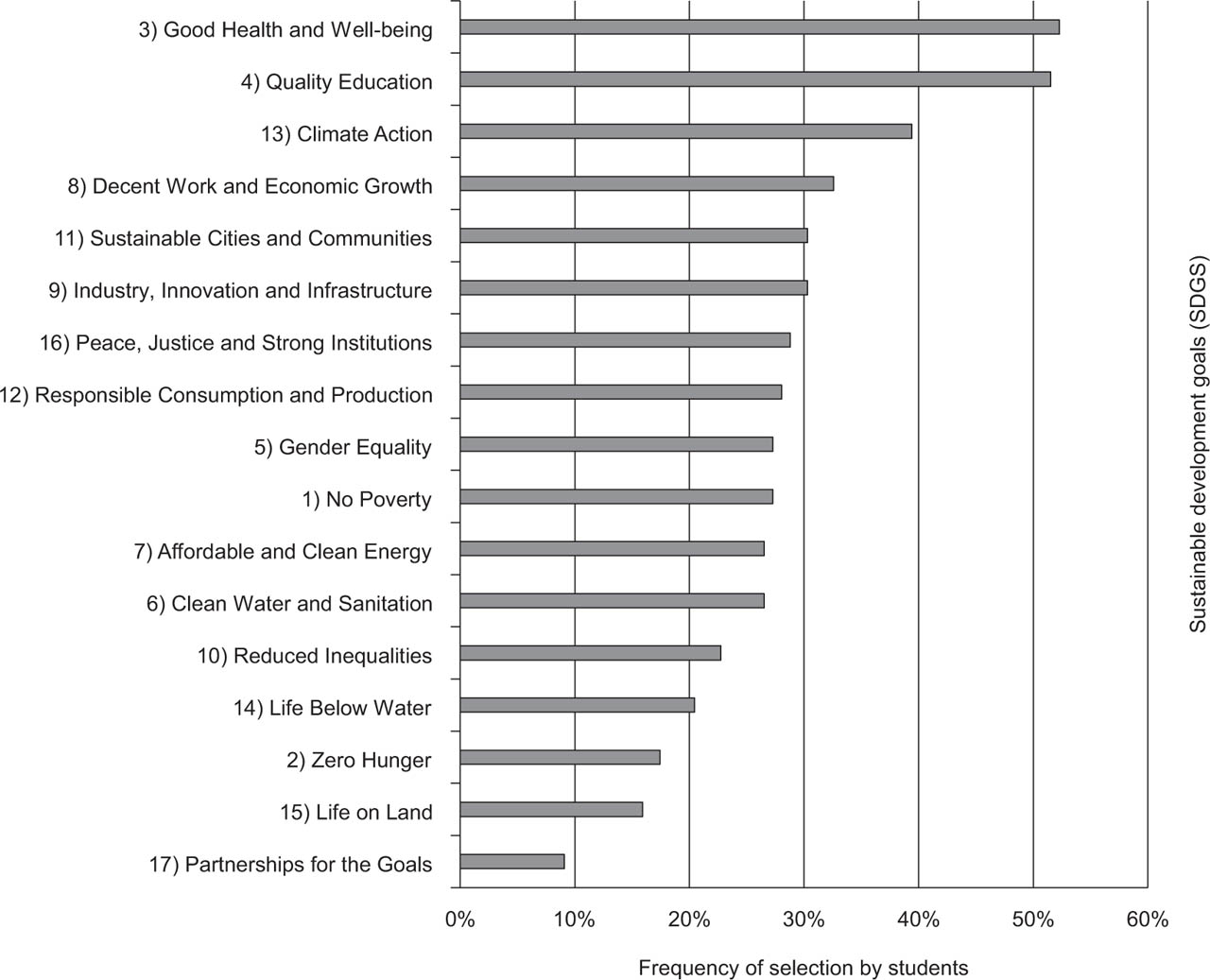
Fig. 4.
Frequency of SDGs selected by students as priorities for university promotion.
The analysis examined whether students' prioritisation of specific SDGs was associated with their scores in the ESF competence area. The findings revealed that students who scored higher in ESF competence were also more likely to select – and be aware of the importance of – certain SDGs. In particular, positive associations were found with Goal 6: Clean Water and Sanitation (rs = 0.19), Goal 13: Climate Action (rs = 0.23), and Goal 14: Life Below Water (rs = 0.20). When disaggregated by sub-competence dimensions, futures literacy showed relationships with four SDGs (Fig. 5), with small-to-moderate effect sizes. For adaptability sub-competence, the strongest association was observed with Goal 13: Climate Action (rs = 0.24), suggesting that students who emphasised the importance of climate-related issues demonstrated greater adaptability.
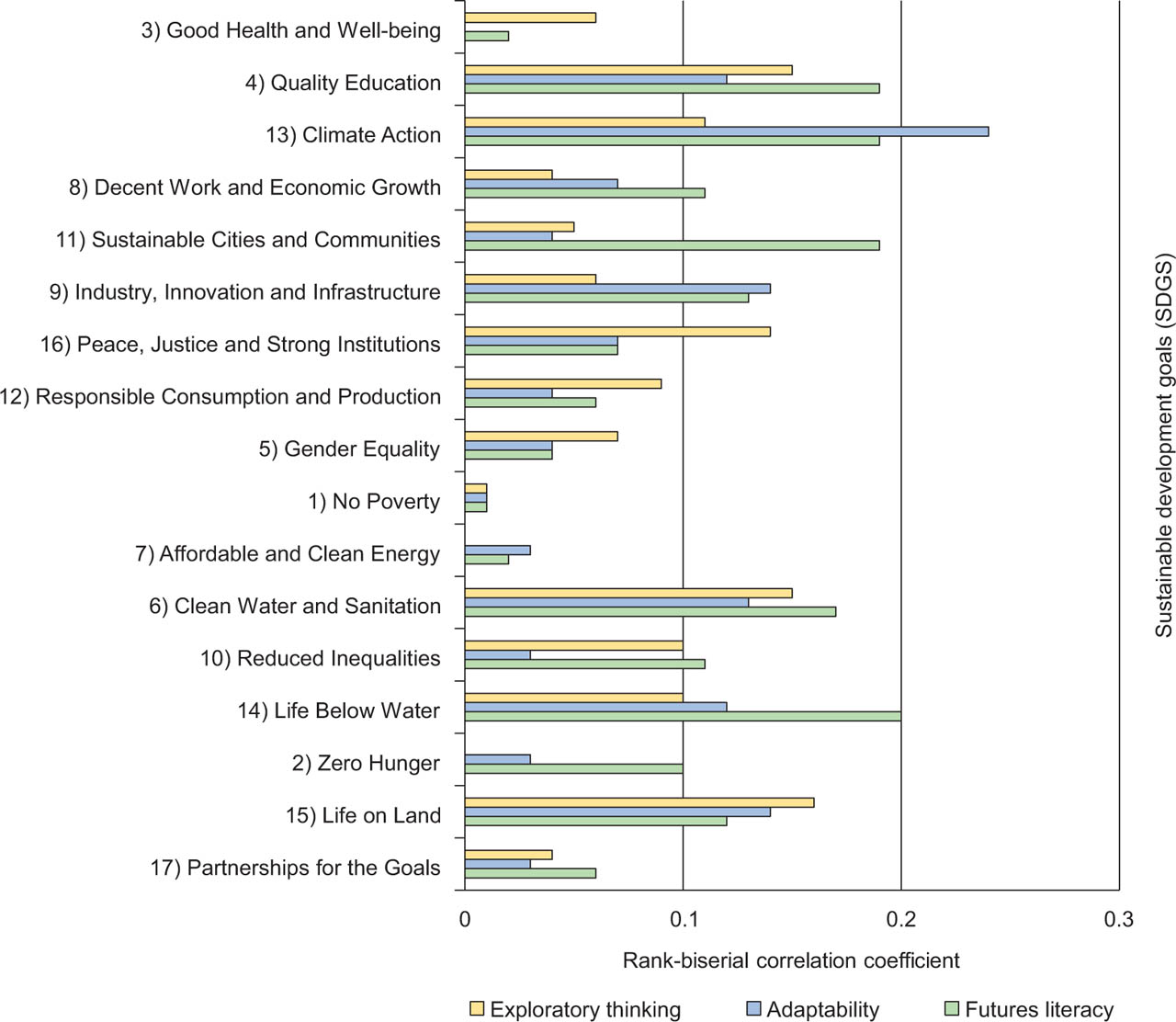
Fig. 5.
Rank-biserial correlation coefficients (rs) between the scores of three sub-competencies of envisioning sustainability futures and the selection of SDGs. As the sample was not randomly selected and participation was voluntary, results should be interpreted solely as illustrative findings within this dataset.
Discussion
Differences in the level of ESF competences and socio-demographic factors
Previous research results on knowledge in the field of sustainable development provide evidence of varying levels of sustainable development knowledge among students (Jati et al. 2019, Cichoń et al. 2021, Al-Zohbi, Pilotti 2023, Abowardah et al. 2024, Leal Filho et al. 2024, Cichoń, Baarová 2025). Researchers usually do not observe large differences in the level of sustainability competences among students (Tuncer 2008). These differences rather result from the professional implications of the sustainable development and, therefore, from the disciplines represented (Zamora-Polo et al. 2019). However, in this study, no relationship was found between the level of ESF competences and the field of study, similarly to other studies (e.g. Al Husban 2025). Although the declared higher ratings of competence level among students of ‘environmental management’ reported, on average, higher competence levels than students from the other fields, particularly among those participating in educational modules, this difference should be interpreted with caution. It is difficult to comment on this finding unequivocally, as the literature reports both high and low scores among students preparing to become teachers (Cebrián, Junyent 2015, Kriewaldt, Lee 2022). Despite this, researchers believe that solid knowledge of sustainable development should be built as part of teacher preparation so that teachers can confidently play a key role in understanding uncertainty, especially in relation to climate crisis (Bagoly-Simó, Kriewaldt 2023).
Neither academic stage nor age influenced the level of competence. According to researchers, age is considered a weak predictor of sustainability competences, as older students are expected to demonstrate more responsible behaviour compared to younger ones (Núñez et al. 2024). Meanwhile, younger students tend to be more environmentally conscious and more willing to engage (Gifford, Nilsson 2014, Cichoń et al. 2021).
The level of competence may also be influenced by students' economic situation (Norazlan et al. 2020), including through difficulties in financing their studies (Nnamani et al. 2014) and taking on additional work (Barteková 2019). This relationship is particularly visible in developing countries (Alam et al. 2024). The relatively high level of socio-economic development in Poland and the Czech Republic and the resulting support from family members or the possibility of taking on additional paid work (average monthly income is around €400) could explain the lack of correlation in the impact of students' financial situation on the level of ESF competence. And, despite similar economic levels, this relationship may stem not so much from nationality as from differences in the education system or educational level (Barth et al. 2007). When comparing the two universities included in this study, their positions in the QS World University Rankings: Sustainability differ, with AMU having higher Environmental Education and Impact of Education values. This stems from AMU's greater commitment to education for sustainable development (ESD), including supporting more engaged students through tutoring, inclusion in research projects and funding student research. The level of ESF competencies also correlates with gender, as confirmed by the results of, among others, Abowardah et al. (2024) and Al Husban (2025), or contradicted by analyses conducted on a large group, among others, by Sargisson et al. (2020).
The influence of non-formal factors on ESF competence level of geography students
The results of this study reveal variation in the level of ESF competences of geography students across non-formal, institutional contexts (Table 4, Figs 2 and 3), pointing to structural factors that may influence the development of competences related to sustainable development. These include targeted extra-curricular initiatives within universities (e.g., science festivals, Earth Days), staff involvement in university-wide events or a broader institutional culture supporting the popularisation of science focused on a sustainable future. Recent studies on the impact of science events organised at universities indicate that only a small number of people are actively engaged in science-focused events and new audiences are also being sought among scientists' families (Rawlinson et al. 2021).
The results of some studies highlight the high assessment of scientific knowledge among the participants and their above-average level of education (e.g. Kennedy et al. 2018, Nielsen et al. 2019, O'Connor et al. 2023). Considering the approach to extra-curricular events in the field of sustainable development, it is more integrated at AMU, which may correlate with the higher average ESF competence scores among AMU students (average ESF score = 4.05) than their counterparts from the UO (average ESF score = 3.44). On the other hand, UO students paid more attention to the impact of non-compulsory events/activities on the development of their ESF competences (Fig. 1) than AMU students. Perhaps UO students are more aware of the importance of these events for the development of sustainability competences by listening to different points of view and having the opportunity to ask questions to experts, which, according to O'Connor et al. (2023), is often a sufficient motivator to participate. Moreover, shifting attention to extracurricular activities is more enjoyable (Krause, Coates 2008), because interest in a given activity for its own sake, without the expectation of external reward, increases cognitive engagement (Jensen, Buckley 2014), which ultimately manifests itself in a tendency to exceed basic requirements. This tendency helps in acquiring knowledge and developing a deep and lasting dedication to their academic goals. However, there are works that question the impact of such events on participants, including Canovan (2020).
Formal determinants of ESF competence level of geography students
The variation in the level of ESF competences of geography students in the formal, institutional context should also be considered in the context of the programme conditions (Table 4, Figs 2 and 3), as the teaching methods used during studies (rs = 0.51) and the content of study programmes (rs = 0.46) showed moderately positive associations with the Exploratory thinking sub-competence of the ESF area. In particular, problem-based learning – characterised by problem-solving through the formulation of hypotheses, discussion and simulation games – showed a strong correlation (rs = 0.64) with higher levels of Exploratory thinking. Although, according to students' self-assessment, the content of study programmes and the types of compulsory classes have less impact on their ESF competences (Fig. 1), differences in ESF scores were observed when analysing the study programmes themselves (Table 4). Students en-rolled in environmental management-oriented programmes achieved the highest mean ESF competence scores, exceeding those in thematic and general geography programmes as well as in teacher education programmes. This suggests several possibilities: either students perceive that the content of the study programme has little impact on their competences, even though it demonstratively does; either students enrolled in environmental management programmes feel inherently more competent than their peers in other fields (or simply rate their ESF competences higher), regardless of the specific curriculum, or the discrepancy is due to limitations of the self-assessment method itself, which may not reliably reflect actual competence levels.
Although we are aware of some limitations of the self-assessment method (see further below), we believe that the first explanation is more likely – namely, that these differences reflect distinct pedagogical orientations and educational goals associated with each degree programme. For example, environmental management programmes tend to emphasise strategic thinking, systems analysis and long-term planning – skills that are closely related to the core competencies of sustainability (Lambrechts et al. 2013). Furthermore, environmental management programmes use interdisciplinary approaches, supported by Inquiry Based Science Education and Problem-based learning (Leal Filho et al. 2019) and transdisciplinary approach (Hammer, Lewis 2023). The use of the two above-mentioned approaches in connection with field activities (Cichoń, Piotrowska 2018) leads to a holistic perception, research and modelling of the environment in the future, which is consistent with the concept of Science, Technology, Engineering and Mathematics (STEM) education, an umbrella term used to group together the distinct but related technical disciplines, that has been developed for years. In reference to the previous considerations, some studies indicate that participation in scientific events and activities outside the university is also considered a key factor inspiring young people to consider further education and a career in the STEM field.
Many works emphasise that study programmes should focus not only on specialist and methodological competences but also on communication and action for sustainable development (Hammer, Lewis 2023, Solis – Espallargas et al. 2023). Therefore, the consensus seems understandable that in the future, competences for sustainable development should constitute the over-arching framework in the development of study programmes (Lozano et al. 2019, Hammer, Lewis 2023), especially for those fields of study that are more disciplinary or focused on theory, as well as those that focus on practical applications in the classroom (e.g. teacher education), as they offer fewer opportunities to shape integrative, anticipatory and transformative forms of thinking. By introducing critical reflection in SD, transformative learning (Sipos et al. 2008) can complement formal education.
Informal education factors and their contribution to the development of ESF competences
In addition to formal academic factors, students themselves identified informal education, specifically the non-academic environment (i.e., home, neighbourhood, virtual spaces) as a key influence on their development related to sustainability. This factor was selected by 41% of AMU students and 38% of UO students as key to their development of ESF competences (Fig. 1). The emphasis on these informal environments suggests that experiences outside the traditional educational framework play a significant role in shaping students' perceptions and competences related to sustainability, as confirmed by various studies (Hopkinson et al. 2008, Caldana et al. 2023, Bush, Löns 2024). For example, Cichoń et al. (2021) argue that participation in informal education, stemming from attachment and a belief in one's own agency, strengthens engagement. According to Kristjanson et al. (2014), this causes young people to unconsciously participate in the social learning. Correlation results reinforce this notion by revealing associations between ESF competence levels and students' engagement in non-academic environments. Specifically, family and neighbourhood activities showed a moderate positive correlation with ESF scores (rs = 0.43), while engagement in virtual environments also showed an association (rs = 0.38) (Fig. 2). These results are consistent with the growing trend of serious games in promoting sustainable development (Hajj-Hassan et al. 2024, Ahmadov et al. 2025) and the value of informal and community-based learning. For example, studies (Jia et al. 2022, Lučić, Uzelac 2024) have highlighted how everyday life contexts – especially those involving civic engagement, online participation or home-based practices – can support the development of critical and reflective sustainability competences. The role of the family environment is also emphasised by Bianchi et al. (2022). On the other hand, students' self-assessed economic status (rs = 0.12) was not associated with ESF competence levels. These results suggest that socioeconomic background alone may not be sufficient to predict students' sustainability competences.
The role of ESF competencies in strengthening environmental awareness
Polish students prioritise basic needs (health and education), climate change and development that would reduce poverty. Czech students also value health, education and development, but in the context of cities and innovation. They emphasise the need for global peace. These results are not surprising, as students in many countries consider goals 3 and 4 to be the most important SDGs (Leiva-Brondo et al. 2022, Zwolińska et al. 2022). German students, on the other hand, ranked goals 2 (hunger) and 6 (water), as basic needs, along with the goals related to ecosystems (Feucht et al. 2024). Interestingly, students studying Geoecology and Geoscience ranked these goals highest.
This relationship is supported by numerous studies that indicate students studying natural sciences may not only have greater knowledge of sustainable development but also value the SDGs from an environmental perspective (Aleixo et al. 2021). Our results also suggest that developing ESF competencies strengthens students' awareness of the seriousness of challenges related to climate action and environmental protection (Figs 4 and 5). Importantly, Goal 13: Climate Action emerged as the most important area, and students who scored higher on the ESF competencies demonstrated a greater understanding of the urgent need to address climate change.
This body of evidence highlights the crucial role of education and competencies in shaping awareness, particularly literacy (Lambrechts et al. 2013, Miller 2018). A key aspect of ESD ESF competencies is future-oriented literature (Bianchi et al. 2022), which fosters a future-oriented mindset. This mindset allows students not only to understand current sustainability issues but also to recognise the long-term risks of inaction (Wiek et al. 2011) and climate change (Enke, Budke 2023). This education is supported by pedagogical innovations that effectively deepen students' scientific understanding of climate change and empower them (Liu 2024) to think critically about the long-term consequences of current environmental practices and to promote policies and actions that support a more sustainable and resilient future.
Limitations of self-perceiving ESF assessment approach
Our results were based on a scaled self-perception assessment approach, where students rated their own competency development on a predetermined scale. This method is currently the most widely used for assessing students' sustainability competencies (Redman et al. 2021), as it is less time-consuming, easily distributable among larger groups of students and, consequently, provides a broader range of information (Galt et al. 2013). This aligns with the views of educational experts who advocate for self-reflection as a valuable tool for formative assessment (Andrade 2019).
However, compared to other assessment methods, self-perception assessments may be less robust and reliable. One key limitation of using self-assessment questionnaires is the abstract nature of the questions related to the competence areas. These questions may be challenging for students to comprehend, particularly for younger age groups, such as those in primary and secondary education (Cebrián, Junyent 2015, Toma et al. 2024). Moreover, the nature of questions that require a considerable level of student's self-reflection and understanding of often abstract concepts. We consider this to be problematic even among university students, especially in their early years of study, when the questions may seem difficult to understand and thus bias the results of such studies.
This challenge can lead to difficulties in interpreting the questions, resulting in inaccurate or imprecise responses, and consequently in errors in both the input data and the final survey outcomes. To mitigate this issue, we ensured that the questionnaire was first carefully explained to students, including a thorough description of the intended meaning of each competence. We are aware of these limitations and have taken them into account when interpreting and evaluating our results.
A possible improvement for future studies could involve complementing self-assessment methods with additional evaluation approaches, such as observation-based or test-based methods, to enhance the robustness and validity of the results.
Conclusion
The results of this study provide evidence of varying levels of sustainability competencies among students across various geography majors (formal education). Students enrolled in programmes focused on environmental management achieved the highest average ESF scores, therefore their curriculum can serve as a foundation for educating graduates with high levels of competencies for a sustainable future. Problem-solving methods and interdisciplinary approaches are also important. Another important factor is student participation, often under the supervision of academics, in non-formal activities organised by various university units. However, it is primarily geography departments, with their broad offerings and a culture supporting the popularisation of geography studies focused on a sustainable future, that are predisposed to educating informed and responsible citizens who will implement the principles of sustainable development.
The effects of this process are already visible today, as students with higher sustainability competencies tend to prioritise more complex or globally impactful goals, particularly in the areas of climate action and environmental protection. However, the relatively low priority given to goals related to global cooperation and ecosystems indicates awareness gaps that need to be addressed through curricular innovation and interdisciplinary engagement. Promoting active, immersive learning methods, such as problem-based assignments and optional geography courses at universities, can further enhance students' readiness to navigate and contribute to a sustainable future. These findings offer practical implications for educators and policymakers striving to design inclusive and effective sustainability education in higher education institutions. This study provides valuable information on the conditions that shape sustainability competencies among geography students. Our findings indicate that while formal education and non-formal factors play an important role, informal environments significantly contribute to the development of ESF competencies. The importance of informal learning – through family, neighbourhoods and digital engagement – highlights the need to recognise and support these environments within institutional sustainability education strategies. In this context, further research would be crucial, not only among students but also among science teachers, educators and community leaders, including those working in the virtual world.
Acknowledgement
We thank all students for their responses, which helped us collect survey data. The authors would like to thank two anonymous reviewers for their valuable suggestions on the article. The internship at the University of Ostrava and the research undertaken were financed under the Adam Mickiewicz University in Poznań project “Excellence Initiative – Research University” (No. 116/07/POB1/0009).
The authors would like to thank the reviewers for their constructive comments on the original version of the article.
Notes
[1] Contributed by Authors' contributions
Conceptualisation: MC, BB; methodology: MC, BB; software: VK; validation: MC, VK; formal analysis: MC, VK; investigation: MC, VK; resources: MC, BB, VK; data curation: VK, MC; writing – original draft preparation: MC; writing – review and editing: VK, MC; visualisation: VK; supervision: MC, VK. The authors declare no conflict of interest in this study. All authors have read and agreed to the published version of the manuscript.