
Table 1.
Matrix of relations in the economic system input–output by Leontief (matrix Xij).
| Sectors of economy | Global product (xi) | Inter-sector flows | Final product (yi) |
|---|---|---|---|
| 1, 2, …, m | |||
| 1 | x1 | x11, x12, …, x1m | y1 |
| 2 | x2 | x21, x22, …, x2m | y2 |
| . | . | . | |
| m | xm | xm1, xm2, …, xmm | ym |
Table 2.
Matrix of technical coefficients of production (matrix Aij).
| Sectors of economy | Technical coefficients of production (sectors of economy) |
|---|---|
| 1, 2, …, m | |
| 1 | d11, d12, …, d1m |
| 2 | d21, d22, …, d2m |
| . | |
| m | dm1, dm2, …, dmm |
Table 3.
The interactive model of the nature–human system by Chojnicki (1971) and Parysek (2006).
| Subsystems | Natural subsystem | Socio-economic subsystem |
|---|---|---|
| Natural subsystem | A | B |
| Socio-economic subsystem | C | D |
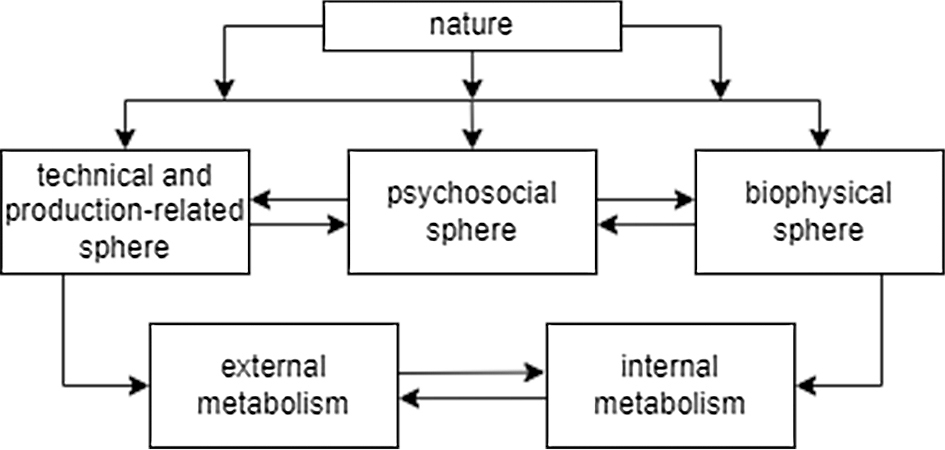
Fig. 1.
Simple, systemic interaction model of the human living environment according to Parysek (1985, 2006).
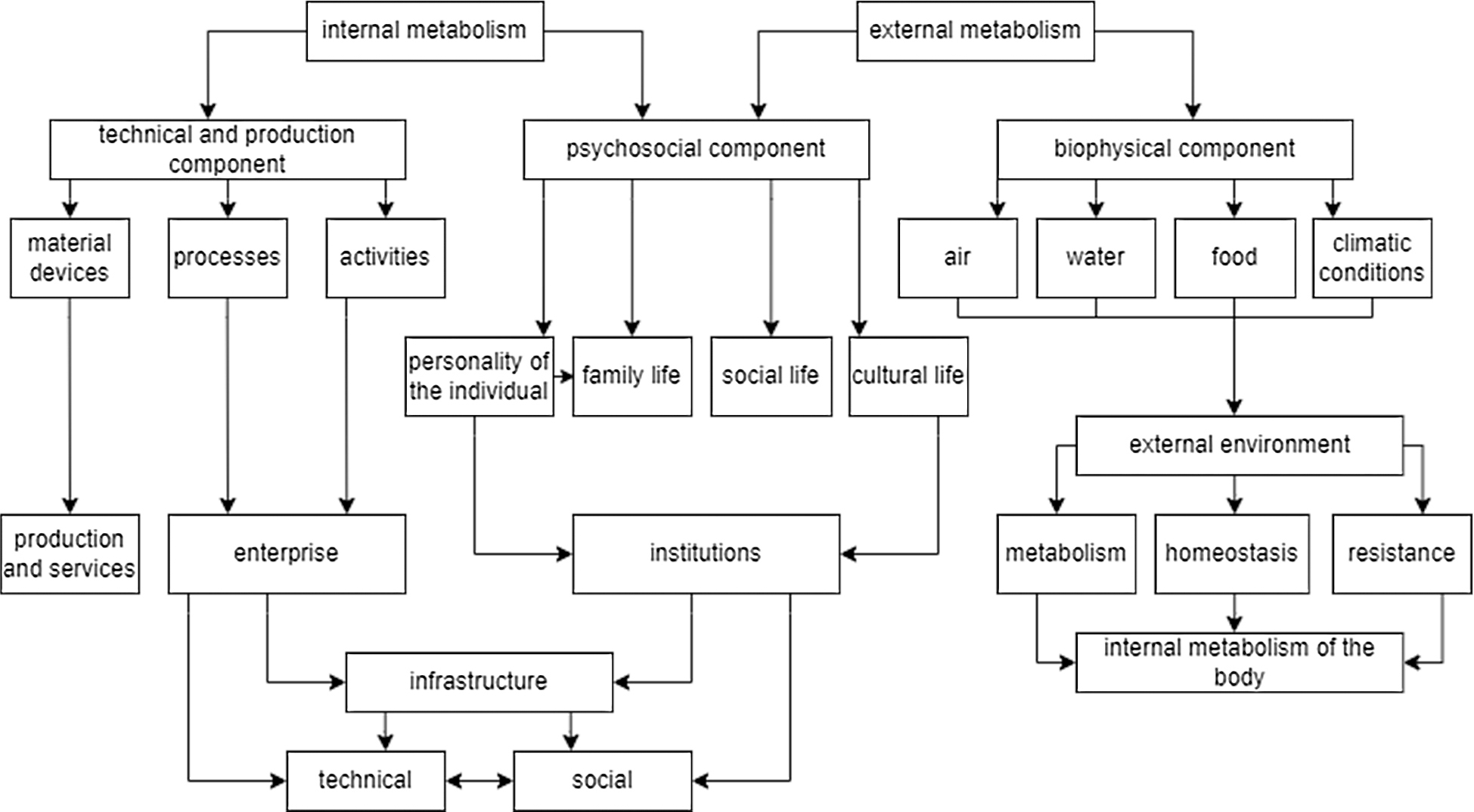
Fig. 2.
A developed, systemic interactive model of the human living environment according to Parysek (1985, 1997).
Table 4.
The city and a living organism: basic analogies according to Haken (1993).
| Living organism | City |
|---|---|
| Circulatory system (blood circulation) | Road infrastructure, street traffic, transport |
| Nourishment | Supplies of energy and matter (goods and services) |
| Digestion | Consumption (making use of energy and matter) |
| Metabolism | Production, service provision (processing of material to provide energy and synthesise new material) |
| Nervous system | Information flow |
| Brain | Management, knowledge, technology |
| Senses | Reception of information, perception |
| Excretion | Waste production and storage (processing) |
Table 5.
The city as an object meeting the necessary conditions for a living organism.
| Necessary conditions with reference to living organism | Necessary conditions with reference to city |
|---|---|
| 1. Unitary whole, or entity distinct from its surroundings | 1. A city is a settlement unit distinct from its surroundings, although today the boundary tends to get blurred; it is also a distinct self-governing unit in a country’s territorial division, hence it is a unitary whole. |
| 2. Metabolism | 2. There is a transformation of matter and energy in the city area; metabolism can be narrowed down to supplying financial components of the urban system that guarantee its operation and development. |
| 3. Homeostasis or maintaining internal equilibrium | 3. Homeostasis is a state of functional equilibrium of the urban system determined by the operation of urban services. |
| 4. Subsystem of information storage and processing, important for functioning | 4. Urban services must accumulate, store, process, and use all kinds of information in order to be able to steer the city’s operation and coordinate its development. |
| 5. Internal operation – regulating system | 5. This system is composed of city authorities and their agencies managing the city’s operation and development using legal, administrative, economic-financial, organisational-technical, and other means. |
Table 6.
The city as a system satisfying potential conditions of a living organism.
| 1. Ability to grow and reproduce | The city has no ability to ‘reproduce’, but it can develop and grow; the growth concerns both, its broadly understood size and its economic potential, and has a quantitative and qualitative aspect. The city can be said to ‘reproduce’ if this process is taken to embrace the appearance of new quarters, housing estates, or investment areas. The use of the term ‘growth’ is more justified than that of ‘reproduction’. |
| 2. Variability in replication, or evolution | One can speak of the evolution of a city, although this is different from the evolution discussed in biology (the evolution of species). The evolution of a city generally means the transformation and adjustment of its spatial organisation and economic system to the current civilisational-cultural reality. While some spatial forms of the city can endure longer, their character evolves over time to meet the challenges of new times and the changing urban community. |
| 3. Mortality (death rate) | The greatest problem in an identification with the city is posed by what in living organisms is called mortality (or better, dying). What can be taken as ‘mortality’ in the case of cities is certainly their downfall. Another kind is their demise or serious destruction caused by a disaster or war, and a decline brought about by an economic crisis. The manifestation of the city’s slow death is also urban shrinkage. While ‘the death of cities’ is not a widespread process today, the fall of cities recorded in history can be taken as proof of their still possible ‘mortality’. |
Table 7.
The city’s operating rhythms.
| Rhythm | Entities operating in a given rhythm |
|---|---|
| Round-the-clock | Economic entities working round the clock, municipal utilities (power, gas, heat, water and sewage systems, communications, public transport, etc.), health service, life and property security units (ambulance service, hospital emergency wards, fire brigades, police), some retail establishments (24-h shops, petrol stations), and services (emergency road service) |
| Daily | Individuals, households, economic entities, offices, kindergartens, schools of various types, health-care facilities, most retail establishments, service facilities, units offering municipal services, recreational facilities, etc. |
| Weekly | Most working places, kindergartens, schools, universities, cultural establishments, medical establishments, sports facilities (events), churches, etc. |
| Monthly | Economic entities, recreation centres |
| Yearly | Economic entities, budgetary units, including schools of various types, churches, cultural institutions, sports and tourist institutions |
| Random | Cultural and sporting events, meetings, conferences, congresses, etc. |
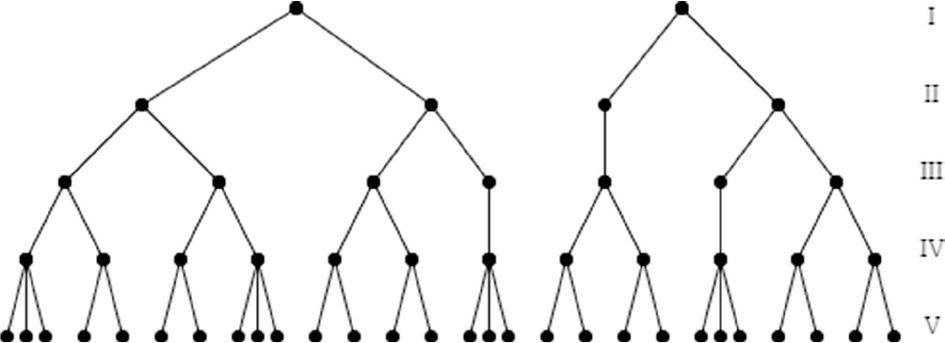
Fig. 3.
Model of the morphological structure of urban systems – I World cities, II Continental cities, III Subcontinental cities, IV National cities, V Regional cities.
Table 8.
Model of relations operating within an urban system based on Chojnicki (1989).
| Aspects | Human community | Territory | ||
|---|---|---|---|---|
| Natural environment (nature) | Artificial elements (economy) | |||
| Human community | x11 | x12 | x13 | |
| Territory | Natural environment (nature) | x21 | x22 | x23 |
| Artificial elements (economy) | x31 | x32 | x33 | |