
Introduction
The formulation of general systems theory by the Austrian biologist and philosopher Ludwig von Bertalanffy opened a new research perspective not only for biological sciences (von Bertalanffy 1950, 1968, Klir 1969, 1972). This theory was shortly adapted to other disciplines: mathematical and physical, technical, social, and also to geography, specifically to socio-economic geography, including even spatial management (Berry 1964, Bourne 1975, Batty 2009a, b), in Poland as well (Chojnicki 1985, 1988, 1989, 1999, 2011, Parysek 1986, 1997, 2006, 2014, 2015, Czyż 1996, Mierzejewska 2009)3. Therefore, in general, it was in those sciences where the subject of research is systems, i.e., certain complex, functional wholes. The publication of general systems theory became the basis for its adaptation to situations occurring in particular scientific disciplines and for enriching its assumptions with new proposals4. Given that cities are undoubtedly functional wholes, systems approaches have become present in the theory and methodology of urban geography. As is often the case in science, there are periods in which there is interest in a given theory, but also periods in which interest in this theory wanes. It seems, however, that in the circumstances of growing environmental problems, conflicts in spatial land use, occurrences and processes of catastrophic nature (natural disasters, epidemics, economic crises, terrorism, tense political situation, more recently the war in Ukraine, etc.), and also other crises cities are in, the topicality of this theory, altogether biological in origin, gains in importance.
The deliberations presented concern precisely cities treated as territorial systems and formed in the hierarchical pattern of urban systems, whose elements are cities treated as systems. Admittedly, the study is generally theoretical and methodological in character, but the deliberations refer also to the problems today’s cities have to deal with, including those diffculties related to planning of development and spatial land use.
System definition
As was already mentioned, a system is a certain functional whole with a unitary, elementary character. In a topological approach, components of each system are elements creating this system, which determine its structure by scalar relations connecting them. The functionality of the system, on the other hand, results from developed vector relations.
A general, simple system model can be written as follows: S = {xi, Rij, Rik}, where: S – system; xi – elements of the system (i = 1, 2, …, m; where: i ∈ S); Rij, – internal relations of the system (i ≠ j; i = 1, 2, …, m; j = 1, 2, …, m; where: i ∈ S, j ∈ S), Rik – external relations of the system (i ∈ S; k ∈ S, k ∈ E, where E – the environment of system S). As follows from the above, internal relations embrace the elements that are part of a particular system (S), and external relations – elements of such a system and the environment (E) in which it functions.
Although general systems theory was formulated in biological science, its broad interpretation has led to the development of two theoretical categories of system models: organicist and mechanicist. For the former, an organism is a model and for the latter – a mechanism (machine). A signifcant difference between these two categories consists primarily in the fact that in the organicist model, the relations integrating the system in a functional whole are deterministic and stochastic, whereas in the mechanistic one, only deterministic.
Each isolated system, especially real existing systems, functions in a specifc environment (E), whose elements (k = 1, 2, …, p) are not part of the system, but are important for its functioning because of the relations the system has with the surroundings (environment). The functioning of the system results primarily from developed internal relations (Rij), but also external ones (Rik). However, it is the former, the internal ones that determine, in particular, the nature of the system and the degree of its coherence. On the other hand, the relationship of internal relations (Rij) to external ones (Rik) determines the degree of the external opening (closing) of the system. Systems relations, both internal (Rij) and external (Rik) may be active or passive.
Although systems are generally isolated units, selected from the environment they function in, they may create hierarchical patterns in some situations. This means that in present conditions many different systems operate, which vary in size, character, a development degree, functioning, the level of the relationship with the environment and which also have a different place in the hierarchical system they are elements of. The subjects of geographical research and spatial management are many systems of this type. This study focuses on cities systemically understood and urban systems5.
Defining the structure of the system as key to understanding its functioning, development planning and spatial land use, and to solving problems
In the briefly described general system model, two categories of relations were distinguished, by which the elements of the system are connected, namely internal (intra-system), expressed by (Rij) and external (relations with the environment), expressed by (Rik). The first maps the system structure, whereas the second – the connection between the system and the environment. Although the former and the latter influence the functioning of the system, it is the first relations, i.e., internal ones (Rij), however, that define and map (reconstruct) the system as a functional whole.
The Nobel Prize winner Wassily Leontieff (1966), who was probably not familiar with general systems theory, reconstructed the system structure (specifically the USA economy) based on internal relations which are input–output (inter-branch) flows in the economy. Nevertheless, he treated the USA economy as a functional whole. Leontief mapped this structure using two matrices: (1) the inputs and outputs (Xij) matrix, oftentimes called the input–output matrix and (2) the matrix of technical coefficients of production (Aij), frequently presented in a matrix form or as tables (Tables 1 and 2).
Table 1.
Matrix of relations in the economic system input–output by Leontief (matrix Xij).
| Sectors of economy | Global product (xi) | Inter-sector flows | Final product (yi) |
|---|---|---|---|
| 1, 2, …, m | |||
| 1 | x1 | x11, x12, …, x1m | y1 |
| 2 | x2 | x21, x22, …, x2m | y2 |
| . | . | . | |
| m | xm | xm1, xm2, …, xmm | ym |
Table 2.
Matrix of technical coefficients of production (matrix Aij).
| Sectors of economy | Technical coefficients of production (sectors of economy) |
|---|---|
| 1, 2, …, m | |
| 1 | d11, d12, …, d1m |
| 2 | d21, d22, …, d2m |
| . | |
| m | dm1, dm2, …, dmm |
The input–output table (Table 1) consists of three elements: vector of total output x, input–output (inter-branch) matrix Xij, and final output vector y. However, matrix Xii, whose elements xij indicate the flow from the ith to jth economic sector, is the actual mapping of the structure. The rows in the matrix are streams of flows called inputs, while columns are flows which are outputs. This table is a kind of arrangement of balances in an economic system, put down in the equation: xi = ∑ xij + yi, where xi denotes the total output of the ith economic sector, ∑ xij – the sum of the flows from the ith economic sector to all the remaining ones, i.e., the jth, whereas yi, – the so-called final output (primarily export to the ith economic sectors and the residue for other purposes).
The strength of input–output relations in the economic system is depicted, however, by the subsequent table of technical coefficients of production (Table 2). The elements of this table are coefficients aij calculated by the formula aij = xij / xj. Therefore, Table 2 comprises matrix Aij with elements aij. The elements aij are calculated on the basis of the state of the economy in a specific period and change over time. They can therefore be calculated for different periods, and also one can make predictive calculations based on the transformation of the above formula. Thus, new matrices of input–output flows Xij can be created, using the transformation: xij = aij x xj, adequately to changes in total output xi and final output yj.
Leontief’s idea used for balancing the economic system can be applied, after appropriate adaptation, to describe the structures of probably each of the systems studied, also the system of the city and urban systems. The problem lies mainly in the choice of the system elements, between which relations are mapped by flow matrix Xij. This requires a tailor-made approach, according to the research problem formulated (Leontieff 1966, Kim 1989, Dietzenbacher, Lahr 2004).
Short history of the application of systems approaches (in Polish research in socio-economic geography and spatial management)
The origins of the systems approach in Polish geography go back to the end of the 1960s and the beginning of the 1970s. This is so, because in 1971 Zbyszko Chojnicki published his work on a systemic, interactive model of mutual dependencies between the socio-economic system and the natural environment (Table 3). The idea of this model sprang from the economic system model presented by Leontieff (1966), which is basically (elements and relations between elements in the input-output matrix) an interactive systems model that reconstruct the input–output relations of the economy. The proposed model enriched the economic sphere, which was the subject of Leontief’s interest, with a social sphere and environmental one. This was presented in the form of an interactive model, in which the interaction concerns two subsystems, i.e., socio-economic (human) and environmental (Table 3). This model distinguishes four interactive matrices. Matrix A – maps the structure of a socio-economic subsystem, matrix D – the structure of an environmental subsystem, matrix B – interactions of both those subsystems, specifcally the inputs of a socio-economic subsystem to an environmental one, and matrix C – also interactions, specifically the inputs of an environmental subsystem to a socio-economic one (Table 3). Such relations as those written in matrices B and C are signifcant in the implementation of all that falls within the concept of rational use of natural environmental resources and environmental policy, which has recently been called the European Green Deal. In turn, the entire model reconstructs relations in the environmental systems we live in, from a local to global scale6. This model may be also applied in cities.
Table 3.
The interactive model of the nature–human system by Chojnicki (1971) and Parysek (2006).
| Subsystems | Natural subsystem | Socio-economic subsystem |
|---|---|---|
| Natural subsystem | A | B |
| Socio-economic subsystem | C | D |
The Chojnicki conception of 1971 was the basis for the formulation of other models of interactive systems in which humans live and operate. Therefore, in 1986, what was presented was a slightly different, simplified, systems model of the human living environment (Fig. 1), and in 1979, its developed (Fig. 2) version (Parysek 1997, 2006). These models were created as the basis for describing the subject of local and spatial management, which was taken as a broadly understood human living environment, according to the anthropocentric approach to socio-economic and spatial management development (Parysek 1997, 2006). Certainly, the city, although specific, is such a living environment for the population. The general idea of these models was to separate three spheres of human living, treated as the subsystems of the living environment system in which people operate, but with a different character in each subsystem. The following spheres (subsystems) were distinguished: (1) biophysical, (2) psychosocial, and (3) technical-production. A human being functions as an organism (homo biologicus) in the first one, in the second as a person who understands, feels, and thinks (homo psychologicus), and in the third as a person operating in material and immaterial spheres (homo oeconomicus). These spheres are connected by two types of relations, called metabolisms. The biophysical and psychosocial spheres are linked by internal metabolism relations, and psychosocial and technical-production – external metabolism relations. The environment for the system understood in this way is the natural environment represented by atmosphere, hydrosphere, lithosphere, and biosphere. The distinguished subsystems of the human environment system thus described are linked with the environment by external metabolism relations (Parysek 1986, 2006; Fig. 1). In the developed model of the system defined in this way, what was distinguished were components of each of subsystems (spheres) and relations between them were indicated (Parysek 1997; Fig. 2).
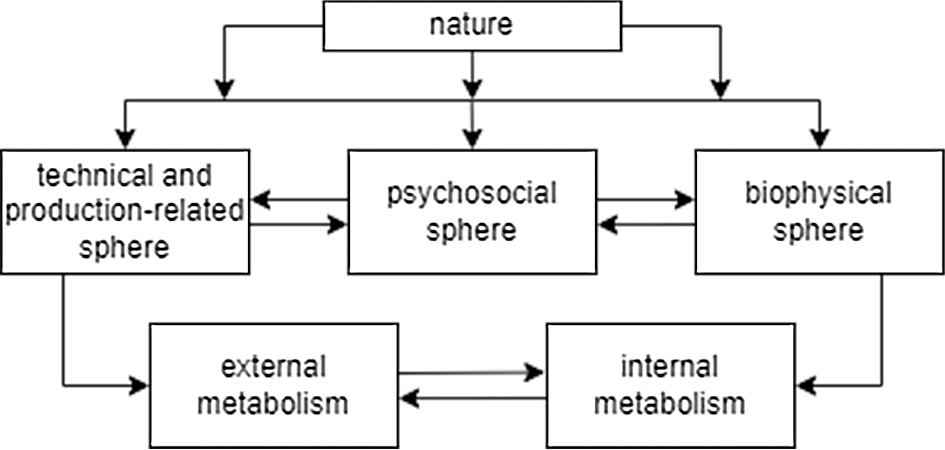
Fig. 1.
Simple, systemic interaction model of the human living environment according to Parysek (1985, 2006).
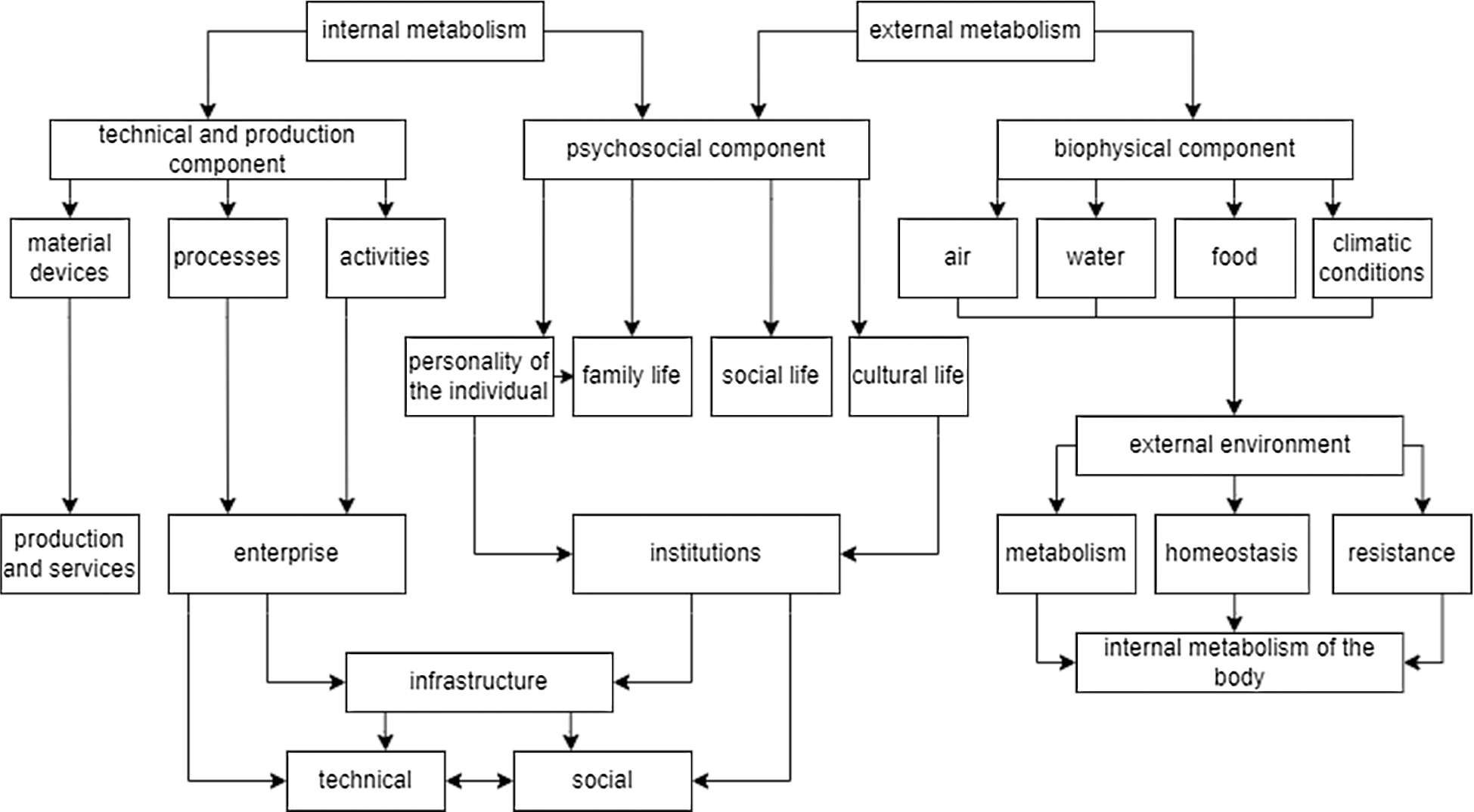
Fig. 2.
A developed, systemic interactive model of the human living environment according to Parysek (1985, 1997).
In the mid-1980s, the conception of a territorial social system, formulated by Chojnicki, was created as part of the deliberation on regions and their systemic nature, which was soon published (Chojnicki 1985, 1988, 1989, 1996, 1999, 2011, Czyż 1996). In a very synthetic approach, a territorial social system, with reference to Chojnicki’s publication, may be defined as such a social system “in which a collective of people permanently occupies, develops and controls a delimited area of the earth’s surface, which is a territory”. The role of such systems is particularly visible in shaping living conditions and in human activity (cf. Chojnicki 1988, 1996). The boundaries of territorial systems are delimited by the boundaries of a unit of a country’s territorial division. An occupied area can be only recognised as a territory when it is inhabited by people with strong, internal social ties, speaking the same language, upholding the same tradition, identifying with the area (which is proved by emotional relationships) over which a particular authority is established (Chojnicki 1988, 1989, 1996, Parysek 1997, 2006). Like any system, the territorial social system, being a functional whole, is determined by its components, relations, and the environment. Chojnicki (1988, 1989, 1996) distinguishes two basic, and at the same time complex, system components, i.e., (1) a social layer and (2) material base layer, which can be recognised as subsystems, composed of elements with greater or lesser complexity. The social layer of the territorial system is created by people (elementary components) and the main fields of human activities, i.e., economic, cultural, and political (complex components, spheres, layers). On the other hand, the material base layer consists of: the sphere of material (environmental) elements and the sphere of artificial (anthropogenic) elements, produced from natural substances as a result of conscious and deliberate human action. The material base of each territorial social system is a well-defined area with its material, natural and artificial content, and the resident population. In a geographical (spatial) sense, the material base overlaps the social layer. A specific area is therefore the place where those two components (subsystems) of the territorial social system integrate (Chojnicki 1988, 1989, 1996, Parysek 2006), whereas the structure of the territorial system is determined by a set of different types of relations which bind the system elements with one another (internal relations) and the system elements with its environment. When assuming that the subject of geographic research or planning activities (spatial management) is the territorial social system itself, it is important to consider three specific features, which are: location, boundaries, and ‘territoriality’, showing a certain interdependence7. It is also important to emphasise that a given spatial unit is a fully territorial social system insofar as the authority (local government) extends over its area. It is precisely the boundaries and authority that constitute a certain autonomy of a particular territorial system8. In the light of the territorial social system thus defined, it is unquestionable that a city has all the features required from a territorial unit considered to be such a system.
City as a territorial social system
As has already been mentioned, the whole and functional character of a city means that it may be treated as a system, and what is more, as a territorial social system. In Polish law, the city is a unit of the country’s territorial division at basic level, i.e., local one, like in many other states. Therefore, almost all assumptions that concern a territorial social system can be applied to the city (Berry 1964, Funck, Blum 1987, Chojnicki 1988, 1989, 1996).
Although Brian Berry (1964) has been admittedly recognised as the pioneer in the application of the systems approach in geography both in the city and the urban system, a strictly systemic approach to city research was proposed by Funck and Blum (1987), 9. In the system of the city, these authors distinguished its three complex elements (subsystems), i.e. (1) urban population, (2) private and public capital resources, and (3) natural resources of the city. The city–system thus defined was an element of a greater metasystem, embracing other cities and the rural areas of a given territory (environment). What was typical of the metasystem determined in this way were mainly structures: technological, institutional, and behavioural, while the relations between the system of the city and its environment (the metasystem that also includes a given city) embraced primarily economic, socio-cultural, political, and administrative processes. The output of the functioning of the relations mentioned are the factors of: production, the quality of the urban environment, as well as political and institutional capacity, important for the functioning of the system as a whole (Funck, Blum 1987). In fact, since then, many researchers have treated the city as a functional, spatial whole, adapting the systems approach to various conceptualisations of the city, and also urban systems (Maik 2008, Mierzejewska 2009, Parysek, Mierzejewska 2013, 2014, Parysek 2014, 2015). This may involve, as already stated, two theoretical city-related system models: mechanicist and organicist. Given the nature of the relations we have in the city, where functional relations (vector) coexist with structural-type relations (scalar), organicist models seem more relevant to the realities of the city.
City as an organism: An organicist conception of the city
The adoption of a systems model of the organisation, structure, and operation of a city may suggest treating this settlement unit as a sort of living organism, in full awareness of the human-made nature of the city itself. Naturally, it is also possible to adopt a mechanistic model, but the city, especially in its operation, shows a greater similarity to a living organism than to the workings of a mechanism. An organicist view of a city is associated with the name of Friedrich Ratzel, a 19th-century German zoologist, geographer, and ethnographer (Maik 2008). But it was not a systems approach, however, because general systems theory was formulated by Ludwig von Bertalanffy much later (von Bertalanffy 1950, 1968).
Analogies between a city and an organism have been sought by many other researchers pointing out similarities in the processes taking place in a city and in a living organism. Table 4 lists acceptable analogies of this kind, although one can hardly speak of a systemic treatment of the city in the approach proposed by Haken (1993). It seems, however, that treating city like an organism is perfectly justified because this unit, being a functional whole (a system), fultils all the necessary conditions or has got all the features that make a living organism what it is (Gánti 1986). Gánti distinguishes five necessary and three potential features that an object must possess to be recognised as an organism (i.e. a living system). The necessary features include: (1) a holistic and individual character, or separation from the outside world, (2) metabolism, (3) homeostasis, or the ability to maintain internal equilibrium, (4) a subsystem of information storage and processing crucial for functioning, and (5) an internal system that regulates functioning. The potential features, in turn, are: (1) the ability to grow and reproduce, (2) variability in replication, or evolution, and (3) mortality.
Table 4.
The city and a living organism: basic analogies according to Haken (1993).
| Living organism | City |
|---|---|
| Circulatory system (blood circulation) | Road infrastructure, street traffic, transport |
| Nourishment | Supplies of energy and matter (goods and services) |
| Digestion | Consumption (making use of energy and matter) |
| Metabolism | Production, service provision (processing of material to provide energy and synthesise new material) |
| Nervous system | Information flow |
| Brain | Management, knowledge, technology |
| Senses | Reception of information, perception |
| Excretion | Waste production and storage (processing) |
When analysing the nature of the necessary features, one can state that they primarily defne a living organism, while potential features rather refer to life processes (Gánti 1986). However, those are important features when we intend to treat the city as a living system or organism. Table 5 lists the necessary features of a living system with reference to the city, and Table 6, the potential features. It seems that their content clearly speaks for the city being treated as an organism, and hence we can further talk of its life (Gánti 1986, 2003).
Table 5.
The city as an object meeting the necessary conditions for a living organism.
| Necessary conditions with reference to living organism | Necessary conditions with reference to city |
|---|---|
| 1. Unitary whole, or entity distinct from its surroundings | 1. A city is a settlement unit distinct from its surroundings, although today the boundary tends to get blurred; it is also a distinct self-governing unit in a country’s territorial division, hence it is a unitary whole. |
| 2. Metabolism | 2. There is a transformation of matter and energy in the city area; metabolism can be narrowed down to supplying financial components of the urban system that guarantee its operation and development. |
| 3. Homeostasis or maintaining internal equilibrium | 3. Homeostasis is a state of functional equilibrium of the urban system determined by the operation of urban services. |
| 4. Subsystem of information storage and processing, important for functioning | 4. Urban services must accumulate, store, process, and use all kinds of information in order to be able to steer the city’s operation and coordinate its development. |
| 5. Internal operation – regulating system | 5. This system is composed of city authorities and their agencies managing the city’s operation and development using legal, administrative, economic-financial, organisational-technical, and other means. |
Table 6.
The city as a system satisfying potential conditions of a living organism.
| 1. Ability to grow and reproduce | The city has no ability to ‘reproduce’, but it can develop and grow; the growth concerns both, its broadly understood size and its economic potential, and has a quantitative and qualitative aspect. The city can be said to ‘reproduce’ if this process is taken to embrace the appearance of new quarters, housing estates, or investment areas. The use of the term ‘growth’ is more justified than that of ‘reproduction’. |
| 2. Variability in replication, or evolution | One can speak of the evolution of a city, although this is different from the evolution discussed in biology (the evolution of species). The evolution of a city generally means the transformation and adjustment of its spatial organisation and economic system to the current civilisational-cultural reality. While some spatial forms of the city can endure longer, their character evolves over time to meet the challenges of new times and the changing urban community. |
| 3. Mortality (death rate) | The greatest problem in an identification with the city is posed by what in living organisms is called mortality (or better, dying). What can be taken as ‘mortality’ in the case of cities is certainly their downfall. Another kind is their demise or serious destruction caused by a disaster or war, and a decline brought about by an economic crisis. The manifestation of the city’s slow death is also urban shrinkage. While ‘the death of cities’ is not a widespread process today, the fall of cities recorded in history can be taken as proof of their still possible ‘mortality’. |
Ascribing the features of both, a living organism and life itself to modern cities makes it possible to treat them not only as organisms, but also as living organisms. Thus, it allows approaching the life of a city as a research problem (Parysek 2014, 2015).
Life of the city and its rhythms
In the light of the above, the organicist conception of the city seems to be justified, especially when the life of the city is to be an object of study. With reference to a city and its inhabitants, the term ‘life’ is usually modified by a suitable adjective. Thus, life can be described as everyday, economic, family, social, sporting, cultural, personal, social, religious, professional, erotic and so on, as well as complicated, difficult, hard, easy, stormy, precarious, hectic, blameless, useless, etc. Some of those adjectives can refer to the city—we can certainly talk of its economic, social, cultural, or sporting life—while other ones, to its inhabitants.
A characteristic feature of the city is the rhythmicity of operation of elements making up this territorial system. While we can identify many various rhythms in its life, however, they are all, to a greater or lesser extent, a consequence of the Earth’s rotational movement. They also result from the properties of the city as a system composed of three distinct subsystems: natural, social, and economic. The rhythmicity of nature is of a different kind than that of city residents and the structures they build, and they both differ from the rhythmicity of the city’s infrastructure, economy, or services. Those various kinds of rhythmicity of nature and human behaviour patterns, social structures, urban infrastructure and services, economic entities, etc. make up this complex process that can be called the city’s life. Taking into consideration how the components of the city system work in time, one can distinguish certain characteristic rhythms of operation and assign to them specific domains of city life. One can certainly speak of: (1) daily (daytime activity), (2) 24-hour, (3) weekly, (4) monthly, (5) yearly, and (6) multi-year rhythms (Table 7).
Table 7.
The city’s operating rhythms.
| Rhythm | Entities operating in a given rhythm |
|---|---|
| Round-the-clock | Economic entities working round the clock, municipal utilities (power, gas, heat, water and sewage systems, communications, public transport, etc.), health service, life and property security units (ambulance service, hospital emergency wards, fire brigades, police), some retail establishments (24-h shops, petrol stations), and services (emergency road service) |
| Daily | Individuals, households, economic entities, offices, kindergartens, schools of various types, health-care facilities, most retail establishments, service facilities, units offering municipal services, recreational facilities, etc. |
| Weekly | Most working places, kindergartens, schools, universities, cultural establishments, medical establishments, sports facilities (events), churches, etc. |
| Monthly | Economic entities, recreation centres |
| Yearly | Economic entities, budgetary units, including schools of various types, churches, cultural institutions, sports and tourist institutions |
| Random | Cultural and sporting events, meetings, conferences, congresses, etc. |
Daily rhythms are a consequence of day and night; they mostly control human life, the operation patterns of households, as well as social and economic life. The 24-hour rhythms embrace all those spheres of human activity that ensure the city correct performance, and its inhabitants, their safety. Weekly rhythms with their religious-cultural roots also affect the operation of households as well as social and economic life. They underlie the measurement of time and the calendar. Also, monthly and yearly rhythms follow from the calendar, and they determine the organisation of economic activity and that of social institutions. Multi-year rhythms, in turn, are an effect of the laws of nature, rules of operation of societies and social changes, variations in the business cycle, etc.
The distinguished rhythms form a hierarchical system determined by the calendar and the temporal organisation of the activity conducted. At its top is the yearly rhythm, and nested in it are, successively, monthly, weekly, 24-hour, and daily rhythms.
Yearly rhythms are connected primarily with the annual mode of organisation and operation of many entities of economic and social life. It is usually in the yearly rhythm that steps are planned and the results assessed. The yearly budget determines the scope of activity of all state-supported units. Also, the statistics of many spheres of social and economic life are collected in an annual pattern. Education is conducted in terms of a specially defined year, viz., the school year and the academic year. Breaks in schooling also include a winter vacation as well as traditional, religious holidays. The same holds for the academic year. The yearly rhythm of activity of cultural establishments, termed an artistic season, is rather specific10. Sporting events follow a similar temporal pattern, although recently games are being arranged almost all year round (outdoor and indoor). Sporting events attracting large numbers of spectators (e.g. football matches, speedway races), and to a lesser extent, mass cultural events, cause a serious disturbance in the daily rhythm of city life, especially in such fields as transport and public order. The yearly rhythm is also characteristic of religious life. We can therefore assume that the yearly rhythm consists of monthly rhythms, although summer months, the traditional vacation period, play a special role here. It is in the summertime that the life of a city differs in various spheres from that in the remaining part of the year.
While the weekly rhythm is also an effect of the organisational framework adopted by entities of social and economic life, its foundations should be sought in the religious (Christian, Jewish, Muslim traditions, etc.) and social solutions adopted. Scientific-technological and civilisational-cultural progress, in turn, have made it possible to limit working time to five days a week. This solution is also treated as a social achievement of working people. Thus, in the countries of the Western cultural zone, the week consists of five working days and two days free from work – and this determines the weekly rhythm of operation of entities of economic and social life. This rhythm, obviously, is not followed by manufacturing and service establishments relying on continuous work as well as municipal services, traffic security, transport, health care, and personal and property security services11. A specific weekly rhythm of work is characteristic of cultural establishments.Cinemas are open practically every day, but mostly in the afternoon and evening, and on work-free days. Museums and exhibition galleries, as well as dramatic theatres, operas and other musical theatres, puppet shows, etc., are open six days a week, and the free day is usually Monday. Symphonic concerts, in turn, are generally held on Fridays, and sometimes also on Saturdays or Sundays. Sunday is the day of concentration of religious services, and so are church feast days. Generally, a five-day learning week is in force in nurseries and schools of various levels. However, institutions involved in teaching in an extramural mode also carry their activity on Saturdays and Sundays (higher schools). A five-day working week is also typical of health-care establishments, although some of them offer emergency first aid on free days. The work of the ambulance service and hospital emergency wards lasts seven days round the clock.
The daily rhythm, determined by the sequence of day and night and the physiology of the human organism, is the one followed by human beings and their households. A clear majority of institutions satisfying various social needs, including municipal services, are adjusted to this rhythm. Day and night control the basic rhythm of human operation. The 24-hour period is usually divided into the time of work or school, the time for arranging household matters, the time of leisure, recreation, etc., and the time for sleep.
As has already been said, a 24-hour rhythm is the one followed by establishments running on continuous work, transport, especially long-distance links, hotels, municipal services, and those protecting health, life and property (the ambulance service, the rescue service, police, the fire brigade), as well as some shops and service establishments. But it is the daily rhythm that plays the main role in moulding the life of a city, viz., its operation in time.
Some rhythms of city life are random in nature, like various meetings, conferences, and congresses, as well as sporting, cultural, and amusement events organised in a concrete city by agencies from outside or by its authorities. Also, occurrences of this kind alter the regular rhythm of the city to a varying extent.
Although several categories of city-life rhythms have been distinguished in this article, the generators of all of them are people, their day-and-night activities, and their needs that have to be satisfied. Thus, the primary role in shaping the life of a city is played by its residents, but in the age of high dynamics and an increase in the degree of centrality of some cities, its life is also substantially modified by residents of the suburban zone and visitors12. It is the needs of city dwellers that the functioning of urban infrastructure and its development should be adapted to, and so it most often happens.
Distinguishing some of the rhythms in the life of a city described above is natural because they are connected with the functioning of individuals, families, households, economic entities, public services, offices, etc. Other rhythms underlie human life cycles, and still other involve conventionally established periods of activity. Some rhythmicity is also imposed by the changeability of weather conditions, including extreme events, disasters, critical situations, other fortuitous events, etc.
The proposed model of the organicist understanding of the city and its life was applied in the research on the urban system of Poznań. The results of the investigation can be found in a two-volume publication Life of a city: The case study of Poznań (Parysek, Mierzejewska 2013, 2014).
The city in a system of cities
Berry’s deliberations on the system of cities referred to Christaller’s central place theory and Lösch’s theory of economic region. The central place theory is also a benchmark today for many discussions on organisation, structure, and functioning of urban systems13.
In 1933, Walter Christaller presented the first depiction of the central place theory, which was to explain the relationship among the size, number, and distribution of settlement units and the relations resulting from these relationships. The subject of Christaller’s interest was central places, i.e., settlement units, characterised by the property called centrality, and to be precise, the centrality level. This level is determined by the so-called central goods manufactured in a given place and delivered to the surrounding area as well as services provided for the residents of the surrounding area. According to the assumptions of central place theory, the centrality of goods manufactured and services provided in a given place determines the position of this place (city, village) in a hierarchical structure of settlement units and assigns to it a market of the appropriate spatial scale. The functions of a given settlement unit (the centrality level) that refer to the hierarchical level, quite clearly determine its functional structure and designate the extent of the spatial impact. Given the type, nature, and quantity of central goods produced and services rendered in a given settlement unit, Christaller distinguished seven hierarchical levels of central places, but one should not attach much importance to this number today.14 In doing so, he assessed their significance, determining the position of each place in the hierarchical structure of a settlement system.15 The network of cities then created the core structure of a settlement system in a given area. Although Christaller reconstructed the hierarchical structure of a settlement system, the main elements of this system were cities with higher centrality levels (Christaller 1933, Lösch 1956). A model of such a structure is a dendrogram, which is a tree graph (Fig. 3).
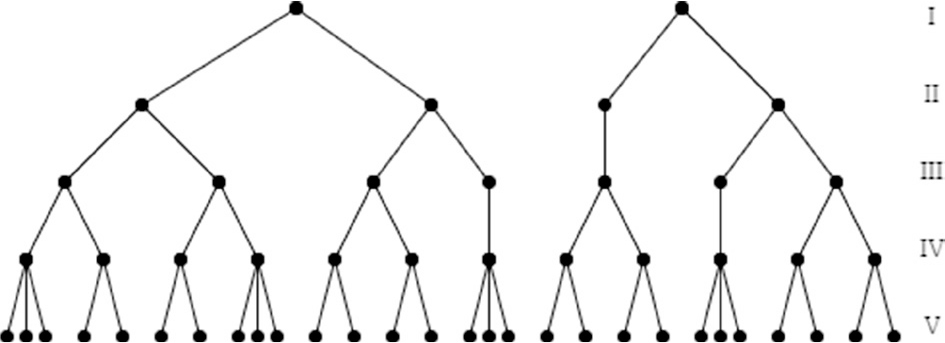
Fig. 3.
Model of the morphological structure of urban systems – I World cities, II Continental cities, III Subcontinental cities, IV National cities, V Regional cities.
Even today, various central functions determine the hierarchical structure of settlement units, especially urban systems, while also designating the extent of the impact of particular places, thus being the basis for the delimitation of functional regions.
Although the urban system is currently defined in different ways, this is in each case a set of urban centres related to one another and distributed across a given area. In other words, the elements of the urban system are cities, which are themselves systems, and specifcally, territorial social systems (Berry 1964, Chojnicki 1988, 1996, Parysek 2014, 2015). The literature provides numerous examples of the hierarchical reconstruction and investigation of the organisation, structure, and functioning of urban systems: regions, countries, groups of countries (EC - European Community), continents, and the entire world. An exception in this respect is a city region, which is an urban system in the smallest spatial scale, and specifically one urban centre and associated smaller towns, called an agglomeration or a daily region. The elements and spatial range of a city region are determined by commuting to work, schools, trade and service establishments, especially those of higher centrality levels (Neuman, Hull 2009, Parr 2010).
There is an extremely rich literature presenting organisations, structure and functioning of urban systems of particular countries, continents, and the world treated as a whole. A special role in the investigation and reconstruction of urban systems was played by studies on global or world cities, which are elements of world and continental urban systems (Friedmann 1986, 1995, Sassen 1992, Knox 1995, 2002, Taylor 1997, 2015, Taylor, Walker 2001, Massey 2007, Taylor, Derudder 2015). The elements of reconstructed urban systems are generally the largest cities in the world, continents, countries, also regions, called large cities, world or global cities, or metropolises. This is not, however, the same. Not every big city can be considered a world city, the less so a global city or metropolis. Moreover, the term global city should be restricted only to those world cities which are the largest and most important in the global economy, science and culture, although these notions are sometimes treated interchangeably (Sassen 1992, Hall 1996, Ng, Hills 2003, Reif 2014, Taylor 2015)16. It seems that every world city may probably be called metropolis, especially when it has metropolitan functions and, as a territorial system, has developed appropriate functional areas (Parysek 2002, 2007, Reif 2014). Metropolitan functions, which are generated by the presence of (1) institutions representing management and governance structures of international economic corporations, (2) management structures of global financial institutions (banks) and main regulators of capital markets (stock exchange), (3) the highest standard institutions of science (universities, research institutes) and technology (new technology centres, technopolises, technology parks), (4) top-level cultural facilities (museums, galleries, opera houses, concert halls, drama theatres) and artistic festivals and events, and also by (5) fast and frequent transport links (planes, high-speed trains) with main continent and world economic centres, (6) the city’s milieu, resulting from its location, specific atmosphere, unique beauty, standards of hotel and catering facilities, variety of cuisines, entertainment institutions, etc., and (7) the predominance of socio-economic and cultural links with other metropolises and other large cities over the links with one’s own region and country. For metropolises, as cities, what is also typical is the occurrence of specific spatio-functional structures, such as: (1) the administrative-economic centre, (2) cultural-artistic centre, (3) shopping and service centre, (4) transport and commercial centre, (5) airport with infrastructure, and (6) centre of political authority (Parysek 2002, 2007).
Many of the presented research results on world cities end with the reconstruction of a hierarchical world urban system, the system which is dynamic, subject to continuous evolution, and as a consequence, alterations (Fujita et al. 1999, Derudder, Taylor 2016). The elements of such a system are, as was stressed on many occasions, cities being territorial systems. Some of the cities in the system are growth centres (Hall, Hay 1980). At the same time, urban systems, especially world cities, as many other non-linear systems, are examples of self-organising systems, which is the result of the development of the elements of such systems, and not of top-down control. The elements of urban systems, being systems themselves, have also the property of self-organisation, although they are regulated to a large extent (authority, planning and development management). In some periods, every system, both city and urban system, remains in equilibrium that is disturbed by unpredictable occurrences and processes (natural catastrophic events, economic crises, wars, terrorist attacks, epidemics, also scientific and technological as well as cultural and civilisational revolutions, and ill-considered political decisions, etc.). In the language of self-organisation theory, these are so-called perturbations, throwing systems out of balance. Self-organisation capacities of systems mean, however, that after some time the so-called fluctuations are activated in the system, leading to changes in its organisation, structure and functioning, and specifically to its adaptation to new conditions and a new stable structure (Nicolis, Prigogine 1977, Prigogine 1978, Prigogine, Stengers 1984). The properties of self-organisation are also ascribed to urban systems (Allen, Sanglier 1981, Allen 1982, Portugali 1997, Banaszak et al. 2015).
The main problem of research on urban systems is the selection of classification criteria of cities considered, which are then the basis for the construction of hierarchical structures. In the literature, there are two categories of criteria: (1) features (central functions) that characterise cities of particular hierarchical levels and (2) links between cities considered – elements of urban systems. In the first period of the reconstruction of urban systems,% what was taken into account were primarily features of cities. The classification made on this basis, using multivariate statistical analysis, was the foundation for the construction of hierarchical patterns (Taylor 1997, 2010, Taylor, Walker 2001). The urban system model obtained this way reflected, first of all, vertical relations in the system. In the course of time, in the procedures of urban systems reconstruction, what started to be considered were links existing between the elements of the system, i.e., horizontal relations (Rozenblat, Pumain 1993, 2006, Taylor et al. 2002, Taylor 2015, Taylor, Derudder 2015, Derudder, Taylor 2016, Wdowicka 2016, 2017). The popular way of explaining the structure of relations in urban systems is recently central flow theory, referring to Christaller’s central place theory (Derudder, Taylor 2018). For some time, systematic research on the system of world cities has been carried out in the Globalization and World Cities Research Network (GaWC). This is where the first classification of world cities was created, within which three levels of the hierarchical pattern were distinguished: Alfa, Beta and Gamma with sublevels (Taylor, Walker 2001). The research repeated from time to time makes it possible to trace changes that are made in the system of world cities. Although three levels still exist (but the number of sublevels changes), two levels of cities were distinguished, which would be on the path to becoming world cities (High Sufficiency, Sufficiency). However, the number of elements in this system of cities (new world cities) is constantly increasing (Fig. 3). The basis for the reconstruction of the world system in the research conducted in GaWC is still links between cities, primarily economic ones, embracing advanced producer services: accountancy, advertising, banking/finance, and law.
When conducting the research on metropolises in Europe, four levels of a hierarchical pattern were selected and classified accordingly: (1) world metropolises, (2) continental metropolises, (3) subcontinental metropolises, and (4) domestic metropolises. The classification criterion was, in this case, the development level of metropolitan functions, the development of appropriate spatio-functional structures, and also air links, which was, however, some reference to the hierarchical classification of world cities from 2001 (Taylor, Walker 2001). The first three selected levels of the hierarchy of metropolises can be seen as corresponding to the three levels of: Alfa, Beta and Gamma, although the research subject was the world cities of Europe (Taylor, Walker 2001, Parysek 2002, 2007).
Significance of systems approaches for problem solving and for planning development, spatial land use, and urban functioning as elements of urban systems
The systems approach to the investigated reality is not only a cognitively attractive conception, but is also highly practical. Its essence is a certain degree of cohesion, a closing of the system in which binding internal relations are stronger than those with the environment (von Bertalanffy 1950, 1968, Klir 1969, Parysek 1997, 2006, Mierzejewska 2020). Such an approach makes it possible to comprehensively analyse and explain numerous phenomena and processes observed today and rationalise planning measures in various spatial scales. In fact, it is this very approach that allows discerning wholeness and complexity, and mapping the way of functioning of such a dynamic unit as a city. Therefore, system conceptions are used, among others, for planning sustainable development of a city and shaping its internal structure (including the territorial social system conception), and they also inspire research into its resilience to various types of threats and stressors (the organicist conception of the city treated as a living organism).
The sustainable development of a city is related to the shaping of proper relations within, namely between meeting residents’ needs, economic growth, and care for the natural environment (Petrişor, Petrişor 2013, Mierzejewska 2017). What is useful in analysing these relations is Leontief’s input–output table, which is the basis for the interactive model of the human-nature system and the territorial social system conception. The basic elements of the territorial social system of a city include, as has already been mentioned, a social layer, which is the collective of people residing in a given city, and a material base layer with natural and artificial elements, separated in the form of territory. However, all the components mentioned are not merely simple, but have a high degree of complexity and numerous internal dependencies. They can be treated then as three relatively autonomous systems, being at the same time the subsystems of the city’s territorial system (social, natural, and economic subsystems), between which different types of relations occur. In each systems approach, a significant role is played not only by relations within a given system, but also by the relations with the environment, creating specific conditions in which the system functions and develops (Parysek 1997, 2006, Mierzejewska et al. 2020).
Since urban sustainable development means achieving a certain level of balance in the system, putting its assumptions into practice involves the formation of proper relations in the system. One can distinguish three types of relations here (Mierzejewska 2017, Table 5):
intra-system relations – occurring within particular subsystems of a city system (social, economic, and natural) and presented in Table 8 as x11, x22 and x33 (the main diagonal of the matrix), decide about the possibility of achieving intra-system equilibria;
inter-system relations – occurring between particular subsystems (between a social and economic subsystem, social and natural, as well as economic and natural) and described as x12, x13, x21, x23, x31, x32, decide about the possibility of forming inter-system equilibria, and
relations with the environment – occurring between the city’s elements and more immediate and further surroundings (not included in Table 8), make it possible to achieve equilibrium within the agglomeration system.
Table 8.
Model of relations operating within an urban system based on Chojnicki (1989).
| Aspects | Human community | Territory | ||
|---|---|---|---|---|
| Natural environment (nature) | Artificial elements (economy) | |||
| Human community | x11 | x12 | x13 | |
| Territory | Natural environment (nature) | x21 | x22 | x23 |
| Artificial elements (economy) | x31 | x32 | x33 | |
However, not all components of the city system thus understood are equally important. The most significant role is played by people deciding about the creation, management, and maintenance of all the remaining elements (Mierzejewska et al. 2020). A human being generating various types of activities (economic, cultural, and political) plays a causative role in developing all the above-mentioned relations, and thus in determining the method of functioning, efficiency, and stability (equilibrium) of the whole system (Chojnicki 1989, 1999). Therefore, in the decision-making process, it is particularly important to allow for aspects resulting from the knowledge of laws, rules, and mechanisms governing the city subsystems, relations occurring between them, and between them and the environment (Mierzejewska 2017).
As was already pointed out, systems may create hierarchical patterns. This very assumption underlies Christaller’s central place theory (1933), traditionally applied to the formation of a settlement network (systems of cities) and a hierarchy of core places in this network. This theory, however, seems to be applicable also to smaller spatial scales. Since the central place is a place where central goods and services are cumulated (Christaller 1933), it does not have to be a city. It can be a place fulflling this condition, or places located within a city space. As a result, the city can be an element of a higher organised urban system (e.g. agglomeration, metropolitan area, a country’s settlement system, etc.), but it can at the same time comprise lower-level systems.
The places where the population density is higher than in the surrounding area with a concentration of broadly defned urban infrastructure (Liu, Wang 2016, Wang et al. 2019, Wang 2021) can be treated as intra-urban centres (subcentres). This viewpoint underlies the conception of urban substructures, which can be understood as relatively autonomous wholes operating in the city’s spatio-functional structure, with a high degree of coherence, comprising the urban subcentre (core) and the area of its influence (an area defined by the walking distance to the subcentre). The basis for distinguishing substructures is the spatial relations generated by the residents living in a given area. It is these relations that determine the coherence mentioned and the relatively autonomous nature of the substructure within a city. To perform their assigned functions, the subcentres of substructures (cores) should be intensively developed, densely populated, multifunctional, equipped with public spaces (including urban greenery), and integrated into an effcient public transport system ensuring connection with other parts of the city, including its centre, and as a result, the functionality of the city system as a whole. An urban substructure may be also perceived as a separate, relatively self-sufficient, territorial system that consists of interrelated elements (residents, business entities, and so on), operating within the system of the city with which it is closely related and, at the same time, as a subsystem of the territorial system of the city (Mierzejewska 2017, 2020).
The advantage of a polycentric spatio-functional city structure, composed of substructures, is providing residents with more egalitarian access to goods and services offered by the city (better, more complete satisfaction of needs) while maintaining a high quality of the natural environment (goods and services within a walking distance), economic efficiency (generating sufficient demand for goods and services offered in subcentres), and shaping the conditions for building communities that identify with the area in which they live, adopting regional identity (Mierzejewska 2021). Thus, the urban structure based on substructures incorporates the principles of sustainable development, building at the same time city resilience to various threats (e.g. epidemics, by limiting residents’ mobility that is conducive to transmission of the virus).
Systems approaches are also adopted in research into city resilience. Cities are seen there, among others, as ecosystems, adaptation systems, but simultaneously as territorial systems. As the territorial social system of a city constitutes a subclass of social systems, the most important element of the system thus understood is inhabitants, their activities and relations with the territory they live in. This is also an assumption adopted in publications on resilience in which human beings are put at the centre of attention, and the main assessment criterion when measuring urban resilience is minimising adverse impacts on people and making it possible for them to return quickly to normal functioning after experiencing disturbances (Desouza, Flanery 2013, Mierzejewska et al. 2020). These interactions may be analysed with reference to the relations and feedbacks described in the territorial social system conception, namely to (1) relations and social activities, (2) relations and transformation activities, and (3) relations or natural-ecological interactions (Chojnicki 1989).
The sources of the challenges, threats, crises, or risks (stressors) faced by cities and their residents may be internal, as a result of relations between the elements of the city system. However, they are often external and come from the more immediate or further city surroundings (some are global, e.g., economic situation, climate change, pandemics) (Mierzejewska et al. 2020). A multitude of city system elements and relations (including interactions) between them, combined with the uncertainty of when, where, and with what intensity the risk may occur, means that city resilience planning should be considered an extremely difficult task. This is so because it requires a comprehensive, flexible, and multifaceted approach to urban development and the awareness that the possibilities of establishing certain relations are limited to a great extent (many of them are outside city authorities’ competences). It applies to both internal relations (e.g. business contacts of economic entities) and (even more so) to relations between the city and its surroundings. Therefore, the development of the overall resilience of the city system to disturbances requires coordinated measures within its particular elements, which make up the resilience of the city system as a whole (Mierzejewska et al. 2020), but also cooperation within internal and external networks of relations.
Conclusion
There are many problems the knowledge and solution of which are dictated by changing reality, especially when the world constantly globalises and relatively sustainable systems go through perturbations, both random and induced by human actions and weaknesses. However, the general problem is still to learn about the organisation, structure, and functioning of both cities and urban systems, to find out about changes in this field, as well as to look for factors responsible for those changes. Both individual cities and urban systems of different spatial scales, different socio-economic and political systems, and different geographic conditions and history should be the subject of cognition. Therefore, the effect of such a cognition should be plans and programmes of socio-economic development and spatial land use, allowing for cross-society effectiveness. Thus, an important problem is the choice of relevant methods that would make it possible to measure the observed states of affairs, events, and processes to the highest degree, and thus make them credible, and further develop effective planning methods of a widely understood development. The research methods can be found in the extensive literature referred to in this study (cf. References). Particular attention should be paid to highlighting the importance of systems approaches, which make it possible, in holistic and functional terms, to examine, describe, and shape the increasingly complex reality surrounding us and the changes occurring within it.
Notes
[1] Universality of a systemic approach means that each territorial unit subjected to development planning may be treated as a system and the considerations presented may be referred to such a unit.
[2] The main point of reference is primarily an output of the Faculty of Human Geography and Planning of the Adam Mickiewicz University in Poznań, which is the leading unit in the field of theory and methodology of socio-economic geography and spatial management.
[3] This refers specifically to geographical units of the Adam Mickiewicz University in Poznań, where theoretical and methodological studies in the field of socio-economic geography and spatial management have been conducted since the 1960s together with the development of the application of quantitative analysis methods. Unfortunately, the time the works were created was not conducive, due to internal and external reasons, to publishing in English-language journals. As a result, the scientific achievements in this field were and still are basically unknown outside Poland (Chojnicki 1989, 1999, 2011, Parysek 2014, 2015).
[4] A monograph edited by Klir (1969, 1972) contains an extensive collection of this kind of publication.
[5] Even though the conception of a territorial social system was formulated as part of the systemic regional conception.
[6] Whenever the term environment is used (without an adjective), it refers to the conglomerate of the natural and socio-economic environment taken together.
[7] This is particularly important when considering the region as a territorial social system, but less so, when the city is the subject of study.
[8] In the case of regions (the country’s territorial division units), boundaries and authority – more specifically, the level of authority – determine territorial integration and, consequently, the formation of a spatial hierarchy of regions.
[9] Barry’s work (1964), however, attempts to combine general systems theory with other theories and geographic concepts relating to the urban system, such as Zipf’s rank-size rule, Christaller’s central place theory (1933) and Lösch’s theory of economic region (1956).
[10] In Poland it lasts primarily from September to June, with a holiday break of at least two months in the summer. In some countries, however (e.g. the USA and Canada), it is precisely in the summer that cultural events grow in number and frequency (e.g. concerts, operatic performances, open-air events and concerts, music and theatre festivals, art workshops, etc.).
[11] There are also some retail establishments, especially large-lot shopping centres, that started to work in a seven-day, weekly rhythm some time ago. The five-day working week of those employed in them is theoretically ensured by suitable organisational solutions. It should be emphasised at this point that in many West European states work on Saturdays and Sundays is seriously limited by legal regulations.
[12] The systems approach was used in many other studies undertaken, the subject of which was the city (Parysek 2006, Mierzejewska 2009, Parysek, Mierzejewska 2013, 2014). It also concerned the approaches to regional research as well as local and spatial management (Parysek 1997, 2006).
[13] The works referring to Christaller’s, Lösch’s and gravity and potential models have been also recently created in the Poznań geographic centre (e.g. Nijkamp et al. 2019, Dzięcielski et al. 2021; Nijkamp, Ratajczak 2021, and so on).
[14] The general assumptions of this theory, albeit formulated nearly 90 years ago, are still valid because they constitute the basis for hierarchical systems of settlement patterns, including urban systems.
[15] Although Christaller investigated the settlement system, which is a set of related (to a different degree) settlement units distributed in a given area, i.e., both towns and village units, a crucial role in the system understood in this way was still played by cities (specifically in Southern Germany – Bavaria).
[16] The literature also offers a slightly different understanding of global cities. These are cities which play the most important role in the globalisation process, which are foci of this process.
[17] Conflicts of interest Conflicts of interest
The authors declare no conflict of interest.
[18] Contributed by Authors’ contributions
All the authors have equally contributed to the article. JP, LM: conceptualisation, writing – original draft preparation, writing – review and editing, visualisation, supervision; LM: project administration. All authors have read and agreed to the published version of the manuscript.
[19] Statement
Data sharing not applicable to this article as no datasets were generated or analysed during the current study.