
Introduction
Geovisualisation is an interdisciplinary field that integrates cartography, GIScience, computer science, cognitive science, and human–computer interaction to support the interactive exploration of spatial data (Krassanakis et al. 2023). It emerged as cartography entered the digital era, emphasising dynamic, computationally supported inference-making rather than static map communication (Dykes et al. 2005, Çöltekin et al. 2017). Foundational work stresses that the prefix ‘geo-’ anchors visualisation in geographic space, place-based processes and Earth-related phenomena (MacEachren, Kraak 2001).
Geocommunication builds on, but extends beyond classical cartographic communication by focusing on how geographic knowledge is narrated and disseminated through digital map-based media. Early scholarship linked it to web-based cartographic infrastructures (Brodersen, Nielsen 2005), while more recent work highlights its integration of storytelling, user-experience (UX) design, and multimodal visual strategies for communicating spatial insights to diverse audiences (Caquard 2011, Redecker et al. 2011, Robinson et al. 2011, Griffin et al. 2017). It also encompasses rhetorical and persuasive dimensions, as visual and narrative styles influence how spatial arguments are interpreted (Muehlenhaus 2012). In this study, geovisualisation and geocommunication are understood as complementary competencies that enable learners to explore spatial data interactively and translate analytical results into audience-oriented spatial narratives. WebGIS interfaces, interactive maps, 3D scenes and storymaps are considered geospatial because they represent, analyse or communicate information explicitly referenced to geographic space.
The transformative potential of these competencies in higher education lies in their ability to merge technology with pedagogy, enabling learners to engage with complex spatial data in dynamic and meaningful ways. In today’s digitising academic environment, geovisualisation and geocommunication have become essential components of spatial literacy and spatial thinking (Goodchild 2008, Kerski 2008). Spatial literacy refers to the ability to interpret, analyse, and communicate spatial information through maps, visualisations, and geospatial tools (Lee, Bednarz 2009), while spatial thinking involves reasoning about spatial patterns, relationships, and geographic processes (NRC 2006, Gersmehl, Gersmehl 2011).
One initiative addressing these educational needs is the Digitally Connecting Real and Virtual Environments (DEvision) project, which develops open educational modules aligned with the Digital Earth (DE) vision. These modules are increasingly integrated into university programmes, offering a structured platform that supports spatial awareness, critical thinking and interdisciplinary collaboration among students and instructors. Despite the growing conceptual interest in geovisualisation and geocommunication, empirical evaluations of how these competencies develop in higher education remain limited. Existing studies often describe tools or theoretical frameworks, but rarely assess learning outcomes across disciplines. The DEvision module addresses this gap by offering a cross-disciplinary curriculum whose impact on spatial literacy and geospatial communication skills can be examined through systematic evaluation.
DE, first articulated by Al Gore in 1998, envisions a multi-dimensional, interactive digital representation of the planet that supports exploration, analysis, and decision-making across domains (Annoni et al. 2023). Over the past two decades, this vision has evolved through advances in geospatial technologies, emphasising their integration into education to address environmental and societal challenges (Craglia et al. 2012, Annoni et al. 2023, Nazarkulova, Strobl 2023). Within this framework, the DEvision project contributes to DE pedagogy by offering open educational resources and blended-learning scenarios that strengthen geospatial competencies across disciplines (Sui, Goodchild 2011, Nazarkulova, Strobl 2023, Piloyan, Petrosyan 2024).
Building on this foundation, the present study aims to evaluate how participation in the DEvision module supports the development of spatial literacy, geovisualisation proficiency, and geocommunication skills among learners from diverse academic backgrounds. Accordingly, the study addresses the following research questions:
To what extent does the module improve participants’ self-assessed spatial thinking and geovisualisation skills?
How do prior GIS (Geographic Information Systems) and ArcGIS Online experience influence learning outcomes and confidence in performing geovisualisation tasks?
What relationships exist between spatial literacy gains, technical proficiency, and UX awareness when interacting with web-based GIS tools?
Within the module, geovisualisation enables students to explore and analyse spatial datasets through maps, 3D scenes, and interactive web applications. These tools transform abstract data into tangible visual representations, enabling learners to recognise spatial patterns, relationships and trends relevant to fields such as urban planning, environmental management, and climate studies (Annoni et al. 2023, Nazarkulova, Strobl 2023). By engaging with these interactive representations, students enhance their spatial literacy and develop a deeper understanding of the geographic dimensions of real-world challenges (Craglia et al. 2012, Kerski 2015).
Geocommunication complements geovisualisation by focusing on the effective dissemination of spatial insights. Through spatial storytelling combining maps, multimedia, infographics, and narrative structure, students learn to communicate geographic information in ways that are both analytically rigorous and accessible to diverse audiences (Caquard 2011, Griffin et al. 2017, Roth 2020, Annoni et al. 2023, Piloyan, Petrosyan 2024). Together, these competencies support the broader goals of modern geospatial education by preparing learners to interpret, analyse, and communicate spatial information across academic and professional contexts (Annoni et al. 2023, Nazarkulova, Strobl 2023).
Despite their documented benefits, challenges remain, including unequal access to technology and limited instructor preparedness for teaching with advanced geospatial tools (Griffin et al. 2017, Annoni et al. 2023, Nazarkulova, Strobl 2023). However, the growing availability of cloud-based platforms and open educational resources offers opportunities to democratise access and scale the use of these methods within interdisciplinary curricula.
Materials and methods
The Geovisualisation and Geocommunication module is designed to develop competencies in the effective visualisation and communication of spatial data. The curriculum introduces students to core principles of cartographic communication, including thematic mapping and the use of visual variables such as colour, size, and shape (Bertin 1983, MacEachren 2004). Students learn to design maps that follow established communication conventions to ensure clarity, relevance and audience-appropriate messaging. Beyond static cartographic techniques, the module incorporates web-based geovisualisation, emphasising distinctions between static and interactive mapping environments. Learners are guided through the complete workflow of designing, developing, and publishing interactive web maps using both desktop and cloud-based platforms. By the end of the module, students are expected to analyse cartographic communication processes, evaluate the design logic of different map types, and apply workflows for producing effective spatial data visualisations.
The module consists of six interconnected units:
Creating and Sharing Web Maps – fundamentals of interactive web mapping and the role of dynamic representations in geospatial communication.
Classification, Symbolisation and Visual Combination – thematic mapping methods and the use of visual variables to enhance cartographic meaning.
Design for Interaction – integration of UX design elements such as pop-ups, basemaps and layer toggles.
Perspective Viewing and 3D Visualisation – interpretation and design of three-dimensional geospatial representations.
Storymapping and Dashboarding – narrative cartography and the integration of multimedia and real-time information for dynamic storytelling.
Creating App Experiences – development of customised spatial applications with emphasis on usability, interface design, and data integration.
A detailed description of the module is available through the DEvision Project Online Learning Platform (2022). The module was delivered over 7 weeks, with 4 h of instruction per week (3 ECTS – European Credit Transfer and Accumulation System credits), providing adequate time for the development of measurable competencies in geovisualisation, geocommunication, and spatial literacy.
A blended-learning framework was adopted, combining instructor-led sessions, practical exercises, and self-paced digital activities. To evaluate the pedagogical effects of the module within an authentic university environment, a mixed-methods design was employed. Quantitative survey data captured changes in spatial thinking, technical proficiency, and UX awareness, while qualitative feedback provided insight into student engagement and learning processes. A case-study approach (Yin 2014) guided the examination of how participants interacted with web-based geovisualisation tools and how these tools supported the development of spatial literacy and geocommunication skills.
The study involved 32 participants: 16 second- and third-year undergraduate students from geography, geology, cartography, and service specialisations; 8 university instructors from geography and related disciplines, and 8 professionals working in private-sector organisations. These groups represented a broad range of prior GIS and WebGIS experience, enabling comparison between novice and more experienced users. The module was implemented in three instructional settings: selected units were integrated into existing undergraduate and graduate courses; the full module was delivered to interdisciplinary student groups at Yerevan State University (YSU), and additional sessions were provided to faculty and private-sector specialists through the YSU Continuing Education Centre. This multi-format implementation enabled comparative insights across different learner backgrounds and professional profiles. For analytical purposes, participants were categorised as experienced or non-experienced users based on their self-reported familiarity with GIS and ArcGIS Online, allowing the study to assess how prior exposure influenced learning outcomes and UX responses.
A structured questionnaire was designed to evaluate participants’ progress in spatial thinking, technical proficiency, confidence in performing geovisualisation tasks, UX-design awareness, and perceived usability of web-based geospatial tools. The instrument also collected information on prior GIS experience and familiarity with the ArcGIS Online environment. Most items were measured on a five-point Likert scale ranging from 0 (very low familiarity or confidence) to 5 (very high). Spatial-thinking improvement was measured on a 10-point scale to provide finer differentiation for this multidimensional construct. Only complete responses were included in the analysis.
Data analysis was conducted using the Python programming language, employing statistical and visualisation libraries such as pandas, scipy, seaborn and matplotlib (McKinney 2017). Key variables included participants’ prior GIS experience, confidence in completing geovisualisation tasks, perceived usability of interactive mapping tools and self-assessed improvement in spatial thinking. Most questionnaire items were measured on a five-point Likert scale (0–5), while the item spatial thinking improvement used a 10-point scale to capture more nuanced cognitive changes (0 = no improvement; 10 = very great improvement). Only complete quantitative responses were included in the analysis.
The analysis focused on identifying relationships between key variables using Pearson’s correlation coefficient, a widely accepted method for assessing the strength and direction of linear associations in educational research. Pearson’s r was selected because Likert-scale items, when treated as interval-level proxies for latent constructs, support linear association analysis commonly applied in geospatial and learning analytics studies. In particular, the study examined how participants’ prior experience with ArcGIS Online influenced their reported gains in spatial thinking, UX design awareness and geovisualisation proficiency. Correlation strength was interpreted following Cohen’s (1988) guidelines, with coefficients above 0.5 considered strong, values between 0.3 and 0.5 moderate, and those below 0.3 weak.
The module was implemented primarily through a web-based GIS environment, with ArcGIS Online serving as the central platform for interactive mapping and geospatial communication tasks. The learning process also integrated the mobile GIS applications Survey123 and QuickCapture, which enabled students and instructors to engage in field data acquisition while exploring interface usability, design logic and visualisation workflows. These tools supported experiential learning activities grounded in user-centred design principles (Phantuwongraj et al. 2021). Although proprietary platforms were used, the pedagogical design and technical workflows are transferable to a range of web-based and open-source geospatial technologies.
All research activities followed established ethical practices for educational studies. Participants were informed of the study’s objectives and provided voluntary consent before participation. No personal or sensitive data were collected, and all responses were anonymised before analysis.
Results
The results in this section are based on responses to a structured questionnaire administered to both students and instructors. The survey assessed the perceived impact of the Geovisualisation and Geocommunication module on spatial literacy, technical proficiency, engagement with interactive web maps and overall pedagogical effectiveness. This approach follows established practices for evaluating technology-enhanced learning interventions in higher education (Garrison, Vaughan 2008, Lee, Bednarz 2009).
To support the interpretation of the results, participants were grouped into experienced and non-experienced users based on their self-reported background in GIS and WebGIS. Experience was measured using two indicators: (1) prior GIS coursework or practical experience, and (2) familiarity with ArcGIS Online. Because ArcGIS Online familiarity alone cannot fully capture a participant’s geospatial competence, both indicators were used together to create the two experience groups. This distinction is important for understanding differences in spatial-thinking gains, UX-awareness improvements and confidence in geovisualisation tasks.
The correlation analysis (Fig. 1) revealed both similarities and differences between lecturers and students in how the module influenced key learning outcomes. For lecturers, a moderate positive relationship was observed between post-module confidence in using ArcGIS Online and effectiveness in communicating spatial data (r = 0.69). A strong association was also found between improvement in spatial thinking and communication effectiveness (r = 0.75), suggesting that enhanced spatial cognition contributed directly to better presentation of geospatial information. The link between post-module confidence and intention to use ArcGIS Online in the future was moderate (r = 0.56), indicating that confdence was an important driver of potential future use.
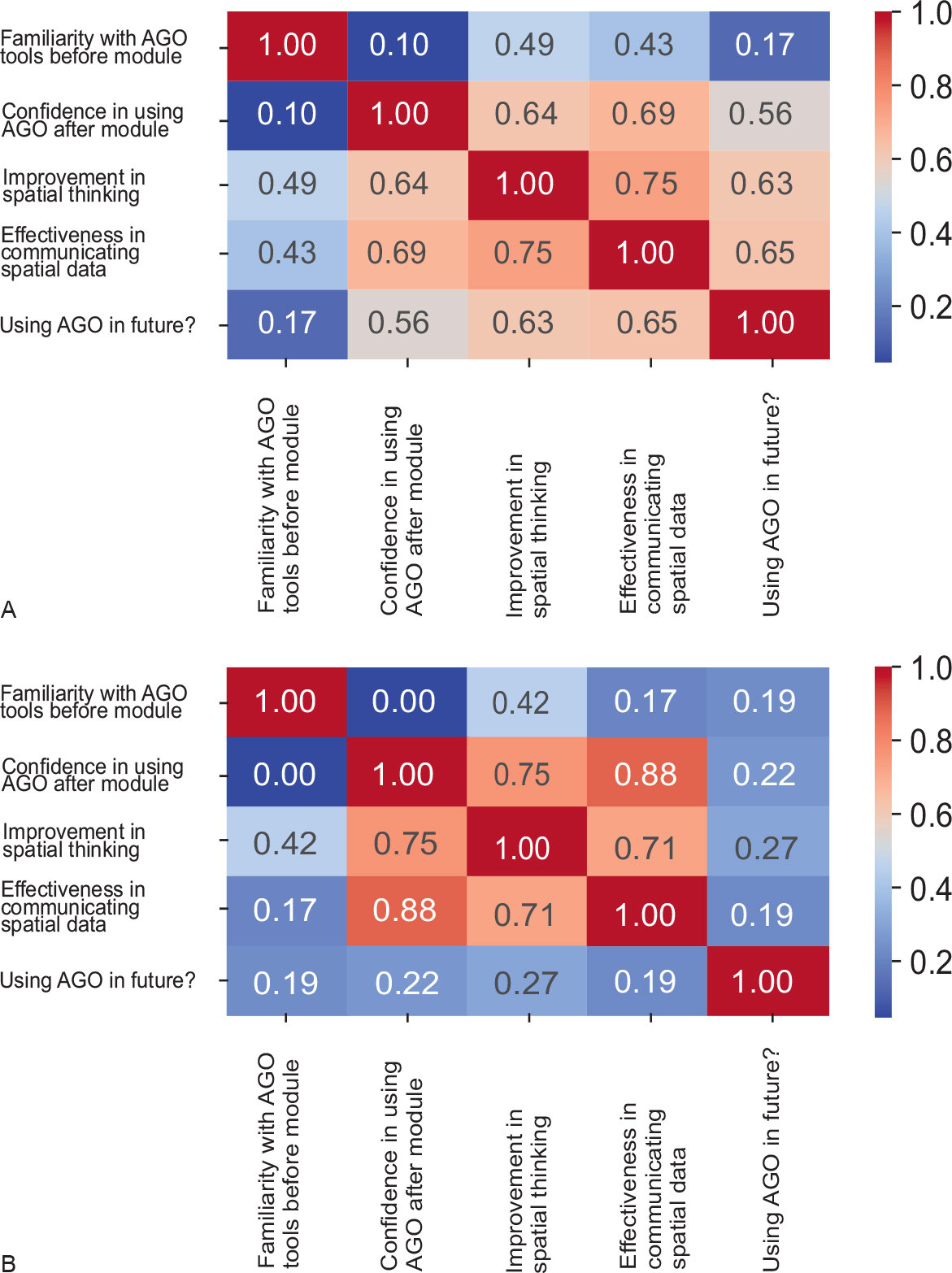
Fig. 1.
Correlation matrices of selected variables for lecturers (A) and students (B): familiarity with ArcGIS Online before the module, post-module confidence in using ArcGIS Online, improvement in spatial thinking, effectiveness in communicating spatial data, and likelihood of using ArcGIS Online in the future.
For students, the patterns were similar in some respects but differed in magnitude. The strongest correlation appeared between post-module ArcGIS Online confdence and communication effectiveness (r = 0.88), substantially higher than that of lecturers and suggesting a strong link between confdence and communication skills among learners. Confidence was also strongly related to gains in spatial thinking (r = 0.75), mirroring the lecturer’s results. As with lecturers, improvement in spatial thinking was positively related to communication effectiveness (r = 0.71). However, the relationship between students’ intentions to use ArcGIS Online in the future and other learning indicators remained consistently weak (r = 0.19–0.27), implying that short-term gains in skills and confidence did not necessarily translate into a strong intention to adopt ArcGIS Online beyond the course.
Figure 2 presents boxplots illustrating spatial-thinking improvement across specialisations for both lecturers and students. Among lecturers (Fig. 2A), geography specialists exhibited the widest range of improvement, suggesting that while some achieved substantial gains, others progressed more moderately. Cartography professionals demonstrated consistently great improvement with minimal variability, indicating that their existing familiarity with spatial representation facilitated more structured skill development. In contrast, specialists from social sciences and cultural studies showed lower median improvements, possibly reflecting weaker initial alignment between their disciplinary backgrounds and the module’s geovisualisation focus. These patterns are consistent with earlier findings that prior domain knowledge can facilitate more rapid acquisition of spatial-thinking skills.
Among students (Fig. 2B), cartography and geology specialists recorded higher median improvement scores than those in the service field, reinforcing the influence of disciplinary alignment with spatial concepts. Geography students showed uniform scores with limited variability. The results also suggest that prior experience with ArcGIS Online and GIS was associated with higher improvement scores, supporting the idea that a foundational understanding of geovisualisation tools contributes to more efficient skill acquisition. Students without such prior exposure displayed more varied outcomes, indicating that while some adapted successfully to the new tools, others encountered greater challenges, a pattern observed in studies of technology-enhanced learning, where initial levels of digital competence strongly influence learning trajectories.
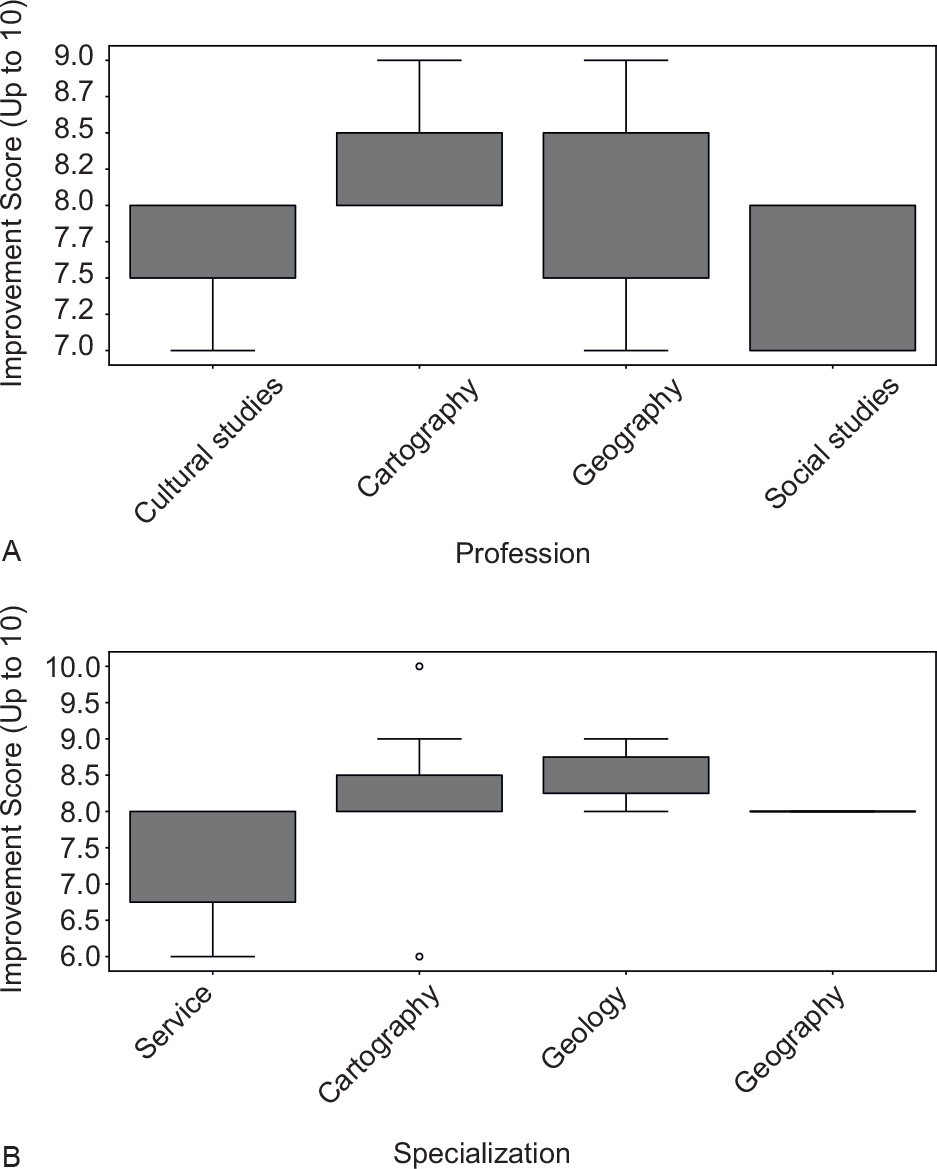
Fig. 2.
Spatial thinking improvement scores by specialisation for lecturers (A) and students (B), scale from 0 to 10.
Figure 3 shows improvements in UX-design and interactivity scores for lecturers (Fig. 3A) and students (Fig. 3B), grouped by prior ArcGIS Online experience. In both groups, the largest gains occurred among participants classified as experienced users, highlighting the role of pre-existing familiarity in accelerating skill development. Among students, prior experience was linked not only to higher median improvement scores but also to greater variability, suggesting that individual strengths or interests may influence the degree of improvement. Students without prior exposure demonstrated more consistent but lower median improvements, reflecting a slower adaptation process to interactive mapping concepts.
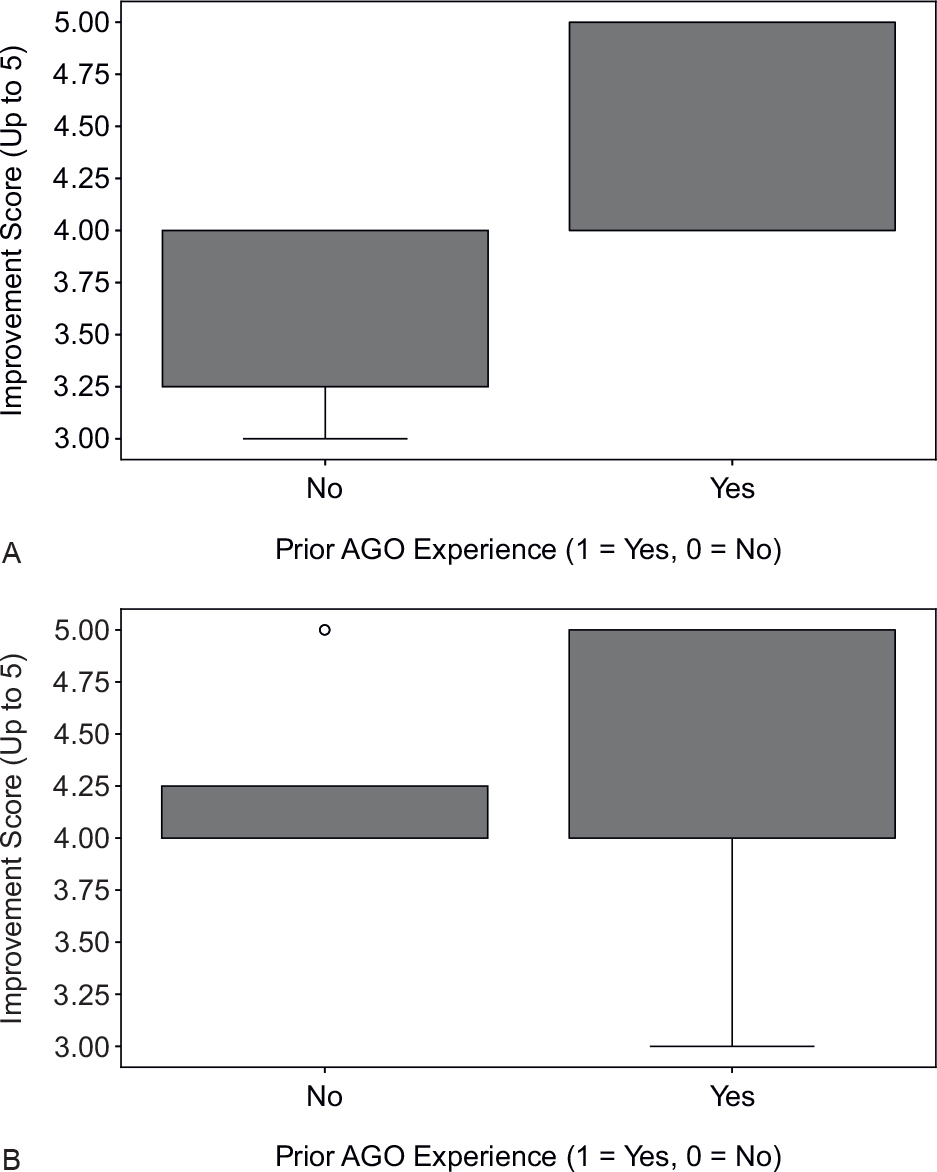
Fig. 3.
Improvements in user-experience (UX) design and interactivity by prior ArcGIS Online experience for lecturers (A) and students (B). ArcGIS Online.
Among lecturers, the gap between experienced and non-experienced users was also evident, with prior GIS and WebGIS knowledge correlating with stronger outcomes. These findings suggest that structured, hands-on training can significantly enhance digital cartographic skills and geovisualisation competencies, even among participants with minimal prior exposure to geospatial platforms. This aligns with the pedagogical emphasis on user-centred and interactive design embedded in the Geovisualisation and Geocommunication module.
Overall, the results indicate that while prior background knowledge and platform familiarity can influence the magnitude of improvement, the module is effective in fostering spatial literacy and geovisualisation skills across a wide range of disciplines. Even participants with limited prior experience achieved meaningful gains, demonstrating the adaptability of the module and its pedagogical value. These fndings suggest that well-structured, practice-oriented training in web-based geospatial tools can support substantial skill development regardless of prior competency level, making such interventions broadly applicable in both academic and professional contexts.
Discussion
The findings of this study demonstrate that the effectiveness of the Geovisualisation and Geocommunication module is influenced by participants’ prior experience, disciplinary background and the availability of sustained institutional support. These factors shape the magnitude and stability of learning gains and help explain the variability observed in the Results.
A primary challenge identified in this study concerns the variation in learning gains between participants with different levels of prior ArcGIS Online and GIS experience. Individuals with previous exposure to WebGIS tools consistently achieved greater improvements in UX design awareness, interactivity, and spatial thinking, while those without such a background showed more heterogeneous outcomes. This pattern aligns with earlier work highlighting the importance of scaffolded learning in geospatial education, where familiarity with geospatial concepts and tools supports more rapid progression into complex tasks. A practical implication is the value of offering short preparatory sessions or introductory ‘bridging modules’ before the main training to ensure that all participants share a foundational understanding before progressing to advanced geovisualisation workflows.
Another challenge relates to disparities in learning gains across academic specialisations. Geography, cartography and geology participants exhibited greater improvements in spatial thinking compared to those from social sciences and service, reflecting longstanding evidence that learners from spatially oriented disciplines benefit disproportionately from geospatial instruction (Bednarz, Kemp 2011). To address this, interdisciplinary adaptations of the module could be introduced, featuring tailored datasets, examples and analytical tasks that better align geovisualisation principles with the epistemological traditions of non-spatial fields.
A further issue concerns the relationship between confdence and sustained platform adoption. Although post-module confdence in ArcGIS Online use was strongly associated with communication effectiveness, the results indicate that profciency alone does not guarantee long-term engagement. Several participants expressed uncertainty about future use despite demonstrating substantial gains, reflecting broader concerns about sustaining the adoption of geospatial technologies in academic environments. Continued institutional support, such as integrating ArcGIS Online into regular coursework, offering follow-up workshops, and ensuring access to relevant datasets, can help maintain momentum and encourage the routine application of geovisualisation skills.
Overall, the findings underscore the importance of structured, adaptive and context-aware learning strategies for maximising the impact of geovisualisation and geocommunication training. Addressing disparities in prior experience, refining interdisciplinary teaching approaches, and sustaining institutional support can foster long-term proficiency and encourage the meaningful application of geospatial skills across academic and professional contexts. In doing so, this study contributes to ongoing discussions on the design of effective DE aligned geospatial curricula and supports the development of pedagogical models that enhance spatial literacy in diverse learner populations.
Conclusion
This study demonstrates the important role of the Geovisualisation and Geocommunication module in strengthening geospatial competencies within higher education. The module proved effective in enhancing spatial thinking and UX-design awareness across participants with diverse backgrounds. Although those without prior ArcGIS Online or GIS experience tended to show lower median gains, the structured and practice-oriented learning design helped narrow these gaps, indicating that foundational disparities can be reduced through well-sequenced instructional approaches. Both students and lecturers exhibited measurable improvement, confirming that geovisualisation training is beneficial regardless of initial familiarity with geospatial tools.
A central strength of the module lies in equipping participants with the ability to create, interpret and communicate spatial information effectively. The integration of web-based mapping tools supported hands-on engagement and encouraged learners not only to develop technical proficiency but also to consider usability and narrative presentation as core elements of cartographic design. This emphasis on user-centred geovisualisation is especially relevant in contemporary academic and professional settings, where spatial literacy and clear geospatial communication play an increasingly critical role.
By highlighting how design choices influence the accessibility and interpretability of spatial data, the module fostered an appreciation for the communicative dimension of geovisualisation. Participants gained practical insights into crafting spatial representations that support informed decision-making and interdisciplinary collaboration.
Overall, the findings suggest that incorporating structured geovisualisation and geocommunication training into university curricula can play a key role in developing a technologically adept and spatially literate academic community. Such training equips learners with the skills necessary to address complex real-world challenges through thoughtful geospatial analysis and effective communication of spatial information.
Acknowledgements
The research was financially supported by Project252: ‘Digitally Connecting Real and Virtual Environments | DEvision’ project funded by the Austrian Development Cooperation’s ‘Austrian Partnership Programme in Higher Education and Research for Development’ (APPEAR) programme. We are especially grateful to colleagues from partner institutions for their comprehensive assistance in various stages of the study. We would like to thank anonymous reviewers for their valuable comments, especially those concerning terminology.
Notes
[1] Contributed by Author’s contribution
VM: conceptualisation, validation, formal analysis, investigation, data curation, resources, software, visualisation, writing – original draft. AP: conceptualisation, methodology, writing – review and editing, supervision.