
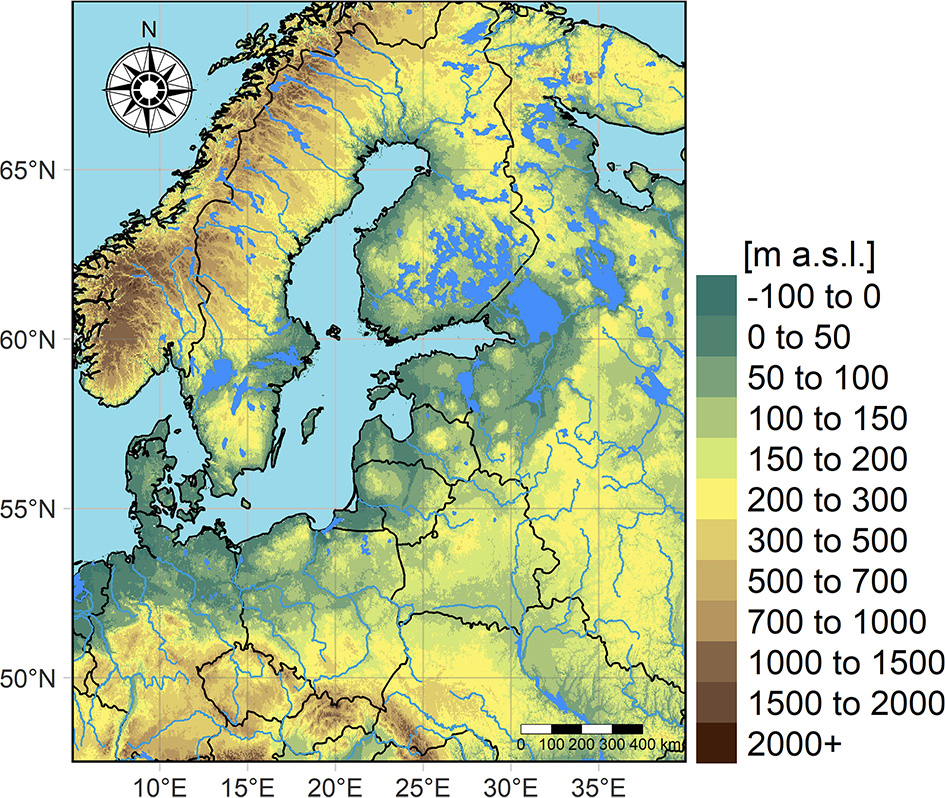
Fig. 1.
Study area.
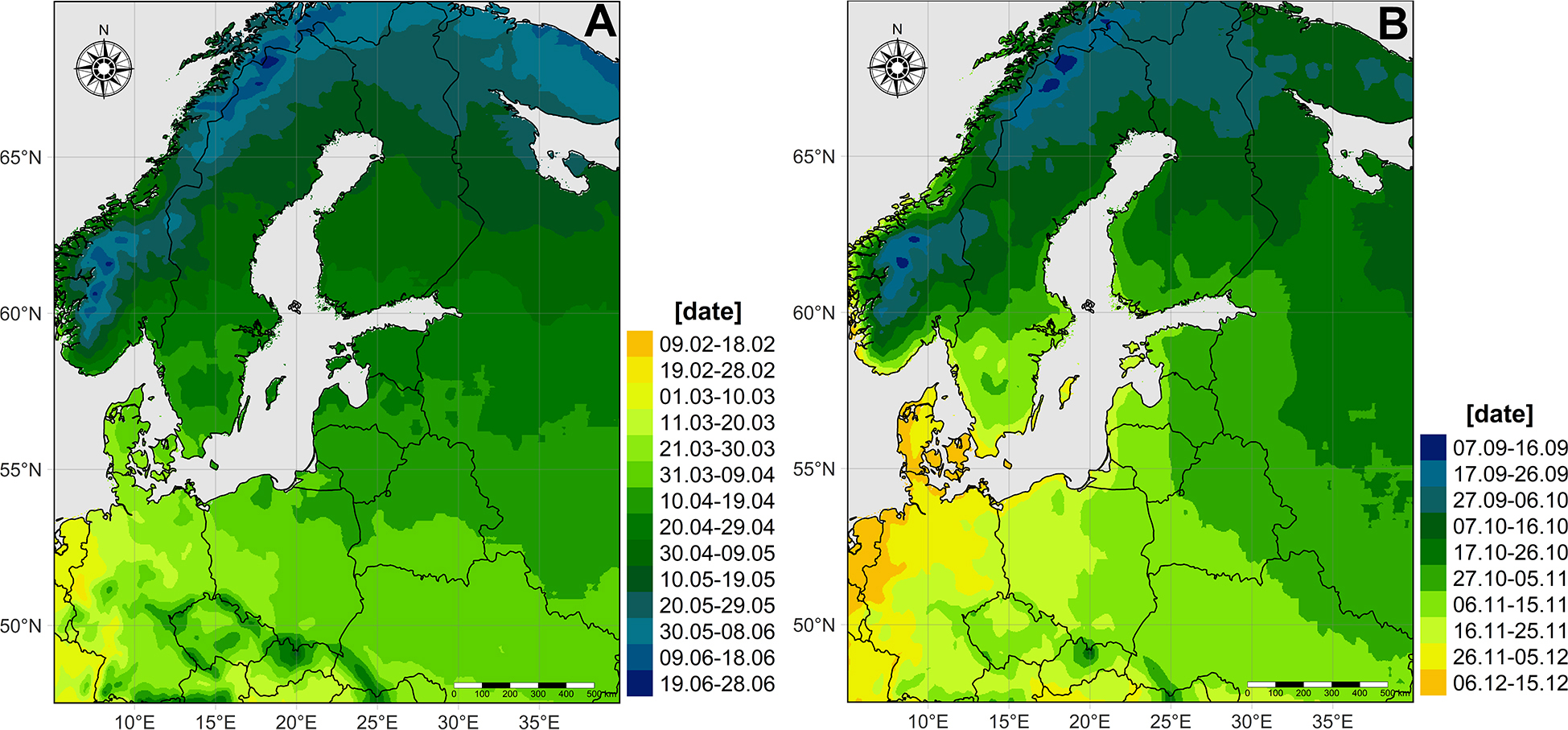
Fig. 2.
Average start (A) and end date (B) of thermal growing season (TGS) in the years 1950–2022.
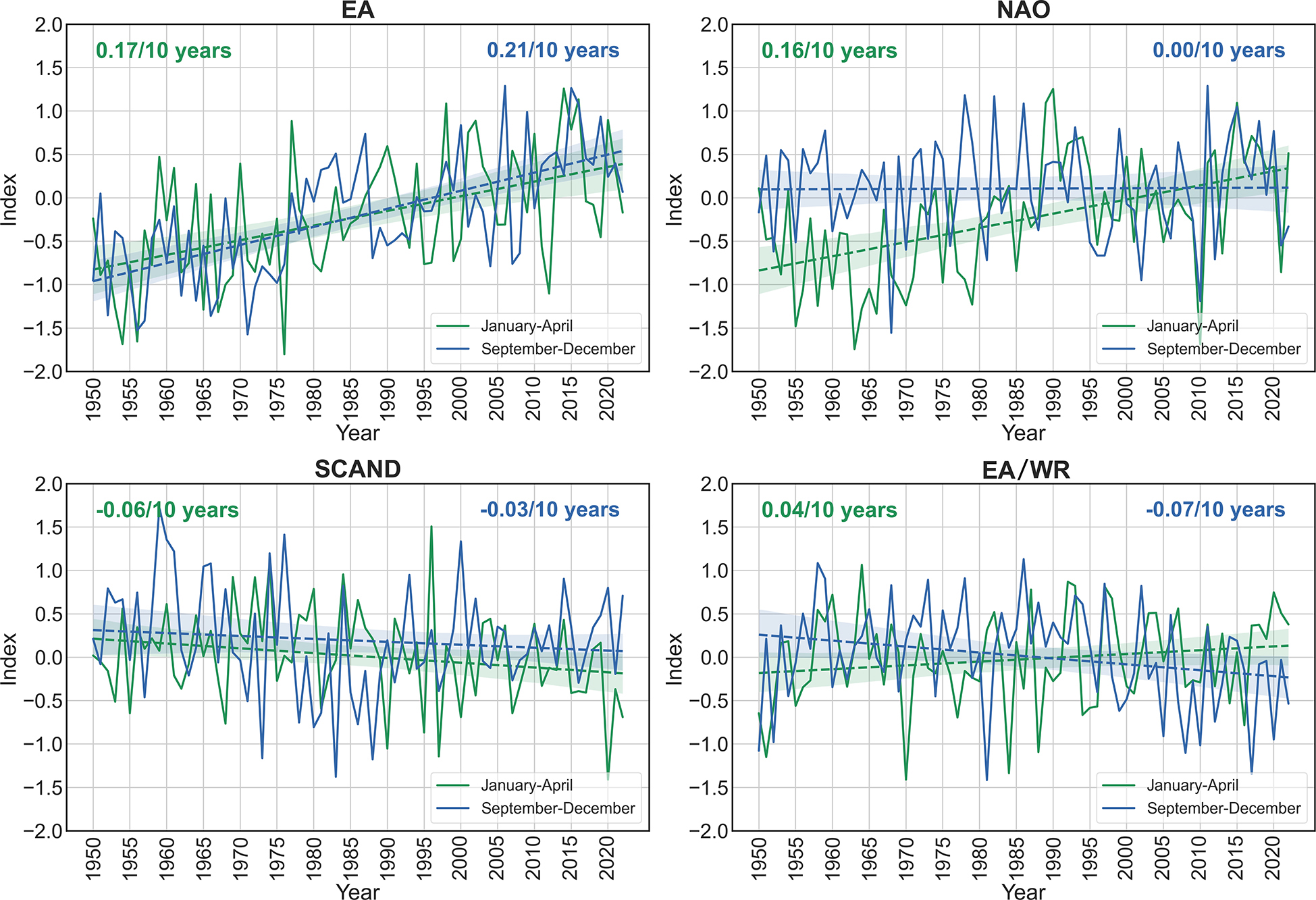
Fig. 3.
The course of the average values of the indices of the analysed teleconnection patterns from January to April and from September to December.
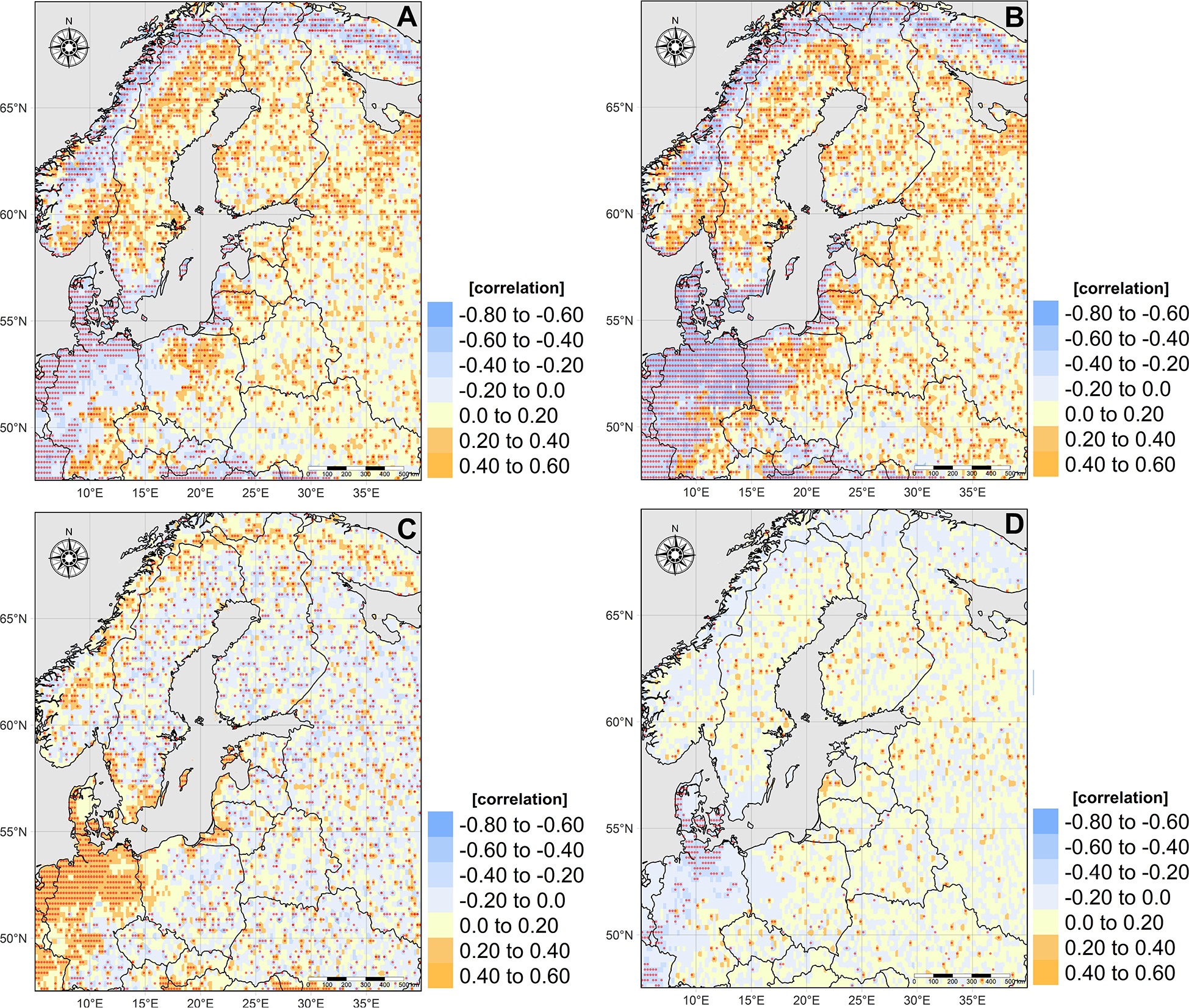
Fig. 4.
Correlation coefficient of the date of the beginning of the thermal growing season with the seasonal average: East Atlantic(A), North Atlantic Oscillation (B), Scandinavia (C), and East Atlantic/Western Russia (D) indices (red dots indicate statistically significant changes (p < 0.05)).
Table 1.
Summary of correlations between circulation indices and the start of the thermal growing season (C – Central, E – East, N – North, S – South, W – West).
| Index | Lowest value of correlation coefficients | The highest value of the correlation coefficients | Mean correlation | % of area with statistically significant correlation (p < 0.05) | Dominant sign of correlation | Main regions of strongest correlation |
|---|---|---|---|---|---|---|
| East Atlantic | –0.54 | 0.55 | 0.03 | 31 | Mixed | +C Sweden, N Russia; –Denmark, N Germany |
| North Atlantic Oscillation | –0.64 | 0.60 | ~0.00 | 40 | Negative | +C Sweden; –W part of the study area, Norway |
| Scandinavia | –0.50 | 0.48 | ~0.00 | 23 | Positive | +W part of the study area, N Scandinavia; –Finland, Russia |
| East Atlantic/Western Russia | –0.37 | 0.42 | ~0.00 | 5 | Weak/mixed | +C Finland; –N Norway |
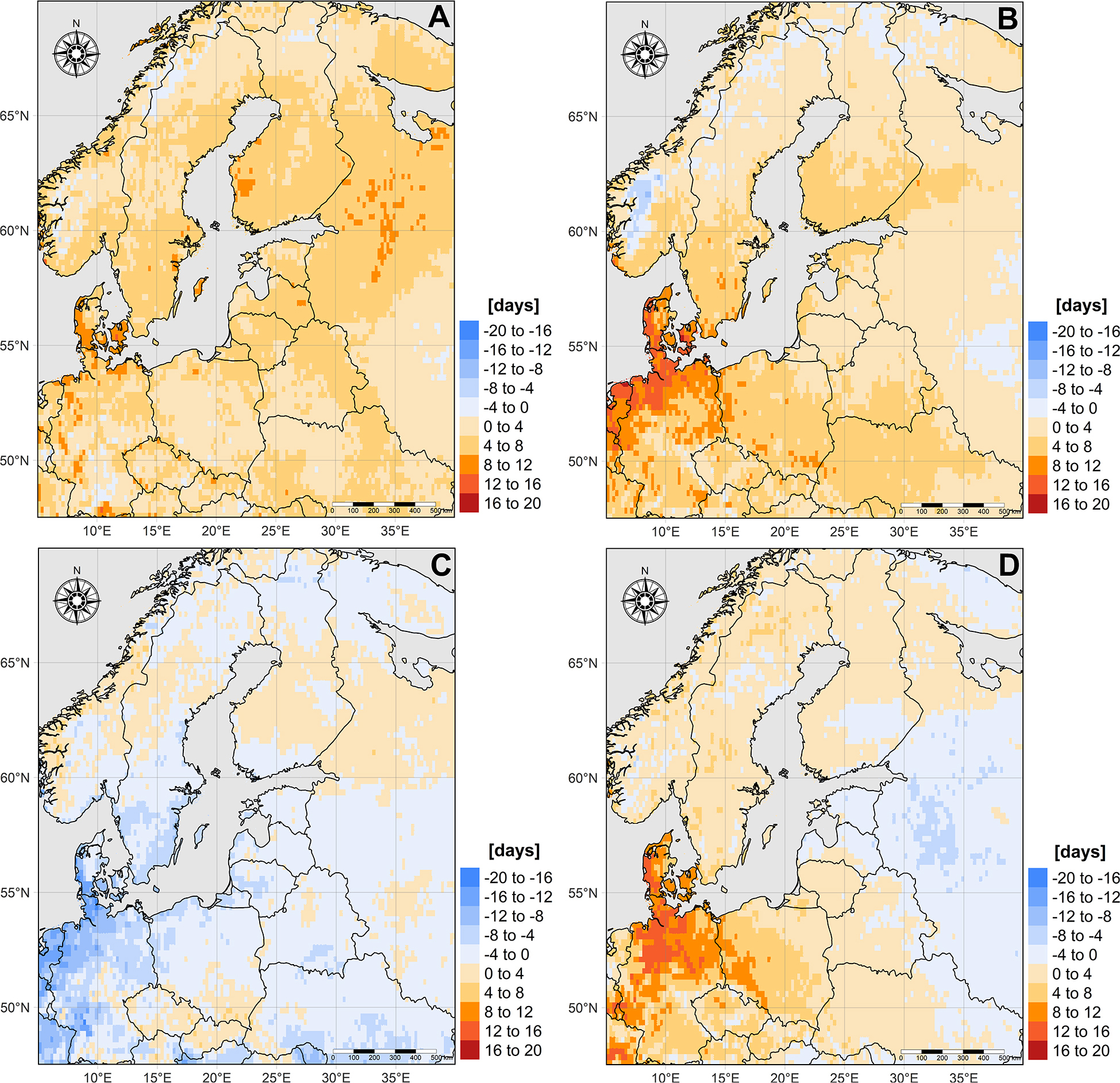
Fig. 5.
Deviation from the average start date of the thermal growing season in seasons with East Atlantic (A), North Atlantic Oscillation (B), Scandinavia (C), and East Atlantic/Western Russia (D) index values below the 25th percentile.
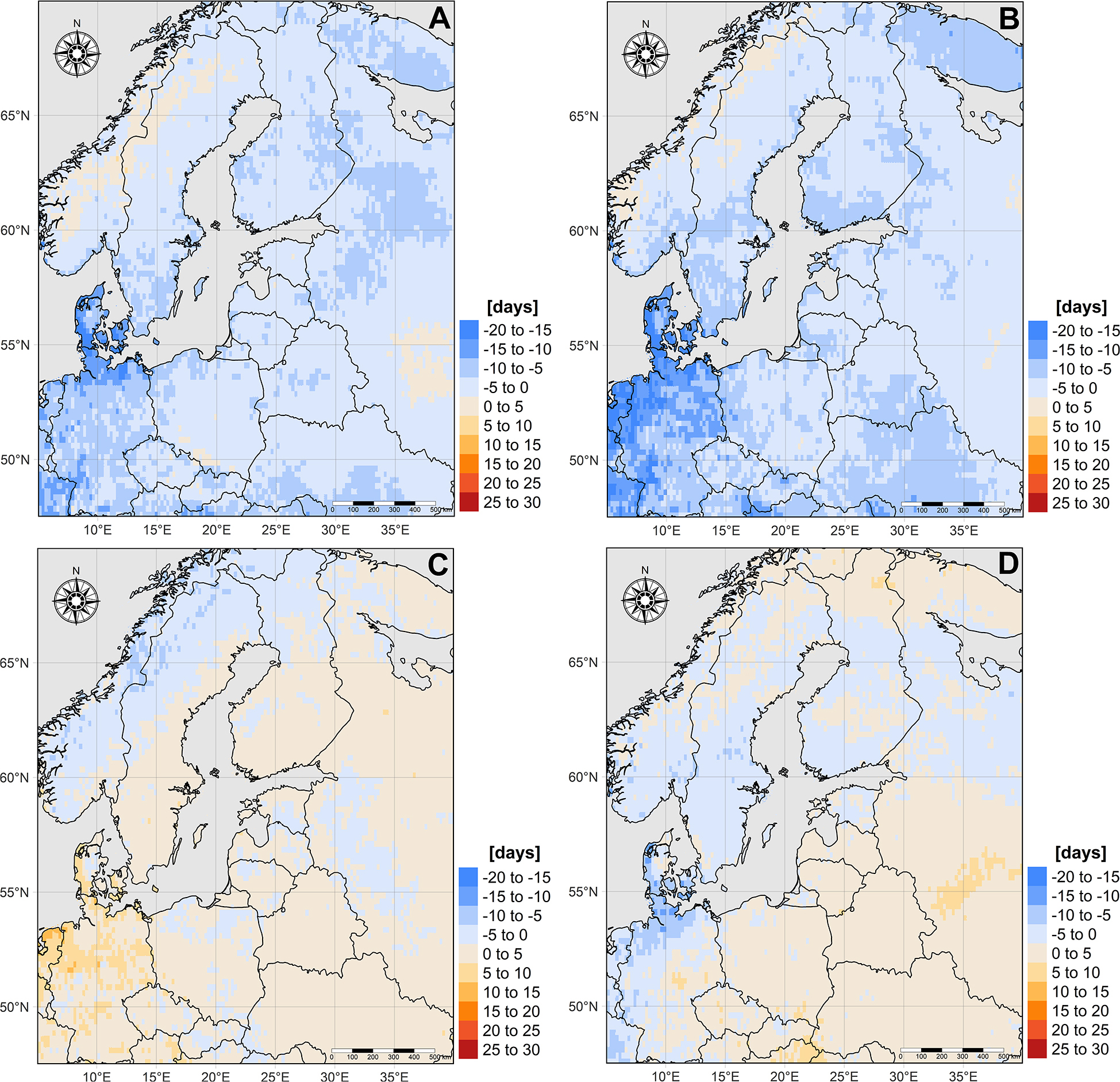
Fig. 6.
Deviation from the average date of the beginning of the thermal growing season in seasons with index values of East Atlantic (A), North Atlantic Oscillation (B), Scandinavia (C), and East Atlantic/Western Russia (D) above the 75th percentile.
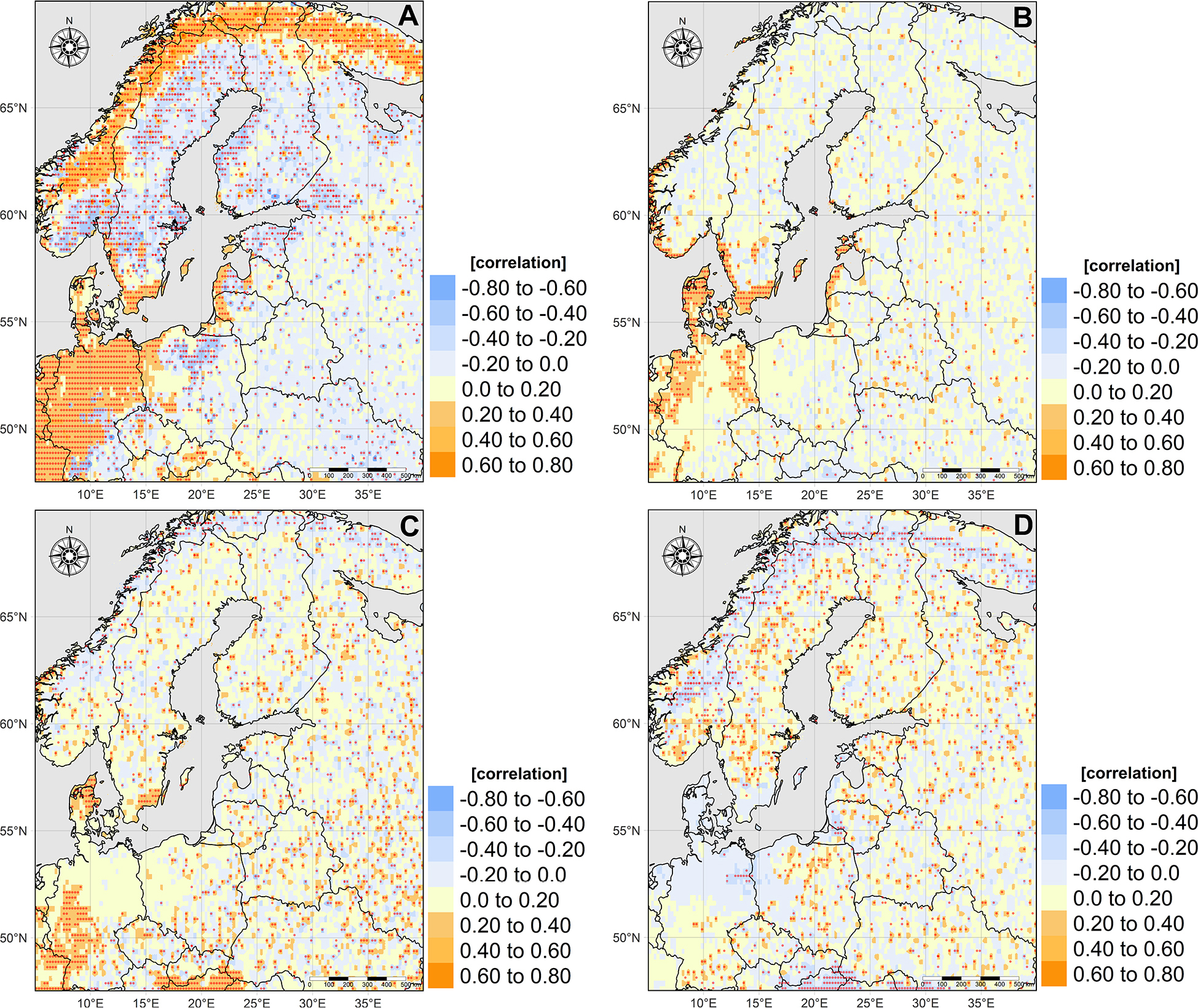
Fig. 7.
Correlation coefficient of the date of the end of the thermal growing season (TGS) with the seasonal mean East Atlantic (A), North Atlantic Oscillation (B), Scandinavia (C) and East Atlantic/Western Russia (D) indices (red dots indicate statistically significant changes (p < 0.05)).
Table 2.
Summary of correlations between circulation indices and the end of the TGS (C – Central, E – East, N – North, S – South, W – West).
| Index | The lowest value of the correlation coefficient | The highest value of the correlation coefficient | Mean correlation | % of area with statistically significant correlation (p < 0.05) | Dominant sign of correlation | Main regions of strongest correlation |
|---|---|---|---|---|---|---|
| East Atlantic | –0.66 | 0.65 | ~0.00 | 33 | Mixed | +N Scandinavia, N Germany; –Estonia, C Finland |
| North Atlantic Oscillation | –0.34 | 0.49 | 0.02 | 6 | Mainly positive (weak) | +Denmark, N Germany, S Sweden; –Belarus, NE Europe |
| Scandinavia | –0.43 | 0.40 | 0.03 | 14 | Mainly negative | +Hungary, Denmark, C Germany; –Finland, N Russia |
| East Atlantic/Western Russia | –0.54 | 0.45 | ~0.00 | 13 | +C Poland, NE Europe; –N Norway, W part of study area |
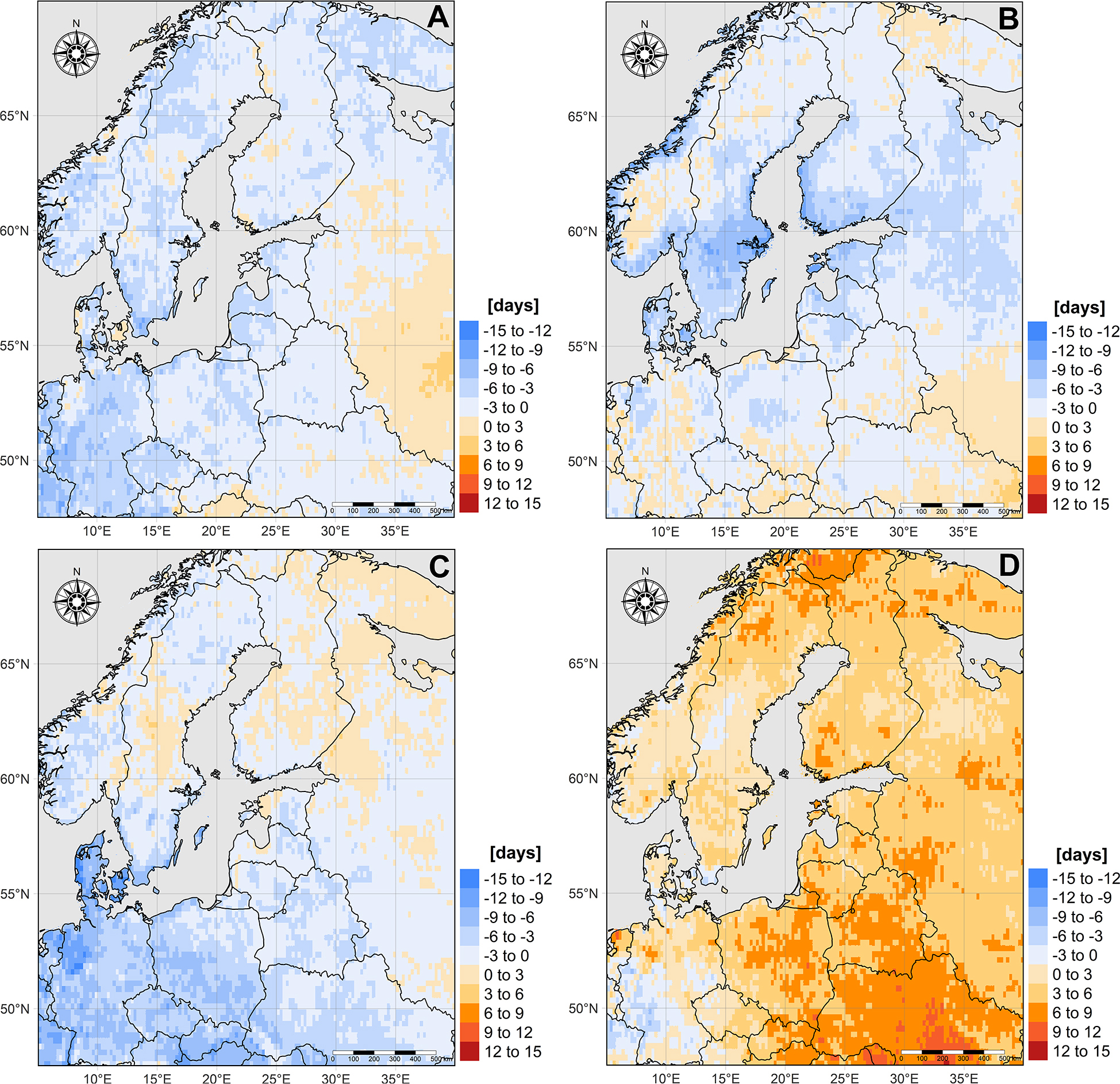
Fig. 8.
Deviation from the average date of the end of the thermal growing season in seasons with East Atlantic (A), North Atlantic Oscillation (B), Scandinavia (C), and East Atlantic/Western Russia (D) index values below the 25th percentile.
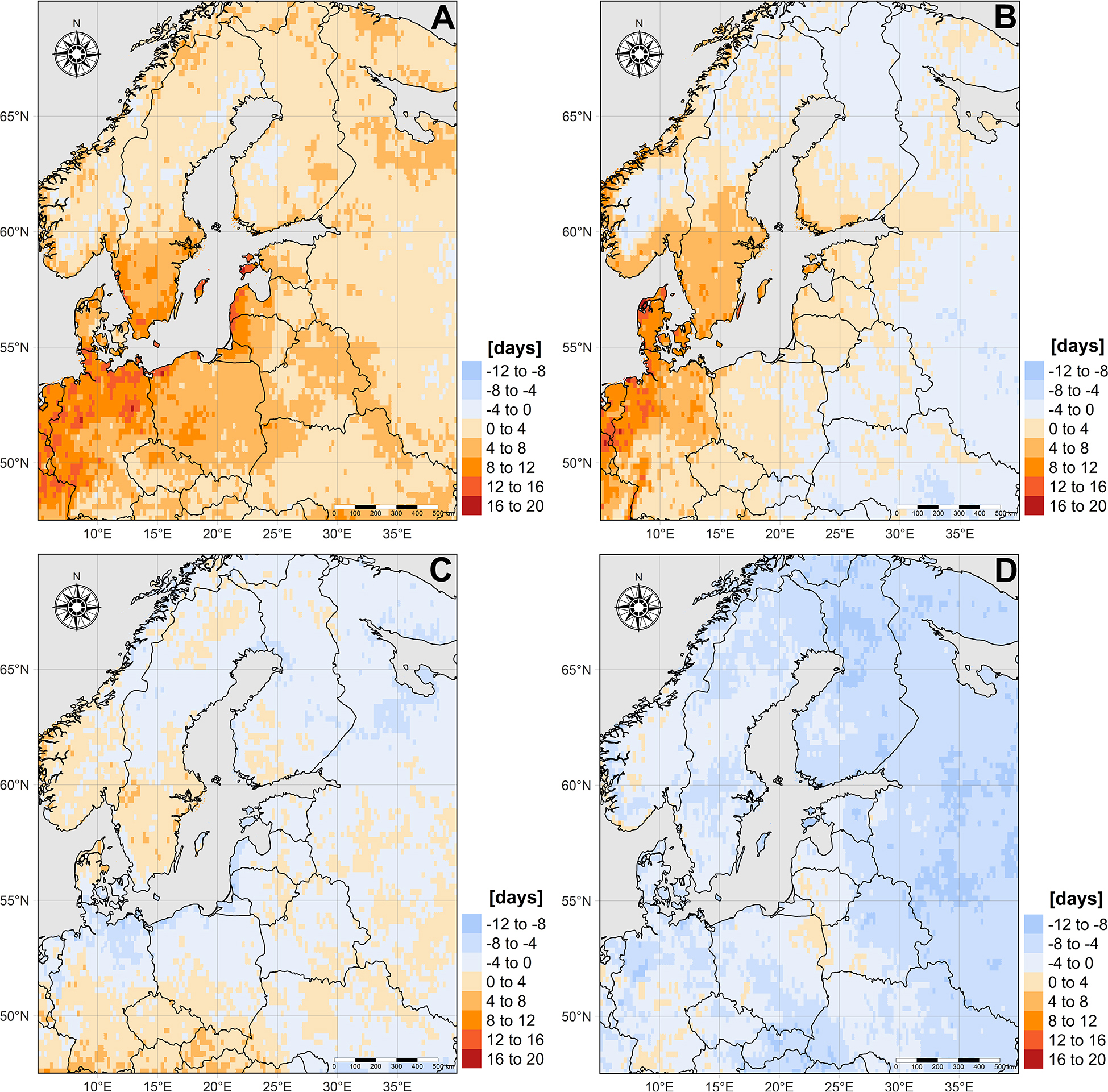
Fig. 9.
Deviation from the average date of the end of the thermal growing season in seasons with index values of East Atlantic (A), North Atlantic Oscillation (B), Scandinavia (C), and East Atlantic/Western Russia (D) above the 75th percentile.