
Introduction
Contemporary climate change is beyond doubt and is evident, among other things, in the observed increase in the average global temperature (IPCC 2021). The 10 warmest years on a global scale occurred in the 21st century, more precisely, in the last 10 years (2015–2024) (NOAA 2025). More intense changes than the global ones have been observed in Europe. Both globally and in Europe, 2024 was the warmest year, with temperature anomalies of 1.28°C and 2.45°C, respectively (NOAA 2025).
The consequence of rising air temperatures is the modification of the start and end dates of the growing season, which translates into a change in its length. Numerous studies have clearly indicated an extension of the growing season. It is estimated that over the past 50 years in Europe, the length of the growing season has increased by about 5 days per decade (Cornes et al. 2019). Similar results were obtained by analysing changes in the length of the thermal growing season (TGS) on a regional scale. Linderholm et al. (2008) showed that its extension in the Baltic region in the second half of the 20th century was about 7 days, with the most significant changes observed in the southeastern part of the studied area. Miś and Tomczyk (2025) demonstrated a trend towards earlier start and later end of the growing season in Central and Northern Europe, which led to its overall extension across most of the region. The lengthening of the growing season was caused more by an earlier start than a later end.
Besides multi-year changes, intra-year changes are also significant, which are caused by circulation conditions, one of the most important factors shaping weather and climate in temperate latitudes. Numerous studies have shown the impact of atmospheric circulation on the start and end of the growing season, and thus its length (Hájková et al. 2018, Tomczyk et al. 2019, Craig, Allan 2022). As demonstrated by Cornes et al. (2019), approximately 57% of interannual variability in the start of the growing season can be explained by the variability of the North Atlantic Oscillation (NAO) and East Atlantic (EA) patterns during the winter season. Conversely, about 55% of the changes in the end of this period can be attributed to East Atlantic/Western Russia (EA/WR) variability. Similar results were obtained in earlier studies by Chmielewski and Rötzer (2001), indicating the significant role of the NAO in the occurrence of the growing season. The authors proved that the highest regional correlation coefficients between NAO and the beginning of the growing season occurred in Central and Northern Europe, where the correlation between air temperature and NAO was also high. This is supported by studies indicating the influence of NAO on the variability of phenological phenomena (D’Odorico et al. 2002, Stenseth et al. 2002, Menzel 2003, Kalvāne et al. 2009). Among the circulation indices identifed in the Northern Hemisphere, the Arctic Oscillation (AO) had the greatest impact on the timing of the start of the growing season in Poland (Tomczyk et al. 2019). The negative phase of AO significantly delayed the onset of the growing season, especially in western Poland. NAO and EA indices were also negatively correlated with the start date, although the influence of EA was weaker and often not statistically significant. However, in Finland, this circulation index had the strongest impact on the parameters of the growing season, particularly in the southern part (Irannezhad, Kløve 2015). As demonstrated by Menzel (2003) through studies in Germany, NAO in January–February explains 41–44% of the variance in the length of the growing season. The influence of NAO on plant phenology is more pronounced in the Baltic countries than in Central Europe, with generally higher correlation coefficients between the winter NAO index and the onset of spring phenological phases (Aasa et al. 2004, Gormsen et al. 2005, Kalvane et al. 2009, Hubálek 2016).
Although previous studies have examined the influence of circulation patterns such as NAO, AO, and EA on the growing season, most focused on short time periods, single regions, or only the onset of the season. Few studies have analysed the combined effects of multiple circulation indices on both the start and end dates across Central and Northern Europe, especially in recent decades of accelerated warming. This study addresses these gaps by providing a long-term (1950–2022), region-wide analysis of how key atmospheric circulation patterns affect the start, end, and length of the growing season. Its novelty lies in simultaneously assessing multiple circulation drivers over an extended period and a broad area, offering a more comprehensive understanding of the phenological responses to changing climate conditions.
As indicated above, one of the most important factors shaping the weather and climate in temperate latitudes is atmospheric circulation, which is why these aspects were the subject of this research. The aim of the study was to determine the impact of atmospheric circulation on the start and end of the growing season in Central and Northern Europe in the years 1950–2022.
Study methods
The study used daily mean air temperature data from the period 1950–2022. Gridded data with a spatial resolution of 0.25° × 0.25° for the area between 5° and 40°E and 47.5° and 70°N were obtained from the European Climate Assessment and Dataset (ECA&D) reanalysis (Haylock et al. 2008). In this study, the selected area was defined as Central and Northern Europe, encompassing parts of Eastern Europe as well (Fig. 1). This region was chosen because it represents a diverse climatic and agricultural gradient, ranging from temperate maritime to continental conditions. Such variability provides a valuable framework for assessing how agroclimatic conditions respond to ongoing climate warming across different environmental settings. Moreover, a significant portion of the study area consists of agriculturally used land. According to the Corine Land Cover database (2018), 71% of the analysed region is covered by agricultural and forested land (note: the database does not include Belarus, Russia, or Ukraine). Therefore, this region is particularly suitable for analysing agroclimatic conditions and their potential impacts on agricultural productivity in the context of rapidly progressing climate change.
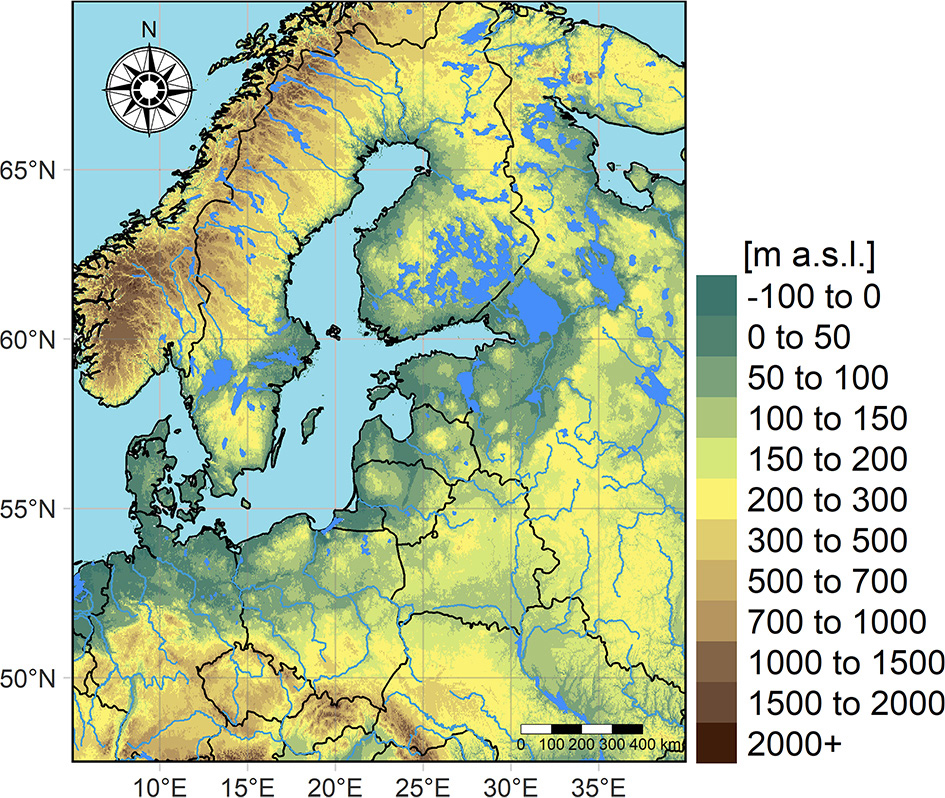
Fig. 1.
Study area.
The growing season is the period of the year during which thermal and moisture conditions are favourable for plant development (Molga 1980). In the literature, the growing season does not have a single definition and is determined in various ways (Walther et al. 2002, Fu et al. 2014, Park et al. 2016, Siłuch et al. 2016, Strong, McCabe 2017, Wypych et al. 2017, Bielec-Bąkowska et al. 2018). A commonly used approach is to define the growing season based on threshold temperature values – the so-called meteorological growing season (Menzel et al. 2003, Song et al. 2010, Körner et al. 2023).
Frich et al. (2002) defined the beginning of the growing season as the first day of a 5-day sequence with a mean temperature (Tmean) >5°C, and the end as a 5-day sequence with Tmean <5°C. In contrast, Carter (1998) extended the end-of-season sequence to 10 days. In the present study, the method used to determine the growing season is analogous to that applied by Linderholm et al. (2008) and Dong et al. (2012). In those studies, the growing season begins on the first day of a 6-day sequence with Tmean >5°C following the last spring frost (Tmean <0°C), and ends on the last day before a 10-day sequence with Tmean <5°C. Walther and Linderholm (2006) pointed out that omitting frost-related criteria can lead to inaccurate results.
In the present study, the growing season was defined as the TGS, which begins with a 6-day sequence of days with a mean temperature (Tmean) >5°C following the last spring frost (Tmean <0°C), and ends with a 6-day sequence of days with T mean <5°C after the first autumn frost (Tmean <0°C). The modification compared with the definitions by Linderholm et al. (2008) and Dong et al. (2012) concerns the end of the TGS, where the 10-day sequence of Tmean <5°C was shortened to 6 days after the first autumn frost (T <0°C) to stand mean ardise the sequence length for both the start and end of the season. Using this method, the average start and end dates of the TGS were calculated.
In the next step, the impact of teleconnection patterns on the start and end dates of the TGS was analysed for the study area. Four circulation indices were used in the analysis: EA, NAO, SCAND, and EA/WR. NAO represents the dominant mode of atmospheric variability over the North Atlantic, defined by the pressure difference between the Azores High and the Icelandic Low (Hurrell 1995). Its positive phase is associated with stronger westerly winds, which transport warm and moist air from the Atlantic towards Northern and Central Europe, often leading to earlier warming in spring and an earlier start of the growing season. Conversely, the negative phase weakens the westerlies, allowing colder air from the Arctic to penetrate southward, delaying the onset of spring. EA is structurally similar to NAO but with its centres of action shifted southeastward (Barnston, Livezey 1987, Comas-Bru, McDermott 2014). Its positive phase typically enhances the westerly and southwesterly flow over Central and Southern Europe, increasing temperatures and accelerating phenological development. In the negative phase, the easterly or northeasterly flows dominate, favouring cooler conditions and a delayed start of the growing season. SCAND, also called the Eurasian blocking pattern, is associated with a persistent high-pressure anomaly over Scandinavia and the low-pressure centres over Western Europe and Siberia (Barnston, Livezey 1987). During its positive phase, blocking leads to cold-air advection over Central and Eastern Europe in spring and summer, potentially advancing the start of the growing season. The negative phase favours cold-air intrusions from the north or northeast, delaying spring onset and shortening early-season warming. EA/WR is a regional teleconnection pattern centred over western Russia, linked to blocking episodes and temperature extremes in Eastern Europe (Barnston, Livezey 1987, Ionita 2014). Its positive phase often produces warm anomalies across the study area, while the negative phase is associated with colder conditions and delayed spring development.
Source data on the circulation indices were obtained from the Climate Prediction Center (CPC) database. The teleconnection patterns included in the CPC database were determined using principal component analysis based on monthly anomalies of the 500 hPa geopotential height field (Barnston, Livezey 1987). These four indices were selected because they are the dominant circulation modes influencing mid-latitude Europe, including the study area. They capture key aspects of atmospheric variability at different spatial scales from the large-scale North Atlantic sector (NAO, EA) to regional blocking regimes over Northern and Eastern Europe (SCAND, EA/WR), which are known to exert significant control over the temperature and precipitation patterns relevant for the timing of the TGS.
To calculate the Spearman correlation coefficient between the start and end of the growing season and the circulation indices, average index values from January–April (for the start of the TGS) and September–December (for the end of the TGS) were used. The statistical significance of the correlation was verified at a significance level of p < 0.05. Subsequently, the start and end dates of the TGS were determined for low and high index values (first and third quartiles of the index value set). Additionally, deviations of seasons characterised by clearly positive or negative circulation index values (i.e., above the 75th and below the 25th percentiles) from the multi-year average dates were calculated. Statistical analyses and visualisations of maps and charts were performed using the R and Python programming languages.
Results
Between 1950 and 2022, the TGS in the study area began on average on 24 April (Fig. 2A). However, the start date varied significantly across the region. The earliest onset of TGS occurred in the southwest, specifically in the Netherlands, western Germany, and northern France, where it typically began between 19 and 28 February. By contrast, the latest TGS start dates were observed in northern Scandinavia and the Scandinavian Mountains, where the season usually began between 19 and 28 June. In the past 20 years, only one growing season began later than the multi-year average (in 2003). On the contrary, the TGS typically ended on 30 October. The earliest end of the season was recorded in northern Scandinavia and the central part of Norway in the Scandinavian Mountains, where the TGS ended between 17 and 26 September (Fig. 2B). Moving south and west across the study area, the season ended progressively later. The latest TGS end dates were observed in the southwest, particularly in the Netherlands, Belgium, Denmark and western Germany, where the growing season ended between 6 and 15 December. In the 21st century, 65% of growing seasons ended later than the average end date. During this period, the TGS ended on average 4 days later than in the 1950–2000 reference period.
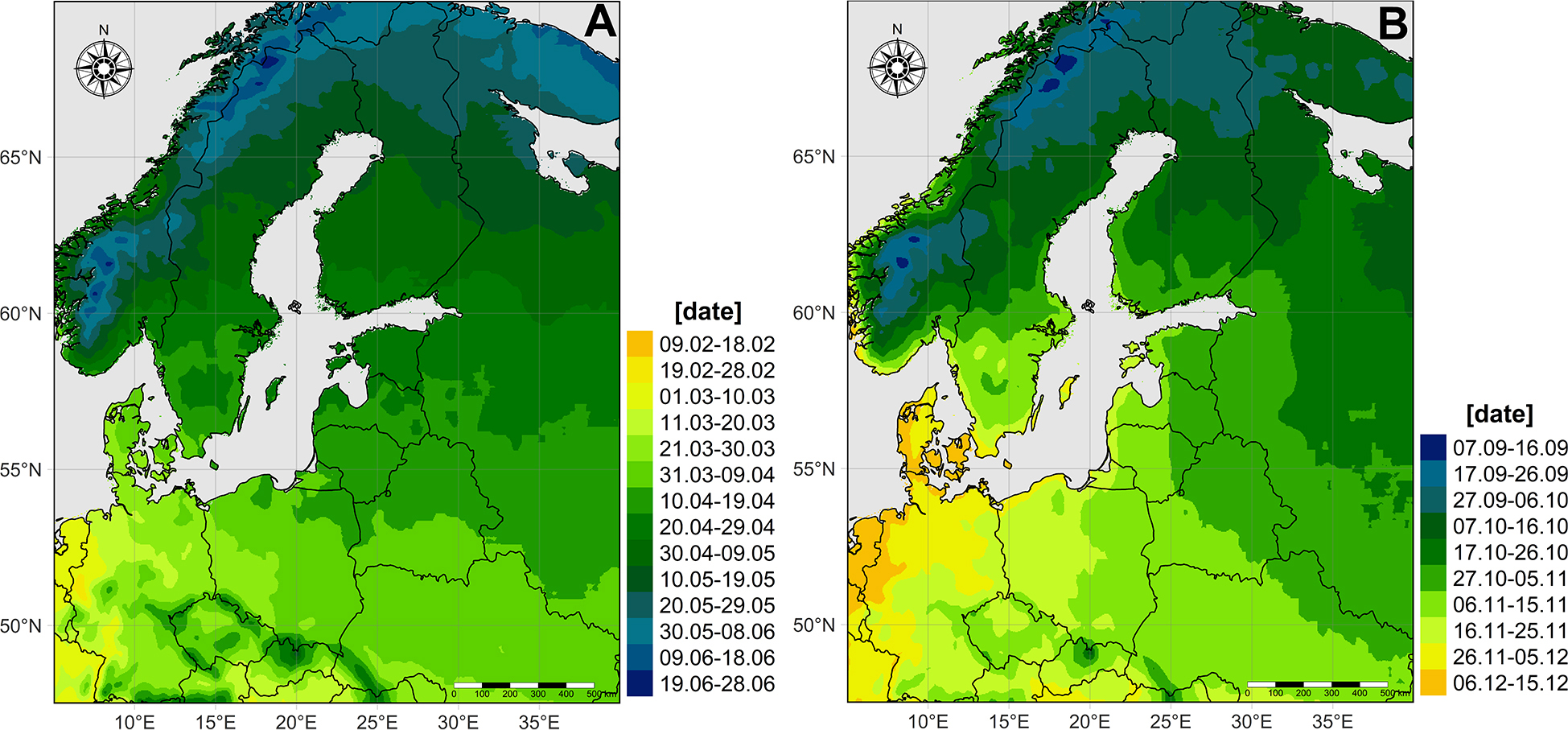
Fig. 2.
Average start (A) and end date (B) of thermal growing season (TGS) in the years 1950–2022.
The values of the EA index showed significant variability during the analysed period. The average value of the index for the months from January to April was –0.22. The highest value during this period was recorded in 2014 (1.26), while the lowest occurred in 1976 (–1.80). From September to December, the average EA index value was slightly higher, at –0.21. The highest level of the index in this time range was observed in 2006 (1.29), and the lowest in 1971 (–1.57). The rate of change of the EA index from January to April over the entire multi-year period was positive and amounted to 0.17/10 years, which was statistically significant. In contrast, from September to December, a positive trend was also observed (0.21/10 years), although it was not statistically significant (Fig. 3).
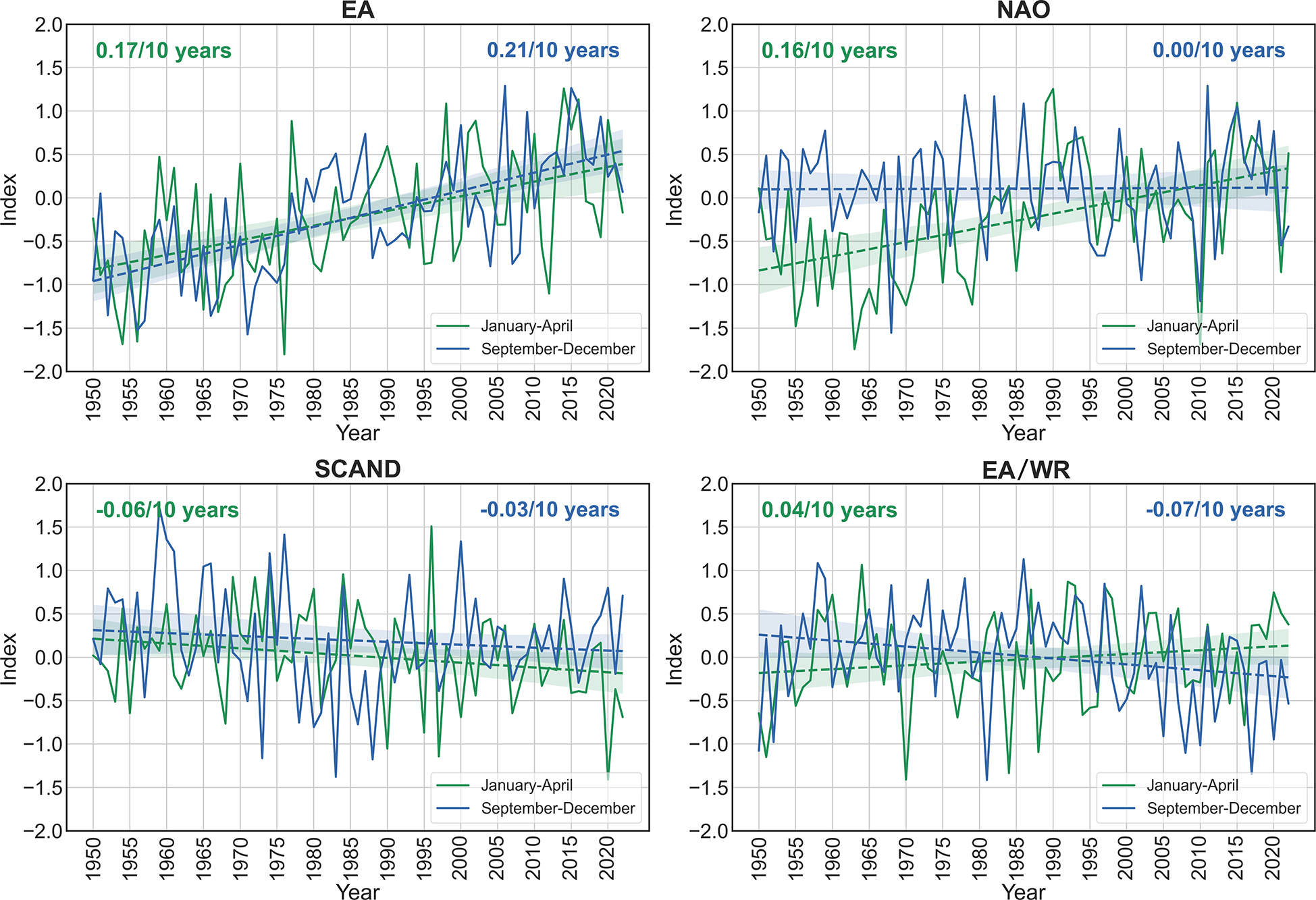
Fig. 3.
The course of the average values of the indices of the analysed teleconnection patterns from January to April and from September to December.
In the case of the NAO index, the average value for the months from January to April was –0.25. The highest value of the index during this period was observed in 1990 (1.25), while the lowest was recorded in 1963 (–1.74) (Fig. 3). For the months from September to December, the average value of the index was 0.11. The highest value in this range was noted in 2011 (1.29), and the lowest in 1968 (–1.55). The rate of change of the NAO index from January to April over the studied period was also positive, amounting to 0.16/10 years, and was statistically significant. By contrast, the rate of change from September to December was 0.0/10 years and was not statistically significant.
The average value of the SCAND index for the months January to April was 0.01. The highest value of the index during this period was recorded in 1996 (1.51), while the lowest was registered in 2020 (–1.41) (Fig. 3). For the months September to December, the average value of the SCAND index was 0.19. The highest level of the index in this part of the year was reached in 1959 (1.72), and the lowest in 1983 (–1.38). The rate of change was negative in both parts of the year, reaching to –0.06/10 years from January to April and –0.03/10 years from September to December. The changes were not statistically significant.
For the EA/WR circulation, the average index value from January to April was –0.02. The highest value in this part of the year was observed in 1964 (1.06), while the lowest was in 1970 (–1.33) (Fig. 3). In the months from September to December, the average EA/WR index value was higher, at 0.01. The highest value was recorded in 1986 (1.13), and the lowest in 1981 (–1.41). The rate of change for this index in the early part of the year was positive, at 0.04/10 years. Conversely, from September to December, the rate of change was negative, reaching –0.07/10 years. The changes were not statistically significant.
Start of the thermal growing season
For the EA index, positive correlations were mainly observed in the central and eastern parts of the study area, with the maximum values in central Sweden and northern Russia (up to 0.55) (Fig. 4A). This pattern indicates that the southeastward-shifted westerly flows associated with the EA+ phases favour earlier warming in these regions. Negative correlations dominated the western areas such as Denmark, northern Germany, the Netherlands, and the Norwegian coast (min –0.54), reflecting cooler air advection from the Atlantic during the EA-phases. Statistically significant correlations were found in 31% of the study area, predominantly in eastern regions (Table 1).
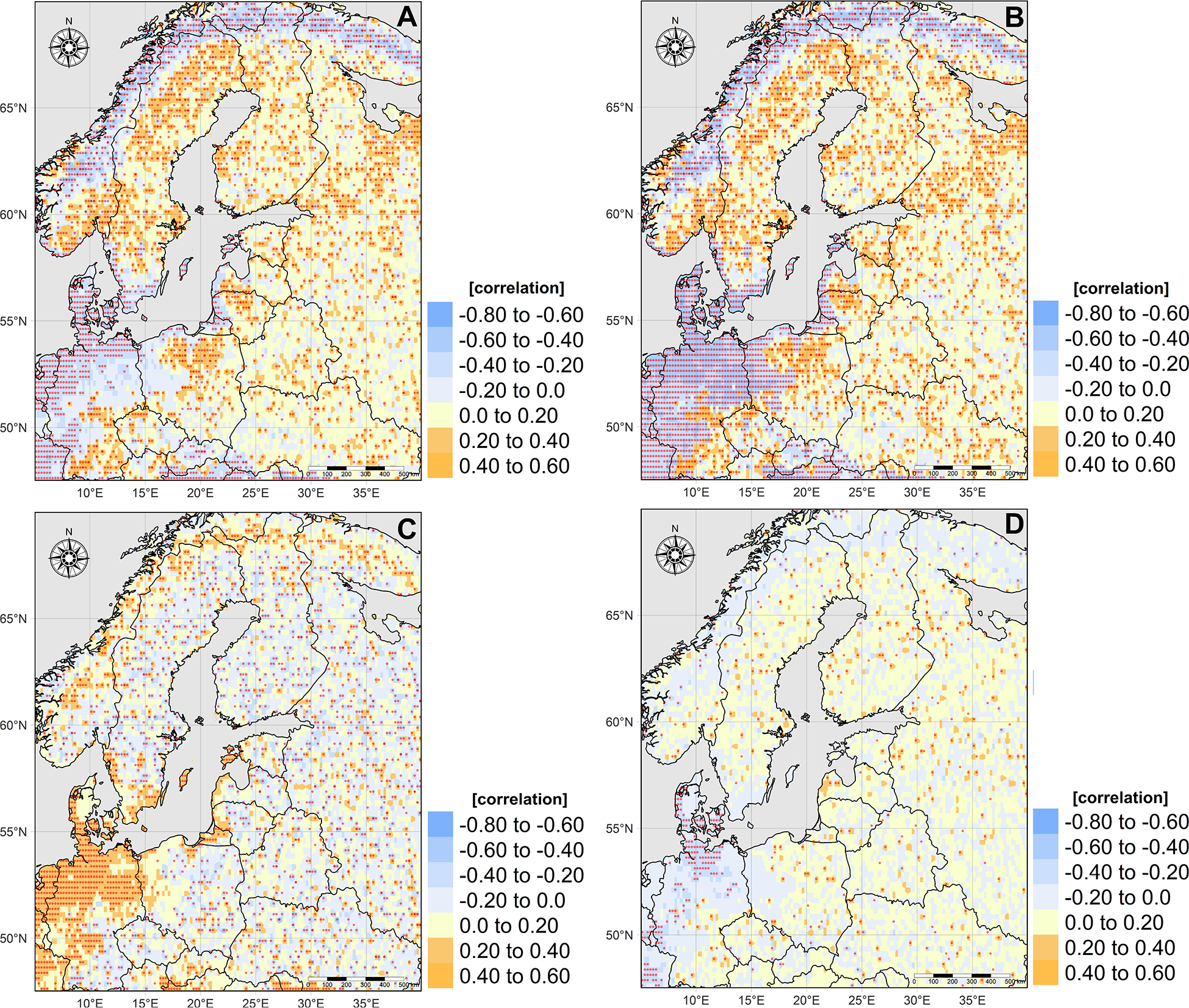
Fig. 4.
Correlation coefficient of the date of the beginning of the thermal growing season with the seasonal average: East Atlantic(A), North Atlantic Oscillation (B), Scandinavia (C), and East Atlantic/Western Russia (D) indices (red dots indicate statistically significant changes (p < 0.05)).
Table 1.
Summary of correlations between circulation indices and the start of the thermal growing season (C – Central, E – East, N – North, S – South, W – West).
| Index | Lowest value of correlation coefficients | The highest value of the correlation coefficients | Mean correlation | % of area with statistically significant correlation (p < 0.05) | Dominant sign of correlation | Main regions of strongest correlation |
|---|---|---|---|---|---|---|
| East Atlantic | –0.54 | 0.55 | 0.03 | 31 | Mixed | +C Sweden, N Russia; –Denmark, N Germany |
| North Atlantic Oscillation | –0.64 | 0.60 | ~0.00 | 40 | Negative | +C Sweden; –W part of the study area, Norway |
| Scandinavia | –0.50 | 0.48 | ~0.00 | 23 | Positive | +W part of the study area, N Scandinavia; –Finland, Russia |
| East Atlantic/Western Russia | –0.37 | 0.42 | ~0.00 | 5 | Weak/mixed | +C Finland; –N Norway |
The NAO index also showed a west–east contrast, but with a broader and stronger negative correlation in Western Europe, including Denmark, the Netherlands, Belgium, France, and much of Germany (min –0.64) (Fig. 4B). This reflects the enhanced westerly flow during the NAO+ phases, bringing warm and moist air to Northern and Central Europe while reducing early spring warming in the western sector. Positive correlations in Central and Eastern Europe (max 0.60) were less consistent, indicating regional variability in the NAO-driven temperature anomalies. Statistically significant correlations covered 40% of the area, with a slight predominance of negative values (Table 1).
By contrast, the SCAND index exhibited an almost opposite pattern (Fig. 4C). Positive correlations were concentrated in the western regions, such as Denmark, the Netherlands, the Norwegian coast, and northern Germany, where blocking highs over Scandinavia during the SCAND+ phases redirect cold air into Western Europe, delaying the start of the growing season. Negative correlations dominated Central and Eastern Europe, reflecting warm-air intrusions from the north and northeast during the SCAND-phases, which accelarate spring onset. Significant correlations were noted in 23% of the study area, highlighting the more localised influence of SCAND (Table 1).
The EA/WR index showed the weakest correlations overall, with positive values in the central and eastern parts and negative values in the west and north (Fig. 4D). This pattern reflects the regional blocking and temperature extremes associated with EA/WR, which primarily affect Eastern Europe and have limited influence in the western regions. Only 5% of the area showed statistically significant correlations, emphasising that EA/WR plays a secondary, regionally restricted role in modulating the start of the TGS (Table 1).
When the circulation index values fell below the 25th percentile of the EA index (values from –1.76 to –0.67), the deviation from the average start date of the TGS exhibited an almost uniformly positive pattern across the entire study area (Fig. 5A). This indicates that during the negative phase of the EA circulation index, the onset of the growing season was generally delayed throughout the whole study area. The most pronounced delay, averaging 12 days, occurred in Denmark, while the mean deviation for the entire study area was slightly above 4 days. These results demonstrate that the negative phase of the EA circulation index exerts a consistent delaying effect on the beginning of the growing season, particularly in Northwestern Europe.
In seasons when the NAO index values fell below the 25th percentile (index values from –1.74 to –0.85), the average deviation of the start date of the TGS was slightly above 3 days (Fig. 5B). Analysis of deviations from the average date showed that almost the entire study area exhibited positive anomalies, indicating a general delay in the onset of the growing season. The largest positive deviations, reaching up to 16–17 days, were observed in Denmark and northern Germany. By contrast, negative deviations occurred only in central Norway and western Russia, where the TGS began up to 8 days earlier than the average. These results indicate that the negative phase of the NAO circulation index is generally associated with a delayed start of the growing season across most of Europe, with regional variations in the northern and eastern parts of the continent.
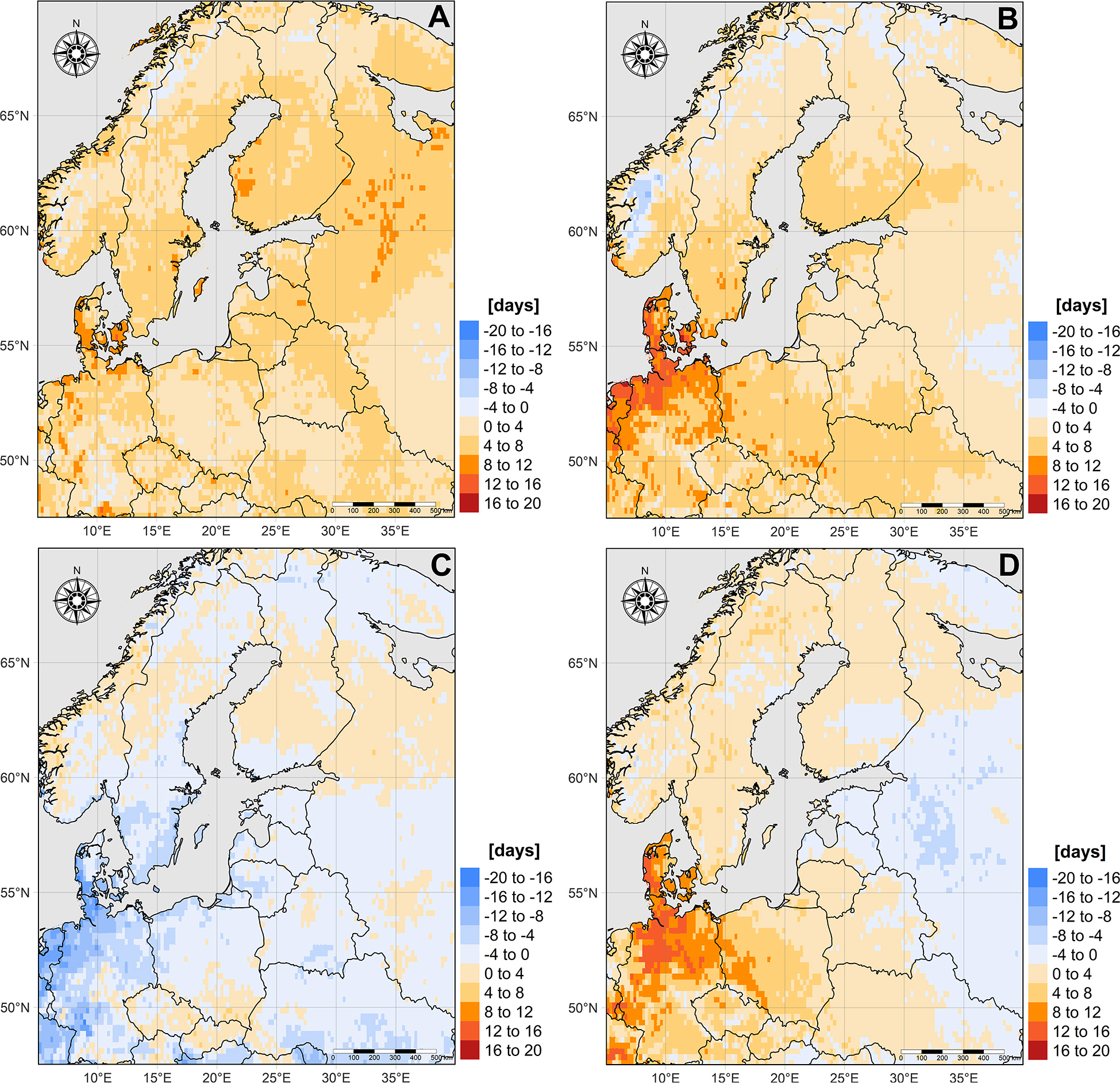
Fig. 5.
Deviation from the average start date of the thermal growing season in seasons with East Atlantic (A), North Atlantic Oscillation (B), Scandinavia (C), and East Atlantic/Western Russia (D) index values below the 25th percentile.
For the SCAND index (with index values ranging from –1.41 to –0.33), the average deviation of the start date of the TGS was approximately 2 days (Fig. 5C). Unlike the other circulation indices, the analysed area was characterised predominantly by an earlier onset of the TGS, as reflected by negative deviations from the average date across most regions. The strongest negative deviations, reaching up to 16 days, were observed in the Netherlands, Denmark, and northern Germany, indicating a markedly earlier start of the growing season in these areas. By contrast, positive deviations of up to 6 days occurred mainly in the eastern part of the study area, including western Russia and central Finland. This spatial distribution suggests that the negative phase of the SCAND circulation index contributes to an acceleration of the growing season onset, particularly in Western and Central Europe.
For the EA/WR circulation (index values from –1.33 to –0.33), the average deviation of the start date of the TGS was slightly above 1 day (Fig. 5D). The spatial distribution of deviations revealed considerable regional variability. The largest positive deviations, reaching up to 15 days, were observed in Denmark and northern Germany, indicating a later onset of the growing season in these regions. By contrast, negative deviations of up to 6 days occurred mainly in western Russia, Estonia, and Latvia, where the TGS began earlier than average. These results highlight the distinct and spatially diverse influence of the negative phase of the EA/WR circulation index on the timing of the growing season onset across Europe.
Under conditions of high EA circulation index values, exceeding the 75th percentile (ranging from 0.33 to 1.26), the average deviation of the start date of the TGS was nearly –4 days (Fig. 6A). Deviations from the average TGS date were generally negative across almost the entire study area, indicating an earlier onset of the growing season. The strongest negative deviations, reaching up to 20 days, were observed in Denmark and northern Germany. Positive deviations occurred only in small areas of central Norway. These results demonstrate that the positive phase of the EA circulation index is associated with a substantial advancement in the onset of the growing season, particularly in Northwestern Europe.
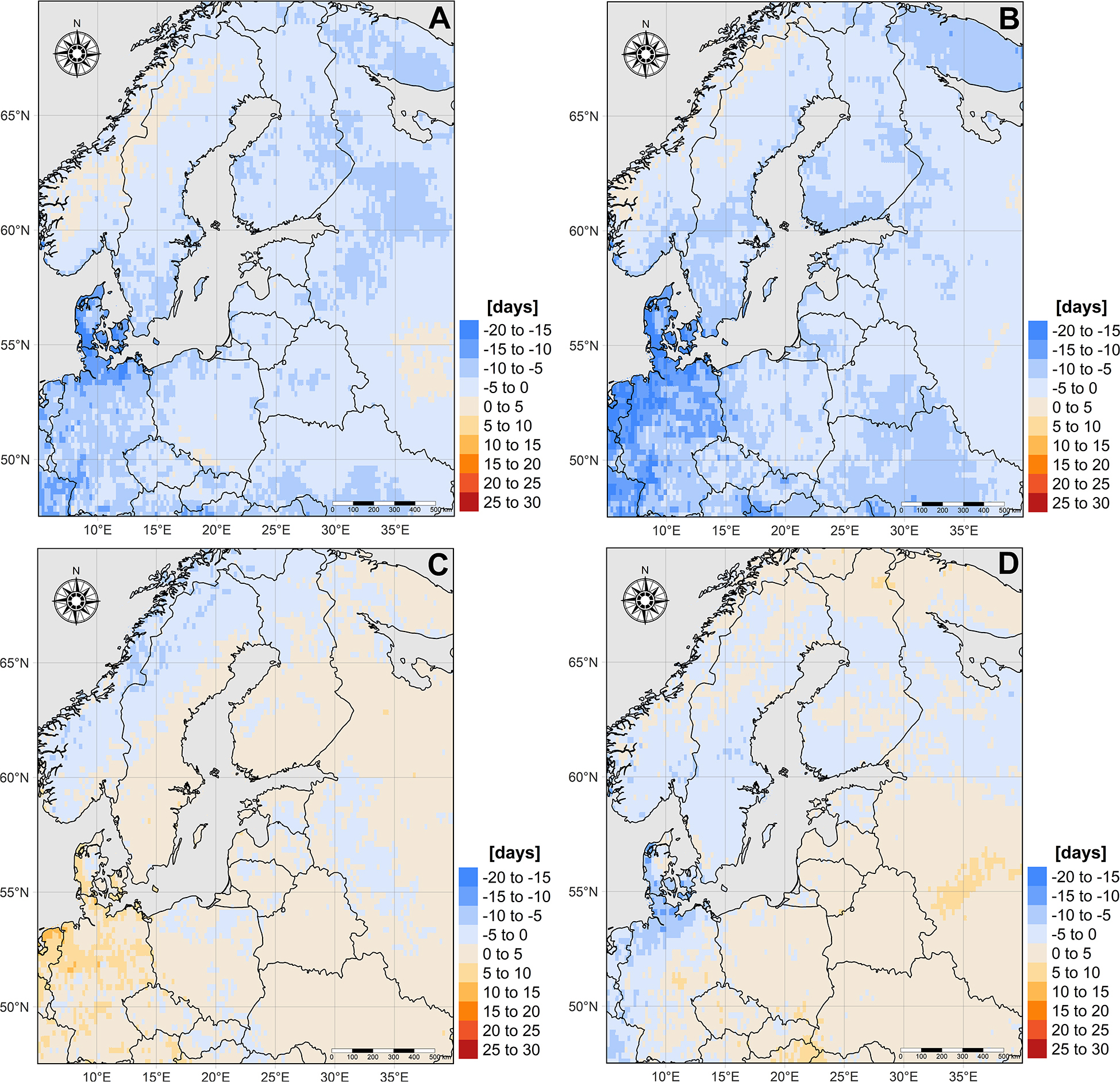
Fig. 6.
Deviation from the average date of the beginning of the thermal growing season in seasons with index values of East Atlantic (A), North Atlantic Oscillation (B), Scandinavia (C), and East Atlantic/Western Russia (D) above the 75th percentile.
For the NAO index (values ranging from 0.11 to 1.25), the average deviation of the beginning of the TGS was nearly –5 days (Fig. 6B). Across most of the study area, the TGS began earlier than average, indicating an overall advancement of the growing season under positive NAO conditions. The largest negative deviations, exceeding 25 days, were recorded in northern Germany and Denmark, while in most regions, deviations ranged between 5 days and 10 days. The spatial pattern also revealed a clear gradient of increasing advancement towards Southwestern Europe. These findings indicate that the positive phase of the NAO circulation index strongly promotes an earlier onset of the growing season across much of Europe, with the greatest effect observed in its northwestern part.
In seasons with high SCAND index values (ranging from 0.34 to 1.51), the average deviation of the beginning of the TGS was approximately 1 day (Fig. 6C). The spatial pattern of deviations differed from those observed for the other circulation indices. Most of the study area was characterised by positive deviations, indicating a later onset of the TGS, with the largest positive values exceeding 10 days recorded in the Netherlands and Germany. By contrast, negative deviations of up to –8 days occurred in central Norway and Sweden, where the growing season began earlier than average. This spatial distribution suggests that the positive phase of the SCAND circulation index is associated with a delay in the onset of the growing season, particularly in Western and Central Europe, likely due to the blocking effect of this circulation pattern, which restricts the inflow of warm air into Western Europe.
For the EA/WR circulation index (values ranging from 0.37 to 1.06), the average deviation of the beginning of the TGS was <1 day (Fig. 6D). The spatial distribution of deviations revealed pronounced regional contrasts. The strongest negative deviations, exceeding –10 days, occurred in northern Germany, indicating a substantially earlier onset of the growing season in this region. By contrast, positive deviations of up to 8 days were observed in the eastern part of the study area, particularly in western Russia, where the TGS began later than average. This pattern demonstrates a strong spatial differentiation in the influence of the positive phase of the EA/WR circulation index, which can result in both an acceleration and a delay of the growing season onset depending on the geographic location.
End of the thermal growing season
For the EA index, positive correlations were mainly recorded in the western and northern parts of the study area, particularly along the coasts, with a maximum of 0.65 in northern Scandinavia and Germany (Fig. 7A). This pattern reflects southeastward westerly flows during the EA+ phases, which bring warmer air later in the season, delaying the end of the growing season in these regions. Negative correlations predominated in eastern areas, such as Estonia, Russia, central Finland, and Sweden, where the EEA-phases facilitate early cooling and a faster end to the season. Statistically significant correlations were observed in 33% of the points, with a predominance of positive values in the coastal regions (Table 2).
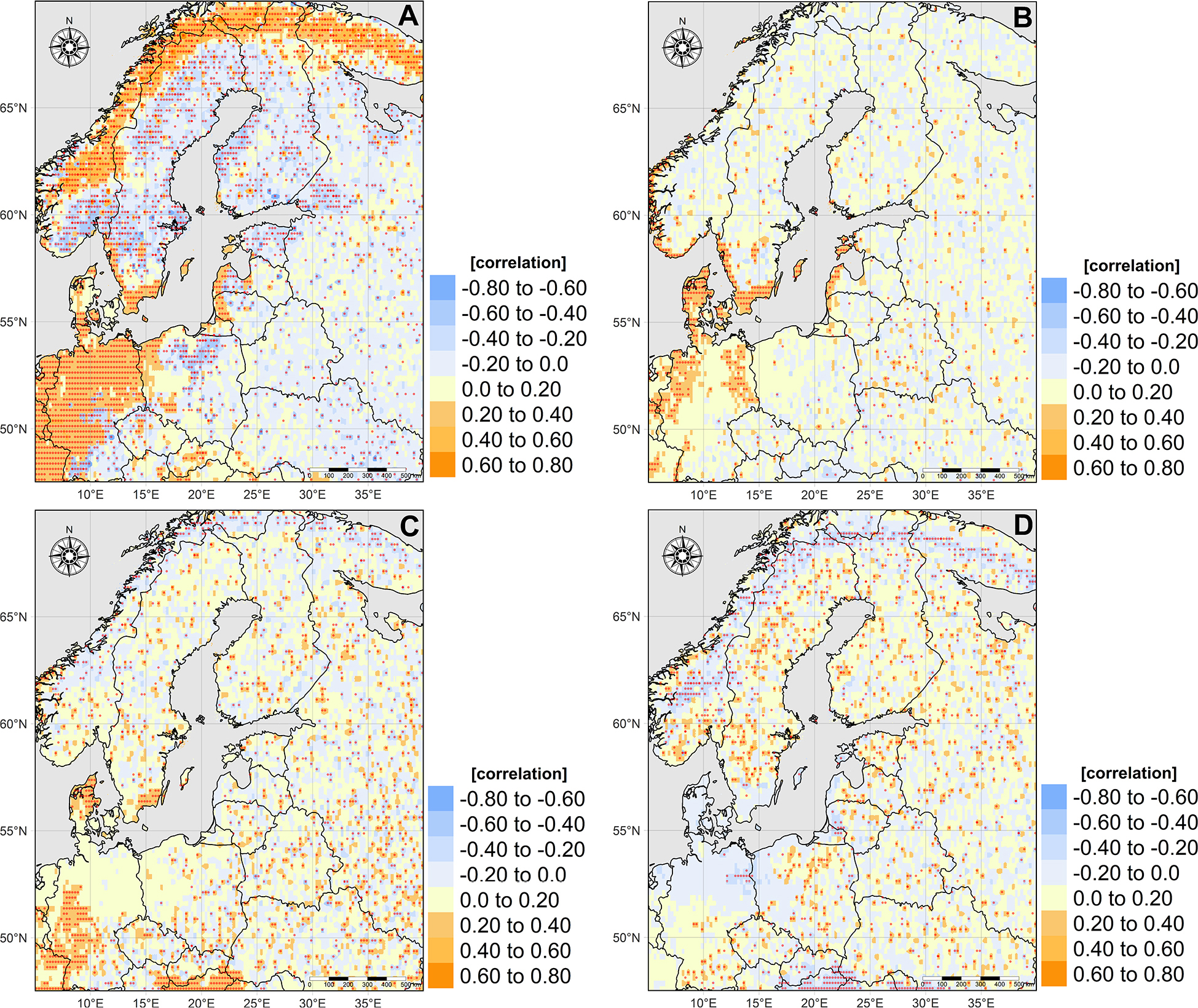
Fig. 7.
Correlation coefficient of the date of the end of the thermal growing season (TGS) with the seasonal mean East Atlantic (A), North Atlantic Oscillation (B), Scandinavia (C) and East Atlantic/Western Russia (D) indices (red dots indicate statistically significant changes (p < 0.05)).
Table 2.
Summary of correlations between circulation indices and the end of the TGS (C – Central, E – East, N – North, S – South, W – West).
| Index | The lowest value of the correlation coefficient | The highest value of the correlation coefficient | Mean correlation | % of area with statistically significant correlation (p < 0.05) | Dominant sign of correlation | Main regions of strongest correlation |
|---|---|---|---|---|---|---|
| East Atlantic | –0.66 | 0.65 | ~0.00 | 33 | Mixed | +N Scandinavia, N Germany; –Estonia, C Finland |
| North Atlantic Oscillation | –0.34 | 0.49 | 0.02 | 6 | Mainly positive (weak) | +Denmark, N Germany, S Sweden; –Belarus, NE Europe |
| Scandinavia | –0.43 | 0.40 | 0.03 | 14 | Mainly negative | +Hungary, Denmark, C Germany; –Finland, N Russia |
| East Atlantic/Western Russia | –0.54 | 0.45 | ~0.00 | 13 | +C Poland, NE Europe; –N Norway, W part of study area |
The NAO index showed smaller spatial variability (Fig. 7B). Positive correlations occurred mainly in the western areas, including Denmark, northern Germany, and southern Sweden, refleeting enhanced westerlies during the NAO+ phases that extend warm conditions late into the season. Negative correlations were more widespread but weaker, with minimum values in Belarus, indicating that NAO-phases bring cooler, continental air that shortens the season in the eastern regions. Only 6% of points were statistically significant, mostly in the west of the study area (Table 2).
The SCAND index displayed an almost opposite pattern (Fig. 7C). Positive correlations were concentrated in Western and Southern Europe, including Denmark, Hungary, southern Sweden, and central Germany. This corresponds to blocking highs over Scandinavia during the SCAND+ phases, which maintain colder air longer in Western and Southern Europe. Negative correlations in Northern and Eastern Europe, especially Finland, Norway, and northern Russia, indicate cold intrusions from the north or northeast during the SCAND-phases, which accelerate the end of the growing season. Significant correlations covered 14% of the study area, with negative values dominating in the north (Table 2).
The EA/WR index had a distinct, more localised influence (Fig. 7D). Positive correlations were observed in the eastern and northern parts of the area, where the EA/WR+ phases produce warm anomalies and prolonged growing conditions, while negative correlations predominated in the west and far north, reflecting the impact of regional blocking and cold-air intrusions during the EA/WR– phases; 13% of points showed statistically significant correlations, with positive and negative values roughly balanced, highlighting EA/WR as a regional driver of late-season temperature variability (Table 2).
For seasons characterised by low EA index values (ranging from –1.57 to –0.73), the average deviation from the mean end date of the TGS was approximately –2 days (Fig. 8A). Almost the entire study area exhibited negative deviations, indicating an earlier termination of the growing season, except for western Russia, where slightly positive anomalies occurred. The strongest negative deviations, exceeding –10 days, were found in central Germany and northern Scandinavia, while the largest positive deviations, up to 4 days, were observed in western Russia. These results suggest that the negative phase of the EA circulation index contributes to a shortening of the growing season across most of Europe, particularly in its central and northern parts.
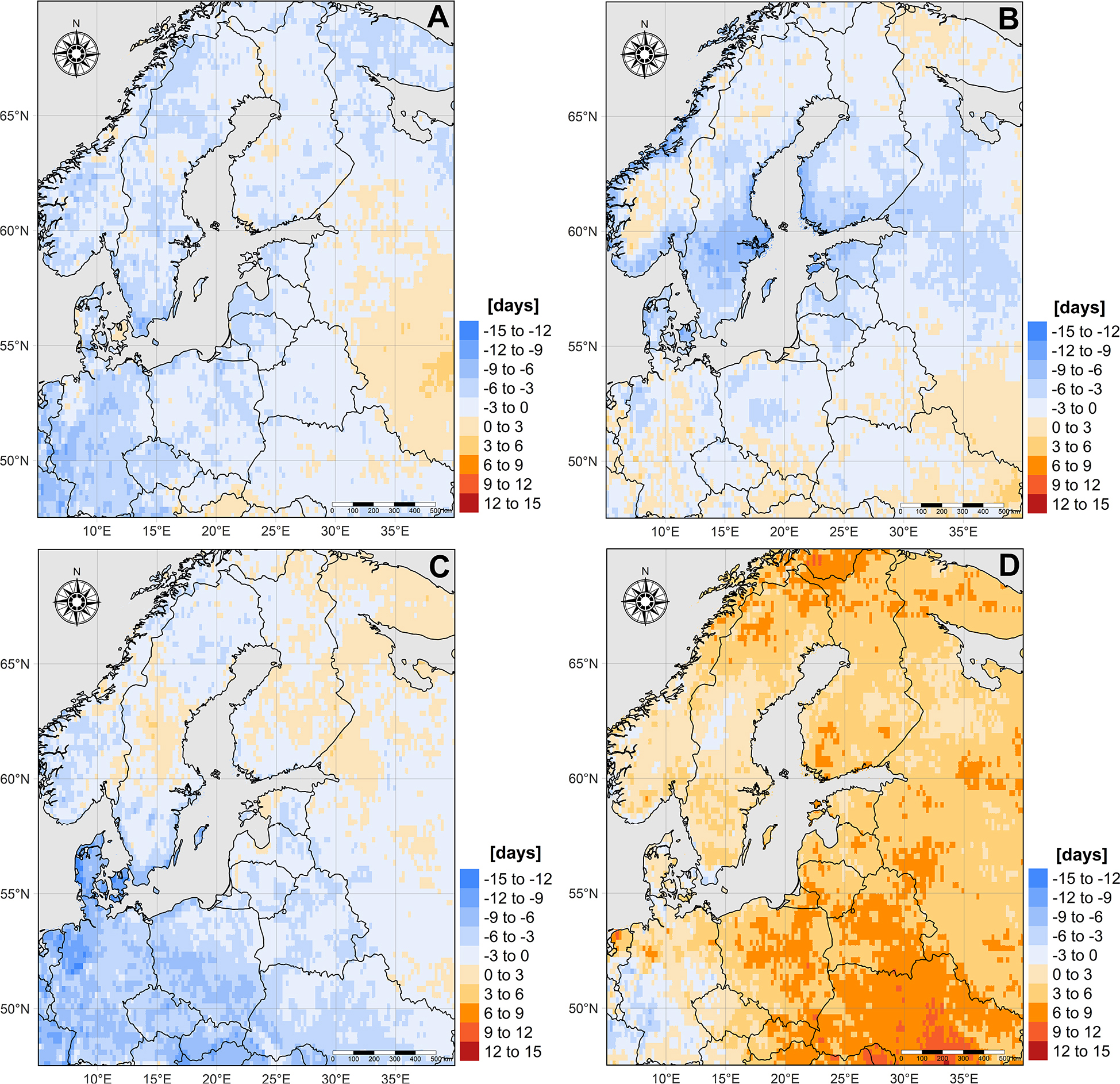
Fig. 8.
Deviation from the average date of the end of the thermal growing season in seasons with East Atlantic (A), North Atlantic Oscillation (B), Scandinavia (C), and East Atlantic/Western Russia (D) index values below the 25th percentile.
During seasons with low NAO index values (ranging from –1.55 to –0.33), the average deviation from the mean end date of the TGS was close to –2 days (Fig. 8B). Most of the study area showed negative deviations, reflecting an earlier end of the growing season, except western Russia and parts of Southern Europe, where positive anomalies were recorded. The most pronounced negative deviations, exceeding –12 days, occurred in southern Sweden and Estonia. Overall, the spatial pattern indicates that the negative phase of the NAO circulation index is associated with a moderate but widespread advancement of the growing season end across northern and Central Europe.
In seasons with low SCAND index values (ranging from –1.38 to –0.13), the average deviation from the mean end date of the TGS exceeded –2 days (Fig. 8C). The spatial distribution was dominated by negative deviations, indicating an earlier end of the growing season, except for the northeastern part of the study area, where small positive anomalies were observed. The strongest negative deviations, reaching up to –14 days, were recorded in Denmark and northern Germany, whereas positive deviations of 2–3 days occurred in northern Russia. These findings indicate that the negative phase of the SCAND circulation index generally shortens the duration of the growing season in Western and Central Europe.
For the EA/WR circulation index (values from –1.41 to –0.30), the spatial pattern of deviations differed markedly from those observed for the other circulation indices (Fig. 8D). Nearly the entire study area exhibited positive deviations, indicating a later end of the growing season, with an average deviation exceeding 4 days. The most pronounced positive anomalies, reaching 10–12 days, were observed in Ukraine and Moldova, suggesting a significant prolongation of the TGS in these regions. This pattern demonstrates that the negative phase of the EA/WR circulation index has a contrasting effect compared with the other indices, contributing to an extended growing season across most of Europe.
In seasons when the EA index values exceeded the 75th percentile (ranging from 0.26 to 1.29), the average deviation from the mean end date of the TGS was approximately 4 days (Fig. 9A). Positive deviations prevailed across nearly the entire study area, indicating a later end of the growing season, particularly in Western Europe. The strongest positive anomalies, exceeding 16 days, were recorded in the Netherlands and northern Germany. This pattern suggests that the positive phase of the EA circulation index is associated with a pronounced extension of the growing season, most evident in the western part of the continent.
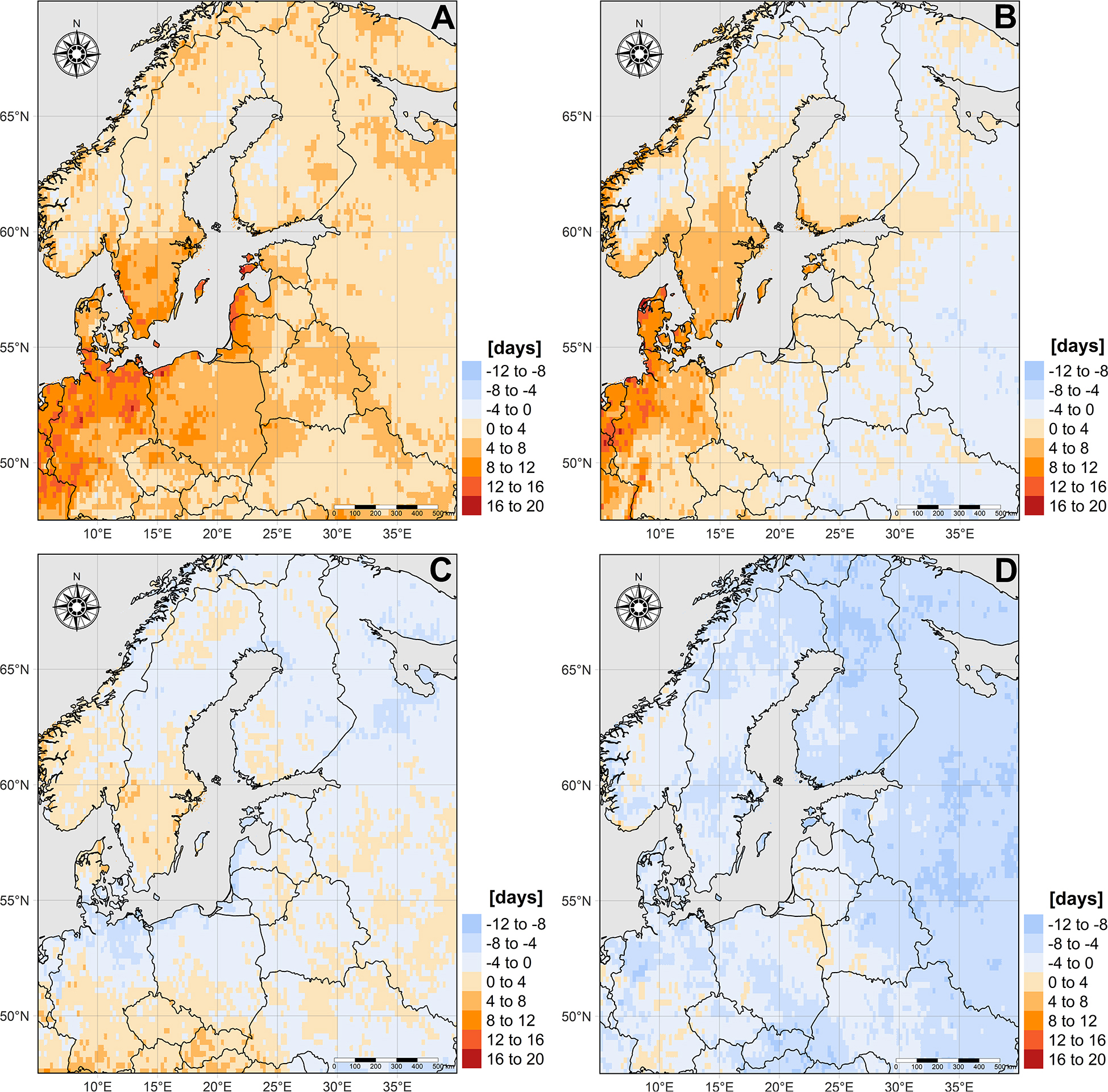
Fig. 9.
Deviation from the average date of the end of the thermal growing season in seasons with index values of East Atlantic (A), North Atlantic Oscillation (B), Scandinavia (C), and East Atlantic/Western Russia (D) above the 75th percentile.
For seasons characterised by high NAO index values (ranging from 0.48 to 1.29), the average deviation from the mean end date of the TGS was nearly 1 day (Fig. 9B). The spatial pattern displayed a distinct west–east contrast: positive deviations dominated in the western part of the study area, while negative deviations occurred in the east. The most pronounced positive anomalies, reaching up to 18 days, were observed in southern and northern Germany, the Netherlands, and Denmark. By contrast, eastern regions such as Ukraine showed earlier TGS endings, up to 6 days before the average. These results indicate that the positive phase of the NAO circulation index favours an extension of the growing season in Western Europe, while shortening it slightly in the eastern part of the continent.
During seasons with high SCAND index values (ranging from 0.63 to 1.72), the average deviation from the mean end date of the TGS was close to –1 day (Fig. 9C). The spatial distribution of deviations showed substantial regional differentiation, with negative anomalies prevailing in Northern and Central Europe and positive deviations dominating in the south. The largest negative deviations, reaching up to –8 days to –10 days, were found in northern Germany and western Russia, indicating a notably earlier end of the growing season. By contrast, positive deviations of up to 10 days occurred in the southern parts of the study area, particularly in Slovakia and the adjacent regions. This pattern highlights the contrasting influence of the positive phase of the SCAND circulation index, which tends to shorten the TGS in the north while extending it in Southern Europe.
Under positive EA/WR circulation conditions (index values from 0.37 to 1.13), the average deviation from the mean end date of the TGS was nearly –5 days (Fig. 9D). The spatial pattern was dominated by negative deviations across almost the entire study area, indicating an earlier termination of the growing season. The strongest negative anomalies, reaching up to –10 days, were recorded in western Russia and northern Finland, while in most other regions the TGS ended between 0 day and 8 days earlier than average. These results demonstrate that the positive phase of the EA/WR circulation index is associated with a general shortening of the growing season throughout Europe, particularly in its northern and eastern regions.
Discussion
The spatiotemporal analysis of the TGS in the study area between 1950 and 2022 revealed significant regional variability in both the onset and the end of the season. The average TGS onset occurred on 24 April, with the earliest dates observed in Southwestern Europe (the Netherlands, western Germany, northern France) and the latest in northern Scandinavia and the Scandinavian Mountains. The TGS generally ended on 30 October, with the earliest terminations in northern Scandinavia and the central Scandinavian Mountains and the latest in the southwestern regions. These patterns are consistent with previous studies by Karlsen et al. (2006) and Szyga-Pluta et al. (2022, 2023), who reported similar spatial gradients in TGS timing across Europe.
Analysis of temporal trends showed a general advancement of the TGS onset and a delay in its end in recent decades. This is in line with findings from Szyga-Pluta et al. (2023), who reported earlier spring onset in the Central European cities such as Prague and Vienna compared with northern cities like Poznań and Toruń. Such trends are likely linked to observed increases in the NAO and EA indices during January–April, reflecting enhanced westerly circulation and milder winters, which contribute to earlier warming and consequently earlier TGS onset. Conversely, the negative but statistically insignificant trends in SCAND and EA/WR suggest a weaker influence of blocking patterns, which may otherwise delay the start of the growing season.
The impact of teleconnection patterns on the TGS was spatially heterogeneous. The EA index showed positive correlations in the central and eastern parts of the study area, particularly central Sweden and northern Russia, indicating that EA+ phases favour earlier TGS onset. Negative correlations dominated the western areas, including Denmark, northern Germany, the Netherlands, and the Norwegian coast. These results are consistent with Craig and Allan (2022), who reported that positive EA phases advance the start of the growing season in continental Europe, while EA-phases can delay spring onset in northwestern regions.
The NAO index exhibited a clear west–east contrast. Negative correlations predominated in Northwestern Europe (Denmark, northern Germany, Norwegian coast), whereas positive correlations were recorded in Central and Eastern Europe, particularly Russia and central Sweden. This pattern supports previous findings (Rust et al. 2015, Craig, Allan 2022) that NAO+ phases advance the onset of the growing season in Northwestern Europe, likely due to enhanced westerly airflow and warmer air advection. Regarding the end of the TGS, positive correlations for NAO were primarily located in Western Europe, while negative correlations dominated the eastern regions, reflecting the moderating effect of NAO on late-season temperatures. An increase in air temperature during winter in Europe associated with the positive NAO phase has also been demonstrated by Smith et al. (2016), Riaz et al. (2017) and Rodrigo (2021).
By contrast, SCAND displayed an almost opposite spatial pattern. Positive correlations, indicating delayed TGS onset, were concentrated in Western Europe, including Denmark, the Netherlands, and the Norwegian coast, whereas negative correlations prevailed in central and Eastern Europe, particularly Finland and northern Russia. These results support the notion that the SCAND+ phases promote colder conditions in Central and Northern Europe, delaying the onset of the growing season (Liu et al. 2014, Tomczyk et al. 2019). At the end of the season, SCAND+ phases were associated with later terminations in Southern Europe and earlier endings in the northern and eastern regions, consistent with the findings of Rust et al. (2015), Gao et al. (2017), and Tomczyk et al. (2019).
The EA/WR pattern exhibited weaker and more spatially heterogeneous correlations for both the onset and end of the TGS. Onset correlations were generally low, reflecting region-specific effects of EA/WR on spring warming. End-of-season correlations showed positive values in Eastern and Northern Europe and negative values in the western and northwestern areas. Statistically significant correlations were limited, suggesting that EA/WR primarily acts as a regional rather than continent-wide driver of TGS variability (Liu et al. 2014).
Analysis of extreme index values confirmed the influence of the teleconnection patterns on TGS deviations. During the low EA and NAO phases (below the 25th percentile), delays in TGS onset of up to 16–17 days were observed in Northwestern Europe, particularly Denmark and northern Germany. Conversely, low SCAND values were associated with earlier onsets in Western and Central Europe, with deviations reaching 16 days in the Netherlands and Denmark. Low EA/WR values displayed mixed effects, with earlier TGS in Northeastern Europe and delays in the northwestern regions. During the high index phases (above the 75th percentile), EA and NAO were linked to earlier TGS onset in Northwestern Europe (up to 25 days), while SCAND and EA/WR showed spatially heterogeneous effects, with delayed onset in eastern Russia and northern Germany.
Regarding TGS ending, low EA and NAO phases generally resulted in earlier ends, particularly in Northern and Central Europe, whereas SCAND-phases accelerated season endings in Western and Central Europe. By contrast, low EA/WR values prolonged the season in Eastern Europe, especially Ukraine and Moldova. High EA and NAO values extended the TGS in Western Europe, with maximum delays of 15– 18 days, whereas high SCAND produced earlier terminations in Northern and Central Europe and delayed endings in Southern Europe. High EA/WR phases were predominantly associated with earlier TGS end, particularly in the northern and eastern regions. These findings are largely consistent with the studies of López-Moreno and Vicente-Serrano (2008) and Irannezhad and Kløve (2015), who demonstrated the importance of teleconnection patterns in modulating seasonal thermal variability across Europe.
Overall, the results highlight that NAO and EA indices exert the most consistent and significant influence on both the onset and end of the TGS across the study area. SCAND and EA/WR effects are more spatially heterogeneous and region-specific, indicating that their role in controlling TGS timing is more localised, though still relevant in certain areas.
Conclusions
The thermal growing season in Europe has lengthened between 1950 and 2022 due to both earlier onsets and later endings, consistent with the regional warming trends.
The NAO and EA indices exert the strongest and most spatially extensive control on TGS variability. Their positive phases promote earlier onset and later termination, particularly in Western and Central Europe.
The Scandinavia (SCAND) and EA/WR patterns play secondary, regionally differentiated roles. SCAND+ tends to delay the start and shorten the TGS in Central Europe, while EA/WR shows localised effects that vary by region.
Among all circulation types, NAO proved to be the most influential index in determining both the timing and duration of the TGS, fulfilling the primary research objective.
The observed circulation-driven trends imply a continued shift towards longer growing seasons in most of Europe, with potential implications for agriculture, forestry, and ecosystem management.
ACKNOWLEDGMENTS
The authors thank the Editor and anonymous reviewers for their valuable comments and suggestions, which helped improve this paper.
Notes
[1] Contributed by Authors’ contribution
F.M.: investigation, methodology, writing – original draft, writing – review & editing, conceptualisation, visualisation, and data curation; A.T.: supervision, writing – review & editing, conceptualisation, methodology, visualisation, and data curation.