
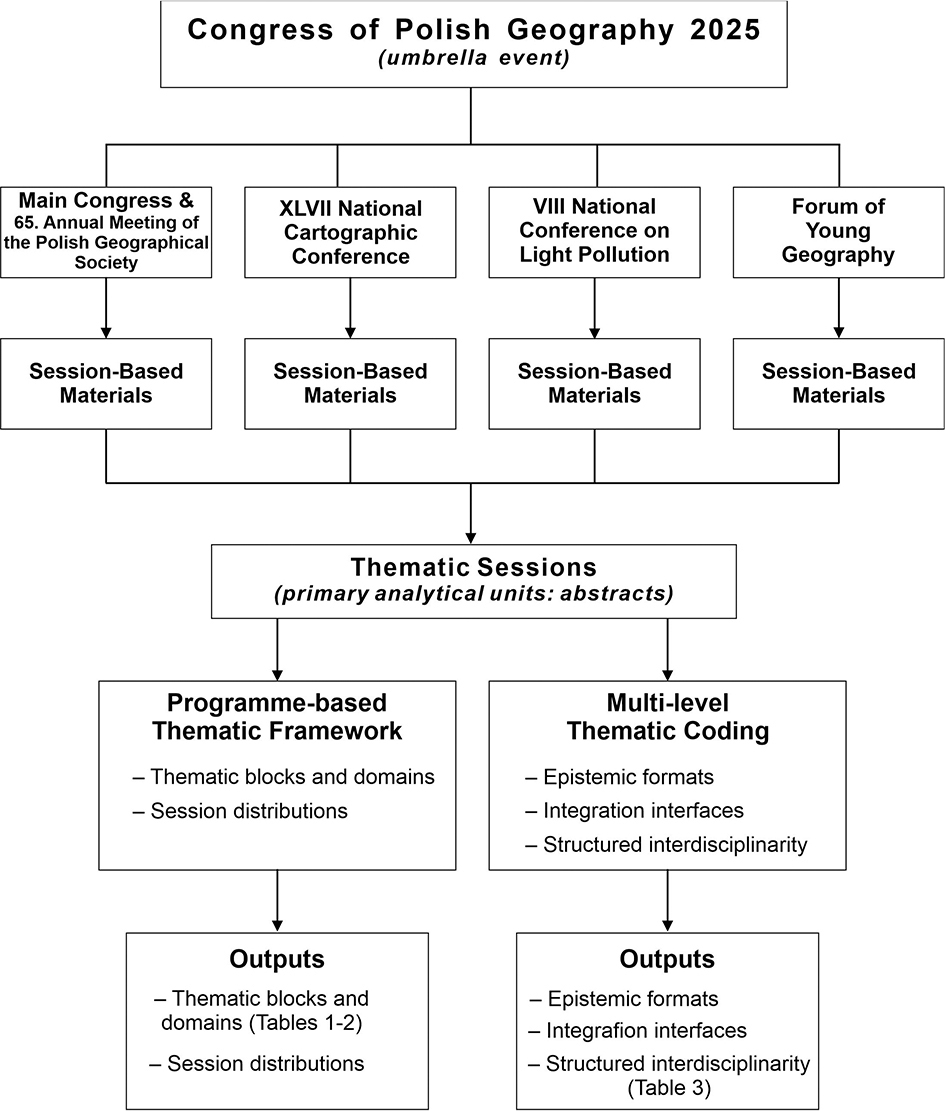
Fig. 1.
Structure of CPG 2025 and the analytical framework used for congress-based thematic analysis.
Table 1.
Thematic blocks and main research domains represented in the congress programme.
| Thematic domain/programme category | Associated the-matic blocks | Representative research areas |
|---|---|---|
| Social and economic geography | 1, 2, 4, 5 | Local communities, economic geography, regional development, transport geography, socio-spatial change |
| Political geography, migration and border studies (cross-cutting domain) | 4, 5 | Historical geography, political geography, geopolitics, migration, borders, transboundary processes |
| Regional cooperation and spatial governance | 6 | Regional cooperation, EU cohesion policy, territorial reform, functional urban areas, suburbanisation |
| Tourism and geotourism | 7 | Tourism geography, geotourism, astrotourism, tourism–environment interactions |
| Medical geography | 8 | Health geography, environmental determinants of health, spatial epidemiology |
| Military geography | 9 | Defence-related spatial analysis, military geography |
| Geoinformation, cartography and remote sensing | 10; NCC | GIS, remote sensing, spatial analysis, cartographic methods, AI applications in cartography |
| Climate and hydrology | 11 | Climate change, hydrology, extreme events, Quaternary context |
| Polar research | 12 | Permafrost, polar climate change, cryospheric processes |
| Geodiversity and landscape studies | 13 | Geodiversity, geoparks, landscape perception and management |
| Geoarchaeology | 14 | Geoarchaeological methods and applications |
| Geomorphology, soils and geology | 15 | Geomorphological processes, soil archives, geological resources |
| Quantitative research methods and statistics | 16 | Statistical methods, spatial modelling, methodological integration, data and data sources |
| Geographical education and didactics (applied and reflexive domain) | 17 | Didactics of geography, curriculum studies, educational tools, societal role of geographical knowledge |
| Interdisciplinary and application-oriented geography | 18 | Anthropocene studies, applied geography, AI in geography, interdisciplinary approaches |
| Problem-focused thematic component | NCLP | Light pollution research (environment–society interactions, regulation, health impacts, GIS-based monitoring) |
Table 2.
Programme-based quantitative structure of contributions presented within the organisational framework of the CPG 2025 by major components.
| Programme component | Oral presentations | Poster presentations | Total contributions |
|---|---|---|---|
| Main congress thematic blocks (Blocks 1–18*) | 356 | 82 | 438 |
| NCC | 37 | 2 | 39 |
| NCLP | 30 | 10 | 40 |
| FYG** | 46 | 21 | 67 |
| Total | 469 | 115 | 584 |
* Block 19 (‘Other’) was formally envisaged but not activated, as all contributions were assigned to existing thematic blocks; it therefore does not constitute an empirical component of the analysis.
** The FYG is included here to document the full organisational scope of the congress; however, its contributions were analysed as a complementary sub-corpus and were not used in deriving aggregate thematic proportions discussed in Sections ‘Major thematic clusters and dominant research domains’, ‘Interdisciplinary linkages and cross-cutting themes’, ‘Research orientations visible in the 2025 congress programme’ and ‘Epistemic formats identified in congress abstracts’.
Table 3.
Programme-based distribution of sessions and oral presentations across selected analytical domains and integration interfaces in the CPG 2025.
| Analytical domain or integration interface | Congress components involved | Number of sessions | Oral presentations |
|---|---|---|---|
| Physical and environmental geography | Blocks 11, 12, 15 | 10 | 104 |
| Social and economic geography | Blocks 1–7 | 14 | 92 |
| Spatial management and governance | Blocks 6, 18; NCLP | 9 | 48 |
| Tourism, geotourism and astrotourism | Block 7; NCLP | 4 | 22 |
| Geographical education (applied/reflexive) | Block 17 | 1 | 9 |
| Geoinformation, cartography and methodological interface | Blocks 10, 16; NCC | 7 | 37 |
| environmental problem-oriented research (integration interface) | Blocks 11, 18; NCLP | 6 | 30 |
| Early-career interdisciplinary research | FYG | 3 | 46 |
1 Note: Categories represent analytical cross-sections and are not mutually exclusive; reported numbers refer to dedicated sessions or formally integrated components constituting the core of a given analytical interface (e.g. the NCC), rather than to all related contributions distributed across thematic blocks.
Table 4.
Conceptual cross-tabulation of thematic domains and epistemic formats identified in the extended corpus of congress abstracts.
| Physical geography and environmental processes | Climate change and hazards | Social and economic geography | Urban studies and spatial structures | Spatial planning and applied geography | Geoinformation, GIS and cartography | Environmental management and policy | Geographical education | |
|---|---|---|---|---|---|---|---|---|
| Localised case-study research | ● | ● | ● | ● | ● | ● | ● | ● |
| Method- and tool-oriented studies | ● | ○ | – | ○ | ● | ● | ● | ○ |
| Problem-oriented integrative analyses | ● | ● | ○ | – | ● | ○ | – | – |
| Application- and practice-focused studies | ○ | – | ● | ● | ● | ● | ● | ● |
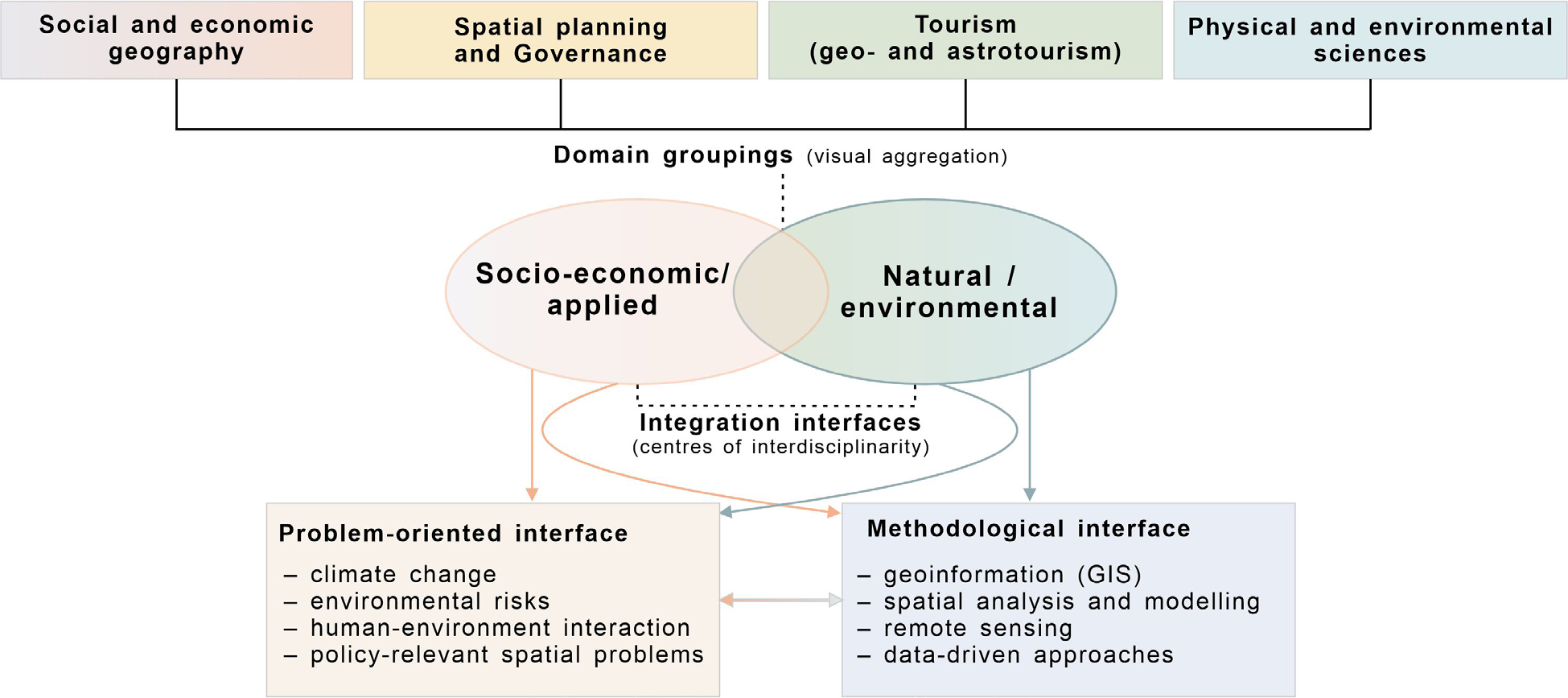
Fig. 2.
Structured interdisciplinarity in contemporary Polish geography inferred from the thematic organisation of the CPG 2025. The diagram provides a conceptual synthesis of two integration interfaces – methodological and problem-oriented – operating across differentiated thematic domains; domain groupings serve as visual aggregation and do not imply hierarchical or genealogical relations.