
Introduction
National congresses as mirrors of disciplinary structures
National scientific congresses provide insight into how academic disciplines organise themselves at a given moment: which topics are prioritised, which research orientations dominate, and where activity clusters within the community. Compared with journal literature – filtered through longer editorial cycles, citation accumulation and increasingly specialised outlets – congress programmes and abstract volumes capture a more immediate, community-facing record of what researchers choose to present to disciplinary peers, including exploratory work, methodological development and integrative agendas that may not yet be prominent in peer-reviewed publication streams. For this reason, structured textual corpora have long been treated as informative sources for examining the organisation of scientific fields (de Solla Price 1963, Small 1973), especially where publication practices and communication channels are heterogeneous (Glänzel, Schoepflin 1999). Conference programmes and abstract collections constitute a particular type of such corpus, offering early-stage, community-defined evidence for tracing thematic configurations, methodological emphases and patterns of interdisciplinary interaction (Lisée et al. 2008).
From a science-studies perspective, congress materials are methodologically advantageous because they are internally structured through session proposals, thematic tracks and programme committees, and therefore reflect negotiated judgements about topical relevance within the community. This structure supports analyses that move beyond simple counts, enabling the reconstruction of thematic clusters, the identification of dominant domains and the examination of overlaps between subfields. Abstracts provide a relatively standardised format in which research aims, methods and empirical contexts are condensed, making them suitable for systematic thematic classification and comparative analysis, as widely applied in science mapping studies (Leydesdorff 2007, Porter, Rafols 2009, Rafols et al. 2010). Although large-scale mappings of disciplinary structures often rely on journal-indexed bibliographic databases, the underlying analytical logic is not confined to journal literature: comprehensive national conference corpora can be thematically explicit, internally coherent, and closely aligned with community self-organisation. This is especially pertinent to geography, given its pronounced internal diversity – spanning physical geography, social and economic geography, spatial planning, geoinformation and applied fields – and its dispersion across journals, languages and publication formats (Chojnicki 1999).
At the same time, congress-based materials are shaped by selectivity that must be made explicit. Programme structures reflect the thematic call, organisational constraints and strategic choices by organisers and participants; they therefore represent active research agendas and community-defined salience rather than an exhaustive inventory of disciplinary output. Studies of scientific communication emphasise that different formats capture different stages and functions of knowledge production, and thus offer perspectives that complement journal-based analyses of disciplinary organisation (Leydesdorff 2007, Rafols et al. 2010). Against this background, the Congress of Polish Geography 2025 (10–14 September 2025, Lublin), with its formally structured programme and broad coverage of subdisciplinary domains, is treated here as an empirically grounded case for examining thematic organisation and integration within contemporary Polish geography.
Geography as an integrative and interdisciplinary science
Geography has long been marked by a tension between internal differentiation and integrative ambition. Since the mid-20th century, methodological debates have drawn attention both to the limitations of excessive exceptionalism and to the need for theoretically grounded approaches capable of linking diverse empirical domains. The critique articulated by Schaefer (1953) challenged idiographic conceptions of geography and called for stronger engagement with generalisation and explanation, contributing to a shift towards analytical integration rather than descriptive particularism.
This orientation was reinforced as geography increasingly positioned itself at the interface between the natural and social sciences, drawing on concepts, methods and explanatory frameworks originating in multiple disciplinary traditions. The integrative potential of the discipline is particularly evident in research addressing complex human–environment systems, where physical processes, socio-economic dynamics and institutional contexts are analytically inseparable. Sustainability science illustrates this convergence by explicitly foregrounding the integration of biophysical and social knowledge in analyses of environment–development interactions (Kates et al. 2001).
Within this broader context, geography has often been conceptualised as a discipline whose coherence does not rest on theoretical unification but on functional integration across differentiated subfields. In Polish geographical scholarship, this issue has been addressed explicitly in methodological reflections on the unity of geography, which emphasise synthesis, spatial reasoning and shared analytical perspectives as sources of coherence, rather than the elimination of specialisation (Chojnicki 1986, Liszewski, Suliborski 2006). These positions anticipate contemporary understandings of geography as an integrative field structured through relational linkages between heterogeneous research traditions.
Interdisciplinarity has simultaneously become a central concern within science studies. Research on scientific communication demonstrates that interdisciplinarity is not merely a normative ideal but a measurable and unevenly distributed feature of research systems, shaped by institutional arrangements, organisational settings and thematic configurations (Leydesdorff 2007, Porter, Rafols 2009). Owing to its plural internal structure, geography occupies a distinctive position within this landscape, maintaining differentiated subfields while engaging with neighbouring disciplines through shared problem framings, methods and analytical tools.
Recent Polish discussions have revisited these issues primarily in the context of educational, institutional and organisational change, often adopting a diagnostic tone and highlighting perceived risks of fragmentation and the weakening of synthetic perspectives (e.g. Bański 2010, Kostrzewski, Roo-Zielińska 2010, Rodzoś 2022). While these contributions provide important insights into disciplinary self-reflection, they tend to privilege structural and normative concerns over systematic empirical examination of thematic organisation and research practice. Such concerns have gained further prominence in the context of recent transformations in Polish science and higher education, accompanied by assessments pointing to advancing disciplinary de-integration alongside rapid methodological development, particularly in the domain of geoinformation and geographic information systems (GIS)-based approaches (Kostrzewski et al. 2025).
At the same time, international scholarship continues to emphasise the relevance of geography as an integrative field, especially in Central and Eastern Europe, where complex socio-environmental challenges and historically embedded research traditions foster problem-oriented and interface-based forms of integration (Lamentowicz et al. 2025). Considered jointly, these perspectives underscore the need to complement programmatic and normative debates with empirically grounded analyses of how differentiation and integration are realised in collective research practice.
From this standpoint, contemporary geography can be understood not as a bounded disciplinary domain but as an integrative platform for addressing complex spatial problems. Its capacity to combine physical, social and technical perspectives within a shared spatial logic provides a crucial interpretative context for examining interdisciplinarity as it is enacted in everyday research practices, including those materialised in the thematic organisation and collective outputs of national scientific congresses.
Research aims and questions
The primary aim of this study is to examine the thematic structure of geographical research in Poland as articulated in materials generated during the Congress of Polish Geography 2025 (CPG 2025). By treating the congress programme and published abstracts as an empirically grounded representation of community-defined research activity, the analysis foregrounds collective research orientations and patterns of disciplinary organisation, rather than assessing individual contributions or research quality.
More specifically, the study seeks to identify the main thematic domains, patterns of disciplinary differentiation and modes of thematic integration visible within the congress corpus at a defined point in time. These patterns are examined through the combined analysis of the formal programme structure – comprising thematic blocks and sessions – and the thematic content articulated in abstracts, allowing reconstruction of how internal coherence is maintained within a highly differentiated disciplinary structure.
A second aim is to examine how the thematic configuration emerging from congress materials reflects integrative and interdisciplinary characteristics commonly attributed to geography in both international and national methodological debates. This involves analysing how research themes connect traditionally distinguished subfields, such as physical geography, social and economic geography, spatial planning and geoinformation, and how problem-oriented and applied research areas operate as interfaces linking these domains within the congress structure.
These aims are addressed through the following research questions:
What thematic domains and research orientations are represented in the programme of a national geographical congress, and how are they distributed across its organisational structure?
How do the identified themes express patterns of disciplinary differentiation and structured thematic integration within contemporary Polish geography?
What role do interdisciplinary, problem-oriented and applied research agendas play in linking differentiated subdisciplinary fields within the congress corpus?
How does the thematic organisation revealed through congress-based analysis contribute to empirical understanding of disciplinary coherence and self-organisation within the geographical research community?
These questions frame the analysis of congress materials as an empirical snapshot of community-defined thematic organisation, while remaining attentive to the methodological opportunities and limitations inherent in this type of data source. In addition, the paper makes a methodological contribution by demonstrating the analytical potential of congress-based datasets for thematic and disciplinary analysis. The combined use of abstract content and programme-based classifications offers a perspective that complements journal-based corpora commonly employed in studies of disciplinary organisation and integration.
Study context
The national geographical congress as an analytical framework
The empirical framework of this study is provided by a national geographical congress treated not simply as a scientific event, but as a structured arena of disciplinary self-representation. In analytical terms, Polish geography is used here in an operational sense to denote academic geographical research as it is articulated through participation in the congress corpus, rather than as an exhaustive representation of the entire disciplinary community or institutional structure.
From this perspective, the congress is approached as a multi-layered empirical dataset composed of interrelated elements, including the official programme, thematic blocks and session structures, session and contribution titles, and the accompanying books of abstracts (Congress of Polish Geography 2025a, b). These components emerge through a combination of bottom-up and top-down processes. Individual submissions and session proposals reflect researchers’ perceptions of topical relevance and intellectual affiliation, while programme committees and thematic coordinators shape the overall architecture by grouping contributions and defining thematic tracks. The resulting programme, therefore, represents a negotiated configuration in which individual research agendas intersect with collectively defined disciplinary frameworks.
The national scale of the congress is analytically significant. In contrast to large international conferences, which often fragment disciplinary content into highly specialised niches, a national congress typically preserves a broad disciplinary scope while remaining embedded in shared institutional, educational and linguistic contexts. This configuration makes it particularly suitable for examining internal differentiation, thematic clustering and zones of integration across subfields within a single, community-defined frame.
Accordingly, the congress is treated here as a bounded empirical snapshot of contemporary geographical research activity rather than as a comprehensive inventory of scholarly output. It is not employed as a normative benchmark of disciplinary unity, quality or coherence, but as an analytical framework for examining how thematic differentiation and integration are articulated within a self-organised research community at a specific moment in time. Its analytical value lies in revealing patterns of thematic organisation, the positioning of integrative agendas and the role of formally integrated associated events that extend the congress corpus in selected domains, including cartography and light pollution research (National Cartographic Conference 2025, National Conference on Light Pollution 2025).
Scope, scale and thematic organisation of the event
The congress analysed in this study was organised as a large-scale national scientific meeting encompassing a broad range of contemporary geographical research conducted in Poland. Its scope covered the major subdisciplines of geography as well as closely related fields located at the interface with environmental science, spatial planning, geoinformation and applied socio-spatial research. This breadth was reflected both in the open call for thematic sessions and in the resulting programme structure, which accommodated diverse theoretical perspectives, methodological approaches and empirical foci.
In terms of participation, the event brought together researchers from universities, research institutes and applied organisations across the country, alongside a limited number of invited international contributors. The scientific programme comprised plenary sessions, parallel thematic sessions and a poster session, forming a multi-layered set of research contributions. This scale made it possible to examine the relative visibility of established research domains and less consolidated thematic strands within a single, community-defined analytical frame, without treating the congress as a comprehensive inventory of disciplinary output.
The thematic organisation of the congress followed a hierarchical structure based on thematic blocks and sessions. Blocks 1–18 represented thematically defined scientific domains and constituted the core analytical framework adopted in this study. Although the programme formally envisaged a residual category (Block 19) for contributions not aligned with predefined thematic tracks, this block was not activated in practice, as all submissions were incorporated into existing thematic blocks and sessions. Block 20 comprised poster presentations (organised into four-poster sessions) and was treated as a distinct analytical layer. Within individual blocks, specialised sessions addressed specific problem framings, methodological approaches or regional contexts, enabling both vertical differentiation between major domains and horizontal connections across thematic areas.
For analytical purposes, the official thematic structure of the congress was treated as a primary classificatory framework reflecting community-defined understandings of topical relevance and disciplinary boundaries. At the same time, the distribution of contributions across blocks and sessions was used to explore patterns of thematic organisation, overlap and integration rather than to infer the relative importance or performance of particular subdisciplines. Together, these elements provide a structured empirical basis for the thematic classification and coding procedures outlined in the following section.
Materials and methods
Data sources and corpus definition
The analysis draws on materials produced for the CPG 2025, treated as a coherent yet internally differentiated empirical corpus. The event was held under the auspices of the Polish Geographical Society and formally constituted its 65th annual meeting. This provides important institutional context for interpreting the corpus as embedded within established structures of the national geographical community, without implying exhaustive representativeness of the discipline as a whole (Dobrowolski et al. 2025a, b).
The core data sources comprise officially published congress materials documenting the full range of scientific contributions presented during the event: (1) the final scientific programme, (2) the main book of abstracts, and (3) books of abstracts prepared for specialised scientific meetings formally integrated into the congress structure (Congress of Polish Geography 2025a, b, National Cartographic Conference 2025, National Conference on Light Pollution 2025). Throughout the paper, the term congress refers to the CPG 2025 as the overarching organisational framework, while conference component denotes specialised scientific meetings formally embedded in its programme, including the National Cartographic Conference (NCC) and the National Conference on Light Pollution (NCLP).
The congress programme was used to reconstruct the formal thematic architecture of the event, including plenary sessions, thematic blocks, parallel sessions and poster sessions. It served as an organisational and classificatory reference framework for identifying the hierarchical arrangement of research domains and the official thematic categories adopted by the organisers, largely reflecting thematic session proposals submitted by conveners (Congress of Polish Geography 2025b). Programme elements were therefore treated as a contextual and structural layer supporting the analysis, rather than as primary units of thematic interpretation.
The principal analytical corpus consisted of the Book of Abstracts of the CPG 2025, which contains standardised abstracts of all accepted oral presentations and posters included in the main scientific programme (Congress of Polish Geography 2025a). Abstracts were treated as the primary units of analysis, as they provide concise, author-defined statements of research objectives, study contexts, methods and analytical focus, and are well suited to systematic thematic and epistemic classification. Throughout the paper, the unit of analysis is the published abstract. each accepted scientific contribution included in the analytical corpus corresponds to a single abstract, covering both oral and poster presentations. The analysis concentrates on the framing of research problems and approaches articulated in abstracts, rather than on the evaluation of empirical results reported in individual contributions.
The corpus was extended to include abstracts published within specialised conferences that formed formal components of the congress programme, namely the XLVII National Cartographic Conference (XLVII NCC) and the VIII National Conference on Light Pollution (VIII NCLP). These meetings produced peer-edited books of abstracts and were included to ensure coverage of research domains that are frequently organised through dedicated conference circuits, particularly cartography, geoinformation, spatial analysis and interdisciplinary research addressing environment–society relations and policy-relevant environmental issues (National Cartographic Conference 2025, National Conference on Light Pollution 2025).
An analytically distinct component of the congress was the Forum of Young Geography (FYG), formally embedded in the congress structure and oriented primarily towards doctoral candidates and early-career researchers. Materials from the Forum were included as a complementary sub-corpus capturing early-stage research agendas, but were treated separately from the main corpus in quantitative summaries and used primarily for contextual interpretation. This separation prevents format- and career-stage-specific clustering from inflating aggregate distributions derived from the main abstract corpus.
Overall, the analytical corpus comprised all published abstracts of oral and poster contributions included in the main congress volumes and formally integrated conference components (N = 517), while the FYG was treated as a separate contextual sub-corpus (N = 67). For clarity, N = 517 refers to the main analytical corpus used to derive aggregate thematic proportions and the distributions of epistemic formats reported in Sections ‘Major thematic clusters and dominant research domains’, ‘Interdisciplinary linkages and cross-cutting themes’, ‘Research orientations visible in the 2025 congress programme’ and ‘Epistemic formats identified in congress abstracts’. The larger programme-level count shown in Table 2 (N = 584) documents the full organisational scope of the event, including the FYG, and is reported for contextual purposes only. All abstracts were included without pre-selection by subdiscipline, institutional affiliation or presentation format. Contributions related exclusively to organisational matters, ceremonial addresses or non-scientific activities were excluded. All materials were analysed in their final, published form as issued by the respective organising committees. As the data sources are publicly available, the analysis did not involve personal data beyond standard academic metadata. The structure of the congress components, the resulting abstract corpus and the dual analytical pathways applied in this study are summarised schematically in Figure 1.
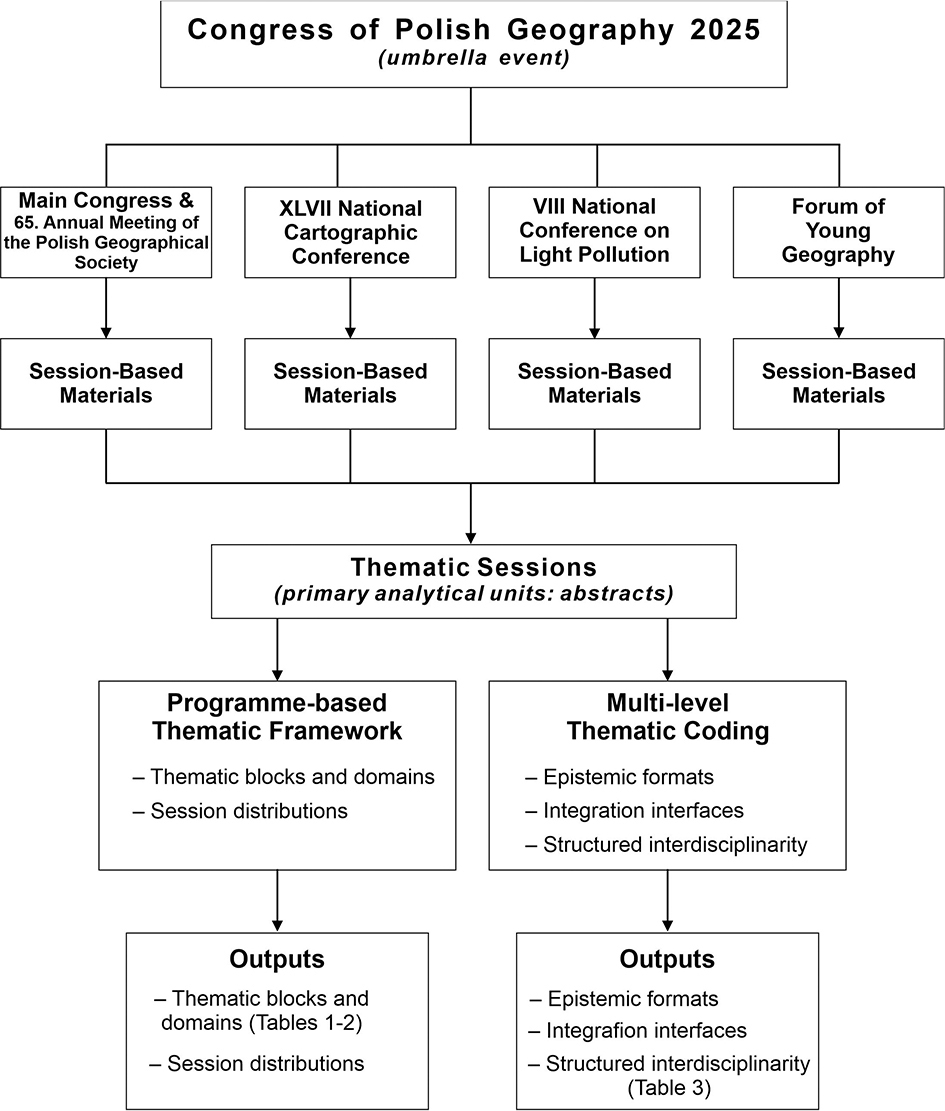
Fig. 1.
Structure of CPG 2025 and the analytical framework used for congress-based thematic analysis.
Thematic classification and coding procedure
The thematic analysis was conducted using a structured qualitative coding approach applied to the full corpus of abstracts defined in Section ‘Data sources and corpus definition’. Abstracts constituted the primary analytical units, as they provide concise and relatively standardised representations of research objectives, thematic focus and methodological orientation. The classification procedure combined deductive and inductive elements to ensure analytical consistency while remaining sensitive to thematic diversity and emergent patterns, following the dual analytical pathways outlined schematically in Figure 1.
In the first stage, a deductive framework was established on the basis of the official thematic organisation of the congress programme, including thematic blocks, session structures and formally integrated conference components. This framework functioned as a top-level classificatory scaffold reflecting community-defined thematic categories and patterns of disciplinary self-organisation. Each abstract was initially assigned to one or more broad thematic domains corresponding to this programme-based structure, ensuring alignment between analytical categories and the organisational logic of the congress. The thematic domains derived at this stage intentionally comprise a heterogeneous set of categories, including subdisciplinary fields, problem-oriented research areas and applied domains, as articulated in the congress programme itself. This mixed classificatory approach reflects the structure of the empirical material rather than a theoretically unified taxonomy and enables subsequent analyses to examine how different epistemic formats are distributed across contrasting modes of thematic organisation.
In the second stage, inductive refinement was carried out through close reading of abstracts within each broad thematic domain. This process enabled the identification of recurrent themes, problem areas and methodological orientations not fully captured by programme-level categories. Where consistent patterns were observed across multiple abstracts, additional analytically meaningful thematic subcategories were introduced. Coding decisions were guided by substantive content – including research questions, study objects, spatial scales and analytical approaches – rather than by institutional affiliation or presentation format.
To account for the interdisciplinary character of contemporary geographical research, the coding scheme allowed multiple thematic assignments where abstracts explicitly addressed more than one research domain. Such cases were treated as indicators of thematic integration rather than as classification ambiguity. Multi-label coding was implemented using a full-counting approach, whereby each thematic assignment was recorded independently, in line with established practices in science mapping and thematic analysis (Leydesdorff 2007, Porter, Rafols 2009). Unless stated otherwise, proportions reported in the Results section refer to the share of abstracts assigned to a category at least once (multi-label), rather than to the share of all coded assignments.
Epistemic formats were identified as a cross-cutting analytical layer, independent of thematic domain assignments. They were coded inductively based on recurring combinations of (i) stated research aims, (ii) emphasis on data, methods or tools, and (iii) the orientation of expected outputs (analytical, integrative or applied). This procedure allowed epistemic formats to cut across thematic domains and to be examined as recurrent modes of research organisation rather than as domain-specific methodological types. On this basis, the approximate shares of thematic categories and epistemic formats reported in the Results section were derived from aggregate abstract-level counts across the full corpus; they indicate patterns of prominence and co-occurrence rather than precise statistical proportions or inferential measures.
The final coding scheme comprised a hierarchical set of thematic categories and subcategories, enabling analysis at different levels of aggregation. At higher levels, it supported assessment of the relative prominence of major thematic domains, while at finer levels it facilitated the identification of thematic clusters, cross-cutting problem areas and zones of interaction between subfields. This multilevel structure is consistent with relational and nested conceptions of disciplinary organisation (Rafols et al. 2010).
Throughout the coding process, emphasis was placed on transparency and internal consistency. Coding rules and category definitions were documented during scheme development and applied consistently across the full analytical corpus. All thematic and epistemic coding was conducted by a single researcher, with coding stability assessed through re-coding a subset of abstracts after the initial coding pass; while interpretative judgement is inherent in qualitative thematic analysis, the procedure was designed to minimise ad hoc classification and to reflect recurring, community-level research orientations.
Analytical approach and methodological limitations
This study adopts an exploratory and descriptive analytical approach to reconstruct the thematic organisation of academic geographical research in Poland as reflected in the CPG 2025. Rather than testing predefined hypotheses, the analysis focuses on identifying patterns of thematic concentration, differentiation and integration within a self-organised corpus generated by the research community. Abstracts and session structures are treated as indicators of how geographical research is thematically framed and prioritised at a specific moment in time, while explicitly recognising that they provide only a partial and context-dependent representation of the broader disciplinary structure.
Participation was voluntary and shaped by institutional, financial and logistical conditions, limiting the representativeness of the corpus. The results, therefore, reflect the research agendas of an active, congress-participating segment of the academic geographical community rather than the full spectrum of actors involved in geographical knowledge production, including practitioners, educators and researchers from non-participating institutions. The congress is thus interpreted as a negotiated expression of thematic salience within the academic core of the discipline, not as an exhaustive inventory of national geographical research.
Although thematic coding was conducted using a systematic, multi-label procedure, a degree of interpretative judgement was unavoidable, particularly in cases involving interdisciplinary or hybrid research content. As in other studies employing qualitative thematic analysis and science-mapping approaches, thematic boundaries remain analytically constructed and sensitive to the chosen level of aggregation. The reconstructed thematic structure therefore represents an analytical reading of research orientations visible in the congress corpus, not a fixed disciplinary taxonomy.
Results
Overall thematic structure of contemporary Polish geography
The congress materials reveal a multi-level thematic architecture through which the internal diversity of contemporary Polish geography is organised within a formally structured programme. In organisational terms, the scientific programme comprised 20 thematic blocks (Blocks 1–20), within which research content was articulated through thematically labelled sessions (Sessions 1–56); the poster component (Block 20) consisted of four poster sessions. For analytical purposes, Blocks 1–18 constituted the core thematic framework of the congress. Although a residual category (Block 19) was formally envisaged in the programme structure, it was not activated in the final programme, as all contributions were assigned within existing thematic blocks and sessions. This arrangement provides an explicit empirical basis for identifying major domains of research activity and patterns of differentiation across blocks and sessions.
Geographical education (Block 17) is treated here as a distinct applied and reflexive domain rather than as a core subdiscipline. Contributions grouped within this block focus primarily on didactic practices, curriculum development and the societal role of geography, rather than on substantive socio-spatial or environmental research.
At the highest level of aggregation, the block structure indicates that the congress covered the full thematic breadth of contemporary geographical research represented within the participating community. Thematically defined blocks correspond to major research domains, including physical and environmental geography, social and economic geography, spatial management and planning, and geoinformation, cartography and remote sensing. These domains and their representative research areas are summarised in Table 1, which synthesises the congress-level thematic organisation derived directly from the official session structure. Importantly, the arrangement of blocks does not reproduce a strict physical–human division but reflects a plural organisational scheme in which subject-based fields coexist alongside method-oriented and application-oriented domains.
Table 1.
Thematic blocks and main research domains represented in the congress programme.
| Thematic domain/programme category | Associated the-matic blocks | Representative research areas |
|---|---|---|
| Social and economic geography | 1, 2, 4, 5 | Local communities, economic geography, regional development, transport geography, socio-spatial change |
| Political geography, migration and border studies (cross-cutting domain) | 4, 5 | Historical geography, political geography, geopolitics, migration, borders, transboundary processes |
| Regional cooperation and spatial governance | 6 | Regional cooperation, EU cohesion policy, territorial reform, functional urban areas, suburbanisation |
| Tourism and geotourism | 7 | Tourism geography, geotourism, astrotourism, tourism–environment interactions |
| Medical geography | 8 | Health geography, environmental determinants of health, spatial epidemiology |
| Military geography | 9 | Defence-related spatial analysis, military geography |
| Geoinformation, cartography and remote sensing | 10; NCC | GIS, remote sensing, spatial analysis, cartographic methods, AI applications in cartography |
| Climate and hydrology | 11 | Climate change, hydrology, extreme events, Quaternary context |
| Polar research | 12 | Permafrost, polar climate change, cryospheric processes |
| Geodiversity and landscape studies | 13 | Geodiversity, geoparks, landscape perception and management |
| Geoarchaeology | 14 | Geoarchaeological methods and applications |
| Geomorphology, soils and geology | 15 | Geomorphological processes, soil archives, geological resources |
| Quantitative research methods and statistics | 16 | Statistical methods, spatial modelling, methodological integration, data and data sources |
| Geographical education and didactics (applied and reflexive domain) | 17 | Didactics of geography, curriculum studies, educational tools, societal role of geographical knowledge |
| Interdisciplinary and application-oriented geography | 18 | Anthropocene studies, applied geography, AI in geography, interdisciplinary approaches |
| Problem-focused thematic component | NCLP | Light pollution research (environment–society interactions, regulation, health impacts, GIS-based monitoring) |
Research addressing integrative and applied topics is distributed across multiple thematic blocks and session types rather than concentrated within a single designated category. Such contributions occur within domains concerned with environmental processes, socio-spatial dynamics, spatial governance and methodological development, indicating that research combining multiple perspectives is embedded within the overall thematic structure of the congress programme rather than separated as a distinct thematic niche.
Within this structure, geoinformation (GIS) and cartography form a clearly identifiable method-oriented domain that links research conducted in physical and environmental geography with studies situated in socio-economic and planning-related fields. In parallel, applied research themes – including environmental risk, sustainability and policy-oriented studies – constitute a problem-focused orientation spanning several thematic domains. Light pollution research illustrates one instance of such problem-oriented thematic integration, bringing together contributions related to environmental processes, socio-spatial impacts, regulation, health and monitoring within a programme-integrated framework. In the congress context, this theme should be understood as an illustrative example of problem-oriented integration rather than a dominant axis for the discipline as a whole.
The block and session structure forms an internally coherent organisational framework in which thematic differentiation coexists with method- and problem-oriented components, without implying hierarchical or genealogical relationships between domains.
Major thematic clusters and dominant research domains
Building on the programme-derived thematic framework outlined in Section ‘Overall thematic structure of contemporary Polish geography’, closer examination of session structures and abstract content allows the identification of a set of major thematic clusters organising the geographical research presented at the congress. These clusters cut across multiple thematic blocks and sessions and can be described as relatively coherent groupings in terms of dominant research objects, methodological orientations and typical spatial scales of analysis evident within the programme.
The most extensive cluster encompasses research associated with physical and environmental geography. It includes studies focused on climate processes, hydrology, geomorphology, biogeography and soils and is distributed across several thematic blocks. Within this broad domain, both process-oriented investigations and applied environmental assessments are well represented. Internal differentiation is visible between contributions addressing fundamental environmental dynamics and those oriented towards environmental change, risk and management-related contexts.
A second major cluster is formed by research situated within social and economic geography, covering issues such as urban and regional development, socio-spatial transformations, demographic processes, economic restructuring and spatial inequalities. This body of work is characterised by a strong presence of place-based and regional analyses, often combined with comparative perspectives and explicit references to policy-relevant contexts. Differentiation within this cluster is evident between studies focused on urban processes, analyses of regional development and broader socio-economic investigations conducted at national and supra-regional scales. Alongside these themes, contributions in political geography, historical geography and border studies form a visible component of this cluster, reflecting sustained interest in territorially and historically grounded perspectives.
Geoinformation, cartography and spatial analysis constitute a distinct cluster defined primarily by methodological orientation rather than by a shared substantive research object. Contributions in this domain address both the development of analytical tools and their application, including GIS-based analyses, remote sensing techniques, spatial modelling and cartographic visualisation. In practice, this cluster intersects with multiple thematic domains and functions as a common analytical toolkit for empirical research conducted in both physical geography and socio-economic geography.
Research related to spatial management and planning represents another clearly identifiable cluster within the congress programme. It includes studies concerned with spatial policy, land-use planning, governance frameworks and planning instruments operating at local, regional and national levels. While strongly oriented towards applied research contexts, these contributions remain anchored in core geographical concepts such as space, scale and territorial differentiation.
Tourism-related research, encompassing tourism geography, geotourism and astrotourism, also displays sufficient thematic coherence to be treated as a distinct cluster. Positioned at the interface between physical geography, social and economic geography and applied spatial studies, this body of work integrates analyses of environmental resources, cultural landscapes and regional development strategies, frequently in conjunction with spatial planning considerations and geoinformation-based analytical tools.
In addition to these domain-oriented clusters, the analysis identifies a cross-cutting set of applied and problem-oriented studies distributed across multiple thematic blocks and session types. This group includes research focused on environmental risks, sustainability-related challenges and policy-relevant spatial issues. Within this broader category, light pollution research represents a clearly defined problem-oriented theme that combines perspectives on environmental processes, socio-spatial impacts, regulatory frameworks and geoinformation-based monitoring, while remaining embedded within existing thematic domains rather than constituting a separate disciplinary field.
The relative distribution and internal differentiation of the identified thematic clusters are summarised in Table 2, which provides an aggregated overview of research domains across the congress programme. Table 2 reports the programme-level numbers of scheduled presentations by congress components (oral/poster), whereas the thematic and epistemic coding results are based on the published-abstract corpus defined in Section ‘Data sources and corpus definition’. Collectively, these clusters outline the dominant thematic configuration articulated within the congress corpus and provide the empirical basis for the analysis of thematic integration and structured interdisciplinarity developed in the following section.
Table 2.
Programme-based quantitative structure of contributions presented within the organisational framework of the CPG 2025 by major components.
| Programme component | Oral presentations | Poster presentations | Total contributions |
|---|---|---|---|
| Main congress thematic blocks (Blocks 1–18*) | 356 | 82 | 438 |
| NCC | 37 | 2 | 39 |
| NCLP | 30 | 10 | 40 |
| FYG** | 46 | 21 | 67 |
| Total | 469 | 115 | 584 |
* Block 19 (‘Other’) was formally envisaged but not activated, as all contributions were assigned to existing thematic blocks; it therefore does not constitute an empirical component of the analysis.
** The FYG is included here to document the full organisational scope of the congress; however, its contributions were analysed as a complementary sub-corpus and were not used in deriving aggregate thematic proportions discussed in Sections ‘Major thematic clusters and dominant research domains’, ‘Interdisciplinary linkages and cross-cutting themes’, ‘Research orientations visible in the 2025 congress programme’ and ‘Epistemic formats identified in congress abstracts’.
Interdisciplinary linkages and cross-cutting themes
Analysis of session structures and presentation distributions indicates that interdisciplinarity within contemporary Polish geography is unevenly distributed across the congress programme and concentrated around a limited number of identifiable centres of integration. These centres are anchored either in shared methodological approaches or in problem-oriented research agendas that require the convergence of multiple disciplinary perspectives. Their organisational embedding within the congress structure is summarised in Table 3.
Table 3.
Programme-based distribution of sessions and oral presentations across selected analytical domains and integration interfaces in the CPG 2025.
| Analytical domain or integration interface | Congress components involved | Number of sessions | Oral presentations |
|---|---|---|---|
| Physical and environmental geography | Blocks 11, 12, 15 | 10 | 104 |
| Social and economic geography | Blocks 1–7 | 14 | 92 |
| Spatial management and governance | Blocks 6, 18; NCLP | 9 | 48 |
| Tourism, geotourism and astrotourism | Block 7; NCLP | 4 | 22 |
| Geographical education (applied/reflexive) | Block 17 | 1 | 9 |
| Geoinformation, cartography and methodological interface | Blocks 10, 16; NCC | 7 | 37 |
| environmental problem-oriented research (integration interface) | Blocks 11, 18; NCLP | 6 | 30 |
| Early-career interdisciplinary research | FYG | 3 | 46 |
1 Note: Categories represent analytical cross-sections and are not mutually exclusive; reported numbers refer to dedicated sessions or formally integrated components constituting the core of a given analytical interface (e.g. the NCC), rather than to all related contributions distributed across thematic blocks.
One centre of interdisciplinary integration is methodological in character and organised around geoinformation, cartography and quantitative research methods. Sessions devoted to GIS, remote sensing, spatial modelling and cartographic approaches occur both within dedicated thematic blocks and as methodological components embedded in thematically diverse sessions. This pattern is reinforced by the incorporation of the XLVII NCC, which consolidates method-oriented contributions within a formally integrated component of the congress programme. As shown in Table 3, this methodological interface provides a shared analytical framework linking physical and environmental research, human and socio-economic studies, and applied spatial analyses.
A second centre of integration is associated with problem-oriented research agendas, most clearly illustrated by the congress component devoted to light pollution research. Unlike the methodological interface, this centre is structured around a shared societal and environmental problem frame. Contributions addressing light pollution span themes related to environmental processes, ecosystem responses, human health and quality of life, spatial regulation, tourism-related issues and technological monitoring, indicating the convergence of multiple subdisciplinary perspectives within a single problem-focused domain.
Interdisciplinary linkages are also evident within early-career research, as reflected in the FYG. Contributions presented within this component frequently combine perspectives from physical geography, social and economic geography and geoinformation within individual studies, forming hybrid research profiles. As indicated in Table 3, the Forum represents a distinct organisational channel for such interdisciplinary configurations within the congress structure.
The patterns summarised in Table 3 indicate that interdisciplinarity in contemporary Polish geography is organised around two complementary centres: a methodological interface based on shared analytical tools and a problem-oriented interface structured around societally relevant research themes. These centres function as stable interfaces linking differentiated research traditions within the congress programme and provide the empirical basis for the more detailed analysis of research orientations and epistemic formats developed in the following sections.
Research orientations visible in the 2025 congress programme
In addition to the dominant thematic clusters and the main forms of interdisciplinary integration discussed in Sections ‘Major thematic clusters and dominant research domains’ and ‘Interdisciplinary linkages and cross-cutting themes’, the congress materials also point to several research orientations that are clearly present within the programme structure, even though they do not account for the largest share of contributions. These orientations are identified here based on their thematic visibility and distribution across sessions within a single congress edition and should be understood as characteristic emphases rather than as indicators of long-term disciplinary change.
A recurring feature of the programme is the strong presence of research oriented towards applied problem-solving and policy-relevant contexts. Contributions addressing concrete spatial issues appear across several thematic blocks and include studies focused on environmental risk management, climate adaptation, spatial governance, public health, infrastructure planning and regional development. Such applied perspectives are not confined to a narrowly defined applied domain but occur within both physical and human geography, suggesting that application-oriented research is widely embedded within the thematic structure of the programme.
Another clearly articulated orientation concerns research located at the interface between environmental processes and human well-being. This is reflected in studies linking environmental conditions with health outcomes, quality of life, recreation and tourism-related activities. Topics such as environmental exposure, landscape values, ecosystem services and the spatial dimensions of leisure and tourism recur in different parts of the programme, including sessions devoted to regulatory frameworks and spatial planning. These contributions illustrate how environmental and social perspectives are combined within a range of thematic contexts rather than being organised as a separate research field.
Technological and data-driven approaches represent a further orientation within the congress programme. While geoinformation and spatial analysis constitute established methodological components of contemporary geographical research (Section ‘Interdisciplinary linkages and cross-cutting themes’), the materials contain recurring references to advanced analytical techniques, including high-resolution spatial data, modelling and applications of artificial intelligence (AI). Such approaches appear not only in method-oriented sessions but also within empirically focused research conducted in both physical and socio-economic geography.
Insights into these orientations are also provided by contributions presented by early-career researchers. Papers included in the FYG frequently combine environmental analysis, socio-spatial interpretation and geoinformation-based methods within single studies, pointing to the emergence of hybrid research profiles articulated at the level of individual research practice rather than through formally defined thematic domains.
A comparable, though analytically distinct, applied and reflexive orientation is evident in contributions devoted to geographical education. These focus primarily on didactic approaches, curriculum development and the societal transmission of geographical knowledge. While not oriented towards substantive thematic research domains, they form an important component of the congress programme by addressing the role of geography in education and public discourse.
Altogether, these observations indicate that contemporary Polish geography, as represented in the congress programme, retains clearly recognisable subdisciplinary structures while simultaneously accommodating a range of applied, problem-oriented and methodologically integrative research orientations. These orientations are expressed through the thematic framing and distribution of contributions within the programme and coexist with established research domains, rather than replacing or displacing them.
Epistemic formats identified in congress abstracts
Epistemic formats were identified using a multi-label coding approach that allowed individual abstracts to be assigned to more than one format where applicable. The formats were derived from the inductive stage of the thematic coding procedure described in Section ‘Thematic classification and coding procedure’ and were operationalised based on recurring combinations of research aims, emphasis on data or methods, and the orientation of analytical outputs. Consequently, the approximate percentage ranges reported below indicate the share of abstracts assigned to a given format at least once within the main analytical corpus (N = 517); owing to the multi-label coding, these percentages do not sum to 100%.
Analysis of the full abstract corpus – including contributions presented within the main programme of the CPG 2025 and formally integrated conference components – led to the identification of a limited set of recurrent epistemic formats. These formats are understood as analytically defined patterns describing how research problems are framed, investigated and communicated in the congress material. They do not represent fixed methodological types; instead, they capture dominant modes of research organisation inferred from recurring emphases in abstracts, such as stated objectives, types of data employed, analytical focus and modes of argumentation.
The conceptual cross-tabulation presented in Table 4 summarises the distribution of these epistemic formats across major thematic domains. It should be read as a qualitative synthesis highlighting typical configurations and areas of co-occurrence, rather than as a rigid classificatory scheme or a quantitative model of disciplinary structure.
Table 4.
Conceptual cross-tabulation of thematic domains and epistemic formats identified in the extended corpus of congress abstracts.
| Physical geography and environmental processes | Climate change and hazards | Social and economic geography | Urban studies and spatial structures | Spatial planning and applied geography | Geoinformation, GIS and cartography | Environmental management and policy | Geographical education | |
|---|---|---|---|---|---|---|---|---|
| Localised case-study research | ● | ● | ● | ● | ● | ● | ● | ● |
| Method- and tool-oriented studies | ● | ○ | – | ○ | ● | ● | ● | ○ |
| Problem-oriented integrative analyses | ● | ● | ○ | – | ● | ○ | – | – |
| Application- and practice-focused studies | ○ | – | ● | ● | ● | ● | ● | ● |
Localised case-study research represents the most prevalent epistemic format, occurring in approximately 35–40% of analysed abstracts. Contributions assigned to this format are characterised by strong anchoring in clearly delimited spatial units – such as cities, regions, catchments or specific sites – and by an emphasis on detailed empirical documentation and place-based analysis of processes operating at the local or regional scale.
Studies oriented towards methods and analytical tools constitute another frequently observed format, present in approximately 30–35% of abstracts and particularly visible in contributions associated with geoinformation and cartography. In these cases, analytical emphasis is placed on data sources, methods and tools, while spatial phenomena primarily serve as empirical material for testing, demonstrating or refining analytical procedures.
Problem-oriented integrative analyses account for approximately 15–20% of abstracts. Studies assigned to this format are organised around clearly defined environmental, climatic or socio-spatial problems and are characterised by the integration of multiple datasets, indicators or analytical perspectives within a single research framework. This format reflects attempts to address complex research questions that cut across conventional thematic or subdisciplinary boundaries.
Application- and practice-focused studies form the least numerous but analytically distinct format, comprising approximately 10–15% of abstracts. These contributions prioritise the production of knowledge intended for practical use in planning, management, regulation or education and are particularly visible in research addressing spatial planning, environmental management and selected problem-oriented domains.
The identified epistemic formats indicate that thematic differentiation within contemporary Polish geography is accompanied by a limited number of recurrent modes of research organisation. These formats cut across thematic domains and function as practical mechanisms through which integrative and interdisciplinary research is enacted within the congress framework. Their frequent co-occurrence within individual contributions reflects the hybrid and integrative character of contemporary geographical research rather than the existence of discrete or mutually exclusive methodological typologies.
Discussion
Interdisciplinarity and integration in contemporary geographical research
Analysis of materials from the CPG 2025 indicates that interdisciplinarity in contemporary Polish geography is not a diffuse or ubiquitous feature of research practice, but instead takes a structurally organised form within the congress corpus. Patterns observed in the thematic distributions and epistemic formats documented in the Results section point to a limited number of clearly identifiable axes of integration around which interdisciplinary linkages are concentrated. This observation is consistent with research on the structure of scientific disciplines, which shows that interdisciplinarity rarely leads to the dissolution of disciplinary boundaries; rather, it tends to operate through relatively stable relational interfaces that connect specialised domains of knowledge while preserving their internal identities (Barry et al. 2008). Science-mapping studies further demonstrate that such integrative processes are selective and uneven, clustering around specific themes, analytical tools and problem configurations rather than encompassing entire disciplines in a uniform manner (Leydesdorff 2007, Porter, Rafols 2009).
In this context, interdisciplinarity appears as a processual and relational phenomenon, sustained by durable thematic and methodological linkages rather than by structural fusion between subdisciplines (Rafols et al. 2010). evidence derived from the congress corpus supports this interpretation by showing that integration is embedded in recurring organisational patterns and research practices visible across thematic blocks and sessions, rather than articulated as a generalised disciplinary condition. This interface-based mode of organising interdisciplinary relations – through which differentiated research domains are connected by functional linkages – is synthesised conceptually in Figure 2.
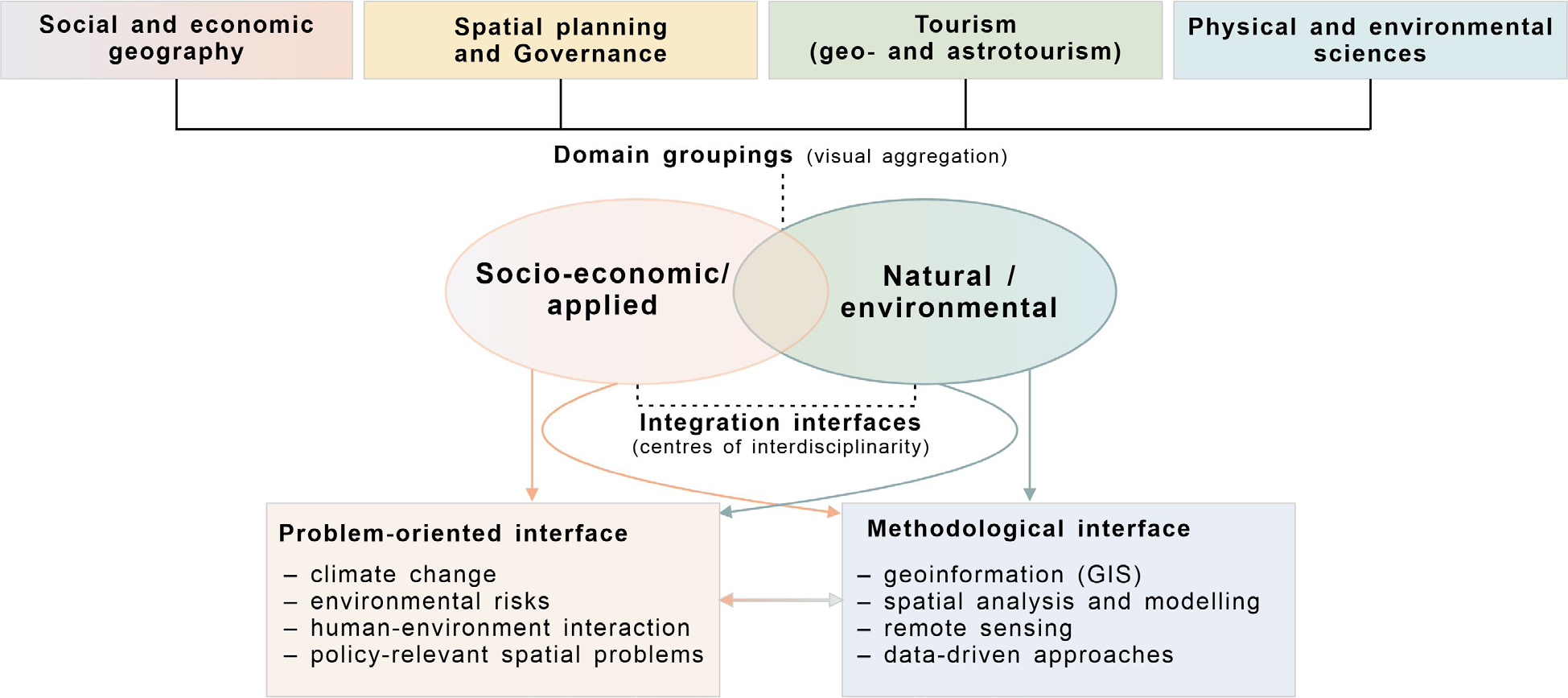
Fig. 2.
Structured interdisciplinarity in contemporary Polish geography inferred from the thematic organisation of the CPG 2025. The diagram provides a conceptual synthesis of two integration interfaces – methodological and problem-oriented – operating across differentiated thematic domains; domain groupings serve as visual aggregation and do not imply hierarchical or genealogical relations.
In the analysed case, two types of integrative interfaces emerge as particularly salient within the congress material: a methodological interface and a problem-oriented interface. The methodological interface is grounded in shared analytical tools – most notably geoinformation, spatial analysis and spatial data processing – which function as a common research language enabling cooperation across differentiated sub-disciplinary streams of geography. Within the congress programme, this interface is evident in the widespread use of GIS-based methods across thematically diverse sessions, linking contributions situated in physical and environmental geography with studies focused on socio-spatial dynamics, spatial planning and applied analyses. The integrative role of GIS and related techniques in connecting physical and socio-spatial research has been extensively documented in the literature (Goodchild 2007, Longley et al. 2015).
The second interface is structured around shared research problems with a clear societal and environmental dimension, including climate change, environmental risks and various forms of anthropogenic pressure. Research organised within these problem frames typically requires the simultaneous consideration of natural processes, social conditions and institutional contexts, creating favourable conditions for interdisciplinary integration. Within the congress corpus, such problem-oriented configurations are visible in contributions addressing human–environment interactions, environmental management and policy-relevant spatial challenges. This mode of integration corresponds closely with established frameworks of human–environment systems and sustainability-oriented research (Kates et al. 2001, Turner et al. 2003).
These patterns indicate that contemporary geography, as represented in the congress material, retains a clearly recognisable internal structure based on classical subdisciplines while simultaneously exhibiting mechanisms of functional interconnection. Integration does not imply the formation of a homogeneous ‘metadiscipline’; instead, it operates through shared methodological infrastructures and problem-oriented fields that facilitate cooperation without eroding domain-specific identities. This interpretation aligns with relational and functional models of interdisciplinarity, in which knowledge integration proceeds through relatively stable interfaces rather than through structural reorganisation of disciplinary boundaries (Barry et al. 2008, Fischer et al. 2011, Holmes et al. 2018).
Importantly, interdisciplinarity within the congress programme is not confined to sessions explicitly labelled as interdisciplinary. Instead, it permeates multiple thematic blocks through recurring epistemic formats, including localised case studies, problem-oriented integrative analyses and method-driven research designs. These formats recur across different thematic domains and provide practical mechanisms through which interaction between subfields is realised in routine research practice rather than as an exceptional or marginal activity. This pattern is consistent with international accounts portraying geography as an integrative field capable of combining natural, social and technical knowledge in response to complex spatial problems (Turner et al. 2003, Fischer et al. 2011, Holmes et al. 2018).
At the same time, the congress analysis demonstrates that integration is selective in character. Not all research areas participate equally in interdisciplinary processes, and centres of integration tend to cluster around specific themes, research problems and analytical tools, including human–environment systems, environmental management and geoinformation-based approaches. This selectivity suggests that interdisciplinarity functions less as a generalised disciplinary condition and more as a mechanism that strengthens particular research areas in response to specific cognitive and societal challenges, in line with findings on the uneven and clustered nature of knowledge integration in science (Leydesdorff 2007, Porter, Rafols 2009, Rafols et al. 2010). At the same time, several thematic areas remain largely organised within domain-specific traditions, with limited cross-block linkage visible in abstracts, suggesting that the identified interfaces coexist with substantial single-domain research practices.
Alongside these interface-based forms of interdisciplinarity, the congress materials also point to limited and selective instances of trans-disciplinary integration, particularly within problem-oriented research agendas. These include contributions involving geographers working jointly with researchers representing other disciplines, such as environmental sciences, geology, economics, sociology and political science. While not systematically assessed within the coding framework, such configurations were visible in selected sessions and presentations and illustrate the practical openness of geographical research to collaboration beyond disciplinary boundaries. Although comparatively limited in scope, these instances underscore geography’s capacity to function as an integrative platform connecting diverse fields of knowledge in response to societally relevant spatial challenges.
The role of geoinformation and data-driven approaches
Within the structure of the CPG 2025, geoinformation and data-driven approaches constitute a key methodological interface facilitating integration across diverse thematic domains of contemporary academic geography in Poland. Topics related to GIS, remote sensing, spatial modelling and cartographic analysis were not confined to dedicated thematic blocks but occurred across a wide range of contributions embedded in different subdisciplines, including physical geography, climate research, urban studies, spatial planning and socio-spatial analysis. Within the congress corpus, this distribution highlights the role of geoinformation as a shared methodological infrastructure supporting interaction between otherwise differentiated research domains (cf. Goodchild 2007, Longley et al. 2015).
Geoinformation functions simultaneously as a specialised field of inquiry and as a transversal set of analytical tools permeating multiple thematic contexts. Its integrative role is reflected not only in the dispersion of GIS-based contributions across thematic blocks but also in the formal organisation of the congress, which incorporated the XLVII NCC as an integral programme component. References to machine learning, AI and advanced spatial analytics appear across several sessions, particularly in studies concerned with environmental monitoring, urban analysis, spatial planning and health-related research, indicating the methodological breadth of data-driven approaches visible within the congress material (Batty 2013, Arribas-Bel 2014, Kitchin 2014, Miller, Goodchild 2015). This emphasis is consistent with recent diagnostic assessments of Polish geography that point to the growing methodological significance of geoinformation and applied analytical tools within the discipline (Kostrzewski et al. 2025).
This configuration is consistent with broader international discussions emphasising the role of spatial data infrastructures and data-intensive practices in enabling the integration of heterogeneous forms of spatial knowledge (Kitchin 2014, Leszczynski 2020). Evidence from the congress materials suggests that geoinformation underpins several of the epistemic formats identified in the Results section, including method-oriented studies and problem-oriented integrative analyses. It operates as a shared analytical infrastructure that facilitates collaboration across thematic domains without necessitating the convergence of distinct epistemological traditions.
At the level of disciplinary organisation visible in the congress programme, geoinformation contributes to a more interface-oriented configuration of geographical research. While physical geography and socio-economic geography remain clearly recognisable thematic clusters, shared tools, datasets and problem framings – such as spatial governance, environmental risks and data availability – create functional spaces for cooperation across these domains. Rather than reinforcing a rigid physical-social divide, this arrangement supports a layered and practice-oriented structure in which integration is achieved primarily through methodological infrastructures and research practices, in line with conceptualisations of geography as a data-intensive spatial science (Goodchild 2010, Kitchin 2014, Leszczynski 2020). However, the congress material also suggests that a substantial share of work – particularly qualitative socio-spatial studies and contributions on geographical education – relies only marginally on geoinformation tools, indicating methodological pluralism rather than a uniform shift towards GIS-based approaches.
Implications for the development of geography as an integrative scientific discipline
The analysis of the thematic structure of the CPG 2025 provides insight into the way contemporary geography in Poland is organised as a scientific discipline at a specific point in time. The observed configuration – characterised by clear internal differentiation combined with thematic coherence around identifiable problem-oriented and methodological nodes – highlights the role of intermediate organisational structures operating between established subdisciplines. While the distinction between physical geography and socio-economic remains recognisable within the congress material, a substantial share of research is organised around shared research problems (e.g. climate change, environmental risk, spatial planning) and shared analytical tools (e.g. GIS, spatial modelling), rather than being articulated exclusively within classical subdisciplinary frameworks (Goodchild 2007, Miller, Goodchild 2015).
The structure of sessions and the observed patterns of thematic co-occurrence indicate that research presented at the congress is organised through configurations that link differentiated subfields via common problem framings and methodological practices. Within the congress corpus, this organisation is visible in the recurrence of themes related to sustainable development, human–environment systems, geoinformation, as well as education and knowledge communication, which appear across multiple thematic blocks rather than being confined to single domains (Turner et al. 2003, Kitchin 2014).
From the perspective of disciplinary organisation, the congress materials suggest that geography operates as a relational system in which coherence is maintained through shared methods, data practices and research infrastructures, rather than through a unifying theoretical paradigm. In this sense, the thematic configuration observed at the CPG 2025 aligns with international accounts that describe geography as an interface-oriented field, capable of linking different types of data, analytical scales and methodological languages within a common spatial framework (Kitchin 2014, Leszczynski 2020).
Importantly, this mode of organisation does not imply a reduction of disciplinary diversity. On the contrary, the congress material demonstrates the coexistence of multiple research styles and epistemic traditions within shared thematic and methodological contexts. This plurality aligns with what Barnes and Sheppard (2010) describe as productive pluralism: coherence emerges not from theoretical unification, but from functional mechanisms that enable cooperation between differentiated research domains, especially around societally and environmentally relevant spatial problems.
Conclusions
This study contributes to empirical analyses of disciplinary organisation by showing how congress-based materials can reconstruct patterns of thematic differentiation and integration within a national geographical research community. Analysis of the CPG 2025 indicates that contemporary academic geography in Poland is characterised by a high degree of internal diversity combined with organisational coherence. Classical subdisciplines remain clearly identifiable within the congress material, while a substantial share of research activity is organised around integrative fields such as environmental studies, spatial planning, sustainability-oriented research and geoinformation-based approaches. Rather than relying on a single unifying paradigm, thematic coherence within the congress corpus is maintained through shared problem framings, methodological infrastructures and research practices articulated in collective research outputs.
Beyond thematic clustering, the analysis identifies a limited set of recurring epistemic formats that operate across thematic domains and shape how research problems are framed and communicated. These formats function as practical mechanisms of interdisciplinary integration, linking specialised research areas without dissolving established subdisciplinary identities. Interdisciplinarity, therefore, emerges as selective and structured, concentrating around specific methodological interfaces and problem-oriented research agendas rather than constituting a pervasive characteristic of the discipline as a whole.
From a methodological perspective, the study highlights the value of congress-derived corpora as a complementary source for examining disciplinary organisation. Analyses of programmes and abstracts provide access to patterns of thematic salience, integrative interfaces and research practices that may not yet be fully visible in journal-based publication records. At the same time, the voluntary nature of participation and the thematic selectivity of congress submissions require cautious interpretation. The findings should therefore be understood as context-dependent and tied to the specific organisational and thematic configuration of the analysed congress.
Future research could extend this framework through comparative analyses of successive congress editions and cross-national comparisons with similar events in other research communities. Further integration with additional data sources, including publication outputs and collaboration networks, would allow a more detailed examination of how the patterns observed in congress materials relate to longer-term processes of disciplinary organisation under varying institutional conditions.
Acknowledgements
The authors gratefully acknowledge the organising, technical and logistical staff and the members of the organising and programme teams whose work supported the implementation of the CPG 2025 and the preparation of the congress materials analysed in this study. They also thank the anonymous reviewer for constructive comments that improved the manuscript, and Professor Zbigniew Zwoliński, Editor, for his careful editorial guidance throughout the review process.
Abbreviations
- CPG 2025
Congress of Polish Geography 2025
- FYG
Forum of Young Geography
- GIS
Geographic Information Systems
- NCC
National Cartographic Conference
- NCLP
National Conference on Light Pollution
Notes
[6] Contributed by Author contributions
PM: Conceptualization; Methodology; Formal analysis; Investigation; Visualization; Writing – original draft; Writing – review & editing. AJ: Conceptualization; Methodology; Investigation; Writing – original draft; Writing – review & editing. RD: Conceptualization; Methodology; Investigation; Writing – original draft; Writing – review & editing. BU: Writing – original draft; Writing – review & editing.
[7] Data availability
All primary sources analysed in this study are publicly available and are cited in the References (conference programme and books of abstracts).
[8] Conflicts of interest Conflict of interest
The authors declare no conflict of interest.