
Introduction
Trace metal (TM) pollution of soil is one of the most serious environmental problems faced by humans around the world. As a result of warfare, contamination of soils can occur in many ways, including the use of conventional weapons, such as artillery shells and bombs, the use of chemical and biological weapons, the construction, usage, abandonment and devastation of military facilities and the spread of military waste. In addition, damage to critical or military infrastructure as a result of missile or bomb explosions can lead to the release of TMs into the environment.
Many literature data (e.g. Pichtel 2012, Lawrence et al. 2015, Broomandi et al. 2020) indicate that military activities generate pollution and environmental devastation. Many authors point to mechanical, physical and chemical damage to soils as a result of bombing, explosions and the movement of military equipment. The main problems are soil erosion, contamination with TMs (Pb, Cu, Zn and Cd) and residues of explosives and fuels. The research was carried out in the Donbas, Kharkiv, Donetsk and Lviv regions, using GIS and laboratory analyses. The results showed significant exceedances of acceptable TM standards and soil contamination in areas of intense fighting (Petrushka et al. 2023, Splodytel et al. 2023). Soil at military sites is often contaminated with TMs and other trace elements. Their concentrations can be tens of times higher than in areas not affected by waxing activities (Islam et al. 2016, Skalny et al. 2021). The soils we analysed affected by military contamination are permeable and can be blown away, so contaminants can migrate and spread freely in the environment. They can enter human and animal bodies with food and water, as well as through skin contact or inhalation. TMs are very dangerous to human health, so it is necessary to know where they accumulate, the intensity of their spread and the health risk. Military activities are associated with environmental contamination with chromium, copper, zinc, lead, cadmium and bismuth (Mander et al. 2004, Gillies et al. 2007, Etim, Onianwa 2012, Broomandi et al. 2020). Extensive research in this area indicates a signifcant accumulation of TMs, particularly on battlefields, firing ranges, small arms ranges, artillery ranges, mortar ranges and rocket ranges (e.g. Gillies et al. 2007, Charles et al. 2020, Barker et al. 2021). TM contamination of soils is amongst the longest-lasting remnants of war in conflict-affected zones. The immobilisation time of these pollutants depends mainly on soil properties, such as redox potential, pH and electrical conductivity. Over time, TMs can be mobilised and new minerals (mainly oxides) can precipitate from the supersaturated soil solution. Conflict areas around the world can therefore represent sites with high concentrations of TMs, as well as potential sources of TM contamination in both soil and water. TM pollution can have a negative impact on the environment and human health. It can cause soil degradation and groundwater contamination, and it can increase the risk of human and animal diseases such as cancer, nervous system and cardiovascular diseases. As a result of military operations across Europe in the 20th century, TM contamination of soils occurred in many areas (e.g. Bausinger et al. 2007, van Meirvenne et al. 2008, Meerschman et al. 2011, Sladkova et al. 2015, Gębka et al. 2016, Kis et al. 2016, Thouin et al. 2016, Tomic et al. 2018). Petrushka et al. (2023) analysed the impact of warfare on the soil in the Lviv region, focussing on TM contamination from shell and missile explosions following Russia’s 2022 aggression against Ukraine. Cadmium (Cd) poses the greatest ecological risk, with the following metals ranked according to risk level:
Rocket explosions cause long-term contamination of soil with TMs, which can seep into groundwater and pose a threat to human health and the ecosystem. Areas of Molotov Line fortifications in Roztocze (SE Poland), associated with intensive logistics related to the establishment of military facilities, transportation of materials and warfare, were also exposed to high concentrations of TMs. Data on the health effects of exposure to TM contamination resulting from military operations are not structured and are not widely known amongst humans. Therefore, it is necessary to continue biomonitoring and laboratory studies to better characterise military-related exposure to metals and the mechanisms underlying their harmful toxic effects.
Metal contaminants can migrate to lower soil horizons, especially through sandy soils characterised by acidic and slightly acidic reactions (Clausen, Korte 2009). Such migration with subsequent groundwater contamination can provide an additional pathway for human exposure to TMs. At the same time, pollution from warfare causes metal contamination of surface water. It has been shown that water on the firing ranges contains higher levels of Pb, Cu and Zn, although the relationship between the level of metals in the water and the frequency of firing was not linear (Hong, Hyun 2014). Kokorîte et al. (2008) analysed soil, plant and groundwater contamination by trace elements in areas of former military bases in Latvia. The results showed that contamination is clearly higher in the upper soil layers, suggesting relatively recent contamination related to military activities. Some areas showed point sources of contamination, and in some cases, contamination had penetrated into deeper layers of soil and groundwater. A study by Greičiūtė et al. (2007) analysed soil degradation and TM contamination on military firing ranges in Lithuania. As a result of the explosion, soil organic matter content drops by 66%–99%, and firing ranges and transport areas are heavily contaminated with lead, copper, nickel and chromium. The contaminants migrate to deeper layers of soil and groundwater, and self-cleaning processes are very slow. The purpose of this study is to study the extent of TM contamination of soils in areas adjacent to the bunkers of the Molotov Line in Roztocze (SE Poland). It is also important to assess the impact of the remediation of the area where military activities took place on the amount of TM contamination of soils. Archival cartographic data were analysed to demonstrate land use changes as an indicator of environmental remediation in the immediate vicinity of the studied bunkers. Soil samples from different locations and facilities (bunkers) with different degrees of damage by military operations were analysed to determine the concentrations of TMs.
Materials and methods
Study area and field method
The study area is located in southeastern Poland (Fig. 1), in the geographic macroregion of the Roztocze and mesoregion of the Eastern Roztocze (Solon et al. 2018). The surface is dominated by organodetritic limestones, shell conglomerates, sands and sandstones of Miocene age deposited on the floor of Upper Cretaceous rocks – geses, opokas and marls. A characteristic feature of the mesoregion’s relief is the occurrence of single, isolated, home-shaped hills, which reach approximately 390 m a.s.l. The maximum height difference exceeds 90 m. Individual rocks are also numerous, within which small karst caves have been inventoried. A characteristic feature of Eastern Roztocze is a very sparse surface water network. The western edge of the mesoregion is dissected by deep valleys of thrust character.2/3 of the mesoregion’s area is covered by dense forest areas (Solon et al. 2018).
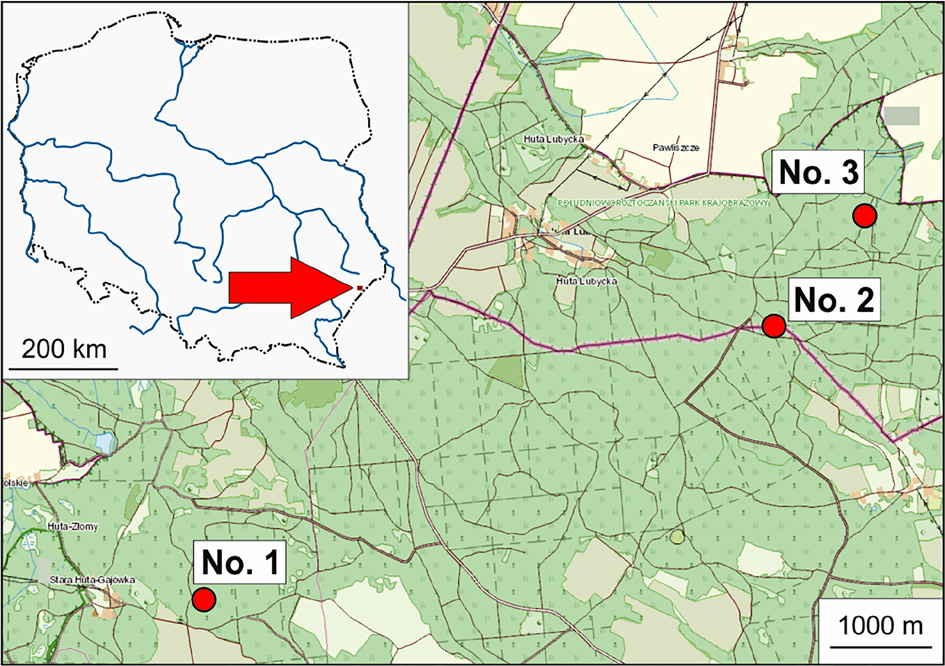
Fig. 1.
Location of the study area (background map source: WMS and WMTS viewing services, Central Office of Geodesy and Cartography, Poland).
Historical background
The Molotov Line is a zone of military fortifications built to protect the Soviet Union’s western border along the so-called demarcation line with the Third Reich, drawn after the division of Polish lands under the ‘Treaty on the Borders and Friendship of the Third Reich-Soviet Union’ (II Ribbentrop-Molotov Pact). It stretched from Lithuania in the north to the mouth of the Danube River in the south. The defence system was based on the so-called fortified regions, which were not intended to form a continuous belt of fortifications, but were to secure the front (the line of division of influence) over a length of 50–120 km (Bereza et al. 2002, Short 2008). Construction of the fortifications began in June 1940, and the Third Reich’s invasion of the Soviet Union a year later, definitively terminated the work. It is estimated that only about 25% of the total fortification zone facilities were finished at the time (Grechuta 2000).
The breakthrough of the Molotov Line by Third Reich troops happened very quickly and without major military action, with only a few shelters intensively stormed by Wehrmacht troops, remaining unconquered for several days. The fortifications abandoned by the Red Army became the focus of German soldiers. Some facilities were fired experimentally with artillery shells or blown up for the purpose of obtaining high-grade steel armament components (Bereza et al. 2002).
The objects studied were part of strongpoints: ‘Wielki Dział’ (bunker No. 1) and ‘Goraje’ (bunker No. 2, bunker No. 3), which were part of the Rava-Russkaia Fortified Region. The bunkers were located within the exposed, highest elevations of Roztocze (Wielki Dział Hill and Krągły Goraj Hill – 390 m a.s.l.). The location accounted for the high defensive qualities of the shelters; besides, it allowed for distant observation of the field (ca. 10 km) and fire protection of their deep foreground. The task of the resistance points was to provide fire cover for the operational direction to Lviv and Rawa Ruska (Bereza, Chmielowiec 2000, Bereza et al. 2002, Short 2008). After the end of hostilities of the Second World War, the combat usefulness of the bunkers became less important. Significant forest areas were severely devastated as a result of direct warfare or looted logging by the occupying forces. Within the strongpoints ‘Wielki Dział’ and ‘Goraje’, immediately after World War II, reclamation of the area began, which included demining, ploughing and restoration of forest stands (Magnuski, Jaszcza 2008, Celej 2021). By the late 1990s, most of the fortifications were falling into disrepair. The significant development of qualified (military) tourism in the last two decades and the growing awareness of local action groups have contributed to an increase in interest and year-by-year progressive tourist pressure on the sites of the Rava-Russkaia Fortified Region of the Molotov Line (Bereza, Chmielowiec 2000, Bereza et al. 2002, Short 2008).
Objects studied
Bunker No. 1
The battle shelter of the Wielki Dział resistance point is located on the southwestern slope of the Wielki Dział hill, at an altitude of about 360 m a.s.l. The large, two-story shelter was used in defensive operations in June 1942. It bears clear traces of shelling, including by large-calibre bullets. It is currently located in the area of a dense mixed forest. The bunker is accessed by well-preserved WWII-era transportation routes, which were used to transport materials needed for its construction. Today they are used to lead hiking trails and bicycle paths. The battle shelter, due to its very good state of preservation of most of its structural elements, armour and equipment, is one of the most visited fortification sites of the Molotov Line in Eastern Roztocze (Fig. 2A).
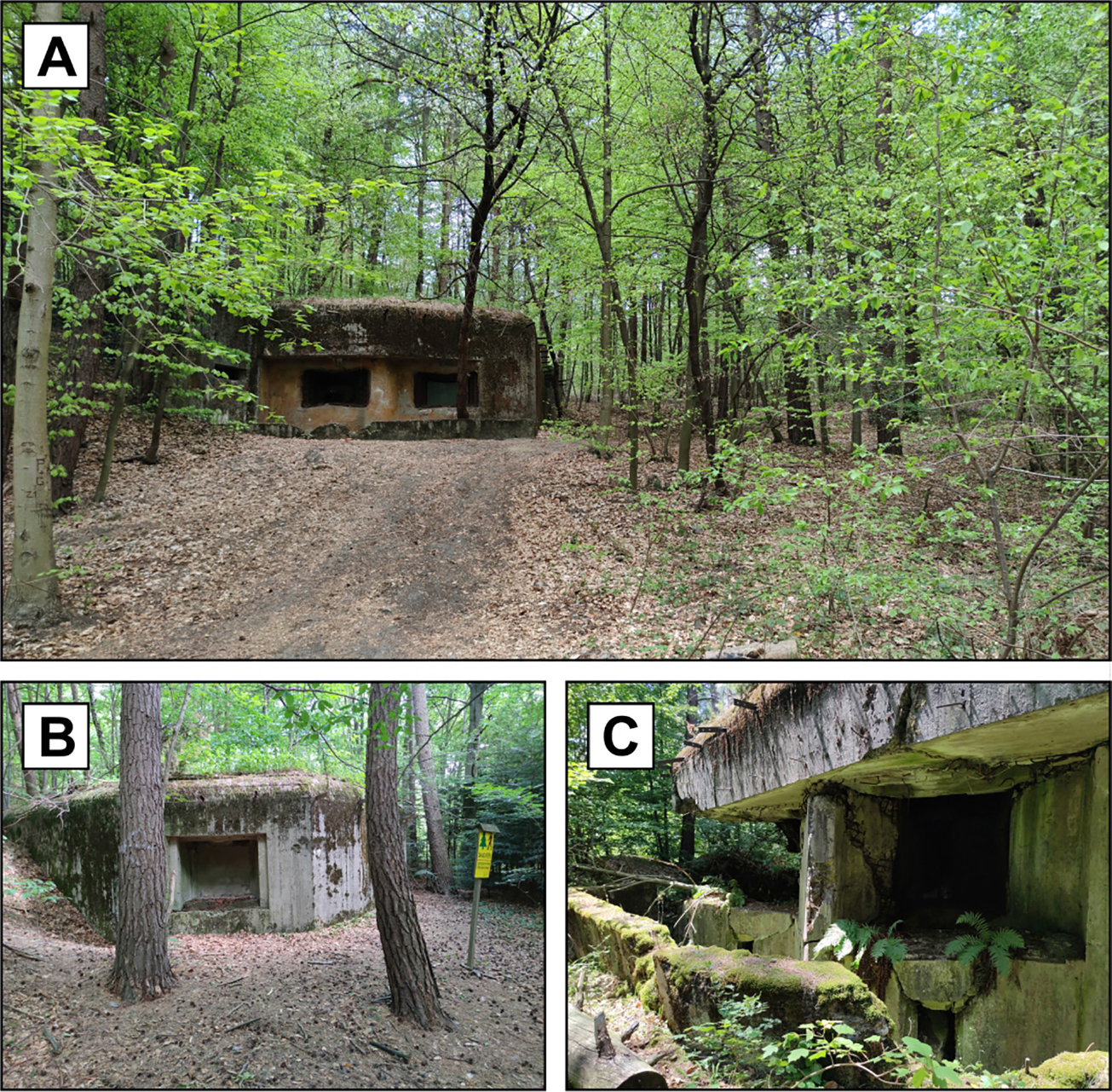
Fig. 2.
Selected bunkers of the Rava-Russkaia Fortified Region of the Molotov Line. A – Bunker No. 1 – tourists visiting a bunker on the Molotov Line, B – Front wall of unfinished bunker No. 2, C – Bunker No. 3 damaged by shelling and experimental explosion (photo by G. Gajek).
Bunker No. 2
On the western slope of Krągły Goraj Hill, at an altitude of about 365 m a.s.l., an unfinished bunker was located (amongst other things, no traces of machine gun armour mounting). The bunker did not take part in defensive operations. No traces of military interference within the facility have survived. Currently, the shelter is located next to a hiking trail, within a compact forest complex (Fig. 2B).
Bunker No. 3
The battle shelter was the only artillery firing point of the Goraje resistance point. It is located at about 1200 m northeast of the culmination of Krągły Goraj Hill, within a pronounced morphological plateau, at an altitude of about 335 m a.s.l. The facility was not completed and therefore did not participate in the defensive operations of the USSR’s western border in 1941. The bunker was very badly damaged, probably as a result of experimental blasting or artillery shelling by Wehrmacht soldiers (Fig. 2C). The interior ceilings, the lower ceiling, along the underground tanks were torn off. The strength of the explosion is evidenced by numerous structural elements found several dozen meters from the bunker. Currently, the bunker is located within a decades-old pine forest bearing traces of post-war reclamation.
Sample preparation
In the zone of each bunker, surface (0–20 cm) and subsurface (20–40 cm) soil samples were collected in 4 directional transects N/S, E/W and distances from the bunkers: 0 m, 10 m, 20 m, 30 m, 40 m and 50 m. The samples were taken from each transect in a straight line with an equal distance of 10 m between each sample using Eijkelkamp soil samplers for topsoil (0–20 cm) and subsoil (20–40 cm). A pooled average sample of three boreholes was taken from each depth. The samples were additionally mixed. A total of 126 average soil samples were taken. The study plots were located using a Garmin Oregon 550t satellite receiver (Olathe, KS, USA). The study material was collected during two field sessions in autumn 2022. Plant detritus was then removed from the soil samples. The samples were dried at room temperature and then sieved through a 2 mm sieve. The so-called earthy parts of the soil, i.e., the fraction below 2 mm, were used for further analyses.
Laboratory analyses
The soil texture was determined using the Malvern Mastersizer analyser with the HydroG dispersion unit (Mastersizer MS-2000, Malvern, Worcestershire UK). The samples were prepared according to the procedure proposed by Ryżak and Bieganowski (2011) and Polakowski et al. (2023) and evaluated according to soil textural classes as provided by FAO (2006). Soil reaction has been measured in water (1:2.5 soil-to-solution ratio) using a glass electrode (EPX-5, Elmetron, Zabrze, Poland) (PN-EN 15933:2013-02). The extraction of basic cations was performed using 1 M ammonium acetate based on the principles of the ammonium acetate method, The International Soil Reference and Information Centre–Food and Agriculture Organisation of the United Nations (van Reeuwijk 2002). In the percolate obtained after extraction with 1 M ammonium acetate, Ca, Mg, Na and K were determined using the Flame Atomic Absorption Spectrometry (FAAS) method. The sum of the contents (Ca + Mg + Na + K) provided the base exchange capacity (BEC). Exchangeable acidity (HA) was determined in 1 M KCl percolate after extraction using method No. 11 by ISRIC-FAO (van Reeuwijk 2002). Effective cation exchange capacity (ECEC) was calculated by summing BEC and HA. The total organic carbon (TOC) contents were determined using a LECO CNS elementary analyser (LECO Truspec, St. Joseph, CN, USA). The accuracy of the determinations was tested against the certifed reference material (calibration soil sample ref. No. 502-062, LECO Corporation is A2LA accredited in accordance with International Standards Organisation ISO/IEC 17025:2005 [Certificate No. 3285.01]). In soils containing calcium carbonate, the calcium carbonate content was determined using the Scheibler method, and a correction was taken into account when determining the TOC content. To determine the pseudototal (hereafter referred to as total) content of TMs, the soil samples were dissolved with aqua regia (ISO 11466).
The contents of Cd, Cu, Mn, Pb, Zn, Ni, Cr and Bi were determined using the ICP-OES technique (ICP-OES Spectrometer 700, Agilent Technologies, Santa Clara, USA). Geochemical analyses were carried out based on reference samples SO-2 and SO-4 from Canada Centre for Mineral and Energy Technology. Analytical accuracy of analyses was within the range from about 1.9% to about 8% (i.e., 1.92% for Cu; 2.13% for Cd; 2.43% Pb; 3.14% for Zn; 4.71 for Mn; 7.4% for Cr, 7.8% for Bi and 8.1% for Ni). Detection limits for ICP-OES is 12.0 μg · dm−3 for Bi, 1.5 μg · dm−3 for Cd, 2.0 μg 00B7 dm−3 for Cu, 4.0 μg 00B7 dm−3 for Cr, 0.3 μg 00B7 dm−3 for Mn, 5.5 μg 00B7 dm−3 for Ni, 14.0 μg 00B7 dm−3 for Pb and 0.9 μg 00B7 dm−3 for Zn. Each soil sample was analysed in duplicate, and in case the analytical results differed by 5%, the analyses were remeasured.
Pollution and ecological risk indicators
To analyse the degree of TM contamination of forest soils, several pollution indices were used: pollution index (PI), degree of contamination, potential ecological risk and top-bottom (TB) index.
The geochemical background of the studied soils was considered to be the content of the analysed elements in the C horizons (80–120 cm) of soils of the same typology collected from an area not affected by warfare and with minimal anthropogenic pressure. The reference area was located in a forest within the buffer zone of the Roztoczański National Park. The parent rock of soils formed from sands contain natural amounts of TMs. These contents were adopted as the geochemical background, the knowledge of which is essential for assessing the degree of contamination in the upper soil horizons. A similar methodology for determining the geochemical background was used by Mazurek et al. (2017). The selection of the reference area for determining the geochemical background was based on the studies by Migaszewski and Gałuszka (2007) and Zgłobicki (2008).
The average natural content of the metals in question in the considered soil bedrock is as follows (in mg 00B7 kg−1): cadmium – 0.5, chromium 4.0, copper – 5.0, manganese 114.0, nickel 4.0, lead 9.0, zinc 22.0 and bismuth 0.2.
At the same time, the adopted levels of elemental values do not differ from the concentrations published in other works on such issues as the geochemical background of Roztocze soils (Czarnowska 1996, Skwaryło-Bednarz 2007, Skwaryło-Bednarz et al. 2014, Mazurek et al. 2017).
PI is the ratio of metal content in the soil to its reference value Eq. (1):
where:– Cn–is the metal content of the test sample,
– Cgb–is the local geochemical background.
The reference value in the PI can be the geochemical background or the local geochemical background. The values of local geochemical background were used, considering this index to be more relevant to the analyses and more accurately reflecting anthropogenic deviations in the study area. The ranges for the pollution load index (PLI) are <1 no pollution, 1–2 low pollution, 2–3 moderate, 3–5 strong and >5 very strong pollution (Shi, Wang 2013).
Igeo, developed by Muller (1969), is used to assess TM contamination based on its content in the soil material under study in relation to a specific GB. Igeo is calculated according to the formula: Eq. (2):
where:– Cn – concentration of individual HMs in the sample,
– GB – geochemical background value for the element under consideration,
– 1.5 – a constant value, reflecting natural variations in the content of the element concerned in the environment.
The Igeo covers seven environmental quality classes:
– Igeo ≤ 0: unpolluted
– 0 < Igeo < 1: unpolluted-moderately polluted
– 1 < Igeo < 2: moderately polluted,
– 2 < Igeo < 3: moderately–highly polluted,
– 3 < Igeo < 4: highly polluted,
– 4 < Igeo < 5: highly–extremely pollute,
– Igeo ≥ 5: extremely polluted.
The degree of contamination is a summary index that allows us to describe the contamination of a given sample by all the metals analysed. The degree of contamination equation has the form Eq. (3):
where:– n is the number of metals analysed,
– PIi is the PI for each metal in the sample.
For results 0–8, we have low contamination, 8–16 moderate, 16–32 strong and >32 very strong (Håkanson 1980).
PLI is the geometric mean of Pli also describing total pollution of sample. PLI is given by Eq. (4):
Potential ecological risk allows to determine the risk of land use in the area and the potential risk associated with the presence and toxicity of TMs found in the soil. The summary RI is calculated according to the formula (Eq. 5):
where:– T – is the toxicity of each metal (Cd-30, Cr-2, Cu-5, Ni-5, Pb-5 and Zn-1) (Håkanson 1980).
For results, <90 ecological risk is low, 90–180 moderate, 180-360 strong, 360–720 very strong and >720 highly strong. (Gong et al. 2008, Zhiyuan et al. 2011).
The TB index shows the proportion of metal content in the higher and lower parts of the soil profile. In our case, the equation of this index is
where:– Ci–20 is the content of a given metal in the 0–20 cm horizon,
– Ci20–40 in the lower horizon (20–40 cm).
Values greater than 1 indicate greater surface metal content relative to deeper horizons. Values <1 indicate greater metal content in the deeper horizon.
Statistical analysis and cartographic analysis
Several statistical methods were used to describe the differences in historical pollution in military zones (bunkers in the Molotov Line), including principal component analysis (PCA), correlation analysis and cluster analysis (CA). Bismuth (Bi) was not included in the statistical analyses because its content was below the detection limit in many cases, and assigning the value of zero to Bi is not appropriate. Statistical analyses and PCA were performed using the symbolic algebra program – Wolfram Mathematica (12.0). PCA was conducted using Mathematica. PCA allows for the reduction of the number of parameters describing the samples and their replacement with principal components characterised by similar variability. It can also be inferred that the data variability within the group is similar, suggesting that they have the same origin.
A similar application is the use of CA in this case. It allows metals to be divided up according to their content in all analysed samples simultaneously. ArcGis 10.8.1 software was used for calibration of raster images (historical maps of study area) and spatial analysis of the basic forms of land use indicating the process of rehabilitation of the area destroyed by military operations, to illustrate the spatial variability of pollution indicators within the studied bunkers. Map of Poland 1:100,000, The Military Geographical Institute 1934, as of 1923, Tactical Map of Poland 1:100,000, The Military Geographical Institute (General Staff, Post-WW2) 1955, as of 1954, Database of Topographic Objects (BDOT10k) 2012, CODGiK. One of the most frequently used methods of geostatistical estimation, the so-called kriging, was applied. Unconstrained linear estimates of the analysed indices were obtained.
Results
Selected physical and chemical properties
The studied bunkers are dominated by autogenic soils that developed on the surfaces of denudation lines and gentle slopes of spur hills composed of Miocene organodetrital and lithothamnium limestones and calcareous-quartz sandstones, covered with a thin (up to 1.5 m, depending on terrain conditions) layer of denudation and deluvial formations. They are composed of sandy material (loose, weakly clayey sands). In these soils, the surface horizons are characterised by grain sizes ranging from loose sand to loamy sand. Due to their varied pedogenesis, they have been classified in the latest Polish Soil Classification (2019) as incomplete rusty soils (Ol–Ofh–A–Bv–C), which are the dominant element of the soil cover of the slope and topsoil portions of the relief. The closest counterparts to the studied soils in the IUSS Working Group WRB (2022) systematics are the Brunic Arenosols. Warfare has irreversibly disrupted the morphology of the soil profle in the analysed area. The most common effects of warfare on the soil (apart from chemical contamination) include the decapitation of topsoil layers, soil compaction and mixing of soil horizons. This causes significant challenges in the proper classifcation of these soils. Closest to the bunkers, where shelling was most intense, Turbisols are present – soils in which the surface layers of the natural soil have been deeply mixed, sometimes with the incorporation of small amounts of foreign material (Kabała et al. 2019). The studied area also contains Aggerosols, which have formed as a result of the accumulation of thick layers of soil material, used as protective embankments. In the IUSS Working Group WRB (2022) classifcation system, Turbisols and Aggerosols are categorised as Dystric/Eutric Regosols. The surface sediments poor in <0.02 mm fractions were dominated by the rusty process. Another type of soil characteristic of the study area, flling most of the numerous feld depressions, are deluvial soils formed by the accumulation of humus soil deluviums of varying thickness and sandy grain size. The proportion of skeletal parts (>2 mm) in the investigated ones did not exceed 10%, and in those few cases where it occurred, it was constituted by concrete rubble, which got there most likely as a result of explosions or during the construction of defence facilities.
The soils within the investigated bunkers were characterised by a wide range of pH. The majority of samples were acidic soils. At bunker No. 1, the pH ranged from 3.5 to 7.5, at bunker No. 2 from 3.5 to 7.2 and at bunker No. 3 from 3.6 to 7.8.
The average total organic carbon (TOC) content of the soils around the first site was 13.0 g · kg−1 (5.0–34.0 g · kg–), while around bunker No. 2, the average was 16.0 g · kg−1 (3.0–49.0 g · kg−1), and around bunker No. 3, the average was 9.0 g · kg−1 (2.0–28.0 g · kg−1).
The soils were characterised by low ECEC sorption capacity averaging at 0–20 cm level, respectively: 9.1 cmol(+) · kg−1 around bunker No. 1, 5.9 cmol(+) · kg−1 around bunker No. 2, 8.1 cmol(+) · kg−1 around bunker No. 3 and low saturation with base cations. Other data are included in Table 1.
Table 1.
Basic physicochemical properties of studied soils.
| Parameter | Unit | Mean | Median | Min | Max | SD |
|---|---|---|---|---|---|---|
| Bunker No. 1 | ||||||
| pH (H2O) | – | 4.7 | 4.2 | 3.5 | 7.5 | 1.3 |
| Sand (grain diameters 2–0.05 mm) | % | 93.1 | 93.2 | 89.0 | 97.1 | 2.2 |
| Silt (grain diameters 0.05–0.002 mm) | 6.8 | 6.7 | 3.0 | 10.0 | 2.0 | |
| Clay (grain diameters <0.002 mm) | 0.1 | 0.0 | 0.0 | 0.8 | 0.2 | |
| Total organic carbon TOC | g · kg-1 | 13.0 | 12.0 | 5.0 | 34.0 | 0.8 |
| Hydrolytic acidity HA | cmol(+) · kg-1 | 4.4 | 4.1 | 0.8 | 11.2 | 2.4 |
| Base exchange capacity BEC | 5.1 | 4.0 | 2.0 | 16.7 | 3.7 | |
| Effective cation exchange capacity ECEC | 9.5 | 9.1 | 5.1 | 20.2 | 4.1 | |
| 0–20 cm | ||||||
| Bi | mg · kg-1 | 4.9 | 4.8 | 0.0 | 4.9 | – |
| Cd | 0.3 | 0.2 | 0.1 | 1.0 | 0.2 | |
| Cr | 11.1 | 8.9 | 0.0 | 30.6 | 9.5 | |
| Cu | 4.3 | 3.6 | 0.6 | 16.0 | 3.5 | |
| Mn | 94.7 | 72.7 | 15.1 | 337.6 | 79.3 | |
| Ni | 7.0 | 5.4 | 0.0 | 21.5 | 6.5 | |
| Pb | 16.2 | 9.7 | 1.8 | 143.0 | 29.3 | |
| Zn | 26.4 | 20.2 | 8.5 | 98.4 | 20.2 | |
| 20–40 cm | ||||||
| Bi | mg · kg-1 | – | – | – | – | – |
| Cd | 0.3 | 0.2 | 0.1 | 1.4 | 0.3 | |
| Cr | 11.0 | 8.5 | 0.3 | 38.5 | 11.5 | |
| Cu | 3.4 | 2.0 | 0.6 | 6.3 | 4.5 | |
| Mn | 163.1 | 182.4 | 14.4 | 320.1 | 95.5 | |
| Ni | 10.6 | 6.5 | 1.2 | 38.5 | 12.1 | |
| Pb | 4.2 | 4.3 | 1.2 | 8.9 | 2.1 | |
| Zn | 15.2 | 11.6 | 3.7 | 37.1 | 9.1 | |
| Bunker No. 2 | ||||||
| pH (H2O) | – | 4.3 | 3.9 | 3.5 | 7.2 | 1.0 |
| Sand (grain diameters 2–0.05 mm) | % | 94.7 | 94.2 | 88.0 | 99.9 | 3.7 |
| Silt (grain diameters 0.05–0.002 mm) | 4.9 | 5.6 | 0.0 | 11.6 | 3.8 | |
| Clay (grain diameters <0.002 mm) | 0.1 | 0.1 | 0.0 | 0.5 | 0.2 | |
| Total organic carbon TOC | g · kg-1 | 16.0 | 16.0 | 3.0 | 49.0 | 1.2 |
| Hydrolytic acidity HA | cmol(+) · kg-1 | 4.1 | 3.6 | 0.9 | 11.7 | 2.4 |
| Base exchange capacity BEC | 2.7 | 1.8 | 0.5 | 9.9 | 2.4 | |
| Effective cation exchange capacity ECEC | 6.4 | 5.9 | 2.3 | 13.8 | 3.3 | |
| 0–20 cm | ||||||
| Bi | mg · kg-1 | 5.3 | 4.6 | 1.8 | 20.0 | 5.0 |
| Cd | 0.3 | 0.2 | 0.1 | 1.0 | 0.2 | |
| Cr | 33.0 | 33.6 | 18.5 | 44.2 | 7.9 | |
| Cu | 3.3 | 2.3 | 1.1 | 9.8 | 2.3 | |
| Mn | 102.3 | 36.6 | 12.1 | 533.9 | 137.1 | |
| Ni | 15.9 | 16.1 | 10.3 | 23.4 | 3.2 | |
| Pb | 13.3 | 12.2 | 4.2 | 35.8 | 6.8 | |
| Zn | 25.5 | 20.8 | 13.0 | 70.1 | 13.0 | |
| 20–40 cm | ||||||
| Bi | mg · kg-1 | 4.5 | 3.8 | 0.0 | 8.2 | 2.1 |
| Cd | 0.2 | 0.1 | 0.0 | 0.5 | 0.1 | |
| Cr | 32.1 | 34.5 | 18.9 | 42.9 | 7.7 | |
| Cu | 1.8 | 1.3 | 0.0 | 7.2 | 1.6 | |
| Mn | 97.6 | 72.5 | 7.8 | 447.2 | 104.1 | |
| Ni | 14.8 | 14.7 | 10.4 | 22.9 | 3.0 | |
| Pb | 3.9 | 3.1 | 1.3 | 11.1 | 2.6 | |
| Zn | 12.8 | 10.6 | 3.5 | 30.3 | 7.4 | |
| Bunker No. 3 | ||||||
| pH (H2O) | – | 4.3 | 3.9 | 3.6 | 7.8 | 1.1 |
| Sand (grain diameters 2–0.05 mm) | % | 80.1 | 79.8 | 71.4 | 90.0 | 5.7 |
| Silt (grain diameters 0.05–0.002 mm) | 18.8 | 19.1 | 9.4 | 27.2 | 5.5 | |
| Clay (grain diameters <0.002 mm) | 1.1 | 1.2 | 0.3 | 1.4 | 0.3 | |
| Total organic carbon TOC | g · kg-1 | 9.0 | 6.0 | 2.0 | 28.0 | 1.8 |
| Hydrolytic acidity HA | cmol(+) · kg-1 | 4.2 | 3.4 | 1.5 | 9.6 | 2.2 |
| Base exchange capacity BEC | 3.9 | 1.1 | 0.3 | 29.0 | 7.4 | |
| Effective cation exchange capacity ECEC | 8.1 | 4.7 | 2.7 | 38.6 | 8.7 | |
| 0-20 cm | ||||||
| Bi | mg · kg-1 | 6.2 | 5.2 | 0.0 | 11.7 | 3.8 |
| Cd | 0.2 | 0.1 | 0.0 | 1.3 | 0.3 | |
| Cr | 15.1 | 14.1 | 11.8 | 34.5 | 4.9 | |
| Cu | 1.4 | 0.9 | 0.0 | 9.0 | 2.1 | |
| Mn | 26.4 | 11.7 | 6.1 | 130.1 | 33.9 | |
| Ni | 9.4 | 8.7 | 7.2 | 19.0 | 2.6 | |
| Pb | 5.2 | 4.3 | 0.6 | 10.6 | 2.6 | |
| Zn | 12.0 | 11.5 | 2.9 | 44.1 | 9.1 | |
| 20-40 cm | ||||||
| Bi | mg · kg-1 | 0.6 | 0.2 | 0.0 | 10.0 | 2.2 |
| Cd | 0.2 | 0.1 | 0.0 | 1.0 | 0.2 | |
| Cr | 15.3 | 15.2 | 11.2 | 23.7 | 2.7 | |
| Cu | 0.6 | 0.2 | 0.0 | 5.5 | 1.3 | |
| Mn | 59.3 | 38.6 | 6.0 | 186.4 | 54.6 | |
| Ni | 9.3 | 9.4 | 7.3 | 15.7 | 1.9 | |
| Pb | 2.7 | 2.3 | 0.7 | 8.3 | 1.6 | |
| Zn | 8.2 | 7.0 | 1.7 | 29.9 | 5.9 | |
Content of selected TMs
It was found that the content of selected TMs in the analysed soils does not exceed the standards specified in the ‘Regulation of the Ministry of Environment on the manner of conducting the assessment of pollution of the earth’s surface’ (Journal of Laws 2016 item 1395, dated 5 September 2016). The average concentrations and ranges of analysed elements in the 0–20 cm horizon are, respectively: Cd: 0.3 mg · kg−1 (0.05–1.35), Cu: 3.05 mg · kg−1 (0.36–21.7), Mn: 97.1 mg · kg−1 (6.01–533.9), Pb: 7.8 mg · kg−1 (0.59–143.1), Zn: 17.8 mg · kg−1 (2.9–98.4), Ni: 11.7 mg · kg−1 (0.8–23.4), Cr: 21.2 mg · kg−1 (0.3144.2) and Bi: 5.1 mg/kg (0.0–20.0). In general, the concentrations of TMs in the subsurface horizons 20–40 cm were lower and were respectively: Cd: 0.2 mg · kg−1 (0.0–1.4), Cu: 2.2 mg · kg−1 (0.0–7.3), Mn: 84.9 mg · kg−1 (8.2–447.2), Pb: 6.7 mg · kg−1 (0.7–11.1), Zn: 12.1 mg · kg−1 (1.7–37.1), Ni: 11.6 mg · kg−1 (1.2–38.5), Cr: 19.5 mg · kg−1 (0.342.9) and Bi: 1.7 mg · kg−1 (0.0–10.0). These patterns were found in all studied bunkers. The results indicate low contamination with the studied trace elements, at the same time, the highest contents of almost all studied elements were found in the vicinity of bunker No. 2. The directional distribution of the studied contaminants showed that in most cases, the highest concentrations occurred in close vicinity of the tested objects. At bunker No. 1., the highest Pb and Zn contamination was found in the west (W) direction and the lowest in the south (S) direction. At the bunker No. 2., clear contamination was found in the north (N) and west (W) directions, especially for Pb, Zn and Cr. The bunker No. 3. was characterised by highest concentration of Zn, Cu and Pb in the southern (S) and eastern (E) directions.
Pollution and environmental indicators
Degree of contamination (CD)
CD around the analysed bunkers varies. The average values of degree of contamination around the bunker No. 1 are at the level of moderate contamination in both the surface horizon (Fig. 3A) and the 20–40 cm horizon (Fig. 4A). Their variation is also small. The coefficient of variation is 54% for the surface and 69% for the 20–40 cm horizon.
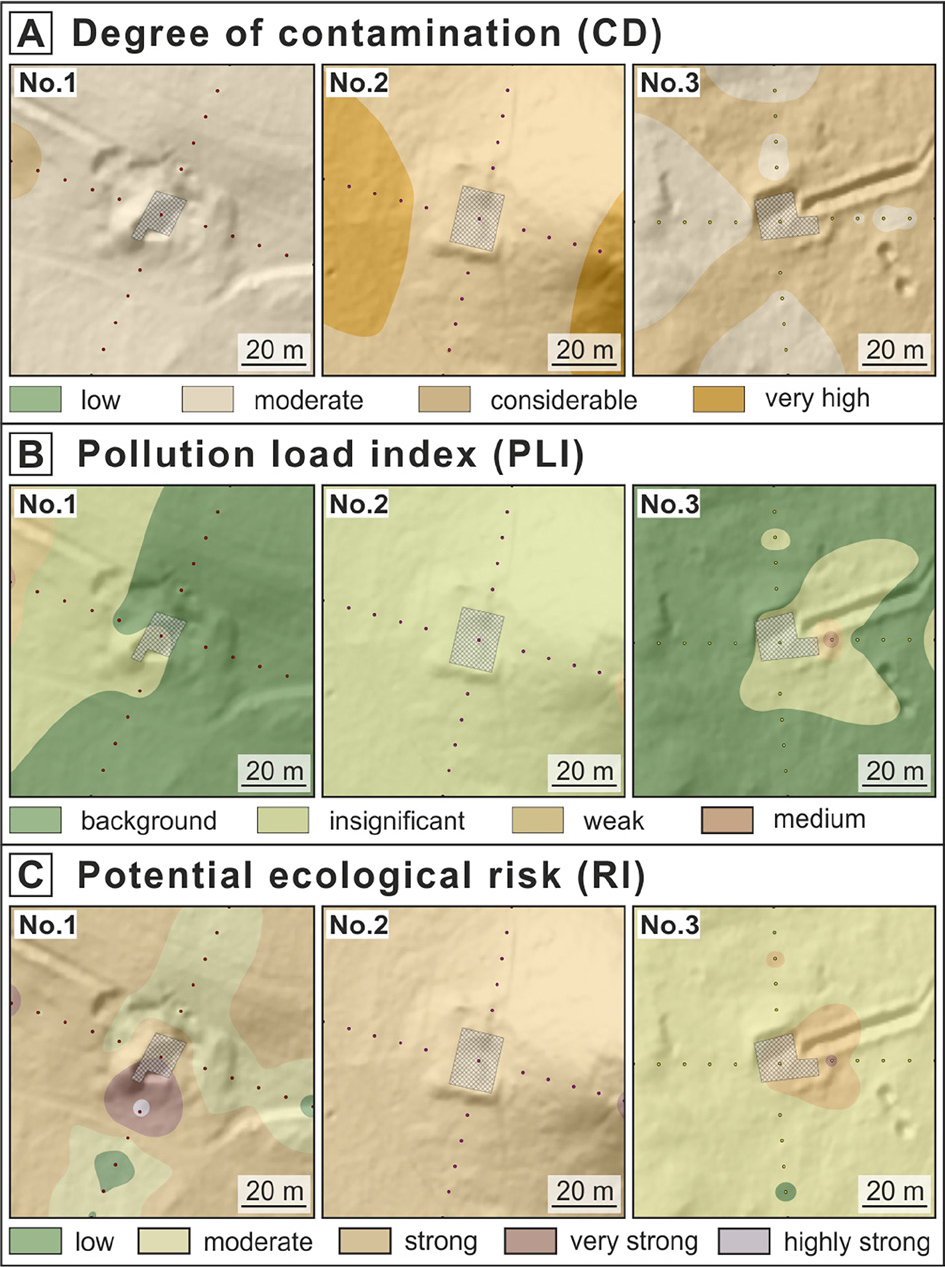
Fig. 3.
Pollution index PI values calculated from the content of selected trace metals TMs in the 0–20 cm horizon; A – Degree of contamination (CD); B – Pollution load index (PLI); C – Potential ecological risk (RI) (background map source: WMS and WMTS viewing services, Central Office of Geodesy and Cartography, Poland).
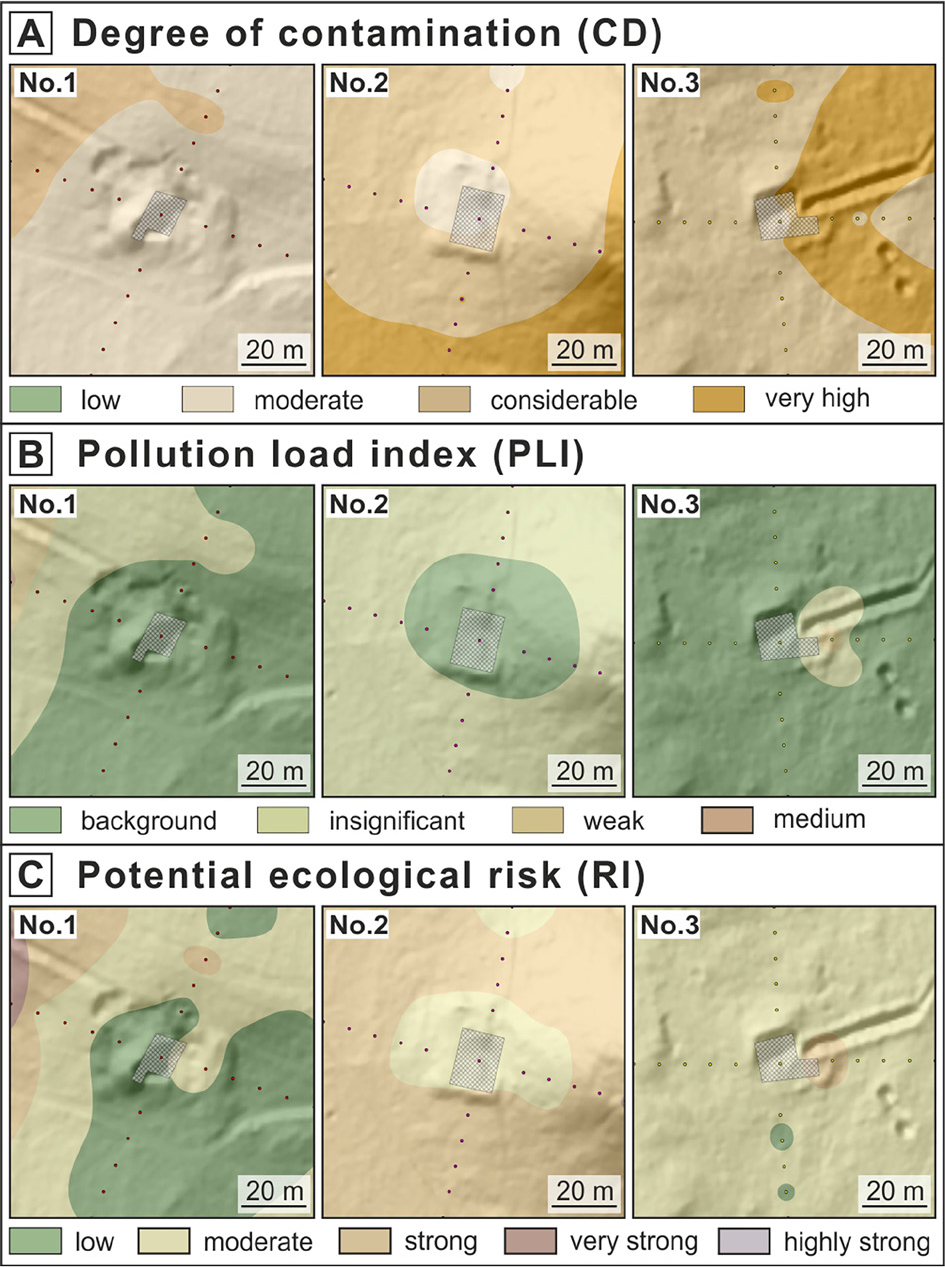
Fig. 4.
Pollution index PI values calculated from the content of selected trace metals TMs in the 20-40 cm horizon; A – Degree of contamination (CD); B – Pollution load index (PLI); C – Potential ecological risk (RI) (background map source: WMS and WMTS viewing services, Central Office of Geodesy and Cartography, Poland).
At the bunker No. 2, the average contamination values are very high for the surface horizon (Fig. 3A) and significant for the 20–40 cm horizon (Fig. 4A). The significant content of Cr, Bi and to a lesser extent Ni is mainly responsible for the contamination in the surface horizon. The variation of contamination around the bunker is relatively evenly distributed, and the coefficient of variation is 75% and 48% for the surface horizon and the layer from a depth of 20–40 cm, respectively.
At the bunker No. 3, the average contamination at the surface is significant (Fig. 3A), while deeper down, it is at a moderate level (Fig. 4A). At the same time, for this site, the variation in contamination at the surface is greater, at 86% and 75% for the 20–40 cm horizon.
Geoaccumulation Index (Igeo)
The highest Igeo values were recorded for lead (Pb) and zinc (Zn), indicating their significant contamination in the vicinity of the bunkers. Other metals, such as manganese (Mn), copper (Cu) and cadmium (Cd), showed mostly low Igeo index values. The analysis of the Igeo index showed higher TM contamination especially in the surface layer of the soil. The most contaminated location appeared to be the area around bunker No. 2 (Table 2), where the highest values of Pb, Zn and Cr were detected. Around bunker No. 1., most of the metals (Mn, Cu, Cd) showed no or moderate contamination (Table 3). The lowest level of contamination with total TMs was found in the soils around bunker No. 3. Only enrichment in Cr and Ni was observed (Table 4). Analysis of the distribution of Igeo values indicates that the 0–20 cm layer is usually more contaminated than the 20–40 cm layer, confirming the surface origin of the contamination (e.g., human activity and military activity).
Table 2.
Igeo of bunker No. 2.
| Depth Sample number* | Zn | Mn | Cu | Ni | Cd | Cr | Pb | |||||||
|---|---|---|---|---|---|---|---|---|---|---|---|---|---|---|
| 0–20 | 20–40 | 0–20 | 20–40 | 0–20 | 20–40 | 0–20 | 20–40 | 0–20 | 20–40 | 0–20 | 20–40 | 0–20 | 20–40 | |
| [cm] | ||||||||||||||
| 2\0\0 | 1.09 | –1.79 | 1.64 | –1.89 | 0.38 | –3.70 | 1.96 | 1.43 | 0.43 | –2.91 | 2.80 | 2.50 | 1.41 | –2.17 |
| 2\N\10 | –0.74 | –2.20 | –2.95 | –4.06 | –2.15 | –4.64 | 1.48 | 1.07 | –2.12 | –3.68 | 2.83 | 2.05 | –0.35 | –2.55 |
| 2\N\20 | –1.32 | –1.88 | –3.82 | –2.03 | –2.02 | –4.64 | 1.20 | 1.22 | –2.47 | –2.44 | 2.27 | 2.56 | –1.46 | –1.19 |
| 2\N\30 | –0.67 | –0.23 | –1.91 | 1.39 | –1.61 | –1.56 | 0.78 | 1.03 | –2.51 | –1.56 | 1.63 | 1.83 | –0.75 | –0.45 |
| 2\N\40 | –0.69 | –0.82 | –2.15 | –0.34 | –2.19 | –2.76 | 0.94 | 0.93 | –2.64 | –2.44 | 1.66 | 1.74 | –0.09 | –2.06 |
| 2\N\50 | –0.45 | –0.92 | –1.98 | –1.10 | –1.69 | –2.41 | 0.98 | 0.79 | –1.99 | –3.18 | 1.75 | 1.66 | 0.05 | –2.38 |
| 2\W\10 | –0.29 | –1.84 | –2.43 | –2.10 | –1.03 | –3.22 | 0.85 | 0.84 | –0.81 | –2.03 | 2.20 | 1.67 | –0.34 | –3.14 |
| 2\W\20 | –0.03 | –1.66 | 1.23 | –0.14 | –2.74 | –2.47 | 1.36 | 1.12 | –1.54 | –2.90 | 2.44 | 2.32 | 0.47 | –2.48 |
| 2\W\30 | –0.78 | –1.60 | –3.09 | –0.71 | –0.98 | –2.33 | 1.40 | 1.15 | –2.90 | –3.91 | 2.50 | 2.63 | –0.04 | –1.07 |
| 2\W\40 | 0.44 | –1.66 | –2.57 | 0.79 | –0.08 | –2.55 | 1.36 | 1.44 | –3.22 | –2.35 | 2.62 | 2.76 | –0.25 | –2.34 |
| 2\W\50 | –1.03 | –1.17 | 0.60 | –1.39 | –2.79 | –1.95 | 1.66 | 1.52 | –1.92 | –3.91 | 2.72 | 2.58 | –1.67 | –0.29 |
| 2\S\10 | 0.07 | –1.46 | –3.73 | –1.82 | –2.17 | –3.27 | 1.40 | 1.50 | –2.21 | –3.17 | 2.84 | 2.80 | –0.93 | –2.29 |
| 2\S\20 | 0.20 | –0.12 | –2.30 | –0.63 | –0.53 | –1.00 | 1.49 | 1.50 | –2.08 | –2.92 | 2.59 | 2.60 | –0.16 | –1.37 |
| 2\S\30 | –1.06 | –1.19 | –1.04 | –0.51 | –2.00 | –3.13 | 1.46 | 1.48 | –3.73 | –2.44 | 2.45 | 2.84 | 0.09 | –3.40 |
| 2\S\40 | –0.83 | –1.43 | –0.02 | –0.44 | –1.81 | –3.26 | 1.52 | 1.48 | –1.95 | –2.92 | 2.56 | 2.55 | –0.51 | –2.02 |
| 2\S\50 | –0.82 | –0.46 | –0.36 | –0.06 | –1.72 | –1.74 | 1.61 | 1.62 | –2.45 | –1.44 | 2.61 | 2.60 | –0.13 | –2.07 |
| 2\E\10 | –0.66 | –3.24 | –3.60 | –4.19 | –2.33 | –3.93 | 1.46 | 1.33 | –2.33 | –3.91 | 2.45 | 2.47 | –0.14 | –3.35 |
| 2\E\20 | –1.26 | –2.89 | –2.92 | –4.46 | –2.21 | –4.64 | 1.42 | 1.24 | –3.13 | –3.64 | 2.35 | 2.30 | –0.44 | –1.77 |
| 2\E\30 | –1.35 | –1.82 | –3.39 | –3.88 | –1.43 | –4.64 | 1.43 | 1.27 | –1.39 | –2.80 | 2.75 | 2.59 | 0.66 | –2.09 |
| 2\E\40 | –0.47 | –3.06 | –3.14 | –3.63 | –1.28 | –2.01 | 1.49 | 1.32 | –1.45 | –2.40 | 2.47 | 2.48 | 0.60 | –2.31 |
| 2\E\50 | –0.47 | –0.92 | –0.35 | –1.03 | –0.31 | –0.06 | 1.85 | 1.93 | –0.05 | –0.48 | 2.88 | 2.77 | 0.47 | –1.12 |
| Unpolluted | Unpolluted to moderately polluted | Moderately polluted | Moderately to strongly polluted | |||||||||||
Table 3.
Igeo of bunker No. 1.
| Depth Sample number* | Zn | Mn | Cu | Ni | Cd | Cr | Pb | |||||||
|---|---|---|---|---|---|---|---|---|---|---|---|---|---|---|
| 0–20 | 20–40 | 0–20 | 20–40 | 0–20 | 20–40 | 0–20 | 20–40 | 0–20 | 20–40 | 0–20 | 20–40 | 0–20 | 20–40 | |
| [cm] | ||||||||||||||
| 1\0\0 | 1.58 | –0.55 | –0.02 | –2.16 | 0.02 | –3.69 | –2.90 | –2.91 | –0.07 | –2.20 | –4.32 | –4.32 | 0.62 | –1.33 |
| 1\N\10 | –0.78 | –1.42 | –2.61 | 0.09 | –1.26 | –1.40 | –2.91 | –2.91 | –1.79 | –1.17 | –4.32 | –4.28 | –0.44 | –1.67 |
| 1\N\20 | –0.88 | –1.08 | –.32 | 0.82 | –1.07 | –0.76 | –2.91 | –2.36 | –1.78 | –1.71 | –4.32 | –4.32 | –0.39 | –0.82 |
| 1\N\30 | –1.28 | –0.15 | –0.73 | 0.90 | –1.50 | 0.23 | –2.91 | 1.46 | –1.87 | 0.23 | –4.32 | 0.57 | –0.88 | –1.09 |
| 1\N\40 | –1.21 | –1.51 | –1.76 | 0.23 | –1.52 | –1.83 | –2.91 | –2.91 | –1.99 | –1.18 | –4.32 | –4.32 | –0.48 | –2.57 |
| 1\N\50 | –1.53 | –1.96 | –1.49 | 0.19 | –1.93 | –3.51 | –0.43 | –0.35 | –2.06 | –1.93 | 0.12 | 0.09 | –0.35 | –2.91 |
| 1\W\10 | –0.66 | –3.16 | –3.22 | –2.43 | –1.77 | –2.39 | –0.53 | –0.40 | –1.69 | –2.45 | 0.35 | 0.21 | –0.33 | –3.47 |
| 1\W\20 | 0.00 | –2.04 | –1.41 | –2.40 | –0.58 | –1.89 | 0.33 | 0.16 | –0.78 | –1.56 | 0.72 | 0.51 | –0.49 | –2.56 |
| 1\W\30 | 0.10 | –1.71 | –0.64 | –0.25 | 0.13 | –1.15 | 0.70 | 0.14 | –0.44 | –1.18 | 1.24 | 0.74 | –0.04 | –1.61 |
| 1\W\40 | –0.94 | –1.25 | –1.94 | 0.56 | –0.96 | –1.27 | 0.01 | 0.11 | –1.34 | –1.07 | 0.58 | 0.50 | –0.39 | –1.24 |
| 1\W\50 | 0.74 | 0.17 | 0.98 | 0.71 | 1.09 | 1.50 | 1.84 | 2.68 | 0.45 | 0.85 | 2.35 | 2.68 | 0.21 | –0.60 |
| 1\S\10 | 0.18 | –1.67 | –0.40 | 0.51 | 0.01 | –2.29 | –2.91 | –2.91 | –1.18 | –2.70 | –4.20 | –4.32 | 3.41 | –1.52 |
| 1\S\20 | –0.70 | –1.01 | –0.42 | 0.47 | –1.21 | –1.80 | –2.91 | –2.91 | –2.21 | –2.40 | –4.32 | –4.32 | 0.26 | –1.35 |
| 1\S\30 | –1.78 | –1.49 | –2.28 | –0.13 | –2.39 | –2.50 | –2.91 | –2.91 | –3.08 | –2.72 | –4.32 | –4.32 | –1.10 | –2.01 |
| 1\S\40 | –1.15 | –1.94 | –2.39 | –0.72 | –2.10 | –2.31 | –2.91 | –2.91 | –2.95 | –3.30 | –4.32 | –4.32 | –0.80 | –2.14 |
| 1\S\50 | –1.38 | –0.34 | –0.94 | –0.76 | –2.54 | –1.32 | –2.91 | –2.91 | –2.84 | –2.93 | –4.32 | –4.32 | –0.68 | –2.76 |
| 1\E\10 | –0.21 | 0.00 | –2.40 | 0.35 | –0.87 | –0.56 | –2.91 | –2.91 | –2.25 | –1.63 | –4.32 | –4.32 | –0.93 | –1.03 |
| 1\E\20 | –0.50 | –1.64 | –1.23 | –2.46 | –0.81 | –2.48 | –2.91 | –2.91 | –2.21 | –2.80 | –4.32 | –4.32 | –0.43 | –4.75 |
| 1\E\30 | 0.30 | –1.68 | 0.08 | –0.30 | –0.08 | –2.44 | –1.83 | –2.91 | –1.44 | –1.92 | –4.32 | –4.32 | –0.80 | –1.55 |
| 1\E\40 | –0.40 | –1.61 | –3.27 | 0.24 | –0.93 | –2.33 | –2.91 | –2.91 | –2.79 | –3.46 | –4.32 | –4.32 | –0.66 | –3.01 |
| 1\E\50 | –1.85 | –1.96 | –3.51 | –3.57 | –3.08 | –2.23 | –2.91 | –2.91 | –2.93 | –3.91 | –4.32 | –4.32 | –1.31 | –2.23 |
| Unpolluted | Unpolluted to moderately polluted | Moderately polluted | Moderately to strongly polluted | Highly polluted | ||||||||||
Table 4.
Igeo of bunker No. 3.
| Depth Sample number* | Zn | Mn | Cu | Ni | cd | Cr | Pb | |||||||
|---|---|---|---|---|---|---|---|---|---|---|---|---|---|---|
| 0-20 | 20–40 | 0–20 | 20–40 | 0–20 | 20–40 | 0–20 | 20–40 | 0–20 | 20–40 | 0–20 | 20–40 | 0–20 | 20–40 | |
| [cm] | ||||||||||||||
| 3\0\0 | –0.24 | –2.65 | –1.24 | –0.78 | –2.15 | –4.64 | 1.08 | 0.84 | –1.38 | –2.53 | 1.82 | 1.54 | –0.29 | –1.96 |
| 3\N\10 | –1.14 | –2.01 | –2.93 | –0.94 | –1.82 | –4.64 | 0.99 | 0.96 | –2.35 | –2.80 | 1.57 | 1.58 | –1.86 | –3.00 |
| 3\N\20 | –0.94 | –1.50 | –3.77 | –0.31 | –0.69 | –1.63 | 0.78 | 0.71 | –2.19 | –3.14 | 1.34 | 1.31 | –0.34 | –2.75 |
| 3\N\30 | –3.15 | –3.33 | –4.49 | –1.63 | –4.64 | –4.64 | 0.39 | 0.42 | –3.00 | –2.96 | 1.03 | 1.06 | –2.07 | –2.31 |
| 3\N\40 | –2.25 | –3.28 | –4.13 | –2.51 | –4.64 | –4.64 | 0.41 | 0.62 | –2.84 | –3.82 | 1.08 | 1.22 | –1.73 | –2.65 |
| 3\N\50 | –3.13 | –2.49 | –3.62 | –4.40 | –3.17 | –4.39 | 0.61 | 0.68 | –3.10 | –2.90 | 1.31 | 1.22 | –1.86 | –2.42 |
| 3\W\10 | –2.40 | –2.83 | –4.09 | –2.17 | –2.99 | –4.64 | 0.76 | 0.70 | –2.37 | –1.17 | 1.21 | 1.25 | –1.44 | –2.31 |
| 3\W\20 | –1.44 | –2.94 | –4.13 | –3.88 | –3.03 | –2.75 | 0.46 | 0.40 | –1.11 | –0.75 | 1.30 | 1.47 | –1.58 | –2.79 |
| 3\W\30 | –1.24 | –2.53 | –4.36 | –3.93 | –2.44 | –4.64 | 0.46 | 0.28 | –2.28 | –1.94 | 1.16 | 1.08 | –0.64 | –3.14 |
| 3\W\40 | –2.00 | –2.00 | –4.82 | –4.31 | –4.64 | –4.64 | 0.27 | 0.35 | –1.76 | –0.69 | 1.06 | 1.37 | –1.94 | –2.25 |
| 3\W\50 | –0.98 | –2.40 | –4.47 | –4.14 | –4.64 | –4.64 | 0.26 | 0.54 | –1.55 | –1.12 | 1.33 | 1.55 | –1.98 | –2.21 |
| 3\S\10 | –0.81 | –2.19 | –0.39 | –1.25 | –1.44 | –4.64 | 0.68 | 0.43 | –0.72 | –2.17 | 1.06 | 1.02 | –0.73 | –2.67 |
| 3\S\20 | –1.45 | –3.82 | –4.23 | –2.13 | –2.12 | –4.64 | 0.47 | 0.28 | –2.83 | –3.19 | 1.11 | 1.02 | –2.20 | –3.45 |
| 3\S\30 | –3.16 | –1.80 | –3.96 | –1.07 | –4.64 | –4.64 | 0.31 | 0.33 | –3.91 | –1.17 | 1.05 | 1.37 | –1.88 | –3.05 |
| 3\S\40 | –3.51 | –4.28 | –2.16 | –4.82 | –3.81 | –4.64 | 0.42 | 0.41 | –2.93 | –3.91 | 1.08 | 1.24 | –4.52 | –4.25 |
| 3\S\50 | –2.40 | –2.27 | –4.22 | –2.64 | –4.64 | –4.64 | 0.45 | 0.37 | –2.92 | –2.49 | 0.98 | 0.90 | –1.42 | –1.15 |
| 3\E\10 | 0.42 | –0.14 | –0.64 | –0.35 | 0.27 | –0.45 | 1.66 | 1.39 | 0.82 | 0.39 | 2.52 | 1.98 | –0.43 | –0.71 |
| 3\E\20 | –1.51 | –1.56 | –3.28 | –0.88 | –4.64 | –4.64 | 0.76 | 0.71 | –2.60 | –3.91 | 1.42 | 1.41 | –0.64 | –2.20 |
| 3\E\30 | –2.00 | –2.00 | –3.57 | 0.12 | –4.64 | –3.19 | 0.65 | 0.68 | –3.91 | –2.59 | 1.26 | 1.35 | –1.51 | –2.95 |
| 3\E\40 | –1.52 | –1.54 | –2.11 | –4.61 | –2.68 | –2.78 | 0.67 | 0.67 | –3.91 | –3.78 | 1.29 | 1.34 | –1.94 | –2.41 |
| 3\E\50 | –1.02 | –1.84 | –2.07 | –0.12 | –1.88 | –2.31 | 0.90 | 0.86 | –2.97 | –2.85 | 1.54 | 1.47 | –1.30 | –1.88 |
| Unpolluted | Unpolluted to moderately polluted | Moderately polluted | Moderately to strongly polluted | |||||||||||
Pollution index (PI
In the surface horizon (–20 cm), average PI values corresponding to moderate pollution are found for Ni and Pb. For Cr, the average PI values correspond to strong pollution, and for Bi, the average values correspond to very strong pollution. In the 20–40 cm horizon, Pb pollution is absent, and the other pollutants are the same as in the surface horizon.
Analysis of the PI shows that for the three metals studied: Mn, Pb and Bi, the variation is significant and exceeds 100%. For Cd and Cu, it reaches 100% variation, while the variation of the PLI for Zn, Ni and Cr is much smaller. PI values indicate enrichment of the soil with these TMs. For both Ni and Cr, there is moderate or significant pollution for almost 80% of the samples.
Cd and Cu contamination is small and randomly located. There is no relationship between the content of these metals in the surface horizon and the 20–40 cm horizon.
Pollution load index (PLI)
Despite the medium to high levels of soil contamination by individual TMs, the PLI taking into account the combined effect of all elements indicates low and weak contamination of the studied samples (Figs 3B and 4B). Analysis of the distribution of contamination indicates that only three surface samples and three samples taken from a depth of 20–40 cm show medium contamination, two 0–20 cm and one 20–40 cm show strong contamination and one surface sample shows very strong contamination.
Potential ecological risk (RI)
Since potential ecological risk takes into account the toxicity of the elements and their contents, the picture emerging from RI is different from that obtained from CD. In bunker No. 1, the average risk values are strong for the surface horizon (Fig. 3C) and moderate for the 20-40 cm horizon (Fig. 4C). The coefficient of variation of RI is high at the site for both horizons (95% and 102%). In addition, the high RI values are due to higher zinc, lead, nickel and bismuth contamination localised in individual samples from the area. The potential ecological risk (RI) values determined for the soils around bunker No. 1 were the lowest compared to the potential ecological risks (RI) for the soils around bunkers No. 2 and No. 3. At bunker No. 2, RI is high for both horizons (Figs 3C and 4C). At the same time, the variation in RI is low. The site is homogeneous in terms of ecological risk and it is heavily polluted.
Bunker No. 3 is characterised by moderate RI values. Metal toxicity modifies the geochemical data and makes the variation in RI low at this site, at 45% for the surface horizon and 35% for the deeper horizon (Figs 3C and 4C).
Top-bottom index (TB index)
The TB index illustrates the natural migration or artificial disturbance of the content of metals (and other substances) in soils. The classic example of anthropogenic soils shows that TM content decreases with depth. In the cases analysed, there is no variation between bunkers. The contents of Zn, Cu and Pb are higher in the surface horizon in most of the samples studied regardless of the site, and the contents of Bi, Mn, Ni and Cr are higher in the 20–40 cm horizon. Cadmium contents are randomly distributed.
Statistical analysis results
We performed a correlation analysis (coefficient of significance α < 0.01) between parameters describing the collected samples: pH, TOC, HA, BEC, ECEC, fractions (sand, silt and clay) and metals (Cu, Ni, Cd, Zn, Cr, Pb and Mn). The analyses show that there are no significant correlations between the basic soil properties and the metal content (r < 0.4 and α > 0.01). There is a moderate correlation (0.4 [α = 0.001] –0.7 [α < 0.001]) between pH and the content of Cd, Zn and Mn, as well as between parameters describing the sorption complex (BEC and ECEC) and Cu, Cd and Zn. There are also strong correlations (0.7 [α < 0.001] –0.9 [α < 0.001]) between the contents of TMs: Cu and Cd, Cu and Zn, Ni and Cr and moderate correlations (0.4 [α = 0.001] –0.7 [α < 0.001]) between Cd and Zn, Cd and Mn and Zn and Mn. These medium correlations between metal contents are also confirmed by the PCA results. Since metal contents in this area are not correlated with the parameters describing the basic physicochemical properties of the soil, it can be assumed that soil parameters do not significantly influence metal contents. This means that their content results from the natural presence of these metals in the parent rock and human activities (mainly military pressure).
PCA analysis reduced the number of parameters to three principal components, which explain over 85% of the variability, or four principal components, which explain almost 93% of the variability. Grouping using PCA gives the following results (Table 5):
1. The first component is mainly influenced by Cu, Cd, Zn and Mn, whose origin can be considered natural with minor local anthropogenic contamination.
2. The second component is mainly influenced by Ni and Cr, whose contents are significantly increased in most of the analysed samples and can be considered of anthropogenic origin.
3. The third component is influenced by Pb content, which is clearly anthropogenic in more than half of the analysed samples.
Table 5.
PCA results for bunkers. Principal components as groups of similar origin. Numbers in columns are influence of each data on the given principal component.
| Parameter | Group 1 (first principal component) | Group 2 (second principal component) | Group 3 (third principal component) | Group 4 (fourth principal component) |
|---|---|---|---|---|
| Cu | -0.85611 | 0.306189 | 0.096109 | -0.242390 |
| Ni | -0.54351 | -0.822840 | -0.103110 | -0.023880 |
| Cd | -0.85712 | 0.127119 | 0.246373 | -0.129310 |
| Cr | -0.48870 | -0.841140 | -0.179290 | -0.055030 |
| Pb | -0.38842 | 0.415467 | -0.818640 | 0.007732 |
| Zn | -0.82996 | 0.298641 | 0.110614 | -0.154310 |
| Mn | -0.74662 | 0.104419 | 0.102310 | 0.647287 |
| Partial variation [%] | 48.6 | 25.2 | 11.5 | 7.5 |
| Summarised variation [%] | 48.6 | 73.8 | 85.3 | 92.8 |
CA, i.e., grouping based on metal content in all samples analysed, gives similar results (Fig. 5): in Group 1 are Cu and Cd (natural group with minor local contamination); in Group 2 are Cr and Ni (moderately contaminated group in ¾ of the samples); in Group 3 are Zn and Pb (weakly contaminated group in more than half of the samples) and Mn forms a separate group.
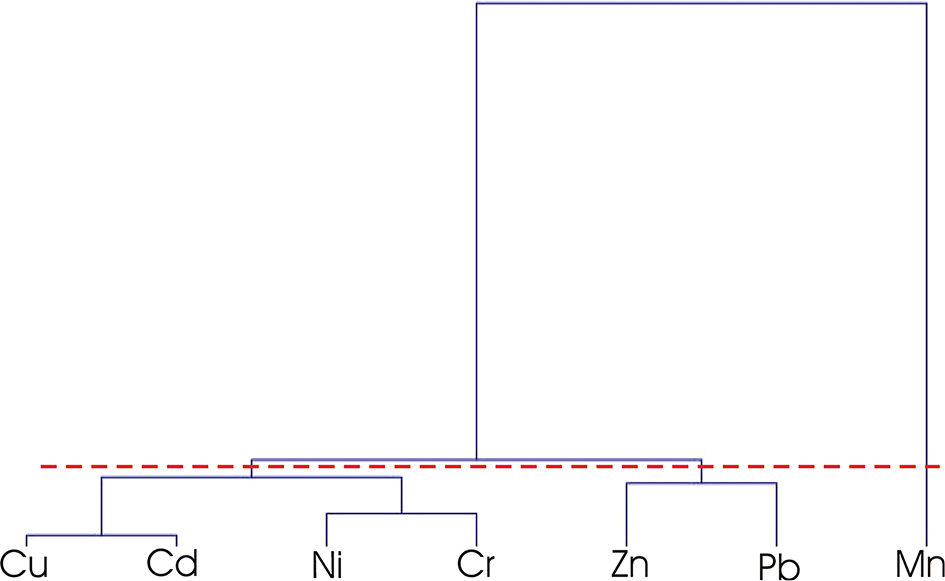
Fig. 5.
Dendrogram created for all bunkers using trace metals (TMs).
Ternary plot and cartographic analysis
To test whether the concentration levels of Cu, Pb and Zn are due to natural content or the result of warfare, a ternary plot was used. This is the method used by Weng et al. (2003), Zgłobicki (2013) and Zgłobicki et al. (2025), amongst others, to determine the ranges of natural proportions of the three metals in samples. This makes it possible to verify whether the samples collected are of natural or anthropogenic origin in terms of the content of the three metals. In the samples studied, Cu:Pb:Zn ratios can be considered natural if they fall within the geochemical background ±3 × standard deviation. The proportions of Cu, Pb and Zn are constant in natural soils and close to the proportions contained in the background (Weng et al. 2003, Zgłobicki 2013, Zgłobicki et al. 2025). Hence, soils in which the proportions of these metals fall within the above-mentioned range can be considered natural (Fig. 6). As can be seen in Fig. 6, the surroundings of bunker 1 can be considered natural. Almost all points around this bunker are in the area of soils with natural Cu:Pb:Zn ratios. The situation is different for bunkers 2 and 3, around which many points are outside the area of ‘natural soils’ in the diagram. This is due to the intensity of the warfare as well as the subsequent reclamation of the area around the surveyed sites.
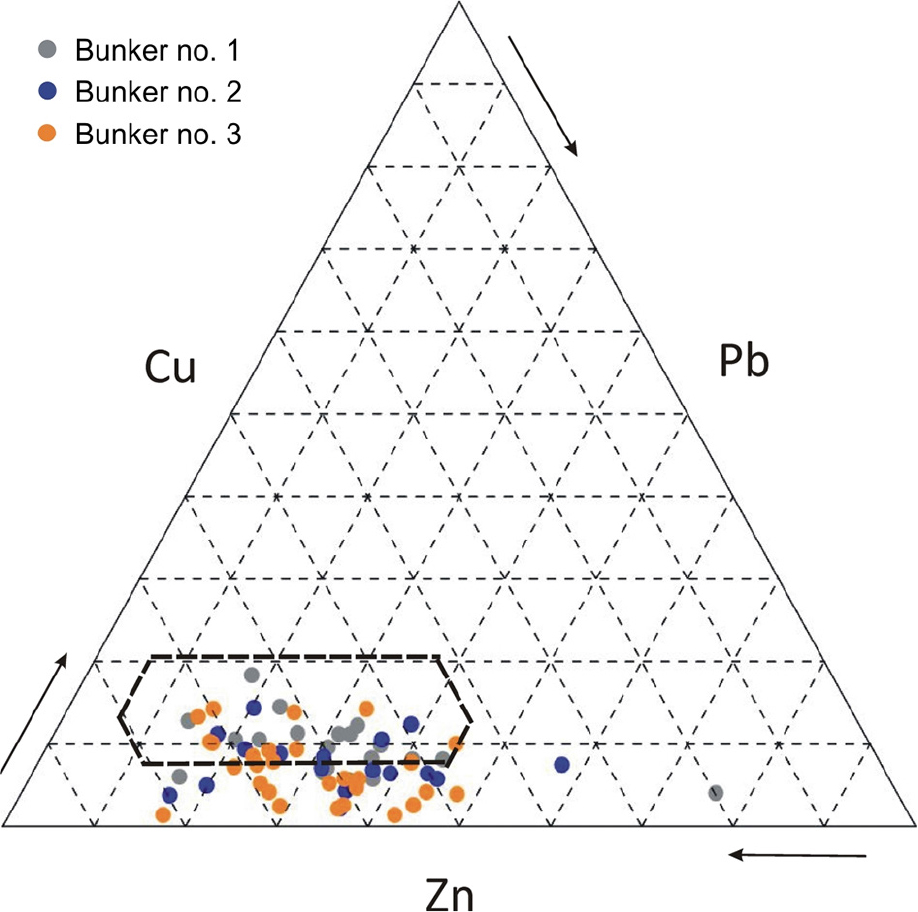
Fig. 6.
Ternary plot Cu, Pb and Zn (bunker No. 1 – grey points; bunker No. 2 – blue points and bunker No. 3 – orange points).
Changes in land use, which may indicate the reclamation of military areas, in the immediate vicinity of the studied bunkers in three time horizons – 1923, 1954 and 2012, are shown in Figure 7.
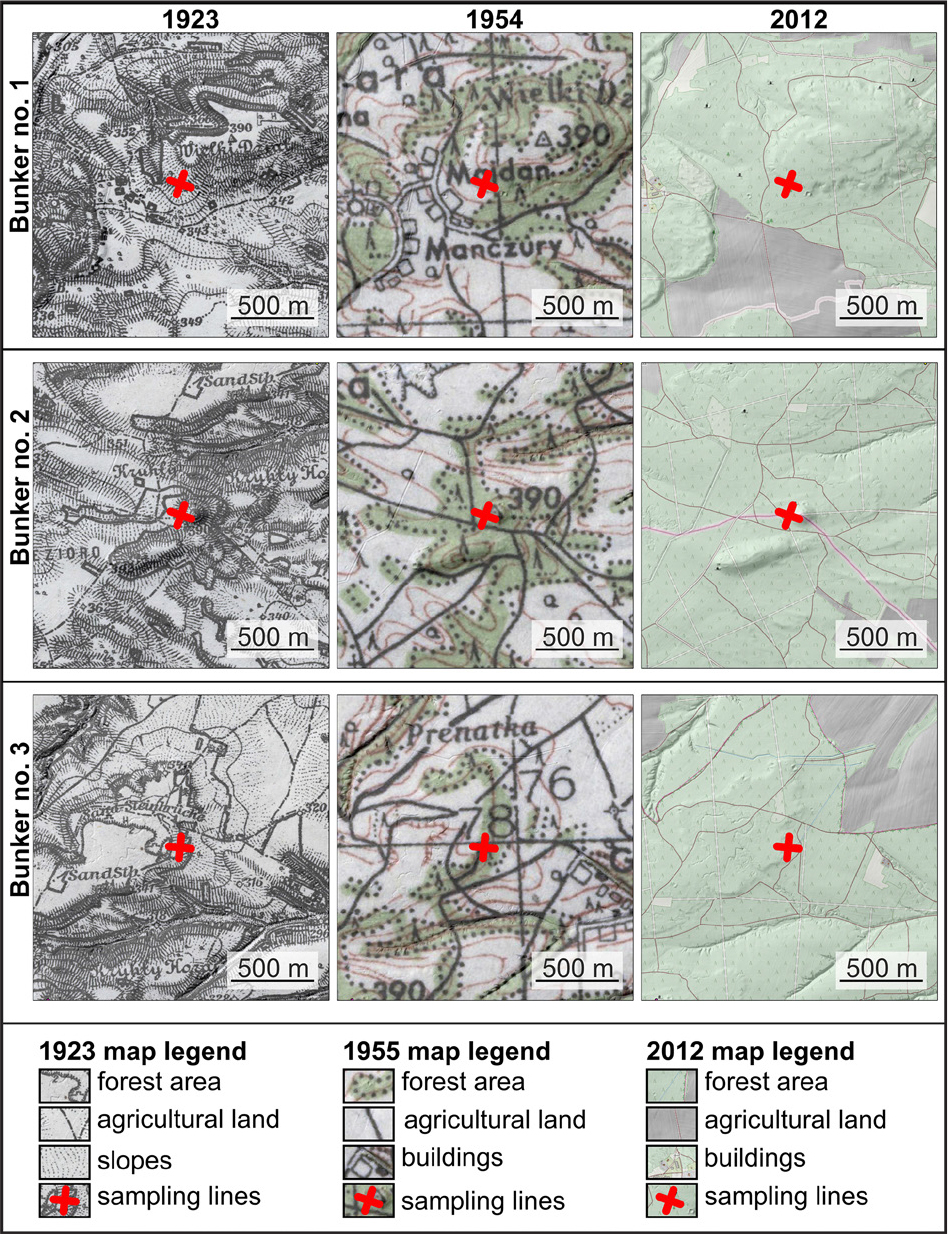
Fig. 7.
Land use changes within the surveyed military sites in 1923, 1954 and 2012 (background map source: WMS and WMTS viewing services, Central Office of Geodesy and Cartography, Poland).
Analysis of historical cartographic data indicates that significant land use transformations were made within bunker No. 1 and bunker No. 3. Prior to World War II, the areas where the bunkers were located functioned as agricultural land, which after World War II were transformed (reclaimed) into a unified large forest complex, in accordance with the principles of forestry forest management operating in postwar Poland (Magnuski, Jaszcza 2008, Celej 2021). Bunker No. 1 and bunker No. 3 remain within the forest complex to this day. The analysis of archival materials shows that the least changes in land use are in the case of bunker No. 3. In all analysed time horizons, the immediate vicinity of the site functioned as a forest area.
Discussion
The determined TM contents in soils in the vicinity of bunkers located in the fortified area of the Molotov Line are higher than those determined by other authors in studies of soils conducted in Roztocze (SE Poland) (Uziak et al. 2004, Skwaryło-Bednarz 2007, Mazurek et al. 2017) and the average TM contents for European soils developed by Kabata-Pendias (2010).The content of TMs, such as Ni Pb, Zn, Cu and Mn, in the surface soil horizon, however, were at the same time higher to the natural content of these elements in the parent material, i.e., the C horizons of the studied soils. The enrichment of surface horizons (0–20 cm) compared to subsurface horizons (20–40 cm) in TMs was confirmed by labelled geochemical indices (I geo, PI) for the investigated soils. Many studies of the soils of areas subjected to military pressure have involved taking soil samples from various depths in contaminated areas and investigating changes in contaminant levels in the profile. Almost all studies have found highly contaminated topsoil profiles (0–10 cm), with levels decreasing rapidly with increasing depth.
More specifically, contamination of TMs is generally confined to the first 20–30 cm depth from the soil surface, although the penetration of contaminants for each metal shows different characteristics. knechtenhofer et al. (2003) reported that topsoil samples from a military shooting range in Switzerland were heavily contaminated with Pb, Sb, Cu and Ni. Their concentrations decreased rapidly with depth, reaching background values for Pb (at a depth of 60–70 cm), Sb and Cu (at a depth of 40 cm) and Ni (in the subsoil). The decrease in concentration has been linked to the soil characteristics of the area, which are characterised by a silicate-rich background and an acidic rock substrate. Another study of vertical profiling of PTE contamination (a small arms shooting range safeguard in Quebec, Canada) showed that contamination was mainly confned to a depth of 30-40 cm from the soil surface (Laporte-Saumure et al. 2011). This study showed a similar trend of the concentration of contamination in the surface layer. This was also confirmed by the top/bottom ratios determined for TMs. Similar studies to those conducted around the bunkers on the Molotov Line included contamination on Latvian military sites and soil degradation on Lithuanian training grounds. The authors detected high concentrations of metals in the upper soil layers, suggesting modern contamination. Their research indicates loss of organic matter and metal contamination, especially on firing ranges and areas used by vehicles. This shows the diversity of contamination sources on the firing ranges. This is important because it shows that military activities have a direct impact on the environment (Greičiūtė et al. 2007, kokorîte et al. 2008).
A study of soils in the vicinity of bunkers located in the Molotov Line fortified area, similarly to numerous studies, showed some elevated concentrations of TMs in soil samples taken from war-affected areas and military training grounds. It should be noted, however, that the degree of enrichment also depended on the intensity of shelling, the time elapsed since hostilities or other activities conducted in these areas after the end of military activity (Meerschman et al. 2011, Denton et al. 2016, Thouin et al. 2016). This study also showed that the distribution of TM contamination tended to depend on the intensity of military activities, soil properties and environmental remediation efforts undertaken after World War II, which show signifcant differences between the locations evaluated. The concentration of TMs around bunker No. 3, which was most damaged during the various military activities, was the highest. A similar link between the intensity of military activities and the concentration of pollutants is indicated by studies of military training grounds around the world (Ryu et al. 2007, Sanderson et al. 2012, Rodriguez-Seijo et al. 2016).
A comparison of TM pollution levels, their distribution and ecological risk in urban areas (Lublin, kraków, Toruń) and military sites showed that the sources of pollution (anthropogenic) are present mainly in the surface layers of the soil (Charzyński et al. 2017, Plak et al. 2024). There are differences in the intensity and type of pollution, as well as in the level of ecological risk. Urban areas are characterised by more diffuse contamination and higher levels of TM concentration, while military areas show only point contamination, but in some cases with levels that are equally significant. These results indicate that both urban and military activities have a significant impact on TM contamination of soils, but the nature and magnitude of this impact differ. Consequently, environmental risk management strategies should be tailored to the specifics of the area, taking into account both the sources of pollution and their potential impact on human health and ecosystems.
An important factor influencing the content and behaviour of TMs in the studied soils around the bunkers is the specific characteristics of the mainly acidic soils, the granulometric composition of sand, low ECEC levels and relatively low TOC contents, all of which increase the intensity of leaching/mobilisation processes, increase the mobility of TMs and thus increase the concentration of elements in the soil solution. As is known, alkaline soils, clay/clay/clay granulometric composition, high ECEC content and high TOC content (separately or in combination) would limit the mobility of TMs and thus reduce their concentration in soil solution and subsequent translocation to plant tissues (Zagury et al. 2016, Tomic et al. 2018). Intense military pressure causes degradation of soil structure. Greičiūtė et al. (2007) found a loss of 66–99% of organic matter in blast epicentres. This results in increased soil permeability, which accelerates the migration of contaminants to groundwater (Greičiūtė et al. 2007,Splodytel et al. 2023). The wide range of soil pH within the studied defence facilities was due to the transformation of soils occurring as a result of anthropopressure – in this case, the alkalisation of soils occurred due to the presence of concrete fragments in them. The cause could have been warfare, the construction of the facilities themselves or the subsequent reclamation and preparation of the land for afforestation. Assessment of TM contamination in the study area solely on the basis of total TM concentrations is not sufficient to draw categorical conclusions, and characterisation of additional parameters and historical documentation can significantly increase the certainty of the contamination assessment of a contaminated site.
Based on the analysis of the PLI, it can be deduced that Ni, Cr and Bi pollution arose prior to the post-war transformation and reclamation of areas of military activities. Pb pollution, on the contrary, may also result from the subsequent use of these areas associated with tourism (bunker tours) and the exploitation of forest complexes associated with the use of motor vehicles. The degree of contamination indicates a great deal of variation between the analysed bunkers. Chemical analyses seemingly do not coincide with historical records of individual sites. Several conclusions can be drawn from the chemical studies and the analysis of land use changes over the 1923–2012 horizon:
1. the greatest contamination of the surface and lower soil horizons is found within bunker No. 2, which was not subject to land use changes as a result of post-war reclamation (no military activities within the bunker). Therefore, the pollution around it can be considered exemplary of the pollution generated during the construction and operation of the facilities of the Molotov Line.
2. The large variation in pollution in the vicinity of bunker No. 3 is the result of artillery shelling and blasting, as a result of which the facility was destroyed. Despite subsequent reclamation (reforestation), the effects of the explosion are still legible in the chemical and morphological record. Reclamation of the military areas of the Molotov Line in the 1950s did not focus on the elimination and phytoextraction of contaminants from the soils, but only on changing the use of the land and restoring forest habitat.
3. The military operations within bunker No.1 were relatively short-lived, which did not produce a clear geochemical record, and their possible record was further obliterated by subsequent reclamation (ploughing and reforestation)
Potential ecological risk indicates that any efforts to rehabilitate areas within which military activities were carried out have a positive environmental effect (reduction of contaminants in the soil). The ecological risk of reclaimed areas is significantly lower than in non-reclaimed areas. Lead (Pb) is the most studied contaminant, showing toxicity to microorganisms, nematodes and jumping tails. There is a lack of research on the synergistic effects of different contaminants (e.g. metals + explosives) which makes it difficult to assess the full risk (Rodríguez-Seijo et al. 2024).
The TB index indicates the disruption of the anthropogenic arrangement of elemental content at the bunker. However, there is no distinction of this parameter between individual sites. The disturbance could have been caused by the construction of the bunker, war activities, and subsequent reclamation. The conducted statistical analyses, including PCA and CA, provide fairly consistent results, which can be summarised (considering both variability and metal content) as follows: The contents of Ni and Cr in the area surrounding the bunkers result from human activity, i.e., military pressure. The concentrations of Cu, Cd, Zn and Pb in the soils are less influenced by military activity and also have natural origins, while Mn has a natural origin.
Conclusions
The research results obtained contribute to the understanding of the complexity and functioning of soils under military pressure. They can contribute to solutions related to the prevention of degradation of soils located in a zone of intense warfare, which, in addition to restoring the soil to its proper function in the ecosystem, will reduce the risk of toxic effects on humans and other living organisms existing in the area of different uses. The properties of such soils subjected to military pressure are often completely different from those of natural soils. A unique element of the research carried out is a comparative analysis of soils adjacent to military sites with a documented degree of damage by actions during World War II, based on TM concentrations and applied geochemical and environmental risk indicators (Igeo, PI, PLI, CD, RI and TB). The results obtained will broaden the existing state of knowledge in this held and can also be used to update the classification parameters of soils subjected to military pressure, especially in terms of chemical contaminants. The results presented in this study and the regularities described can form the basis for actions concerning the directions of revitalisation activities for areas with sensitive use, e.g., military training grounds. It also makes it possible, for the site in question, to select the best suited remediation techniques. The results presented here allow us to conclude that despite the remediation activities undertaken (ploughing and afforestation), there is a clear geochemical record of military activities on the Molotov Line in SE Poland. Further research on soils subjected to military pressure should focus on the influence of soil properties (e.g., TOC, sorption, and mineralogy of inorganic soil components) on the bioavailability and mobility of TMs. The chemical speciation of contaminants and the bioavailability of TMs should be taken into account in future human health risk assessment processes to obtain more accurate results for areas under military pressure.
Acknowledgments
The research was financed by the statutory research fund of the Institute of Earth and Environmental Sciences at Maria Curie-Skłodowska University in Lublin, Poland. The authors would like to thank the anonymous reviewers for their insightful comments, which contributed to improving the quality of the article.
Notes
[4] Conflicts of interest Conflict of interests
The authors declare that they have no known competing financial interests or personal relationships that could have appeared to influence the work reported in this paper.
[5] Contributed by Author’s contribution
AP: conceptualization, methodology, validation, investigation, writing - original draft, writing - review & editing, supervision. GG: conceptualization, methodology, validation, investigation, writing - original draft, visualization, project administration. MT: software, formal analysis, validation, investigation. MB: resources, data curation. PH: resources, data curation. TS: resources, software, visualization.