
Introduction
The 20 years that have passed since Poland joined the European Union (EU) are a perfect occasion to look into foreign trade (FT) changes from the NUTS-2 level perspective. Since 2004, Poland’s economy has functioned under the conditions of EU membership, which has resulted in several consequences. However, the adaptation to membership and de facto integration began earlier. In 1991, the European Agreement establishing an association between Poland and the European Communities was signed. The association was a period of changes, preparing business units to operate in the conditions of an open and competitive market. The association intertwined with the social and economic reforms that started in 1989 as part of the so-called Balcerowicz Plan. In the 1990s, two processes paralleled: transformation and integration. In 1996, Poland became a member of the Organisation for Economic Cooperation and Development (OECD), which significantly influenced the scale of foreign direct investment (FDI) inflow, becoming an important element of the transformation process, especially in foreign trade (FT).
The consequences of Poland’s membership in the EU have been analysed both in general (macroeconomic) terms and with regard to more specific issues, including those relating to the openness of the economy (FT and FDI) (Ambroziak et al. 2024, Hagemejer, Matuszczak 2024). Changes that have taken place in FT since Poland joined the EU are much less often considered from a regional perspective. However, it is at the junction of regions and international markets that changes and adjustments can be observed. Regions are small, open economies with idiosyncratic profiles of industrial production, competitiveness, territorial capital (Komornicki, Ciołek 2017), and FT.
This paper aims to: (i) inspect the dynamics of regions’ export performance under EU membership, which also indirectly allows grasping the effects of absorbing inward FDI and EU structural funds; (ii) reveal regional heterogeneity behind increased overall economic openness; (iii) propose a set of variables for the clustering agglomeration procedure that comprehensively covers various aspects of export adjustments; (iv) identify clusters of regions with similar trajectories of export adjustments.
We do not illustrate the FT relations of entities based in individual regions of Poland strictly in relation to the EU, but rather analyse them in membership conditions and absorption of significant inward FDI and EU structural funds. To provide a cross-sectional, synthetic analysis, we refer to openness (exports per capita), share of foreign-owned entities (FOEs), share of food and agricultural products, share of high-tech (HT) products in exports, intensity of intra-industry trade (IIT), and unit values of exports per kilogramme (EUR/KG). They cover the key aspects of export changes and adjustments that are used in the international trade literature.
Clustering usually occurs with static data. The novelty brought by this research stems from the focus on changes. To synthesise regional differences and capture export trajectory groupings, we employ Ward’s hierarchical cluster analysis using Euclidean distances and standardised variables. The clustering is based on changes between 2004 and 2023, emphasising dynamic regional transformation rather than static levels. Robustness checks using alternative clustering methods were performed, and the optimal number of six clusters was determined using the Duda and Hart (1973) Je(2)/Je(1) index. This methodology provides an empirical basis for identifying regionally differentiated patterns of export development, offering new insights for territorial policy design.
Before we proceed to a more detailed analysis strictly relating to exports (and imports) in regional terms, it is necessary to present the most important conditions related to the changes that Poland’s economy has undergone since 2004.
The package of reforms launched in 1989, combined with adjustments to the EU’s acquis communautaire during the association with the EU, despite significant social costs, prepared Poland to absorb the membership-related benefits. As a result of the implemented reforms, and later also as a consequence of membership in the EU, GDP per capita (GDPPC) grew. In 1990, GDPPC in current prices for Poland amounted to 1731 USD, which was 11.2% of the EU average. In the following years, Poland’s GDPPC increased, but the growth accelerated after 2004. In comparison, it is worth providing data for Ukraine, a country that did not go through such a serious transition reform package as Poland had initiated in 1989. In 1990, Ukraine’s GDPPC (1563 USD) was similar to Poland’s. According to the World Bank, in 2023, Poland’s GDPPC was 53.3% of the EU average, while in Ukraine it was 12.2%. The high rate of Poland’s economic growth resulted in a reduction of the development gap vs. the EU (Fig. 1). Considering GDPPC at purchasing power parity, in 2004 it was 51.5% of the EU (EU-27) average, and in 2023 it reached 79.5% (Ambroziak et al. 2024). According to Cieślik and Turgut (2021), the positive impact of the EU enlargement became more apparent in 2007, when the new EU member states were admitted into the Schengen zone.
Since the beginning of the transformation, but especially during membership in the EU, Poland has absorbed significant external financing in the form of FDI and EU funds, which have exerted a positive impact on competitiveness and export potential. Both affected the economy in different ways. The effects of FDI inflow were the subject of numerous analyses, which primarily indicate technology transfer and productivity growth, leading to increases in exports (Javorcik et al. 2018, Bajgar, Javorcik 2020, Umiński, Borowicz 2021, Umiński et al. 2023). The growth of exports is supported by functioning within transnational corporations (networking and access to the distribution network), which helps to reduce the risk and foreign expansion costs. EU funds, the beneficiary of which was Poland, influenced the export potential indirectly (i.e. through the development of infrastructure) and directly (modernisation of the machine park, co-financing investments, and matching business partners). According to Ambroziak et al. (2024), between 2004 and 2023, the value of net financial transfers amounted to 162 bn EUR. EU transfers accounted for about 2.1% of Poland’s GDP. In the same period, the value of FDI inflow was higher (about 3% of GDP on average per year). In nominal terms, this amounted to ca. 260 bn EUR (depending on the method of calculating cumulative FDI values).
The openness of Poland’s economy increased significantly, measured by the share of exports of goods and services in GDP (from 34.1% to 58.1%). This openness, vs. selected other economies, is depicted in Figure 2. It is higher than for Germany (Poland’s main trade partner) and for France, Spain, Italy, or the UK (representing ‘big’ European economies). The levels and trends in exports to GDP ratios for France, Spain, Italy, and the UK are similar. To provide visualisation clarity, they are presented as an average. Not being a small economy itself, Poland’s openness is similar to socalled small, open economies such as Estonia, Lithuania, Latvia1, or Czechia.
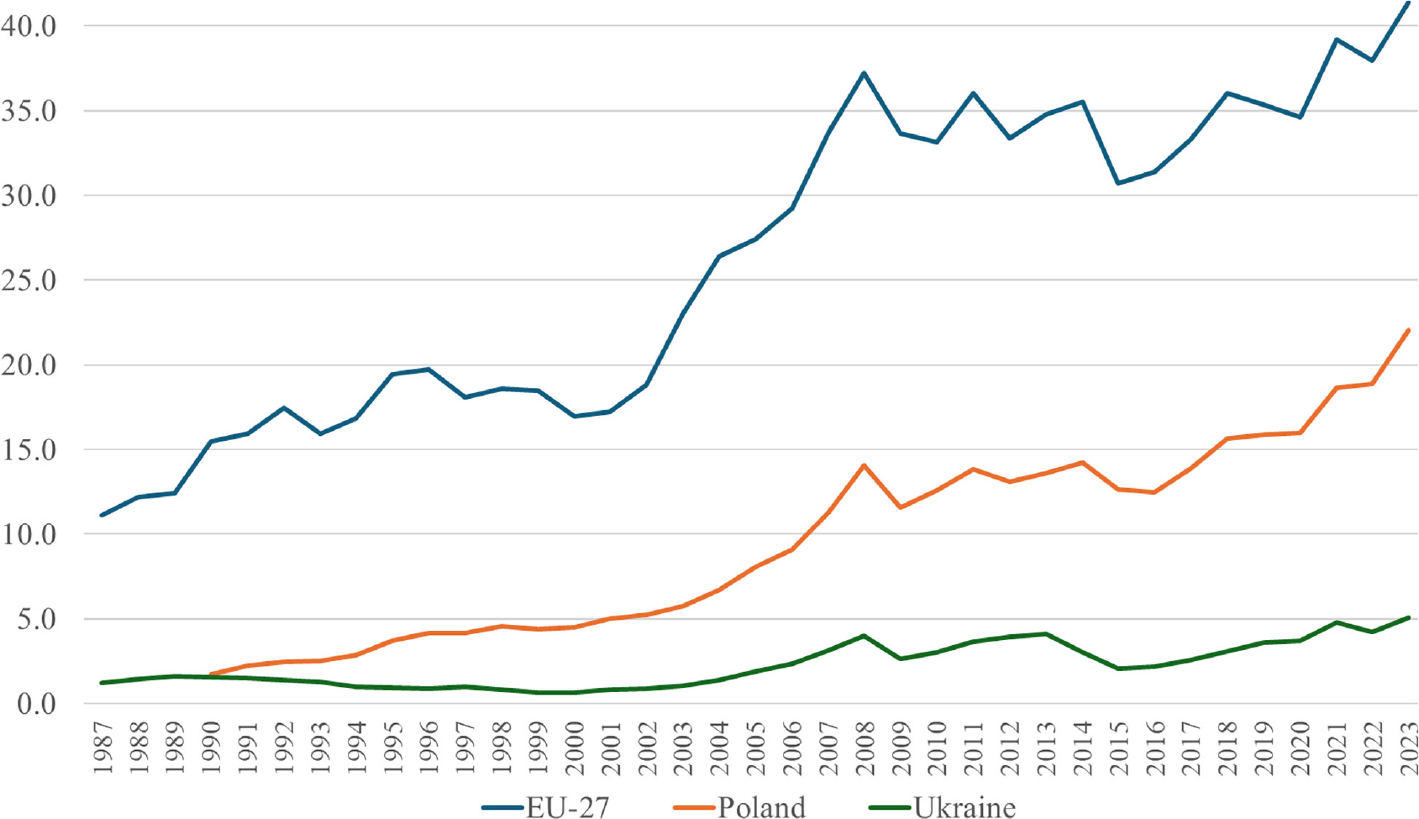
Fig. 1.
GDP per capita, Poland, EU-27, and Ukraine (current USD in thousands) based on World Bank data.
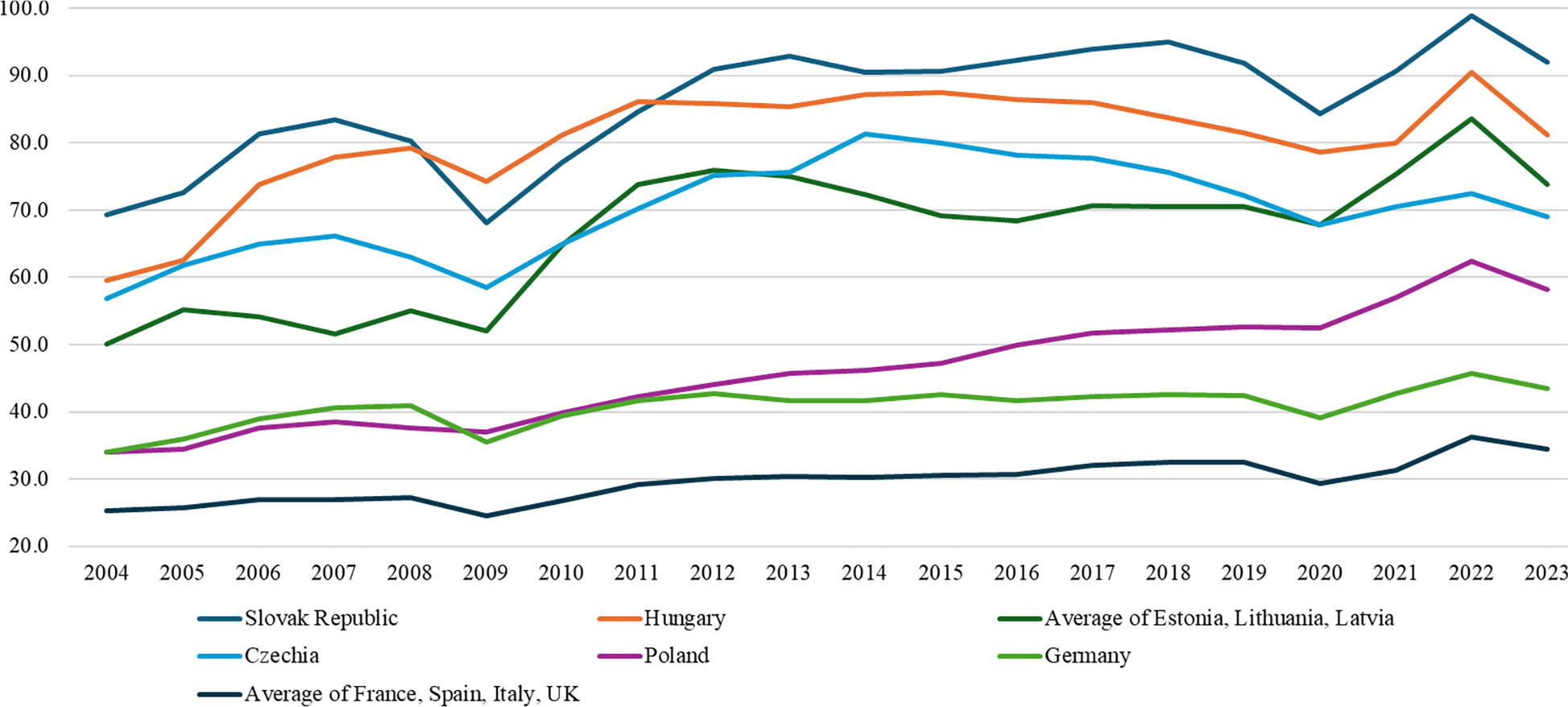
Fig. 2.
Exports of goods and services (% of GDP) 2004–2023 based on World Bank data.
Data for countries with similar export-to-GDP ratios and trends are shown as averages, to ensure visualisation clarity.
The openness of Poland’s economy applies primarily to exports. On the other hand, outward FDI remains low, compared to other post-transition economies. The cumulative value of outward FDI carried on by Polish entities in 2023 accounted for 4.7% of GDP, while the average annual value of investments undertaken in 2004–2023 corresponded to 0.6% of GDP (UnctadStat). Among the selected post-transition economies presented in Figure 3, only in the case of Slovakia, the openness through outward FDI is at a lower level.
4. Technological position is an important determinant of exports (van Hulst et al. 1991, Cieślik et al. 2016). A place on the technological ladder determines the bundle of products, a country can export. The unique technology is part of the exporter’s competitive advantage. Technology shapes productivity, the key determinant of exports. In 2004, the share of expenditures on R&D in Poland’s GDP was at the level of 0.56% (Statistics Poland 2005); by 2023, it grew to 1.56% (Eurostat). However, it remains well below the EU-27 average of 2.22%. In the case of 12 EU countries, this share is higher than for Poland. In the first years of EU membership, Poland was among the group of catching-up or losing-ground countries, with the lowest position in the European Innovation Scoreboard (European Commission 2005, 2006). Until 2024, the situation hardly changed; Poland ranks among emerging innovators (synthetic index value 72.5). Lower positions than Poland in the ranking are occupied by Slovakia, Latvia, Bulgaria and Romania (European Commission 2024).
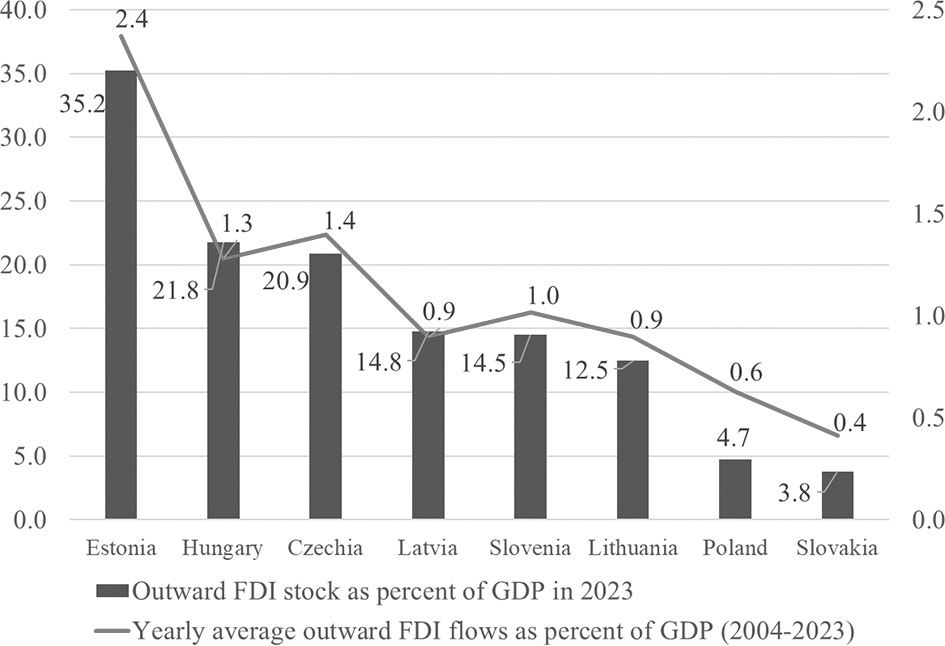
Fig. 3.
Comparison of Poland’s position in outward FDI with selected post-transition economies based on UnctadStat data.
The remainder of the article is structured as follows. The literature review comprises selected concepts useful in FT analysis from the regional perspective. Consequently, a research gap has been identified; cross-sectional long-term regional-oriented inquiry shall supplement country-level assessments of Poland’s membership in the EU. Then, the research purpose, data, and the method are presented, followed by cluster analysis findings and results. The summary section concludes the article.
Literature overview
FT analysis is predominantly assessed at the country level. However, the research on territorial units is growing. Several theories and concepts bridge regional science and international economics. North (1955) formulated a concept of a regional, idiosyncratic export base around which regions grow. In the lumpy countries theory, Courant and Deardorff (1992) treat diversified regions as small, open economies. Their specific export specialisation patterns stem from differences in factor abundance. According to Capello (2016: 1), space is a source of economic advantages (or disadvantages) that translate into international expansion (Batabyal, Nijkamp 2015, Coşar, Fajgelbaum 2016). New Economic Geography (NEG) combines location and trade aspects with economies of scale, focusing on benefits from the proximity of firms and the interplay between trade and agglomeration effects (Fujita, Krugman 2003). International trade theory recently evolved into the heterogeneity of firms (Melitz, Redding 2014), and underlines the role of productivity and innovative capacity (Altomonte et al. 2013, Cieślik et al. 2016). Referring to the heterogeneity idea, we can make the nexus between international and regional dimensions. Baldwin and Okubo (2006) integrated a Melitz-style model of monopolistic competition with heterogeneous firms with NEG and indicated selection and sorting effects within the core–periphery framework.
Regional heterogeneity of exporting activity is subject to more advanced research. Treating regions as small open economies opens the possibility of using several theories, so far predominantly perceived as related to countries (Umiński, Nazarczuk 2020). An example is an analysis of IIT for regions of Japan (Yoshida 2008) or Poland and Spain (Brodzicki et al. 2019). Regional heterogeneity stems, for example, from metropolitan status, path dependency (the role of historical factors) (Brodzicki, Umiński 2017), core–periphery location (Gajewski, Tchorek 2017), technological competitiveness or investment incentives (Nazarczuk, Umiński 2018a, b, 2019). An important element of the economic transition and export boosting was FDI (Brodzicki et al. 2019, Cieślik 2019, Nazarczuk et al. 2020a, b). Special economic zones as an instrument of regional policy also played a role in attracting foreign investors and in export capacity improvements (Nazarczuk, Umiński 2018a, 2019), in particular through the intensive margin, rather than based on an extensive one (Nazarczuk, Umiński 2018b).
Literature overview depicts a research gap in the cross-sectional inquiry into the changes of FT in a long-term regional perspective, which would supplement country-level assessments of Poland’s membership in the EU.
Research purpose, data, and method
The purpose is a cross-sectional, synthetic analysis of changes in Poland’s FT at the NUTS-2 region level in conditions of membership in the EU. The aim is not to illustrate the FT with the EU as such. The prerequisite for our approach is that structural changes, improvements in competitiveness, and the opening of the economy, driven by the EU membership, resulted in FT expansion to the EU single market and paved the way to non-EU markets. The focus is on the structure and quality of exports, IIT, and the role of FOEs. As a summary, the cluster analysis presents changes in selected dimensions of FT in regions between 2004 and 2023.
The analysis is primarily based on the datasets of the Polish National Revenue Administration in the territorial order, by country, product, and ownership form. The Intrastat and Extrastat systems collect data obtained from entities having their registered seat in a territorial unit, which does not have to be the place from which the goods are transported. In addition, intermediaries constitute a significant share of FT. Data from the National Bank of Poland, Statistics Poland, OECD, and Eurostat were also used. In the territorial framework, only information on the FT of goods is available (there is no information on trade in services). If it was necessary in calculations, the value of the so-called unknown voivodeship was allocated to 16 voivodeships, according to their contribution to Polish exports in total.
Several analytical methods have been applied, including the Grubel–Lloyd index of IIT, unit values, HT shares calculations, and cluster analysis using Ward’s agglomerative cluster method (Ward 1963). The share of HT products in exports is an estimate due to the need to switch from the combined nomenclature (CN) to the standard international trade classification (SITC). Indicators on HT by Eurostat were used2, corresponding to the OECD definition of HT products (involving a high intensity of R&D). It was necessary to carry out expert method corrections, adjusting the conversion to the level of the four-digit classification. For the territorial analyses, the usage of a 6-digit would not be optimal (concealment of information due to statistical secrecy rules). Calculations are probably biased and slightly overestimated. However, for Poland overall, the share of HT products in exports (11.7%) is close to the World Bank estimates (11% in 2023)3.
IIT intensity calculations are sensitive to data aggregation levels. They should be implemented at the highest possible level of detail (e.g. 8-digit CN codes). However, in the territorial framework, it would be a problem due to the statistical secrecy of a lot of information. 4-digit CNs seem optimal in this respect.
The IIT share was calculated based on the Grubel–Lloyd index according to the following formula: where:
where:– IITR,i,t – IIT ratio of region R for product i and year t,
– XRit – exports from region R of product i in year t,
– XRit – imports of region R of product i in year t
The IIT indices for each of the CNs 4-digit groups were averaged using the weight: the share of a given product group in the value of total trade (imports and exports) for a given region.
Figures 4 and 6 can be used to identify the geographical location of each region of Poland, particularly for readers unfamiliar with Poland’s territorial divisions.
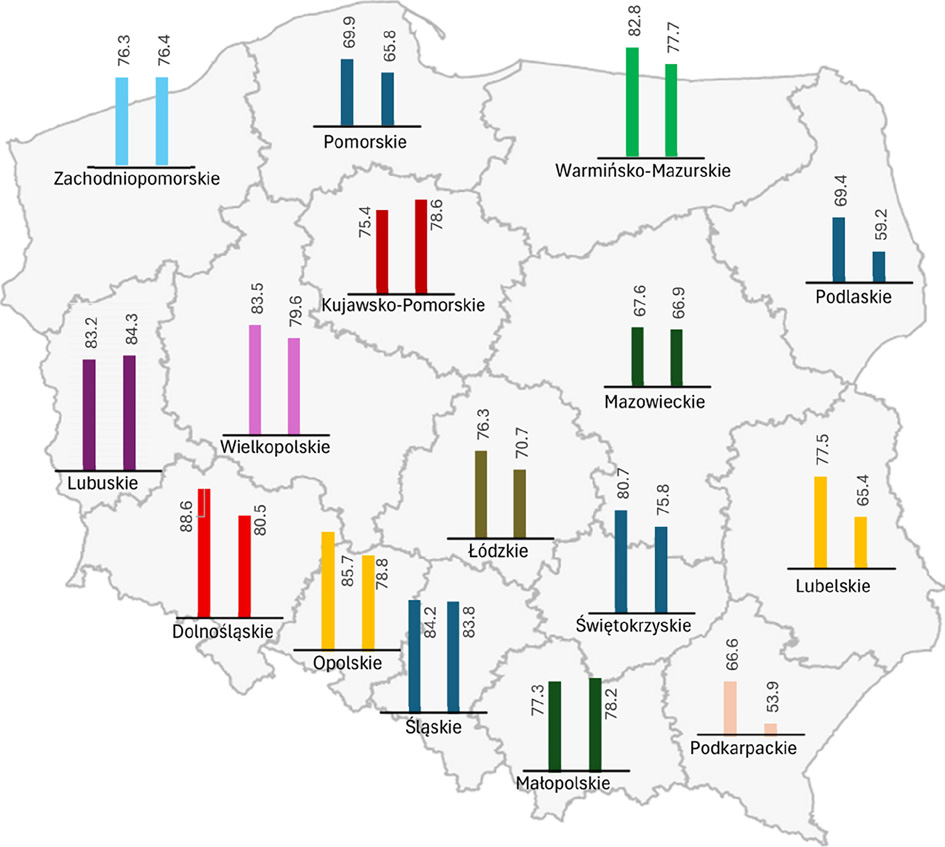
Fig. 4.
Share of the EU in overall exports (2004 and 2023, %) based on the Polish National Revenue Administration data.
The left bar shows the share of the EU in each region’s overall exports in 2004, the right bar – in 2023. For Poland overall, these shares were 78.7% (2004) and 74.6 (2023).
Findings
As was mentioned, Poland’s economic openness increased significantly. Considering goods only, in 2004–2023, the share of exports in GDP increased from 28.4% to 46.6%. In per capita terms, exports increased from 1530 to 9265 EUR (details are presented in Table 1). Between 2004 and 2023, the share of individual regions in Poland’s exports did not change much, which confirms the territorial stability (or inertia) in this respect.
Table 1.
Characteristics of Poland’s NUTS-2 regions’ foreign trade (2004, 2023) based on Eurostat, National Bank of Poland, Polish National Revenue Administration, and Statistics Poland data.
| Exports of goods (% of GDP) | Exports of goods (per capita, EUR) | Share of FOEs in exports (%) | Share of food and agricultural products in exports (%) | Share of HT products in exports (%) | Unit value of exports (EUR/KG) | Share of IIT (%) | ||||||||
|---|---|---|---|---|---|---|---|---|---|---|---|---|---|---|
| 2004 | 2023 | 2004 | 2023 | 2004 | 2023 | 2004 | 2023 | 2004 | 2023 | 2004 | 2023 | 2004 | 2023 | |
| Dolnośląskie | 39.8 | 82.0 | 2 169 | 17 719 | 65.7 | 72.6 | 1.8 | 3.2 | 4.4 | 5.6 | 1.9 | 5.0 | 33.6 | 37.4 |
| Kujawsko–pomorskie | 19.3 | 39.3 | 915 | 6 205 | 39.0 | 46.7 | 10.5 | 22.0 | 5.2 | 7.4 | 0.9 | 1.6 | 30.8 | 37.0 |
| Lubelskie | 12.8 | 26.0 | 490 | 3 500 | 37.1 | 38.7 | 24.3 | 30.1 | 4.1 | 2.9 | 0.5 | 2.3 | 25.1 | 41.4 |
| Lubuskie | 37.9 | 76.7 | 1 810 | 12 276 | 57.1 | 61.1 | 4.8 | 8.0 | 7.7 | 4.5 | 0.7 | 2.0 | 33.6 | 35.5 |
| Łódzkie | 13.9 | 33.5 | 692 | 6 406 | 53.1 | 57.1 | 7.3 | 21.4 | 3.9 | 10.0 | 1.4 | 3.1 | 35.4 | 41.3 |
| Małopolskie | 17.9 | 35.4 | 856 | 6 230 | 34.3 | 44.0 | 9.9 | 11.6 | 14.6 | 10.1 | 1.2 | 2.8 | 35.1 | 43.0 |
| Mazowieckie | 24.2 | 34.4 | 1 975 | 11 124 | 60.8 | 49.8 | 20.3 | 21.8 | 10.0 | 10.2 | 1.2 | 2.3 | 33.3 | 43.0 |
| Opolskie | 18.7 | 49.9 | 862 | 7 791 | 38.4 | 48.8 | 6.1 | 14.9 | 6.8 | 7.3 | 0.5 | 1.3 | 35.0 | 48.6 |
| Podkarpackie | 26.2 | 55.4 | 1 025 | 7 593 | 54.2 | 63.5 | 4.2 | 6.0 | 15.9 | 31.1 | 1.5 | 4.5 | 28.6 | 56.9 |
| Podlaskie | 17.8 | 32.7 | 710 | 4 836 | 35.5 | 17.9 | 26.7 | 38.4 | 2.7 | 3.9 | 1.4 | 1.1 | 20.1 | 37.2 |
| Pomorskie | 43.4 | 49.7 | 2 292 | 9 457 | 34.0 | 47.8 | 6.6 | 27.5 | 10.8 | 10.9 | 0.9 | 1.6 | 51.3 | 42.9 |
| Śląskie | 42.6 | 60.4 | 2 566 | 12 460 | 65.2 | 63.6 | 1.0 | 5.0 | 2.1 | 5.6 | 0.4 | 1.9 | 34.1 | 53.2 |
| Świętokrzyskie | 12.5 | 29.9 | 538 | 4 343 | 55.8 | 54.5 | 8.8 | 6.9 | 1.2 | 9.1 | 0.6 | 1.5 | 24.3 | 31.5 |
| Warmińsko-mazurskie | 22.0 | 36.7 | 896 | 4 980 | 53.1 | 41.8 | 8.6 | 19.0 | 2.1 | 0.9 | 1.6 | 2.9 | 21.3 | 32.3 |
| Wielkopolskie | 38.0 | 56.0 | 2 189 | 11 786 | 69.2 | 60.6 | 9.8 | 19.4 | 7.1 | 4.7 | 2.1 | 2.9 | 42.2 | 44.7 |
| Zachodniopomorskie | 27.2 | 41.0 | 1 324 | 6 655 | 44.1 | 64.6 | 11.1 | 20.6 | 3.6 | 5.7 | 0.6 | 1.4 | 38.5 | 38.0 |
| Poland overall | 28.4 | 46.6 | 1 530 | 9 265 | 56.4 | 56.9 | 8.7 | 14.7 | 6.8 | 11.7 | 0.8 | 2.8 | 52.5 | 63.0 |
The share of the ‘top 5’ regions4 in overall exports in 2004 was 70%; by 2023 it had decreased to 66%. The largest changes in shares were recorded for Śląskie (–5.2 pp.), Pomorskie (–2.2 pp.), and Dolnośląskie (+3.9 pp.) Voivodeships. Openness is significantly diversified territorially, which reflects idiosyncrasies in the industrial base, competitiveness and the role of FOEs. There are significant regional differences in the share of FOEs in exports (from 18% for Podlaskie to nearly 73% for Dolnośląskie Voivodeships). The shares of FOEs in exports are presented in Table 1. Their participation in the change in the value of exports is also shown. For example, in Dolnośląskie Voivodeship, 73.9% of the increase in the value of exports was generated by FOEs. Changes in the role of FOEs since 2004 are difficult to interpret unambiguously. They result from the activity of individual firms, including transnational corporations, playing an important networking role (Forsgren 2024). A positive correlation can be pointed out between the increase in exports per capita and FOEs’ share in export change in 2004–2023 (Fig. 5), however, this requires further research.
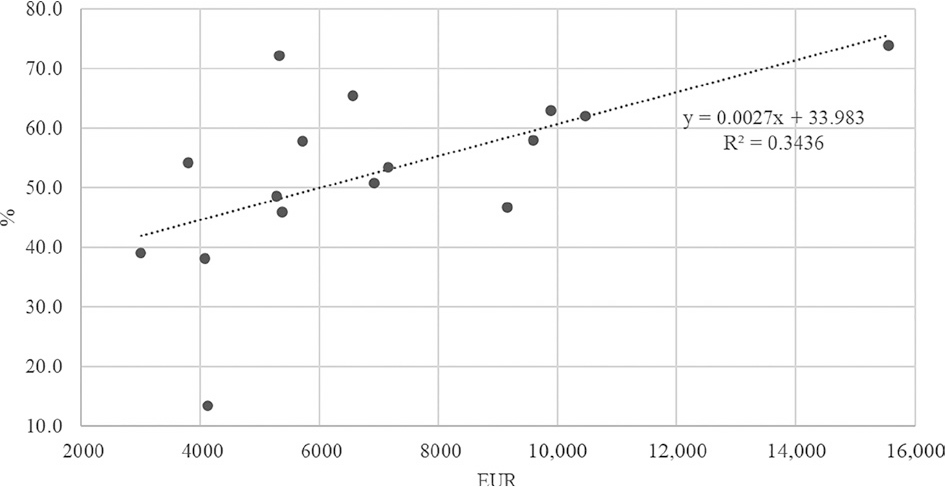
Fig. 5.
Correlation between an increase in exports per capita (EUR) and the share of foreign-owned entities (FOEs) in exports change (%) (2004–2023) based on the Polish National Revenue Administration data.
Structural and qualitative aspects of exports were analysed in three dimensions: share of agrifood goods, share of HT goods, and unit values.
Goods belonging to I–IV sections of the CN (Chapters 01–24) are classified as agri-food. Since 2004, their importance in Poland’s overall exports has increased from 8.7% to 14.7%. Świętokrzyskie Voivodeship is the only region for which its share decreased. It remained at a similar level in the case of Mazowieckie and Małopolskie Voivodeships (Table 1).
In the territorial framework, there is a large variation in the importance of HT products (Table 1). The position of Podkarpackie Voivodeships is unique, where turbojet and turboprop engines play a high role in exports. The qualitative aspect can also be analysed using the unit values (export values per kilogramme) (Table 1). In this respect, two voivodeships stand out: Dolnośląskie and Podkarpackie (EUR/KG above 4).
One of the basic measures used in FT analyses is IIT. This type of exchange (as opposed to inter-industry) concerns developed countries that trade with partners with a similar level of development, are located in geographical proximity, and belong to integration groupings (e.g. the EU). Within IIT, the overlapping of imports and exports occurs. Variants of heterogeneous products are traded. The so-called love for variety and the activities of transnational corporations are regarded as the main determinants of IIT. Calculated on 4-digit CNs, IIT for Poland increased from 52.5% to 63% between 2004 and 2023. It should be mentioned that for individual regions, the intensity of IIT is lower (Table 1) than for the country as a whole (Brodzicki et al. 2019).
As a summary of the above dimensions of territorial differences and changes in the regions’ FT, we depict the share of the EU in exports and the changes during the EU membership. The membership was conducive to export increases for Poland and its regions. As was mentioned, per capita exports of goods significantly increased. The dynamics of exports overall, however, were higher outside the EU than to the EU countries. Thus, the EU’s share in Poland’s exports between 2004 and 2023 reduced from 78.7% to 74.6%. The structural changes the economy went through, including the increased competitiveness strongly driven by the inflow of FDI and the EU funds, resulted in export growth. However, each region had a specific profile of export changes (Fig. 4). In 12 out of 16 regions, the EU’s share decreased. Exports expanded not only towards the EU internal market. Membership in the EU has served as a kind of springboard, triggering competitiveness improvements that were recognised globally.
Cluster analysis
The databases used are very detailed, which is an advantage. On the other hand, it might be considered a drawback, making providing a synthetic inquiry difficult, which is important from the regional policy perspective. This is why the cluster analysis has been done, to classify regions into possibly homogenous groups, using the hierarchical approach. Cluster analysis results are presented in Figure 6. It comprises a dendrogram depicting the distances between individual clusters regarding FT changes for Poland’s regions between 2004 and 2023, as well as a map that visualises the composition of each of the six clusters.
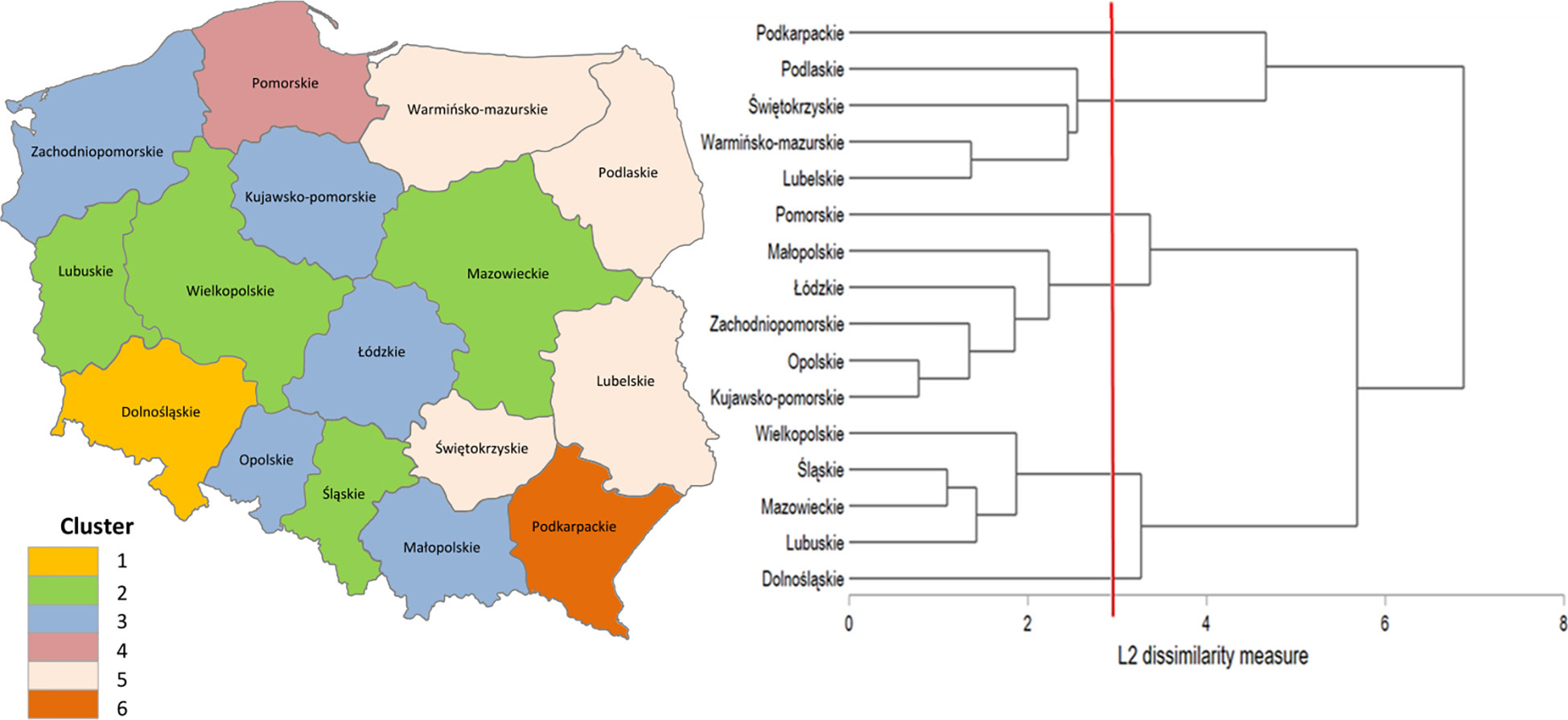
Fig. 6.
Results of cluster analysis for Poland’s NUTS-2 regions (voivodeships).
The vertical axis of the dendrogram represents grouped objects, and each of them is unique. Moving to the right, the decision threshold gradually lowers, and the decision is taken on whether individual cases are exceptional. They are grouped into bigger clusters. Finally, all regions are merged into one. Several agglomeration methods were applied to provide robustness. Finally, Ward’s method (1963) and the Euclidean distance were employed as they created homogeneous clusters. The analysis is based on: openness (exports per capita), share of FOEs, share of food and agricultural products, share of HT products in exports, intensity of IIT, and unit values (EUR/KG). Calculations were performed using the standardised data according to the following formula:
where:– x – the non-standardised variable,
– μ – the mean,
– σ – the standard deviation.
Each of the variables represents the changes between 2004 and 2023. Based on the Duda and Hart (1973) Je(2)/Je(1) index, it was found that the optimum number of clusters is six (Milligan, Cooper 1985). The characteristics of clusters are described in Table 2. The table also presents the decrease of the EU share in exports (pp.) for each cluster.
Table 2.
Clusters composition and characteristics of changes within particular features (2004–2023).
| Cluster/voivodeships | Increase of exports per capita | Change of FOEs’ share in exports | Increase of food and agricultural products share in exports | Increase of HT products share in exports | Change of IIT share in trade | Increase of unit values of exports | Decrease of EU share in exports (pp.) |
|---|---|---|---|---|---|---|---|
| 1. Dolnośląskie | very high | increase | moderate | low | no change | moderate | –8.1 |
| 2. Lubuskie, Mazowieckie, Śląskie, Wielkopolskie | moderate | decrease | high | low | increase | significant | –1.0 |
| 3. Kujawsko–Pomorskie, Łódzkie, Małopolskie, Opolskie, Zachodniopomorskie | high | significant increase | high | moderate | increase | moderate | –1.7 |
| 4. Pomorskie | very low | significant increase | very high | very low | decrease | low | –4.1 |
| 5. Lubelskie, Podlaskie, Świętokrzyskie, Warmińsko-Mazurskie | moderate | decrease | low | very high | significant increase | moderate | –8.1 |
| 6. Podkarpackie | high | increase | low | high | significant increase | significant | –12.7 |
The results of cluster analysis defy simple interpretation. It has been performed on changes, and probably this is why it does not resemble the usually obtained static clustering patterns for Poland’s regions, mainly wrapped around the east-west territorial differences and GDPPC variety. Three regions form clusters ‘on their own’ (#1, #4 and #6), which reflects the idiosyncrasy of their export characteristics and adjustments. Each of them is of a border type, which strongly determines their position as an exporter. Dolnośląskie Voivodeship registers the highest exports per capita level and its growth in 2004–2023. It witnessed the increase of FOEs’ share in exports, even though this share has been the highest among all regions of Poland. The specific situation of Pomorskie Voivodeship stems from a high share of exports attributed to the maritime industries and the low, but significantly increasing, share of FOEs. Also, a very high increase in the share of food and agricultural products has been observed. Idiosyncrasy of Podkarpackie Voivodeship exports stems from the strong position of the aviation industry, driven by a high and increasing share of FOEs, and of HT products. It results in a very high and significantly increasing unit value of exports (which is a proxy of export quality). Cluster #5 is formed by four relatively less developed regions, situated in the eastern part of Poland; three of them are border regions. Cluster #2 embraces Mazowieckie, Wielkopolskie, and Śląskie Voivodeships, which represent the most competitive and developed regions of Poland, and Lubuskie Voivodeship, which borders Germany. There are five regions in cluster #3 with a high increase in exports per capita and a significant increase in FOE’s share.
Summary
Over the two decades of EU membership, Poland’s FT landscape has changed significantly. Integration into the EU single market and access to structural funds and FDI have contributed to a substantial increase in trade openness and competitiveness. However, this transformation did not proceed in the same way across regions. Opportunities and stimuli arising from integration into the EU internal market and the opening of the economy overlapped with existing long-term regional diversities. Our analysis reveals considerable regional heterogeneity in FT dynamics, driven by differences in industrial structure, foreign ownership, and sectoral specialisation.
While EU membership catalysed access to the internal market, it also served as a platform for diversification beyond the EU, contributing to Poland’s emergence as a globally competitive exporter. This dual expansion is visible in most regions, although with different intensities and sectoral footprints.
A key contribution of this study lies in applying cluster analysis to dynamic changes in trade performance across Poland’s NUTS-2 regions – an approach not commonly used in the literature. Unlike static classifications, this method uncovers diverse trajectories of export transformation over time, shaped by both EU integration and external market expansion. The resulting six regional clusters highlight varying patterns of openness, quality, and IIT intensities, offering new empirical evidence on regional trade divergence under shared macroeconomic conditions.
These findings have important implications for regional policy. Tailored support strategies should account for region-specific trade characteristics, including the role of FOEs, technological intensity, and export quality. Export promotion instruments need to reflect not only levels of trade activity but also their underlying structure and dynamics.
Each of the aspects of FT discussed in the paper should be a subject of further in-depth research. An interesting follow-up research would be to inquire more into intensive vs. extensive export margins (at firm analysis level) (Mayer, Ottaviano 2008) for each region, as well as look into the nature of IIT (horizontal vs. vertical components). The analysis should also include FT in services, once the relevant data is available. Given Poland’s growing role in international services trade, expanding the analysis to services will be critical to understanding the full picture of regional competitiveness in a modern, trade-driven economy (Brodzicki 2024).
Notes
[3] Presented together as an average in Figure 2 due to similarities and for visualisation clarity.