
Table 1.
Theoretical assumptions for the RIGMA model of teachers’ technological advancement, as a modification of the SAMR model distinguishing into four levels of technology integration with consideration of map functionality.
| Substitution | At this stage, teachers and students employ text programs instead of traditional paper methods (Islam 2018). Technology is not imperative for the mapping task, given the prevalent administering approach. In this context, the student assumes a passive role as a recipient of knowledge, whereas the teacher functions as a lecturer. Consequently, the map serves merely as a tool for visualizing phenomena and processes. |
| Augmentation | The primary goal of technology is to augment the learning experience (Danieluk 2019). At this level, teachers utilize maps, among other tools, to enhance the illustration and assimilation of discussed content by students. The Nearpod application proves valuable not just for map presentations but particularly for the analysis of maps, marking objects, and drawing conclusions. |
| Modification | This represents a phase of purposeful technology utilization for creatively executing tasks and showcasing outcomes, as students transition from passive knowledge recipients (Dylak 2013). At this stage, the map evolves into a fundamental tool for problem-solving. An intriguing application of map functionality includes an online geographic atlas (http://www.maplab.pl) or leveraging the geoportal resource www.geoportal.gov.pl, which facilitates access to spatial data and associated services. |
| Redefinition | This phase exclusively depends on the utilization of GIS tools and applications. The foundation for creativity, as suggested by Islam (2018), encompasses old maps, archival and satellite images, along with the geoportal. During this stage, students share the information they have gathered, and leveraging technological knowledge, including the QGIS program, they can collaboratively generate a multi-layered map. |
Table 2.
25 original indicators of technological advancement with the corresponding questionnaire items.
| No. | Indicator | Questionnaire items |
|---|---|---|
| 1 | WP3 | 1.; 3.; 22. |
| 2 | WT1 | 10. |
| 3 | WT2 | 16. 16. |
| 4 | WC2 | 26. |
| 5 | WE2 | 10.; 26. |
| 6 | WO1 | 6_ 1. |
| 7 | WI1 | 4_4.; 4_6. |
| 8 | WP1 | 3.; 22. |
| 9 | WP5 | 3.; 4_4.; 4_6.; 22. |
| 10 | WI6 | 4_1.; 4_2.; 4_4.; 4_5.; 4_6.; 4_9. |
| 11 | WE1 | 4_1.; 4_2.; 4_4.; 4_5.; 4_6.; 4_9.; 6_1. |
| 12 | WI4 | 3.; 4_4.; 4_6.; 6_1.; 7_6. |
| 13 | WI3 | 4_4., 4_6., 6_1., |
| 14 | WO4 | 3.; 7_6. |
| 15 | WI5 | 4_1.; 4_2.; 4_4.; 4_5.; 4_6.; 4_9. |
| 16 | WC1 | 1., 6_1.; 7_8. |
| 17 | WA1 | 18. |
| 18 | WI2 | 4_1.; 4_2.; 4_5.; 4_9. |
| 19 | WP4 | 4_1.; 4_2.; 4_5.; 4_9.; 7_2.; 7_9. |
| 20 | WP2 | 1.; 3.; 22. |
| 21 | WO2 | 7_6. |
| 22 | WO3 | 6_1.; 7_6. |
| 23 | WP6 | 3.; 6_1.; 7_6.; 22. |
| 24 | WE4 | 3.; 10.; 16.; 22. |
| 25 | WE3 | 3.; 7_9.; 18. |
Table 3.
Descriptive statistics of the analyzed parameters (N = 130).
| Indicator | Symbol | M | Me | SD | Sk | Kurt | Min | Max | V |
|---|---|---|---|---|---|---|---|---|---|
| 1 | WP3 | 1.35 | 1.00 | 1.22 | 2.03 | 5.71 | 0.00 | 7.00 | 0.90 |
| 2 | WT1 | 46.62 | 50.00 | 26.51 | 0.17 | −1.07 | 0.30 | 90.00 | 0.57 |
| 3 | WT2 | 26.94 | 0.00 | 35.02 | 0.98 | −0.42 | 0.00 | 100.00 | 1.30 |
| 4 | WC2 | 3.15 | 3.00 | 0.79 | −0.57 | −0.38 | 1.00 | 4.00 | 0.25 |
| 5 | WE2 | 1.49 | 1.45 | 0.91 | 0.54 | −0.49 | 0.20 | 3.60 | 0.61 |
| 6 | WO1 | 16.54 | 18.00 | 6.74 | −1.00 | −0.34 | 0.00 | 22.00 | 0.41 |
| 7 | WI1 | 0.77 | 0.75 | 0.43 | 0.23 | −0.25 | 0.00 | 2.00 | 0.56 |
| 8 | WP1 | 0.47 | 0.10 | 0.68 | 2.27 | 6.25 | 0.10 | 4.00 | 1.45 |
| 9 | WP5 | 1.17 | 1.00 | 0.92 | 1.36 | 2.07 | 0.00 | 4.75 | 0.79 |
| 10 | WI6 | 1.36 | 1.31 | 0.75 | 0.52 | 0.69 | 0.00 | 3.75 | 0.55 |
| 11 | WE1 | 13.01 | 7.62 | 16.04 | 3.03 | 10.90 | 0.00 | 100.00 | 1.23 |
| 12 | WI4 | 3.90 | 1.68 | 7.67 | 5.15 | 31.36 | 0.00 | 61.70 | 1.97 |
| 13 | WI3 | 20.44 | 22.00 | 11.54 | 0.10 | −1.00 | 1.50 | 44.00 | 0.56 |
| 14 | WO4 | 44.29 | 32.50 | 40.96 | 1.78 | 4.18 | 0.00 | 240.00 | 0.92 |
| 15 | WI5 | 0.39 | 0.38 | 0.31 | 3.74 | 22.27 | 0.00 | 2.50 | 0.79 |
| 16 | WC1 | 1.62 | 1.09 | 1.78 | 3.39 | 15.92 | 0.00 | 13.00 | 1.10 |
| 17 | WA1 | 17.19 | 14.00 | 15.26 | 1.46 | 1.88 | 1.00 | 60.00 | 0.89 |
| 18 | WI2 | 1.88 | 1.75 | 0.63 | 0.39 | 0.49 | 0.50 | 4.00 | 0.34 |
| 19 | WP4 | 1.21 | 0.75 | 1.26 | 1.79 | 3.38 | 0.00 | 6.10 | 1.04 |
| 20 | WP2 | 1.23 | 1.10 | 0.92 | 1.00 | 0.84 | 0.20 | 4.10 | 0.75 |
| 21 | WO2 | 16.04 | 16.00 | 8.55 | 0.89 | 0.55 | 0.00 | 40.00 | 0.53 |
| 22 | WO3 | 1.29 | 0.88 | 1.45 | 2.97 | 9.90 | 0.00 | 8.60 | 1.12 |
| 23 | WP6 | 0.56 | 0.11 | 1.49 | 6.84 | 55.55 | 0.00 | 14.00 | 2.66 |
| 24 | WE4 | 0.41 | 0.09 | 0.89 | 4.36 | 23.72 | 0.01 | 6.80 | 2.17 |
| 25 | WE3 | 2.44 | 0.50 | 5.92 | 4.18 | 18.76 | 0.00 | 36.00 | 2.43 |
Table 4.
Description of technological advancement indicators.
| No. | Symbol or formula | Description |
|---|---|---|
| 10 | WI6 = WI1x WI2 | The product of independence for creating and using own presentations, work-sheets, and independence for frequent use of readymade materials |
| 15 | WI5 = WI1/4-WI2 | The quotient of the sum of points for the independence of creating and using own presentations and worksheets and the difference between the value of four points (very high frequency of use of four readymade materials from the Internet) and the actual independence of frequent use of these four readymade materials from the Internet (games, maps, videos, tutorials) |
| 17 | WA1 | Number of days of adaptation to distance education |
| 18 | WI2 | Total points for independence in using the Internet: games (max. 1 pt); maps (max. 1 pt); videos (max. 1 pt); tutorials (max. 1 pt) at frequency: 1 pt when always doing it; 0.75 pt when doing it very often; 0.5 pt often; 0.25 pt occasionally |
| 19 | WP4 | The quotient of multiplication of the independence of using readymade materials from the Internet and the number of hours of training per week, and the number of hours per week needed to prepare worksheets |
| 24 | WE4 = WP1x (WT1 + WT2) | The product of the number of learned and applied programs and the sum of the belief in the ability to develop skills and the belief in the effectiveness of distance education |
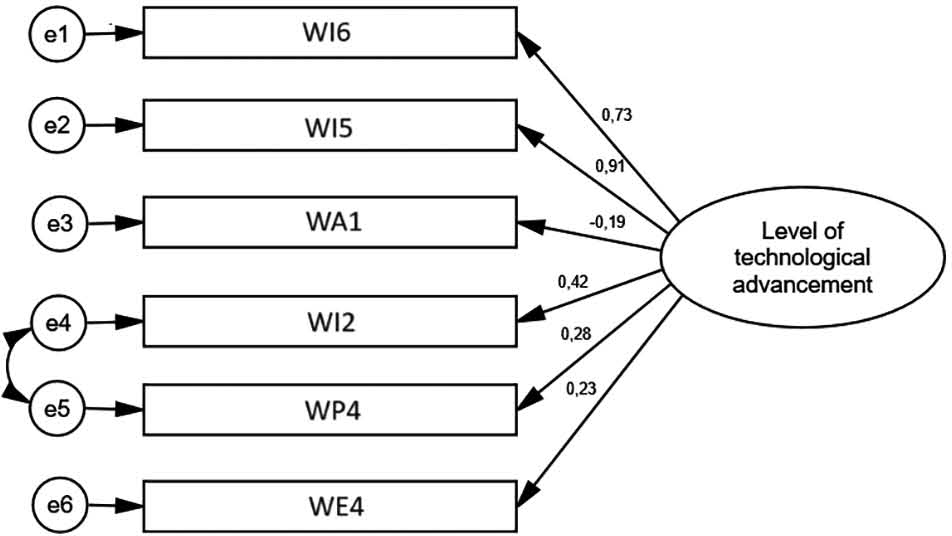
Fig. 1.
Confirmatory factor analysis (CFA) model for technological advancement level.
Table 5.
Regression coefficients of the CFA (confirmatory factor analysis) model of the level of technological advancement.
| Indicator | B | SE | Z | p | β |
|---|---|---|---|---|---|
| WI6 | 0.55 | 0.07 | 8.24 | <0.001 | 0.73 |
| WI5 | 0.28 | 0.03 | 9.99 | <0.001 | 0.91 |
| WA1 | −2.90 | 1.42 | −2.04 | 0.042 | −0.19 |
| WI2 | 0.27 | 0.06 | 4.65 | <0.001 | 0.42 |
| WP4 | 0.35 | 0.12 | 2.97 | 0.003 | 0.28 |
| WE4 | 0.20 | 0.09 | 2.35 | 0.019 | 0.23 |
Table 6.
Average values of predictors in relation to levels of teacher technological advancement.
| Levels of technology proficiency of geography teachers | Number of teachers (N = 130) | Means for WI5 for range 0–2.5 | Means for WI6 for range 0–3.75 | Means for WI2 for range 0.5–4.0 | Means for WP4 for range 0–6.1 | Means for WE4 for range 0–6.8 | Means for WA1 for range 1.0–60.0 |
|---|---|---|---|---|---|---|---|
| (−9.1; −10.60) | 6 | 0.25 | 0.84 | 1.54 | 0.71 | 0.05 | 60.0 |
| (−7.61; −9.0) | 2 | 0.42 | 1.47 | 2.00 | 1.23 | 0.08 | 60.0 |
| (−6.1; −7.60) | 2 | 0.50 | 1.75 | 1.50 | 2.85 | 0.70 | 52.5 |
| (−4.61; −6.0) | 2 | 0 | 0 | 0.87 | 0.09 | 0.09 | 30.0 |
| (−3.1; −4.60) | 12 | 0.27 | 1.03 | 1.95 | 0.74 | 0.11 | 30.0 |
| (−1.61; −3.0) | 18 | 0.29 | 1.12 | 1.95 | 1.27 | 0.19 | 24.1 |
| (−0.01; −1.60) | 22 | 0.28 | 1.01 | 1.76 | 1.00 | 0.44 | 15.7 |
| (0.01; 1.60) | 38 | 0.39 | 1.44 | 1.84 | 1.09 | 0.36 | 8.84 |
| (1.61; 3.0) | 19 | 0.45 | 1.69 | 1.67 | 1.39 | 0.97 | 4.29 |
| (3.1; 4.60) | 7 | 0.67 | 2.50 | 2.39 | 2.20 | 0.53 | 11.7 |
| (4.61; 6.0) | 2 | 1.12 | 2.25 | 2.75 | 3.75 | 0.65 | 4.00 |
Table 7.
Percentage of teachers using maps with different functionality according to their level of technological advancement.
| Functionality of maps | Percentage of teachers by grade level | ||||
|---|---|---|---|---|---|
| −6, 1; −10.60 | −3, 1; −6.0 | −0.01; −3.0 | 0.01; 3.0 | 3.1; 6.0 | |
| Map in paper textbook – page range sent | 6 | 0 | 0 | 0 | 0 |
| Map in exercise book/worksheet – range of tasks sent | 55 | 33 | 25 | 2 | 0 |
| Map in a Polish TV program (online lessons on TVP) | 44 | 16 | 21 | 7 | 41 |
| Map in a movie (YouTube) | 83 | 63 | 79 | 76 | 66 |
| Map in an e-book | 28 | 25 | 37 | 40 | 50 |
| Map on the geography24 website | 0 | 58 | 12 | 25 | 25 |
| Map in a multimedia presentation – giving Methods – lecture | 61 | 96 | 84 | 70 | 75 |
| Map in quizzes, e.g., Wordwall, Quizzes, interactive exercises | 44 | 39 | 46 | 43 | 67 |
| Map in tests, e.g., testportal | 6 | 29 | 7 | 9 | 0 |
| Map in interactive applications, e.g., earth.nullschool.net | 29 | 4 | 0 | 2 | 15 |
| Google maps, Google Earth | 0 | 4 | 7 | 17 | 5 |
| Maps in map services | 0 | 8 | 9 | 4 | 0 |
| Map in Internet atlas, e.g., meridian, maplab | 0 | 8 | 0 | 4 | 21 |
| Maps on the websites of institutions, e.g., Central Statistical Office (CSO) | 0 | 0 | 10 | 5 | 7 |
| Map in geoportal – solving a problem, creating new knowledge | 0 | 0 | 0 | 8 | 46 |
| Map in GIS (geographic information system) and tutorials – creating new knowledge, e.g., in the form of a map | 0 | 0 | 0 | 12 | 65 |
Table 8.
RIGMA (recommendation, imitation, gamification, mobilization, action) model with levels of technological advancement of geography teachers.
| Ranges of the level of technological advancement of geography teachers | Percentage of teachers | The concept defining a given level of advancement and the corresponding SAMR level (substitution, augmentation, modification, redefinition) | Description of their actions by teachers | Criterion for evaluation of students | Description/interpretation of actions during distance education by teachers |
|---|---|---|---|---|---|
| −6.1; −10.60 | 8 | Recommendation (SAMR – Substitution) | ‘I send recommended sites’ ‘the student has to search on his own’ | ‘independence in searching and sending completed worksheets’ | ‘aimlessness and confusion’ |
| −3.1; −6.0 | 11 | Imitation (SAMR – Substitution) | ‘students search the Internet for their own interpretations’ | ‘reproducible knowledge’ | ‘willingness to devote time’ |
| Minimum range of skills | |||||
| −0.01; −3.0 | 31 | Gamification (SAMR – Augmentation) | ‘gamification’ | ‘independence of tasks and work performed’ | ‘dependence on technology and constraints’ |
| 0.01; 3.0 | 44 | Mobilization (SAMR – Modification) | ‘work in such a way as to interest, I propose problematic tasks’ | ‘engagement in lessons’, ‘degree of use of ICT for analysis and inference’ | ‘mobilization’ ‘New materials and tools give me opportunity’ |
| 3.1; 6.00 | 6 | Action (SAMR – Redefinition) | ‘out-of-the box approach to the topic’ ‘creative self-work’ | ‘responsibility and regularity’ | ‘passion’ |