
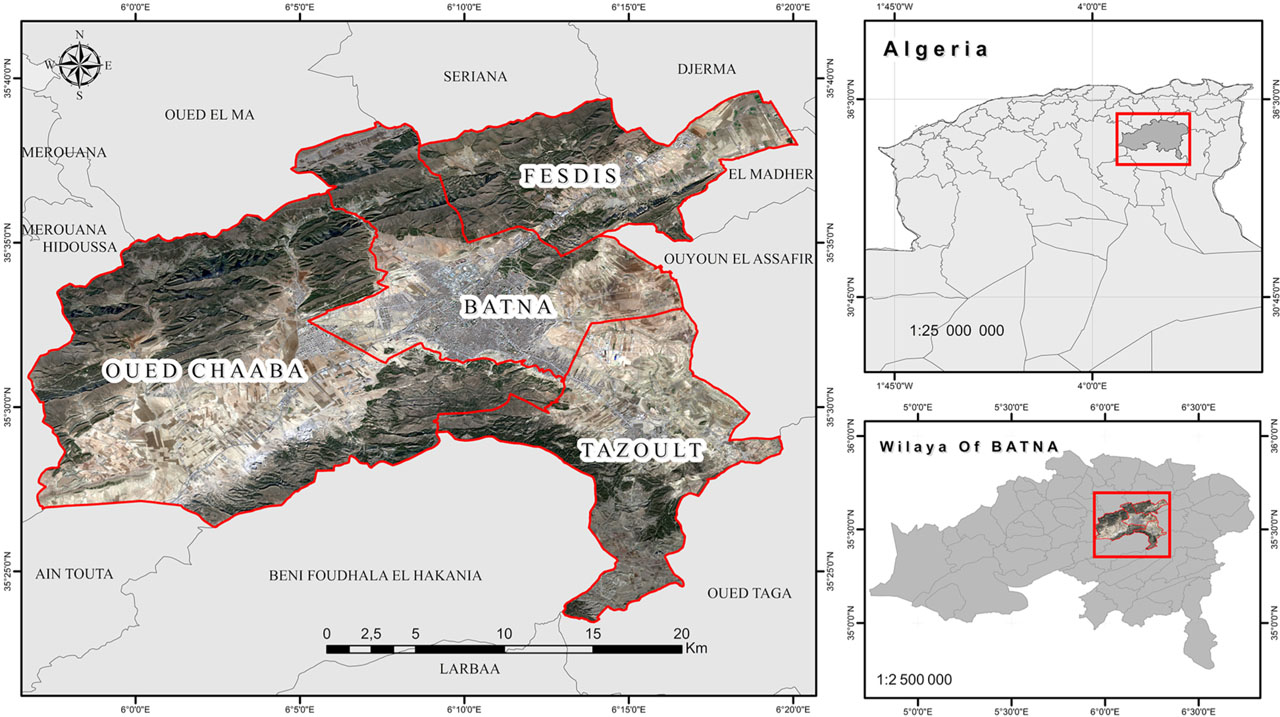
Fig. 1
Location of the inter-municipal grouping of Batna.
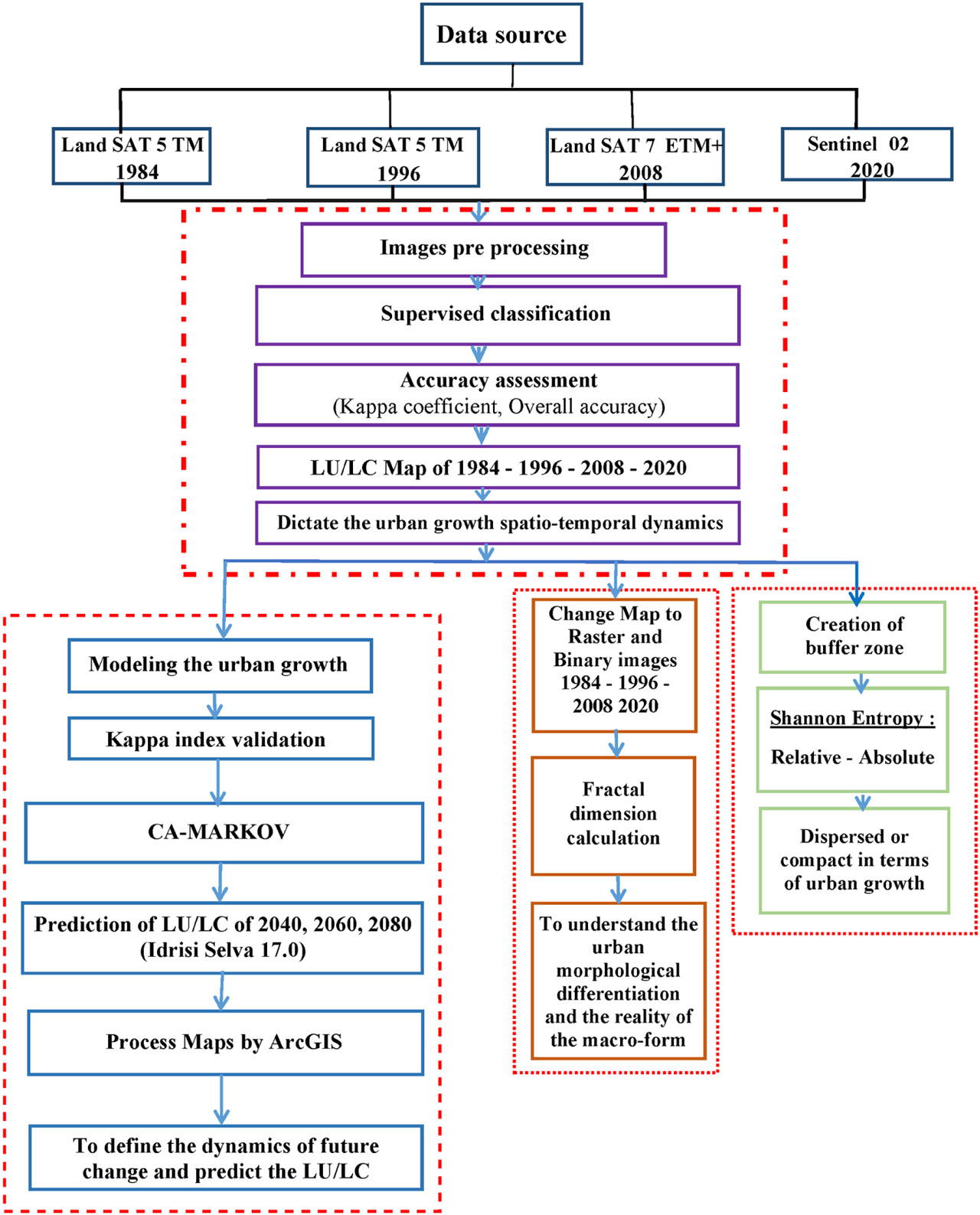
Fig. 2
The methodology flowchart applied in this study.
Table 1
Detailed information on satellite images.
| No | Acquisition date | Satellites | Resolution Scale [m] | Number of bands | Projection |
|---|---|---|---|---|---|
| 01 | 30-06-1984 | Land SAT 5 TM | 30 | 7 | WGS 84 UTM Zone 31 N |
| 02 | 21-10-1996 | Land SAT 5 TM | 30 | 7 | WGS 84 UTM Zone 31 N |
| 03 | 16-06-2008 | Land SAT 7 ETM+ | 30 | 7 | WGS 84 UTM Zone 31 N |
| 04 | 12-03-2020 | Sentinal 02 | 10 | 11 | WGS 84 UTM Zone 31 N |
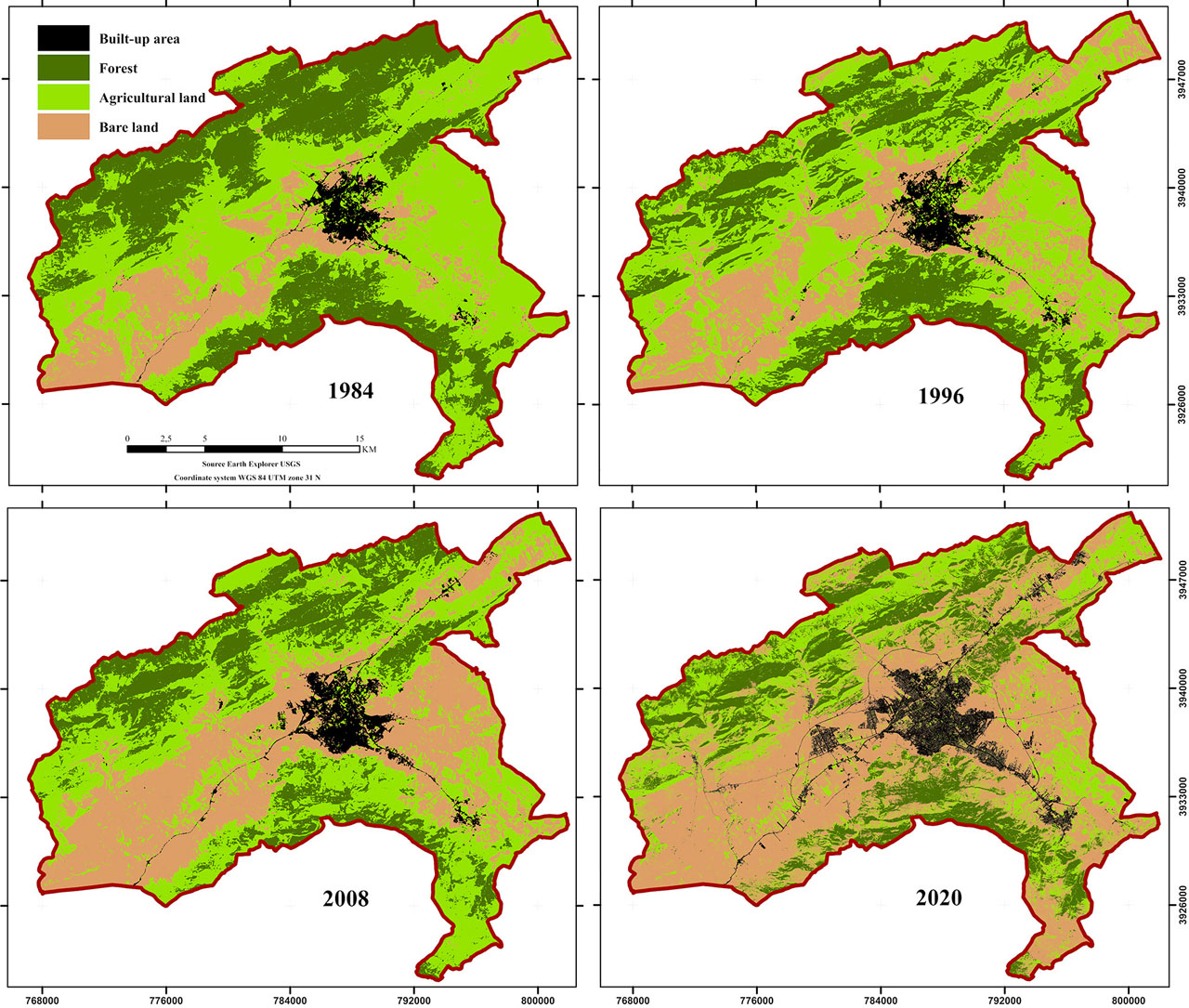
Fig. 3
Supervised classification of the Batna inter-municipal grouping on the images of 1984, 1996, 2008 and 2020.
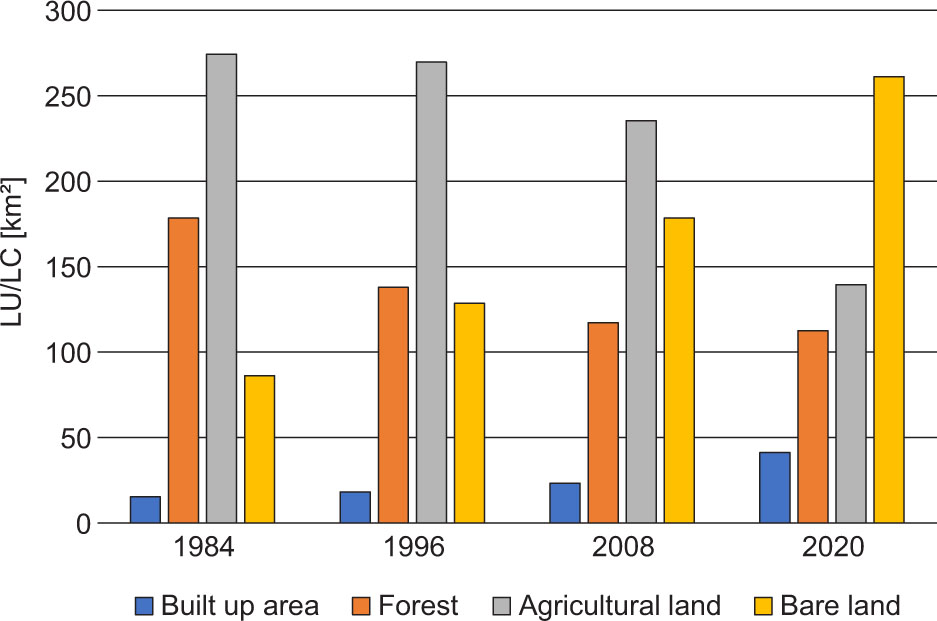
Fig. 4
Graphical representation of the evolution of LU/LC in the Batna intermunicipal area between 1984 and 2020.
Table 2
Overall accuracy index values and kappa coefficient for the years 1984, 1996, 2008 and 2020.
| Year | Overall accuracy [%] | Kappa coefficient |
|---|---|---|
| 1984 | 88 | 0.8378 |
| 1996 | 90 | 0.8671 |
| 2008 | 90 | 0.8661 |
| 2020 | 86 | 0.8091 |
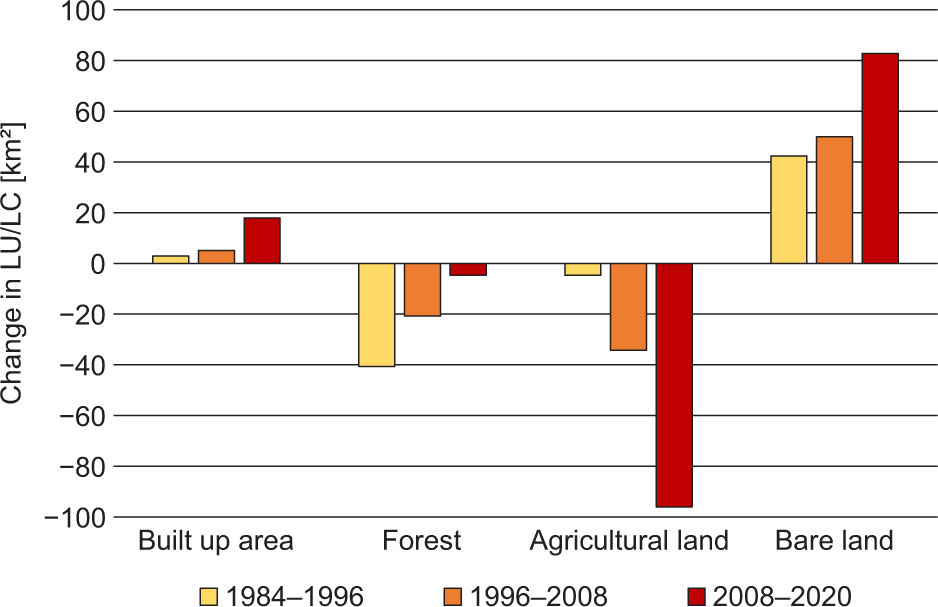
Fig. 5
The change in LU/LC surfaces between 1984 and 2020 of the inter-municipal grouping of Batna.
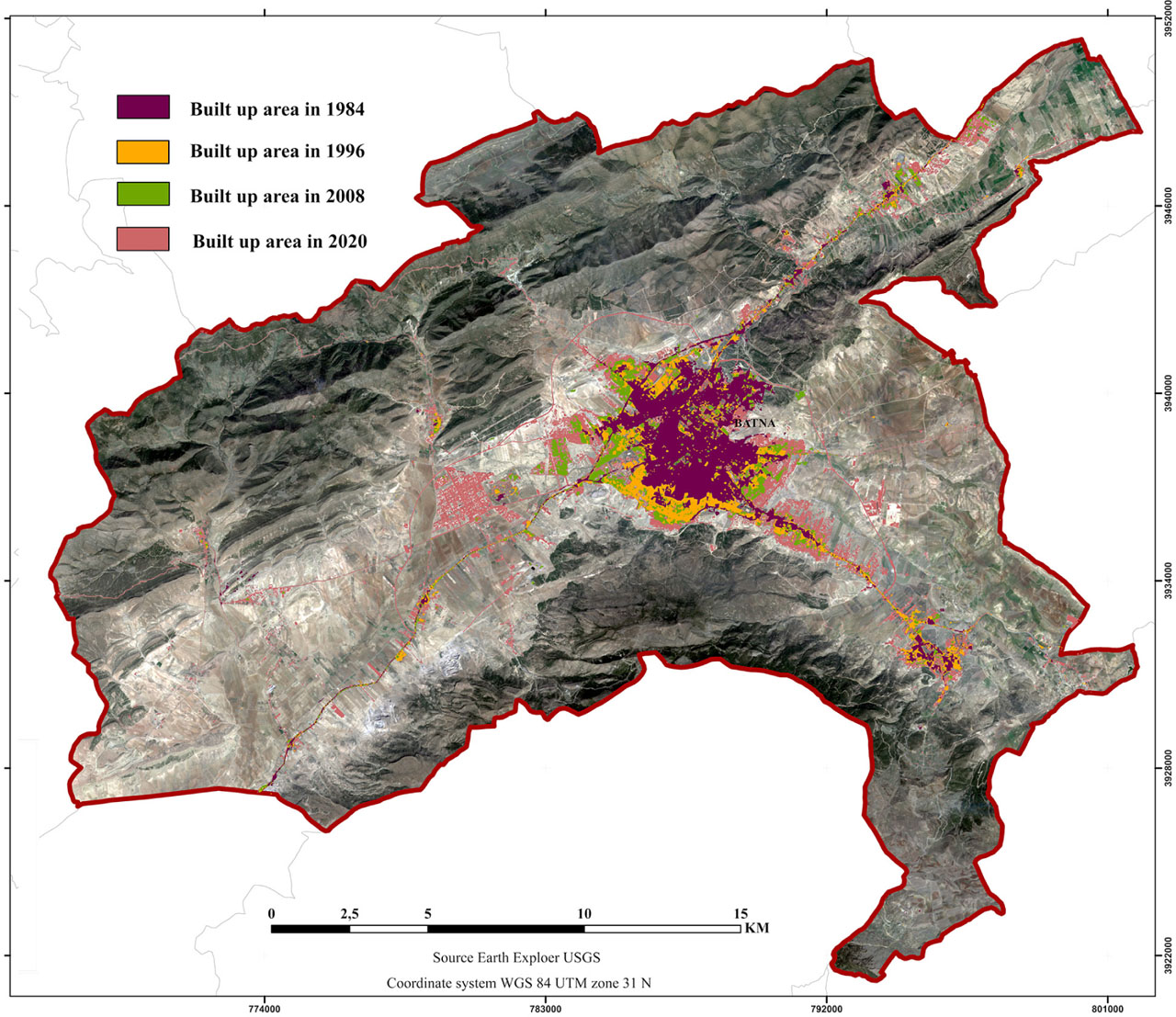
Fig. 6
Evolution of the urban area of the Batna inter-municipal grouping between 1984 and 2020.
Table 3
Average annual rate of change of the urban extension (VT), urbanisation intensity index (UII), dynamic degree of urban expansion (K) of the inter-municipal grouping of Batna between 1984 and 2020.
| Dates | VT | UII | K |
|---|---|---|---|
| 1984–1996 | 0.24 | 0.04 | 1.56 |
| 1996–2008 | 0.43 | 0.08 | 2.35 |
| 2008–2020 | 1.49 | 0.27 | 6.40 |
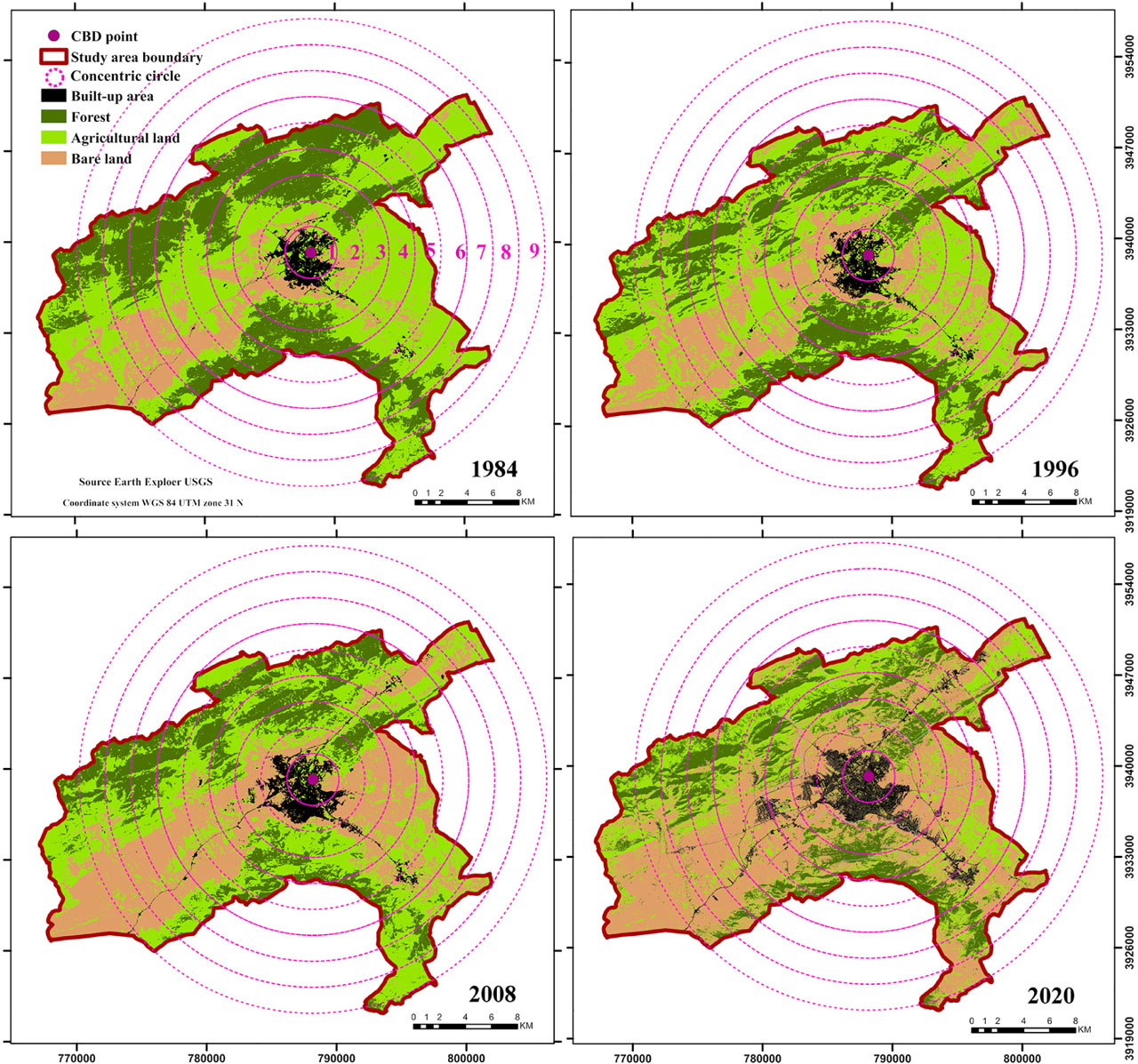
Fig. 7
Circular buffer zones of the Shannon entropy.
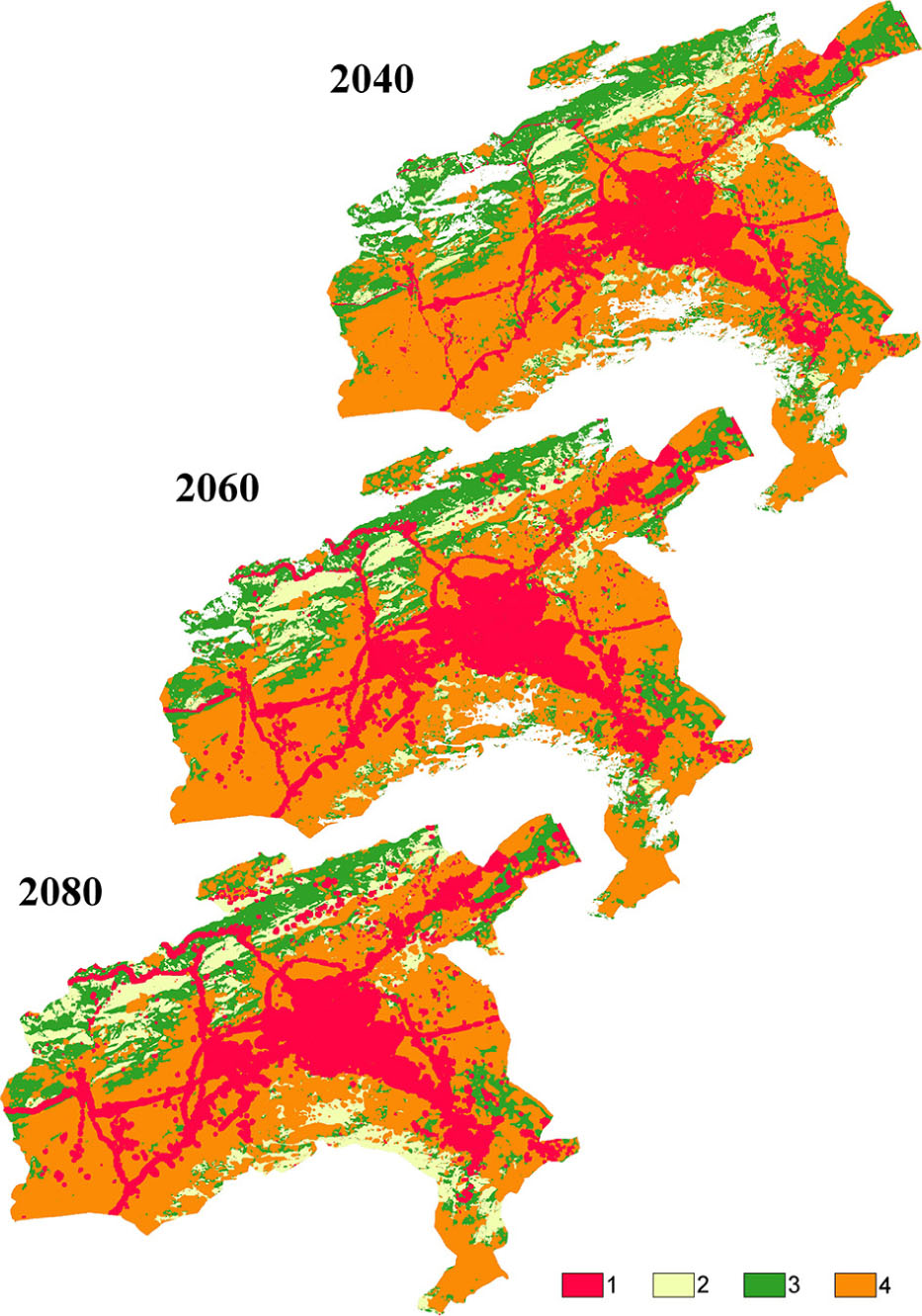
Fig. 8
The future projection of the urban macroform of Batna inter-communal grouping in the years 2040, 2060, and 2080 (processed by Idrisi Selva17).
1 – built up area, 2 – forest, 3 – agricultural land, 4 – bare land.
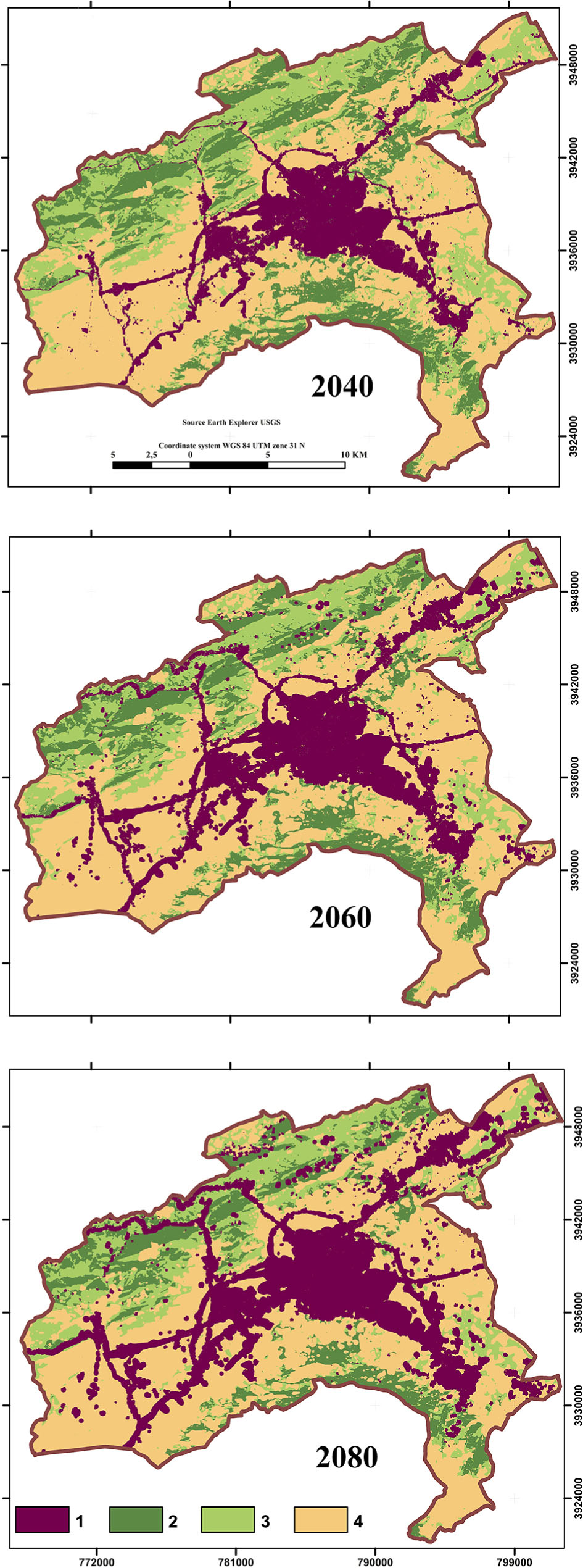
Fig. 9
The future projection of the urban macroform of Batna inter-communal grouping in the years 2040-2060-2080 (processed by ArcGIS 10.5).
1 – built up area, 2 – forest, 3 – agricultural land, 4 – bare land.
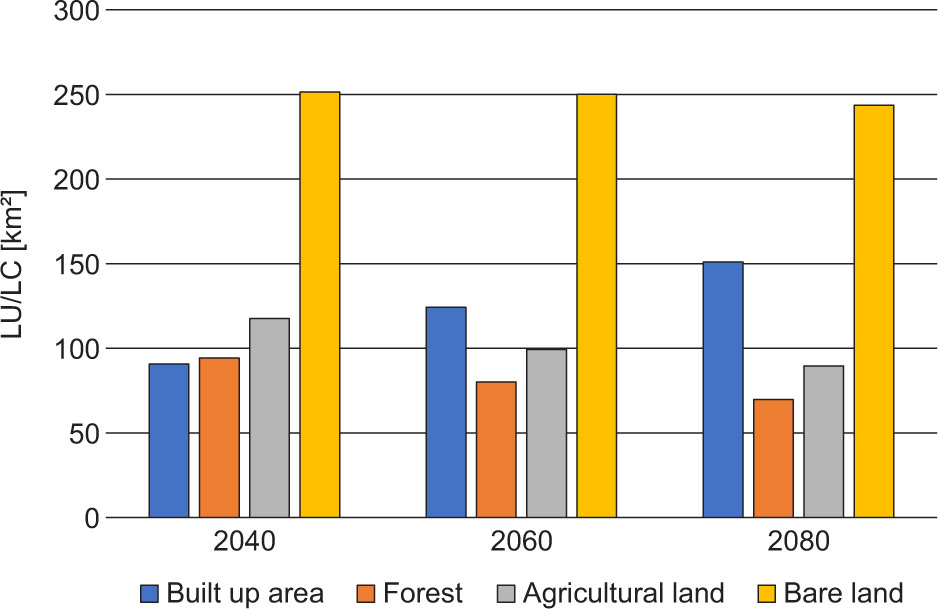
Fig. 10
Comparison graph of the future projection of the urban macroform of Batna the years 2040, 2060, and 2080 (processed by ArcGIS 10.5).