

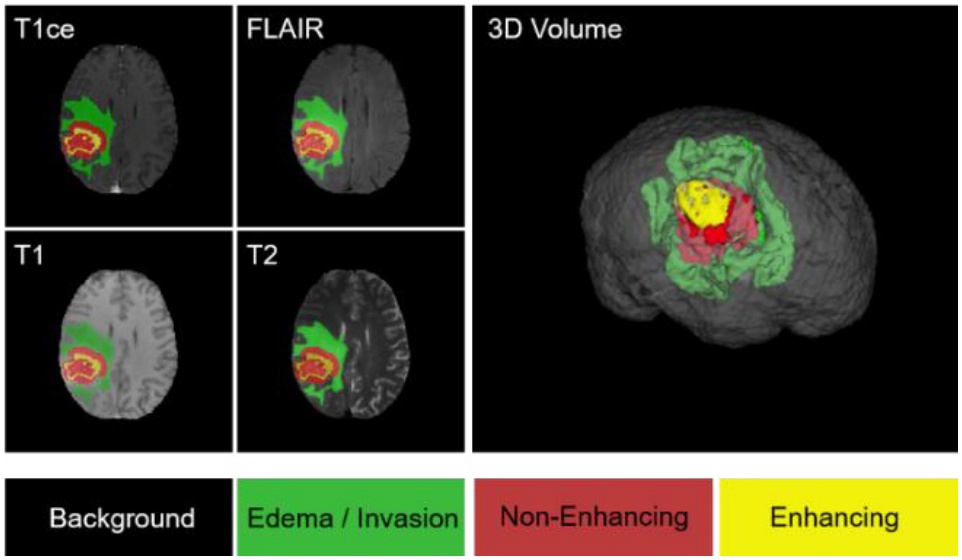
Figure 1.
Illustration depicting various sub-regions for brain tumor segmentation [1]
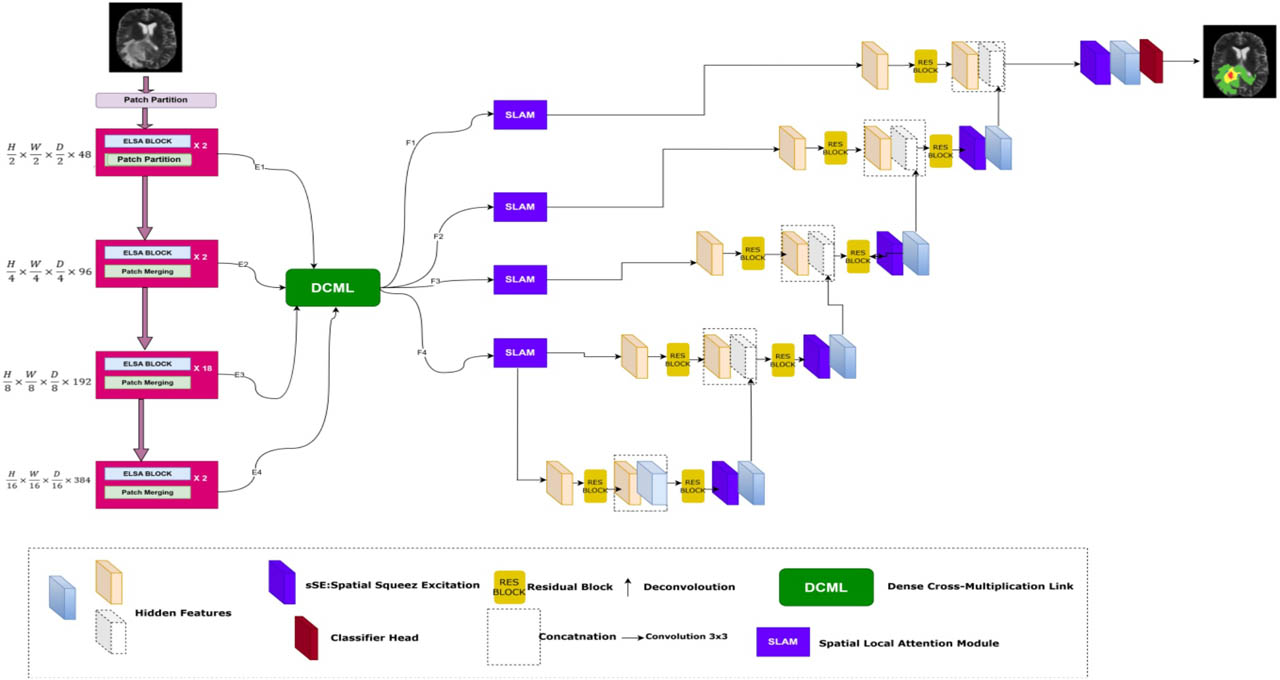
Figure 2.
SwinNetPlus Architecture
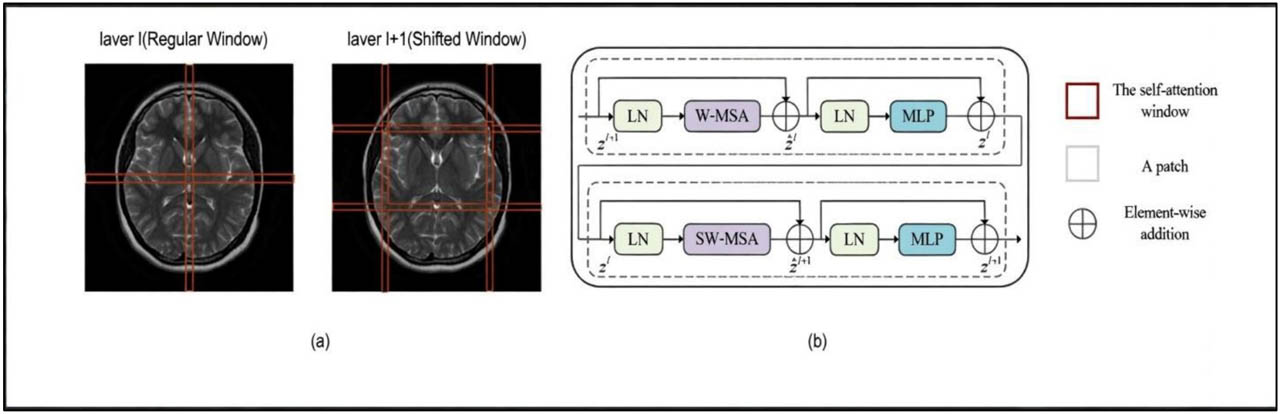
Figure 3.
The Swin Transformer architecture comprises distinct components. (a) Self-attention computations within adjacent layers l and l +1 utilize both regular and shifted windows. (b) Further insights into the intricacies of the Swin Transformer are provided
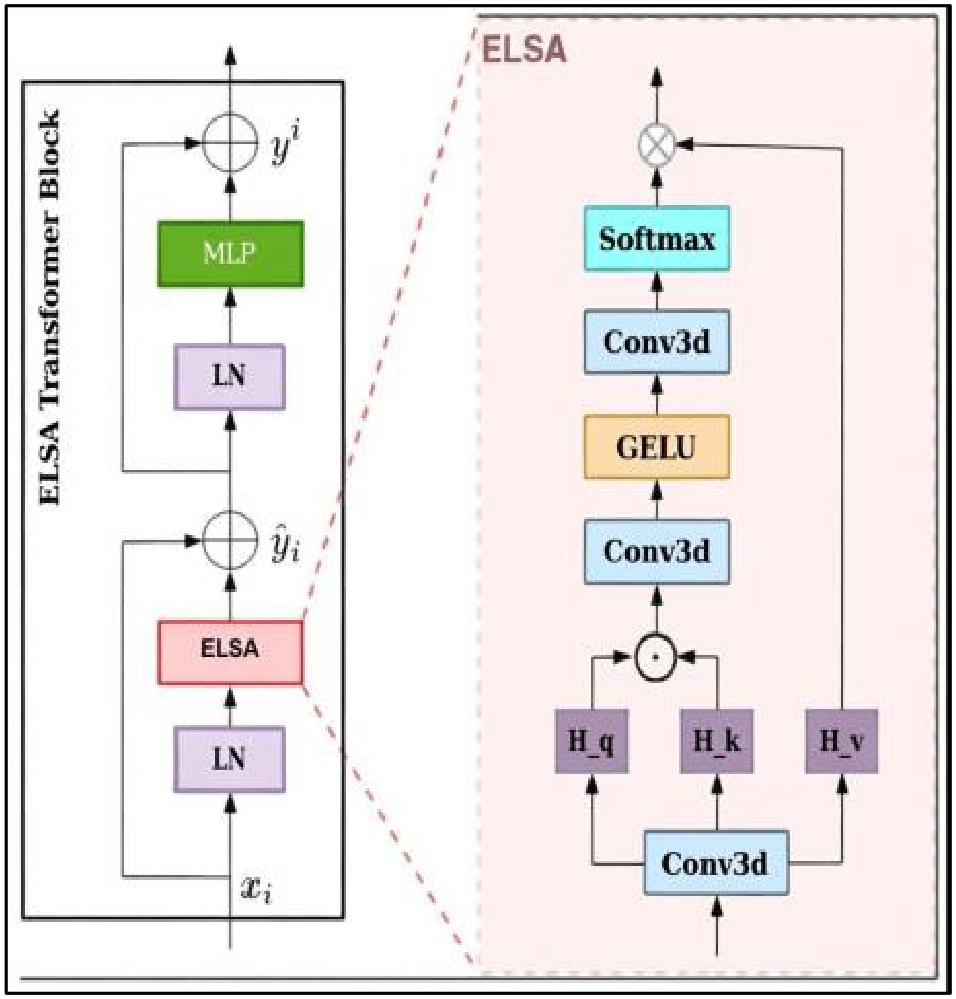
Figure 4.
Swin Transformer with ELSA Block [20]
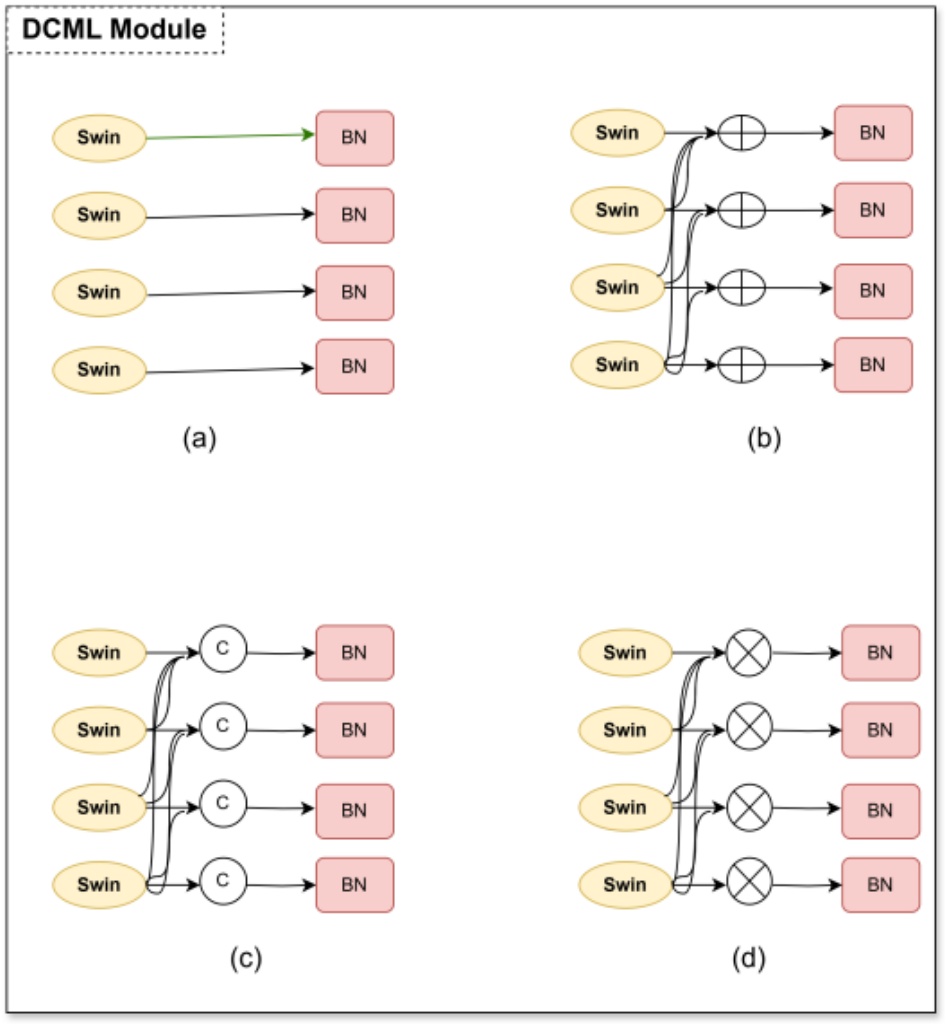
Figure 5.
DCML Module
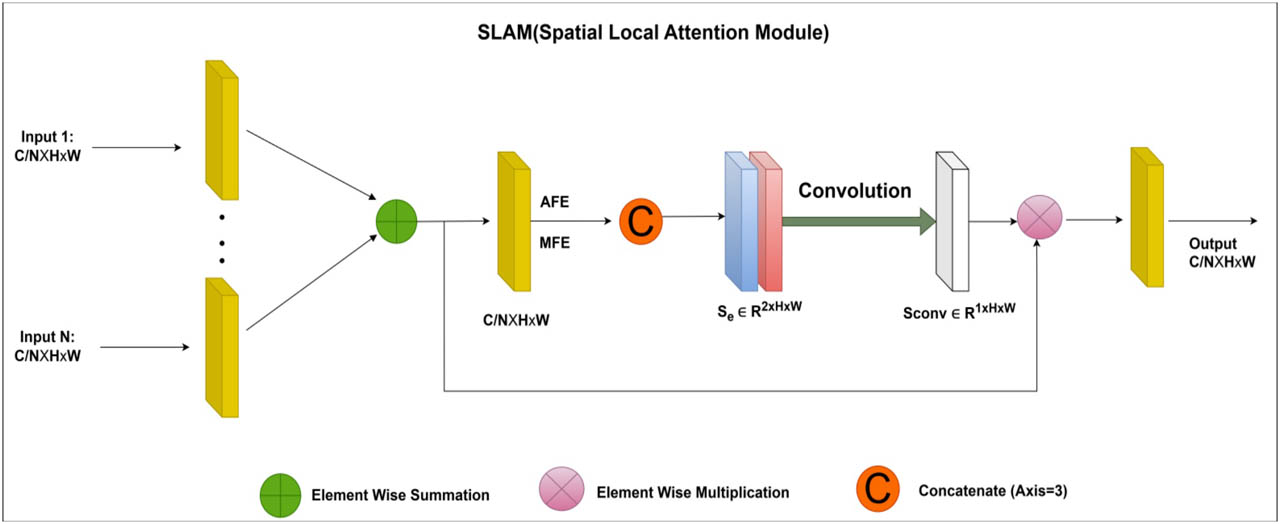
Figure 6.
The architecture of the SLAM module
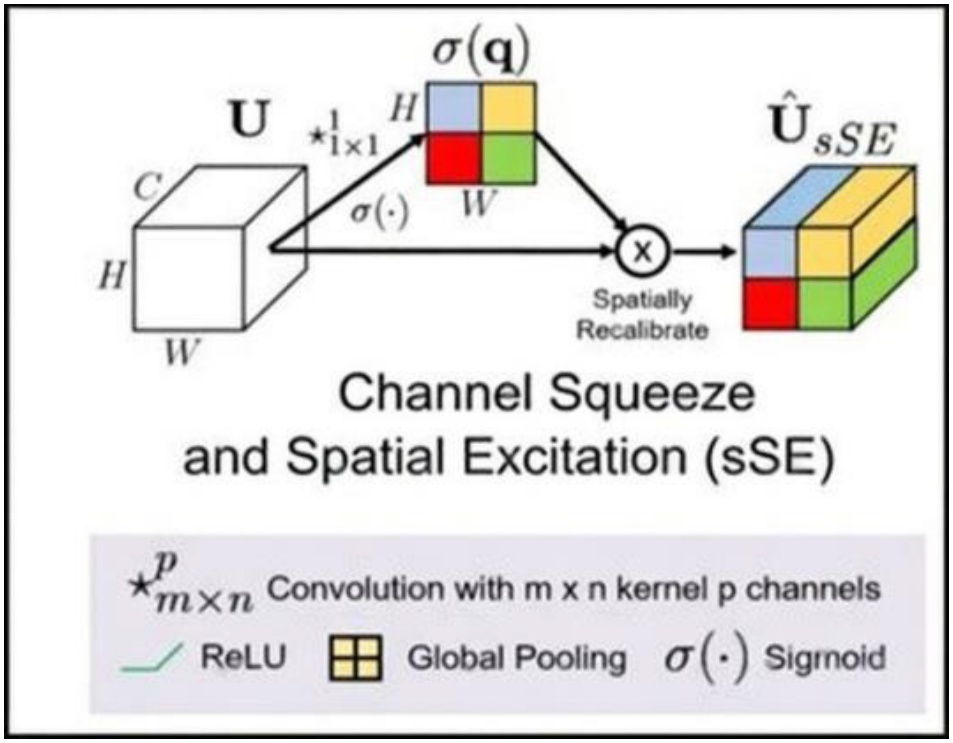
Figure 7.
Channel Squeeze and Spatial Excitation (sSE[21])
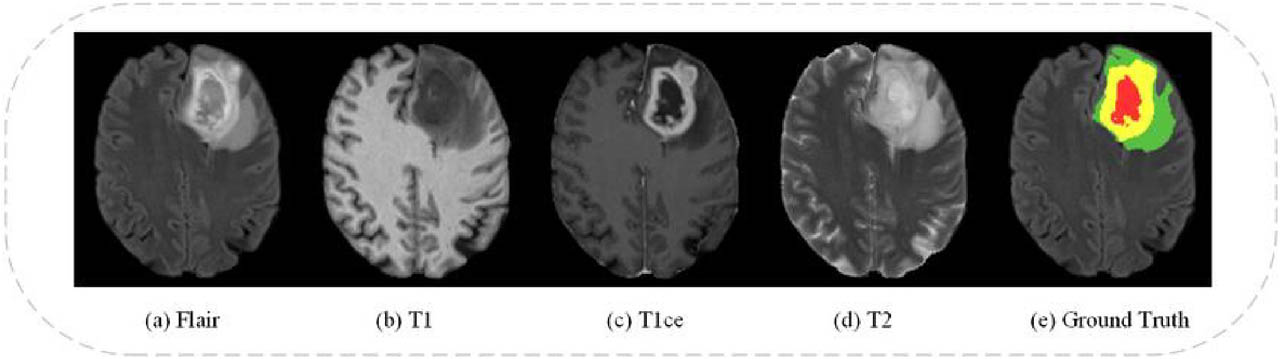
Figure 8.
Illustration depicting various modalities of BraTS 2021[1]
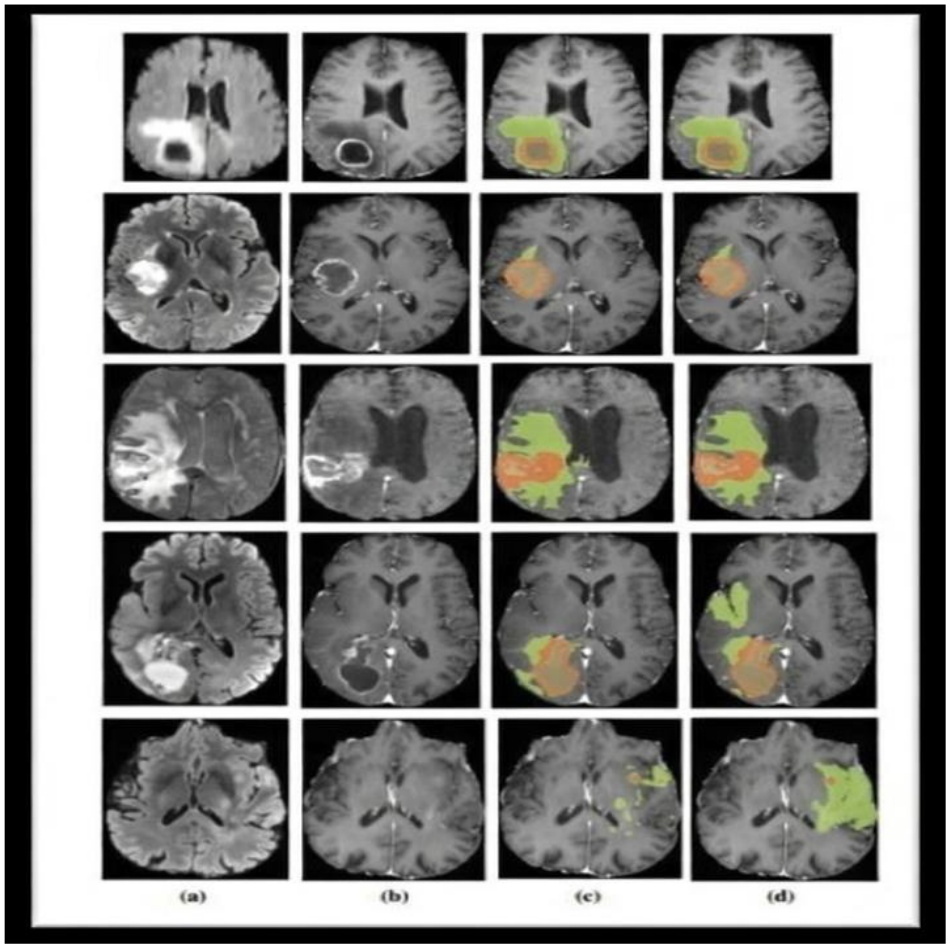
Figure 9.
Segmentation results of the proposed method: a. FLAIR, b. T1ce, c. proposed method, and d. ground truth segmentation
Table 1.
Summary of Key Related Works and Limitations
| Author(s) | Method | Key Contributione | Limitation |
|---|---|---|---|
| Long et al. [2] | FCN | End-to-end semantic segmentation | Poor boundary localization |
| Ronneberger et al. [3] | U-Net | Encoder–decoder with skip connections | Limited global context |
| Zhou et al. [4] | UNet++ | Nested skip connections | Increased complexity |
| Çiçek et al. [5] | 3D U-Net | Volumetric segmentation | High memory usage |
| Dosovitskiy et al. [8] | ViT | Global self-attention | Computationally expensive |
| Liu et al. [9] | Swin Transformer | Efficient hierarchical attention | Weak local boundary sensitivity |
| Chen et al. [13] | TransUNet | Hybrid CNN–Transformer | Feature inconsistency |
| Hatamizadeh et al. [14] | UNETR | Transformer encoder for 3D data | Requires large datasets |
| Jiang et al. [16] | SwinBTS | Swin-based brain tumor segmentation | Limited local attention |
| Ghazouani et al. [21] | Swin + ELSA | Enhanced local attention | Inadequate multiscale fusion |
| Xing et al. [17] | NestedFormer | Modality-aware transformer | High computational cost |
Table 2.
Segmentation outcomes observed on the BraTS 2021 validation dataset
| Method | Dice Score (%) | 95% Hausdorff Dist. (mm) | ||||||
|---|---|---|---|---|---|---|---|---|
| ET | TC | WT | AVG. | ET | TC | WT | AVG. | |
| UNETR[14] | 58.5 | 76.1 | 78.9 | 71.16 | 9.35 | 8.84 | 8.26 | 8.81 |
| 3DUNet[5] | 83.93 | 85.11 | 89.15 | 85.97 | 4.73 | 11.92 | 12.26 | 10.26 |
| NestedFormer[17] | 80 | 86.4 | 92 | 86.13 | 5.26 | 5.31 | 4.56 | 5.04 |
| SwinBTS[16] | 83.21 | 84.75 | 91.83 | 86.59 | 16.03 | 15.51 | 3.65 | 8.54 |
| SegTransVAE[22] | 85.48 | 90.52 | 92.6 | 89.53 | 2.89 | 3.57 | 5.84 | 4.1 |
| Swin UNETR[18] | 85.8 | 88.5 | 92.6 | 88.96 | 6.01 | 3.77 | 5.83 | 5.2 |
| Our Method | 90.12 | 94.19 | 93.77 | 92.69 | 7.32 | 4.4 | 4.31 | 5.34 |
Table 3.
Ablation study of SwinNetPlus on the BraTS 2021 validation dataset
| Model Variant | DCML | SLAM | Mult. Fusion | Dice Score (AVG) ↑ | 95% HD (AVG) ↓ |
|---|---|---|---|---|---|
| Baseline ( without DCML/SLAM) | ✗ | ✗ | ✗ | 87.15 | 6.93 |
| Baseline + DCML | ✓ | ✗ | ✓ | 88.76 | 6.15 |
| Baseline + SLAM | ✗ | ✓ | ✗ | 89.21 | 5.94 |
| Baseline + DCML + SLAM (Additive Fusion) | ✓ | ✓ | ✗ | 90.03 | 5.59 |
| Full Model (SwinNetPlus) | ✓ | ✓ | ✓ | 92.69 | 5.34 |
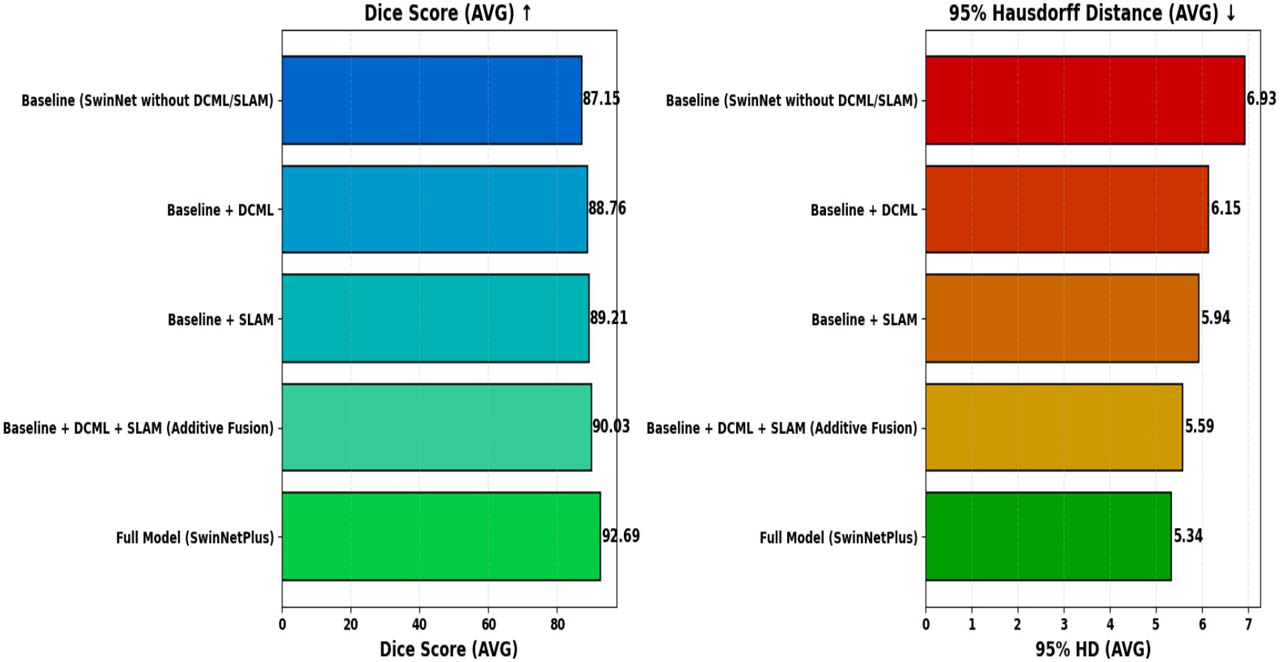
Figure 10.
Ablation Study Results of SwinNetPlus on the BraTS 2021 Validation Dataset