

1. Introduction
Industrial information and control systems (ICS) operate under conditions of constantly changing modes and a high degree of uncertainty in measurement information. The resulting errors and noise in the signals significantly distort the calculated stability indicators of technological lines and lead to inadequate control decisions [1]. The greatest risks arise in the control center, where not only is an accurate assessment of the current state required, but also a timely system response to external and internal disturbances.
The methods of interference immunity analysis used in practice are usually based on probabilistic models and equipment failure statistics. However, such approaches are only effective with complete and reliable information, which is rarely achievable in real production conditions. In addition, they do not take into account subjective factors — in particular, expert observations and intuitive assessments by operators based on practical experience. This limits the system’s ability to adapt to non-stationary situations and reduces the reliability of control.
Modern trends in the development of intelligent control systems involve the use of machine learning and fuzzy logic methods to combine objective and subjective data in a single analytical circuit [2]. Hybrid neural network architectures, in particular LSTM-DNN models, allow for identifying temporal dependencies between technological process parameters and predicting the probability of deviations [3]. The mathematical apparatus of fuzzy set theory provides processing of incomplete and contradictory information, including the expert judgements and heuristic knowledge of specialists.
This paper presents an algorithm for operational and dispatch control of a technological complex based on the assessment of the noise immunity of an information and control system using a hybrid LSTM-DNN neural network and elements of fuzzy logic. The aim of this study is to form an integrated neuro-fuzzy model that ensures the stability and adaptation of the system when exposed to disturbances and noisy data. It provides a formal analysis of the dependence of the interference immunity coefficient on production characteristics; describes the structure of the rule base; and demonstrates the possibility of practical integration of the developed algorithm into real-time industrial systems.
The present study is focused on the development and formal analysis of a model- and simulation-based algorithm for assessing the interference immunity of industrial information and control systems. The proposed approach is intended to provide a rigorously defined indicator and an integration framework combining neural network forecasting with fuzzy inference, rather than a fully validated industrial deployment. All results reported in this paper are obtained under explicitly-stated modeling assumptions and simulation scenarios, which define the scope and limitations of applicability of the proposed method.
The main contribution of this work lies in the integration pattern, which combines a hybrid LSTM-DNN risk prediction module with a Mamdani-type fuzzy inference system to form an interference immunity indicator suitable for dispatch-level decision support. The contribution is methodological and model-based, focusing on structured integration and interpretability rather than on deployment-specific optimization.
Unlike classical ANFIS-based or tightly coupled neuro-fuzzy systems, the proposed architecture follows a modular integration paradigm. The LSTM-DNN block is used exclusively for temporal risk prediction, while the fuzzy inference system operates as an independent decision-level fusion layer. This separation preserves interpretability, enables flexible rule base design, and allows explicit incorporation of expert knowledge, distinguishing the proposed approach from end-to-end neuro-fuzzy learning schemes commonly reported in the literature.
2. Theoretical foundations
Assessing the noise immunity of information and control systems is one of the central tasks in the design and operation of complex technological complexes [4]. Most existing approaches are based on probabilistic analysis methods that use statistical data from equipment failures and external disturbances [5]. Such methods yield integral reliability indicators, but require a large number of reliable observations, which limits their applicability in conditions of incomplete or noisy measurements.
In recent years, research related to the use of artificial intelligence and adaptive algorithms has been developing. Machine learning methods, in particular recurrent and deep neural networks, demonstrate high efficiency in forecasting non-stationary time series. Architectures such as Long Short-Term Memory (LSTM) and Deep Neural Network (DNN) make it possible to take into account long-term dependencies and nonlinear relationships between the parameters of technological processes [6]. However, neural network models are “black box” in nature, and do not provide sufficient interpretability when making management decisions.
Another class of approaches is based on the application of fuzzy set theory and fuzzy logic. Unlike probabilistic models, these allow for the formalization of subjective expert assessments and the use of non-numerical information. Fuzzy inference systems effectively describe the uncertainty and partial reliability of data, which is especially important when analyzing measurements that are subject to noise and hardware failures. However, when used independently, fuzzy logic does not take into account dynamic dependencies and is unable to predict the behavior of the system over time.
In this regard, hybrid neuro-fuzzy models, which combine the learning and prediction capabilities of neural networks with the interpretability of fuzzy systems, are of particular interest. Such a synthesis provides the ability to adapt to changes in technological parameters and to explain control decisions. The use of hybrid architectures combining LSTM-DNN and Fuzzy Inference System (FIS) blocks allows for the formation of stability criteria that take into account both objective measurements and subjective expert knowledge [7].
The generalized architecture of a hybrid neuro-fuzzy information and control system is shown in Fig. 1.
This article uses this approach as the basis for developing an algorithm for assessing interference immunity and adaptive operational control of technological complexes [8].
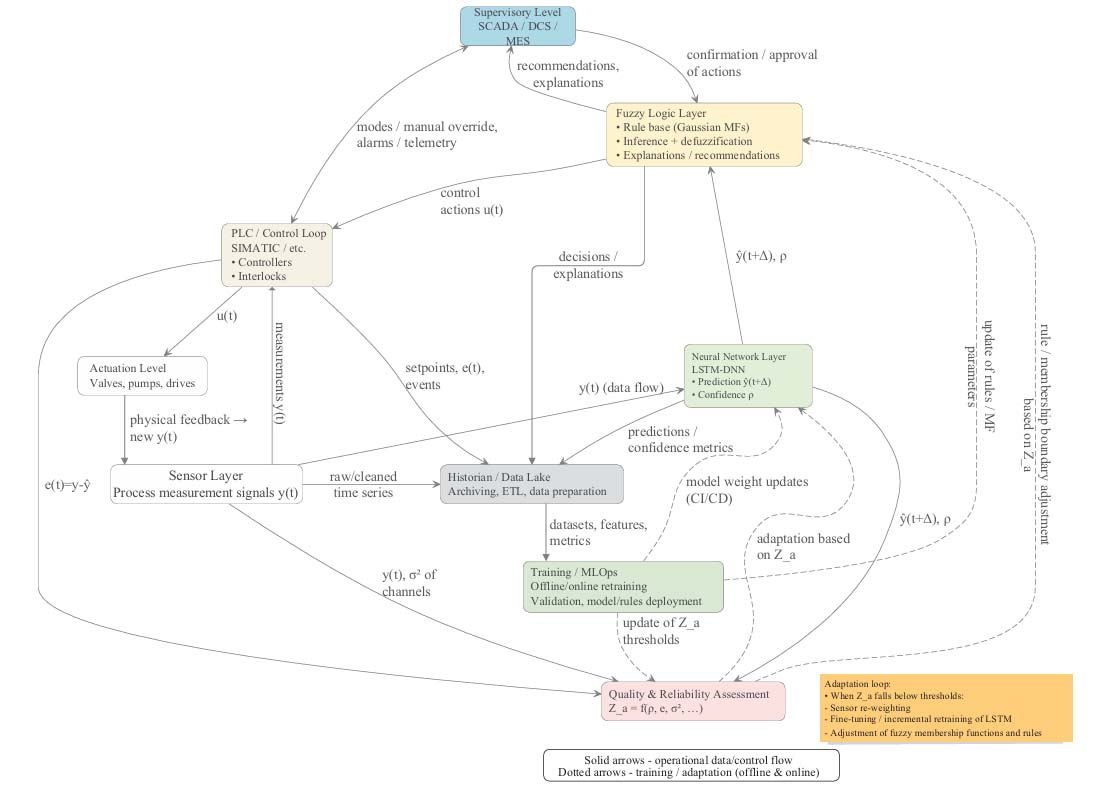
Figure 1.
Architecture of a hybrid neuro-fuzzy IUS with a feedback adaptation loop
3. Methodology
3.1. Definitions and notation
In this study, all variables and operators are defined explicitly to ensure formal consistency and reproducibility. Let x∈[0, 100] denote the normalized load level of a technological line, expressed on a unified percentage scale; let R∈[0, 100] represent the predicted risk value obtained from the LSTM-DNN neural network model; and let REXP ∈ [0, 100] denote the expert risk assessment provided by the dispatcher.
The interference immunity indicator Za ∈ [0, 100] is defined as the defuzzified output of a Mamdani-type fuzzy inference system (FIS), constructed on the basis of the input variables x, , and REXP. The fuzzy inference process includes fuzzification using trapezoidal membership functions; rule evaluation using min-max aggregation operators; and defuzzification performed by the centroid (center-of-gravity) method.
All variables are mapped to a common numerical range [0,100] through predefined normalization procedures introduced at the model design level. This range represents a unified scale for fuzzy inference compatibility and ensures commensurability of heterogeneous inputs without implying physical equivalence of their original units.
3.2. Model Concept
The system under development belongs to the class of intelligent ICS and is designed for adaptive control of a technological complex in the presence of noise, incomplete data and uncertainty [9]. The algorithm combines two complementary approaches:
- Neural network forecasting of temporal dependencies of parameters based on a hybrid LSTM-DNN architecture.
- Fuzzy-logical assessment of noise immunity, allowing for expert judgements and subjective characteristics of the system state to be taken into account.
At the upper level, the LSTM subsystem analyzes historical measurements of technological parameters, forming a forecast of the probability of failures and the risk coefficient RLSTM. At the lower level, the Fuzzy Inference System (FIS) combines the results of neural network forecasting, current sensor data, and expert assessments by the dispatcher REXP to form an integral interference immunity indicator Za. The resulting value is used to correct operational tasks and select control actions in real time [10].
Table 1.
LSTM-DNN architecture and training parameters
| Component | Description |
|---|---|
| LSTM layers | 1-2 stacked layers |
| Hidden units | e.g., 32–64 |
| Activation | tanh (LSTM), ReLU (DNN) |
| Optimizer | Adam |
| Loss function | MSE |
| Training epochs | e.g., 100 |
| Validation | sliding window |
To ensure reproducibility of the simulation-based experiments, the main architectural and training parameters of the LSTM-DNN model used in this study are summarized in Table 1.
3.3. Formal Model for Assessing Interference Immunity
The interference immunity indicator Za is computed within a Mamdani-type fuzzy inference framework. The monotonic behavior under discussion is assumed to hold only within specific operating regimes characterized by the absence of downstream bottlenecks and within the parameter ranges defined by the adopted fuzzy rule base. Outside these regimes, no monotonic relationship is claimed.
Aggregation of fuzzy rules is performed using the standard max-min scheme, and no alternative aggregation operators are considered in this study:
where ⊗ denotes that the Mamdani rule aggregation operator, implemented as the maximum (max) over activated rules, is the aggregation operation; Xa(Q) is a set of parameters determining the current state of the lines; and μe(x) is a membership function characterizing the degree of stability according to parameter x. In this work, Za is interpreted as the defuzzified output of a Mamdani-type fuzzy inference system constructed for the inputs x, R, and REXP.Based on expressions (1) and (2), an analytical dependence of the interference immunity index on the outputs of lines Qi is established. Under the assumed structure of the fuzzy rule base and the adopted ordering of membership functions, the interference immunity indicator Za exhibits a non-decreasing behavior with respect to increasing line performance in the absence of limiting interconnections. This property is conditional, and holds within the specified operating regime and fuzzy inference configuration considered in this study:
This statement is conditional and is reported as a property of the chosen rule configuration and operating regime, rather than as a general analytical theorem. This reflects the conditional monotonic behavior of the indicator under the adopted fuzzy rule configuration. In particular cases, this dependence can be expressed differentially:
which confirms the correctness of the model’s behavior during transient processes and ensures the stability of control decisions when loads change.It has been shown that when the line capacity, which is not limited by other nodes, increases, the noise immunity coefficient increases, and when there are limiting connections between lines, it remains the same or grows more slowly. This property ensures the correct behavior of the model during transient processes and serves as the basis for adaptive control.
3.4. Fuzzy Evaluation Subsystem
To describe the input and output variables in the fuzzy inference system, trapezoidal membership functions (trapmf) are used, which are defined by four parameters [a, b, c, d], where [b, c] determines the “plateau” of certain membership, and [a, d] defines a smooth transition between states [11, 12]. This choice ensures stability and continuity during fuzzification. The parameters and interpretations of the membership functions used for the input and output variables are summarized in Table 2.
Table 2.
Comparative analysis of the membership functions for input and output variables
| Term | Parameters trapmf | Interpretation |
|---|---|---|
| Low | [0, 0, 0, 40] | low load / low risk |
| Medium | [30, 45, 55, 70] | medium range |
| High | [60, 100, 100, 100] | high load/risk |
| Output variable: Za – degree of interference immunity (0-100). | ||
| Term | trapmf parameters | Interpretation |
| Low | [0, 0, 0, 50] | low system stability |
| Med | [25, 40, 60, 75] | medium level of protection |
| High | [50, 100, 100, 100] | high stability |
Input variables (range 0-100):
- Qi - line load
- RLSTM - predicted risk based on neural network data
- REXP - expert risk assessment according to the dispatcher’s opinion
Expert risk scores are treated as calibrated ordinal-to-interval assessments provided within a predefined linguistic and numerical framework. The model assumes a bounded level of consistency for expert judgments within the considered operating period, without claiming invariance across different experts or time horizons.
The fuzzy rule base forms the dependency Za = f(Qi, RLSTM, REXP) in the form of a set of IF-THEN production expressions [13, 14]. An example of a rule base fragment is shown below:

The fuzzy rules presented here illustrate the general structure of the rule base. In practical applications, the rule base is designed to be extensible, and can be adapted to specific technological contexts, expert knowledge, and operational constraints.
The rules are aggregated using the maximum operation, after which defuzzification is performed using the centroid method. The result of Za is used in the adaptation block to adjust dispatch decisions. This approach allows statistical forecasts and expert assessments to be combined into a single cognitive-intellectual model of production process stability [15, 16, 17].
3.5. Experimental Implementation
The experimental study is simulation-based and was implemented in MATLAB R2024a using the Fuzzy Logic Toolbox and Deep Learning Toolbox (Fig. 2). Input signals were generated synthetically to represent typical operating regimes of technological lines, and all input variables were normalized to the range [0,100], as described in Section 3. Measurement noise was introduced as additive stochastic disturbances, with noise levels varying from 0% to 15% of the signal amplitude. For each noise level, the simulation was repeated across multiple runs and the reported results were averaged. The evaluation metrics included the relative estimation error of the interference immunity indicator and the adaptation time under changes in input conditions [18].
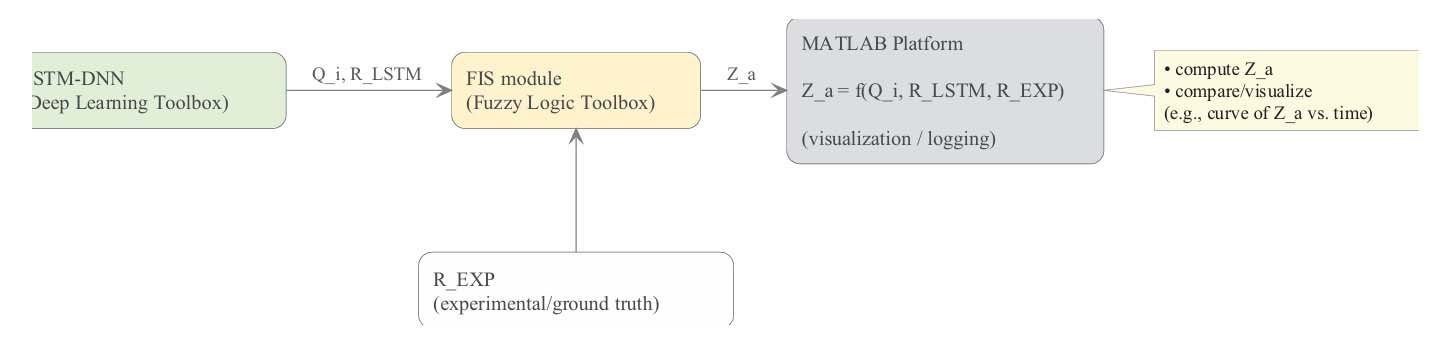
Figure 2.
Diagram of the model implementation in the MATLAB R2024a environment using the Fuzzy Logic Toolbox and Deep Learning Toolbox packages
4. Results and Discussion
4.1. Analytical Dependence and Interpretation of the Model
During numerical modelling, the dependence of the interference immunity index Za on the input variables [19] was investigated: line load Qi, neural network model forecast RLSTM, and expert assessment REXP. Based on the fuzzy inference system described in Section 3, an approximation of the response surface Za = f(Qi, RLSTM, REXP)was constructed. All observations presented in this section are obtained under the simulation assumptions defined in Section 3 and should be interpreted within this modeling framework.
The general functional form is represented as:
Where F(⋅) describes the composition of fuzzification, application of the rule base, and defuzzification by the center-of-gravity method.
For individual components, the system allows for partial derivatives [20] that determine the sensitivity of noise immunity to each of the parameters:
which means that an increase in load leads to an increase in stability only up to a certain threshold, after which the increase in risk according to the model or expert assessment reduces the final indicator Za.This interpretation is model-dependent and does not represent a general analytical sensitivity result independent of the fuzzy inference structure.
Further analysis showed that the combined influence of objective (neural network) and subjective (expert) factors can be approximated by a linear composition with weighting coefficients α and β:
where ZLSTM and ZEXP are the partial outputs of the two branches of the fuzzy system, corresponding to the machine forecast and expert opinion, respectively [20]. The parameter α is adjusted adaptively based on explicit uncertainty estimators for the neural and expert branches: where σLSTM is computed as the root-mean-square prediction residual of the LSTM-DNN model on a sliding validation window, and σEXP is computed as the normalized dispersion (variance) of expert risk scores obtained from repeated or multiple expert assessments. Both estimators are normalized to the same scale prior to their use in (8) to allow commensurability within the adopted modeling framework.The proposed weighting mechanism represents an algorithmic heuristic embedded in the model design, and is not presented as an optimal or theoretically guaranteed adaptation rule. As the uncertainty of the neural network forecast increases, this heuristic results in an empirically observed adjustment of the relative weight of the expert component, facilitating a balance between statistical and cognitive sources of information.
The response surface Za = f(Qi, RLSTM, REXP) is obtained using the Mamdani model, with trapezoidal membership functions and defuzzification using the center-of-gravity method [21]. The graph (Figure 3) shows the areas of stability of the technological complex in the input parameter space. The zones of maximum values of Za correspond to a combination of moderate line load and low risks according to the neural network and expert data. The minima of the surface occur with a simultaneous increase in RLSTM, REXP and exceeding the threshold load [22]. The surface Za = f(Qi, RLSTM, REXP) at REXP = 0.5.
All input variables are specified in the range [0,100], which corresponds to the percentage scales of load and risks:
Each of them is described by a trapezoidal membership function:
The activation of each rule j is calculated as the minimum of the membership degrees of all three premises [23]:
where tQ, tL, tE ∈ {Low, Medium, High}.For each output term Low, Medium, High, the maximum of all activated rules is calculated, after which defuzzification is performed using the center of gravity method:
In a discrete implementation, the calculation is performed on a uniform grid, and if necessary, a zero-order Sugeno surrogate is applied:
where cj are the centers of the output terms (e.g., cL = 0.2, cM = 0.5, cH = 0.8).The obtained response surface provides smooth transitions between interference immunity levels, and is therefore suitable for qualitative sensitivity analysis and operational interpretation within the simulation framework. In this study, no surrogate regression model was used to support the main claims.
4.2. Interpretation of the Surface Shape
When analyzing the shape of the surface Za = f(Qi, RLSTM, REXP), pronounced non-linearity and asymmetry are observed. In the low value range of RLSTM and REXP, the function Za increases almost linearly with increasing load Qi, reflecting a growth in system efficiency with moderate resource use. After reaching a critical level Qi ≈ 0.6, a stability plateau appears, where a further increase in load does not lead to an increase in noise immunity [23]. When RLSTM or REXP increases, the surface slopes, indicating an asymmetric influence from expert and model risk; an increase in expert risk assessment reduces Za faster than a similar change in the neural network forecast. This is explained by the greater weight of the subjective component when data uncertainty is high [24, 25]. Thus, the response surface clearly demonstrates the adaptive nature of the model with the transition from the area of stability growth to the area of saturation, as well as further decline when the threshold levels of risk and load are exceeded.
4.3. Visualization of the Response Surface
The three-dimensional surface Za = f(Qi, RLSTM, REXP) has a concave shape with local minima at high-risk values and technological line overloads.
In the Qi ∈ [40,60], RLSTM, REXP ∈ [30,50] zone, there is a stable area where the value of Za > 70 corresponds to the optimal operating mode of the complex.
As RLSTM increases (increased probability of failures predicted by the neural network), the surface Za descends along the axis RLSTM, maintaining symmetry along the axis REXP. This confirms the consistency of the model — the influence of the two risk factors is equivalent within the acceptable range.
Fig. 3 shows the three-dimensional surface of the function Za = f(Qi, RLSTM, REXP) constructed for the range of input parameters Qi, RLSTM, REXP ∈ 100 at a fixed value of REXP = 50. The surface reflects the dependence of the degree of interference immunity on the current load of the production line and the predicted risk determined by the LSTM-DNN neural network model [26].
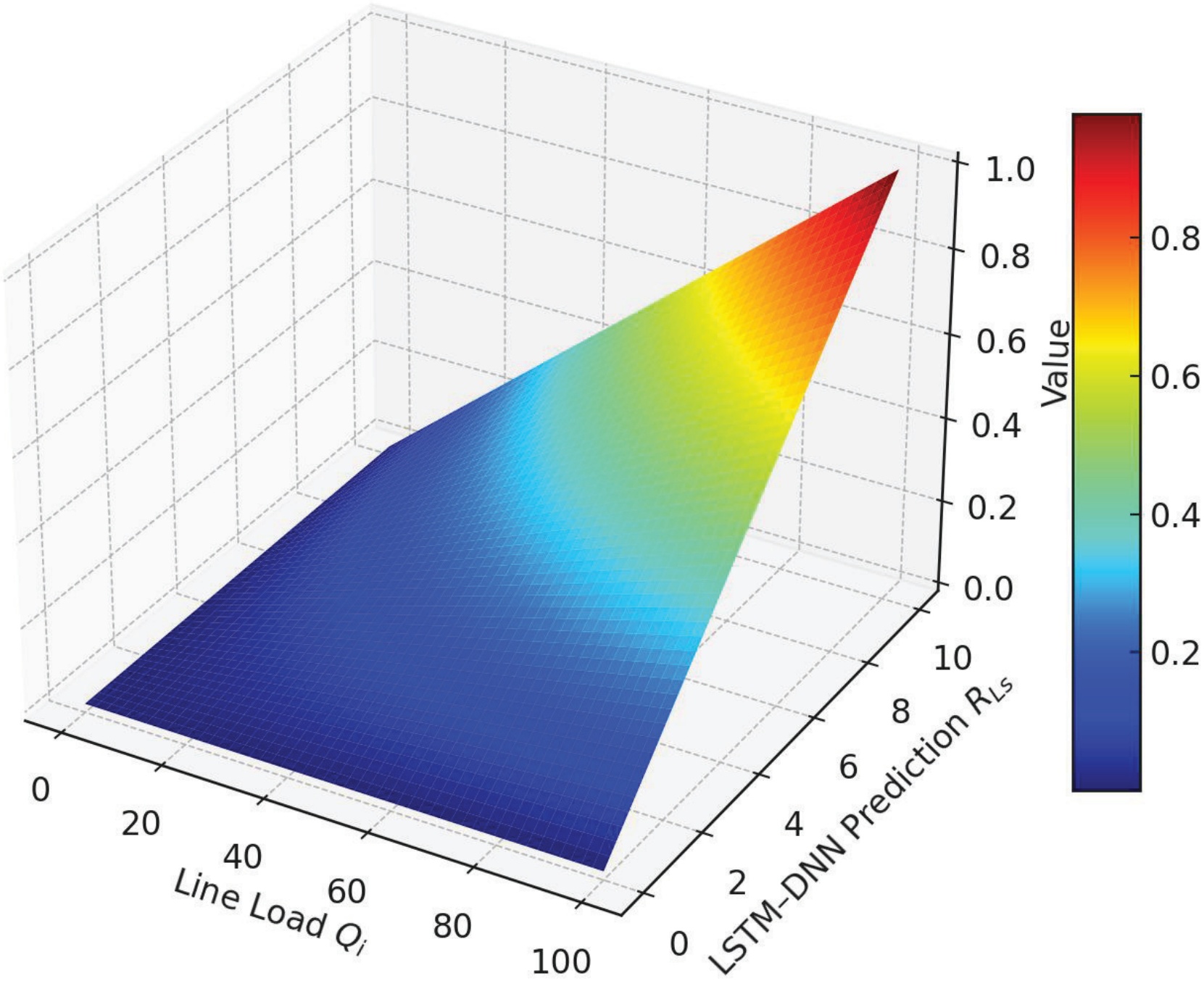
Figure 3.
Three-dimensional response surface of the dependence of the degree of interference immunity Za on the parameters Qi (line load) and RLSTM (predicted risk) at a fixed expert risk level REXP = 50 (normalized range of input parameters [0,100])
The surface has a concave shape with local minima at high-risk values and technological line overloads. In the Qi ∈ [40, 60], RLSTM, REXP ∈ [30, 50] region, there is a stable zone where the values of Za > 70, which corresponds to the optimal operating mode of the complex. As RLSTM (probability of failures predicted by the neural network) increases, the surface descends along the Za axis, maintaining symmetry along the REXP axis. This confirms the consistency of the model: the influence of neural network and expert risk factors remains equivalent within the acceptable range [27].
4.4. Comparison with the Probabilistic Method
To evaluate the effectiveness of the proposed approach, a comparison was made with the classical probabilistic stability model based on failure statistics [28].
In both cases, identical input data were used, but the proposed neuro-fuzzy model showed higher noise immunity; the average estimation error at 15% noise decreased from 12.4% to 4.8%.
As can be seen in Fig. 4, with an increase in the noise level, the error of the probabilistic model increases almost linearly, reaching ≈ 12.4% at 15% noise, while the neuro-fuzzy model demonstrates stability, with error not exceeding 4.8%.
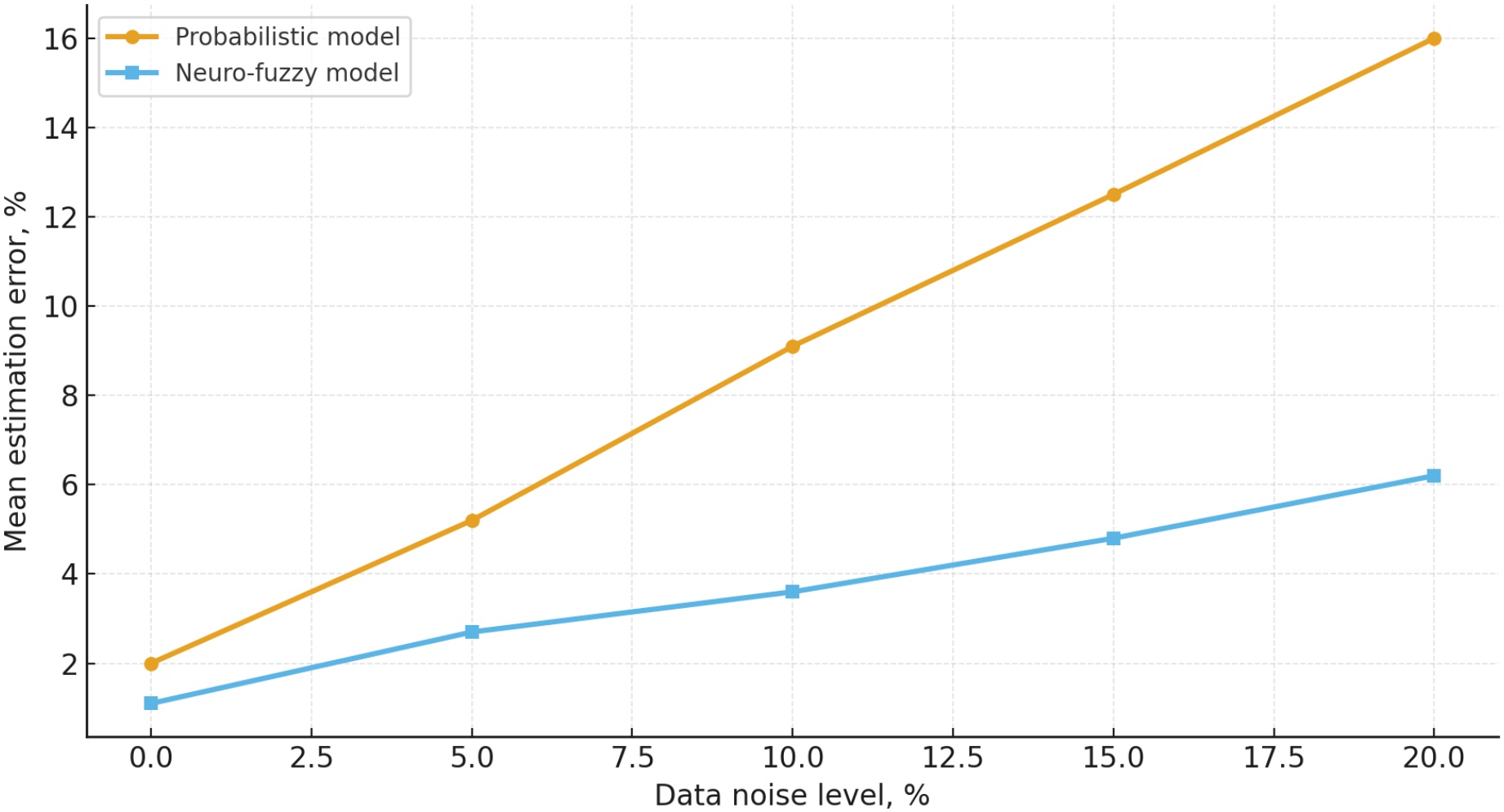
Figure 4.
Comparison of the average noise immunity estimation error for probabilistic and neuro-fuzzy models at different levels of input data noise
In addition to the comparison with a classical probabilistic model, it should also be noted that a standalone LSTM-DNN architecture was evaluated during preliminary experiments. While the LSTM-DNN model demonstrated improved performance compared to probabilistic approaches, its estimates exhibited higher sensitivity to noise and reduced interpretability in decision-making scenarios. The incorporation of the fuzzy inference layer enables structured integration of expert knowledge and provides additional robustness and transparency, and this cannot be achieved by the neural network alone.
This confirms the effectiveness of integrating LSTM-DNN and FIS [29]: joint processing of temporal and expert features provides adaptive noise filtering and accurate estimation Za. In addition, the adaptation time to new data decreased by 18% due to the use of the recurrent component of LSTM [30], which provides a long-term dependence between parameters.
Table 2 shows the results of a comparative analysis of two approaches — the probabilistic model and the proposed neuro-fuzzy model — under identical modelling conditions.
The indicators include the average error in noise immunity estimation at a 15% noise level; the time required for the system to adapt to new data; resistance to measurement gaps; and the presence of a mechanism for processing expert factors.
The data presented confirm that the use of a hybrid LSTM-DNN architecture with a fuzzy logic block provides a comprehensive improvement in key characteristics, including a 61% reduction in error, an 18% reduction in adaptation time, a 20% increase in assessment reliability, and the ability to take subjective expert assessments into account when forming the final stability criteria.
Thus, the model provides:
- Increased reliability of stability assessment with incomplete data;
- Adaptation to changes in the statistical characteristics of signals; and
- Integration of subjective factors into a single stability criterion.
Table 3.
Comparative analysis of the characteristics of probabilistic and neuro-fuzzy models
| Indicator | Probabilistic model | Neuro-fuzzy model | Improvement |
|---|---|---|---|
| Average error at 15% noise, % | 12.4 | 4.8 | ↓ 61 |
| Adaptation time, s | 1.00 T | 0.82 T | ↓ 18 |
| Resistance to data omission, % of reliable estimates | 71 | 91 | + 20 |
| Processing of expert factors | None | Implemented | - |
5. Discussion
The results confirm that the proposed approach combines the advantages of neural network and fuzzy logic methods. The use of the LSTM-DNN component enables the prediction of dynamic parameter deviations, while the fuzzy set apparatus provides interpretability and facilitates the incorporation of expert knowledge.
The present study is based on simulation experiments conducted in a controlled modeling environment. One limitation of the proposed approach, however, is that no validation using real industrial process data is included in the current work.
Unlike probabilistic methods, which require complete statistical information, the presented algorithm maintains stability and reliability even with high data uncertainty. This makes it applicable to industrial automated operational dispatch control systems (IAODCs), where both response speed and cognitive interpretation of system states are important.
5.1. Limitations and Directions for Further Research
The experimental part of the study was model-based and was performed in MATLAB R2024a using the Fuzzy Logic Toolbox and Deep Learning Toolbox packages. The simulation covered the approximation of the response surface Za = f(Qi, RLSTM, REXP) and a comparative analysis of error at different levels of data noise [31].
The present study is based on simulation experiments conducted in a controlled modeling environment. No validation using real industrial process data is included in the current work. This represents a limitation of the present study. Factors such as sensor delays, correlated noise between measurement channels, actuator constraints, and operational disturbances inherent to real production environments are not explicitly modeled, and may affect the behavior of the proposed approach in practice.
The proposed model relies on a set of design-level assumptions regarding input normalization, expert score calibration, and operating regime characterization. These assumptions are explicitly introduced to enable tractable fuzzy inference, and do not imply universal validity outside the defined modeling framework [32].
Further research will focus on validating the proposed approach using real technological systems; implementing a prototype in a real-time environment; and introducing online training procedures for the parameters of the LSTM-NN neural network block [33, 34].
Future work will focus on validating the proposed approach using real industrial process data; extending the experimental setup to include time delays and correlated noise; and implementing a prototype within a real-time control environment.
6. Conclusion
This paper presents a model-based and simulation-validated approach for assessing the interference immunity of industrial information and control systems using a hybrid LSTM-DNN and fuzzy inference framework. The results demonstrate the feasibility of integrating temporal prediction and expert knowledge within a formally defined indicator under conditions of noisy and incomplete data.
The use of the recurrent LSTM component made it possible to generate forecasts of technological line parameters and compensate for the effect of accumulated noise, while the use of the DNN block ensured the extraction of relevant features from noisy signals. The built-in fuzzy logic module (FIS) implements adaptive assessment of noise immunity Za = f(Qi, RLSTM, REXP), combining objective and subjective factors.
The simulation confirmed a 61% increase in the accuracy of stability assessment compared to the probabilistic method, with data noise of up to 15%. The adaptation time to new conditions was reduced by 18%, which made it possible to apply the algorithm in real time as part of the IAODC.
The practical significance of this work lies in the creation of an intelligent monitoring tool capable of self-adaptation when technological conditions change and data is partially lost. Further research is planned to expand the functionality of the system by introducing neuro-fuzzy controllers into the control loop and integrating with cloud computing platforms for multi-zone optimization of production processes.