

1. Introduction
Nowadays, environmental protection is a very important issue. Recycling is one of the most crucial methods used to protect the environment, and involves recovering raw materials by transforming substances or materials contained in waste in the production process to obtain the substance or material for the fate of primary or other purposes. Its main goal is to reduce the waste stored in landfills and conserve natural resources. In many European countries, waste segregation is done in households, i.e. at the beginning of the recycling pipeline, and involves dividing rubbish into groups such as metal, glass, plastic, paper, and organic waste. This approach makes using selective automatic techniques much easier than for municipal solid waste. However, most waste is still collected as mixed waste. Therefore, it is reasonable to strive to reprocess waste materials more effectively, and an alternative to a manual-automatic sorting process is highly sought-after. With the development of artificial intelligence, deep learning, and other intelligent technologies, it is possible to reduce the manpower and material resources required for the waste sorting process. Therefore, the main goal of this paper is to propose an efficient system for waste classification. goal of this paper is to propose an efficient system for waste classification.
2. Related Works
Two different categories of research on waste classification methods can be found in the literature: traditional methods and neural network methods. An exemplary traditional approach is applied in [1], which presents a Bayesian computational framework for material category recognition; the proposed augmented Latent Dirichlet Allocation (aLDA) model achieves a 44.6% recognition rate. An existing manual engineering model, an improved conventional machine learning algorithm, and a random forest classifier are used in [2] to obtain the best effect and improve prediction quality for emptying recycling containers. In [3], a mathematical statistics method is proposed to express individual bounded rationality and use the specific graph structure of a scale-free network to represent the group structure.
The results presented in this paper should have a positive effect on waste classification. It should be noted that traditional machine learning methods need the calibration of a large amount of training data. Algorithms such as k-Nearest Neighbor (kNN) and random forest (RF) perform a huge amount of calculations, and thus cannot fit the data and balance samples well. Therefore, it can appear that traditional machine learning technologies are not a suitable choice for waste classification. However, the advantage of neural network methods (specifically the convolutional neural network) over the traditional machine learning approach is shown in [4]. Accuracy levels obtained using kNN, Support Vector Machine (SVM) and RF were 88%, 85%, and 80%, respectively. By comparison, test accuracies of 93% and 91% were achieved using, a pre-trained VGG-16 CNN and AlexNet CNN respectively. The comparison of results obtained with traditional and neural network approaches can also be seen in [5].
There are many research works in the waste sorting literature that use neural network methods. In [6], published in 2016, the first important results in waste sorting using deep learning were obtained, leading to the development of TrashNet, a municipal waste database. database was used by authors to train two classifiers, SVM (Support Vector Machine) and CNN (Convolutional Neural Network), to classify images of waste into six categories: metal, paper, glass, plastic, trash, and cardboard. The former achieved an accuracy of 63%, while the latter did not learn well because of the hyper-parameter setup, and only 22% accuracy was achieved.
Following the results of [6], the same dataset was augmented in [7] and used to train Faster R-CNN, which obtained a better mean average precision of 68.3%.
Further research on the TrashNet (or TrashNet with some augmentation) dataset has provided better results. For example, a validation accuracy of 88.42% was achieved in [8] with VGG-19 CNN. The authors performed some adjustments to the hyperparameters, architecture, and classification on the fully connected layers. A precision of 84.2% and a recall of 87.8% were obtained in [9] using a Faster R-CNN based on InceptionV2 and pre-trained on the MSCOCO dataset. The study [10] experimented with several different deep CNN architectures — for example, DenseNet121, with a test accuracy of 95%, and Inception-ResNetV2, with a test accuracy of 87%. The same study proposed a novel architecture specific to the recycling material dataset, RecycleNet, which obtained a test accuracy of 81%.
In [11], the results showed a test accuracy of 87% after using a 50-layer residual network (ResNet50) as the extractor with an SVM classifier. A very high accuracy (98.7%) was achieved in [5] by using MobileNetV2 for feature extraction and an SVM classifier. In [12], several types of CNN are applied to municipal waste identification. Two types of object detectors are studied in this paper: Single Shot Detectors (SSD), which are fast and able to detect large objects, and Regional Proposal Network (RPN), which is very good at identifying small objects, but is slower than SSD networks. The highest accuracy (97.63%) was obtained with SSD MobileNetV2. The RPN model — Faster R-CNN architecture based on Inception-ResNet — achieved 95.76% accuracy.
The literature shows that the TrashNet dataset (and/or its augmentations) are widely used [4–12]. However, there are also authors who used their own dataset for their research. In [13], for example, the Labelled Waste in the Wild dataset is proposed and used for training the Faster R-CNN, which obtained 86% of the mean average precision. A custom garbage dataset for training a multilayer hybrid deep learning model (MLH) for waste classification was developed in [14], demonstrating that the MLH approach can achieve higher classification performance than the CNN-only model. This approach yielded accuracies of 98.2% and 91.6% under two different testing scenarios.
A multilayer hybrid convolutional neural network was also proposed as a waste classification method in [15] — another study based on the TrashNet dataset - and achieved an accuracy of 92.6%. Another interesting study can be found in [16], which proposed a deep neural network based on Faster R-CNN to detect coastal waste; the authors created a new waste object dataset named IST-Waste, and presented a model that obtained 83% of the mean average precision.
3. Materials and Methods
In many countries — but not all — pre-sorting of garbage already occurs at home.
Therefore, in some sorting plants, it is necessary to sort waste into individual fractions. This is a timeconsuming and costly job, and that is why automatic sorting systems are appearing more and more often. In this study, we propose a simple method based on the analysis of the histograms of photos of waste. A camera will be placed on a conveyor belt, and the captured photo will be sent to a computer for analysis and decision-making. Then, each type of rubbish is directed to the appropriate container with the help of a mechanical arm. Another way to use the proposed method is with a portable microcomputer that an employee can use to classify types of waste. The basic prerequisite when developing this algorithm was that it should be simple and fast, so that it could be used in the sorting plant in realtime.
First, we load the image, and a cascading object detector uses the Viola-Jones algorithm to detect plastic waste in the digital image. In the preliminary tests, we adapted the detector to our task, teaching it how to detect garbage using images from the database used in the experiment. After detecting the object, the region of interest (Rol) is extracted from the RGB image. In the next step, we compute a histogram for each R, G and B component of the RoI. The histogram is then analysed by comparing the sums of the ranges of the starting (A) and ending (B) parts of the histograms. For example, we might add the first 100 and last 100 elements of the histogram together and compare the two sums. In the case of plastic, the first sum will be higher, while in the case of other opaque materials, the second sum will be higher (Figures 2 and 3). In the last phase, a decision is made to classify the facility as “Plastic” or “Not Plastic.”
Algorithm
- load the photo I;
- detection of the object D on I;
- select the area I2 from I contains object D;
- calculate the histogram of I2 for each RGB component separately;
- select ranges A and B ;
- calculate the sum of elements range A and B;
- compare sums;
- make decision: Plastic / not Plastic
In Figures 1 and 2, we can see the calculated histograms for a non-plastic object (Fig. 1) and a plastic object (Fig. 2). We use the equation:
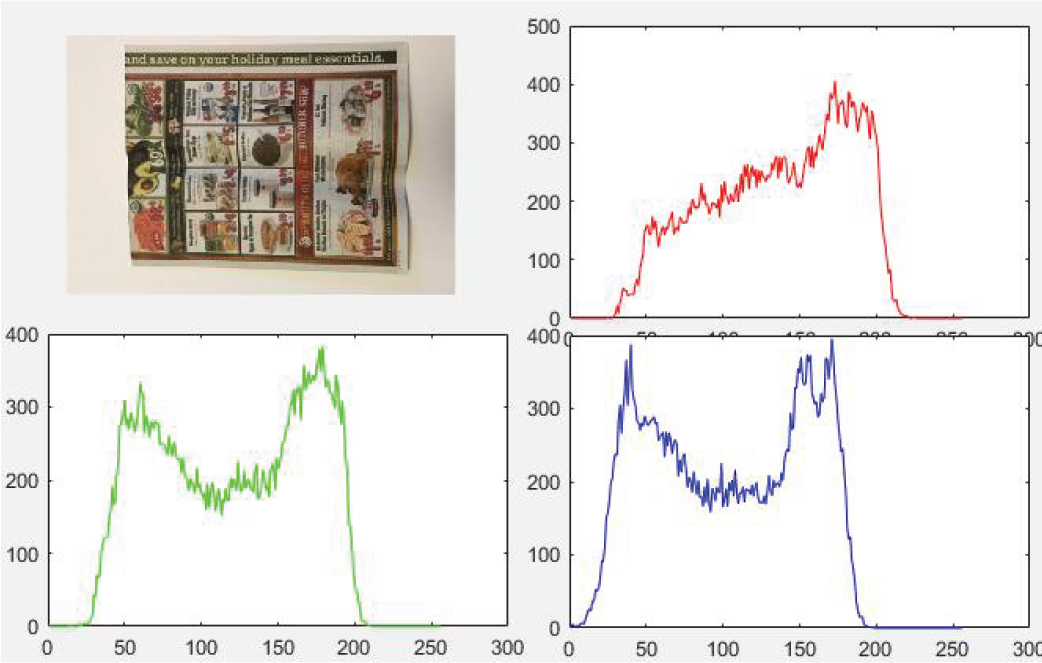
Figure 1.
Histogram of a non-plastic object
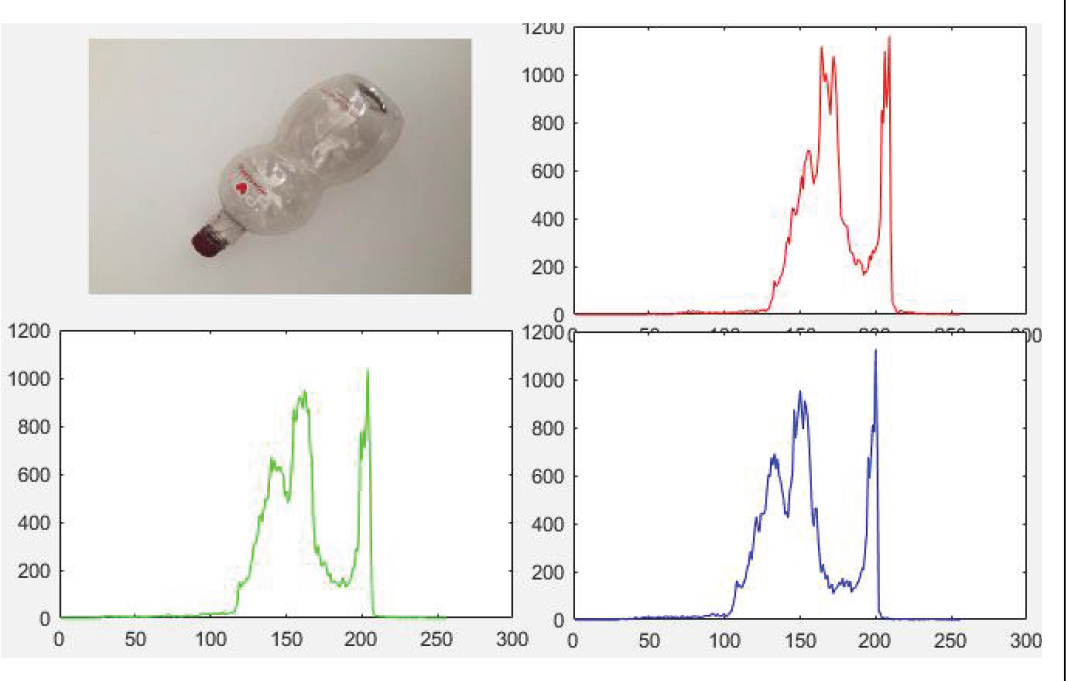
Figure 2.
Histogram of a plastic object
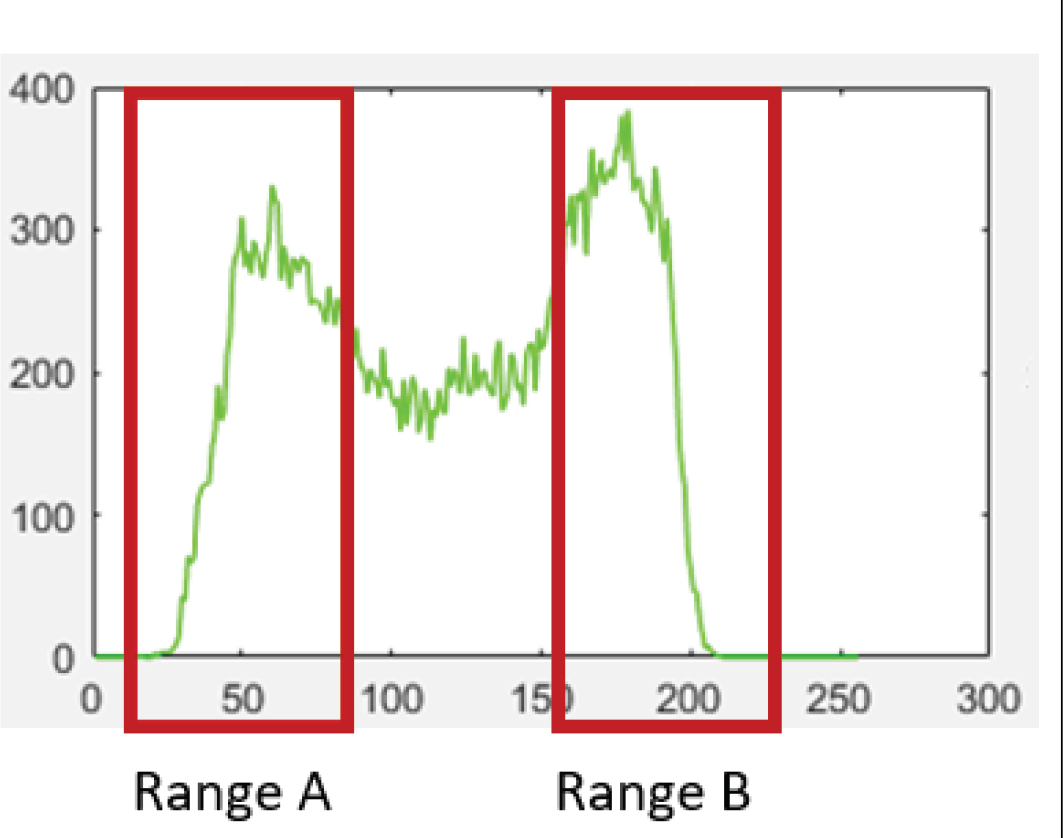
Figure 3.
Histogram of an image ofa plastic object
3.1. TrashBox Dataset
We used the TrashBox dataset for waste classification in the experiment [17], which contains 17,785 waste object images scraped from the website. Images don’t contain detection annotations provided in the repository. In this study, we use 5,000 random images from all categories. Image parameters are as follows:
Size: 512 × 384 pixels
Color depth: 24 bits
Resolution: 96 dpi
Format:.jpg
Waste categories are as follows:
Trash waste: random; the number of images = 2, 010.
Plastic: bags, bottles, containers, cups; number of images = 2, 669.
Paper: Tetra Paks, newspapers, paper cups, paper tissues; the number of images = 2, 695.
Metal: beverage cans, scrap, spray cans, food-grade cans; number of images = 2, 586.
Glass: bottles; number of images = 2, 528.
Cardboard: number of images = 2, 414.
Hardware used in experiment: Processor: Intel Core i7 - 10700F - 8-core; RAM: 16 GB ; NVIDIA GeForce RTX 2080 Ti - 8GB GDDR6 197; HDD: SSD 1TB.
4. Results and Discussion
Table 1 presents the results of the main experiment. The object recognition task was tested based on the ranges of the histogram (Fig. 2). When analyzing the results, we can see that the selection of the element ranges from the histogram has a significant impact on the recognition results. A simple symmetrical split in half produces weaker results, as do selecting 100 extreme elements at each end of the histogram. The best results were obtained for asymmetric sizes of ranges A and B and their asymmetrical position. In addition, it is also recommended to select the range from the so-called overlap, that is, one that partially overlaps.
Table 1.
Results of experiment
| Range A | Range B | Accuracy [%] |
|---|---|---|
| 1-100 | 155-255 | 74 |
| 1-100 | 101-255 | 91 |
| 1-150 | 155-255 | 54 |
| 1-100 | 101-200 | 88 |
| 50-150 | 151-200 | 51 |
| 50-100 | 101-200 | 89 |
| 50-150 | 151-255 | 70 |
| 1-120 | 151-255 | 69 |
| 1-120 | 121-255 | 83 |
| 1-180 | 121-255 | 94 |
Table 2 shows the results of the second stage of the experiment, in which we tested the method’s effectiveness depending on the type of material from which the object in the garbage photo is made. We obtained the best results for mixed waste and plastic. We got the worst level of identification for metal. The reason for this may be the properties of the metal in the form of light reflections. Regardless, we achieved an average recognition rate of 94%.
Table 2.
The results of recognition using the Trashnet database
| No. | Type | FRR | FAR | Accuracy |
|---|---|---|---|---|
| 1 | Carton | 0 | 4 | 96 |
| 2 | Glass | 0 | 8 | 92 |
| 3 | Metal | 0 | 15 | 85 |
| 4 | Paper | 0 | 6 | 94 |
| 5 | Plastic | 0 | 2 | 98 |
| 6 | Trash | 0 | 1 | 99 |
| Average | 0 | 6 | 94 |
Table 3 shows a comparison of our proposed method with other known methods. Compared to the methods that use artificial neural networks, particularly convolutional networks (CNN), the proposed method is less effective due to lower computational complexity. This is an advantage when we want to use a method on a mobile device or in real-time; however, compared to other methods using KNN, SVM or Random Forest, asymmetric histogram analysis provides better results.
Table 3.
Comparison to other methods
| Study | Year | Dataset | Method | Accuracy [%] |
|---|---|---|---|---|
| [6] | 2016 | TrashNet | SVM | 63 (test accuracy) |
| CNN | 22 | |||
| [7] | 2017 | TrashNet | Faster R-CNN | 68.3 (mAP) |
| [8] | 2018 | TrashNet | VGG-19 CNN | 88.4 (validation accuracy) |
| [9] | 2018 | TrashNet | Faster R-CNN based on Inception V2 | 84.2 (precision) 87.8 (recall) |
| Dense Net2 11 InceptionRes | 95 (test accuracy) | |||
| [10] | 2018 | TrashNet | NetV2 | 87 (test accuracy) |
| RecycleNet | 81 (test accuracy) | |||
| Pretrained VGG-16 CNN | 93 | |||
| [4] | 2018 | TrashNet | AlexNet CNN | 91 |
| KNN Random Forest | 88 85 | |||
| SVM | 80 | |||
| [11] | 2019 | TrashNet | ResNet50 CNN with SVM Classifier | 87 |
| [5] | 2020 | TrashNet | MobileNet V2 | 98.7 |
| [12] | 2020 | TrashNet | MobileNet V2 | 97.6 (precision) 94.4 (recall) |
| Faster R-CNN based on Inception ResNet | 95.8 (precision) 94.4 (recall) | |||
| [13] | 2019 | LWW | Faster R-CNN | 86 (mAP) |
| [14] | 2018 | Custom dataset | Multilayer HybridCN N (MHS) | 98.2 (accuracy) 98.5 (precision) 99.3 (recall) |
| [15] | 2021 | TrashNet | Multilayer Hybrid CNN (MLHCNN) | 92.6 |
| [16] | 2021 | ISTWaste | Faster RCNN | 83 (test mAP) |
| [18] | 2021 | Wadaba | CNN | 74 (accuracy) |
| Own work | 2022 | TrashNet | Histogram | 94 (accuracy) |
The analysis of the results we obtained allows us to conclude that the idea of applying the asymmetric histogram analysis turned out to be correct, and that the obtained results allow for its implementation in real conditions.
5. Conclusion
The paper presents a method of recognizing domestic waste using computer vision techniques. We used a simple scheme to analyze the asymmetry of the histogram of a digital image of a garbage object. The conducted research confirms that the use of simple image analysis techniques allows for the construction of effective methods for identifying or classifying objects. The method proved to be 94% effective, which is a satisfactory result, and allows the process to be used in real systems, particularly on mobile microcomputers. This implementation calls for its wider application and further development in the area of waste management.
Despite the many years of struggle with this problem, it remains current. Work on comprehensive waste management systems is still ongoing. New projects sponsored by global concerns are being launched to reduce the scale of the problem, but there is still a lot of work to be done. Therefore, research should still be conducted to develop effective methods for automating the recycling processes.
Notes
[1] Contributed by Author Contributions: Conceptualisation, J.B.; methodology, J.B.; software, J.B.; validation, K.P.; formal analysis, K.P.; investigation, J.B.; resources, K.P.; data curation, K.P.; writing—original draft preparation, K.P.; writing—review and editing, J.B.; visualisation, J.B.; supervision, J.B.; funding acquisition, K.P. All authors have read and agreed to the published version of the manuscript.
[2] Conflicts of interest Conflicts of Interest: The authors declare no conflict of interest. The funders had no role in the design of the study; in the collection, analyses, or interpretation of data; in the writing of the manuscript, or in the decision to publish the results.