

1. Introduction
The Resource-based view (RBV) provides a framework for examining the development of sustainable competitive advantages over time [1], which maintains that strategic resources could lead to sustained competitive advantage [2]. This approach suggests that organizational diversity and heterogeneity create resources and capabilities that establish a competitive position. From this theory, dynamic capabilities view emerges, where it assumes that the value of strategic resources will erode over time as trends evolve [3]. Hence, more than justhard-to-replicate assets are needed; it is essential to equip oneself with capabilities to create, expand, and update the organization’s asset base. Building on the outlined theoretical foundations, the role of innovation as a capability is established as crucial in value creation.
Innovation capability represents the exploitative potential of knowledge, from its exploration and seizing within and outside the company [4]. Innovation involves a comprehensive process of knowledge exchange with the implementation of new ideas, products, processes, or services [5]. Therefore, innovation can occur within the business model, embodying the delivery of value and enabling organizations to adapt and position themselves in the value chain [6].
Innovation is influenced by enabling conditions and is linked to human, organizational, or environmental knowledge and capabilities [7]. In the agricultural context, these factors facilitate the emergence of new ideas that use existing resources and capabilities to identify opportunities and innovative solutions [8,9], but it lacks infrastructure and technology needed to develop capabilities to stimulate innovation [10]. To solve that, farmers are conformed associative units that help producers to gain bargaining power, reduce production costs, improve productivity and marketing, and manage price uncertainty [11], where cohesion derives from the links of trust and cooperation that promote participatory work schemes among its members [12]. Likewise, a business model may involve a collaborative process that includes partnerships to address common issues and achieve social and financial goals, i.e., associating with others allows organizations to market with lower investments at an individual level [13]. Therefore, analyzing the innovation capabilities and business models of these organizations can provide insight into their success factors and how to address challenges using their unique skills and preferences to make significant and novel changes to the key components and architecture of a business model [14]. While the agricultural sector requires participation from both public and private entities, small producers can develop their own innovative approaches considering their unique circumstances [15]. For instance, in emerging economies such as Colombia, farming organizations face significant obstacles in obtaining direct and fair access to various resources that could potentially provide competitive advantages. Although possessing knowledge and experience across various domains, these organizations struggle to identify the factors that enable the establishment of innovative, inclusive, and profitable negotiation models.
Therefore, it is imperative to explore new theoretical approaches that align with the realities of these organizations, facilitating a comprehensive discussion of their organizational dynamics.
The main aim is to analyze the interaction between innovation capabilities and elements of the business model of farming organizations in Boyacá, Colombia. It focuses on analyzing the factors that affect innovation from dynamic capabilities perspective within the business models of the organizations that bring together farmers. This used the Partial Least Squares Path Modeling (PLS-PM) method to estimate the proposed theoretical model and a representative sample of farming organizations in Boyacá are used as well. This method examines complex multivariate relationships between observable and latent variables [16]. Seven hypotheses are evaluated considering the relationships between innovation capabilities (Sensing, seizing, and transformation) and business model innovation (creation, delivery, and value capture) in farming organizations. Findings highlight a strong correlation between innovation sensing and seizing capabilities and the creation and delivery of business models. The document is structured as follows: Section 2 presents a theoretical foundation. Section 3 shows the methodological component to validate the hypotheses suggested in the theoretical model. Sections 4 and 5 present results and a discussion on the estimation of the model. Finally, Section 6 shows the conclusions drawn about the related elements.
2. Theoretical Framework
2.1. Dynamic Capabilities
Extensive research has been conducted on the creation and development of competitive advantages in organizations. Previous studies have analyzed the dynamics of strengths and measures to mitigate potential threats that can lead to a favorable competitive position [17]. These studies examined the resources, capabilities, and strategies that are comparable among different companies in a specific industry but unique in obtaining a competitive advantage [1]. Capabilities are resources used to gain a competitive advantage, whose value is determined by the market context [18]. They develop at different rates and have life cycles that demonstrate how they are configured to generate advantages [19]. Lawson and Samson [20] argue that capabilities enhance management and resource utilization for innovation and technological development through learning processes, product development, and process improvement (p. 379). Likewise, capabilities undergo a continuous adaptive process, in which strategic management adjusts, integrates, and restructures both internal and external elements, i.e., it is the ability to consistently reinvent capabilities in response to a changing environment [21]. Thus, this perspective suggests that the development of new capabilities are an opportunity to achieve sustainable results within organizations over time in line with changing environments [18].
Finally, this dynamic in capabilities development promotes the ability to innovate, due to how it involves a continuous process of utilizing, exploring, and exploiting knowledge to create new products, services, or processes [6]. Indeed, innovation in this dynamic is known as innovation capability, for it is constantly engaged in the use, exploration, and harnessing of knowledge. Hence, innovation capability translates knowledge into pioneering products and services that can adapt to the ever-changing environment [4].
2.2. Innovation Capabilities
Innovation capabilities are part of a dynamic process that can be explained by the micro-foundations of sensing, seizing, and transforming [2]. Sensing involves identifying opportunities through skills such as exploration, knowledge generation, and networking. This process includes discovery and exploration of knowledge for subsequent absorption and exploitation [4,22]. Likewise, the knowledge and information acquired can be used to exploit opportunities in various industries and markets. Seizing capabilities involves the efficient exploitation of these opportunities, providing a competitive advantage by capitalizing on emerging trends and advancements [6]. Transformation capabilities are vital for long-term competitiveness, as they allow organizations to adapt by reconfiguring resources and processes [6]. Transformation process enables the use of knowledge in the form of innovation, transfer, or exploitation that is appropriate for the organization [4]. Indeed, it highlights the importance of having strong leverage and transformation capabilities to achieve sustained competitive advantage [3]. Thus, these microfoundations can be understood as a staged model with a significant interdependence between its elements for its development in organizations [23–25]. Each stage is crucial for the development of innovation capabilities in organizations. In that sense:
H1a: The Sensing capacity is the determining factor for the existence of a seizing capacity.
H1b: Seizing capacities are a determining factor for the existence of transformative capacities.
2.2.1. Business Model Innovation
The business model is critical to the dynamic ability of an organization to adapt and succeed in an everchanging environment, and its significance lies in the strategic positioning of the organization within the value chain [6], reflecting changes in the fundamental elements and architectural framework of the business model [14]. Business model innovation entails leveraging internal and external resources and capabilities to create value, deliver new proposals for firm’s segments, and generate sustainable profits, ensuring that revenue covers costs [26]. This innovation process may follow a sequential trajectory, marked by distinct features for transitioning from one stage to the next [23–25].
Notably, business model innovation can manifest in various dimensions, including shifts in industry mindset, alterations in the delivery of value, and adaptations in the conditions for capturing value [23]. In essence, business model innovation involves the integration of the three value domains to create innovation, deliver products, services, technology, and information flows of y capture value in a growth cycle [26]. In that sense:
H3a: Innovation in creating value is critical to innovating in delivering value,
H3b: Innovation in delivering value is critical to innovating in capturing value.
2.2.2. Sensing and Value Creation Capabilities
Identifying business opportunities that arise from market and industry trends is crucial for business model innovation. The ability to sense these opportunities is essential for adapting to a dynamic environment [24,27]. To identify new opportunities, organizations should engage in exploration, creation, and learning activities that enable them to anticipate and identify key environmental signals [23]. These signals will enable greater flexibility in adapting and continuously renewing the organization’s underlying business model [28]. Value creation necessitates continuous observation of the environment beyond the current customer. It is crucial to possess an exploratory capability that can identify opportunities [26] to gain a better understanding of opportunities and threats [29]. To comprehend the significance of integrating new knowledge with the organization’s capabilities to create cultural and economic value, a convergent view of the organization is essential. Kiani et al. [30] argue that integrating in a dynamic environment is crucial for an organization’s success. In that sense:
H2a: Sensing capabilities influence innovation in the value chain of agricultural organizations.
2.2.3. Seizing Capabilities and Value Delivery
During the seizing stage, organizations aim to recombine their technology, resources, knowledge, and market to take advantage of emerging opportunities. These opportunities typically manifest as changes in the organization’s value delivery, such as new products, processes, or services. However, to maintain and improve technological competencies, it is necessary to invest in design and processes, strive for quality improvement, and make necessary investments to gain market acceptance [2]. This type of change often generates tensions, so it is important to possess skills to manage expectations and foster acceptance and buy-in in the face of defensive attitudes that may arise during the process [23]. Changes to the value delivery are crucial as they directly impact the solutions offered to customers and how they are presented. It is essential for an organization’s success in scaling new products and services and enhancing the customer offering to incorporate seizing capabilities [26,30]. Thus, the renewal process cannot be completed solely with the existing resource base.
To take advantage of market opportunities, it is recommended to develop new capabilities, create a different offering, and foster a culture that reduces resistance to change during the transition period [24]. Key elements for success are delivering value and innovation. In that sense:
H2b: Seizing capacity influences innovation in the value delivery of agricultural organizations.
2.2.4. Transformation and Value Capture Capabilities
Transformational capacity is essential for achieving sustainability and is closely linked to sustaining the new business model. It enables the organization to share its knowledge with the outside world to reap benefits [31]. This capability is considered the final stage in the process of structural innovation and sustainability of the business model [25]. Ensuring sustainable performance requires understanding how firms generate cost-covering revenues and profits [26]. Value capture involves not only setting prices but also considering factors such as timing and effectiveness, which can impact customer interactions and the sustainability of a value-based pricing strategy [32]. Hence, the ability to recombine capabilities and adapt to change is crucial in supporting the new business model with existing resources, organizational design, and culture [23]. In that sense:
H2c: Transformation capacity influences innovation in value capture by agricultural organizations. Once the hypotheses of the theoretical model have been presented, they are consolidated in Figure 1:
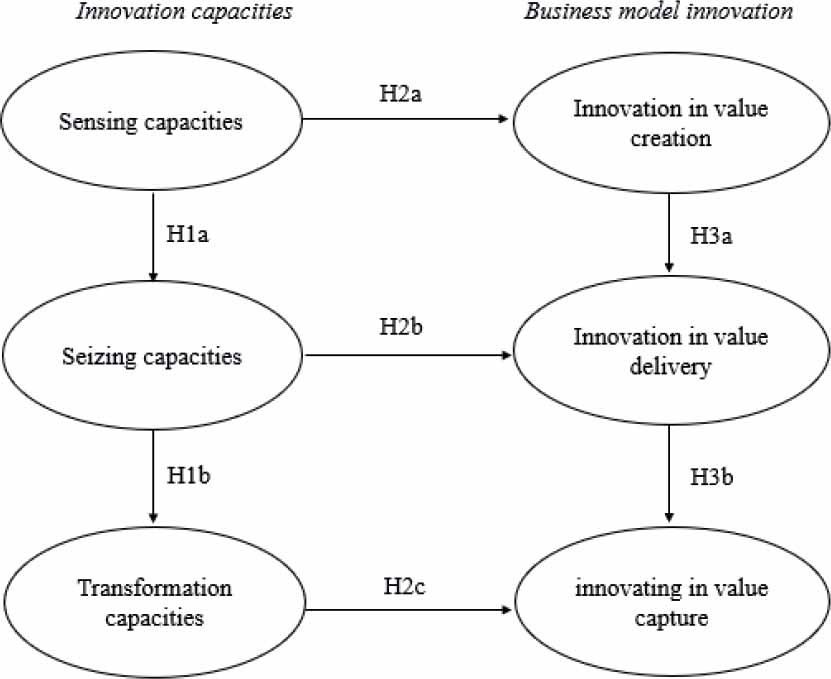
Figure 1.
Theoretical model
3. Method
The paper analyzes numerical data to test hypotheses that support the proposed theoretical model for identifying the determinants of innovation capabilities in business models of farming organizations. The PLS-PM method is utilized to estimate the relationship coefficients and validate the hypotheses. This method is developed in two stages, allowing for creating indices associated with unobservable theoretical variables and establishing their statistical relationships.
A sample of 65 agricultural organizations participating in the Productive Alliances Programme of the Ministry of Agriculture and Rural Development in Boyacá-Colombia is considered. The information collection was carried out during January and February 2023, where visits were made directly to the companies’ establishments, and even when the managers were absent, appointments were made with them to apply the instrument on another date. The Universidad Pedagogica y Tecnologica de Colombia (UPTC) Ethics Committee reviewed this research project, and each of the participants read and signed the informed consent form, agreeing to participate in the research project anonymously. The sample was obtained through simple random sampling and included individuals from 13 provinces within the department. The provinces with the highest participation rates were Tundama (18.5%), Occidente (16.9%), Centro (15.4%), and Sugamuxi (12.3%) (see Table 1). In terms of economic activities, the organizations mainly engage in fruit tree cultivation (27.7%), cattle and milk production (20%), vegetable farming (15.4%), and potato cultivation (13.8%). Notably, 81.5% of the organizations in the sample are established as associations, and 70% have a membership of 20 or more individuals.
Table 1.
Distribution of organizations by province and economic activity
| Province | Economic Activities | ||||||||
|---|---|---|---|---|---|---|---|---|---|
| Beekeeping | Handicrafts | Fruit trees | Cattle and dairy | Sheep and goats | Vegetables | Potatoes | Agricultural services | Total | |
| Centro | 1.50% | 1.50% | 3.10% | 1.50% | 1.50% | 1.50% | 3.10% | 1.50% | 15.40% |
| Gutiérrez | 0.00% | 0.00% | 0.00% | 3.10% | 3.10% | 0.00% | 0.00% | 1.50% | 7.70% |
| La libertad | 0.00% | 0.00% | 0.00% | 1.50% | 0.00% | 0.00% | 0.00% | 0.00% | 1.50% |
| Lengupá | 0.00% | 0.00% | 1.50% | 1.50% | 1.50% | 0.00% | 0.00% | 0.00% | 4.60% |
| Márquez | 0.00% | 0.00% | 1.50% | 3.10% | 0.00% | 0.00% | 1.50% | 0.00% | 6.20% |
| Neira | 0.00% | 0.00% | 0.00% | 0.00% | 0.00% | 1.50% | 0.00% | 1.50% | 3.10% |
| Norte | 0.00% | 0.00% | 0.00% | 0.00% | 1.50% | 0.00% | 0.00% | 0.00% | 1.50% |
| Occidente | 0.00% | 0.00% | 9.20% | 6.20% | 0.00% | 1.50% | 0.00% | 0.00% | 16.90% |
| Oriente | 0.00% | 1.50% | 1.50% | 0.00% | 0.00% | 0.00% | 0.00% | 0.00% | 3.10% |
| Ricaurte | 0.00% | 0.00% | 6.20% | 0.00% | 0.00% | 0.00% | 0.00% | 0.00% | 6.20% |
| Sugamuxi | 0.00% | 0.00% | 0.00% | 1.50% | 0.00% | 7.70% | 3.10% | 0.00% | 12.30% |
| Tundama | 0.00% | 3.10% | 4.60% | 1.50% | 1.50% | 3.10% | 3.10% | 1.50% | 18.50% |
| Valderrama | 0.00% | 0.00% | 0.00% | 0.00% | 0.00% | 0.00% | 3.10% | 0.00% | 3.10% |
| Total | 1.50% | 6.20% | 27.70% | 20.00% | 9.20% | 15.40% | 13.80% | 6,20% | 100% |
3.1. Instrument
The purpose of this study is to establish the correlation between variables related to dynamic innovation capabilities and business model capabilities, as illustrated in Figure 1. The instrument used includes characteristics related to six innovation capabilities that are essential to a dynamic process: learning orientation, relationships, strategic direction, creative culture, product and service development or improvement, and adaptability used a 5-point Likert scale [33]. Furthermore, business model innovation is pursued with a focus on creating value through technology, processes, and partnerships. The value delivered relates to the interaction between organizations, customers, and markets. Finally, value capture is assessed from the perspective of resource management and the creation of innovative cost and revenue structures. These approaches are shown in Table 2.
Table 2.
Theoretical structure of the proposed instrument
| Latent variables | Observable variables | Authors | No. of questions |
|---|---|---|---|
| Sensing capability [2] Sensing | Capacity for learning orientation | [22,29,30,34–37] | 3 |
| Relationship capacity | [35,38,39] | 2 | |
| Seizing capacity [2] Sensing | Capacity to develop innovative culture | [8,22,37,39,40] | 2 |
| Strategic direction capacity | [8,36,39,40] | 2 | |
| Transformation capacity [2] transforming | Capacity to develop and improve products or services | [37,39,41–45] | 2 |
| Adaptive Capacity | [29] | 1 | |
| Value creation innovation [26] | New technologies | [26,34,46] | 2 |
| New processes | [26] | 1 | |
| New partnerships | [11,26,47] | 1 | |
| Value delivery innovation [26] | New consumer relationships | [26] | 2 |
| New customers and markets | [11,26,48] | 2 | |
| Innovation in value capture [26] | New cost/revenue structures | [26] | 2 |
| Resource management | [22] | 2 |
3.2. Method of Estimation: Partial Least Squares – Path Modeling (PLS-PM)
To test the hypotheses in the theoretical framework, we use Structural Equation Modeling (SEM) methodology. SEM is a widely used multivariate analytical tool in scientific research that combines measurable variables with unobserved variables to produce precise results [16,49,50]. The process of SEM involves two stages. The first step involves estimating the external model to establish relationships between latent variables or evaluate associated indices. The subsequent step involves estimating the internal model to focus on causality or dependence relationships.
The goal is to validate or invalidate proposed hypotheses by estimating the relationship coefficients (Path) using Ordinary Least Squares (OLS) [50–53]. This study employs the PLS-PM method, which uses groups of observable variables to create a dataset associated with the theoretical concept. To validate the construct, statistical tests such as Cronbach’s Alpha and Dillon Goldstein’s Rho are applied, and parameters are estimated using OLS. The validation is achieved through statistical tests such as t-tests and bootstrapping [18,31,49,50,52,53]. To perform these calculations, we used the PLS.PM library in the R programming language [53].
4. Results
4.1. External Model
To evaluate the statistical validity of the questions and measurement of latent variables in the proposed theoretical model, we performed a Confirmatory Factor Analysis (CFA) using the instrument. The analysis comprises four indicators: Cronbach’s Alpha, which measures the percentage of variance explained by the set of manifest variables for the latent variable [49,54]; The Dillon Goldstein Rho, which determines the level of variation among a set of variables; and the loading coefficient, which illustrates the explained variance of each manifest variable in the instrument. Furthermore, the communality, which is the square of the loading coefficient, is highly correlated with the loading coefficient (see Table 3).
Table 3.
Evaluation measurement results
| Latent variables | Cronbach’s Alpha | Dillon Goldstein Rho | Observable variables | Meaning | Loading | Communality |
|---|---|---|---|---|---|---|
| Sensing | 0.864 | 0.903 | C1OA1 | Linking of experts | 0.803 | 0.645 |
| C1OA2 | Knowledge application | 0.717 | 0.515 | |||
| C1OA3 | Idea generation | 0.79 | 0.624 | |||
| C1RE1 | Partnership management | 0.842 | 0.709 | |||
| C1RE2 | Opportunity identification | 0.868 | 0.753 | |||
| Seizing | 0.809 | 0.876 | C2DE1 | Organizational design | 0.877 | 0.769 |
| C2DE2 | Organizational strategy | 0.822 | 0.676 | |||
| C2CI1 | Lessons learned | 0.68 | 0.463 | |||
| C2CI2 | Innovation culture | 0.807 | 0.651 | |||
| Transformation | 0.731 | 0.85 | C3DP1 | New developments | 0.822 | 0.676 |
| C3DP2 | Improvements | 0.874 | 0.764 | |||
| C3AD2 | Adaptations | 0.72 | 0.519 | |||
| Creation | 0.808 | 0.874 | BM1NT1 | Technology acquisition | 0.795 | 0.632 |
| BM1NT2 | Technical team | 0.834 | 0.696 | |||
| BM1NP2 | Process monitoring | 0.817 | 0.667 | |||
| BM1NS2 | Partnership | 0.736 | 0.541 | |||
| Deliver | 0.842 | 0.894 | BM2NR1 | Customer seizing | 0.831 | 0.691 |
| BM2NR2 | Competitiveness | 0.838 | 0.702 | |||
| BM2NC1 | New markets | 0.83 | 0.688 | |||
| BM2NC2 | New channels | 0.794 | 0.63 | |||
| Capture | 0.758 | 0.847 | BM3CI1 | Costs | 0.662 | 0.438 |
| BM3CI2 | Portfolio diversification | 0.786 | 0.617 | |||
| BM3GR1 | Financing | 0.8 | 0.639 | |||
| BM3GR2 | Resource management | 0.79 | 0.624 |
To ensure the validity of questions, it is necessary to achieve an optimal Cronbach’s Alpha value of 0.7 or greater [52]. Additionally, an optimal Dillon Goldstein’s Rho value should be equal to or greater than 0.7. When validating individual questions, it is necessary to have a loading of 0.7 or greater and a communality greater than 0.7, which indicates a communality value of at least 50%. Table 3 displays the results of the CFA performed on the blocks of observable variables. The analysis confirms the validity and statistical robustness of the obtained values, validating the relevance of each observable variable in explaining the hypotheses. Thus, the proposed external model for the research is confirmed.
4.2. Internal Model
This section discusses the assessment of path or relationship coefficients between latent variables, including their direction and magnitude. The estimated effects demonstrate a positive direction, which supports the hypothesis (see Table 4). Quotations are clearly marked, and filler words are avoided. Additionally, medium-strong relationships between Sensing and Seizing capability are observed (H1a 0.709). Organizations face challenges in obtaining and adapting the knowledge required for innovation [22]. To achieve greater knowledge appropriation and identify opportunities to generate value, effective practices include alliance and relationship management [24,55].
Table 4.
Results and validation of hypotheses
| Hypotheses | Path | t-value | Boots. Interval | Hypotheses |
|---|---|---|---|---|
| H1a - Sensing ->Seizing | 0.709 | 7.98 | (0.657 - 0.781) | Validated *** |
| H1b - Seizing ->Transformation | 0.633 | 6.48 | (0.6769 - 0.7991) | Validated *** |
| H2a - Sensing ->Creation | 0.735 | 8.601 | (0.5713 - 0.7067) | Validated *** |
| H2b - Seizing ->Delivery | 0.404 | 3.701 | (0.3215 - 0.5245) | Validated *** |
| H2c - Transformation ->Capture | 0.204 | 1.65 | (0.0664 - 0.3356) | No Validated |
| H3a - Creation ->Delivery | 0.462 | 4.23 | (0.3474 - 0.5486) | Validated *** |
| H3b - Delivery ->Capture | 0.572 | 4.61 | (0.4672 - 0.6988) | Validated *** |
The correlation coefficient of 0.633 between seizing capacity and transformation suggests a direct and moderate relationship (H1b). In the agricultural sector, it is important to establish infrastructures that facilitate the creation and refinement of products or services. This requires cooperative networks to assimilate essential knowledge necessary for collaborative innovation [37,44].
A significant association was found between sensing and value generation (H2a 0.735). Sensing involves investigating, producing, and acquiring knowledge to anticipate and recognize environmental cues that enable better understanding of opportunities and threats [23]. Additionally, building and maintaining professional relationships is a crucial factor in creating value. This capability allows organizations, particularly those with limited resources and technical expertise, to discover and access new ideas, technologies, processes, projects, resources, contacts, and products or services [12].
The results indicate moderate relationships, such as the correlation between the seizing variable and innovation in value delivery (H2b). To encourage collective action, agricultural organizations should prioritize the development of flexible organizational processes and communication mechanisms to improve their production systems. Incorporating culture into innovation strategies is crucial for addressing process inefficiencies and facilitating change to take risks [12,40,56].
The correlation between value creation and value delivery (H3a 0.462) suggests that establishing connections with various stakeholders facilitates collaborative knowledge generation [45]. Internal partnerships have been demonstrated to be critical for organizations. However, as organizations expand and prosper, new employees face significant obstacles due to the resulting increase in the complexity of their work scenarios. This finding supports that higher levels of organizational complexity are associated with increased intensity and improved quality of interactions.
In terms of innovation in value delivery and value capture (H3b 0.572), a direct relationship exists with the business model that enables higher returns. However, benefits are not limited to commercialization. Effective management of external resources that aligns with socio-entrepreneurial empowerment is also crucial. Value capture heavily relies on favorable policies and institutional arrangements that support collective action [57].
H2c was rejected (0.204), indicating no correlation between transformation capacity and value capture. This outcome may be attributed to organizational factors, specifically the complexity of decision-making processes within boards that require the participation of all members, ultimately limiting adaptability. Additionally, these organizations have both economic and social objectives, which could lead to a different interpretation of the value capture process [23]. The study found that 43% of participants did not participate in joint marketing activities. Instead, they received alternative benefits such as knowledge, relationships, status, or visibility. Figure 2 shows the validation of the proposed theoretical model and the relationship coefficients.
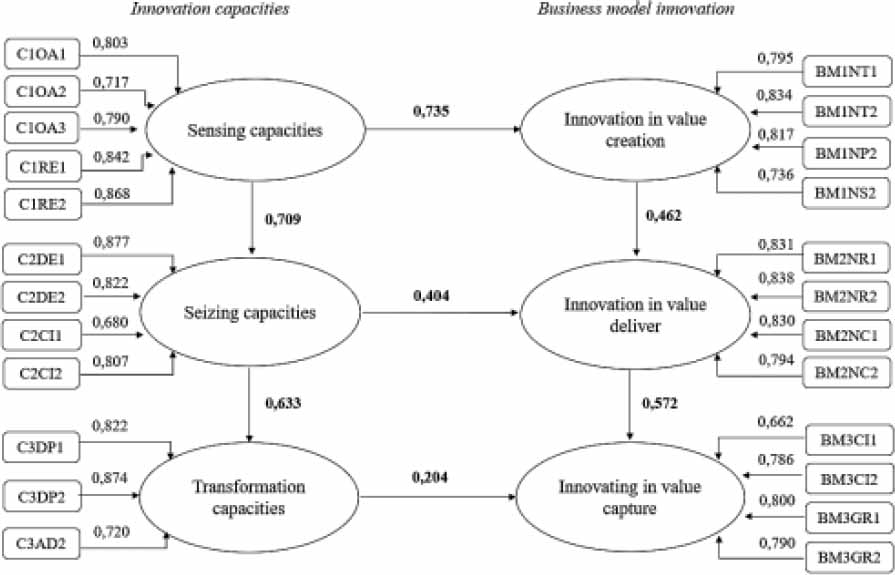
Figure 2.
Estimated model
There is a direct correlation between an organization’s sensing and seizing capabilities and its ability to innovate, both in the delivery and creation of value. These capabilities enable firms to identify new ideas and resources, receive training and technical assistance, and develop strategies for greater bargaining power. However, there is no clear relationship between an organization’s transformational capabilities and its ability to capture value. There is a significant need to develop skills that facilitate the enhancement and creation of products to establish a robust value proposition.
5. Discussion
This research delves into the intricate relationship between innovation capabilities and the evolution of the business model in agricultural organizations in Boyacá, Colombia. The RBV perspective underscores the significance of internal factors for competitiveness, emphasizing innovation as a dynamic process capable of leveraging knowledge to foster organizational adaptability [4,14].
The study conducted by Kiani et al. [30] shows a significant correlation between innovation, sensing, and seizing capabilities. This emphasizes the importance of continuous learning and effective knowledge management, which are crucial for farming organizations. The process of detecting and adapting knowledge closely aligns with the use of technologies in the production system. However, organizations face a challenge in assimilating knowledge to mobilize the necessary technical and economic support for innovation [22].
Alliance management is a recurring and effective practice for acquiring and adapting knowledge [55]. The ability to build relationships is essential for identifying opportunities and involving governmental, private, or non-profit actors in an open innovation approach [39]. Constructing networks that involve diverse actors is a way to absorb external knowledge and expose the organization to new stimuli and experiences. During the seizing stage, it is crucial to highlight the importance of strategic direction and address any cultural challenges that may hinder the perception of lessons learned as opportunities for innovation [8]. Organizational culture plays a critical role in the innovation strategy, as lessons learned do not always translate into opportunities for further learning and experimentation. The transformation stage shows a direct and moderate relationship, highlighting the importance of developing innovation capabilities for products and services [45]. In the agricultural context, cooperative networks emphasize co-creation as crucial for product development, representing a tangible manifestation of innovation [44]. In the field of business model innovation, there is a moderate correlation between value creation and value proposition. Effective relationship management with stakeholders from both the public and private sectors, as well as internal collaborations among team members, is crucial. However, these collaborations often encounter challenges that can raise entry barriers within organizations and complicate coordination.
The relationship between sensing capabilities and innovation in value creation is significant, highlighting the complementarity between these concepts. Sensing capabilities play a crucial role in exploring, creating, and learning to anticipate and detect environmental signals. Relationship-building is also fundamental for organizations with limited resources. Although agricultural organizations generate value through external products and services, it is important to highlight their role in strengthening internal bonds with associates, or their social capital. The relationship between seizing capabilities and innovation in the value proposition is direct and moderate, underscoring the need for flexible organizational processes and the incorporation of culture into the innovation strategy. There is no clear relationship between transformation capabilities and value capture. This lack of correlation can be attributed to the fact that participating organizations are relatively young and focused on immediate growth, which explains the low significance of transformation capabilities. The dual purpose of agricultural organizations, which pursue both economic and social objectives, creates divergences in value capture. Furthermore, the limited control over production costs restricts the impact of transformation capabilities in this aspect.
However, it is possible to capture value through the sensing process by creating proposals that align with the needs of both internal and external clients. In conclusion, this research highlights the importance of improving innovation capabilities through continuous learning, effective knowledge management, external collaboration, and an innovation strategy that considers both cultural and economic aspects. Internal and external collaboration, along with diversification of the product offering, emerge as key elements for the success of agricultural organizations in this context [24]. Future research should thoroughly explore the dynamics of transformation capabilities in more mature organizations and environments. Additionally, an analysis of the specific impact of divergences in economic and social objectives on value capture is suggested. These areas could provide valuable insights to further advance the field of study
6. Conclusion
The study uses the dynamic capabilities framework to identify innovation capabilities in farming organizations operating in Boyacá, a department in Colombia, and to establish their relationship with the innovation elements in the business model. The identified innovation capabilities enable a comprehensive innovation assessment across various dimensions, including learning and culture. The relationship between innovation capabilities and the elements of the business model of agricultural organizations indicates that sensing and seizing capabilities affect the processes of value creation and delivery, primarily through capabilities such as relationships and learning. Sharing knowledge and experiences with external actors can facilitate the creation of open innovation scenarios, benefiting organizations with limited resources and capabilities in generating new ideas. However, it has been found that transformation capabilities do not play a critical role in the value capture process. Due to barriers that hinder the development of innovation capabilities, such as discrepancies between social and economic goals and convoluted participatory structures that obstruct decisionmaking and adaptation, the innovation process may not play a crucial role in the process of value capture.
The research aims to measure innovation and identify innovative capacities in rural, peasant, and associative work contexts. These areas often face challenges and shortcomings in developing profitable economic activities. The information obtained can assist decision-makers and actors of the National Agricultural Innovation System (NAIS) in promoting innovation. These findings can aid economic development practitioners in crafting strategies that are congruent with their locales. Additionally, this methodology may be especially beneficial for rural areas that have not yet fully integrated into the global economy.
The primary limitation of this study is its narrow focus on a specific region in Colombia, with an emphasis on agriculture and livestock. Therefore, it is recommended that future research investigate other contexts to supplement these findings. To advance research in this area, it is recommended that efforts focus on developing strategies that promote transformational capabilities to achieve sustainability and competitive advantage.
ACKNOWLEDGMENT
This project was supported by Ministerio de Ciencia, Tecnología e Innovación, Minciencias and Universidad Pedagógica y Tecnológica de Colombia 75878. Also, Research supported by Red Sistemas Inteligentes y Expertos Modelos Computacionales Iberoamericanos (SIEMCI), project number 522RT0130 in Programa Iberoamericano de Ciencia y Tecnología para el Desarrollo (CYTED).
Notes
[1] Data availability
We declare that the data collected in this research are under protection as determined by the ethics committee for research of the Universidad Pedagógica y Tecnología de Colombia (UPTC) and will only be shared upon request to said committee through the email comite.eticainvestigacion@uptc.edu.co