Have a personal or library account? Click to login
School district administrators' perspectives on special education policy and practice in Norway and Sweden Cover

School district administrators' perspectives on special education policy and practice in Norway and Sweden

Open Access
|May 2012

Figures & Tables

Table 1. A categorical and relational view of special needs (Persson 2003, 277).
Categorical perspectiveRelational perspectiveOntology of special needsSpecial needs refer to actual characteristics of individualsSpecial needs are social constructsApproach to differenceDifferentiating and categorizingUnifyingMajor contributionMapping and systematizing the fieldProblematizing and deconstructing the fieldImplications for provisionSpecial provisionIntegrated/inclusive provisionUnderstanding of special educational competenceSuperior support directly related to diagnosed difficulties among studentsSuperior support for incorporating differentiation into instruction and contentReasons for special educational needsStudents with difficulties; difficulties are either innate or otherwise bound to the individualStudents in difficulties; difficulties arise from different phenomena in educational settings and processes
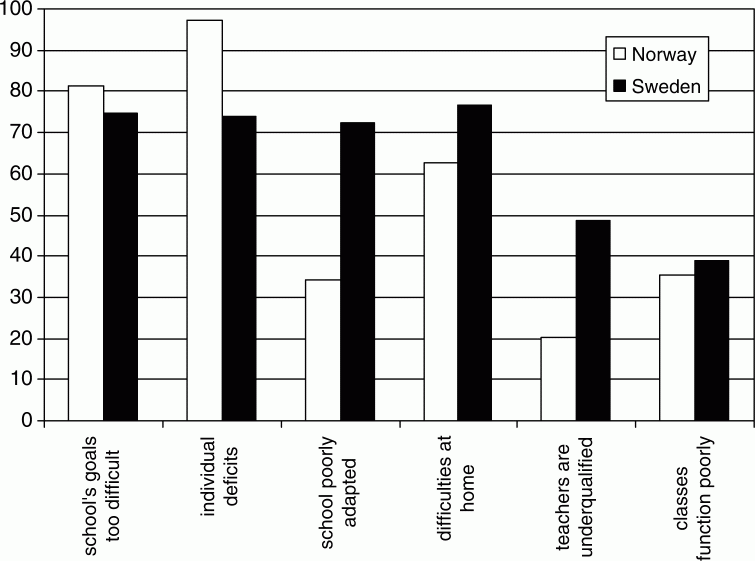
Figure 1. 

Percentage of municipalities indicating reasons for a student to need special support as ‘very’ or ‘somewhat’ common.
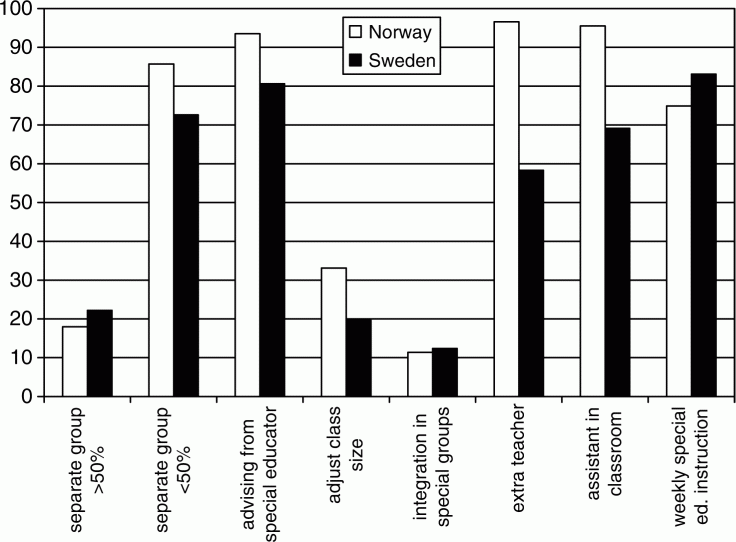
Figure 2. 

Percentage of municipalities indicating an organizational approach as ‘very’ or ‘somewhat’ common.

Table 2. Municipalities' ratings of the relevance of a medical diagnosis for providing special support.

SwedenNorwayVery relevant7.622.6Somewhat relevant29.950.6Not very relevant53.024.5Not at all relevant9.62.3Note: Ratings are reported as percentage of participating municipalities within each country (Sweden, n=262; Norway, n = 266). Swedish results do not add up to 100% due to rounding.

Table 3. Means, standard deviations and categories1 of ratings for desirability of organizational solutions.

NorwaySwedenMSDRatingMSDRatingSeparate group >50%2.020.84low1.660.71lowIntegration in special groups1.850.80low1.820.92lowSeparate group <50%2.910.66moderate2.790.78moderateWeekly resource room2.960.80moderate2.750.84moderateAdjustment of class size2.500.84moderate23.050.81highAssistant in the classroom3.240.57high2.150.78lowSpecial educator in classroom3.350.55high3.500.62highExtra teacher support3.350.56high3.080.81highNotes: 1Mean ratings were categorized into three groups: low <2.5 (below theoretical neutral), moderate 2.5–3.0, and high >3.0. 2The mean for ‘adjustment of class size’ in the Norwegian sample is equal to the theoretical neutral indicating a low-moderate (or neutral) rating for desirability.

Table 4. Means, standard deviations and categories of ratings1 for importance of policy documents.

NorwaySwedenMSDRatingMSDRatingEducation Act3.880.32high3.950.26highCompulsory school regulations3.740.52high3.920.30highNational Curriculum3.570.58high3.920.28highLocal school policy3.040.75high3.640.59highState guidelines and reports2.610.79moderate3.090.64highEducational department policy documents2.820.75moderate2.930.72moderateSalamanca Declaration2.360.84low3.600.57highUN Standard Rules on Disabilities (EOPD)2.210.80low3.350.71highUN Convention on the Rights of the Child2.000.81low3.330.77highNote: 1Mean ratings were categorized into three groups: low <2.5 (theoretical neutral), moderate 2.5–3.0, and high >3.0.
Language: English
Page range: 212 - 231
Submitted on: Apr 6, 2010
Accepted on: Jan 24, 2011
Published on: May 3, 2012
In partnership with: Paradigm Publishing Services

© 2012 David Lansing Cameron, Claes Nilholm, Bengt Persson, published by Stockholm University Press
This work is licensed under the Creative Commons Attribution 4.0 License.