
Different types of copying processes
Portable Document Format (PDF) is used to create documents in electronic format independent of the type of software, hardware, or operating system with which it is viewed. It was developed by Adobe® Systems which has since transferred control of the PDF to ISO (International Organization for Standardization). Since that time, PDF has become an “open standard”. The specifications of the current version of the PDF format (1.7) are documented within the ISO 32000 category [1]. ISO is also responsible for updating and developing current and future versions. It is one of the most popular formats on the Internet for exchanging documents, and for this reason it is widely used by companies, governments and educational institutions for file generation and sharing. Originally developed by Adobe® Systems as a universally compatible file format, it has become an international format for the exchange of documents and information.
PDF files can be generated by virtual printing [“print to PDF”], converting text files (e.g. word file *.doc or *.docx) or, scanning paper documents. Each PDF file contains a complete description of the two-dimensional document [and with the new version of Acrobat 3D, embedded 3D documents], included properties [Title, Author, etc.], text, character styles [fonts], images and graphic objects [2D vector].
FHEs are often called upon to analyse and study signatures and handwritten entries on PDF documents which, depending on how they were generated [copies from digital FAX; scanning or “virtual printing”] are characterized by a different quality of the line. These PDF files have a different quality than their original counterparts. The characteristics and circumstances of the PDF process influence the quality of the handwritten line observed in the document [2].
• Electrophotography
This term is referred, principally, to a xerography printing process and related machines. The seven-step process of printing or copying involves: 1) charging; 2) exposure; 3) development; 4) transfer; 5) separation or detach; 6) fusing; 7) cleaning. The process called “exposure” can be characterized by the use of a laser or LED. Printers that use the laser methodology are more accurate and faster than those that use LEDs to electrostatically charge the drum. The process is very similar to that used by LEDs with the main difference being in the initial phase where the “image” to be printed on the sheet is transmitted to the drum through a laser. During the “fusing” phase, a material called “toner” is bonded on the paper. This material is made with organic and inorganic materials that are formulated to provide a clean image on the paper [3]. The component may also contain a “magnetic” compound. The magnetic compound may be analysed to discriminate different toners on the paper, and to analyse the exact order of intersecting lines between toner and ink pen stroke [4]. Color printers usually have a higher cost than monochrome ones and this type of printing and copying procedure, moreover, is characterized by higher consumable costs (Toner) than inkjet.
However, particular attention should be paid to copies of documents generated with photoelectrographic photocopiers. In these cases, the expert must pay close attention to the information that the line provides. It has been established by the forensic community that this copying system can, depending on both the printing resolution, the number of copying passes that the document undergoes, the state of cleanliness of the glass of the machine or, the state of wear of the drum, add or remove parts of the handwriting line that can lead the expert into interpretative errors. Pen lifts or feather strokes, for example, may appear or disappear because of the copying process [9].
• Inkjet
Inkjet printers are the most ubiquitous type of printer and range from small, inexpensive consumer models to expensive, professional machines. This printing process is characterized by the projection of particles of liquid ink, black or coloured, following the mixing of the main Cyan, Magenta, Yellow and Black (CMYK) colours, onto the sheet of paper. The projection of the ink particles takes place by means of a head that moves to the right and left in a bi-directional or boustrophedonical mode. The head can project the ink on the sheet by one of two methods: Continuous (CIJ) or Drop-On-Demand (DOD). CIJ inkjet means the flow is pressurized and in a continuous stream whereas DOD means that the fluid is expelled from the jet nozzle one drop at a time. The expulsion process involves a large electrical charge pulling drops out of a nozzle, sound waves pushing fluid from a nozzle, or a chamber volume expansion to expel a drop from the nozzle. There are many ways to produce a DOD inkjet document. Common methods include thermal DOD and piezoelectric DOD to speed up the frequency of drops. Most commercial and consumer inkjet printers use a piezoelectric material in an ink-filled chamber behind each nozzle instead of a heating element. When a voltage is applied, the piezoelectric material changes shape, generating a pressure pulse in the fluid, which pushes a droplet of ink from the nozzle. In the thermal inkjet process, the print cartridges consist of a series of tiny chambers, each containing a heater. To eject a droplet from each chamber, a pulse of current is passed through the heating element, causing a rapid vaporization of the ink in the chamber and forming a bubble. This causes a large pressure increase, propelling a droplet of ink onto the paper. This procedure could also be called “Bubble Jet”. Consumer inkjet printers with photographic-quality printing are widely available, and in comparison to laser printing, inkjet printers have the advantage of minimal warm up time, and often result in less cost per page. Inkjet documents can have poor to excellent archival durability, depending on the quality of the inks and paper used. If low-quality paper is used, it can yellow and degrade due to residual acid in the untreated pulp, and over time can crumble into small particles when handled. High-quality inkjet prints can last as long as typewritten or handwritten documents on the same paper. Because the ink used in many low-cost consumer printers is watersoluble, care must be taken with inkjet-printed documents to avoid moisture, which can cause severe blurring, regardless of the age of the document. For this reason, the quality of the printed document is highly dependent on the quality and formulation of the ink. Many inkjet printers now utilize pigment-based inks which are highly water resistant. To increase the durability of inkjet printed documents, more attention towards the ink cartridge is needed. [5].
• Microfiches
Microfiche (flat sheets) are scaled-down reproductions (microforms) of documents, typically either films or paper, made for the purposes of transmission, storage, reading, and printing. A sheet of microfilm measures 105 mm x144 mm (4” x 6”) and contains multiple micro-images arranged in a grid pattern. Microfiche may contain identification information at the top that can be read without magnification as well as an index frame(s) listing the location of each document image [6]. A single microfiche can hold a range of a few images to several hundred, in a reduction range from 20X to 48X. The finished master microfiche may be duplicated as a unit, rapidly, inexpensively and in any quantity. Microfiche offers fast information retrieval, which may be either manual (with eye-readable identification in the heading) or automatic (through edge notching or other machine-readable coding) [7].
The principal disadvantage of microforms (scaled-down reproductions of documents) is: 1) the image is (usually) too small to read with the naked eye and requires analog or digital magnification to be read; 2) the reader machines used to view microform are often difficult and tedious to use; 3) photographic images reproduce poorly in microform format, with loss of clarity and halftones [8]. The latest electronic digital viewer/scanners can scan in grey shade, which greatly increases the quality of photographs; 4) reader printers are not always available, limiting the user’s ability to make copies for their own purposes and conventional photocopy machines cannot be used. However, the conventional and commercial scanners that could offer swappable modules for the different microform types, are usually able to convert to digital images.
• Faxes
A fax is the telephonic transmission of scanned or printed material (including both text and images), normally to a telephone number connected to a printer or other output device. In the recent era, faxes could also be sent and received digitally. This means that the origin of the transmission or the destination takes place via the Internet without the need for either a sending or receiving fax machine. In these cases, the telephone number is also “virtual”. The documents transmitted can be either scans of paper documents or documents generated directly by the computer without the need to be printed. In fact, the source of starting transmission or at destination could be different (i.e. traditional faxes at the outgoing transmission and online fax at the destination or vice versa).
The transmission process, like all copying processes, can involve a series of data loss (with reference to the quality of the line) or addition of graphic elements not present in the source document thus causing the change of the graphic line relating, for example, to the signatures on the document sent (Seaman, 1991). In fact, the connections between the letters may appear different than the originally transmitted document pen lifts can increase or decrease. Some feathered strokes can be distorted to appear that they were made with greater pressure, or the fine details may be lost in the process which results in the appearance of a pen lift, when on the actual document, there was not. One of the main causes of loss of line quality is the use of thermal paper both in shipping and, above all, in the fax receiving printing machine [9].
• 3. Aims
The recent global pandemic situation has exacerbated the habit of transacting signed and handwritten documents in non-original format. Often times, the original documents are not easily available. In these circumstances, the FHEs are called upon to analyse and express opinions about the “line quality” visible on the non-original documents. Many past studies have been carried out regarding the characteristics that are included in the concept of line quality. Some studied nonoriginal documents for comparison to their original format [10], and some researched the ability of FHEs to express reliable opinions by analysing non-original documents [11]. By “line quality”, we must therefore understand the combination of the characteristics that concern a measure of fluency of handwriting, the degree of regularity; a product of a combination of features including speed, skill, fluency and pen pressure of the writing stroke (Modular Forensic Handwriting Method– Version 2016). This study aims to acquire information about the concept of “line quality” in non-original documents [12], and which characteristics, in the opinion of the FHE, allow a determination of “sufficient”, “poor” or “good” quality. Further and consequent objectives are to investigate which and how many limitations to the examiner are connected to the “quality of the line” in a non-original document [13], and how the scales of conclusions should be adequately applied in this type of analysis.
Procedure
The authors decided to prepare a questionnaire to be submitted to FHEs and FDEs who participated in professional meetings which took place in 2021. The first meeting was organized by ENFSI-ENFHEX in June, and the second was organized by ASQDE in August. As a result, the views and opinions of 105 experts working all over the world were collected. The survey included thirteen questions, some with limited answers to just one option (10), and others with the possibility of multiple answers (3).
Results
A total of 13 questions were submitted to the participants. The graphs and tables show that the answers were not fully reliable, highlighting different opinions of the experts involved in the study.
Question 1
How many times in your FHE activity are you required to analyse the handwriting of non-original documents? (single choice)
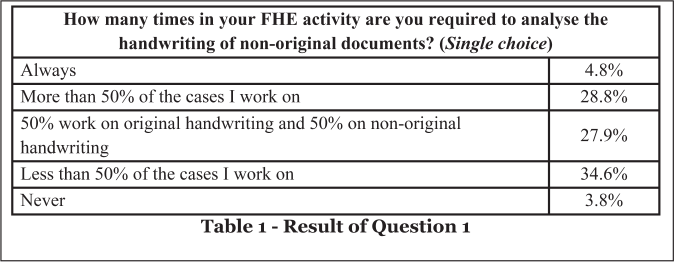
On the first question, most of the experts interviewed (34.6%) stated that they work on cases of documents in non-original format less than 50% of the time. Approximately 30% of the participants replied that they are called equally to work on both original and non-original documents, and another 30% work more on documents in non-original format.
Question 2
The characteristic “Line Quality” is a collective characteristic defined as: “A measure of fluency of handwriting, the degree of regularity; a product of a combination of features including speed, skill, fluency and pen pressure of the writing stroke”. Which of these characteristics do you think can be detected and studied only by analysing the original document? (multiple choice)
The second question, which involves a multiple choice, was one of the most important. This question asked the opinion of the experts regarding which characteristics of the line can be studied and analysed only with the analysing the document and handwritten entries in original format. The options available to the experts were: (a) All; (b) Fluency; (c) Degree of regularity; (d) Speed; (e) Skill; (f) Pen pressure; (g) None of these characteristics can be studied on a nonoriginal document.
According to 21.3% of experts, the main characteristic that cannot be detected and studied on a non-original document is pen pressure. 8.5% believe that both pressure and fluency cannot be studied, and 20.2% believe that all features cannot be analysed in non-original format documents. The remaining responses were varied.
Question 3
The term “Non-Original” or “Copy Document” means: “photocopies, pdf copies, faxes, microfiche copies”. Which copying process do you think produces a “clearer” copy that does not differ from the original one? (single choice)
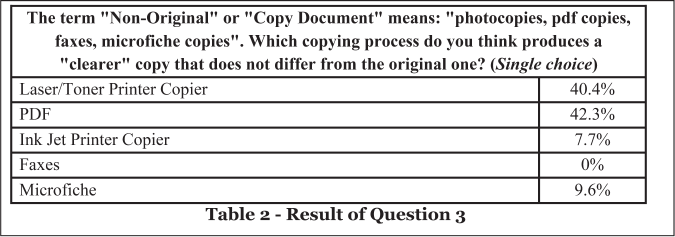
For this question, the experts were divided into two main groups. The first group believes that the best quality is given by documents in PDF format (42.3%), and a second group considers that those generated with toner printers are of good quality (40.4%). However, particular attention should be paid to copies of documents generated with photoelectrographic photocopiers. In these cases, the expert has to pay close attention to the information that the line provides. It has been established by the forensic community that this copying system can, depending on both the printing resolution, the number of copying passes that the document undergoes, the state of cleanliness of the glass of the machine or the state of wear of the drum, add or remove parts of the handwriting line that can lead the expert into interpretative errors. Pen lifts or feather strokes, for example, may appear or disappear as a result of the copying process [9]. The consensus of the surveys is that the worst line quality is displayed by those documents produced by fax.
Question 4
Which one do you think produces the most loss of information? (multiple choice)
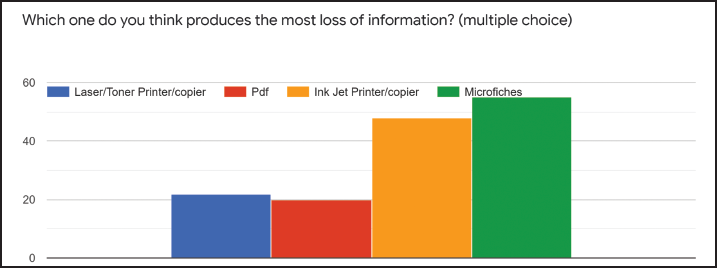
This question allowed the experts to answer with multiple responses. There were four choice: Pdf; Laser/Toner Printer-Copier; Ink Jet Printer-Copier and Microfiches. The fax has been omitted among the choices as its use is less frequent.
In the opinion of the experts involved, the greatest loss of information occurs with microfiche documents (32.7%) and in reproductions generated with ink-jet printing systems (17.3%).
Question 5
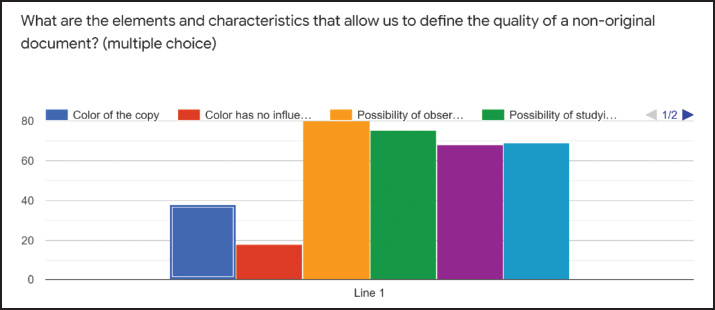
What are the elements and characteristics that allow us to define the quality of a non-original document? (multiple choice)
This question forms the real core of the study. The answer options were as follows:
(a) Color of the copy; (b) Color has no influence on the quality judgment; (c) Possibility of observing and detecting more or less thick or thinned features; (d) Possibility of studying the type and number of pen lifts; (e) Possibility of studying the number of stroke intersections; (f) Possibility of studying the complexity of the line.
The main preferences were identified in the answer (c) “Possibility of observing and detecting more or less thick or thinned features”. This trend of opinion clearly highlights and confirms that the expert involved in the study of a handwritten line in non-original format considers it important to have the possibility of studying and inferring the pressure with which the strokes are generated.
The other answers that concerned the possibility of studying the number of pen lifts, the number of intersections of the strokes, and the complexity of the line were similar..
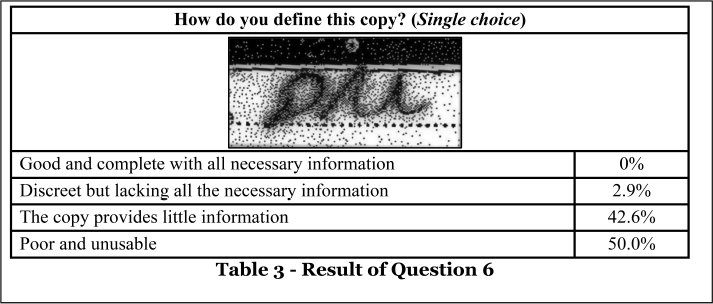
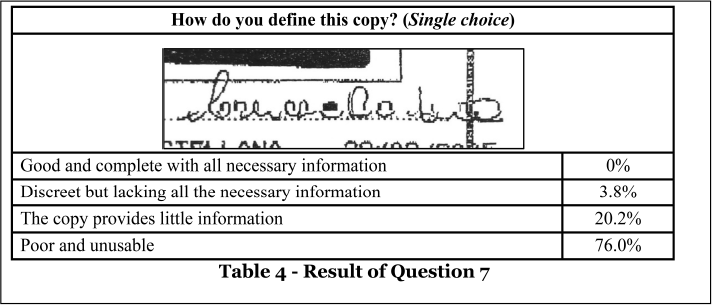
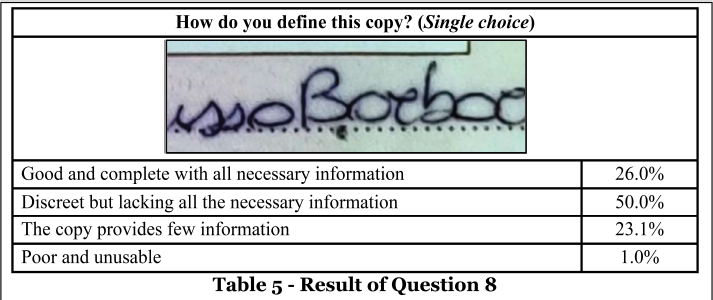
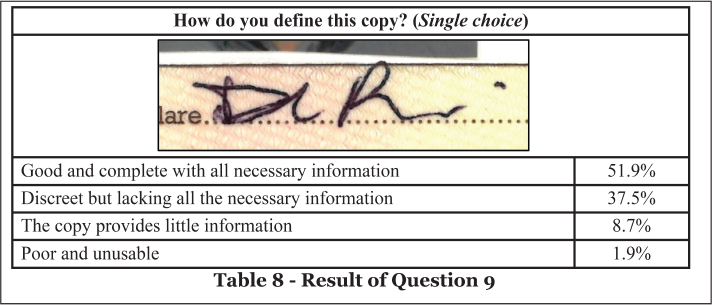
The survey also included the submission of five different images in which different line qualities were visible. The procedure required that each image was defined in its quality. These were questions 6-10 of the survey. The purpose of these questions was for the expert to define the line quality depicted in the accompanying image.
The first image (question n. 6), in black and white (B&W) format, was defined as “poor and unusable” by half of the participants, while the other half (42.6%) answered that “the copy provides little information”. The second image (question 7), also in B&W format, was defined as “poor and unusable” by 76% of the experts. About twenty percent answered that “the copy provides little information”, while 3.8% defined it as “discreet but lacking all the necessary information”.
The responses relating to the images provided in color (question 8 and 9) were also found to be mixed. For question 8, half of the experts defined it as “discreet but lacking all the necessary information”, while the rest of the participants split into two groups of opinions; 26% of the experts thought it was “good and complete with all necessary information”, while 23% of the experts thought “the copy provides little information”.
For question 9, opinions were even more varied. The majority (51.9%) defined it as “good and complete with all necessary information”, the next group (37.5%) “discreet but lacking all the necessary information”, a third group (8.7%) “the copy provides few information” and the last group (1.9%), “poor and unusable”.
The tenth question pertained to the quality of the line in a B&W image. Answers were less varied and more unambiguous. Many of the experts (52.9%) expressed the opinion that “the copy provides little information”, while a significant number of experts (39.4%) expressed the opinion that the image is “poor and unusable”.
Question 6
Question 7
Question 8
Question 9
Question 10
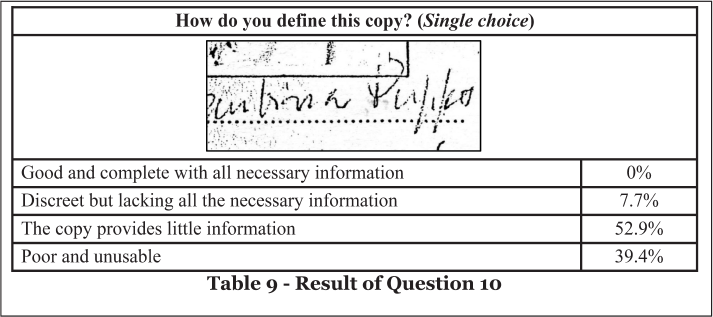
Question 11
Using a 9-level scale of conclusions (ENFSIENFHEX Collaborative Exercise), how far can the expert reach in the final judgment when he has non-original documents available? (Single choice)
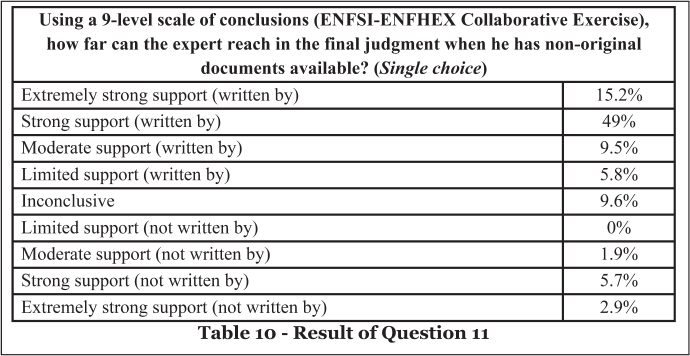
To answer this question, the authors made available to the experts involved the scale of conclusions used by ENFSI-ENFHEX during the periodicals “Collaborative Exercise” (CE) available to the experts involved. This conclusion scale provides nine levels of opinions. Almost half of the experts (49%) believe that if a document in a non-original format is being analysed, the maximum level of expression should be level two, i.e., “Strong support (written by)”. Only a small portion of experts (15.2%) believe that it is possible to express the strongest opinion of level one of the scale, “Extremely strong support (written by)”. A small percentage of experts (9.6%) believe that the maximum level should be “inconclusive” (level 5).
Question 12
Do you think that, taking into consideration the limits to the investigation given by the analysis of a non-original document, it is necessary to set limits also to the final judgment? (Single choice)
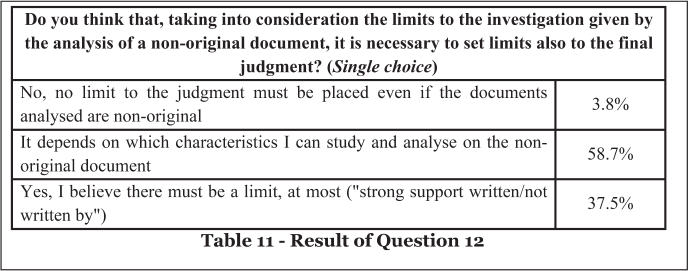
The authors asked the experts whether or not they feel it is necessary to set a priori maximum expression limit in the event that the document and the line are in non-original format. The majority answered that it would not be correct to set limits in advance, but that it should be assessed on a case-by-case basis according to the information that the quality of the line can provide (58.7%). A little more than one third (37.5%), on the other hand, felt that the maximum limit of conclusions used by ENFSIENFHEX should be “strong support written/not written by”.
Question 13
Do you think that the limits given by the copy are more influential and decisive if it is “questioned” document or “known” sample? (Single choice)
The thirteenth and final question asked the experts whether the final limits given by the document in non-original format are greater if it is the “questioned” document or whether it is a sample document. 60.5% of the participants were of the view that greater limits in the final opinion occur when the document in non-original format is the questioned document.
Discussion
This study is the first of its kind to get the opinions of experts from all over the world, of differing training and backgrounds, regarding the concept of “line quality” in handwritten lines in non-original format [14]. The request to express an opinion regarding the limits that non-original documents present in an analysis, both from a theoretical and a practical point of view, is also new. The opinion of the experts involved was in fact requested in reference to images of real handwritten lines provided in non-original format.
The responses of the experts involved were varied. This result lends support to many points that have previously only been dealt with theoretically. The SWGDOC Standard for the Examination of Handwritten Items [15] and other authors [16] recommend that it is preferable to analyse documents in original format rather than non-original, but the answers to the survey have shown, although they have been various, that the analysis of documents in non-original format has now become a necessary and frequent circumstance.
Another finding that emerged from this study relates to the opinion of many experts that there are no limits to be set in advance on the scale of conclusions used by the laboratory. In the opinion of other experts, a final judgment can also be expressed using a high, but not maximum, level (“Strong support written by”) of the scale of conclusions which, in this study, utilized the ENFSI-ENFHEX for periodicals “Collaborative Exercise” (CE) opinion scale (at 9 levels).
A further result from this study, and on which it is important to reflect, is that there has not been a single and strong response regarding the “quality” of the line of images provided. The diversity of opinions shows that the same line, in non-original format, is being judged qualitatively different by experts. It may not be possible to establish which “qualities” of the line are to be considered significant to reach a scientifically valid final conclusion [17]. Each line, in non-original format, requires a specific evaluation, also considering the type of document copying process [18] (inkjet [19]; toner [20]; faxes). The survey also showed that the experts involved in the case should not have any preliminary biases and limitations simply because the document is in a nonoriginal format.. Some recent research [21] has shown that the quality of the line in documents in non-original documents can depend and be influenced both by the type of printing machine (toner/ink jet printing resolution or low speed printing process), and by circumstances external to the printing process (foreign contamination on glass platen and photoconductor drum).
However, it remains necessary to leave some preliminary hypotheses open, including the possibility of the original document no longer existing (i.e. the copy was created by collage or cut & paste of the handwritten entries), and that certain characteristics may not correspond between the non-original format and the original one (pen lift; feather stroke, pressure, speed, and complexity). Any expert judgment should thus only refer to the genuineness of the signature and not to the authenticity of the document [22].
Limitations
There were limitations to this study. Only five images were provided to the experts and the lack of images of complex signatures was also a limitation. Also, 34.6% of the experts involved initially stated that less than half of the cases in which they are involved have handwritten lines and documents in non-original format and that their experience in analyzing this type of document is not to be considered particularly high.
Acknowledgement
We would like to thank Ascanio Trojani, Italian FDE expert of Prosecutor Office and Civil Court in Rome, who provided useful information and references regarding the documents copied into microfiches.