
1. Introduction
English and Korean alphabets both utilize phonograms, i.e., they can be vocalized by combining consonant alphabets; this differs linguistically from Chinese characters, which are ideograms. However, the Korean alphabet and Chinese characters have common traits such as vertical writing and syllables in a square frame in which graphemes are constructed in a correlated manner. This latter trait is a representative character of Northeast Asia.
The Korean alphabet has been used with Chinese characters for almost 500 years. Figure 1 shows a section of Hunminjeongeum, a document titled The Correct/Proper Sounds for the Instruction of the People. The document shows vertical writing, which is a common characteristic of Sinosphere characters, as well as a mixture of Chinese characters with a Korean alphabet. During its initial print, the common people in Korea did not know how to read Chinese characters; thus, the text was converted into the Korean alphabet and the characters were placed in the lower right corner of their Chinese counterparts. In fact, Chinese characters have been used in Chinese, Korean, and Japanese languages [2], and everything in Korea was written in Chinese prior to the invention of the Korean alphabet in 1446. Therefore, the Korean alphabet was hybridized with Chinese characters and popularization among the public was taken into consideration during its invention. For this reason, the Korean alphabet naturally adopted the vertical writing system and square frame structure of Chinese characters [3]. This is an important factor in understanding the features shared between the Korean alphabet and Chinese characters. In contrast to horizontal alphabetic writing, the radicals and graphemes arranged within a square frame in a syllable structure occupy their own area as Sinosphere characters. When a syllable impulse is formed [4], graphemes will form shapes in a particular size, slant, and spacing, which results in a unique square frame shape. Although there have been studies on the relationship between handwriting analysis and the structure of the Chinese/ Japanese languages [5], to the best of our knowledge, no study has reported on the inherent common features between the Korean alphabet and Chinese characters. Due to the globalization of our modern society and the emerging coexistence of various cultures, FDEs are now faced with a wider and more difficult task of learning about various characters and events to be able to properly examine unfamiliar writing [6]. Therefore, this study introduces Sinosphere characters as central to the basic structure of the Korean alphabet. An understanding of those features that Chinese characters and the Korean alphabet hold in common, in contrast to English, will aid FDEs in their handwriting analysis of Sinosphere characters and the structure of the Korean alphabet.
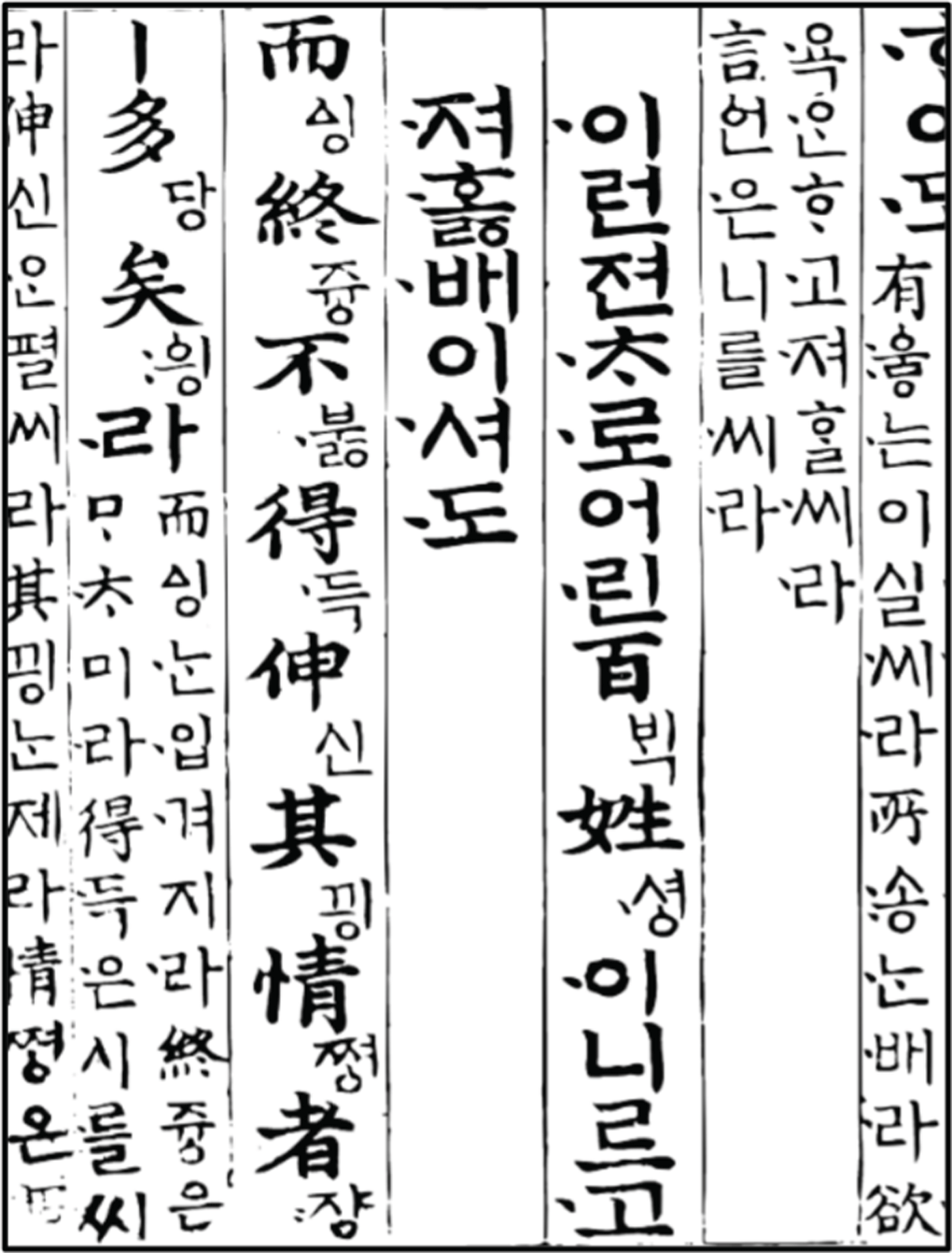
Figure 1.
Hunminjeongeum. This Hangul manuscript (1446) teaches the proper sounds of Korean [1].
2. Structure of the Korean Alphabet
In 1446, King Sejong and his researchers invented the Korean alphabet to provide easier texts as a means of expression for most commoners and to invent a method that could be used like Chinese characters. Since, the Korean writing is phonemic and comprised of phonograms, which are symbols written as they sound, it is possible to replace Chinese sounds with Korean letters. Additionally, in personal and place names, Chinese characters and the Korean letters are used at the same time [7]. Table 1 consists of fourteen (14) basic consonants, five (5) double consonants, ten (10) basic vowels, and eleven (11) diphthongs. Figure 2 below indicates consonants and vowels and six (6) combination rules. In Table 1 and Figure 2, consonants are indicated by the color orange, and vowels are indicated by the color green. Figure 2 shows the six (6) placement types within the square frame range of consonants and vowels, which are separated by color.
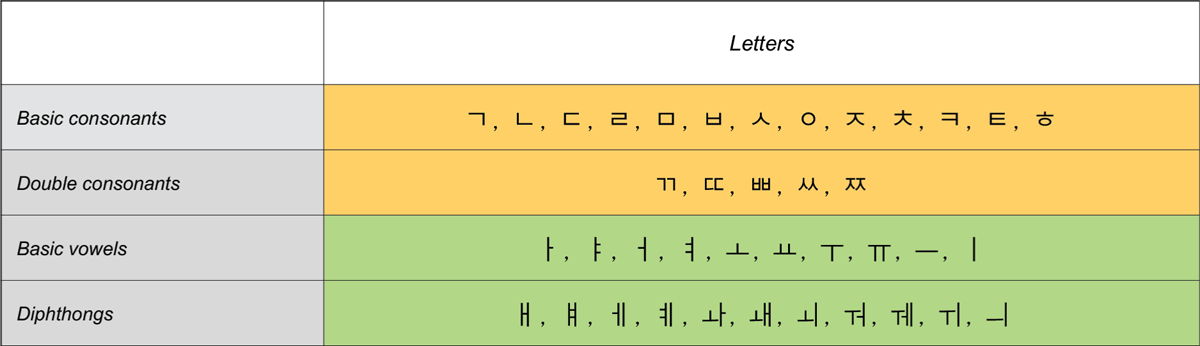
Table 1.
Classification of the Korean alphabet.
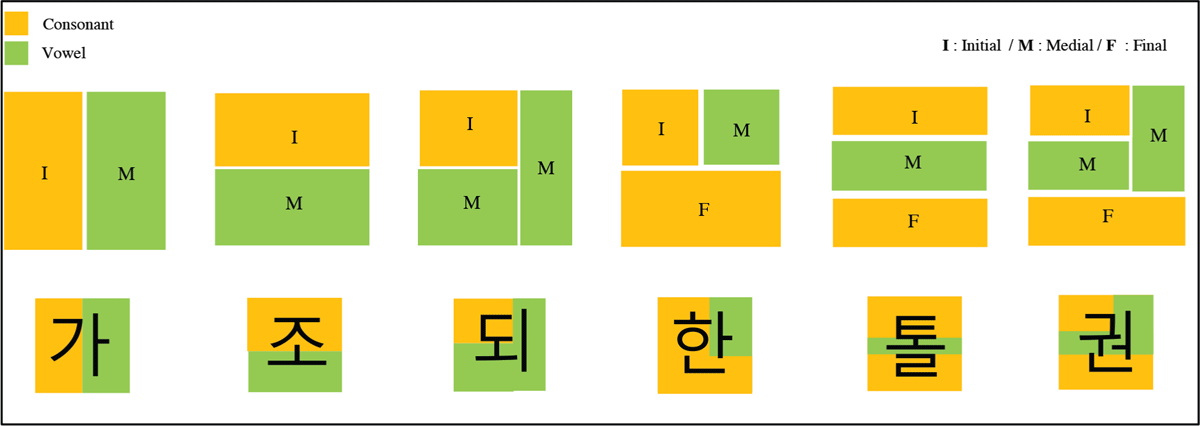
Figure 2.
The placement of the initial (consonant), medial (vowel), and final (consonant).
The Korean alphabet uses a syllable-based writing system and a square-framed, vertical writing structure. These characteristics are the result of influence from northeast Asian Chinese culture. In vertical writing, which is characteristic of the Sinosphere, ancient Chinese characters were written using a brush and vertical bamboo plate. Functionally, it was also a way to prevent confusion between characters with high stroke density by limiting the width of Chinese characters or the Korean letters, which consists of a combination of characters, to the horizontal and vertical square frame.
The Korean alphabet follows certain rules. Consonants and vowels are grouped together to form a complete letter. Combining the initial, medial, and final, there are three forms of horizontal placement, vertical placement, and compound placement in the square frame. The consonants are placed in the primordial, and consonants and vowels are always located in the neutral position. In some cases, the same or different double consonants may be located to express the unique pronunciation of Korean alphabet, different combinations of consonants are also created in the final consonant. The vowels are located to the right of the square frame and can only be located at the bottom or the top of the chord. The number of unique syllables that can be created according to these rules is 11,172. However, there are only 2350 characters in the completed form of the Korean-language, but only 520 in common use [8].
3. English, Korean, and Chinese Characters
The phonogram is the common factor between English and Korean, which means that you can read the characters if you know that language’s alphabet and know each sound [9]. However, the writing method of these languages differ. The Korean alphabet has a shorter history than the English alphabet, and so, there has been little change in the form of letters. The English alphabet has been used for a long time. The English alphabet uses balanced characters, which make it suitable for a horizontal writing; however, Korean and Chinese characters appear as a syllabic block [10].
Table 2 lists the main characteristics of English, Korean, and Chinese characters. User figures were used with the assumption that the users of the language would be similar to the corresponding character users. English and Chinese characters were created spontaneously from ancient times, but the Korean alphabet was deliberately produced by King Sejong the Great and his researchers to widely disseminate the easier form of easy characters. The number of Chinese users is overwhelming due to the large Chinese population. There are 527 million native users of English, but there are 1.5 billion who learn English as a second language. This phenomenon results from academic and business needs. The Korean alphabet has a total of 77.2 million users, which includes South Korea and North Korea, as well as overseas Koreans and Chinese ethnic minorities. With more than 50 million users, Korean is listed in 12th place in the Ethnologue’s language user statistics. These statistics show that there are more Korean alphabet users than German or French users [11].
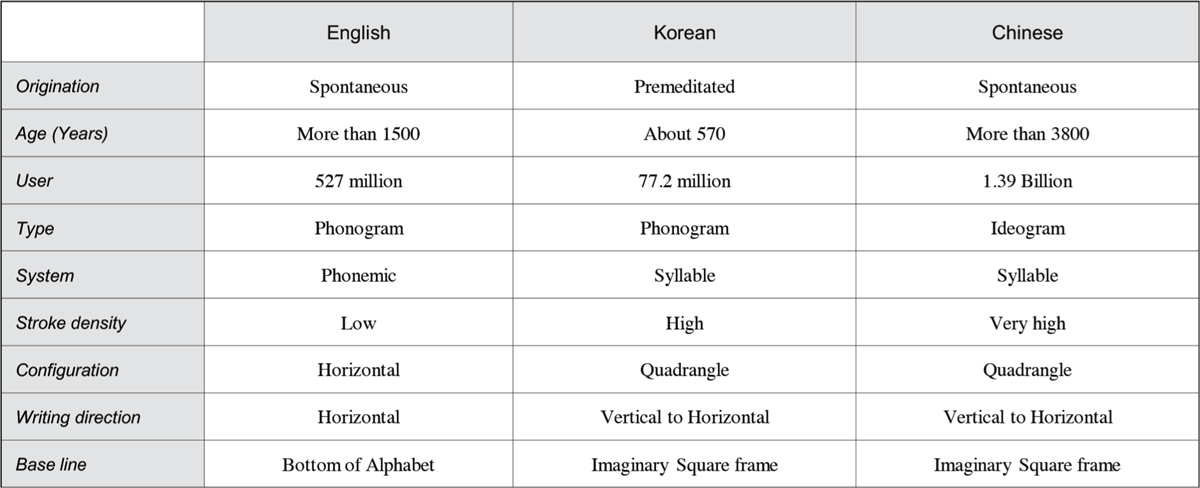
Table 2.
A comparison of intrinsic characteristics for English, Korean, and Chinese characters.
English and Korean letters are characteristic of a phonogram, whereas Chinese characters are categorized by ideograms. English uses a phonemic structure, while Chinese and Korean use syllable-based structures, which is characteristic of the Sinosphere character. The Sinosphere character type combines collaterals or letters in the square frame. This structure has a relatively higher stroke density than a phoneme-based letter. The Korean alphabet is composed of 14 consonants and 10 vowels. The Chinese characters are relatively very high in stroke density. In terms of configuration, Chinese characters and Korean letters are arranged in an imaginary square frame, and English is arranged along the horizontal axis [12]. Their respective arrangements influence the formation of handwriting baselines, so that Chinese characters and Korean letters which use the square frame to form syllabic blocks, and English uses a horizontal baseline. In particular, Korean letters and Chinese characters have been produced vertically because the stroke density in the square frame complicates writing when compared to English. In other words, the vertical and horizontal strokes accumulate in a square frame, forming a Sinosphere character. In determining a baseline, the overall position of the x and y axes must be taken into account. It is also possible to locate the baseline from the size, slant, and proportion of the radicals or one’s graphic maturity.
4. Vertical Writing and the Square Frame Structure
Since the adoption of Chinese characters into the Korean alphabet, writers have attempted to harmonize the two. Since the invention of the Korean alphabet in 1446, Korean writing has been developed based on vertical writing, which is a characteristic of the Sinosphere [13]. Figure 3 below demonstrates the vertical alignment of the Korean alphabet and Chinese characters. In particular, it highlights the Korean alphabet and Chinese characters maintain the spatial ratio between consonants, vowels, and sides, alignment of phonemes, and its intrinsic symmetry. In the case of the horizontal writing of the English characters, the alphabetic characters correspond (written along) to the horizontal baseline. Discrepancies between the strokes of grapheme and Chinese radical in the Korean and Chinese characters were confirmed. The reason for this discrepancy was the inherited principle that Sinosphere characters were written vertically. This was a measure of the consistency of the writer by angle of the vertical axis of the sentence from a macro point of view and of the inclination of the vertical axis of each character from a microscopic point of view. Therefore, measurements associated with consistency on the vertical axis are notable features of the handwriting identification of Sinosphere characters. In addition, it is used as an important measure to determine the author’s identification and timing of his work from an aesthetic point of view of Sinosphere calligraphy. However, since this observation is based on the printed characters of the Korean alphabet and Chinese characters and it is intended to point out the inherent characteristics, more studies should be carried out that consider the relationship between vertical writing, the Korean alphabet, and Chinese characters, in terms of both individual consistency and individuality.
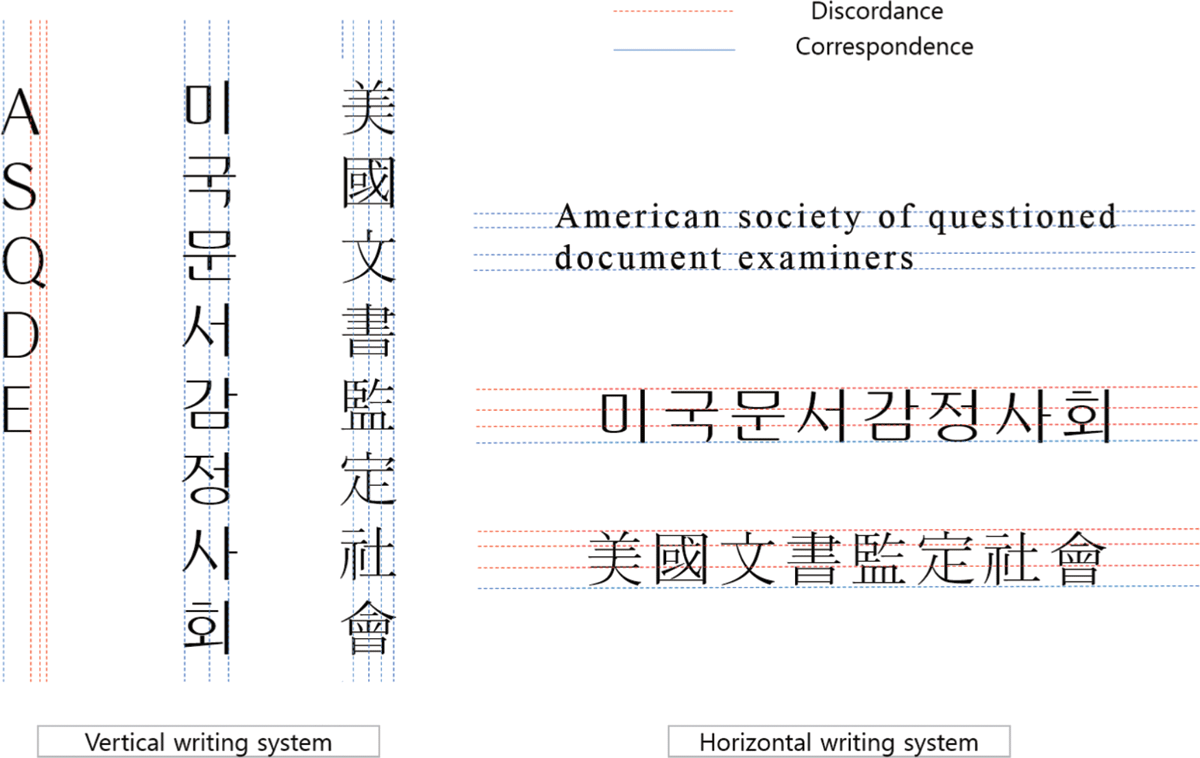
Figure 3.
Comparison of vertical and horizontal characteristics of English, Korean, and Chinese characters.
The Sinosphere characters, which include Chinese characters, are given various meanings because the emphasis was placed on the traditional consciousness of heaven, earth, and human beings, and it was presumed that the vertical writing came down from the sky naturally follows this logic. However, with the influx of Western culture in the modern era, horizontal writing is generally used. Compared to an alphabet in which the characters are written in the horizontal direction, the Korean alphabet is arranged in a square frame so that each grapheme has a complex structure made by arranging and rearranging the regions. In the case of alphabetic characters, the width and position vary according to the type of character and the number of strokes. In contrast, the Korean alphabet is limited to the square frame even if the structures of consonants and vowels are combined. These shared traits are likely to cause confusion unless the width is specified because the characters are composed of complicated combinations of Chinese characters and the Korean alphabet [14]. This not only has a close relationship with the stroke density necessary for the readability of Chinese characters, but also suggests the use of vertical writing and the imaginary square frame. This structure can be compared with the structure of Chinese characters consisting of side and letter. In other words, the individual differences in the square frame, formed by the combination of the side and the letter in the square frame of the Chinese character, can be selected as an element of handwriting analysis. The intrinsic symmetry of the side and the letter can be observed [15]. Although, the Korean alphabet differs from Chinese characters in language form, the Korean alphabet shares its syllabic structure (baseline by square frame). It consists of fourteen (14) consonants and ten (10) vowels in six (6) types, and these form an interrelated area between the pointers in the square frame, which limits the space for the completion of the characters. In other words, a writer that has sufficient graphic maturity in writing Chinese and Korean characters produces a master pattern, consisting of a number of graphemes in the limited area of the square frame. Such writing unconsciously establishes the form of the square by the combination of the consonant and vowel of the Korean alphabet. In addition, there is a focus on five elements of writing: strength of pen movement, pen pressure, arrangement of grapheme or radical, sequence of strokes, and detailed writing qualities which produce a distinct personal handwriting. The Japanese Metropolitan Police Agency mention these qualities of writing as part of their methodology in assessing handwriting [16].
5. Discussion
As the Korean alphabet is traditionally a soft brush culture using paper and brush within the Sinosphere, then the English alphabet can be seen as a more hard brush culture using a quill pen on parchment paper. In other words, Chinese characters and the Korean alphabet (i.e., Sinosphere characters) aimed to produce a wide range of emotional expression through flexibility and freedom of the soft brush and paper, as well as through its varying width of the line. On the other hand, the English alphabet with its stroke deviations and more regular thickness of strokes produces a writing that has excellent readability. In its structural aspect, the Korean alphabet is adapted from the Chinese manner of writing using a square frame, whereas English uses more balanced characters developed for horizontal writing [17]. These factors illustrate how the Sinosphere characters, differ from English characters and how the shared characteristics such as the influence of the square frame impact on how a letter is written. It also embraces the principle of relationships or holism, that is, all things are related to a myriad of other things; in order to know one, you have to know its relationship with everything else [18]. An example is how elements of the Korean alphabet characters such as the graphemes interact within the square frame.
A Korean writer with sound intentions, unintentionally sets the space and arrangement of an area of the square frame, where the components do not hinder the readability of the characters within the rules of homeostasis of the individual handwriting. Then, considering the mutual arrangement of the consonants and vowels, this arrangement becomes habitual, it becomes an individual character of the writer. Similarly, a combination of letters written in a particular manner producing a word in the English alphabet also becomes habitual over time and individual to the writer. Such habits could be position of the characters to the horizontal baseline or alignment of the letters to one another.
The basic structure of the Korean alphabet, means each character is examined from the view point of the syllable-based writing of the square frame structure of Korean and Chinese characters. The Korean alphabet is phonetic comprising of fourteen (14) consonants and ten (10) vowels; which have been used with Chinese characters since ancient times. Korean writing was created on the premise of vertical writing and the squareframed syllable structure (a block structure), which are also features of Chinese characters. These syllable blocks contrast with the horizontal writing style of English alphabetic characters. This is because the horizontal alignment of the alphabet is constant, while the symmetry of Korean and Chinese characters is observed in vertical alignment. For western or occidental forensic document examiners, this structure may be seen as complex when compared to the English alphabet [19]. This is due to the syllable structure in the square frame. Since, the combination of basic characters is limited within the square frame, the stroke density per unit area is higher than that of the alphabetic characters, which lowers readability.
In the modern era, those Sinosphere countries that have the horizontal writing system including Korea tend to use only their own characters. Nevertheless, it is important to understanding the origin of these shared characteristics between Chinese and Korean. Despite differences in language morphology between Korean and Chinese characters, these common features continue to influence characters in the Sinosphere culture, and this study provides a fundamental background for understanding and interpreting Chinese characters and other characters of the Sinosphere, as well as understanding the Korean alphabet. This study also provides a useful insight into the basic structure of written Korean and its dependence on the square frame that will prove helpful for forensic document examination.
Notes
[3] Sinosphere - refers to a grouping of countries and regions in East Asia that were historically influenced by the Chinese culture. Wikipedia (https://en.wikipedia.org/wiki/East_Asian_cultural_sphere) Accessed: 10 June 2018.